×

Dominican Republic🇩🇴 | national parksParque Nacional CotubanamáCueva del Puente, Isla Saona, Bayahibe entrance, Taíno pictographs | things to do and best time to go

Explore Los Haitises National ParkExplore Sierra de Bahoruco National Park

Backpacking in Parque Nacional Cotubanamá
🏆 Top picknational park ranked #1
By Johan Kruseman 🇳🇱 | Updated October 23, 2026

Parque Nacional Cotubanamá has no hotel, no shop and no public transport inside it, and the park has two ranger-post entrances, at Guaraguao near Bayahibe and at Boca de Yuma on its eastern end. It sits in the southeast corner of the Dominican Republic, across from Isla Saona and east of La Romana. The upside is a protected swath of dry forest, mangrove and limestone coast with caves holding Taíno rock art, plus manatees, iguanas and a lot of birds. The downside is that most visitors arrive in catamaran convoys from resort hotels, so the beaches near the boat docks can feel like a floating buffet. The smarter move is to skip the boat circuit. Hikes here are short, flat and hot, because shade is patchy and the ground is porous rock, so you carry more water than seems sane and start early. A good first day: take the Bayahibe entrance at opening, walk the forest trail to the caves with a local ranger guide, then eat grilled fish in the village.

Discover everything you want to know in the 📖 Dominican Republic Travel Guide.


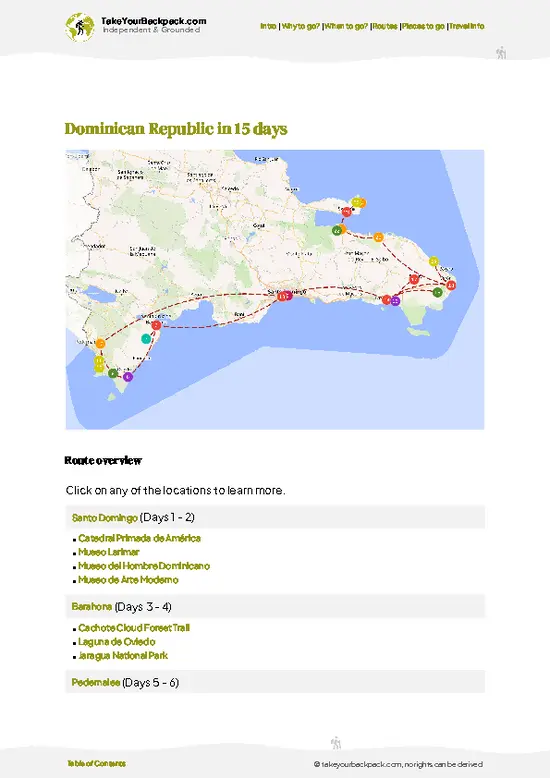
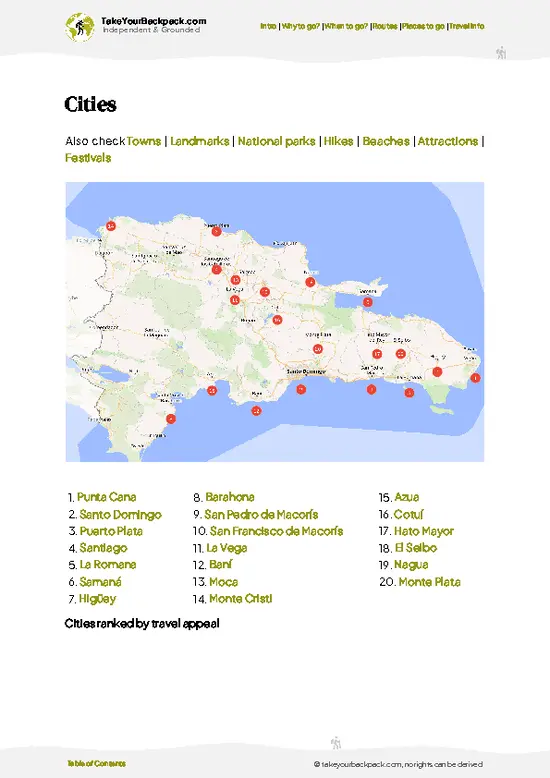
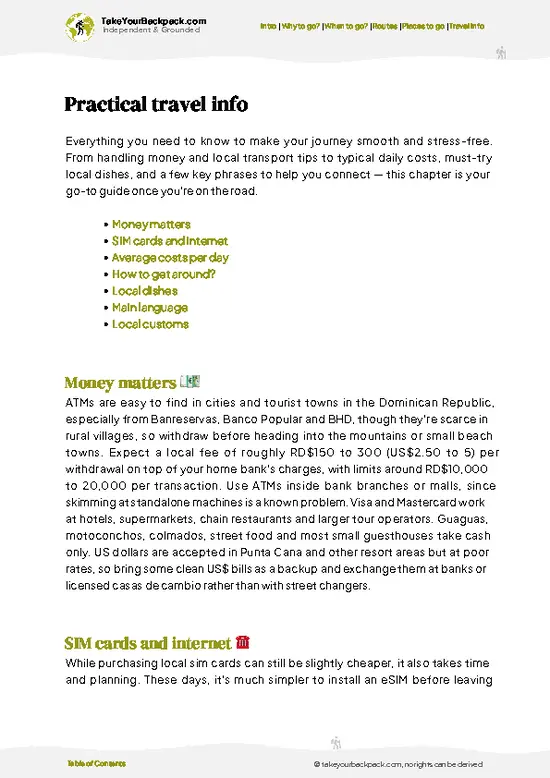
example page 0 from our offline Travel Guide for Dominican Republic
example page 1 from our offline Travel Guide for Dominican Republic
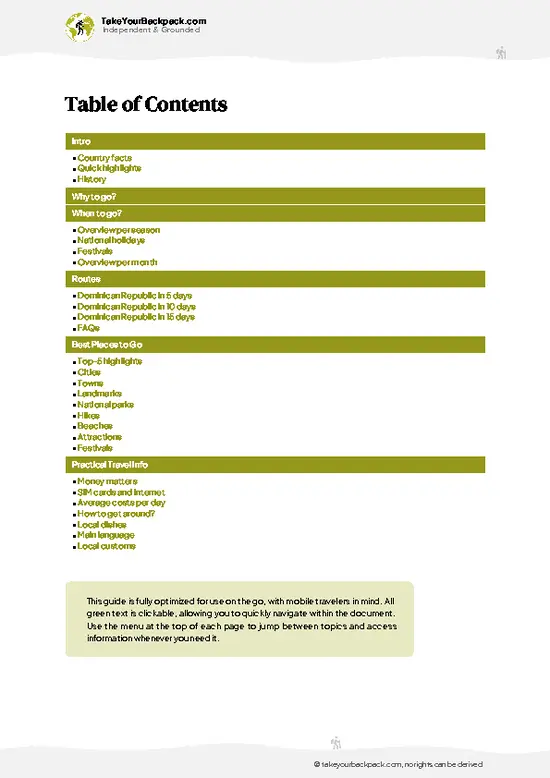
example page 2 from our offline Travel Guide for Dominican Republic
example page 3 from our offline Travel Guide for Dominican Republic
example page 4 from our offline Travel Guide for Dominican Republic
example page 5 from our offline Travel Guide for Dominican Republic
example page 6 from our offline Travel Guide for Dominican Republic
example page 7 from our offline Travel Guide for Dominican Republic
Loading the map 🌍
CLICK TO FILTER
cities
towns
landmarks
national parks
hikes
beaches
attractions
festivals
SHOW COUNTRY’S BESTSHOW ALL

✨ Why go?
Ranked #1 national park in Dominican Republic
Why visitors keep coming back

Parque Nacional Cotubanamá suits independent travelers because the cheapest way in is the least obvious one: you hire a ranger-guide at the Bayahibe gate, walk, and avoid the packaged boat day entirely. That gets you the Taíno cave art without a crowd, and the guide explains which marks are pictographs and which are later graffiti. The second reason is geography. The park covers roughly 800 square kilometers of land and sea, so you can pair dry forest with coastline in a single outing, and the mix of subtropical dry forest, mangroves and reef gives you far more variety than the resort brochures suggest. Bayahibe village sits next door with simple guesthouses and dive shops, so you can sleep cheaply, eat local and be at the gate before the tour buses roll in. Self-guided travelers should know … read more 👉
Parque Nacional Cotubanamá suits independent travelers because the cheapest way in is the least obvious one: you hire a ranger-guide at the Bayahibe gate, walk, and avoid the packaged boat day entirely. That gets you the Taíno cave art without a crowd, and the guide explains which marks are pictographs and which are later graffiti. The second reason is geography. The park covers roughly 800 square kilometers of land and sea, so you can pair dry forest with coastline in a single outing, and the mix of subtropical dry forest, mangroves and reef gives you far more variety than the resort brochures suggest. Bayahibe village sits next door with simple guesthouses and dive shops, so you can sleep cheaply, eat local and be at the gate before the tour buses roll in. Self-guided travelers should know that access inside is restricted, so the sensible approach is a hybrid: arrange a ranger or small-group operator for specific trails, then use free time for snorkeling or beach walking on your own schedule. It is a place where a little planning beats a big tour.

💡 HighlightsDon't-miss highlights and experiences

  1. Cueva del Puente: A collapsed limestone cavern bridged by a natural stone arch, with a short walk through dry forest to reach it. The overhead roots and filtered light make it the park’s most photographed landscape.
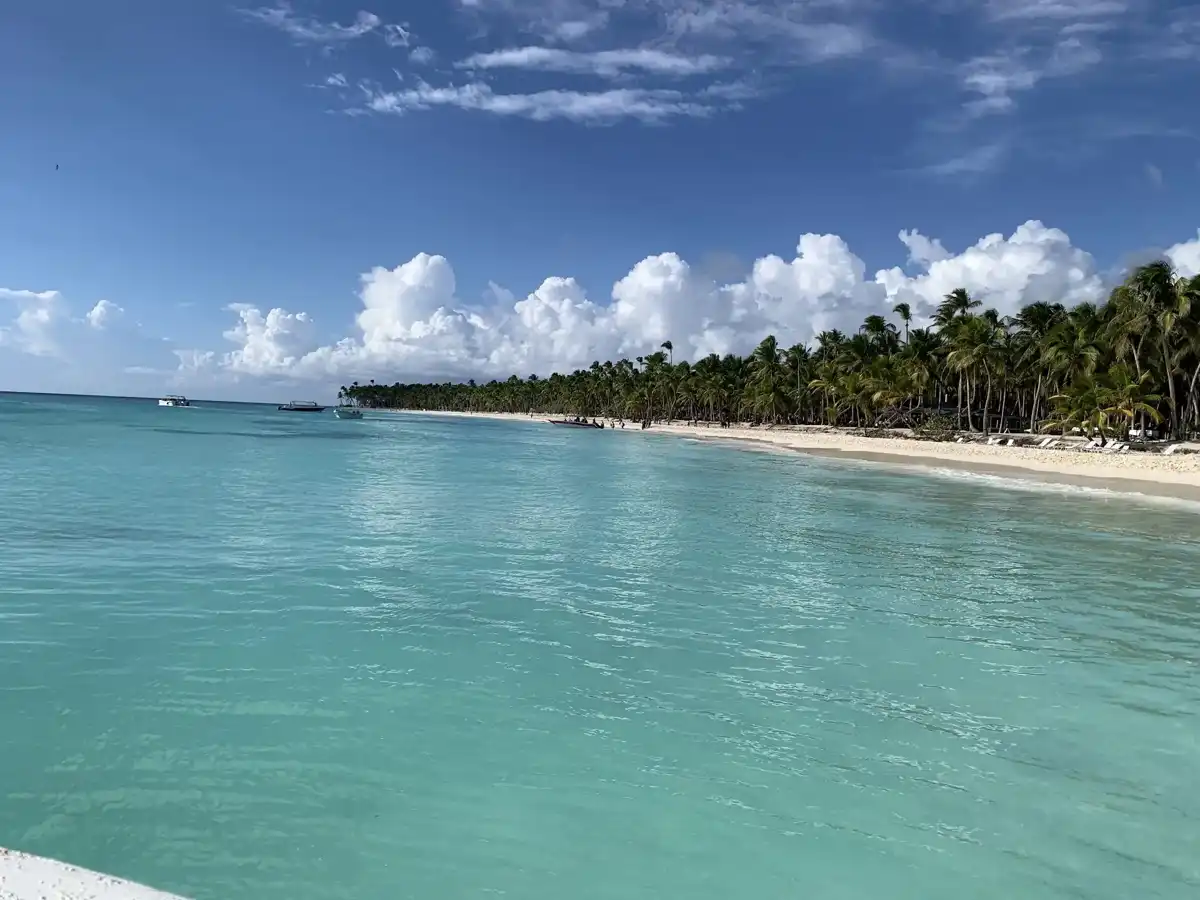
  2. Isla Saona: The big offshore draw, with white sand, shallow turquoise water and palm-lined beaches. It is crowded at midday, so it is best treated as a morning or late-afternoon stop.
  3. Piscina Natural: A knee-deep sandbar in the sea where starfish rest on the bottom. It is touristy, loud and still a fun swim if you arrive early.
  4. Bayahibe coastline and reef: Snorkeling and diving spots just off the park edge, with coral heads, parrotfish and the occasional turtle.
  5. Mangrove channels near Boca de Yuma: Quieter waterways where herons, pelicans and other shorebirds feed, and where manatees
… read more 👉
  1. Cueva del Puente: A collapsed limestone cavern bridged by a natural stone arch, with a short walk through dry forest to reach it. The overhead roots and filtered light make it the park’s most photographed landscape.
  2. Isla Saona: The big offshore draw, with white sand, shallow turquoise water and palm-lined beaches. It is crowded at midday, so it is best treated as a morning or late-afternoon stop.
  3. Piscina Natural: A knee-deep sandbar in the sea where starfish rest on the bottom. It is touristy, loud and still a fun swim if you arrive early.
  4. Bayahibe coastline and reef: Snorkeling and diving spots just off the park edge, with coral heads, parrotfish and the occasional turtle.
  5. Mangrove channels near Boca de Yuma: Quieter waterways where herons, pelicans and other shorebirds feed, and where manatees are sometimes reported.
  6. Dry forest trails: Shaded walks through gumbo-limbo, mahogany and cacti, with a good chance of spotting rhinoceros iguanas, solenodons’ burrows and many bird species, including the endemic Hispaniolan parrot.
  7. Cueva de José María: A cave known for its large collection of Taíno pictographs, one of the richest sets in the Caribbean. It is a short walk from a quiet coastal approach.
Cueva del Puente and the other cave stops cost nothing beyond the park entry ticket, which makes them the cheapest highlights here.
Spotted a mistake or missing something? Contact us.
🌤️ When to go?When to go for the best experience

Late November through April is the easiest window for Parque Nacional Cotubanamá, with dry days and calmer seas for the boat crossing to Isla Saona.
  • Peak Season (December to April): Highs of 28 to 31°C (82 to 88°F), lows around 21 to 23°C (70 to 73°F), and little rain. Crowds and prices peak around Christmas and Easter, and Saona day trips fill up.
  • Shoulder Months (May and November): Showers arrive in short bursts, trails in the Guaraguao forest stay walkable, and rooms in Bayahibe cost less.
  • Wet Season (June to October): Temperatures climb to 31 to 34°C (88 to 93°F) with heavy humidity and afternoon downpours. Mosquitoes thicken on the cave trails, and hurricane risk peaks from August to October. Rates drop, and the beaches are far emptier.
  • Daylight: Roughly 11 hours in December and 13 in June,
… read more 👉
Late November through April is the easiest window for Parque Nacional Cotubanamá, with dry days and calmer seas for the boat crossing to Isla Saona.
  • Peak Season (December to April): Highs of 28 to 31°C (82 to 88°F), lows around 21 to 23°C (70 to 73°F), and little rain. Crowds and prices peak around Christmas and Easter, and Saona day trips fill up.
  • Shoulder Months (May and November): Showers arrive in short bursts, trails in the Guaraguao forest stay walkable, and rooms in Bayahibe cost less.
  • Wet Season (June to October): Temperatures climb to 31 to 34°C (88 to 93°F) with heavy humidity and afternoon downpours. Mosquitoes thicken on the cave trails, and hurricane risk peaks from August to October. Rates drop, and the beaches are far emptier.
  • Daylight: Roughly 11 hours in December and 13 in June, so start early to finish before the afternoon heat.
  • Wildlife Timing: Humpback whales visit Samaná, not here, but nesting sea turtles use the beaches from about May to October.
Book Saona boats a day ahead in peak weeks and go on a weekday.


source: climatestotravel.comJANJanuary: excellent for travelingFEBFebruary: excellent for travelingMARMarch: excellent for travelingAPRApril: highly recommended for travelingMAYMay: highly recommended for travelingJUNJune: good for travelingJULJuly: good for travelingAUGAugust: good for travelingSEPSeptember: fair for travelingOCTOctober: fair for travelingNOVNovember: highly recommended for travelingDECDecember: excellent for traveling
dominican-republic-national-park-parque-nacional-cotubanama
© Google | Rinaldo Timpano

✈️ The backpacker research shortcutDominican Republic Travel Guide

An offline-friendly backpacking guide with optimized travel routes, ranked highlights, transport advice, and the best areas to stay.
example page 0 from our offline Travel Guide for Dominican Republic
example page 1 from our offline Travel Guide for Dominican Republic
example page 2 from our offline Travel Guide for Dominican Republic
example page 3 from our offline Travel Guide for Dominican Republic
example page 4 from our offline Travel Guide for Dominican Republic
example page 5 from our offline Travel Guide for Dominican Republic
example page 6 from our offline Travel Guide for Dominican Republic
example page 7 from our offline Travel Guide for Dominican Republic
The digital guide (336 pages) contains:
✅ 108 highlights, ranked by travel appeal
✅ Optimized 5, 10 & 15-day travel routes
✅ Cities, national parks, landmarks, beaches
✅ How to get around
✅ Offline-friendly for travel without Wi-Fi
👉 Click to see all 30+ guide features

📅 Plan smarter in minutes, not weeks
✅ Month by month travel advice
✅ Festivals & national holidays
✅ Budget expectations

🗺️ Go to the right places, skip the overrated ones
✅ Honest pros & cons of destinations
✅ Top hikes, parks & viewpoints
✅ Lesser-known places most travelers miss
✅ Clear “worth it vs skip it” guidance

🛏️ Travel smoothly without rookie mistakes
✅ Best areas to stay
✅ Transport systems explained simply
✅ Common scams & safety advice
✅ SIM cards, money & practical tips

🌍 Understand the country, not just visit it
✅ Culture & traditions
✅ 52 Essential phrases & customs
✅ Festivals worth planning around
✅ Traveler-friendly historical context
✅ Insights that make places more meaningful

📱 Built for real travel conditions
✅ Fully downloadable PDF
✅ Works completely offline
✅ Optimized for phone use
✅ Useful in remote areas & buses
✅ Everything in one place
Stop searching, start planning
Get instant access to your full guide. 30‑day money-back guarantee.
+ Add another guide for just

By proceeding you agree to our terms.
Sent to your inbox immediately after payment • 100% Secure Checkout
Best Backpacking Travel Advisor 2025 tourism awardBest Backpacking
Travel Advisor
2025
What others say about Take Your Backpack Guides:
⭐⭐⭐⭐⭐
Fantastic, amazing amount of information!
⭐⭐⭐⭐⭐
My goodness this is amazing, it's what I've been looking for hats off too you!
⭐⭐⭐⭐⭐
I think this is absolutely BRILLIANT
⭐⭐⭐⭐
Very complete and informative. It's still missing places, but I gotta to commend you
⭐⭐⭐⭐⭐
This is truly amazing, thank you, can't wait to explore it with my kids!
⭐⭐⭐⭐⭐
Awesome resource, thank you!
⭐⭐⭐⭐⭐
This is amazing! Can't wait to explore the ones I haven't seen
⭐⭐⭐⭐
I love this! Well done, great idea.
⭐⭐⭐⭐⭐
Thanks for taking the time to make this gem!
⭐⭐⭐⭐⭐
This might be the best website I've ever seen.
⭐⭐⭐⭐⭐
Congratulations, and thank you so much for your work; it's incredibly valuable.
⭐⭐⭐⭐
In all seriousness I think you did a great job pointing out the important spots
⭐⭐⭐⭐⭐
10/10 very good
⭐⭐⭐⭐⭐
As someone who's only just starting to visit regularly this is awesome, thank you.
⭐⭐⭐⭐
Thank you very much! I'm going to visit my dad, it's going to be very useful!
⭐⭐⭐⭐⭐
This is really cool! We'll be travelling for the first time and this definitely come in handy.
⭐⭐⭐⭐⭐
You are now our minister of culture, congratulations 👨‍💼
⭐⭐⭐⭐⭐
Just wanted to tell you that this is a pearl! Going to follow your recommendations.
⭐⭐⭐⭐⭐
This is so cool. I'll definitely be using the resource for my travels soon.
⭐⭐⭐⭐⭐
This is very impressive! Good work.
⭐⭐⭐⭐⭐
This is an amazing and informative site. Very well done!

🛏️ Where to stay?Where staying makes the most sense

Bayahibe is the best base for Parque Nacional Cotubanamá, because the main park entrance and the Saona boat docks sit at its edge. There is no lodging inside the park, and camping is not part of the usual visitor setup, so you sleep outside and enter for the day.
Bayahibe is a small fishing village with guesthouses and simple hotels, usually US$35 to 80 a night for a private room with air-conditioning. Small restaurants line the waterfront, and the village is walkable. Expect to share the beach with all-inclusive guests from nearby resorts, but evenings are quiet once the tour boats return.
Dominicus, … read more 👉
Bayahibe is the best base for Parque Nacional Cotubanamá, because the main park entrance and the Saona boat docks sit at its edge. There is no lodging inside the park, and camping is not part of the usual visitor setup, so you sleep outside and enter for the day.
Bayahibe is a small fishing village with guesthouses and simple hotels, usually US$35 to 80 a night for a private room with air-conditioning. Small restaurants line the waterfront, and the village is walkable. Expect to share the beach with all-inclusive guests from nearby resorts, but evenings are quiet once the tour boats return.
Dominicus, a short walk or quick motorbike hop along the coast, has more hotels and slightly higher prices, mostly US$60 to 150. It suits you if you want a pool and a wider choice of restaurants.
For the cheapest beds and the eastern park access at Boca de Yuma, look for family-run guesthouses in Boca de Yuma itself, often US$25 to 50. It is remote, so bring cash and expect limited dining.
La Romana is the larger city nearby, with supermarkets, ATMs, and the bus links, and hotels start around US$40. It works if you arrive late or want city amenities, but you lose the early start Bayahibe gives you.

👛 Costs (as of 23 October 2026)What things cost and how to budget

Expect to spend about US$95 a day at Parque Nacional Cotubanamá on a modest budget, including a Saona-area outing, lodging in Bayahibe, and local food. Costs are paid in Dominican pesos, but the figures below are in US dollars.
CategoryBudget RangeLocal Reality
Park entranceUS$10 to 12Foreign adults pay at the ticket booth. Boat tours often include the fee, so check before paying twice.
Accommodation (high season)US$35 to 60Private rooms with air-conditioning in Bayahibe guesthouses. Prices fall in the wet season.
Saona boat tour or guideUS$15 to 40A day on a shared boat or a guide for the caves. Private speedboats cost far more.
Local transportUS$3 to 10Shared taxis and motorbike rides between La Romana, Bayahibe, and Dominicus. Cheapest by público.
Food and waterUS$10 to 20Fried fish and rice
… read more 👉
Expect to spend about US$95 a day at Parque Nacional Cotubanamá on a modest budget, including a Saona-area outing, lodging in Bayahibe, and local food. Costs are paid in Dominican pesos, but the figures below are in US dollars.
CategoryBudget RangeLocal Reality
Park entranceUS$10 to 12Foreign adults pay at the ticket booth. Boat tours often include the fee, so check before paying twice.
Accommodation (high season)US$35 to 60Private rooms with air-conditioning in Bayahibe guesthouses. Prices fall in the wet season.
Saona boat tour or guideUS$15 to 40A day on a shared boat or a guide for the caves. Private speedboats cost far more.
Local transportUS$3 to 10Shared taxis and motorbike rides between La Romana, Bayahibe, and Dominicus. Cheapest by público.
Food and waterUS$10 to 20Fried fish and rice at waterfront comedores. Buy water and snacks before entering the park.
Total Daily BudgetUS$73 to 142About US$95 is realistic for a mid-range backpacker day using the high-season lodging figure.
⚠️ Prices can change and everyone travels differently, so take this as a rough guide. Hope it helps you plan your adventure!

🥾 TrailsHiking Parque Nacional Cotubanamá national park: highlights and difficulty

Parque Nacional Cotubanamá works best on foot with a guide, because the trail network is short and the terrain is rough, sharp limestone under a thin layer of leaf litter. Wear closed shoes, not sandals.
  • Cueva del Puente trail: Roughly 2 to 3 kilometers round trip, about 1.5 to 2 hours with stops. Easy to moderate, flat forest floor with a few rocky steps down into the cave. Features the natural stone arch and good bird-watching.
  • Cueva de José María route: Longer, around 4 to 6 kilometers round trip, 2 to 3 hours. Moderate difficulty, rougher footing and less shade. Best done in the early morning
… read more 👉
Parque Nacional Cotubanamá works best on foot with a guide, because the trail network is short and the terrain is rough, sharp limestone under a thin layer of leaf litter. Wear closed shoes, not sandals.
  • Cueva del Puente trail: Roughly 2 to 3 kilometers round trip, about 1.5 to 2 hours with stops. Easy to moderate, flat forest floor with a few rocky steps down into the cave. Features the natural stone arch and good bird-watching.
  • Cueva de José María route: Longer, around 4 to 6 kilometers round trip, 2 to 3 hours. Moderate difficulty, rougher footing and less shade. Best done in the early morning for the cooler air.
  • Coastal and mangrove paths: Short, level strolls near Boca de Yuma and the Bayahibe side, 1 to 2 hours, with sand, mud and mangrove roots underfoot.
Wildlife is the quiet bonus. Look for rhinoceros iguanas along the tracks, hutias in the brush, and plenty of birds in the early hours, including parrots and woodpeckers. Offshore, manatees, dolphins and turtles are occasionally seen.
Getting there is easiest from Bayahibe, which has local minibuses and guaguas from La Romana, and you can walk or take a short motorbike taxi to the gate. Boca de Yuma is harder to reach by public transport, so most people use a taxi or rental car. Crowds are heaviest from late morning when the boat tours land. An entrance fee applies, paid at the gate in pesos or by card at some points, and rangers will help arrange a guide. Bring more water than you think you need and a hat, since shade is unreliable.
⚠️ Hiking info can sometimes be outdated or inaccurate. Before you hit the trail, check the latest conditions with locals. If you do spot anything that's off, I'd love to hear from you, so I can update it for fellow travelers.

🛡️ SafetyTraveler Safety Guide

Parque Nacional Cotubanamá is straightforward and well managed, and most problems come from heat, sun, and boat logistics rather than danger. Trails are short and mostly flat, running through dry forest to caves with Taíno rock art. Footing is uneven limestone in places, so wear closed shoes, not flip-flops. Shade is patchy, so carry at least 2 liters of water per person, a hat, and sunscreen.
Mosquitoes and biting flies are the main wildlife nuisance, especially after rain and near caves, so bring repellent. Land crabs, iguanas, and the occasional snake are harmless if left alone. Do not feed animals or touch nesting turtles and their eggs.
The sea crossing to Isla Saona can be choppy, and operators sometimes cancel in rough weather. Wear a life jacket when offered and keep valuables in a dry … read more 👉
Parque Nacional Cotubanamá is straightforward and well managed, and most problems come from heat, sun, and boat logistics rather than danger. Trails are short and mostly flat, running through dry forest to caves with Taíno rock art. Footing is uneven limestone in places, so wear closed shoes, not flip-flops. Shade is patchy, so carry at least 2 liters of water per person, a hat, and sunscreen.
Mosquitoes and biting flies are the main wildlife nuisance, especially after rain and near caves, so bring repellent. Land crabs, iguanas, and the occasional snake are harmless if left alone. Do not feed animals or touch nesting turtles and their eggs.
The sea crossing to Isla Saona can be choppy, and operators sometimes cancel in rough weather. Wear a life jacket when offered and keep valuables in a dry bag.
Go with a licensed park guide if you want to find the caves, since trail marking is limited. Keep cash and phones out of sight on the beach, and use the official ticket booth rather than street sellers.

FAQCommon questions from travelers

Two days is the practical minimum for Parque Nacional Cotubanamá. One day covers the cave trails near Guaraguao, and a second day lets you take the boat to Isla Saona or the beaches near Bayahibe. Add a third day if you want to reach Boca de Yuma or spend a night on the eastern side.
Yes, Parque Nacional Cotubanamá is workable without a car. Take a bus or shared taxi from Santo Domingo to La Romana, about 1.5 to 2 hours, then a público to Bayahibe for roughly US$1 to 3. From there, tour boats and guides go into the park, and motorbike taxis cover short hops.
Yes, Parque Nacional Cotubanamá charges an entrance fee of roughly US$10 to 12 for foreign adults, paid in pesos at the ticket booth. No separate permit is needed for the standard trails and beaches. Saona boat tours usually bundle the fee into the price, which runs about US$15 to 40 on a shared boat.
⚠️ Things can change over time, so always validate details locally before you go.

Other Dominican national parks near Parque Nacional Cotubanamá

Explore more nearby:


💡 Not sure where to go next?
Create a personalized itinerary for Dominican Republic including Parque Nacional Cotubanamá and the places that fit your trip.

Generate my itinerary

👉 Discover all national parks

Or checkout all Dominican Republic has to offer (think cities, towns, villages, national parks, hikes, beaches, festivals)
Country photo of Dominican Republic

We 💚 feedbackSumming up the experience

Parque Nacional Cotubanamá has a second gate near Boca de Yuma that most visitors never see, and it is where the park feels closest to wild. The cliffs there are open to the sea, the paths are empty and the guides know every bird by call. Go on a weekday, hire a ranger and bring plenty of water.

✍️ Help improve this page!
The information on this page is based on in-depth research, insights shared by experienced travelers, and feedback from the local travel community in Dominican Republic. While every effort is made to keep the information accurate and current, conditions can change — so if you spot anything incorrect or outdated, please get in touch.


🙋‍♂️ Give feedback

👋 Meet the founderWho’s Behind Take Your Backpack?

Johan, backpacker and founder of TakeYourBackpackHi, I’m Johan (Netherlands 🇳🇱), the creator of TakeYourBackpack. Over the past 3 decades, I’ve backpacked through 90+ countries across six continents, gaining extensive experience with independent travel, long-term trips, and overland routes.

This site is built on a combination of firsthand travel experience and carefully curated insights from other backpackers. Many guides are based on places I’ve personally visited, while others bring together tips, observations, and practical advice shared by trusted travelers I’ve met along the way.

The goal is to provide realistic, experience-driven guidance — not generic itineraries — so you can explore destinations with better context, clearer expectations, and more confidence.