
×

Ecuador🇪🇨 | citiesCuencaPanama hat workshops, blue cathedral domes, Tomebamba riverside, Inca ruins | things to do and best time to go

Explore SalinasExplore Guayaquil

Backpacking in Cuenca
🏆 Top pickcity ranked #2
By Johan Kruseman 🇳🇱 | Updated October 19, 2026

Cuenca sits at about 2,500 meters in the southern Andes of Ecuador, so the Panama hat you’ll see everywhere was actually woven here and in nearby villages, not in Panama. It’s a UNESCO-listed colonial center of red-tile roofs, river promenades and domed churches, and it suits slow walkers, food hunters and anyone who likes a calm base. Party seekers and adrenaline junkies will find it tame, and the streets can feel quiet after 10 PM. Smart move: skip the first taxi hustle and walk the compact center, because everything sits within about 20 minutes on foot and drivers love to inflate fares for short hops. I stepped off the bus, headed straight for Parque Calderón, and heard the Catedral Nueva’s blue domes ringing with pigeons while a woman fanned fresh empanadas on a cart. Then I wandered on to the flower market, where roses sat in buckets the color of sunset.

Discover everything you want to know in the 📖 Ecuador Travel Guide.


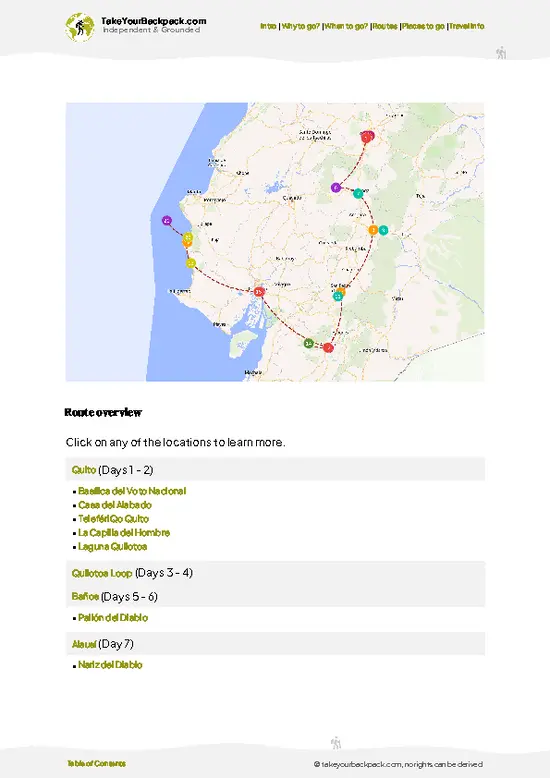
example page 0 from our offline Travel Guide for Ecuador
example page 1 from our offline Travel Guide for Ecuador
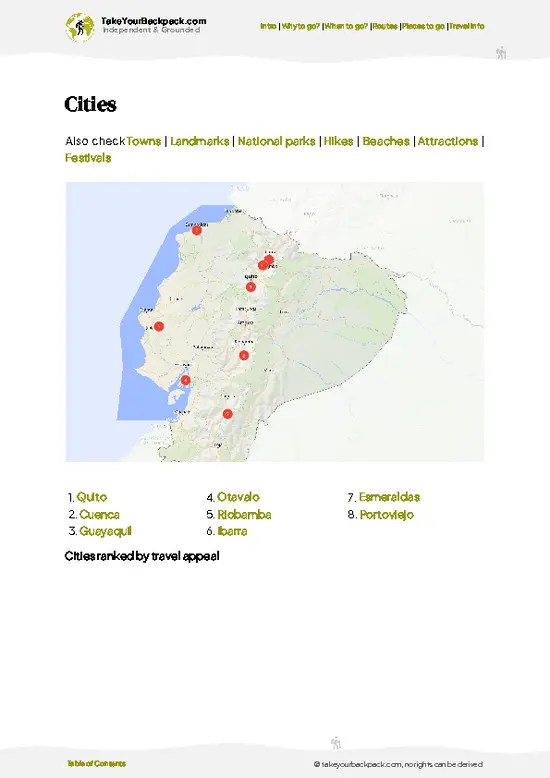
example page 2 from our offline Travel Guide for Ecuador
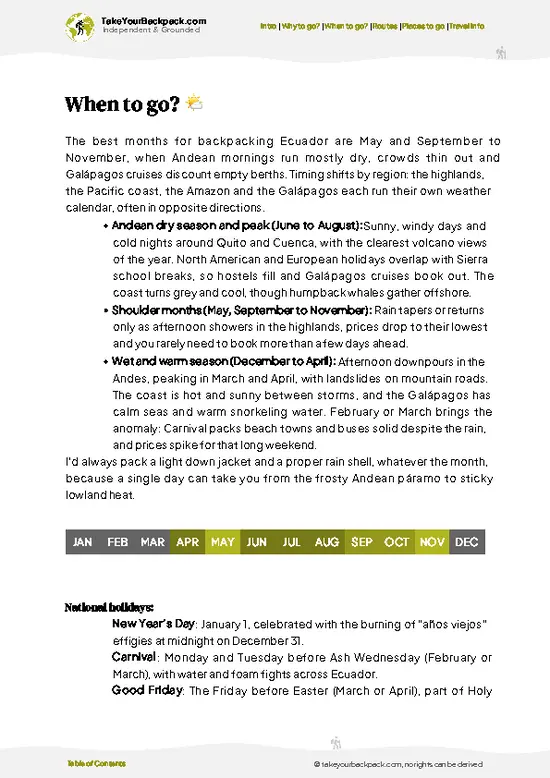
example page 3 from our offline Travel Guide for Ecuador
example page 4 from our offline Travel Guide for Ecuador
example page 5 from our offline Travel Guide for Ecuador
example page 6 from our offline Travel Guide for Ecuador
example page 7 from our offline Travel Guide for Ecuador
Loading the map 🌍
CLICK TO FILTER
cities
towns
landmarks
national parks
hikes
beaches
attractions
festivals
SHOW COUNTRY’S BESTSHOW ALL

✨ Why go?
Ranked #2 city in Ecuador
What makes this city worth visiting

Cuenca works for backpackers because the best of it is packed into a small center you can cover on foot, with no need to juggle buses between sights. You can spend three or four days here and never feel rushed, thanks to a run of museums on the Tomebamba River, cafés, and plenty of Panama hat workshops where you can watch a toquilla straw hat take shape. Food is a big draw too, with cheap set lunches and market stalls serving roast pork, so you can eat well without much planning. Hostels cluster around the historic center, which makes meeting other travelers easy, and it’s a comfortable place to recover between rougher stretches of the Andes. Cuenca also serves as a springboard for the highlands and mountain lakes nearby, so it fits neatly between Quito and the south or Peru. Nightlife is … read more 👉
Cuenca works for backpackers because the best of it is packed into a small center you can cover on foot, with no need to juggle buses between sights. You can spend three or four days here and never feel rushed, thanks to a run of museums on the Tomebamba River, cafés, and plenty of Panama hat workshops where you can watch a toquilla straw hat take shape. Food is a big draw too, with cheap set lunches and market stalls serving roast pork, so you can eat well without much planning. Hostels cluster around the historic center, which makes meeting other travelers easy, and it’s a comfortable place to recover between rougher stretches of the Andes. Cuenca also serves as a springboard for the highlands and mountain lakes nearby, so it fits neatly between Quito and the south or Peru. Nightlife is low-key, mostly bars and live music, so treat it as a gentle stop, not a party town.

💡 HighlightsDon't-miss highlights and experiences

  1. Catedral de la Inmaculada Concepción (Catedral Nueva): The blue-and-white domes dominate Parque Calderón and the interior is vast, with a marble floor from Italy. Go in the morning when it’s quiet. Entry is about US$2, and 30 to 45 minutes is plenty. The tower climb costs a little extra.
  2. Parque Calderón: The main square, shaded by trees and ringed by old churches and government buildings. Evenings fill with locals and vendors. Free, and an hour of people-watching is easy.
  3. Museo Pumapungo: Ruins of the Inca city of Tomebamba sit alongside an ethnographic museum, a bird park and llamas on the grounds. The shrunken heads display is a standout. Entry is free, and you want 2 to 3 hours. Morning is best.
  4. Museo del Sombrero de Paja Toquilla (Homero Ortega): Hat-making workshops show how fine straw becomes
… read more 👉
  1. Catedral de la Inmaculada Concepción (Catedral Nueva): The blue-and-white domes dominate Parque Calderón and the interior is vast, with a marble floor from Italy. Go in the morning when it’s quiet. Entry is about US$2, and 30 to 45 minutes is plenty. The tower climb costs a little extra.
  2. Parque Calderón: The main square, shaded by trees and ringed by old churches and government buildings. Evenings fill with locals and vendors. Free, and an hour of people-watching is easy.
  3. Museo Pumapungo: Ruins of the Inca city of Tomebamba sit alongside an ethnographic museum, a bird park and llamas on the grounds. The shrunken heads display is a standout. Entry is free, and you want 2 to 3 hours. Morning is best.
  4. Museo del Sombrero de Paja Toquilla (Homero Ortega): Hat-making workshops show how fine straw becomes a Panama hat, with finished hats for sale. Tours run about 30 to 45 minutes and are usually free, while hats start around US$30 and climb fast. Go on a weekday morning.
  5. Mirador de Turi: A hilltop lookout with a sweeping view of Cuenca’s rooftops and church domes. Late afternoon gives the best light. Free to enter, and a taxi up is the easy way. Stay about an hour.
  6. Calle Larga and the Tomebamba riverside: A walk along the old stone steps and past colonial houses, with cafés and bars on the upper side. Best in late afternoon, free, and about an hour.
  7. Plaza de las Flores: A small square where women sell flowers beside the Old Cathedral. Go before noon. It’s free and takes 20 to 30 minutes.
  8. Mercado 10 de Agosto: A busy covered market with fruit stalls and hot meals, including hornado. Go at lunchtime and plan to spend about US$3 to 6 on food in an hour.
For day trips, you can head out to Cajas National Park, the Ingapirca ruins and the pottery town of Chordeleg and Gualaceo. If time is short, skip the hat shops and spend it at Pumapungo instead.
Spotted a mistake or missing something? Contact us.

Things to do in Cuenca

Ratings based on Tripadvisor reviews. When you book through this link, you support our work at no extra cost to you.

🏘️ NeighborhoodsKey areas and districts to know

Cuenca packs its best ground into a few compact zones, so you can cover nearly all of it on foot and let the Tomebamba River steer you.
  • El Centro Histórico: The colonial grid around Parque Calderón is where you start. The blue-domed New Cathedral, Pumapungo's ruins and the flower market at Plaza de las Flores sit within about 15 minutes of each other. Cobblestones are uneven and the old streets go quiet by 10 pm, so an experienced traveler explores by day and eats late elsewhere.
  • Calle Larga and the Barranco: Stairways drop from Calle Larga to the river, with museums, cafés and the best bar crawl in town. It hums on Thursday to Saturday nights. Locals walk the riverside path rather than the busy street above because it is flatter and cooler.
  • El Vergel and Avenida Remigio Crespo: A residential
… read more 👉
Cuenca packs its best ground into a few compact zones, so you can cover nearly all of it on foot and let the Tomebamba River steer you.
  • El Centro Histórico: The colonial grid around Parque Calderón is where you start. The blue-domed New Cathedral, Pumapungo's ruins and the flower market at Plaza de las Flores sit within about 15 minutes of each other. Cobblestones are uneven and the old streets go quiet by 10 pm, so an experienced traveler explores by day and eats late elsewhere.
  • Calle Larga and the Barranco: Stairways drop from Calle Larga to the river, with museums, cafés and the best bar crawl in town. It hums on Thursday to Saturday nights. Locals walk the riverside path rather than the busy street above because it is flatter and cooler.
  • El Vergel and Avenida Remigio Crespo: A residential strip west of the center with modern restaurants, craft beer and quieter cafés. Walk in 20 minutes or take a short taxi when it rains.
  • Mercado 10 de Agosto area: Fruit stalls, juice counters and hearty set lunches pack this market district. Go before 1 pm, when the best food runs out, and carry small bills because vendors rarely break big ones.
  • Turi: A hilltop viewpoint south of the center with the classic panorama of red roofs and church domes. Taxis climb quickly, and savvy visitors ride up and stroll down for the views.

⌛️ 1 day1-day itinerary for Cuenca

Walk everything, then take a short taxi up to the viewpoint after lunch and rest during the warm midday hours, when the church interiors are cooler than the streets.
8:00 AM: Mercado 10 de Agosto Start with breakfast among fruit sellers and juice stalls. Try a fresh juice and a savory plate to fuel up, then stroll five minutes to the square.
9:30 AM: Parque Calderón and the Catedral Nueva Admire the blue domes and step inside before tour groups arrive. Then cross to the Old Cathedral and nearby flower plaza, a few steps away.
11:00 AM: Calle Larga and the Tomebamba Follow the stone steps down to the river and walk east along the colonial façades. This leads to the museum complex.
12:00 PM: Museo Pumapungo Wander the Inca ruins, the aviary and the llamas, then see the ethnographic displays. It’s … read more 👉
Walk everything, then take a short taxi up to the viewpoint after lunch and rest during the warm midday hours, when the church interiors are cooler than the streets.
8:00 AM: Mercado 10 de Agosto Start with breakfast among fruit sellers and juice stalls. Try a fresh juice and a savory plate to fuel up, then stroll five minutes to the square.
9:30 AM: Parque Calderón and the Catedral Nueva Admire the blue domes and step inside before tour groups arrive. Then cross to the Old Cathedral and nearby flower plaza, a few steps away.
11:00 AM: Calle Larga and the Tomebamba Follow the stone steps down to the river and walk east along the colonial façades. This leads to the museum complex.
12:00 PM: Museo Pumapungo Wander the Inca ruins, the aviary and the llamas, then see the ethnographic displays. It’s a long, absorbing stop that most skip for the cathedral.
2:00 PM: Lunch and a break Find a set lunch near the museum and rest for an hour at a café.
4:00 PM: Mirador de Turi Take a taxi up for broad views of the city as the light softens. Linger at the church and craft stalls.
6:30 PM: Barranco and the Tomebamba at dusk Come back down for a lesser-known stroll through the quiet Barranco neighborhood, where old houses overlook the water. Finish with a drink at a riverside bar.

🌤️ When to go?When to go for the best experience

June to August is the driest stretch in Cuenca, though at 2,550 meters the weather changes fast in any month.
  • Dry Season (June to September): Mostly sunny mornings, cool nights near 7 to 9°C (45 to 48°F) and daytime highs of 19 to 21°C (66 to 70°F). This is peak backpacker season, and Corpus Christi in June draws domestic crowds.
  • Wet Season (February to May): Afternoon downpours are common, with highs of 18 to 20°C (64 to 68°F). Hostels are emptier, rates can drop 10 to 20 percent, and the hills turn green.
  • Transition Months (October to January): Changeable skies, light rain and fewer visitors. Christmas and New Year parades, especially the Pase del Niño on December 24, bring a spike in prices.
  • Daylight: Close to 12 hours daily all year, with sunsets arriving at roughly the same time every month.
… read more 👉
June to August is the driest stretch in Cuenca, though at 2,550 meters the weather changes fast in any month.
  • Dry Season (June to September): Mostly sunny mornings, cool nights near 7 to 9°C (45 to 48°F) and daytime highs of 19 to 21°C (66 to 70°F). This is peak backpacker season, and Corpus Christi in June draws domestic crowds.
  • Wet Season (February to May): Afternoon downpours are common, with highs of 18 to 20°C (64 to 68°F). Hostels are emptier, rates can drop 10 to 20 percent, and the hills turn green.
  • Transition Months (October to January): Changeable skies, light rain and fewer visitors. Christmas and New Year parades, especially the Pase del Niño on December 24, bring a spike in prices.
  • Daylight: Close to 12 hours daily all year, with sunsets arriving at roughly the same time every month.
Pack a rain jacket and a warm layer whatever the month, and book ahead for Pase del Niño week.


source: climatestotravel.comJANJanuary: fair for travelingFEBFebruary: fair for travelingMARMarch: fair for travelingAPRApril: fair for travelingMAYMay: highly recommended for travelingJUNJune: excellent for travelingJULJuly: excellent for travelingAUGAugust: excellent for travelingSEPSeptember: excellent for travelingOCTOctober: highly recommended for travelingNOVNovember: fair for travelingDECDecember: fair for traveling
when-to-go

✈️ The backpacker research shortcutEcuador Travel Guide

An offline-friendly backpacking guide with optimized travel routes, ranked highlights, transport advice, and the best areas to stay.
example page 0 from our offline Travel Guide for Ecuador
example page 1 from our offline Travel Guide for Ecuador
example page 2 from our offline Travel Guide for Ecuador
example page 3 from our offline Travel Guide for Ecuador
example page 4 from our offline Travel Guide for Ecuador
example page 5 from our offline Travel Guide for Ecuador
example page 6 from our offline Travel Guide for Ecuador
example page 7 from our offline Travel Guide for Ecuador
The digital guide (274 pages) contains:
✅ 87 highlights, ranked by travel appeal
✅ Optimized 5, 10 & 15-day travel routes
✅ Cities, national parks, landmarks, beaches
✅ How to get around
✅ Offline-friendly for travel without Wi-Fi
👉 Click to see all 30+ guide features

📅 Plan smarter in minutes, not weeks
✅ Month by month travel advice
✅ Festivals & national holidays
✅ Budget expectations

🗺️ Go to the right places, skip the overrated ones
✅ Honest pros & cons of destinations
✅ Top hikes, parks & viewpoints
✅ Lesser-known places most travelers miss
✅ Clear “worth it vs skip it” guidance

🛏️ Travel smoothly without rookie mistakes
✅ Best areas to stay
✅ Transport systems explained simply
✅ Common scams & safety advice
✅ SIM cards, money & practical tips

🌍 Understand the country, not just visit it
✅ Culture & traditions
✅ 52 Essential phrases & customs
✅ Festivals worth planning around
✅ Traveler-friendly historical context
✅ Insights that make places more meaningful

📱 Built for real travel conditions
✅ Fully downloadable PDF
✅ Works completely offline
✅ Optimized for phone use
✅ Useful in remote areas & buses
✅ Everything in one place
Stop searching, start planning
Get instant access to your full guide. 30‑day money-back guarantee.
+ Add another guide for just

By proceeding you agree to our terms.
Sent to your inbox immediately after payment • 100% Secure Checkout
Best Backpacking Travel Advisor 2025 tourism awardBest Backpacking
Travel Advisor
2025
What others say about Take Your Backpack Guides:
⭐⭐⭐⭐⭐
Fantastic, amazing amount of information!
⭐⭐⭐⭐⭐
My goodness this is amazing, it's what I've been looking for hats off too you!
⭐⭐⭐⭐⭐
I think this is absolutely BRILLIANT
⭐⭐⭐⭐
Very complete and informative. It's still missing places, but I gotta to commend you
⭐⭐⭐⭐⭐
This is truly amazing, thank you, can't wait to explore it with my kids!
⭐⭐⭐⭐⭐
Awesome resource, thank you!
⭐⭐⭐⭐⭐
This is amazing! Can't wait to explore the ones I haven't seen
⭐⭐⭐⭐
I love this! Well done, great idea.
⭐⭐⭐⭐⭐
Thanks for taking the time to make this gem!
⭐⭐⭐⭐⭐
This might be the best website I've ever seen.
⭐⭐⭐⭐⭐
Congratulations, and thank you so much for your work; it's incredibly valuable.
⭐⭐⭐⭐
In all seriousness I think you did a great job pointing out the important spots
⭐⭐⭐⭐⭐
10/10 very good
⭐⭐⭐⭐⭐
As someone who's only just starting to visit regularly this is awesome, thank you.
⭐⭐⭐⭐
Thank you very much! I'm going to visit my dad, it's going to be very useful!
⭐⭐⭐⭐⭐
This is really cool! We'll be travelling for the first time and this definitely come in handy.
⭐⭐⭐⭐⭐
You are now our minister of culture, congratulations 👨‍💼
⭐⭐⭐⭐⭐
Just wanted to tell you that this is a pearl! Going to follow your recommendations.
⭐⭐⭐⭐⭐
This is so cool. I'll definitely be using the resource for my travels soon.
⭐⭐⭐⭐⭐
This is very impressive! Good work.
⭐⭐⭐⭐⭐
This is an amazing and informative site. Very well done!

🛏️ Where to stay?Where staying makes the most sense

The historic center and the Calle Larga area are the best bases in Cuenca, with the widest choice of dorm beds and the shortest walks to everything. Dorm beds usually run US$8 to 14 a night, and private rooms in budget guesthouses cost US$20 to 35.
The center keeps you within a few minutes of the bus stops, markets, tram line and cheap set-lunch spots, and taxis are easy to flag on nearly every corner. Streets stay lit and well walked until late evening, so it is comfortable for solo travelers returning after dinner. Noise is the main downside. Rooms facing Calle Larga or the plazas can hear bar … read more 👉
The historic center and the Calle Larga area are the best bases in Cuenca, with the widest choice of dorm beds and the shortest walks to everything. Dorm beds usually run US$8 to 14 a night, and private rooms in budget guesthouses cost US$20 to 35.
The center keeps you within a few minutes of the bus stops, markets, tram line and cheap set-lunch spots, and taxis are easy to flag on nearly every corner. Streets stay lit and well walked until late evening, so it is comfortable for solo travelers returning after dinner. Noise is the main downside. Rooms facing Calle Larga or the plazas can hear bar music and traffic on weekend nights, so ask for a back or upper-floor room, or bring earplugs.
If you want quiet, the streets just east and south of the historic core, toward El Vergel and the Remigio Crespo area, have fewer hostels but calmer nights and easy tram or bus links. You will walk about 15 to 20 minutes to the main plaza, or take a US$2 to 3 taxi after dark.
Book ahead for Easter week, the April 12 founding festivities, early November independence week and late December, when beds fill up and prices jump. Outside those weeks, walk-in availability is normally fine.

🚌 Getting aroundHow to get from A to B

Walking is the easiest way to get around Cuenca because the historic center is flat, compact and cut by only a few busy streets. You can cross it in about 20 minutes, and most sights, markets and hostels sit within that zone. Traffic thickens on weekdays around the market area, but buses and taxis are cheap and reliable enough that you rarely lose time.
  • Walking: Free and fastest for the center. Cobblestones turn slick in the rain, so wear shoes with grip, and use the riverside paths along the Tomebamba to dodge exhaust fumes on Calle Larga.
  • Tram (Tranvía): A light rail line running roughly 10 kilometers from the south of town through the center to the north. A ride costs about US$0.35 and it runs from early morning until around 10 pm. It suits longer hops, such as to the Parque Industrial or
… read more 👉
Walking is the easiest way to get around Cuenca because the historic center is flat, compact and cut by only a few busy streets. You can cross it in about 20 minutes, and most sights, markets and hostels sit within that zone. Traffic thickens on weekdays around the market area, but buses and taxis are cheap and reliable enough that you rarely lose time.
  • Walking: Free and fastest for the center. Cobblestones turn slick in the rain, so wear shoes with grip, and use the riverside paths along the Tomebamba to dodge exhaust fumes on Calle Larga.
  • Tram (Tranvía): A light rail line running roughly 10 kilometers from the south of town through the center to the north. A ride costs about US$0.35 and it runs from early morning until around 10 pm. It suits longer hops, such as to the Parque Industrial or the southern neighborhoods, but it skips most tourist spots, so most backpackers ride it once or not at all.
  • City buses: Fares are about US$0.30 to 0.35, paid in cash as you board or with a card. Routes are numbered and posted in the windshield, but there are no useful maps, so ask the driver or check a maps app before boarding. Services thin out after about 9 pm. Buses are the way to reach Turi, though a taxi is easier.
  • Taxis: Yellow and white cars with meters are everywhere. Short rides in town usually cost US$2 to 3, and the minimum fare is around US$1.50 to 2. Insist the driver uses the taximeter. Experienced travelers use a taxi at night or when carrying a pack, and the airport ride costs about US$3 to 5.
  • Intercity buses: The Terminal Terrestre, about 2 kilometers northeast of the center, handles long-distance routes: Guayaquil takes roughly 3.5 to 4 hours for about US$8 to 10, and Quito 8 to 10 hours for US$12 to 18. Overnight buses save a hotel night but arrive early, so book a late checkout or leave bags at your hostel. The Terminal Terrestre is a short taxi ride or a 25-minute walk from the center, and Terminal Sur serves southern routes. Day trips to Cajas and Gualaceo leave from separate stops, so confirm the departure point first.

👛 Costs (as of 19 October 2026)Typical daily expenses

A backpacker in Cuenca typically spends about US$32 to 38 a day, and this budget works out to US$35 using high-season dorm prices.
CategoryBudget RangeLocal Reality
Dorm (high season)US$10 to 14June to September and festival weeks; most dorms include breakfast or kitchen use.
Dorm (off-season)US$8 to 11February to May and October to November, with easier walk-in availability.
MealsUS$10 to 14Set lunch US$2.50 to 4, street snacks US$1 to 2, and a casual dinner US$5 to 8.
Local transportUS$2 to 4Buses cost about US$0.30 and a short taxi US$2 to 3.
City transport passUS$0 to 1No tourist pass is needed; the tram and bus use a rechargeable card or cash at about US$0.35 a ride.
Activities and entry feesUS$3 to 6Many museums cost US$0 to 3, and Cajas has free entry, though the bus costs extra.
MiscellaneousUS$3
… read more 👉
A backpacker in Cuenca typically spends about US$32 to 38 a day, and this budget works out to US$35 using high-season dorm prices.
CategoryBudget RangeLocal Reality
Dorm (high season)US$10 to 14June to September and festival weeks; most dorms include breakfast or kitchen use.
Dorm (off-season)US$8 to 11February to May and October to November, with easier walk-in availability.
MealsUS$10 to 14Set lunch US$2.50 to 4, street snacks US$1 to 2, and a casual dinner US$5 to 8.
Local transportUS$2 to 4Buses cost about US$0.30 and a short taxi US$2 to 3.
City transport passUS$0 to 1No tourist pass is needed; the tram and bus use a rechargeable card or cash at about US$0.35 a ride.
Activities and entry feesUS$3 to 6Many museums cost US$0 to 3, and Cajas has free entry, though the bus costs extra.
MiscellaneousUS$3 to 5Snacks, laundry at US$1 to 2 per kilo, coffee and a drink out.
Total Daily BudgetUS$35Based on high-season dorm, mid-range of other rows.
Cook a few breakfasts in your hostel kitchen and eat the set lunch at the markets, which usually costs less than half of a dinner out.


source: ecuador.travel
⚠️ Prices can change and everyone travels differently, so take this as a rough guide. Hope it helps you plan your adventure!

🚌 Day tripsExploring the surroundings

Cuenca works well as a base for day trips because the Andean highlands, artisan villages and national park all sit within about two hours, and buses run frequently and cheaply.
Cajas National Park:
High-altitude lakes, polylepis forest and trails at 3,100 to 4,400 meters make this the favorite escape, about 45 minutes to an hour west by bus. Buses toward Guayaquil leave from the Terminal Terrestre and cost about US$2 to 3, plus park entry is free. Tell the driver your stop at the park entrance and plan your return, because flagging a bus back is not guaranteed. Bring warm layers and rain gear year-round, since temperatures can drop near freezing. Go between June and September for the best chance of clear views.
👉 Explore Cajas National Park
Gualaceo and Chordeleg:
These two towns are the home … read more 👉
Cuenca works well as a base for day trips because the Andean highlands, artisan villages and national park all sit within about two hours, and buses run frequently and cheaply.
Cajas National Park:
High-altitude lakes, polylepis forest and trails at 3,100 to 4,400 meters make this the favorite escape, about 45 minutes to an hour west by bus. Buses toward Guayaquil leave from the Terminal Terrestre and cost about US$2 to 3, plus park entry is free. Tell the driver your stop at the park entrance and plan your return, because flagging a bus back is not guaranteed. Bring warm layers and rain gear year-round, since temperatures can drop near freezing. Go between June and September for the best chance of clear views.
👉 Explore Cajas National Park
Gualaceo and Chordeleg:
These two towns are the home of Azuay's weaving and silver filigree. Gualaceo has a Sunday market with fresh produce and local food, and Chordeleg is lined with jewelry shops. Buses run from the terminal for about US$1 to 1.50 each way and take 45 to 60 minutes, and the two towns are about 20 minutes apart. Compare prices before buying, since silver quality varies widely.

Ingapirca:
Ecuador's largest Inca ruins, including the Temple of the Sun, are about two hours north. Buses from Terminal Terrestre to Ingapirca cost roughly US$3 to 4 each way, and entry is around US$2 to 6 with a guide. Go early, since afternoon return buses thin out, and the ruins take about two hours to see.
👉 Explore Ingapirca
Girón Waterfall:
A 60 to 90 minute ride south leads to a roughly 70-meter waterfall, reached by a short walk. Buses cost about US$1.50 to 2 each way. Visit in the wetter months for the strongest flow, and bring sturdy shoes because the final path is muddy.

🍲 FoodWhat to Eat & Drink

Cuenca's kitchen leans on mote, hominy corn boiled until chewy, served as mote pillo (scrambled with eggs and scallions) or as a side to roast pork. The city also loves hornado, slow-roasted pork with crackling skin, and cuy, guinea pig, which is more of a festival and special-occasion dish here.
For breakfast, look for tamales and humitas, steamed corn parcels that cost about US$1 to 2 at market counters. Sweet-toothed travelers should hunt down quimbolitos, a soft cake steamed in a leaf, and helado de salcedo style ice-cream stands near the plazas. The signature drink is canelazo, hot sugarcane spirit with cinnamon, which warms up chilly evenings, and locals also drink morocho, a thick spiced corn drink, in the morning.
Head to Mercado 10 de Agosto and Mercado 9 de Octubre for hearty set lunches … read more 👉
Cuenca's kitchen leans on mote, hominy corn boiled until chewy, served as mote pillo (scrambled with eggs and scallions) or as a side to roast pork. The city also loves hornado, slow-roasted pork with crackling skin, and cuy, guinea pig, which is more of a festival and special-occasion dish here.
For breakfast, look for tamales and humitas, steamed corn parcels that cost about US$1 to 2 at market counters. Sweet-toothed travelers should hunt down quimbolitos, a soft cake steamed in a leaf, and helado de salcedo style ice-cream stands near the plazas. The signature drink is canelazo, hot sugarcane spirit with cinnamon, which warms up chilly evenings, and locals also drink morocho, a thick spiced corn drink, in the morning.
Head to Mercado 10 de Agosto and Mercado 9 de Octubre for hearty set lunches (almuerzos) for about US$2.50 to 4, usually soup, a main and juice. Go before 1 pm for the best choice. Cafés along Calle Larga and in El Vergel serve coffee from Ecuadorian highlands for US$2 to 3, and craft beer bars cluster around the river for evening drinks at US$3 to 5 a pint.

🛡️ SafetyScams, Hazards, and Annoyances

Cuenca is one of Ecuador's calmer cities, and most trouble comes from petty theft rather than anything violent. Pickpockets and bag snatchers work crowded spots like the Mercado 10 de Agosto, the bus terminal and busy plazas during festivals, so carry your phone in a front pocket and keep daypacks zipped and in front on buses. Phones left on café tables are an easy grab.
The historic center feels comfortable at night, though side streets empty after about 10 pm. Solo travelers, women included, generally walk home from Calle Larga without issue, but it is smart to take a taxi from the street rather than a hail from a stranger, and to skip the quiet riverbank paths after dark. Avoid the area around the old stadium and the far edges of the market at night.
Overcharging is the most common annoyance. … read more 👉
Cuenca is one of Ecuador's calmer cities, and most trouble comes from petty theft rather than anything violent. Pickpockets and bag snatchers work crowded spots like the Mercado 10 de Agosto, the bus terminal and busy plazas during festivals, so carry your phone in a front pocket and keep daypacks zipped and in front on buses. Phones left on café tables are an easy grab.
The historic center feels comfortable at night, though side streets empty after about 10 pm. Solo travelers, women included, generally walk home from Calle Larga without issue, but it is smart to take a taxi from the street rather than a hail from a stranger, and to skip the quiet riverbank paths after dark. Avoid the area around the old stadium and the far edges of the market at night.
Overcharging is the most common annoyance. Make sure the taxi meter is running, or agree on a price before you start. Altitude can cause headaches in the first day or two, so drink water and go easy on alcohol.

FAQCommon questions from travelers

Two to three days is enough to cover Cuenca's main sights, including the historic center, the Pumapungo museum and ruins, and a viewpoint at Turi. Add a fourth day for a Cajas National Park hike (about an hour by bus) or a loop through Gualaceo and Chordeleg. Slow travelers who like cafés and markets often stretch to five days.
Yes, Cuenca is among the safer cities in Ecuador for solo backpackers, and the historic center stays comfortable into the evening. Petty theft at the markets, the bus terminal and festivals is the main risk, so keep your phone and bag close. Use taxis, which cost US$2 to 3 for short rides, after about 10 pm instead of quiet side streets.
Cuenca is known for its UNESCO-listed colonial center, the blue-domed New Cathedral, and the Tomebamba River with its riverside walks. Panama hats, which are actually woven in the region, are sold at shops around the center, and the nearby villages of Gualaceo and Chordeleg are famous for textiles and silver. Cajas National Park, with more than 200 lakes, is about an hour away by bus.
⚠️ Things can change over time, so always validate details locally before you go.

Other Ecuadorian cities near Cuenca

Explore more nearby:

  • Guayaquil—Guayas riverfront, iguana park, painted hill steps, Galápagos gateway| 126 km away
  • Riobamba—Chimborazo base, Devil’s Nose train, Saturday market, wide grid streets| 143 km away
  • Ambato—Fruit orchards, flower trade, hillside parks| 188 km away

💡 Not sure where to go next?
Create a personalized itinerary for Ecuador including Cuenca and the places that fit your trip.

Generate my itinerary

👉 Discover all cities

Or checkout all Ecuador has to offer (think cities, towns, villages, national parks, hikes, beaches, festivals)
Country photo of Ecuador

We 💚 feedbackWhat to keep in mind

Give Cuenca three nights. That covers the center, Pumapungo and one outing to the mountains without feeling hurried. I would add a fourth night only if you want Cajas hiking or a slow café-and-museum pace. Skip it if you’re chasing nightlife or wild adventure, because the calm is the whole point here.

✈️ When did I visit Ecuador?
Ecuador I visited during my half year trip through South and Central America back in 2003

✍️ Help improve this page!
The information on this page is based on my own backpacking experience in Ecuador, supplemented with up-to-date research and feedback from other travelers. Travel details can change, so if you notice anything outdated or incomplete, feel free to let me know.


🙋‍♂️ Give feedback

👋 Meet the founderWho’s Behind Take Your Backpack?

Johan, backpacker and founder of TakeYourBackpackHi, I’m Johan (Netherlands 🇳🇱), the creator of TakeYourBackpack. Over the past 3 decades, I’ve backpacked through 90+ countries across six continents, gaining extensive experience with independent travel, long-term trips, and overland routes.

This site is built on a combination of firsthand travel experience and carefully curated insights from other backpackers. Many guides are based on places I’ve personally visited, while others bring together tips, observations, and practical advice shared by trusted travelers I’ve met along the way.

The goal is to provide realistic, experience-driven guidance — not generic itineraries — so you can explore destinations with better context, clearer expectations, and more confidence.