
×
Galápagos Islands

Ecuador🇪🇨 | national parksGalápagos IslandsGiant tortoises, sea lion piers, Kicker Rock, island hopping | things to do and best time to go

Explore Cuyabeno Wildlife ReserveExplore Los Illinizas

Backpacking in Galápagos Islands
UNESCO World Heritage site
🏆 Top picknational park ranked #1
By Johan Kruseman 🇳🇱 | Updated October 19, 2026

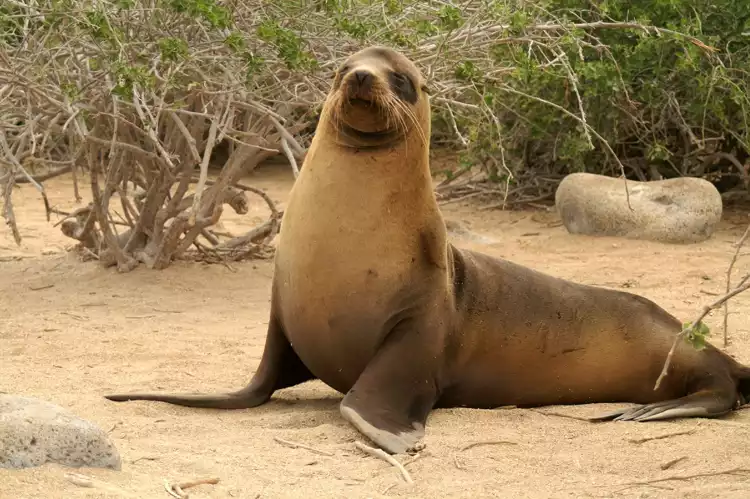
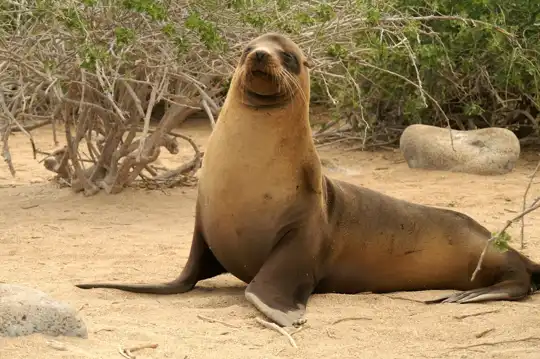
Four of the Galápagos Islands have hostels, restaurants and day-tour boats, so you can explore independently without booking a cruise. The archipelago sits in the Pacific, west of mainland Ecuador, and about 97 percent of its land is national park. Wildlife is absurdly close: sea lions sprawl on benches, marine iguanas crowd the pier, and blue-footed boobies dive just offshore. The catch is that most visitor sites require a licensed guide, so expect short, controlled walks instead of long treks. Costs sneak up on you, so carry cash for the park fee and the transit card, and book flights early. Ferries between islands sell out, so reserve a day ahead and pack seasickness tablets. I walked Avenida Charles Darwin in Puerto Ayora comparing agency boards before paying anyone, while a sea lion snored on a bench beside me, reeking of fish. Do that, and skip the first quote. Snorkelers and wildlife fans will love it. Anyone chasing wilderness treks or rock-bottom prices won’t.

Discover everything you want to know in the 📖 Ecuador Travel Guide.


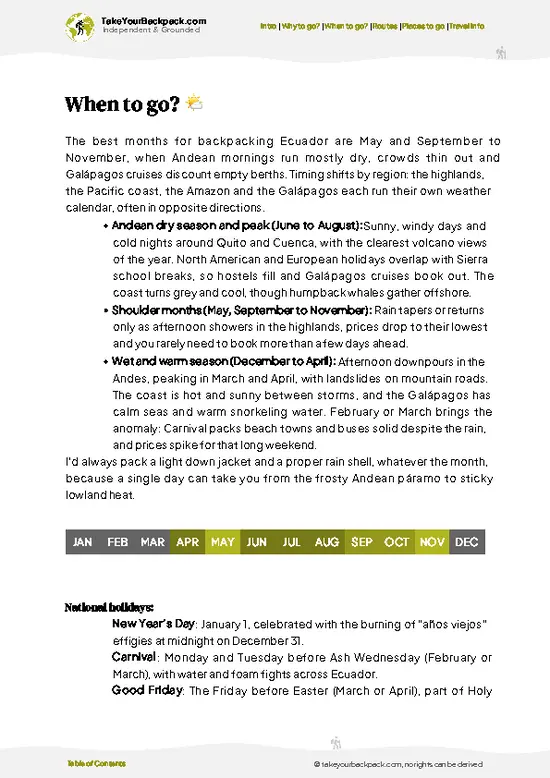
example page 0 from our offline Travel Guide for Ecuador
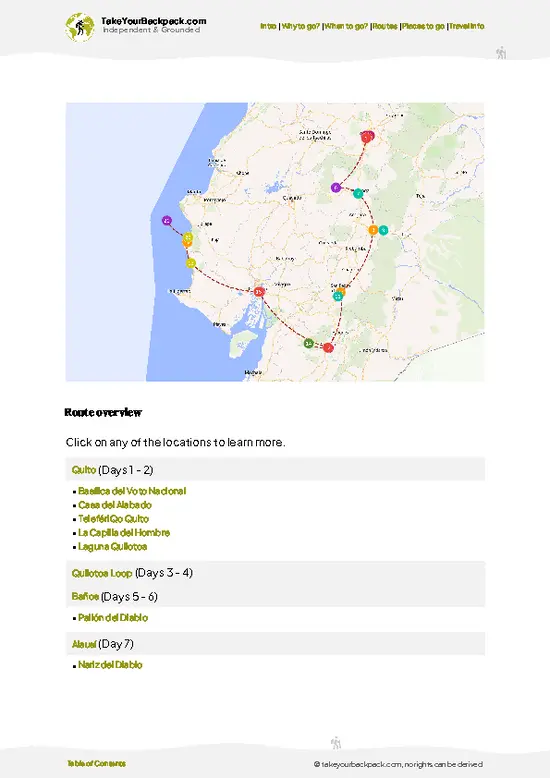
example page 1 from our offline Travel Guide for Ecuador
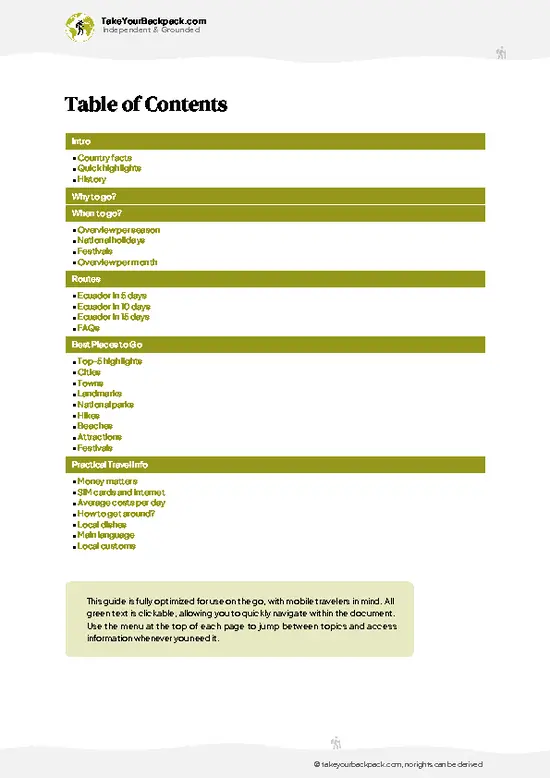
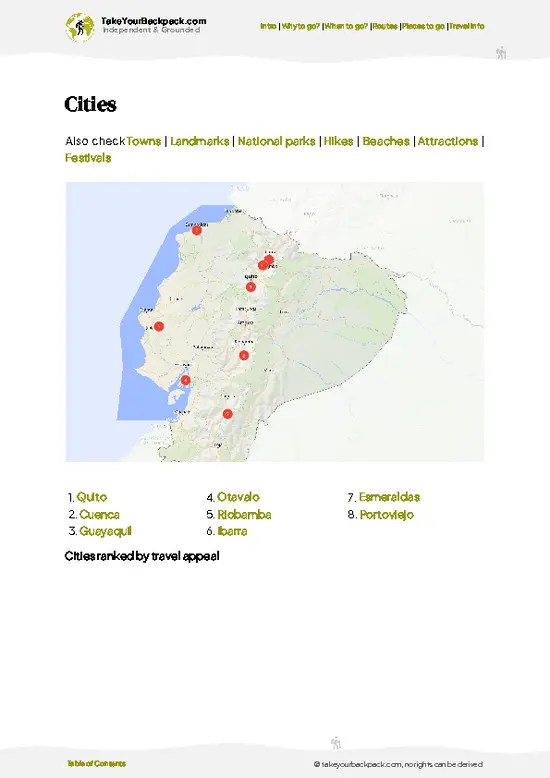
example page 2 from our offline Travel Guide for Ecuador
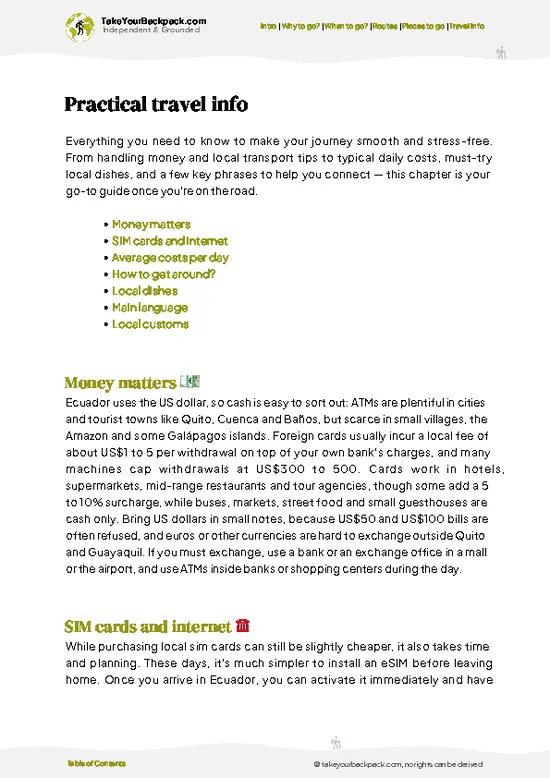
example page 3 from our offline Travel Guide for Ecuador
example page 4 from our offline Travel Guide for Ecuador
example page 5 from our offline Travel Guide for Ecuador
example page 6 from our offline Travel Guide for Ecuador
example page 7 from our offline Travel Guide for Ecuador
Loading the map 🌍
CLICK TO FILTER
cities
towns
landmarks
national parks
hikes
beaches
attractions
festivals
SHOW COUNTRY’S BESTSHOW ALL

✨ Why go?
Ranked #1 national park in Ecuador
What sets this place apart

Galápagos Islands works for backpackers because the inhabited islands let you build your own trip. Puerto Ayora on Santa Cruz has the biggest choice of hostels, cheap set-lunch kitchens and agencies, and from there you can walk to Tortuga Bay on your own, swim with marine iguanas nearby, and wander the town’s pier at dusk when sharks and rays circle under the lights. Hop by ferry to Isabela or San Cristóbal and you can repeat the formula with a different landscape each time: volcano rims on one, sea lion colonies in town on the other.
The real saving comes from picking day tours instead of a cruise. You choose which sites to pay for, snorkel with turtles and hammerheads near Kicker Rock, then come back to a bed on land. The trade-off is that many sites need a guide and you sleep on shore, so … read more 👉
Galápagos Islands works for backpackers because the inhabited islands let you build your own trip. Puerto Ayora on Santa Cruz has the biggest choice of hostels, cheap set-lunch kitchens and agencies, and from there you can walk to Tortuga Bay on your own, swim with marine iguanas nearby, and wander the town’s pier at dusk when sharks and rays circle under the lights. Hop by ferry to Isabela or San Cristóbal and you can repeat the formula with a different landscape each time: volcano rims on one, sea lion colonies in town on the other.
The real saving comes from picking day tours instead of a cruise. You choose which sites to pay for, snorkel with turtles and hammerheads near Kicker Rock, then come back to a bed on land. The trade-off is that many sites need a guide and you sleep on shore, so you skip remote western islands. Still, for travelers who like to haggle, compare boards and decide each morning, this is the cheapest way in.

💡 HighlightsThe experiences that define the visit

  1. Charles Darwin Research Station: The place most people picture first, in Puerto Ayora, where giant tortoise breeding centers show hatchlings and adults of several island races. Walking in is free and takes about an hour. It is the quickest way to understand why each island has its own tortoise shape.
  2. Tortuga Bay: A paved path of roughly 2.5 km leads from town to a wide white beach. Marine iguanas sprawl in the dunes, and a calm lagoon at the end suits swimming and kayaking. It is free and takes half a day.
  3. Sierra Negra Volcano: On Isabela, this crater is among the widest basaltic calderas in the world. The rim trail passes black lava fields, sulfur vents and views across to neighboring volcanoes. Go early, before clouds fill the crater.
  4. Kicker Rock (León Dormido): A split volcanic pillar rising
… read more 👉
  1. Charles Darwin Research Station: The place most people picture first, in Puerto Ayora, where giant tortoise breeding centers show hatchlings and adults of several island races. Walking in is free and takes about an hour. It is the quickest way to understand why each island has its own tortoise shape.
  2. Tortuga Bay: A paved path of roughly 2.5 km leads from town to a wide white beach. Marine iguanas sprawl in the dunes, and a calm lagoon at the end suits swimming and kayaking. It is free and takes half a day.
  3. Sierra Negra Volcano: On Isabela, this crater is among the widest basaltic calderas in the world. The rim trail passes black lava fields, sulfur vents and views across to neighboring volcanoes. Go early, before clouds fill the crater.
  4. Kicker Rock (León Dormido): A split volcanic pillar rising from the sea off San Cristóbal. Snorkelers glide through the channel between the walls, where Galápagos sharks, eagle rays and turtles pass beneath.
  5. Los Túneles: Off Isabela, collapsed lava tubes form arches in shallow water. Seahorses, white-tipped reef sharks and turtles hover below, while blue-footed boobies nest on the rocks above.
  6. Bartolomé Pinnacle Rock: A boardwalk of about 370 steps climbs to the island’s summit for a view of Pinnacle Rock and two curved beaches. Penguins sometimes pass at the base, and the snorkeling is good.
  7. El Chato Tortoise Reserve: In the Santa Cruz highlands, wild giant tortoises graze in muddy pastures and pools. You can walk among them, and rubber boots are provided at the gate. Lava tubes nearby extend the visit.
  8. Las Grietas: A water taxi crosses the harbor to a narrow, rocky fissure where fresh and salt water mix in a turquoise pool. Locals jump from the walls, and swimming here is quick and cool.
If time is short, skip Las Grietas, since it is mostly a short swim and a rocky walk.
Spotted a mistake or missing something? Contact us.

Things to do near Galápagos Islands

Ratings based on Tripadvisor reviews. When you book through this link, you support our work at no extra cost to you.

🌤️ When to go?When to go for the best experience

The warm, wet season from January to May is the easiest time for swimming and snorkeling, while June to December is cooler, drier and better for wildlife on land.
  • Warm Season (Jan to May): Air temperatures run about 24 to 30°C (75 to 86°F), the sea reaches 24 to 27°C (75 to 81°F) and the sun is strong. Short, heavy showers pass through, mostly in the afternoon. Sea turtles nest and the highlands turn green. Snorkeling visibility is at its best.
  • Cool Season (Jun to Dec): Garúa mist hangs over the highlands and the water drops to about 18 to 22°C (64 to 72°F), so you will want a 3 mm wetsuit. Air temperatures sit around 20 to 26°C (68 to 79°F). Blue-footed boobies court and the waters are rich with fish and penguins.
  • Peak Crowds and Prices: Mid-June to August and Christmas to early January fill
… read more 👉
The warm, wet season from January to May is the easiest time for swimming and snorkeling, while June to December is cooler, drier and better for wildlife on land.
  • Warm Season (Jan to May): Air temperatures run about 24 to 30°C (75 to 86°F), the sea reaches 24 to 27°C (75 to 81°F) and the sun is strong. Short, heavy showers pass through, mostly in the afternoon. Sea turtles nest and the highlands turn green. Snorkeling visibility is at its best.
  • Cool Season (Jun to Dec): Garúa mist hangs over the highlands and the water drops to about 18 to 22°C (64 to 72°F), so you will want a 3 mm wetsuit. Air temperatures sit around 20 to 26°C (68 to 79°F). Blue-footed boobies court and the waters are rich with fish and penguins.
  • Peak Crowds and Prices: Mid-June to August and Christmas to early January fill tours and flights. Expect fares and cruise rates to rise noticeably, so book 2 to 3 months ahead. Daylight stays at roughly 12 hours all year.
September to November and February to April are quieter, with last-minute tour deals easier to find in town.


source: climatestotravel.comJANJanuary: good for travelingFEBFebruary: highly recommended for travelingMARMarch: highly recommended for travelingAPRApril: highly recommended for travelingMAYMay: good for travelingJUNJune: good for travelingJULJuly: fair for travelingAUGAugust: fair for travelingSEPSeptember: good for travelingOCTOctober: good for travelingNOVNovember: highly recommended for travelingDECDecember: good for traveling
Ecuador - Galápagos Islands

✈️ The backpacker research shortcutEcuador Travel Guide

An offline-friendly backpacking guide with optimized travel routes, ranked highlights, transport advice, and the best areas to stay.
example page 0 from our offline Travel Guide for Ecuador
example page 1 from our offline Travel Guide for Ecuador
example page 2 from our offline Travel Guide for Ecuador
example page 3 from our offline Travel Guide for Ecuador
example page 4 from our offline Travel Guide for Ecuador
example page 5 from our offline Travel Guide for Ecuador
example page 6 from our offline Travel Guide for Ecuador
example page 7 from our offline Travel Guide for Ecuador
The digital guide (274 pages) contains:
✅ 87 highlights, ranked by travel appeal
✅ Optimized 5, 10 & 15-day travel routes
✅ Cities, national parks, landmarks, beaches
✅ How to get around
✅ Offline-friendly for travel without Wi-Fi
👉 Click to see all 30+ guide features

📅 Plan smarter in minutes, not weeks
✅ Month by month travel advice
✅ Festivals & national holidays
✅ Budget expectations

🗺️ Go to the right places, skip the overrated ones
✅ Honest pros & cons of destinations
✅ Top hikes, parks & viewpoints
✅ Lesser-known places most travelers miss
✅ Clear “worth it vs skip it” guidance

🛏️ Travel smoothly without rookie mistakes
✅ Best areas to stay
✅ Transport systems explained simply
✅ Common scams & safety advice
✅ SIM cards, money & practical tips

🌍 Understand the country, not just visit it
✅ Culture & traditions
✅ 52 Essential phrases & customs
✅ Festivals worth planning around
✅ Traveler-friendly historical context
✅ Insights that make places more meaningful

📱 Built for real travel conditions
✅ Fully downloadable PDF
✅ Works completely offline
✅ Optimized for phone use
✅ Useful in remote areas & buses
✅ Everything in one place
Stop searching, start planning
Get instant access to your full guide. 30‑day money-back guarantee.
+ Add another guide for just

By proceeding you agree to our terms.
Sent to your inbox immediately after payment • 100% Secure Checkout
Best Backpacking Travel Advisor 2025 tourism awardBest Backpacking
Travel Advisor
2025
What others say about Take Your Backpack Guides:
⭐⭐⭐⭐⭐
Fantastic, amazing amount of information!
⭐⭐⭐⭐⭐
My goodness this is amazing, it's what I've been looking for hats off too you!
⭐⭐⭐⭐⭐
I think this is absolutely BRILLIANT
⭐⭐⭐⭐
Very complete and informative. It's still missing places, but I gotta to commend you
⭐⭐⭐⭐⭐
This is truly amazing, thank you, can't wait to explore it with my kids!
⭐⭐⭐⭐⭐
Awesome resource, thank you!
⭐⭐⭐⭐⭐
This is amazing! Can't wait to explore the ones I haven't seen
⭐⭐⭐⭐
I love this! Well done, great idea.
⭐⭐⭐⭐⭐
Thanks for taking the time to make this gem!
⭐⭐⭐⭐⭐
This might be the best website I've ever seen.
⭐⭐⭐⭐⭐
Congratulations, and thank you so much for your work; it's incredibly valuable.
⭐⭐⭐⭐
In all seriousness I think you did a great job pointing out the important spots
⭐⭐⭐⭐⭐
10/10 very good
⭐⭐⭐⭐⭐
As someone who's only just starting to visit regularly this is awesome, thank you.
⭐⭐⭐⭐
Thank you very much! I'm going to visit my dad, it's going to be very useful!
⭐⭐⭐⭐⭐
This is really cool! We'll be travelling for the first time and this definitely come in handy.
⭐⭐⭐⭐⭐
You are now our minister of culture, congratulations 👨‍💼
⭐⭐⭐⭐⭐
Just wanted to tell you that this is a pearl! Going to follow your recommendations.
⭐⭐⭐⭐⭐
This is so cool. I'll definitely be using the resource for my travels soon.
⭐⭐⭐⭐⭐
This is very impressive! Good work.
⭐⭐⭐⭐⭐
This is an amazing and informative site. Very well done!

🛏️ Where to stay?Best areas and accommodation options

Puerto Ayora on Santa Cruz is the best base for most backpackers, with the widest range of hostels and the easiest access to tours and ferries.
No lodging exists inside the national park itself, since overnight stays are limited to the inhabited zones of four islands and to licensed boats. Camping is only possible at a few approved sites, such as private farms in the highlands of Santa Cruz, and wild camping is not allowed.
Puerto Ayora has dorm beds from about US$15 to 25 and private rooms from US$35 to 70. Most sit near Charles Darwin Avenue and the fish market, so you can walk to the pier for … read more 👉
Puerto Ayora on Santa Cruz is the best base for most backpackers, with the widest range of hostels and the easiest access to tours and ferries.
No lodging exists inside the national park itself, since overnight stays are limited to the inhabited zones of four islands and to licensed boats. Camping is only possible at a few approved sites, such as private farms in the highlands of Santa Cruz, and wild camping is not allowed.
Puerto Ayora has dorm beds from about US$15 to 25 and private rooms from US$35 to 70. Most sit near Charles Darwin Avenue and the fish market, so you can walk to the pier for day-trip boats to Bartolomé, Seymour Norte and Plazas.
Puerto Baquerizo Moreno on San Cristóbal is quieter and cheaper, with rooms from US$30 to 60. Sea lions lounge on the waterfront, and Tijeretas, Playa Mann and Punta Carola are reachable on foot.
Puerto Villamil on Isabela suits travelers who want sandy streets, flamingo lagoons and access to the Sierra Negra volcano trail. Rooms run from US$30 to 65 and many are a short walk from the beach.
Floreana has only a handful of small guesthouses. Hopping between islands by speedboat costs about US$35 to 40 per trip, so plan a land-based route of three islands to save money compared with a cruise.

👛 Costs (as of 19 October 2026)Typical daily expenses

Expect to spend about US$115 per day on a land-based backpacking route in the Galápagos Islands, with island hopping and a day tour pushing that higher.
CategoryBudget RangeLocal Reality
Park Entrance FeeUS$200 (one-time)Paid per visitor on arrival, plus a US$20 transit control card at the mainland airport. Many travelers divide this over their stay, so it is not counted in the daily total.
Accommodation (high season)US$25 to 60Dorm beds start around US$15 to 25 in the low season, while private rooms run US$35 to 70 in Puerto Ayora and cost a bit less on San Cristóbal.
FoodUS$20 to 35Set lunches called almuerzos cost US$5 to 8, and dinners at casual restaurants run US$10 to 18. Groceries are noticeably pricier than on the mainland.
Local TransportUS$2 to 10Water taxis in port are US$0.80 to 1 and
… read more 👉
Expect to spend about US$115 per day on a land-based backpacking route in the Galápagos Islands, with island hopping and a day tour pushing that higher.
CategoryBudget RangeLocal Reality
Park Entrance FeeUS$200 (one-time)Paid per visitor on arrival, plus a US$20 transit control card at the mainland airport. Many travelers divide this over their stay, so it is not counted in the daily total.
Accommodation (high season)US$25 to 60Dorm beds start around US$15 to 25 in the low season, while private rooms run US$35 to 70 in Puerto Ayora and cost a bit less on San Cristóbal.
FoodUS$20 to 35Set lunches called almuerzos cost US$5 to 8, and dinners at casual restaurants run US$10 to 18. Groceries are noticeably pricier than on the mainland.
Local TransportUS$2 to 10Water taxis in port are US$0.80 to 1 and taxis in town run about US$2 to 5. Inter-island speedboats cost US$35 to 40 per leg, averaged out here.
Tours and ActivitiesUS$25 to 60Day trips to nearby islands cost US$100 to 180, while snorkel tours such as Tortuga Bay kayaking or Las Grietas run US$15 to 40. Snorkel gear rents for US$5 to 10 a day.
Total Daily BudgetUS$115Based on a mid-range backpacker day with one paid activity, high season accommodation and moderate eating out.
⚠️ Prices can change and everyone travels differently, so take this as a rough guide. Hope it helps you plan your adventure!

🥾 TrailsScenic routes and wildlife spotting in Galápagos Islands

Galápagos Islands has plenty of walking, but most of it is short, controlled and tied to wildlife, with only a handful of routes open without a guide.
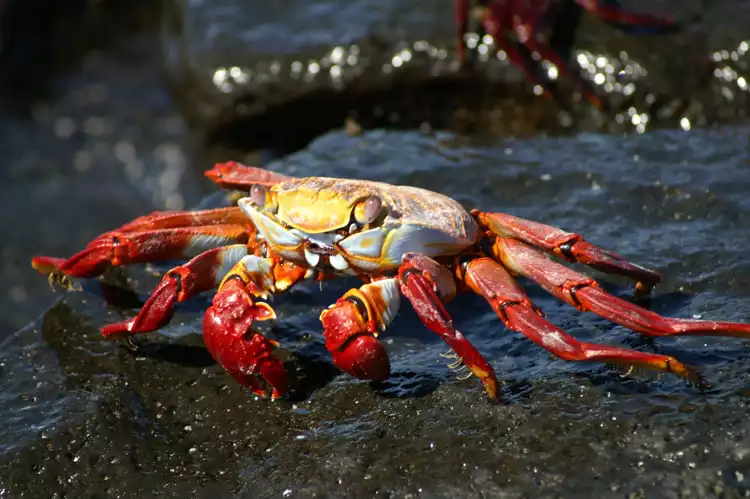
  • Tortuga Bay: About 2.5 km one way, 45 minutes to an hour each direction, easy. A paved path with steps leads to the beach through dry forest with cactus and finches. Marine iguanas and sally lightfoot crabs gather at the surf end. No guide is needed, but it closes at dusk.
  • Sierra Negra to Volcán Chico: Roughly 16 km round trip, 5 to 6 hours, moderate. A dirt track climbs through highland farms to the huge caldera rim, then crosses black lava to fumaroles
… read more 👉
Galápagos Islands has plenty of walking, but most of it is short, controlled and tied to wildlife, with only a handful of routes open without a guide.
  • Tortuga Bay: About 2.5 km one way, 45 minutes to an hour each direction, easy. A paved path with steps leads to the beach through dry forest with cactus and finches. Marine iguanas and sally lightfoot crabs gather at the surf end. No guide is needed, but it closes at dusk.
  • Sierra Negra to Volcán Chico: Roughly 16 km round trip, 5 to 6 hours, moderate. A dirt track climbs through highland farms to the huge caldera rim, then crosses black lava to fumaroles and views toward other volcanoes. Guided, with a large exposed section and little shade.
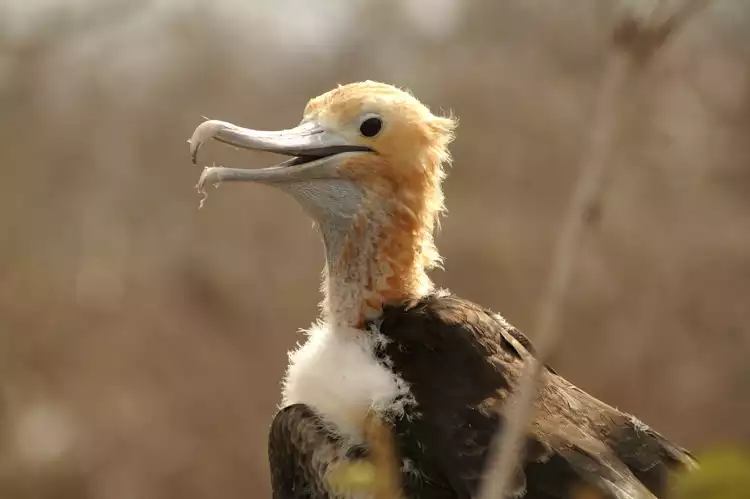
  • Cerro Tijeretas: Around 1.5 km round trip from Puerto Baquerizo Moreno on San Cristóbal, one hour, easy. The route passes the visitor center, rises to a lookout above the bay and ends at Darwin’s statue, with frigatebirds overhead. Free and guide-free.
  • Bartolomé summit: Short but steep, about 30 minutes, with 370 wooden steps on a volcanic cone. Mostly bare lava, so bring water and a hat.
  • Cerro Dragón: A trail of about 2 km, 1.5 hours, easy, on Santa Cruz. It leads past a flamingo lagoon to a ridge where land iguanas dig burrows. It is reached by boat and guided.
  • Las Grietas: A rocky 20 to 30 minute walk beyond the water taxi, moderate for footing, ending at the swimming fissure.
Most sites sit within the national park, where you must follow marked trails and stay at least a couple of meters from animals. Almost everyone arrives by air at Baltra or San Cristóbal, then moves between islands by ferry. The park entrance fee is US$200 for foreign adults, paid in cash on arrival, and a separate transit card is required at the mainland airport. Crowds peak in December and January and in mid-year, so reserve ferries and the busiest snorkeling tours a day or two ahead. Hiking is best in the morning, when it is cooler and animals are more active.
⚠️ Hiking info can sometimes be outdated or inaccurate. Before you hit the trail, check the latest conditions with locals. If you do spot anything that's off, I'd love to hear from you, so I can update it for fellow travelers.

🛡️ SafetyScams, Hazards, and Annoyances

The Galápagos are safe and tightly managed, and the main hazards are sun, sea and the rules.
The equatorial sun burns fast, even on cloudy days, so wear a long-sleeved rash guard, reef-safe sunscreen and a hat. Carry at least 2 liters of water on trails such as Sierra Negra or Pinnacle Rock, where shade is scarce. Lava rock is sharp and uneven, so wear closed shoes with grip.
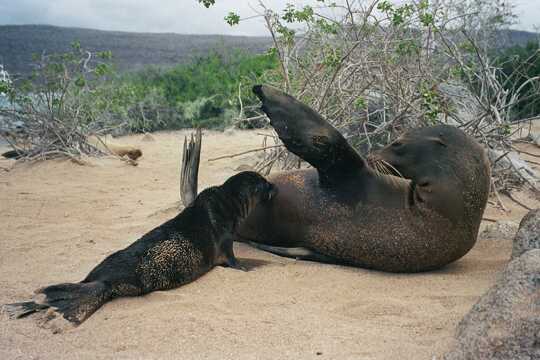
Currents and surf can be strong at some beaches, so swim where others do and heed any red flags. Sea lions can bite if crowded, especially males and pups, and you should stay at least 2 meters away from all animals. Never touch, feed or chase wildlife.
Park rules require you to stay on marked trails, and most visitor sites need a licensed naturalist guide. Many first-timers underpack on seasickness tablets for boat transfers, … read more 👉
The Galápagos are safe and tightly managed, and the main hazards are sun, sea and the rules.
The equatorial sun burns fast, even on cloudy days, so wear a long-sleeved rash guard, reef-safe sunscreen and a hat. Carry at least 2 liters of water on trails such as Sierra Negra or Pinnacle Rock, where shade is scarce. Lava rock is sharp and uneven, so wear closed shoes with grip.
Currents and surf can be strong at some beaches, so swim where others do and heed any red flags. Sea lions can bite if crowded, especially males and pups, and you should stay at least 2 meters away from all animals. Never touch, feed or chase wildlife.
Park rules require you to stay on marked trails, and most visitor sites need a licensed naturalist guide. Many first-timers underpack on seasickness tablets for boat transfers, which can be rough. Petty theft is rare, though valuables should stay out of sight on beaches.

FAQCommon questions from travelers

Plan on 5 to 7 days for the Galápagos Islands if you want to see more than one island. A base on Santa Cruz takes care of Tortuga Bay, the Charles Darwin Research Station and day trips to North Seymour, while adding San Cristóbal and Isabela needs about 8 to 10 days. Live-aboard cruises typically run 4, 5 or 8 days.
Yes, you can explore the Galápagos Islands without a car, and most backpackers do. Walking, water taxis at US$0.80 to 1, and public buses from Puerto Ayora to Bellavista cover the main sights on Santa Cruz, while speedboats cost about US$35 to 40 between islands and take 2 to 2.5 hours. Tours to farms, lava tunnels and Los Gemelos can be arranged by taxi or guide for US$30 to 60.
Yes, the Galápagos Islands charge a national park entrance fee of US$200 for most foreign adults, paid in cash or by card on arrival at the airport, with reduced rates for children. You also need the US$20 Transit Control Card, bought at the mainland airport in Quito or Guayaquil before your flight. Isabela also charges a dock fee of about US$10 on arrival, and most sites need an authorized guide.
⚠️ Things can change over time, so always validate details locally before you go.

📸 PhotosTravel photos from Galápagos Islands

Take your backpack - Galapagos Islands - 0
Take your backpack - Galapagos Islands - 1
Take your backpack - Galapagos Islands - 2
Take your backpack - Galapagos Islands - 3
Take your backpack - Galapagos Islands - 4
Take your backpack - Galapagos Islands - 5
Take your backpack - Galapagos Islands - 6
Take your backpack - Galapagos Islands - 7
Take your backpack - Galapagos Islands - 8
Take your backpack - Galapagos Islands - 9
Take your backpack - Galapagos Islands - 10
Photographed by: Johan Kruseman

Other Ecuadorian national parks near Galápagos Islands

Explore more nearby:


💡 Not sure where to go next?
Create a personalized itinerary for Ecuador including Galápagos Islands and the places that fit your trip.

Generate my itinerary

👉 Discover all national parks

Or checkout all Ecuador has to offer (think cities, towns, villages, national parks, hikes, beaches, festivals)
Country photo of Ecuador

We 💚 feedbackSumming up the experience

Galápagos Islands trips go wrong when travelers prebook every tour from the mainland, then arrive with no flexibility and pay inflated prices. I would book only flights and the first two nights, then compare boards and ask other guests about conditions once you land. Keep a free day for weather changes, because rough seas cancel the best snorkeling trips, and reserve ferries early.

✈️ When did I visit Ecuador?
Ecuador I visited during my half year trip through South and Central America back in 2003

✍️ Help improve this page!
The information on this page is based on my own backpacking experience in Ecuador, supplemented with up-to-date research and feedback from other travelers. Travel details can change, so if you notice anything outdated or incomplete, feel free to let me know.


🙋‍♂️ Give feedback

👋 Meet the founderWho’s Behind Take Your Backpack?

Johan, backpacker and founder of TakeYourBackpackHi, I’m Johan (Netherlands 🇳🇱), the creator of TakeYourBackpack. Over the past 3 decades, I’ve backpacked through 90+ countries across six continents, gaining extensive experience with independent travel, long-term trips, and overland routes.

This site is built on a combination of firsthand travel experience and carefully curated insights from other backpackers. Many guides are based on places I’ve personally visited, while others bring together tips, observations, and practical advice shared by trusted travelers I’ve met along the way.

The goal is to provide realistic, experience-driven guidance — not generic itineraries — so you can explore destinations with better context, clearer expectations, and more confidence.