

×

Fiji🇫🇯 | national parksKoroyanitu National Heritage ParkSavuione Falls, Mt Batilamu climb, village-led trails, highland birds | things to do and best time to go

Explore Colo-i-Suva Forest ParkExplore Sigatoka Sand Dunes National Park

Backpacking in Koroyanitu National Heritage Park
🌟 Highlightnational park ranked #3
By Johan Kruseman 🇳🇱 | Updated October 15, 2026

The decision most visitors face is whether to arrive as a day trip or to sleep in the highlands, and the early start tips it. Day trippers lose hours on rough access, while an overnight lets you hit the trail at dawn before cloud builds on the ridge. Koroyanitu sits in the Mt Evans Range of western Viti Levu in Fiji, inland from the Lautoka and Nadi coast. Expect forested hills, a waterfall with a swimming pool, steep summit walks, and village hosts who actually run the place. It stays quiet, but there is no big visitor infrastructure. Pay the village entry fee in cash, bring more cash than you think, and don’t trust phone maps on the final track. Wear shoes with grip, because clay turns slick after rain. Compared with Colo-i-Suva Forest Park near Suva, which is gentler and easier to reach, Koroyanitu is steeper, more remote and far more community-led.

Discover everything you want to know in the 📖 Fiji Travel Guide.


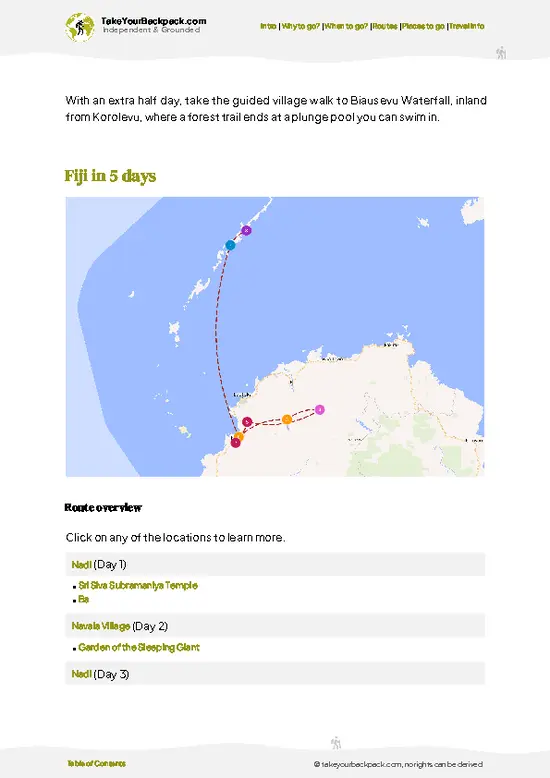
example page 0 from our offline Travel Guide for Fiji
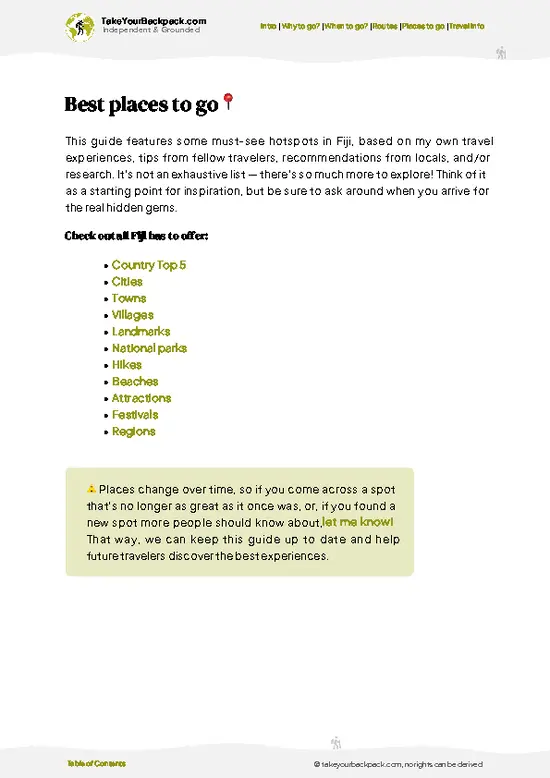
example page 1 from our offline Travel Guide for Fiji
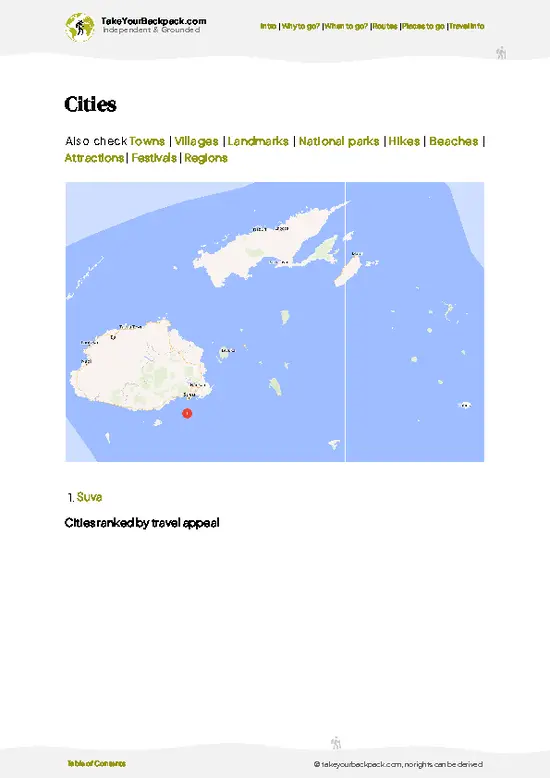
example page 2 from our offline Travel Guide for Fiji
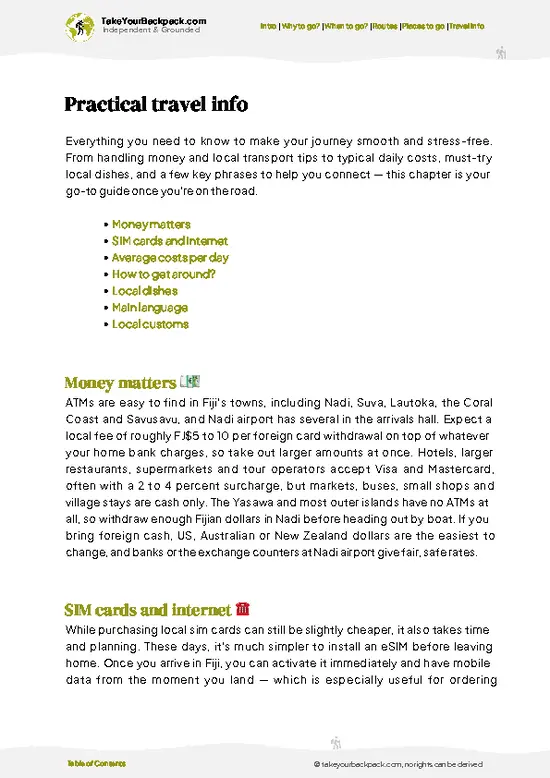
example page 3 from our offline Travel Guide for Fiji
example page 4 from our offline Travel Guide for Fiji
example page 5 from our offline Travel Guide for Fiji
example page 6 from our offline Travel Guide for Fiji
example page 7 from our offline Travel Guide for Fiji
Loading the map 🌍
CLICK TO FILTER
cities
towns
villages
landmarks
national parks
hikes
beaches
attractions
festivals
regions
SHOW COUNTRY’S BESTSHOW ALL

✨ Why go?
Ranked #3 national park in Fiji
What sets this place apart

Backpackers choose Koroyanitu because it is Fiji without the resort layer. The park is run by the highland communities, so you pay a fee that goes to the villages and are met by people who grew up on these ridges. Walking with a local guide here means stories about the old fortified sites and the plants used for medicine, not a scripted patter. The second pull is the trail range packed into a small area: an easy waterfall walk for a half day, and the long, sweaty climb to the Mt Batilamu summit for anyone wanting a proper day. You can see the Mamanuca islands and the coast from up high on clear mornings. It also suits self-guided travelers who like arranging things directly. Staying in a village lodge or homestay near Abaca keeps costs low and gets you to the trailheads before day trippers, and there are no tour buses clogging the paths.

💡 HighlightsDon't-miss highlights and experiences

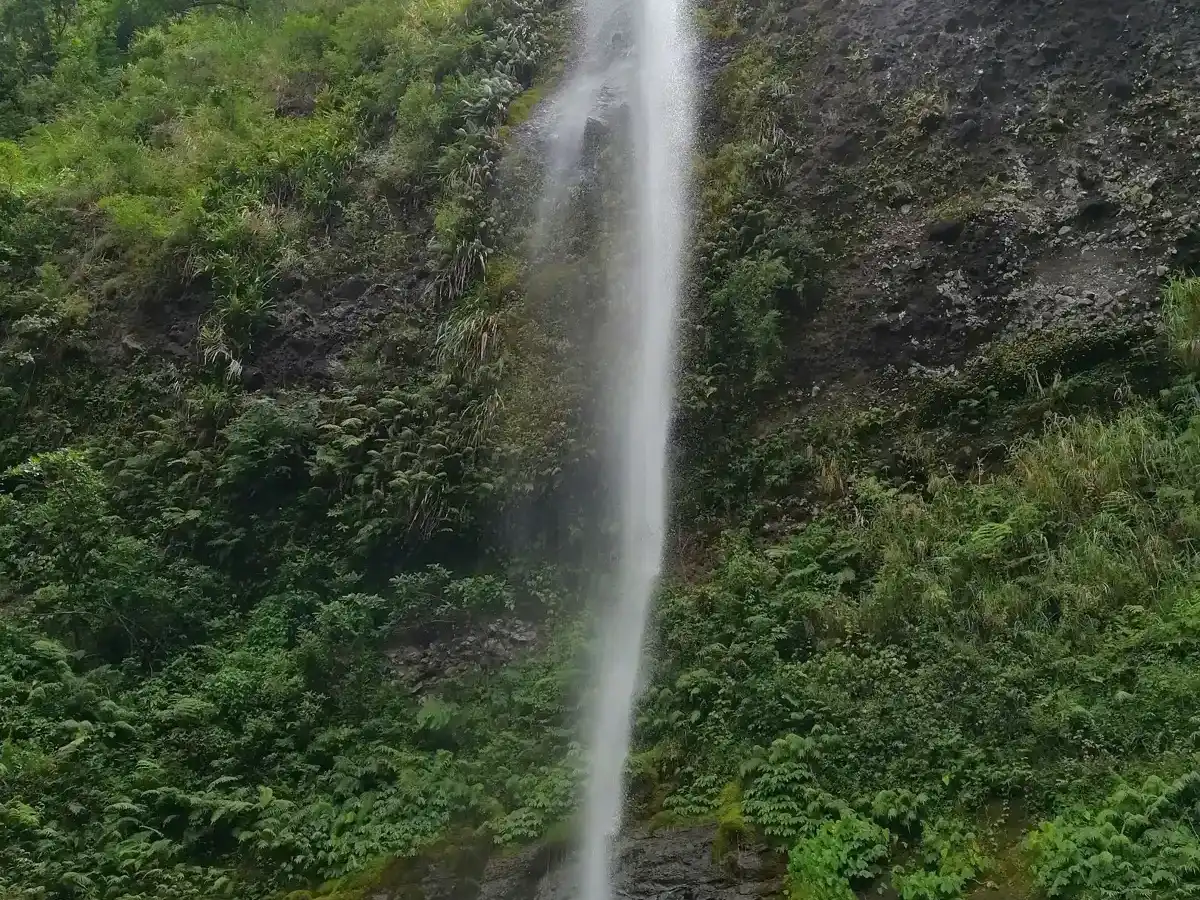
  1. Savuione Waterfall: The park’s best-known sight, a cascade tumbling into a cool, deep pool that is good for a swim after the walk in. The forest around it is dense and loud with birds.
  2. Mt Batilamu summit: The big climb of the park, steep and sometimes slippery, with wide views across western Viti Levu and out to the islands when the sky is clear.
  3. Abaca village: The main gateway, where the community welcomes visitors, collects fees and arranges guides. Its yard-and-garden setting is a good place to meet your hosts and ask about the trails.
  4. Native forest and birdlife: Highland forest here shelters Fiji bird species rarely seen near the coast. Early morning with a guide is the best time to listen and look.
  5. Navilawa village and ridge walks: Another community within the park, with paths over open ridges
… read more 👉
  1. Savuione Waterfall: The park’s best-known sight, a cascade tumbling into a cool, deep pool that is good for a swim after the walk in. The forest around it is dense and loud with birds.
  2. Mt Batilamu summit: The big climb of the park, steep and sometimes slippery, with wide views across western Viti Levu and out to the islands when the sky is clear.
  3. Abaca village: The main gateway, where the community welcomes visitors, collects fees and arranges guides. Its yard-and-garden setting is a good place to meet your hosts and ask about the trails.
  4. Native forest and birdlife: Highland forest here shelters Fiji bird species rarely seen near the coast. Early morning with a guide is the best time to listen and look.
  5. Navilawa village and ridge walks: Another community within the park, with paths over open ridges and grassy hillsides that give a different feel from the closed forest below.
  6. Old fortified hilltop sites: Ridgetop ground once used by highland clans for defense, shown by local guides along with stories of the people who lived and fought here.
  7. Medicinal plant walks: Guides point out leaves, roots and bark that villagers use for remedies, which turns an ordinary forest stroll into something more specific.
Start with Savuione Waterfall, since the walk is manageable, you can swim afterward, and it gives you a feel for the terrain before you commit to the summit.
Spotted a mistake or missing something? Contact us.

Things to do near Koroyanitu National Heritage Park

Ratings based on Tripadvisor reviews. When you book through this link, you support our work at no extra cost to you.

🌤️ When to go?Seasonal considerations and timing

  • Dry Season (May to October): The most reliable window for the Mt Batilamu ridge and the Savuione and Abaca trails. Days run 24 to 28°C (75 to 82°F), nights in the village can dip to 15 to 18°C (59 to 64°F), and the summit ridge feels cooler. Daylight lasts roughly 11 to 12 hours, with sunset near 6pm.
  • Wet Season (November to April): Expect 28 to 32°C (82 to 90°F), heavy humidity and sudden downpours. Clay trails turn slick, streams swell and the Abaca village access road can get muddy. Cyclone risk peaks January to March. Daylight stretches to about 13 hours.
  • Crowds and Prices: The park sees few visitors in any month. Fees and village homestay rates stay flat all year, though Nadi transfers and hotels cost more from July to September and over Christmas.
  • Seasonal Activities: Waterfall swims at
… read more 👉
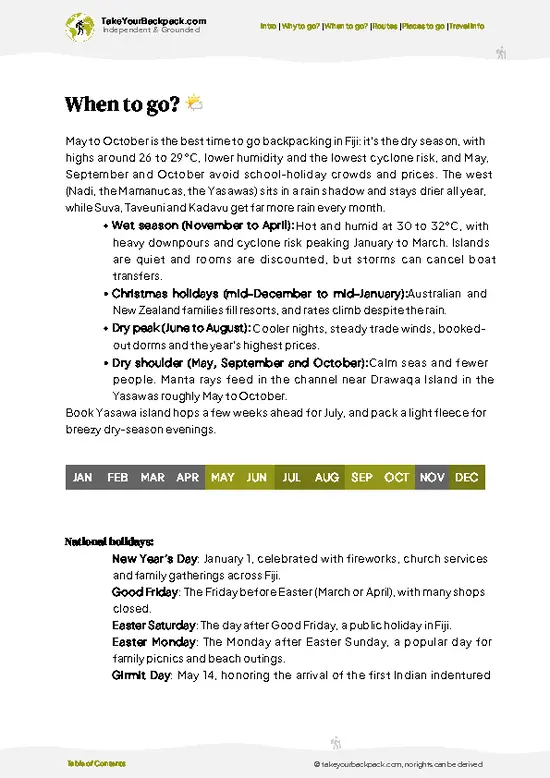
  • Dry Season (May to October): The most reliable window for the Mt Batilamu ridge and the Savuione and Abaca trails. Days run 24 to 28°C (75 to 82°F), nights in the village can dip to 15 to 18°C (59 to 64°F), and the summit ridge feels cooler. Daylight lasts roughly 11 to 12 hours, with sunset near 6pm.
  • Wet Season (November to April): Expect 28 to 32°C (82 to 90°F), heavy humidity and sudden downpours. Clay trails turn slick, streams swell and the Abaca village access road can get muddy. Cyclone risk peaks January to March. Daylight stretches to about 13 hours.
  • Crowds and Prices: The park sees few visitors in any month. Fees and village homestay rates stay flat all year, though Nadi transfers and hotels cost more from July to September and over Christmas.
  • Seasonal Activities: Waterfall swims at Savuione are best from June to October, when water is clearer and the pools are calmer.
Book your guide a few days ahead for June to September, since local guides are few and villages run their own schedules.


source: climatestotravel.comJANJanuary: fair for travelingFEBFebruary: fair for travelingMARMarch: fair for travelingAPRApril: fair for travelingMAYMay: highly recommended for travelingJUNJune: excellent for travelingJULJuly: excellent for travelingAUGAugust: excellent for travelingSEPSeptember: excellent for travelingOCTOctober: highly recommended for travelingNOVNovember: fair for travelingDECDecember: fair for traveling
fiji-national-park-koroyanitu-national-heritage-park
© Google | Estienne Lewies

✈️ The backpacker research shortcutFiji Travel Guide

An offline-friendly backpacking guide with optimized travel routes, ranked highlights, transport advice, and the best areas to stay.
example page 0 from our offline Travel Guide for Fiji
example page 1 from our offline Travel Guide for Fiji
example page 2 from our offline Travel Guide for Fiji
example page 3 from our offline Travel Guide for Fiji
example page 4 from our offline Travel Guide for Fiji
example page 5 from our offline Travel Guide for Fiji
example page 6 from our offline Travel Guide for Fiji
example page 7 from our offline Travel Guide for Fiji
The digital guide (159 pages) contains:
✅ 41 highlights, ranked by travel appeal
✅ Optimized 2, 3 & 5-day travel routes
✅ Cities, national parks, landmarks, beaches
✅ How to get around
✅ Offline-friendly for travel without Wi-Fi
👉 Click to see all 30+ guide features

📅 Plan smarter in minutes, not weeks
✅ Month by month travel advice
✅ Festivals & national holidays
✅ Budget expectations

🗺️ Go to the right places, skip the overrated ones
✅ Honest pros & cons of destinations
✅ Top hikes, parks & viewpoints
✅ Lesser-known places most travelers miss
✅ Clear “worth it vs skip it” guidance

🛏️ Travel smoothly without rookie mistakes
✅ Best areas to stay
✅ Transport systems explained simply
✅ Common scams & safety advice
✅ SIM cards, money & practical tips

🌍 Understand the country, not just visit it
✅ Culture & traditions
✅ 52 Essential phrases & customs
✅ Festivals worth planning around
✅ Traveler-friendly historical context
✅ Insights that make places more meaningful

📱 Built for real travel conditions
✅ Fully downloadable PDF
✅ Works completely offline
✅ Optimized for phone use
✅ Useful in remote areas & buses
✅ Everything in one place
Stop searching, start planning
Get instant access to your full guide. 30‑day money-back guarantee.
+ Add another guide for just

By proceeding you agree to our terms.
Sent to your inbox immediately after payment • 100% Secure Checkout
Best Backpacking Travel Advisor 2025 tourism awardBest Backpacking
Travel Advisor
2025
What others say about Take Your Backpack Guides:
⭐⭐⭐⭐⭐
Fantastic, amazing amount of information!
⭐⭐⭐⭐⭐
My goodness this is amazing, it's what I've been looking for hats off too you!
⭐⭐⭐⭐⭐
I think this is absolutely BRILLIANT
⭐⭐⭐⭐
Very complete and informative. It's still missing places, but I gotta to commend you
⭐⭐⭐⭐⭐
This is truly amazing, thank you, can't wait to explore it with my kids!
⭐⭐⭐⭐⭐
Awesome resource, thank you!
⭐⭐⭐⭐⭐
This is amazing! Can't wait to explore the ones I haven't seen
⭐⭐⭐⭐
I love this! Well done, great idea.
⭐⭐⭐⭐⭐
Thanks for taking the time to make this gem!
⭐⭐⭐⭐⭐
This might be the best website I've ever seen.
⭐⭐⭐⭐⭐
Congratulations, and thank you so much for your work; it's incredibly valuable.
⭐⭐⭐⭐
In all seriousness I think you did a great job pointing out the important spots
⭐⭐⭐⭐⭐
10/10 very good
⭐⭐⭐⭐⭐
As someone who's only just starting to visit regularly this is awesome, thank you.
⭐⭐⭐⭐
Thank you very much! I'm going to visit my dad, it's going to be very useful!
⭐⭐⭐⭐⭐
This is really cool! We'll be travelling for the first time and this definitely come in handy.
⭐⭐⭐⭐⭐
You are now our minister of culture, congratulations 👨‍💼
⭐⭐⭐⭐⭐
Just wanted to tell you that this is a pearl! Going to follow your recommendations.
⭐⭐⭐⭐⭐
This is so cool. I'll definitely be using the resource for my travels soon.
⭐⭐⭐⭐⭐
This is very impressive! Good work.
⭐⭐⭐⭐⭐
This is an amazing and informative site. Very well done!

🛏️ Where to stay?Best areas to stay in Fiji

The best option for most backpackers is a village homestay or lodge inside the park area, with Nadi or Lautoka as a back-up base.
Koroyanitu is managed by the communities of Abaca, Navilawa and Koroyanitu villages, who run simple accommodation. Abaca (pronounced Am-bartha) has a small guesthouse and a campsite with basic facilities, and visitors can also stay in village homes. Expect shared bathrooms, meals cooked by your hosts, and little or no mobile signal. Bring cash and cold-water bathing is the norm. Staying overnight lets you start the Mt Batilamu hike early, before the heat builds, and … read more 👉
The best option for most backpackers is a village homestay or lodge inside the park area, with Nadi or Lautoka as a back-up base.
Koroyanitu is managed by the communities of Abaca, Navilawa and Koroyanitu villages, who run simple accommodation. Abaca (pronounced Am-bartha) has a small guesthouse and a campsite with basic facilities, and visitors can also stay in village homes. Expect shared bathrooms, meals cooked by your hosts, and little or no mobile signal. Bring cash and cold-water bathing is the norm. Staying overnight lets you start the Mt Batilamu hike early, before the heat builds, and sit down to kava in the evening.
To avoid the village option, Lautoka is the closest town of size, around 20 to 30 minutes by road from the Abaca turnoff, with a handful of budget hotels and a large market for stocking up. Nadi, about 30 to 45 minutes away, has the widest choice of hostels and dorm beds, plus the international airport, and it is where most day trips to the park originate. Backpackers on a tight schedule often stay in Nadi and take a pre-arranged transfer.
In villages, ask about dress codes. Shoulders and knees covered is the courtesy.

👛 Costs (as of 15 October 2026)What things cost and how to budget

Expect to spend about US$55 a day at Koroyanitu National Heritage Park when you stay in a village guesthouse and hire local guides.
CategoryBudget RangeLocal Reality
Entrance and guide feesUS$8 to 15Access is arranged through the villages of Abaca, Navilawa and Koroyanitu, which charge a per-person fee that usually includes a guide for the Mt Batilamu or Savuione waterfall walks. Pay in cash.
Accommodation (high season)US$20 to 30Abaca village has a basic guesthouse and a campsite with shared facilities, often priced per person with meals offered as a package. Rates are a little lower in the wetter months.
Local transportUS$6 to 12Buses from Lautoka or Nadi run to the Abaca turnoff, then you need a carrier, taxi or arranged village pickup for the rough road up. Carrier hire is the main cost.
Food
… read more 👉
Expect to spend about US$55 a day at Koroyanitu National Heritage Park when you stay in a village guesthouse and hire local guides.
CategoryBudget RangeLocal Reality
Entrance and guide feesUS$8 to 15Access is arranged through the villages of Abaca, Navilawa and Koroyanitu, which charge a per-person fee that usually includes a guide for the Mt Batilamu or Savuione waterfall walks. Pay in cash.
Accommodation (high season)US$20 to 30Abaca village has a basic guesthouse and a campsite with shared facilities, often priced per person with meals offered as a package. Rates are a little lower in the wetter months.
Local transportUS$6 to 12Buses from Lautoka or Nadi run to the Abaca turnoff, then you need a carrier, taxi or arranged village pickup for the rough road up. Carrier hire is the main cost.
Food and suppliesUS$8 to 12Village meals of root crops, fish or chicken and cassava are served at the guesthouse. Stock up on snacks, water purification and cash in Lautoka before you go, since there are no shops nearby.
Extras (kava gift, tips)US$2 to 5A modest kava bundle is customary for the village chief. Guides appreciate small tips but they are not expected.
Total Daily BudgetUS$55Per person, per day, in high season.
⚠️ Prices can change and everyone travels differently, so take this as a rough guide. Hope it helps you plan your adventure!

🥾 TrailsExploring Koroyanitu National Heritage Park: trails, terrain, and views

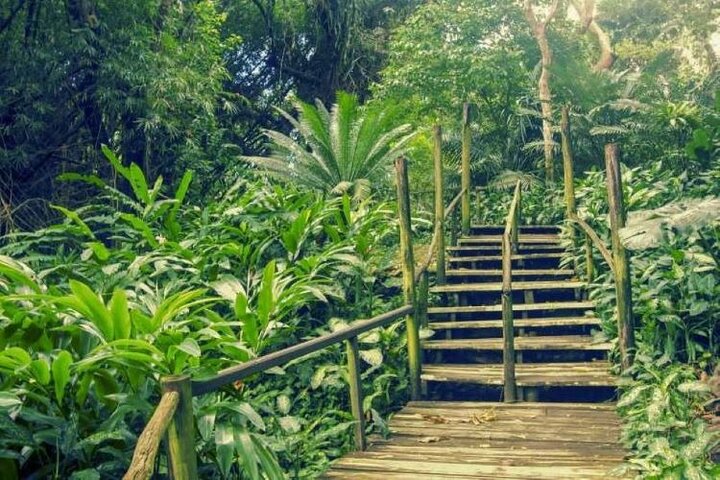
Walking in Koroyanitu is mostly steep, forested and humid, with red clay underfoot that gets treacherous after rain. Most routes start from the village of Abaca, where guides are arranged on the spot.
  • Savuione Waterfall walk: Roughly 1 to 2 hours return at an easy to moderate level. The path climbs through forest and across streams to a cascade and swimming pool.
  • Mt Batilamu climb: Roughly 4 to 6 hours return and hard going. The route is steep, with loose ground and ridge exposure, and it opens to wide views over the coast and islands on a clear morning.
  • Village and ridge walks: Half-day outings
… read more 👉
Walking in Koroyanitu is mostly steep, forested and humid, with red clay underfoot that gets treacherous after rain. Most routes start from the village of Abaca, where guides are arranged on the spot.
  • Savuione Waterfall walk: Roughly 1 to 2 hours return at an easy to moderate level. The path climbs through forest and across streams to a cascade and swimming pool.
  • Mt Batilamu climb: Roughly 4 to 6 hours return and hard going. The route is steep, with loose ground and ridge exposure, and it opens to wide views over the coast and islands on a clear morning.
  • Village and ridge walks: Half-day outings of 2 to 4 hours, moderate effort, crossing open grassy ridges, past plantations and through patches of native forest.
  • Wildlife and plants: Expect forest birds, butterflies and the occasional gecko, plus plant walks with guides who explain traditional uses.
Public transport only goes part of the way. Local buses run toward the turn-off, and a carrier or pickup arranged with the village covers the last rough stretch, so confirm your ride in advance. A guide is expected for most walks and the village charges an entry fee, usually in the range of F$15 to 30 (about US$7 to 14) per person, with extra for guiding. Bring cash because there is no card machine. The park is quiet on weekdays and sees few visitors even in busy months. Pack water, rain gear and sturdy shoes, and start early because cloud gathers on the ridges by midday.
⚠️ Hiking info can sometimes be outdated or inaccurate. Before you hit the trail, check the latest conditions with locals. If you do spot anything that's off, I'd love to hear from you, so I can update it for fellow travelers.

🛡️ SafetySafety Tips and Common Scams in Koroyanitu National Heritage Park

Koroyanitu is a well-run community park where the main risks are heat, slippery clay and overconfidence on the longer ridge hikes.
Most trails are marked, but the Mt Batilamu ascent, a steep climb of several hours on loose soil and exposed rock, is best done with a village guide who knows the route and the weather. Start by 7am. By midday the open ridges are hot and shadeless, so carry at least 2 to 3 liters of water, sun protection and a hat. After rain, stream crossings near Savuione rise quickly and rocks become greasy, so wear shoes with real tread rather than flip-flops.
There are no dangerous large animals. Expect mosquitoes, so bring repellent, and wild pigs and feral goats are occasionally seen on the slopes. Signal is patchy, so tell your hosts your route and turnaround time. First-time … read more 👉
Koroyanitu is a well-run community park where the main risks are heat, slippery clay and overconfidence on the longer ridge hikes.
Most trails are marked, but the Mt Batilamu ascent, a steep climb of several hours on loose soil and exposed rock, is best done with a village guide who knows the route and the weather. Start by 7am. By midday the open ridges are hot and shadeless, so carry at least 2 to 3 liters of water, sun protection and a hat. After rain, stream crossings near Savuione rise quickly and rocks become greasy, so wear shoes with real tread rather than flip-flops.
There are no dangerous large animals. Expect mosquitoes, so bring repellent, and wild pigs and feral goats are occasionally seen on the slopes. Signal is patchy, so tell your hosts your route and turnaround time. First-time visitors most often underestimate the humidity and the lack of shops on the trails. Pack snacks, a basic first-aid kit and a light rain jacket.

FAQTraveler FAQ

Two days and one night is the ideal length. That gives you time for the Mt Batilamu ridge hike (roughly 4 to 6 hours return with a guide) on day one and a morning at the Savuione waterfall or village walks before heading back. A single day trip from Nadi is possible for the waterfall alone, but you will be rushed.
Yes, but it takes some planning. Local buses run from Nadi and Lautoka toward the Abaca turnoff (around 30 to 60 minutes depending on the starting point), then you need a taxi or pre-arranged village pickup for the unsealed final stretch. Transfers from Nadi hostels or from the villages themselves usually cost roughly US$20 to 50 each way.
Yes, village fees apply and are paid in cash on arrival. Expect around US$10 to 25 per person for park access, with a guide charged on top for longer hikes such as Mt Batilamu. No government permit is needed, but you should arrange your visit through the Abaca, Navilawa or Koroyanitu community contacts, ideally a few days ahead.
⚠️ Things can change over time, so always validate details locally before you go.

Other Fijian national parks near Koroyanitu National Heritage Park

Explore more nearby:


💡 Not sure where to go next?
Create a personalized itinerary for Fiji including Koroyanitu National Heritage Park and the places that fit your trip.

Generate my itinerary

👉 Discover all national parks

Or checkout all Fiji has to offer (think cities, towns, villages, national parks, hikes, beaches, festivals)
Country photo of Fiji

We 💚 feedbackIs it worth it?

The classic mistake is turning up for a quick afternoon, then rushing the summit with no guide and no cash. Slow down. Arrange the night in the village ahead of time, carry small notes for fees, and do the waterfall walk first. Save Mt Batilamu for the next dawn, when the air is cool and the views are open.

✍️ Help improve this page!
The information on this page is based on in-depth research, insights shared by experienced travelers, and feedback from the local travel community in Fiji. While every effort is made to keep the information accurate and current, conditions can change — so if you spot anything incorrect or outdated, please get in touch.


🙋‍♂️ Give feedback

👋 Meet the founderWho’s Behind Take Your Backpack?

Johan, backpacker and founder of TakeYourBackpackHi, I’m Johan (Netherlands 🇳🇱), the creator of TakeYourBackpack. Over the past 3 decades, I’ve backpacked through 90+ countries across six continents, gaining extensive experience with independent travel, long-term trips, and overland routes.

This site is built on a combination of firsthand travel experience and carefully curated insights from other backpackers. Many guides are based on places I’ve personally visited, while others bring together tips, observations, and practical advice shared by trusted travelers I’ve met along the way.

The goal is to provide realistic, experience-driven guidance — not generic itineraries — so you can explore destinations with better context, clearer expectations, and more confidence.