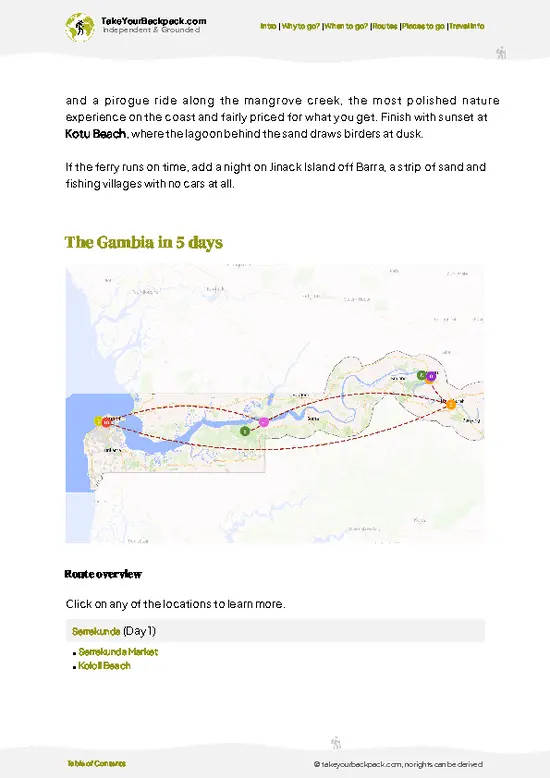
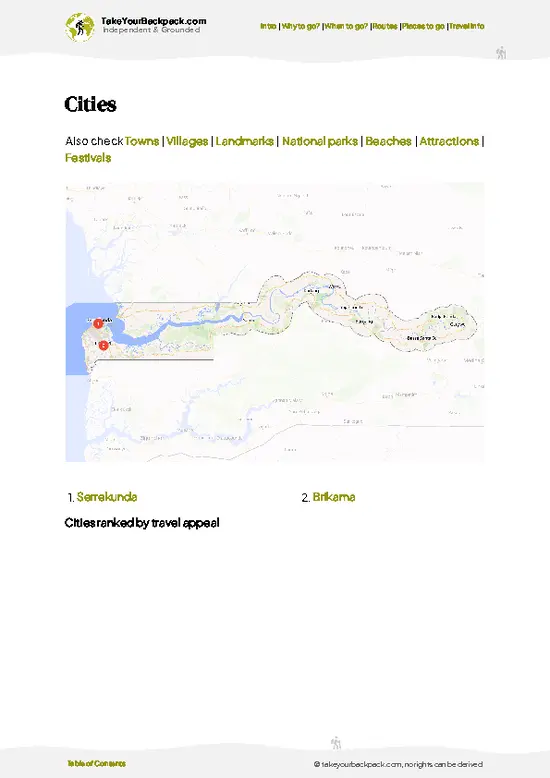
How many cities: I advise visiting three to four places in The Gambia, with one on the coast and one or two upriver. Roads are slow, heat saps energy by midday, and each town rewards a few unhurried hours in the market, on the riverbank or over a plate of domoda. More than that and you spend the trip in the back of a minibus.
Which kind to prioritize: Choose the coast if you want hot showers, reliable food, beach time and easy day trips with guides. Choose upriver towns if you want cheaper, quieter streets, river light at dusk, ferries, kids waving from doorways and a real sense of local routine. Mixing both gives the best balance, with the coast as a soft landing and the river as the real adventure.
What it costs: Budget US$20 to 35 a day, or about 1,400 to 2,500 dalasi, for guesthouse rooms, …
read more 👉 How many cities: I advise visiting three to four places in The Gambia, with one on the coast and one or two upriver. Roads are slow, heat saps energy by midday, and each town rewards a few unhurried hours in the market, on the riverbank or over a plate of domoda. More than that and you spend the trip in the back of a minibus.
Which kind to prioritize: Choose the coast if you want hot showers, reliable food, beach time and easy day trips with guides. Choose upriver towns if you want cheaper, quieter streets, river light at dusk, ferries, kids waving from doorways and a real sense of local routine. Mixing both gives the best balance, with the coast as a soft landing and the river as the real adventure.
What it costs: Budget US$20 to 35 a day, or about 1,400 to 2,500 dalasi, for guesthouse rooms, street meals of rice and fish at roughly 60 to 150 dalasi, and shared taxis of about 50 to 300 dalasi per hop. Midrange comfort runs US$45 to 80. Local guides typically charge US$10 to 25 for a half day, museum or heritage-site entries are usually a few dollars, and boat or ferry trips run from a few dollars to US$30 or more for private hires.
Safety and culture: Petty theft and persistent touts, known locally as bumsters, are the main nuisance on the coast. A calm, firm greeting works better than ignoring them, and a smile often earns you a friendly chat. Carry small notes, because change is scarce. The country is mostly Muslim, so cover shoulders and knees in towns, ask before photographing people, and avoid public displays of affection. Same-sex relations are illegal, so discretion matters. Drink bottled or filtered water, take malaria prevention, and avoid walking dark, unlit streets, where power cuts leave everything pitch black.

 Best Backpacking
 Hi, I’m Johan (Netherlands 🇳🇱), the creator of TakeYourBackpack. Over the past 3 decades, I’ve backpacked through 90+ countries across six continents, gaining extensive experience with independent travel, long-term trips, and overland routes.