×

Ghana🇬🇭 | townsAximFort St. Anthony, Atlantic beaches, Nzulezo gateway | things to do and best time to go

Explore KintampoExplore Denu

Backpacking in Axim
🏆 Top picktown ranked #3
By Johan Kruseman 🇳🇱 | Updated October 22, 2026

Axim is not the beach resort some summaries make it sound like. It is a working fishing port, and the surf-and-hammock scene most backpackers want is 20 km east in Busua. Axim sits on the Gulf of Guinea in Ghana’s Western Region, about 65 km west of Takoradi on the road to the Ivorian border at Elubo. Expect woodsmoke, drying fish, diesel from outboard motors and a 500-year-old fort glowing ochre at sunset. Transport is easy because shared taxis and tro-tros run the coastal road all day. Don’t wait for a full vehicle at the Takoradi station after 3 PM; leave by midday. Evenings are quiet, with a few beer spots and almost no other travelers. If you want company, sleep in Busua and visit Axim as a day trip. Axim is more local and less polished than Busua, and far slower than Takoradi.

Discover everything you want to know in the 📖 Ghana Travel Guide.


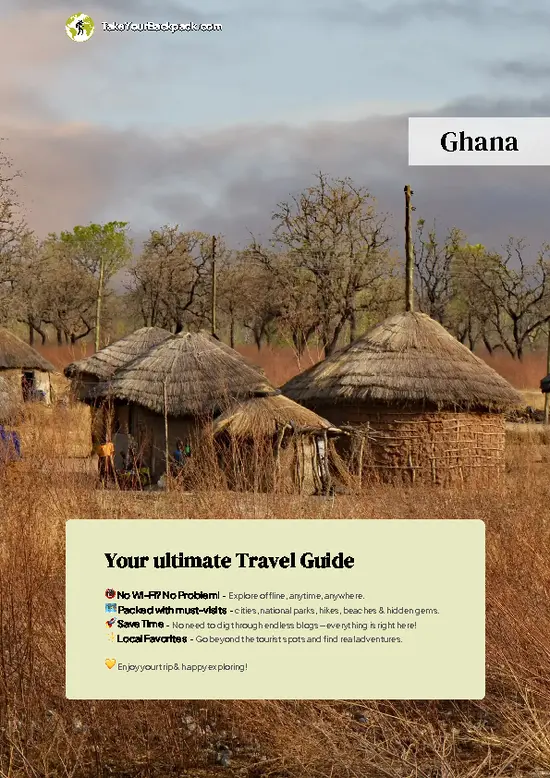
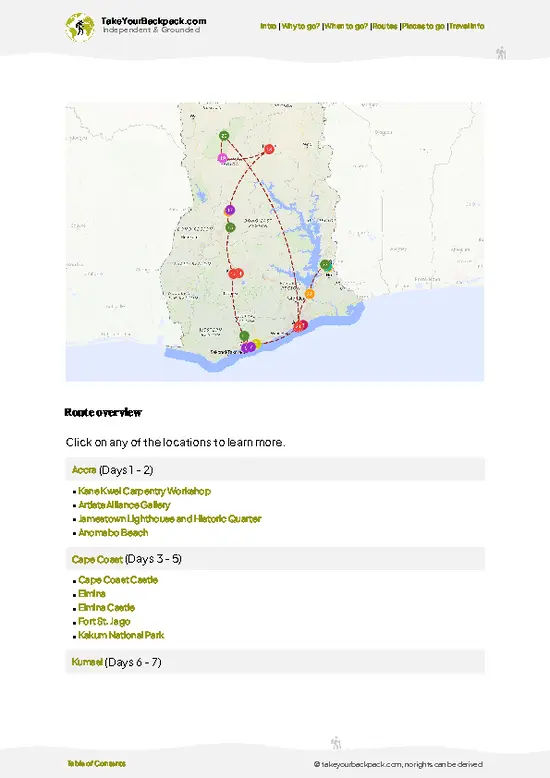
example page 0 from our offline Travel Guide for Ghana
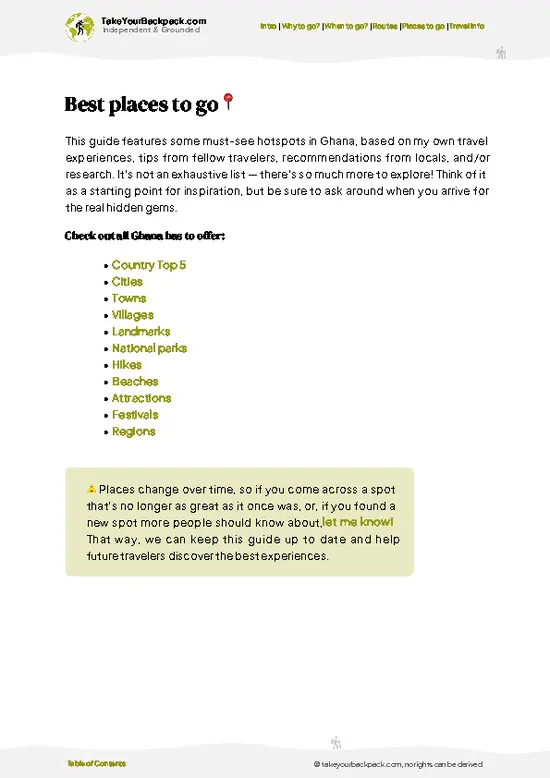
example page 1 from our offline Travel Guide for Ghana
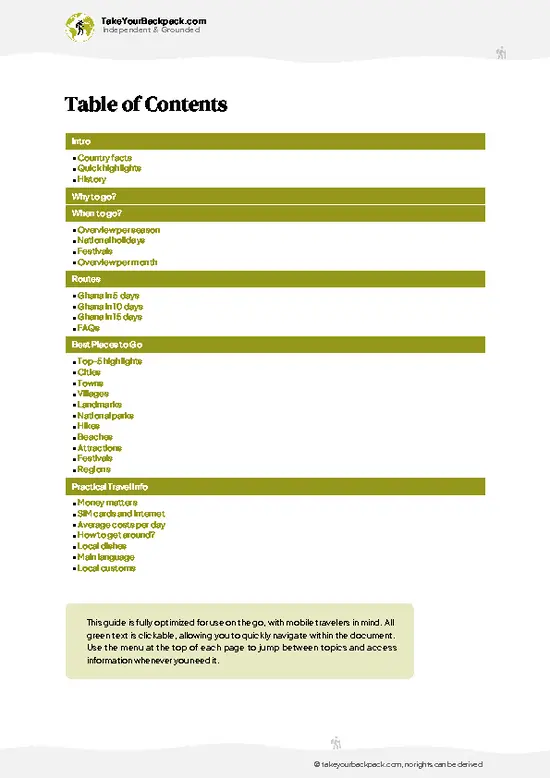
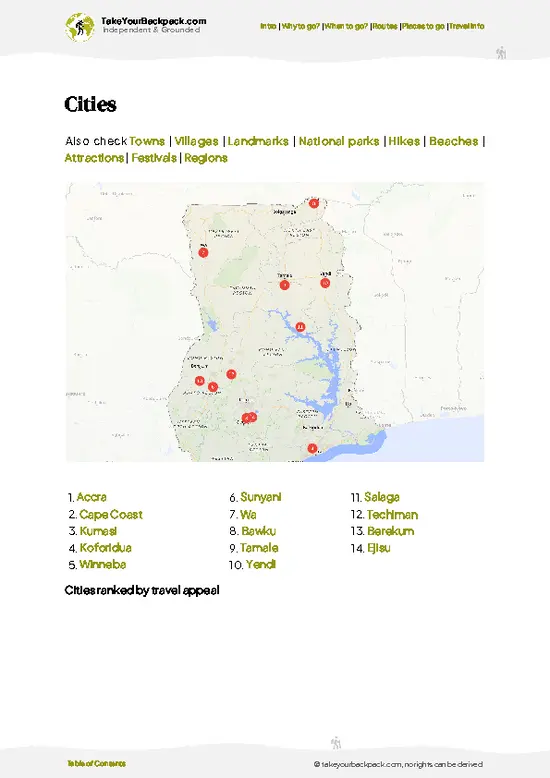
example page 2 from our offline Travel Guide for Ghana
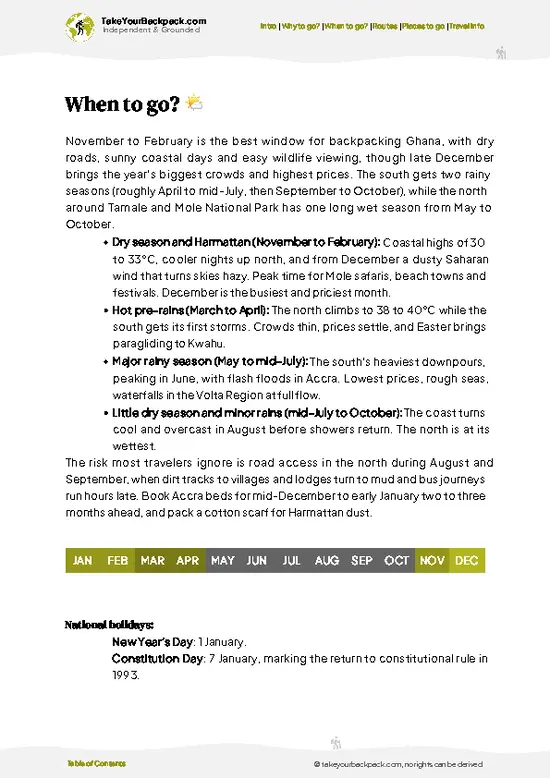
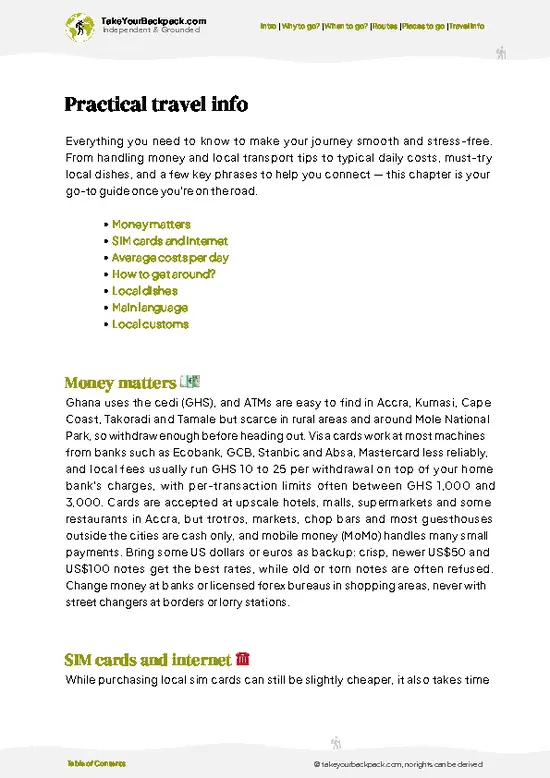
example page 3 from our offline Travel Guide for Ghana
example page 4 from our offline Travel Guide for Ghana
example page 5 from our offline Travel Guide for Ghana
example page 6 from our offline Travel Guide for Ghana
example page 7 from our offline Travel Guide for Ghana
Loading the map 🌍
CLICK TO FILTER
cities
towns
villages
landmarks
national parks
hikes
beaches
attractions
festivals
regions
SHOW COUNTRY’S BESTSHOW ALL

✨ Why go?
Ranked #3 town in Ghana
Why visitors keep coming back

Go to Axim for the fort and for a coastal town that has not rearranged itself around visitors. You can walk from the fishing harbor to the market in minutes, eat grilled fish and banku from a street stall for a few dollars, and watch canoes come in without a single sales pitch. Most travelers give it half a day to one night, usually as a break on the Takoradi to Elubo route or on a loop through the Western Region forts. It also works as a practical base for Ankasa Conservation Area and the stilt village of Nzulezu, since both are closer from here than from Takoradi. It suits slow travelers, history readers and solo travelers who are happy to start conversations themselves. It does not suit anyone who needs hostels, nightlife or a ready-made backpacker crowd. Guesthouses are basic, so carry cash, because ATMs can be unreliable.

💡 HighlightsEssential experiences to have while visiting Axim

  1. Fort San Antonio. Portuguese-built in 1515 and later Dutch and British, it sits on a headland with whitewashed walls, old cannons and views over palms and open sea. It is part of the UNESCO-listed Forts and Castles of Ghana. Go at 8 to 9 AM or around 4:30 PM for softer light. Entry is roughly US$3 to 6 for foreigners, and a guided look takes 45 to 90 minutes.
  2. Axim fishing harbor. Below the fort, painted canoes land their catch, nets are mended and women haggle over crates of fish. Early morning, 6 to 8 AM, is the busiest. It is free to watch, though a small tip for photographing people is polite. Allow 30 to 60 minutes.
  3. Axim beach. The town beach is a place for walking and watching the surf, not for casual swimming, because currents are strong and rocks lie close to shore. Late afternoon is
… read more 👉
  1. Fort San Antonio. Portuguese-built in 1515 and later Dutch and British, it sits on a headland with whitewashed walls, old cannons and views over palms and open sea. It is part of the UNESCO-listed Forts and Castles of Ghana. Go at 8 to 9 AM or around 4:30 PM for softer light. Entry is roughly US$3 to 6 for foreigners, and a guided look takes 45 to 90 minutes.
  2. Axim fishing harbor. Below the fort, painted canoes land their catch, nets are mended and women haggle over crates of fish. Early morning, 6 to 8 AM, is the busiest. It is free to watch, though a small tip for photographing people is polite. Allow 30 to 60 minutes.
  3. Axim beach. The town beach is a place for walking and watching the surf, not for casual swimming, because currents are strong and rocks lie close to shore. Late afternoon is best, with fishermen working the shore. It costs nothing and 1 hour is plenty.
  4. Axim market. Here you find smoked fish, cassava, plantain, palm oil, coconuts and cheap cloth. Go before noon, when stalls are full. A snack lunch costs about US$2 to 5. Plan 45 to 60 minutes and keep small notes handy.
  5. Fort-side lanes and old town. The streets behind the harbor hold weathered colonial-era buildings, small chop bars and neighbors who will chat. Walk them in the cooler late afternoon. It is free and takes about 1 hour.
For day trips, I would pick Busua first for its surf and beach shacks 20 km east, while Butre Fort, Princes Town and the Ankasa forest are also within reach. Nzulezu, the stilt village near Beyin, is the one I would add if you have a second day.
Spotted a mistake or missing something? Contact us.

Things to do near Axim

Ratings based on Tripadvisor reviews. When you book through this link, you support our work at no extra cost to you.

🏘️ NeighborhoodsKey areas and districts to know

Axim is small enough to cover on foot in a day, and each corner has its own rhythm, from fort-top breezes to the clatter of the fish landing.
  • Fort St. Anthony and the headland: A 1515 Portuguese fort sits on a rocky point, its whitewashed walls glaring in midday sun and the Atlantic booming against the rocks below. Go at 7 to 8 a.m. or near sunset when the light turns the stone gold. Entry is a few cedis, and a local guide on site is worth paying for the stories about the cannons and dungeons. Walkable from the center in 10 minutes.
  • Old Town and the fishing harbor: Narrow lanes drop to the canoe beach, where the air is thick with smoke from fish-curing racks and diesel from outboards. Mornings are loudest, as catches come in and women haggle over buckets of tuna and sardines. Look for grilled
… read more 👉
Axim is small enough to cover on foot in a day, and each corner has its own rhythm, from fort-top breezes to the clatter of the fish landing.
  • Fort St. Anthony and the headland: A 1515 Portuguese fort sits on a rocky point, its whitewashed walls glaring in midday sun and the Atlantic booming against the rocks below. Go at 7 to 8 a.m. or near sunset when the light turns the stone gold. Entry is a few cedis, and a local guide on site is worth paying for the stories about the cannons and dungeons. Walkable from the center in 10 minutes.
  • Old Town and the fishing harbor: Narrow lanes drop to the canoe beach, where the air is thick with smoke from fish-curing racks and diesel from outboards. Mornings are loudest, as catches come in and women haggle over buckets of tuna and sardines. Look for grilled fish with kenkey and pepper sauce at plastic-table stalls. Mind the slippery, muddy ground, and ask before photographing people.
  • Town center and market: Along the main road, tro-tro vans honk, vendors sell plantain chips and cold sachet water, and chop bars serve banku, fufu and light soup. Dense and dusty, but you can cross it in 15 minutes. Nightlife means a few spot bars with loud highlife and cold Club beer, and it quiets down by 10 p.m.
  • Axim Beach: A long curve of palm-fringed sand with a few beach bars, reached by a short walk or a cheap taxi. Swim with care, as currents can be strong. It is the place for slow afternoons, fresh coconut and grilled lobster or fish when the kitchens have catch. After dark it is dim and mostly empty, so travel by taxi.

⌛️ 1 dayA smart one-day plan

Axim rewards a slow day: one fort, one harbor, one market and plenty of sea air.
6:30 AM, Fishing harbor: Arrive as canoes land the catch. Watch the sorting and bargaining, buy a fresh bread and tea breakfast from a stall nearby, then walk uphill to the fort.
8:30 AM, Fort San Antonio: The light is soft and the heat has not arrived. Take a guided visit of 45 to 90 minutes, climb the ramparts for the coast view, and pay the entry fee, roughly US$3 to 6.
10:30 AM, Axim market: It is a short walk from the fort. Browse smoked fish, plantain and cloth stalls, and buy coconut water for the next stretch.
12:30 PM, Lunch at a chop bar: Order grilled fish with banku or fried yam with pepper sauce for about US$2 to 5. Rest through the hottest hours.
2:30 PM, Canoe-building beach (off the standard route): … read more 👉
Axim rewards a slow day: one fort, one harbor, one market and plenty of sea air.
6:30 AM, Fishing harbor: Arrive as canoes land the catch. Watch the sorting and bargaining, buy a fresh bread and tea breakfast from a stall nearby, then walk uphill to the fort.
8:30 AM, Fort San Antonio: The light is soft and the heat has not arrived. Take a guided visit of 45 to 90 minutes, climb the ramparts for the coast view, and pay the entry fee, roughly US$3 to 6.
10:30 AM, Axim market: It is a short walk from the fort. Browse smoked fish, plantain and cloth stalls, and buy coconut water for the next stretch.
12:30 PM, Lunch at a chop bar: Order grilled fish with banku or fried yam with pepper sauce for about US$2 to 5. Rest through the hottest hours.
2:30 PM, Canoe-building beach (off the standard route): Walk along the shore past the harbor, where fishermen repair boats and mend nets. Ask before photographing, and expect curious chats rather than sales pitches.
4:30 PM, Old town lanes: Wander the quiet backstreets behind the harbor, look at the weathered colonial-era buildings and greet people as you pass.
6:00 PM, Sunset at the fort: Return to the headland as the light turns amber and fishermen head out. Finish with a cold beer or soft drink at a local spot, then head to your guesthouse.

🌤️ When to go?Seasonal considerations and timing

The best months for Axim are November to March, when the main dry season brings less rain and the most comfortable beach days.
  • Dry Season (November to March): Highs of 30 to 32°C (86 to 90°F), lows around 23°C (73°F), with hazy harmattan skies some years. Roads are easiest and the sea calmest. Sunrise is around 6 a.m. and sunset near 6 p.m. year-round, as it sits close to the equator.
  • Major Rainy Season (April to July): Axim is among the wettest places in Ghana. Expect heavy downpours, humid air, and temperatures of 24 to 30°C (75 to 86°F). Dirt roads turn muddy, and boat trips may be canceled. Rooms are easier to bargain for.
  • Short Dry Spell (August): Cooler at 23 to 28°C (73 to 82°F), with lighter showers and few visitors.
  • Minor Rains (September to October): Showers return but are shorter and
… read more 👉
The best months for Axim are November to March, when the main dry season brings less rain and the most comfortable beach days.
  • Dry Season (November to March): Highs of 30 to 32°C (86 to 90°F), lows around 23°C (73°F), with hazy harmattan skies some years. Roads are easiest and the sea calmest. Sunrise is around 6 a.m. and sunset near 6 p.m. year-round, as it sits close to the equator.
  • Major Rainy Season (April to July): Axim is among the wettest places in Ghana. Expect heavy downpours, humid air, and temperatures of 24 to 30°C (75 to 86°F). Dirt roads turn muddy, and boat trips may be canceled. Rooms are easier to bargain for.
  • Short Dry Spell (August): Cooler at 23 to 28°C (73 to 82°F), with lighter showers and few visitors.
  • Minor Rains (September to October): Showers return but are shorter and more scattered.
  • Christmas and Easter: Ghanaians and returning diaspora fill beach rooms and prices rise.
Book ahead for late December, but arrive in January for calmer weather and better rates.


source: climatestotravel.comJANJanuary: excellent for travelingFEBFebruary: excellent for travelingMARMarch: highly recommended for travelingAPRApril: fair for travelingMAYMay: fair for travelingJUNJune: fair for travelingJULJuly: good for travelingAUGAugust: good for travelingSEPSeptember: fair for travelingOCTOctober: fair for travelingNOVNovember: highly recommended for travelingDECDecember: excellent for traveling
ghana-city-axim
© Google |

✈️ The backpacker research shortcutGhana Travel Guide

An offline-friendly backpacking guide with optimized travel routes, ranked highlights, transport advice, and the best areas to stay.
example page 0 from our offline Travel Guide for Ghana
example page 1 from our offline Travel Guide for Ghana
example page 2 from our offline Travel Guide for Ghana
example page 3 from our offline Travel Guide for Ghana
example page 4 from our offline Travel Guide for Ghana
example page 5 from our offline Travel Guide for Ghana
example page 6 from our offline Travel Guide for Ghana
example page 7 from our offline Travel Guide for Ghana
The digital guide (321 pages) contains:
✅ 105 highlights, ranked by travel appeal
✅ Optimized 5, 10 & 15-day travel routes
✅ Cities, national parks, landmarks, beaches
✅ How to get around
✅ Offline-friendly for travel without Wi-Fi
👉 Click to see all 30+ guide features

📅 Plan smarter in minutes, not weeks
✅ Month by month travel advice
✅ Festivals & national holidays
✅ Budget expectations

🗺️ Go to the right places, skip the overrated ones
✅ Honest pros & cons of destinations
✅ Top hikes, parks & viewpoints
✅ Lesser-known places most travelers miss
✅ Clear “worth it vs skip it” guidance

🛏️ Travel smoothly without rookie mistakes
✅ Best areas to stay
✅ Transport systems explained simply
✅ Common scams & safety advice
✅ SIM cards, money & practical tips

🌍 Understand the country, not just visit it
✅ Culture & traditions
✅ 52 Essential phrases & customs
✅ Festivals worth planning around
✅ Traveler-friendly historical context
✅ Insights that make places more meaningful

📱 Built for real travel conditions
✅ Fully downloadable PDF
✅ Works completely offline
✅ Optimized for phone use
✅ Useful in remote areas & buses
✅ Everything in one place
Stop searching, start planning
Get instant access to your full guide. 30‑day money-back guarantee.
+ Add another guide for just

By proceeding you agree to our terms.
Sent to your inbox immediately after payment • 100% Secure Checkout
Best Backpacking Travel Advisor 2025 tourism awardBest Backpacking
Travel Advisor
2025
What others say about Take Your Backpack Guides:
⭐⭐⭐⭐⭐
Fantastic, amazing amount of information!
⭐⭐⭐⭐⭐
My goodness this is amazing, it's what I've been looking for hats off too you!
⭐⭐⭐⭐⭐
I think this is absolutely BRILLIANT
⭐⭐⭐⭐
Very complete and informative. It's still missing places, but I gotta to commend you
⭐⭐⭐⭐⭐
This is truly amazing, thank you, can't wait to explore it with my kids!
⭐⭐⭐⭐⭐
Awesome resource, thank you!
⭐⭐⭐⭐⭐
This is amazing! Can't wait to explore the ones I haven't seen
⭐⭐⭐⭐
I love this! Well done, great idea.
⭐⭐⭐⭐⭐
Thanks for taking the time to make this gem!
⭐⭐⭐⭐⭐
This might be the best website I've ever seen.
⭐⭐⭐⭐⭐
Congratulations, and thank you so much for your work; it's incredibly valuable.
⭐⭐⭐⭐
In all seriousness I think you did a great job pointing out the important spots
⭐⭐⭐⭐⭐
10/10 very good
⭐⭐⭐⭐⭐
As someone who's only just starting to visit regularly this is awesome, thank you.
⭐⭐⭐⭐
Thank you very much! I'm going to visit my dad, it's going to be very useful!
⭐⭐⭐⭐⭐
This is really cool! We'll be travelling for the first time and this definitely come in handy.
⭐⭐⭐⭐⭐
You are now our minister of culture, congratulations 👨‍💼
⭐⭐⭐⭐⭐
Just wanted to tell you that this is a pearl! Going to follow your recommendations.
⭐⭐⭐⭐⭐
This is so cool. I'll definitely be using the resource for my travels soon.
⭐⭐⭐⭐⭐
This is very impressive! Good work.
⭐⭐⭐⭐⭐
This is an amazing and informative site. Very well done!

🛏️ Where to stay?Choosing the right base

The best area for a budget stay in Axim is the town center near the main road, with Axim Beach as a quieter second choice.
The center has the most guesthouses and simple budget rooms, and it sits within walking distance of the market, chop bars, ATMs and the tro-tro station. Dorm beds are rare in Axim, so most backpackers book a basic private room with a fan, often with a shared or cold-water bathroom. This is why you should expect to pay for a room rather than a bunk, and why traveling as a pair saves money. Noise is the trade-off: horns, generators, church services and music can start before … read more 👉
The best area for a budget stay in Axim is the town center near the main road, with Axim Beach as a quieter second choice.
The center has the most guesthouses and simple budget rooms, and it sits within walking distance of the market, chop bars, ATMs and the tro-tro station. Dorm beds are rare in Axim, so most backpackers book a basic private room with a fan, often with a shared or cold-water bathroom. This is why you should expect to pay for a room rather than a bunk, and why traveling as a pair saves money. Noise is the trade-off: horns, generators, church services and music can start before sunrise, so bring earplugs and ask for a room at the back. Walking in the center after dark is generally fine in the early evening, and transport links are the best here.
Axim Beach has a handful of guesthouses and eco-style lodges within earshot of the surf, which makes for better sleep and sea breezes. The downside is distance from town, a short taxi ride, and limited late-night food and transport. Few places have reliable air conditioning, so a fan and a mosquito net matter more than anything else. Book ahead at Christmas and Easter, when rooms fill.

🚌 Getting aroundHow to get from A to B

From the tro-tro and bus station in Axim, the town center is a flat 5 to 10 minute walk, or a shared taxi for a few cedis if you carry a heavy pack. The town is compact, the road is loud with horns and diesel, and public transport is frequent but loosely scheduled.
  • Walking: Free and the smartest way to see the fort, market and harbor, since the lanes are too narrow for vehicles. Go early, before the heat hits around 10 a.m., and wear closed shoes because the harbor mud is slick and uneven. At night, take a taxi instead of walking dark stretches.
  • Shared taxis: These run set routes along the main road for roughly GHS 3 to 6 per seat. They leave when full, so expect a squeeze of four passengers in the back, which is how they keep fares low. Ask the driver if the route reaches your destination before
… read more 👉
From the tro-tro and bus station in Axim, the town center is a flat 5 to 10 minute walk, or a shared taxi for a few cedis if you carry a heavy pack. The town is compact, the road is loud with horns and diesel, and public transport is frequent but loosely scheduled.
  • Walking: Free and the smartest way to see the fort, market and harbor, since the lanes are too narrow for vehicles. Go early, before the heat hits around 10 a.m., and wear closed shoes because the harbor mud is slick and uneven. At night, take a taxi instead of walking dark stretches.
  • Shared taxis: These run set routes along the main road for roughly GHS 3 to 6 per seat. They leave when full, so expect a squeeze of four passengers in the back, which is how they keep fares low. Ask the driver if the route reaches your destination before getting in.
  • Private taxi (charter): A short ride costs about GHS 15 to 40, with beach trips at the higher end. Prices are not metered, so agree on the fare before you sit down. Locals ask a guesthouse or shop owner what the going rate is first, then negotiate.
  • Tro-tro and buses: Minivans to Takoradi (about 2 to 3 hours, roughly GHS 40 to 60) and Elubo leave from the station from dawn until mid-afternoon. They depart only when packed, so arrive by 7 or 8 a.m. to avoid waiting. Services thin out after about 4 p.m., and you do not want to be stuck.
  • Motorbike taxis (okada): Quick and cheap for short hops, about GHS 5 to 15, though they can be risky on wet roads. Most travelers pick shared taxis for reliability, and always ask for a helmet.

👛 Costs (as of 22 October 2026)How expensive it really is

Axim costs a backpacker roughly US$27 to 53 a day, with beds and fresh fish both cheaper than in Accra or Cape Coast. Prices are paid in cedis, and the figures below are converted to US dollars.
CategoryBudget RangeLocal Reality
Dorm accommodationUS$10 to 18Dorms are scarce, so most travelers take a basic private room or a beach guesthouse bed, with fans and sometimes no hot water.
MealsUS$8 to 14Rice or banku with fish or chicken costs US$2 to 4 at a roadside spot, and grilled lobster or barracuda runs higher at beach restaurants.
Local transportUS$2 to 5Shared trotros and short taxi hops are cheap, and a private taxi costs more for longer runs.
Basic activities/entry feesUS$4 to 10Fort St. Anthony entry is a few dollars, and a canoe or guide for local sights adds a little.
Miscellaneous expensesUS$3
… read more 👉
Axim costs a backpacker roughly US$27 to 53 a day, with beds and fresh fish both cheaper than in Accra or Cape Coast. Prices are paid in cedis, and the figures below are converted to US dollars.
CategoryBudget RangeLocal Reality
Dorm accommodationUS$10 to 18Dorms are scarce, so most travelers take a basic private room or a beach guesthouse bed, with fans and sometimes no hot water.
MealsUS$8 to 14Rice or banku with fish or chicken costs US$2 to 4 at a roadside spot, and grilled lobster or barracuda runs higher at beach restaurants.
Local transportUS$2 to 5Shared trotros and short taxi hops are cheap, and a private taxi costs more for longer runs.
Basic activities/entry feesUS$4 to 10Fort St. Anthony entry is a few dollars, and a canoe or guide for local sights adds a little.
Miscellaneous expensesUS$3 to 6Water, SIM data, snacks and a cold drink in the evening.
Total Daily BudgetUS$27 to 53About US$40 is a comfortable middle figure.
Buy fish straight from the canoes at the landing or from market vendors, and eat your biggest meal at lunch when prices are lowest.
⚠️ Prices can change and everyone travels differently, so take this as a rough guide. Hope it helps you plan your adventure!

🚌 Day tripsWhere to go beyond the main area

Axim sits in the far southwest of Ghana's coast, so day trips here mean beaches, forts and rainforest edge, all reachable by shared minibus (trotro) or a hired taxi in a morning.
Nzulezo Stilt Village:
This village of wooden houses on stilts over Lake Tadane is the headline trip. Allow a full day: roughly 1.5 to 2 hours by road to Beyin, then a 40 to 60 minute paddle in a dugout canoe along a narrow channel lined with raffia palms. Budget US$25 to 45 including transport, the entry and guide fee and the canoe. The dry months from November to March keep the channel easy and the road passable. First-timers often arrive after midday and rush it, so leave Axim early.
👉 Explore Nzulezo
Beyin and Fort Apollonia:
Combine this with Nzulezo, since Beyin is the launch point. The whitewashed fort now holds … read more 👉
Axim sits in the far southwest of Ghana's coast, so day trips here mean beaches, forts and rainforest edge, all reachable by shared minibus (trotro) or a hired taxi in a morning.
Nzulezo Stilt Village:
This village of wooden houses on stilts over Lake Tadane is the headline trip. Allow a full day: roughly 1.5 to 2 hours by road to Beyin, then a 40 to 60 minute paddle in a dugout canoe along a narrow channel lined with raffia palms. Budget US$25 to 45 including transport, the entry and guide fee and the canoe. The dry months from November to March keep the channel easy and the road passable. First-timers often arrive after midday and rush it, so leave Axim early.
👉 Explore Nzulezo
Beyin and Fort Apollonia:
Combine this with Nzulezo, since Beyin is the launch point. The whitewashed fort now holds a small museum on the Nzema people and the region's trade history, and the beach beside it is mostly empty, with fishing canoes pulled onto the sand. Entry is about US$3 to 5. Skip a separate taxi and share one for both stops.

Busua Beach:
Busua is the area's surf and hangout beach, with a long curved bay, reggae bars and board rentals. Count on 1.5 to 2 hours each way via Takoradi or a connecting trotro, and US$10 to 20 for transport plus a surf lesson or board rental at US$10 to 25. Waves are best from roughly April to October, though the sea is swimmable most of the year. Many people underestimate the return journey, and the last trotros thin out by late afternoon.
👉 Explore Busua Beach
Ankasa Conservation Area:
This protected rainforest inland has towering trees, forest elephants and a huge bird and butterfly list, though sightings take patience. Expect about 2 to 3 hours by road each way, so it suits an early start and a hired driver, with a total of US$50 to 90 shared between travelers. The drier season from December to February gives easier tracks. Book a guide at the gate, because the trails are hard to follow alone.
👉 Explore Ankasa Conservation Area

🛡️ SafetyScams, Hazards, and Annoyances

Axim is a calm, friendly small town where most visitors feel at ease, and the main issues are petty ones. Keep phones and cash out of sight in the market and at the harbor, where crowds are tight, and carry small cedi notes so you do not flash a wallet. Walk in the center until early evening, then take a taxi to and from the beach or quieter outskirts, since streets are poorly lit. Solo travelers, including women, usually find people welcoming, though persistent questions and marriage jokes are common and a polite, firm smile works. Agree taxi and boat prices before leaving, and ask a guesthouse for the usual fare to avoid overcharging. Guides at the fort and lake may ask for a larger tip, but it is fine to pay what was agreed. Swim carefully because of strong currents, and use mosquito nets and repellent.

FAQCommon questions from travelers

Axim is worth a short visit rather than a long stay. Fort San Antonio, dating from 1515, and the working fishing harbor are the real draws, and both can be seen in half a day. Busua, 20 km east, is better for swimming and meeting other travelers.
One night is enough, and a full day covers the highlights. Spend the morning at the fort and harbor and the afternoon at the market and beach. Add one or two more days only if you plan trips to Ankasa Conservation Area or the stilt village of Nzulezu.
Yes, Axim works as a day trip from Takoradi, about 65 km east. Shared taxis and tro-tros take roughly 1.5 to 2 hours each way, with fares of about GH¢ 30 to 60. Leave before 9 AM and head back by 4 PM, as vehicles thin out toward evening.
⚠️ Things can change over time, so always validate details locally before you go.

Other Ghanaian towns near Axim

Explore more nearby:

  • Elmina—St. George’s Castle, fishing harbor, Portuguese-built| 103 km away
  • Nkawkaw—Kwahu escarpment, railway junction, hillside roads| 248 km away
  • Mampong-Akuapem—Akuapem ridge, cool hills, Aburi road| 260 km away

💡 Not sure where to go next?
Create a personalized itinerary for Ghana including Axim and the places that fit your trip.

Generate my itinerary

👉 Discover all towns

Or checkout all Ghana has to offer (think cities, towns, villages, national parks, hikes, beaches, festivals)
Country photo of Ghana

We 💚 feedbackSumming up the experience

Axim’s big win is the fort, quiet enough that you may have the ramparts to yourself while fishermen work below. The drawback is simple: it is thin on traveler infrastructure. Guesthouses are basic, evenings are sleepy and ATMs can fail. Visit with cash, patience and curiosity, and use nearby Busua if you want company.

✈️ When did I visit Ghana?
Ghana I visited in December 2024, starting in Accra following the coast, then up north to Mole National park to finish in the Volta Region.

✍️ Help improve this page!
The information on this page is based on my own backpacking experience in Ghana, supplemented with up-to-date research and feedback from other travelers. Travel details can change, so if you notice anything outdated or incomplete, feel free to let me know.


🙋‍♂️ Give feedback

👋 Meet the founderWho’s Behind Take Your Backpack?

Johan, backpacker and founder of TakeYourBackpackHi, I’m Johan (Netherlands 🇳🇱), the creator of TakeYourBackpack. Over the past 3 decades, I’ve backpacked through 90+ countries across six continents, gaining extensive experience with independent travel, long-term trips, and overland routes.

This site is built on a combination of firsthand travel experience and carefully curated insights from other backpackers. Many guides are based on places I’ve personally visited, while others bring together tips, observations, and practical advice shared by trusted travelers I’ve met along the way.

The goal is to provide realistic, experience-driven guidance — not generic itineraries — so you can explore destinations with better context, clearer expectations, and more confidence.