×

Ghana🇬🇭 | best townsExplore the 10 Best towns in Ghana

Ghana’s towns run on red laterite dust, charcoal smoke and the thump of a mortar pounding fufu. In the south, coastal towns mean salt air, fishing canoes and crumbling colonial forts, with the most visitors and the highest prices. Inland, the Ashanti and Eastern hills are humid, green and loud with trotro horns. The north is drier, quieter and cheaper, with mud-walled architecture and Harmattan haze. Independent travel works well because shared minibuses link nearly everything, though roads are slow and potholed. Pick by mood: beach, forest or savanna.

By Johan Kruseman 🇳🇱 | Updated October 23, 2026
Explore the best villages in Ghana

Why go?Understanding Their Importance

Ghana suits town-hopping because its history is written into its settlements. Centuries of Atlantic trade left European forts and castles along a coastline of about 550 kilometers, while the inland Ashanti kingdom shaped market towns, chieftaincy and craft traditions that are still active. Chiefs, festivals and kente weaving are living institutions, not museum pieces, so a town stop often means drumming drifting over a tin roof or a funeral procession in red and black cloth.

Geography splits the country into distinct climates and cultures: wet, humid forest in the south and center, then dry savanna in the north with Islamic influence and clay architecture. English is widely spoken, the cedi is stable enough for easy budgeting, and the country is among the more stable and welcoming in West … read more 👉
Ghana suits town-hopping because its history is written into its settlements. Centuries of Atlantic trade left European forts and castles along a coastline of about 550 kilometers, while the inland Ashanti kingdom shaped market towns, chieftaincy and craft traditions that are still active. Chiefs, festivals and kente weaving are living institutions, not museum pieces, so a town stop often means drumming drifting over a tin roof or a funeral procession in red and black cloth.

Geography splits the country into distinct climates and cultures: wet, humid forest in the south and center, then dry savanna in the north with Islamic influence and clay architecture. English is widely spoken, the cedi is stable enough for easy budgeting, and the country is among the more stable and welcoming in West Africa.

Before choosing Ghana, know that infrastructure is uneven. Intercity travel is by trotro and shared buses that leave only when full, power cuts happen, and heat sits heavy at midday. Towns are working places, not polished attractions, so expect noise, dust, bargaining and the smell of frying plantain on every corner. Patience pays back with warm greetings and very little tourist fatigue.
How the List Was Created
The list of best towns in Ghana is created based on charm, local culture, atmosphere, hidden gems, and visitor appeal. If you feel a town is missing in this list, please let us know.

When to go?Optimal Periods for Travel

Best months: The best months for Ghana’s towns are November to March, when the dry season brings sunshine, lower humidity and passable roads. Daytime temperatures in the south sit around 30 to 33°C, while the north can top 38 to 40°C by March. From December to February the Harmattan wind carries Saharan dust, turning the sky a pale, milky gray, cooling the nights in the north to roughly 15 to 20°C and cutting visibility for photography.
Shoulder and rainy seasons: The south has two rainy seasons: the heavy one runs April to July (the coast around Accra gets 700 to 800 mm a year, the southwest far more), with a shorter burst in September to October. Red roads turn to slick mud, and trotros slow to a crawl. Mid-August often brings a drier lull. The north has a single rainy season from roughly … read more 👉
Best months: The best months for Ghana’s towns are November to March, when the dry season brings sunshine, lower humidity and passable roads. Daytime temperatures in the south sit around 30 to 33°C, while the north can top 38 to 40°C by March. From December to February the Harmattan wind carries Saharan dust, turning the sky a pale, milky gray, cooling the nights in the north to roughly 15 to 20°C and cutting visibility for photography.
Shoulder and rainy seasons: The south has two rainy seasons: the heavy one runs April to July (the coast around Accra gets 700 to 800 mm a year, the southwest far more), with a shorter burst in September to October. Red roads turn to slick mud, and trotros slow to a crawl. Mid-August often brings a drier lull. The north has a single rainy season from roughly May to September, with fierce afternoon storms and lush green fields.
Crowds and prices: Peak pressure falls around Christmas and New Year, when diaspora visitors fill coastal guesthouses and rates can rise 20 to 50 percent. Book ahead then. Festival weeks, such as those held in different towns through the year, can also sell out rooms. Rainy months bring lower rates and quiet streets.

town hoppingSuggested Travel Strategies

Pacing and direction: A trip linking several Ghanaian towns needs 10 to 16 days, and 14 gives room to breathe. The country is long rather than wide, so the logical shape is a line: Accra and the coast first, then inland through Kumasi and the central forest, then north via Tamale if time allows. Start in the south to get used to the heat and humidity, and finish in the dry, slower north. Flying out of Accra afterward means a loop back, so consider a domestic flight from Tamale (about 1 hour).
Time per stop and between regions: Allow two nights per town as a minimum, three where there are forts, forest walks or festivals to fit in. Coast to Kumasi takes roughly 4 to 6 hours by road from Accra, Kumasi to Tamale about 6 to 8 hours by bus, and Accra to Tamale 10 to 12 hours. Coastal towns between … read more 👉
Pacing and direction: A trip linking several Ghanaian towns needs 10 to 16 days, and 14 gives room to breathe. The country is long rather than wide, so the logical shape is a line: Accra and the coast first, then inland through Kumasi and the central forest, then north via Tamale if time allows. Start in the south to get used to the heat and humidity, and finish in the dry, slower north. Flying out of Accra afterward means a loop back, so consider a domestic flight from Tamale (about 1 hour).
Time per stop and between regions: Allow two nights per town as a minimum, three where there are forts, forest walks or festivals to fit in. Coast to Kumasi takes roughly 4 to 6 hours by road from Accra, Kumasi to Tamale about 6 to 8 hours by bus, and Accra to Tamale 10 to 12 hours. Coastal towns between Cape Coast and Takoradi are only 1 to 3 hours apart.
Planning mistakes: The classic error is cramming too many towns in, forgetting that shared vehicles wait to fill and that heat saps midday energy. Travel early, ideally before 8 a.m., when the air is cooler and roads emptier. Another is trusting a map’s distances: potholes and checkpoints stretch every leg. Keep one flexible buffer day per week and book long northern buses a day ahead.

The ListThe Best towns of Ghana

1 Elmina

St. George’s Castle, fishing harbor, Portuguese-built

Climb the ramparts of a 1482 trading castle, then drop to the harbor where painted canoes land the morning catch.

ghana-city-elmina
© Google |

2 Akosombo

Volta Dam, lake cruises, Atimpoku bridge

Tour the hydroelectric dam that created Lake Volta, then board a boat from the nearby jetty for shoreline villages and open water.

3 Axim

Fort St. Anthony, Atlantic beaches, Nzulezo gateway

Walk up to an 18th-century Dutch fort above the sea, then use the town as a launch point for stilt-village trips.

ghana-city-axim
© Google |

4 Kintampo

Kintampo Falls, middle-belt junction, Fuller Falls

Break the long road between Kumasi and Tamale at a junction town with cascades, forest picnic spots and roadside food stalls.

ghana-city-kintampo
© Google |

5 Paga

Sacred crocodiles, Pio’s palace, border trade, pito

Crouch beside semi-tame crocodiles in a sacred pond, then tour a mud-walled Kassena palace and sip pito near the Burkina Faso frontier.

6 Ho

Volta capital, Wli Falls, Mount Adaklu

Plan waterfall and hill excursions from a regional capital with a lively market, plain guesthouses and frequent minibuses to the surrounding villages.

7 Amedzofe

Mountain-ridge village, Mount Gemi cross, forest waterfall, mission church

Climb to a hilltop cross above the Togo border, then follow a forest path to a waterfall before mist lifts off the valleys.

ghana-city-amedzofe
© Google |

8 Keta

Sea defense wall, Keta Lagoon, Fort Prinzenstein

Follow a thin sand spit between ocean and lagoon to ruined colonial fortifications and eroded streets reclaimed by waves.

9 Bolgatanga

Basket weaving, Sirigu pottery, Paga crocodiles

Base a day trip loop around woven baskets, painted compound houses, leather work and crocodile ponds close to the Burkina Faso border.

10 Tongo

Tengzug shrines, granite boulders, Talensi compounds, pito calabashes

Follow a local guide through Talensi compounds to shrines wedged among granite boulders, with millet fields and baobabs spread below.

11 Damongo

Gonja chieftaincy, shea market, tuo zaafi, laterite lanes

Browse sacks of shea nuts and smoked locust beans at the morning market, then pay a courtesy call near the chief’s palace.

12 Nkawkaw

Highway junction, lorry station, Kwahu Scarp, tilapia chop bars

Break the Accra to Kumasi journey among yam sellers and shouting tro-tro mates, with the green Kwahu Scarp rising behind the rooftops.

13 Sogakope

Volta crossing, canoe landings, boat rides, banku and tilapia

Drift past reed banks and fishing canoes on the Volta, then eat grilled tilapia with banku at a riverside chop bar.

14 Kpandu

Volta lakeshore, Ewe markets, ferry crossings

Catch a lake ferry or browse stalls selling kente, fresh fish and produce in an Ewe trading town on the Volta shore.

15 Somanya

Krobo beads, lorry-park hub, Krobo hills, Dipo season

Watch glass beads poured into clay molds and fired by Krobo makers, then catch late light on the ridge above town.

16 Akwamufie

Volta riverbanks, Adomi area, quiet farmland

Stop at a small Eastern Region river settlement near the Volta, where paddling, fishing canoes and farm lanes set a slow pace.

17 Mampong-Akuapem

Kente looms, Okuapemhene palace, ridge viewpoints, Basel Mission quarter

Watch weavers build narrow kente strips in family compounds, then look out over the valley toward the Volta basin from the ridge edge.

18 Nalerigu

Nayiri palace, escarpment paths, Mamprusi market, Damba drums

Meet the courtyards of the Mamprusi paramount chief, then walk the escarpment edge for views across savanna and baobabs.

19 Denu

Togo border, Aflao road, lagoon fishing

Cross toward the Togo frontier through a Volta Region coastal town of fish smokers, salt flats and busy shared taxis.

20 Bimbilla

Dagomba chiefdom, Northern crossroads, Guinea fowl market

Visit a Dagomba town of the Northern Region to see chieftaincy traditions, weekly trading and everyday life far from the coast.

21 Daboya

White Volta, indigo cloth, smock weaving

Watch dyers and weavers produce traditional cloth beside the White Volta, in a riverside town reached by long, rough northern roads.

Think you know Ghana?

Prove you’re a true local — uncover 11 lesser-known towns in Ghana that locals tend to keep to themselves.
Loading the map 🌍

Expert viewExpert Commentary on towns

How many towns to visit: Plan on four to six towns in two weeks, and three or four in a week. Ghana’s travel days are long, with rattling trotros, waiting for seats to fill and the smell of diesel and fried dough at every station, so each extra town costs half a day. Staying two or three nights lets you actually reach the market at dawn, hear the evening drumming or sit down to a plate of banku with grilled tilapia, rather than just collecting names.
Choosing the kind of town: Coastal towns suit those who want history, beaches and easy social scenes: salty breezes, hostels with hammocks and fort tours at sunset. Inland Ashanti and forest towns reward craft and culture seekers, with weaving villages, markets and palace traditions, though they are hotter and louder. Northern towns suit travelers … read more 👉
How many towns to visit: Plan on four to six towns in two weeks, and three or four in a week. Ghana’s travel days are long, with rattling trotros, waiting for seats to fill and the smell of diesel and fried dough at every station, so each extra town costs half a day. Staying two or three nights lets you actually reach the market at dawn, hear the evening drumming or sit down to a plate of banku with grilled tilapia, rather than just collecting names.
Choosing the kind of town: Coastal towns suit those who want history, beaches and easy social scenes: salty breezes, hostels with hammocks and fort tours at sunset. Inland Ashanti and forest towns reward craft and culture seekers, with weaving villages, markets and palace traditions, though they are hotter and louder. Northern towns suit travelers who want quiet, mud architecture and wildlife access, with long dusty drives and big skies. First-timers should lean south; repeat visitors can go north.
What it costs: A backpacker can manage on US$25 to 45 a day (roughly GH¢300 to 550): dorm beds or basic rooms at US$10 to 25, street meals such as waakye or jollof at US$2 to 4, and trotro rides at US$1 to 6 depending on distance. Fort and heritage site entries usually run US$3 to 15 for foreigners. A local guide for a town walk or craft visit is typically US$5 to 20, and a motorbike or taxi hop around town US$1 to 4. Long buses between regions cost US$8 to 20. Tips and small gifts at craft workshops are appreciated.
Safety and etiquette: Ghana is considered one of West Africa’s safer countries, and towns feel relaxed by day. Petty theft happens in crowded stations and markets, so keep phones in a front pocket. After dark, take a taxi rather than walking unlit roads, where potholes are as much a hazard as anything. Malaria is present nationwide, so bring repellent and discuss prophylaxis with a doctor, and drink bottled or sachet water.

Culturally, greet first. Walking into a shop or home without a “good morning” reads as rude, and a handshake with a snap of the fingers is common. Use your right hand for eating, passing money and handing items. Ask before photographing people, shrines or funerals, and dress modestly in northern Muslim towns and at palaces. Remove hats and sandals when asked at chiefs’ courts. Respect for elders earns open doors, shared stools and plates piled with food.

✈️ The backpacker research shortcutGhana Travel Guide

An offline-friendly backpacking guide with optimized travel routes, ranked highlights, transport advice, and the best areas to stay.
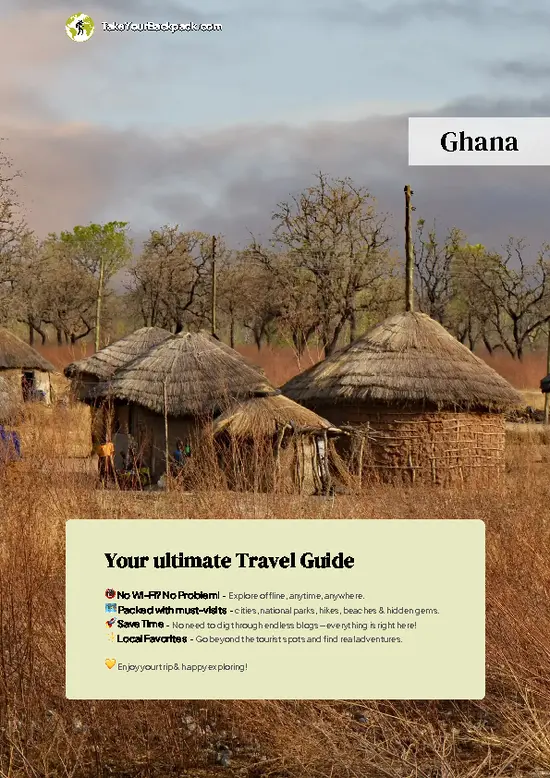
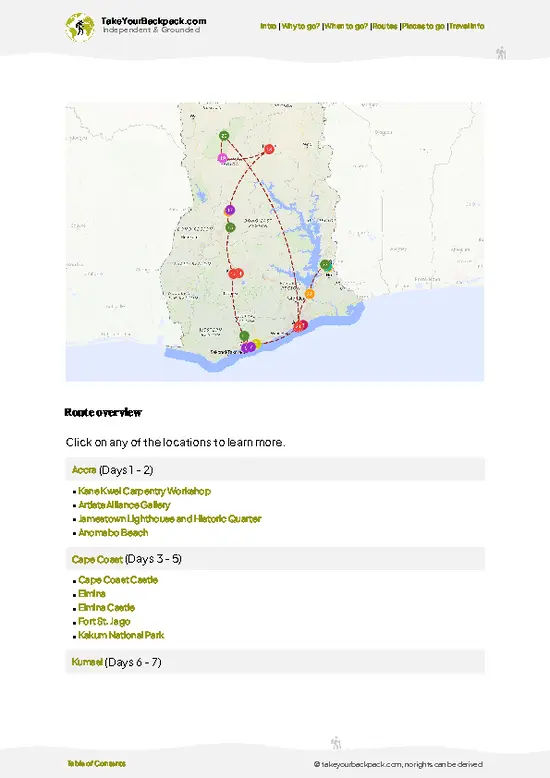
example page 0 from our offline Travel Guide for Ghana
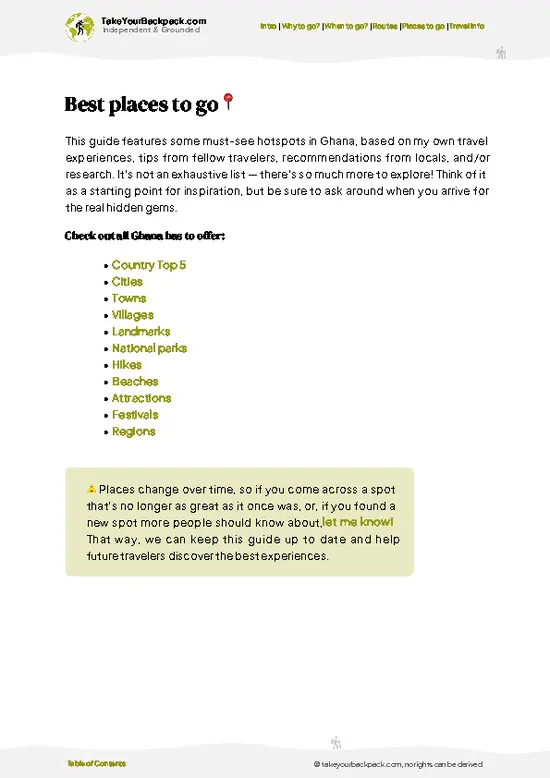
example page 1 from our offline Travel Guide for Ghana
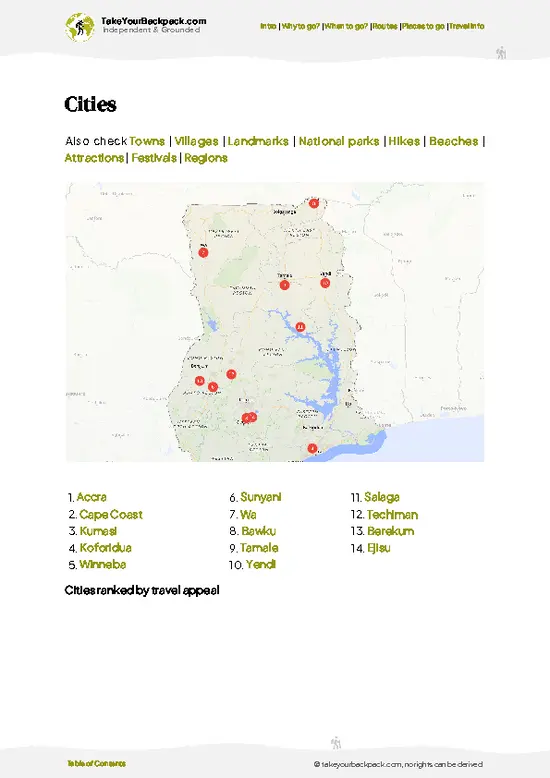
example page 2 from our offline Travel Guide for Ghana
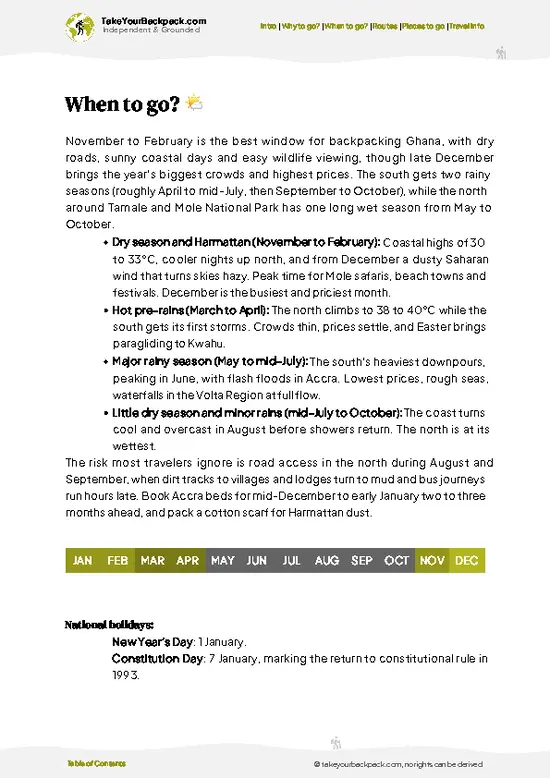
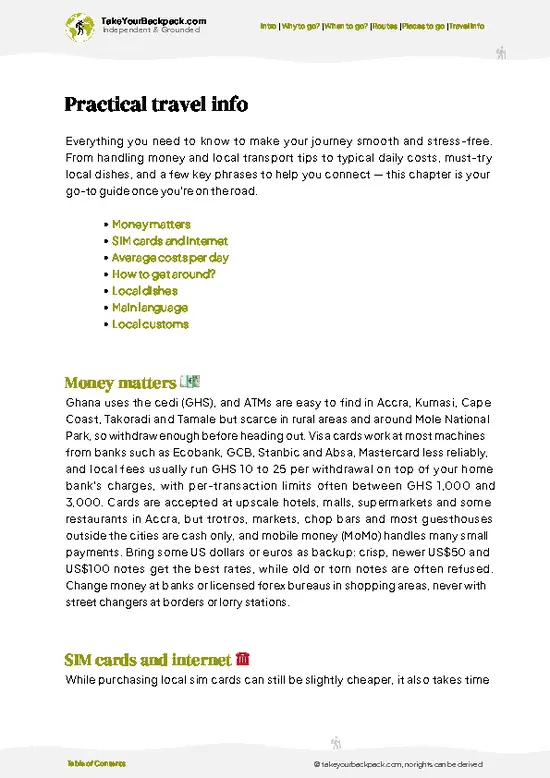
example page 3 from our offline Travel Guide for Ghana
example page 4 from our offline Travel Guide for Ghana
example page 5 from our offline Travel Guide for Ghana
example page 6 from our offline Travel Guide for Ghana
example page 7 from our offline Travel Guide for Ghana
The digital guide (321 pages) contains:
✅ 105 highlights, ranked by travel appeal
✅ Optimized 5, 10 & 15-day travel routes
✅ Cities, national parks, landmarks, beaches
✅ How to get around
✅ Offline-friendly for travel without Wi-Fi
👉 Click to see all 30+ guide features

📅 Plan smarter in minutes, not weeks
✅ Month by month travel advice
✅ Festivals & national holidays
✅ Budget expectations

🗺️ Go to the right places, skip the overrated ones
✅ Honest pros & cons of destinations
✅ Top hikes, parks & viewpoints
✅ Lesser-known places most travelers miss
✅ Clear “worth it vs skip it” guidance

🛏️ Travel smoothly without rookie mistakes
✅ Best areas to stay
✅ Transport systems explained simply
✅ Common scams & safety advice
✅ SIM cards, money & practical tips

🌍 Understand the country, not just visit it
✅ Culture & traditions
✅ 52 Essential phrases & customs
✅ Festivals worth planning around
✅ Traveler-friendly historical context
✅ Insights that make places more meaningful

📱 Built for real travel conditions
✅ Fully downloadable PDF
✅ Works completely offline
✅ Optimized for phone use
✅ Useful in remote areas & buses
✅ Everything in one place
Stop searching, start planning
Get instant access to your full guide. 30‑day money-back guarantee.
+ Add another guide for just

By proceeding you agree to our terms.
Sent to your inbox immediately after payment • 100% Secure Checkout
Best Backpacking Travel Advisor 2025 tourism awardBest Backpacking
Travel Advisor
2025
What others say about Take Your Backpack Guides:
⭐⭐⭐⭐⭐
Fantastic, amazing amount of information!
⭐⭐⭐⭐⭐
My goodness this is amazing, it's what I've been looking for hats off too you!
⭐⭐⭐⭐⭐
I think this is absolutely BRILLIANT
⭐⭐⭐⭐
Very complete and informative. It's still missing places, but I gotta to commend you
⭐⭐⭐⭐⭐
This is truly amazing, thank you, can't wait to explore it with my kids!
⭐⭐⭐⭐⭐
Awesome resource, thank you!
⭐⭐⭐⭐⭐
This is amazing! Can't wait to explore the ones I haven't seen
⭐⭐⭐⭐
I love this! Well done, great idea.
⭐⭐⭐⭐⭐
Thanks for taking the time to make this gem!
⭐⭐⭐⭐⭐
This might be the best website I've ever seen.
⭐⭐⭐⭐⭐
Congratulations, and thank you so much for your work; it's incredibly valuable.
⭐⭐⭐⭐
In all seriousness I think you did a great job pointing out the important spots
⭐⭐⭐⭐⭐
10/10 very good
⭐⭐⭐⭐⭐
As someone who's only just starting to visit regularly this is awesome, thank you.
⭐⭐⭐⭐
Thank you very much! I'm going to visit my dad, it's going to be very useful!
⭐⭐⭐⭐⭐
This is really cool! We'll be travelling for the first time and this definitely come in handy.
⭐⭐⭐⭐⭐
You are now our minister of culture, congratulations 👨‍💼
⭐⭐⭐⭐⭐
Just wanted to tell you that this is a pearl! Going to follow your recommendations.
⭐⭐⭐⭐⭐
This is so cool. I'll definitely be using the resource for my travels soon.
⭐⭐⭐⭐⭐
This is very impressive! Good work.
⭐⭐⭐⭐⭐
This is an amazing and informative site. Very well done!

🛏️ Where to stay?Best Places to Stay in Ghana

Ghana has a modest but growing hostel scene, with dorm beds typically around GH₵150 to 300 (US$12 to 25) and basic guesthouse rooms from about GH₵350 (US$30), concentrated mostly in Accra and along the coast. In Accra, Osu puts you on Oxford Street’s bars, cheap chop bars and late nights but comes with noise and heavy traffic, while East Legon and Airport Residential are quieter, leafier and handy for flights yet far from the action and pricier per night. Elsewhere, beachy Kokrobite west of Accra is laid-back and drum-filled on weekends, Cape Coast keeps you walking distance from the castle and the fishing harbor, and Adum in Kumasi is central and cheap but loud and chaotic around the market. … read more 👉
Ghana has a modest but growing hostel scene, with dorm beds typically around GH₵150 to 300 (US$12 to 25) and basic guesthouse rooms from about GH₵350 (US$30), concentrated mostly in Accra and along the coast. In Accra, Osu puts you on Oxford Street’s bars, cheap chop bars and late nights but comes with noise and heavy traffic, while East Legon and Airport Residential are quieter, leafier and handy for flights yet far from the action and pricier per night. Elsewhere, beachy Kokrobite west of Accra is laid-back and drum-filled on weekends, Cape Coast keeps you walking distance from the castle and the fishing harbor, and Adum in Kumasi is central and cheap but loud and chaotic around the market.

If you enjoy meeting fellow travelers, consider choosing hostels with high ratings for atmosphere. On the other hand, if you prefer having your own space, a hotel might be a better option.

GhanaExplore Ghana

👋 Meet the founderWho’s Behind Take Your Backpack?

Johan, backpacker and founder of TakeYourBackpackHi, I’m Johan (Netherlands 🇳🇱), the creator of TakeYourBackpack. Over the past 3 decades, I’ve backpacked through 90+ countries across six continents, gaining extensive experience with independent travel, long-term trips, and overland routes.

This site is built on a combination of firsthand travel experience and carefully curated insights from other backpackers. Many guides are based on places I’ve personally visited, while others bring together tips, observations, and practical advice shared by trusted travelers I’ve met along the way.

The goal is to provide realistic, experience-driven guidance — not generic itineraries — so you can explore destinations with better context, clearer expectations, and more confidence.