v2.webp)
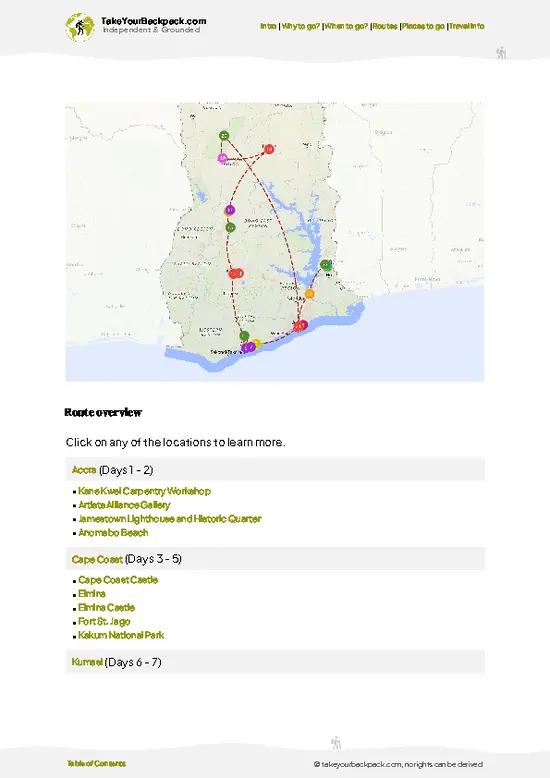
- Bolgatanga Central Market. Trading runs on a three-day cycle, and on the big days the aisles fill with shea butter, dried fish, smocks, calabashes and sacks of millet. Go between 7 and 10 AM, before the heat. Entry is free, and you will need 1 to 2 hours.
- Basket weavers’ workshops. Bolga baskets, woven from tightly bundled straw and dyed in bold colors, are made in family yards and stalls around town, including the Zuarungu side. Watching one take shape shows why prices are fair. Plan 1 hour. Small baskets start around GH¢50, and large market baskets can pass GH¢300. Morning is best, when weavers are working.
- A tuo zaafi lunch. Tuo zaafi is a firm millet or maize dough served with green ayoyo soup, a staple of the north. Chop bars near the market serve it for about GH¢15 to 35. Eat around 12:30
- Bolgatanga Central Market. Trading runs on a three-day cycle, and on the big days the aisles fill with shea butter, dried fish, smocks, calabashes and sacks of millet. Go between 7 and 10 AM, before the heat. Entry is free, and you will need 1 to 2 hours.
- Basket weavers’ workshops. Bolga baskets, woven from tightly bundled straw and dyed in bold colors, are made in family yards and stalls around town, including the Zuarungu side. Watching one take shape shows why prices are fair. Plan 1 hour. Small baskets start around GH¢50, and large market baskets can pass GH¢300. Morning is best, when weavers are working.
- A tuo zaafi lunch. Tuo zaafi is a firm millet or maize dough served with green ayoyo soup, a staple of the north. Chop bars near the market serve it for about GH¢15 to 35. Eat around 12:30 to 2 PM, when everything is freshest, and allow 45 minutes.
- An evening at a pito bar. Pito is a sour, slightly smoky millet beer poured from calabashes, and the bars are social spots where strangers will happily explain it. Expect to pay about GH¢5 to 15 a round. Go around sunset for 1 to 2 hours.
Spotted a mistake or missing something? Contact us.

 Best Backpacking
.jpg) Hi, I’m Johan (Netherlands 🇳🇱), the creator of TakeYourBackpack. Over the past 3 decades, I’ve backpacked through 90+ countries across six continents, gaining extensive experience with independent travel, long-term trips, and overland routes.
Hi, I’m Johan (Netherlands 🇳🇱), the creator of TakeYourBackpack. Over the past 3 decades, I’ve backpacked through 90+ countries across six continents, gaining extensive experience with independent travel, long-term trips, and overland routes.