×

Guinea-Bissau🇬🇼 | townsCacineFar-south river landing, smoked fish, faded arcades, estuary dusk | things to do and best time to go

Explore CacheuExplore Canchungo

Backpacking in Cacine
👀 For curious travelerstown ranked #18
By Johan Kruseman 🇳🇱 | Updated October 22, 2026

Cacine rewards travelers who accept slow logistics: the road south from Bissau is rough and the river ferries keep their own schedule, so you carry water, cash and patience. Cacine sits in the far south of Guinea-Bissau, on the Cacine River, where tidal mud smells of salt and mangrove. Evenings are quiet, with generator hum and cooking smoke, and few other backpackers. Expect basic guesthouses and simple fish meals. Unlike livelier Bubaque, Cacine has no beach scene, only river life.

Discover everything you want to know in the 📖 Guinea-Bissau Travel Guide.


example page 0 from our offline Travel Guide for Guinea-Bissau
example page 1 from our offline Travel Guide for Guinea-Bissau
example page 2 from our offline Travel Guide for Guinea-Bissau
example page 3 from our offline Travel Guide for Guinea-Bissau
example page 4 from our offline Travel Guide for Guinea-Bissau
example page 5 from our offline Travel Guide for Guinea-Bissau
example page 6 from our offline Travel Guide for Guinea-Bissau
example page 7 from our offline Travel Guide for Guinea-Bissau
Loading the map 🌍
CLICK TO FILTER
cities
towns
national parks
beaches
attractions
festivals
regions
SHOW COUNTRY’S BESTSHOW ALL

✨ Why go?
Ranked #18 town in Guinea-Bissau
The unique appeal for travelers

Cacine suits slow travelers who want the deep south of Guinea-Bissau without any tourist infrastructure. The draw is the river: pirogues leave from the waterfront, and the mangrove channels and the edge of Cantanhez National Park are within reach. Guesthouses are tiny and the market is small, so you eat what fishermen land. Most people stay a night or two, and solo travelers who speak some Portuguese or Kriol will get the most from the Cacine River waterfront. Anyone needing nightlife or comforts should skip it.

💡 HighlightsPlaces and moments you shouldn't skip

  1. Cacine River waterfront and port: The town sits on the river that carries its name, and the landing is where pirogues and small cargo boats unload fish, rice and cashew sacks. Come early in the morning, when the catch arrives and the air is still cool. Free, 45 minutes to 1 hour.
  2. Cacine market: A compact open-air market of cassava, palm oil, dried fish, peppers and secondhand clothes under tin roofs and tarps. Go before late morning, before the heat flattens the trade. Entry is free, and a basic snack costs about €0.50 to 1. Allow 45 minutes.
  3. Old colonial buildings along the main street: A few faded Portuguese-era administrative buildings with peeling pastel walls and arcades survive in the center. Late afternoon gives the softest light for photos. Free, about 30 to 45 minutes on foot.
  4. Fishing
… read more 👉
  1. Cacine River waterfront and port: The town sits on the river that carries its name, and the landing is where pirogues and small cargo boats unload fish, rice and cashew sacks. Come early in the morning, when the catch arrives and the air is still cool. Free, 45 minutes to 1 hour.
  2. Cacine market: A compact open-air market of cassava, palm oil, dried fish, peppers and secondhand clothes under tin roofs and tarps. Go before late morning, before the heat flattens the trade. Entry is free, and a basic snack costs about €0.50 to 1. Allow 45 minutes.
  3. Old colonial buildings along the main street: A few faded Portuguese-era administrative buildings with peeling pastel walls and arcades survive in the center. Late afternoon gives the softest light for photos. Free, about 30 to 45 minutes on foot.
  4. Fishing quarter by the riverbank: Smoking racks, drying nets and wooden boats under repair make this the most lived-in corner of town. Greet people first and ask before taking photos. Free, 30 to 45 minutes, best in the morning.
  5. Sunset on the estuary shore: The river widens toward mangroves, and the flat water turns orange and pink while boats head home. Mosquitoes arrive with dusk, so bring repellent. Free, about 45 minutes.
For day trips, Cacine's surroundings include the mangrove creeks of the Cacine estuary and the forest edge of Cantanhez National Park to the north, both reached with local transport or a hired boat. All five stops fit comfortably into one unhurried day of roughly four to five hours of actual visiting.
Spotted a mistake or missing something? Contact us.

🏘️ NeighborhoodsNeighborhood guide to Cacine

Cacine is small enough to walk end to end in under an hour, so think of it as a few distinct zones rather than districts. Distances look short, but midday heat makes them feel long, so you walk early or after the sun drops.
  • Port and riverfront: The Cacine River is the town’s working edge. Pirogues unload, fish is smoked on racks, and the air is muddy and salty. Come at dawn when boats land, because the quay goes quiet by midday.
  • Market area: Stalls of rice, cashews, palm oil and dried fish sit around the main road. It is loud and dusty, and most vendors prefer cash in small notes, so carry change.
  • Upper town and administrative streets: Wide red-dirt streets, a few government buildings and shaded courtyards. Quiet at night apart from generators and radios. Evenings mean a plastic chair, a cold
… read more 👉
Cacine is small enough to walk end to end in under an hour, so think of it as a few distinct zones rather than districts. Distances look short, but midday heat makes them feel long, so you walk early or after the sun drops.
  • Port and riverfront: The Cacine River is the town’s working edge. Pirogues unload, fish is smoked on racks, and the air is muddy and salty. Come at dawn when boats land, because the quay goes quiet by midday.
  • Market area: Stalls of rice, cashews, palm oil and dried fish sit around the main road. It is loud and dusty, and most vendors prefer cash in small notes, so carry change.
  • Upper town and administrative streets: Wide red-dirt streets, a few government buildings and shaded courtyards. Quiet at night apart from generators and radios. Evenings mean a plastic chair, a cold drink and little else, since nightlife is minimal.

⌛️ 1 daySeeing the highlights in 24 hours

A slow river day, built around water and food. 7:00 AM, Waterfront: Watch pirogues unload the night’s catch in soft light, and have coffee and bread nearby. Walk to the market afterward.
9:00 AM, Market: Browse fish stalls and cashew sellers, and buy fruit for later. Chat with vendors in Portuguese or Kriol.
10:30 AM, Colonial center: Wander the old administrative buildings on foot, a short stroll from the market.
1:00 PM, Fish lunch: Eat grilled fish and rice at a simple local spot, then rest through the heat.
3:30 PM, Mangrove channels: Hire a boatman off the standard route for the tide-fed creeks, quiet and full of birds.
6:00 PM, Riverbank: Return as the cooking fires start and finish with a sit by the water.

🌤️ When to go?When to go for the best experience

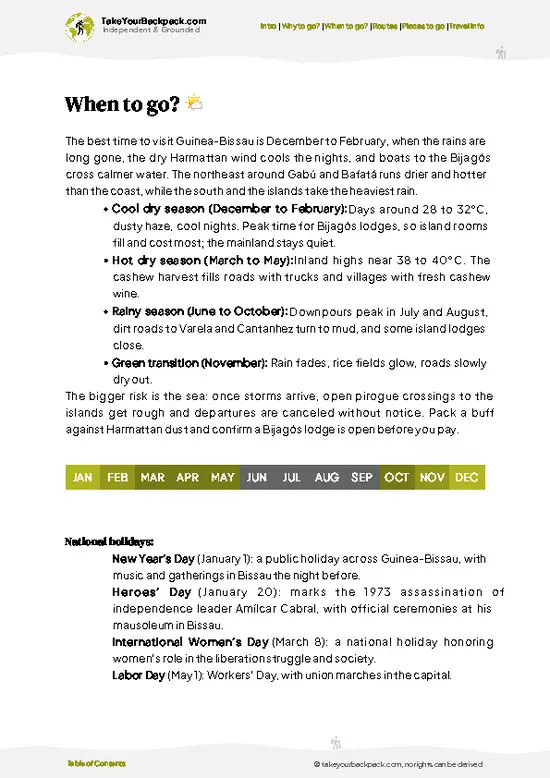
  • Dry season (November to May): Mostly sunny, around 24 to 35°C (75 to 95°F), with roads passable and boats running easily. Harmattan haze can dull the light in January and February.
  • Rainy season (June to October): Heavy downpours, humid heat of 24 to 32°C (75 to 90°F), flooded tracks and few visitors. Prices for transport can rise when roads are bad.
Daylight stays close to 11 to 13 hours year-round. Travel in December or January, when the roads are firm and the heat is gentler.

source: climatestotravel.comJANJanuary: excellent for travelingFEBFebruary: excellent for travelingMARMarch: excellent for travelingAPRApril: excellent for travelingMAYMay: highly recommended for travelingJUNJune: fair for travelingJULJuly: fair for travelingAUGAugust: fair for travelingSEPSeptember: fair for travelingOCTOctober: fair for travelingNOVNovember: highly recommended for travelingDECDecember: excellent for traveling
when-to-go

✈️ The backpacker research shortcutGuinea-Bissau Travel Guide

An offline-friendly backpacking guide with optimized travel routes, ranked highlights, transport advice, and the best areas to stay.
example page 0 from our offline Travel Guide for Guinea-Bissau
example page 1 from our offline Travel Guide for Guinea-Bissau
example page 2 from our offline Travel Guide for Guinea-Bissau
example page 3 from our offline Travel Guide for Guinea-Bissau
example page 4 from our offline Travel Guide for Guinea-Bissau
example page 5 from our offline Travel Guide for Guinea-Bissau
example page 6 from our offline Travel Guide for Guinea-Bissau
example page 7 from our offline Travel Guide for Guinea-Bissau
The digital guide (214 pages) contains:
✅ 48 highlights, ranked by travel appeal
✅ Optimized 2, 3 & 5-day travel routes
✅ Cities, national parks, landmarks, beaches
✅ How to get around
✅ Offline-friendly for travel without Wi-Fi
👉 Click to see all 30+ guide features

📅 Plan smarter in minutes, not weeks
✅ Month by month travel advice
✅ Festivals & national holidays
✅ Budget expectations

🗺️ Go to the right places, skip the overrated ones
✅ Honest pros & cons of destinations
✅ Top hikes, parks & viewpoints
✅ Lesser-known places most travelers miss
✅ Clear “worth it vs skip it” guidance

🛏️ Travel smoothly without rookie mistakes
✅ Best areas to stay
✅ Transport systems explained simply
✅ Common scams & safety advice
✅ SIM cards, money & practical tips

🌍 Understand the country, not just visit it
✅ Culture & traditions
✅ 52 Essential phrases & customs
✅ Festivals worth planning around
✅ Traveler-friendly historical context
✅ Insights that make places more meaningful

📱 Built for real travel conditions
✅ Fully downloadable PDF
✅ Works completely offline
✅ Optimized for phone use
✅ Useful in remote areas & buses
✅ Everything in one place
Stop searching, start planning
Get instant access to your full guide. 30‑day money-back guarantee.
+ Add another guide for just

By proceeding you agree to our terms.
Sent to your inbox immediately after payment • 100% Secure Checkout
Best Backpacking Travel Advisor 2025 tourism awardBest Backpacking
Travel Advisor
2025
What others say about Take Your Backpack Guides:
⭐⭐⭐⭐⭐
Fantastic, amazing amount of information!
⭐⭐⭐⭐⭐
My goodness this is amazing, it's what I've been looking for hats off too you!
⭐⭐⭐⭐⭐
I think this is absolutely BRILLIANT
⭐⭐⭐⭐
Very complete and informative. It's still missing places, but I gotta to commend you
⭐⭐⭐⭐⭐
This is truly amazing, thank you, can't wait to explore it with my kids!
⭐⭐⭐⭐⭐
Awesome resource, thank you!
⭐⭐⭐⭐⭐
This is amazing! Can't wait to explore the ones I haven't seen
⭐⭐⭐⭐
I love this! Well done, great idea.
⭐⭐⭐⭐⭐
Thanks for taking the time to make this gem!
⭐⭐⭐⭐⭐
This might be the best website I've ever seen.
⭐⭐⭐⭐⭐
Congratulations, and thank you so much for your work; it's incredibly valuable.
⭐⭐⭐⭐
In all seriousness I think you did a great job pointing out the important spots
⭐⭐⭐⭐⭐
10/10 very good
⭐⭐⭐⭐⭐
As someone who's only just starting to visit regularly this is awesome, thank you.
⭐⭐⭐⭐
Thank you very much! I'm going to visit my dad, it's going to be very useful!
⭐⭐⭐⭐⭐
This is really cool! We'll be travelling for the first time and this definitely come in handy.
⭐⭐⭐⭐⭐
You are now our minister of culture, congratulations 👨‍💼
⭐⭐⭐⭐⭐
Just wanted to tell you that this is a pearl! Going to follow your recommendations.
⭐⭐⭐⭐⭐
This is so cool. I'll definitely be using the resource for my travels soon.
⭐⭐⭐⭐⭐
This is very impressive! Good work.
⭐⭐⭐⭐⭐
This is an amazing and informative site. Very well done!

🛏️ Where to stay?Choosing the right base

The upper town around the main road is the best choice for a budget bed in Cacine, with a handful of simple guesthouses charging roughly €8 to 20 a night. Dorm beds are not a thing here, so expect basic private rooms, often with a fan and bucket-style washing. Streets are calm after dark, and you are within walking distance of the market and the bush taxi pickup. The riverfront area is the alternative if you want early boats, but it is noisier with engines at dawn and fewer rooms. Arrive before dark, since power is often supplied by generator and finding a free room is easier in daylight.

🚌 Getting aroundTransportation options and practical tips

A shared ride in a local motorbike taxi within Cacine costs roughly €0.30 to 0.80, and you pay the driver in cash when you arrive, so keep small coins ready. The town is compact and walkable, but red dust and heat make midday strolls tiring. Public transport is informal and leaves when full, so patience matters more than a timetable.
  • Walking: Free, and the best way to see the market, the port and the main streets. Go early or late, because shade is scarce and the sun is harsh at noon.
  • Motorbike taxi: The default for longer hops or luggage, about €0.30 to 0.80 per ride. Agree the price before you climb on, since there are no meters.
  • Shared bush taxi or minibus: Runs toward Catió and onward routes, often €5 to 12 depending on the destination and road state. It departs only when packed, usually
… read more 👉
A shared ride in a local motorbike taxi within Cacine costs roughly €0.30 to 0.80, and you pay the driver in cash when you arrive, so keep small coins ready. The town is compact and walkable, but red dust and heat make midday strolls tiring. Public transport is informal and leaves when full, so patience matters more than a timetable.
  • Walking: Free, and the best way to see the market, the port and the main streets. Go early or late, because shade is scarce and the sun is harsh at noon.
  • Motorbike taxi: The default for longer hops or luggage, about €0.30 to 0.80 per ride. Agree the price before you climb on, since there are no meters.
  • Shared bush taxi or minibus: Runs toward Catió and onward routes, often €5 to 12 depending on the destination and road state. It departs only when packed, usually in the morning, so arrive early. The rains can double journey time on the dirt sections.
  • Pirogue: Boats along the river and coast cost about €2 to 10 depending on distance. Schedules follow tides and demand, so ask at the port the day before.

👛 Costs (as of 22 October 2026)Money, prices, and spending tips

Cacine costs about €27 a day for a backpacker in high season, since it is a small, cash-based town with few services.
CategoryBudget RangeLocal Reality
Dorm accommodation€8 to 15Simple private rooms in guesthouses; no true dorms
Meals€4 to 7Rice with fish or chicken, street snacks, bread and coffee
Local transport€1 to 3Motorbike taxis and walking
Basic activities/entry fees€2 to 5Boat hire or small guide fees
Miscellaneous expenses€1 to 3Water, phone credit, small tips
Total Daily Budget€27Cash only, paid in local currency
Buy rice meals at the market stalls rather than guesthouses, which saves a few euros each day.

source: worldbank.org
⚠️ Prices can change and everyone travels differently, so take this as a rough guide. Hope it helps you plan your adventure!

🚌 Day tripsEasy escapes and nearby places

Cacine works as a base for short rural and river outings, but infrastructure is thin, so plan with a local guide or driver and start at dawn.Cacheu-style river creeks by pirogue: Hire a pirogue from the port for a half day among mangrove channels and fishing camps. Expect €10 to 25 for the boat, shared if you find others. Go on a rising tide and carry water and sun cover. Many first-timers forget to agree on the return time.
Catió: The nearest larger town sits inland by dirt road, about 2 to 4 hours each way depending on the season. A shared taxi costs around €5 to 12 one way. Go in the dry months, since the road can be nearly impassable after heavy rain, and leave early so you are back before dark.
👉 Explore CatióCantanhez National Park edges: The forest around Cantanhez holds chimpanzees and … read more 👉
Cacine works as a base for short rural and river outings, but infrastructure is thin, so plan with a local guide or driver and start at dawn.Cacheu-style river creeks by pirogue: Hire a pirogue from the port for a half day among mangrove channels and fishing camps. Expect €10 to 25 for the boat, shared if you find others. Go on a rising tide and carry water and sun cover. Many first-timers forget to agree on the return time.
Catió: The nearest larger town sits inland by dirt road, about 2 to 4 hours each way depending on the season. A shared taxi costs around €5 to 12 one way. Go in the dry months, since the road can be nearly impassable after heavy rain, and leave early so you are back before dark.
👉 Explore CatióCantanhez National Park edges: The forest around Cantanhez holds chimpanzees and red colobus monkeys. A day visit is possible with a local guide for roughly €15 to 30 including transport, though sightings are not guaranteed. Dry season is best, and wear long sleeves for insects.

🛡️ SafetyStaying Safe: What Travelers Should Know

Cacine is calm and people are welcoming, with violent crime rare. Petty theft is the main concern, mostly in the busy market, so keep your phone and cash in a front pocket. Walking at night is generally fine on lit main streets, but power cuts leave side lanes dark, so carry a torch and avoid wandering alone. Officials sometimes ask to see documents at checkpoints, so keep a passport copy handy and stay polite. Ask for prices before taking a motorbike taxi to avoid inflated fares. Women traveling solo usually get curiosity rather than hassle.

FAQFrequently asked questions about Cacine

Cacine is worth a visit if you want a quiet river town far from tourist routes, though not for sights alone. The riverfront with its pirogues and smoking fish racks, and nearby mangrove creeks, are the highlights, and Cantanhez National Park lies within reach. Facilities are basic, with rooms around €8 to 20 a night.
Two to three days suit Cacine. One day covers the port, market and town streets, and a second allows a pirogue trip on the river for around €10 to 25. Add a third day for a guided forest outing toward Cantanhez or a slow road journey in or out.
Cacine is too remote for a comfortable day trip from a city like Bissau, since the road journey takes many hours and conditions vary by season. A one-way shared taxi toward Catió costs roughly €5 to 12 and routes depend on road state. Plan at least one overnight in Cacine to make the trip worthwhile.
⚠️ Things can change over time, so always validate details locally before you go.

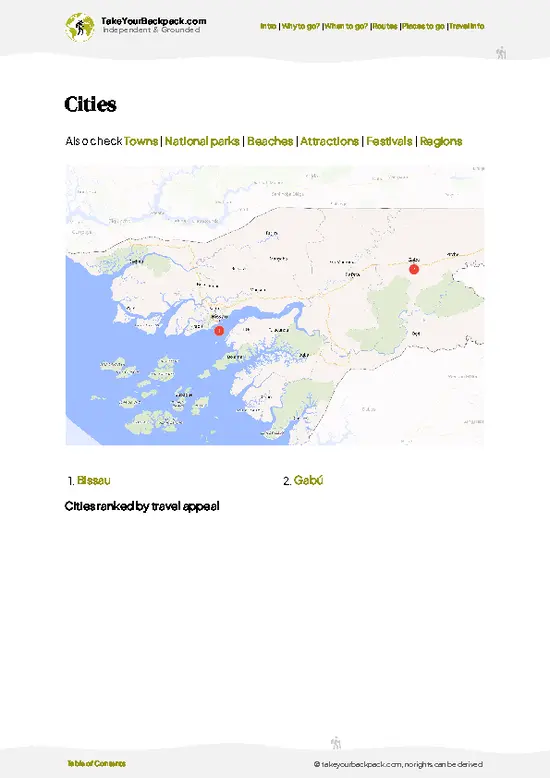
Other Bissau-Guinean towns near Cacine

Explore more nearby:

  • Quebo—savanna edge, weekly market, crossroads village| 26 km away
  • Catió—forest fringe, regional trading post, ethnic diversity| 31 km away
  • Empada—rice fields, small river port, local fishing| 52 km away

💡 Not sure where to go next?
Create a personalized itinerary for Guinea-Bissau including Cacine and the places that fit your trip.

Generate my itinerary

👉 Discover all towns

Or checkout all Guinea-Bissau has to offer (think cities, towns, villages, national parks, hikes, beaches, festivals)
Country photo of Guinea-Bissau

We 💚 feedbackParting advice and final tips

Cacine pairs well with Cantanhez National Park and a night in Catió on a slow southern loop. Bring cash, a headlamp, and snacks, because power and supplies are patchy. I would give it one night, then move on.

✍️ Help improve this page!
The information on this page is based on in-depth research, insights shared by experienced travelers, and feedback from the local travel community in Guinea-Bissau. While every effort is made to keep the information accurate and current, conditions can change — so if you spot anything incorrect or outdated, please get in touch.


🙋‍♂️ Give feedback

👋 Meet the founderWho’s Behind Take Your Backpack?

Johan, backpacker and founder of TakeYourBackpackHi, I’m Johan (Netherlands 🇳🇱), the creator of TakeYourBackpack. Over the past 3 decades, I’ve backpacked through 90+ countries across six continents, gaining extensive experience with independent travel, long-term trips, and overland routes.

This site is built on a combination of firsthand travel experience and carefully curated insights from other backpackers. Many guides are based on places I’ve personally visited, while others bring together tips, observations, and practical advice shared by trusted travelers I’ve met along the way.

The goal is to provide realistic, experience-driven guidance — not generic itineraries — so you can explore destinations with better context, clearer expectations, and more confidence.