

×

Guyana🇬🇾 | attractionsGuyana ZooJaguar enclosure, harpy eagle, capybaras, shaded paths | things to do and best time to go

Explore Guyana National MuseumExplore Umana Yana

Backpacking in Guyana Zoo
👀 For curious travelersattraction ranked #8
By Johan Kruseman 🇳🇱 | Updated October 19, 2026

Most people come to Guyana Zoo to meet the animals they probably won’t spot in the interior: a jaguar pacing behind mesh, harpy eagle, giant anteater, tapir. What gets overlooked is its use as a rehearsal. Ten minutes at the cages teaches you the shapes, colors and sizes before you hunt for them in rainforest. The zoo sits in Guyana’s capital, Georgetown, beside the Botanical Gardens, under tall trees with a damp, leafy smell and macaw screams over the paths. It is small and a bit worn, and enclosures vary. Go in the morning, when the animals are active and the heat is gentler, and carry water. Wildlife nerds and families on a Georgetown layover will like it most. Anyone expecting polished, large-scale habitats won’t.

Discover everything you want to know in the 📖 Guyana Travel Guide.


example page 0 from our offline Travel Guide for Guyana
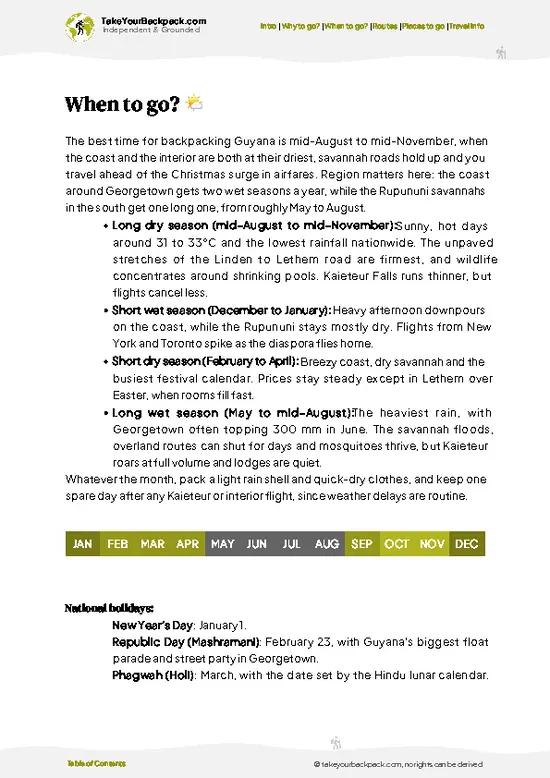
example page 1 from our offline Travel Guide for Guyana
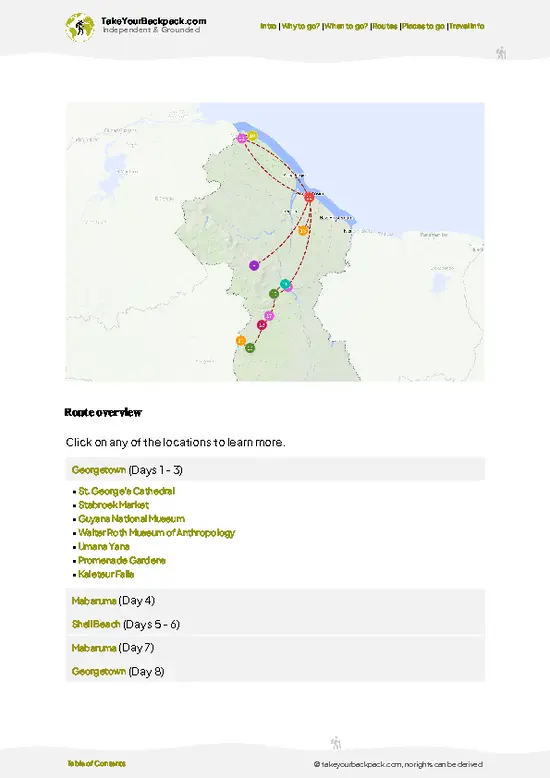
example page 2 from our offline Travel Guide for Guyana
example page 3 from our offline Travel Guide for Guyana
example page 4 from our offline Travel Guide for Guyana
example page 5 from our offline Travel Guide for Guyana
example page 6 from our offline Travel Guide for Guyana
example page 7 from our offline Travel Guide for Guyana
Loading the map 🌍
CLICK TO FILTER
cities
towns
villages
landmarks
national parks
hikes
beaches
attractions
festivals
regions
SHOW COUNTRY’S BESTSHOW ALL

✨ Why go?
Ranked #8 attraction in Guyana
Why Guyana Zoo should be on your travel list

Guyana Zoo is the easiest place in the country to see the animals that make Guyana famous, with no guide, boat or long drive. If your route includes Kaieteur Falls or the Rupununi, a visit here gives you a face-to-face look at a jaguar and the other big names that mostly hide in the forest. It also pairs with the Botanical Gardens next door, so one easy walk covers shade, ponds and cages. And it is a very local outing. On weekends you share the paths with Georgetown families, school groups and kids pointing at the caiman, which tells you plenty about how Guyanese people relate to their own wildlife. Treat it as a short, low-cost warm-up for the wild interior rather than a headline attraction, and you will leave glad you came.

💡 HighlightsDon't-miss highlights and experiences

  1. Jaguar enclosure: The zoo’s star. South America’s largest cat is far easier to see here than in the bush, and the size of its paws and head sinks in.
  2. Harpy eagle: One of the world’s most powerful raptors, with a split crest and talons the size of a hand. Look at it up close.
  3. Giant anteater: A strange, shaggy animal with a long snout and bushy tail, which the keepers’ enclosures let you watch properly.
  4. Tapir: Stocky and surprisingly quiet, with a flexible snout it uses like a short trunk.
  5. Caiman pond: Dark, still water with black caiman and spectacled caiman lying in the sun like logs until one blinks.
  6. Macaws and parrots: Loud, vivid and photogenic, with reds, blues and yellows against the green of the trees.
  7. Capybara area: The world’s largest rodent is calm and often relaxed, and its sociable behavior
… read more 👉
  1. Jaguar enclosure: The zoo’s star. South America’s largest cat is far easier to see here than in the bush, and the size of its paws and head sinks in.
  2. Harpy eagle: One of the world’s most powerful raptors, with a split crest and talons the size of a hand. Look at it up close.
  3. Giant anteater: A strange, shaggy animal with a long snout and bushy tail, which the keepers’ enclosures let you watch properly.
  4. Tapir: Stocky and surprisingly quiet, with a flexible snout it uses like a short trunk.
  5. Caiman pond: Dark, still water with black caiman and spectacled caiman lying in the sun like logs until one blinks.
  6. Macaws and parrots: Loud, vivid and photogenic, with reds, blues and yellows against the green of the trees.
  7. Capybara area: The world’s largest rodent is calm and often relaxed, and its sociable behavior makes it a favorite with kids.
  8. Shaded walking paths: Mature trees from the gardens give the grounds cool pockets and birdsong between enclosures.
If time is short, skip the shaded paths and head straight for the jaguar and the harpy eagle.
Spotted a mistake or missing something? Contact us.

Things to do around Guyana Zoo

Ratings based on Tripadvisor reviews. When you book through this link, you support our work at no extra cost to you.

🌤️ When to go?Best time to visit Guyana Zoo

Guyana Zoo is best visited in the two dry spells, February to April and September to November, when paths stay firm and animals are active.
  • Short Dry Season (Feb to Apr): Highs of 29 to 32°C (84 to 90°F), little mud, and daylight of roughly 12 hours year-round.
  • Long Rains (May to mid-August): Heavy downpours turn the grounds soggy, though showers usually pass within an hour. Temperatures sit near 27 to 31°C (81 to 88°F), and the zoo is quiet on weekdays.
  • Second Dry Season (Sep to Nov): The most comfortable window for walking, with lower humidity and steadier sun.
  • Short Rains (Dec to Jan): Intermittent showers, around 26 to 30°C (79 to 86°F). Local school holidays bring families.
  • Weekends and Holidays: Crowds peak on Sundays and around Easter and Mashramani in February.
Arrive at opening, because … read more 👉
Guyana Zoo is best visited in the two dry spells, February to April and September to November, when paths stay firm and animals are active.
  • Short Dry Season (Feb to Apr): Highs of 29 to 32°C (84 to 90°F), little mud, and daylight of roughly 12 hours year-round.
  • Long Rains (May to mid-August): Heavy downpours turn the grounds soggy, though showers usually pass within an hour. Temperatures sit near 27 to 31°C (81 to 88°F), and the zoo is quiet on weekdays.
  • Second Dry Season (Sep to Nov): The most comfortable window for walking, with lower humidity and steadier sun.
  • Short Rains (Dec to Jan): Intermittent showers, around 26 to 30°C (79 to 86°F). Local school holidays bring families.
  • Weekends and Holidays: Crowds peak on Sundays and around Easter and Mashramani in February.
Arrive at opening, because animals are most active in the cooler morning hours.


source: climatestotravel.comJANJanuary: fair for travelingFEBFebruary: excellent for travelingMARMarch: excellent for travelingAPRApril: highly recommended for travelingMAYMay: fair for travelingJUNJune: fair for travelingJULJuly: fair for travelingAUGAugust: excellent for travelingSEPSeptember: excellent for travelingOCTOctober: excellent for travelingNOVNovember: excellent for travelingDECDecember: fair for traveling
guyana-attraction-guyana-zoo
© Google |

✈️ The backpacker research shortcutGuyana Travel Guide

An offline-friendly backpacking guide with optimized travel routes, ranked highlights, transport advice, and the best areas to stay.
example page 0 from our offline Travel Guide for Guyana
example page 1 from our offline Travel Guide for Guyana
example page 2 from our offline Travel Guide for Guyana
example page 3 from our offline Travel Guide for Guyana
example page 4 from our offline Travel Guide for Guyana
example page 5 from our offline Travel Guide for Guyana
example page 6 from our offline Travel Guide for Guyana
example page 7 from our offline Travel Guide for Guyana
The digital guide (161 pages) contains:
✅ 43 highlights, ranked by travel appeal
✅ Optimized 5, 10 & 15-day travel routes
✅ Cities, national parks, landmarks, beaches
✅ How to get around
✅ Offline-friendly for travel without Wi-Fi
👉 Click to see all 30+ guide features

📅 Plan smarter in minutes, not weeks
✅ Month by month travel advice
✅ Festivals & national holidays
✅ Budget expectations

🗺️ Go to the right places, skip the overrated ones
✅ Honest pros & cons of destinations
✅ Top hikes, parks & viewpoints
✅ Lesser-known places most travelers miss
✅ Clear “worth it vs skip it” guidance

🛏️ Travel smoothly without rookie mistakes
✅ Best areas to stay
✅ Transport systems explained simply
✅ Common scams & safety advice
✅ SIM cards, money & practical tips

🌍 Understand the country, not just visit it
✅ Culture & traditions
✅ Local customs
✅ Festivals worth planning around
✅ Traveler-friendly historical context
✅ Insights that make places more meaningful

📱 Built for real travel conditions
✅ Fully downloadable PDF
✅ Works completely offline
✅ Optimized for phone use
✅ Useful in remote areas & buses
✅ Everything in one place
Stop searching, start planning
Get instant access to your full guide. 30‑day money-back guarantee.
+ Add another guide for just

By proceeding you agree to our terms.
Sent to your inbox immediately after payment • 100% Secure Checkout
Best Backpacking Travel Advisor 2025 tourism awardBest Backpacking
Travel Advisor
2025
What others say about Take Your Backpack Guides:
⭐⭐⭐⭐⭐
Fantastic, amazing amount of information!
⭐⭐⭐⭐⭐
My goodness this is amazing, it's what I've been looking for hats off too you!
⭐⭐⭐⭐⭐
I think this is absolutely BRILLIANT
⭐⭐⭐⭐
Very complete and informative. It's still missing places, but I gotta to commend you
⭐⭐⭐⭐⭐
This is truly amazing, thank you, can't wait to explore it with my kids!
⭐⭐⭐⭐⭐
Awesome resource, thank you!
⭐⭐⭐⭐⭐
This is amazing! Can't wait to explore the ones I haven't seen
⭐⭐⭐⭐
I love this! Well done, great idea.
⭐⭐⭐⭐⭐
Thanks for taking the time to make this gem!
⭐⭐⭐⭐⭐
This might be the best website I've ever seen.
⭐⭐⭐⭐⭐
Congratulations, and thank you so much for your work; it's incredibly valuable.
⭐⭐⭐⭐
In all seriousness I think you did a great job pointing out the important spots
⭐⭐⭐⭐⭐
10/10 very good
⭐⭐⭐⭐⭐
As someone who's only just starting to visit regularly this is awesome, thank you.
⭐⭐⭐⭐
Thank you very much! I'm going to visit my dad, it's going to be very useful!
⭐⭐⭐⭐⭐
This is really cool! We'll be travelling for the first time and this definitely come in handy.
⭐⭐⭐⭐⭐
You are now our minister of culture, congratulations 👨‍💼
⭐⭐⭐⭐⭐
Just wanted to tell you that this is a pearl! Going to follow your recommendations.
⭐⭐⭐⭐⭐
This is so cool. I'll definitely be using the resource for my travels soon.
⭐⭐⭐⭐⭐
This is very impressive! Good work.
⭐⭐⭐⭐⭐
This is an amazing and informative site. Very well done!

🛏️ Where to stay?How to pick the right area

Georgetown is the base to choose, since the zoo sits on Vlissengen Road beside the Botanical Gardens, a short taxi ride from the center. Most backpackers stay in the Kitty and Subryanville areas or near Main Street and Camp Street. Kitty has the densest cluster of guesthouses and cheap eateries, a seawall for evening strolls, and a reputation as the easiest area for meeting other travelers. Subryanville is quieter and leafier, with a more residential feel, and suits those who want calmer nights. Central Georgetown puts you closest to Stabroek Market, the museums, and minibus stops, but streets … read more 👉
Georgetown is the base to choose, since the zoo sits on Vlissengen Road beside the Botanical Gardens, a short taxi ride from the center. Most backpackers stay in the Kitty and Subryanville areas or near Main Street and Camp Street. Kitty has the densest cluster of guesthouses and cheap eateries, a seawall for evening strolls, and a reputation as the easiest area for meeting other travelers. Subryanville is quieter and leafier, with a more residential feel, and suits those who want calmer nights. Central Georgetown puts you closest to Stabroek Market, the museums, and minibus stops, but streets empty after dark, so use a registered taxi after sunset. Avoid walking to the zoo area on foot at night. Dorms and budget rooms run about US$15 to 30 a night, and booking ahead is wise around Mashramani and Easter.

👛 Costs (as of 19 October 2026)How expensive it really is

Guyana Zoo costs most backpackers about US$32 to 48 a day in Georgetown, with the entry ticket itself under US$3 for foreign adults.
CategoryBudget RangeLocal Reality
Zoo entryUS$1 to 3Tickets are paid in Guyanese dollars at the gate, and visitors from abroad pay more than residents. Children pay less.
Botanical Gardens next doorFreeThe gardens sit beside the zoo on Vlissengen Road, with manatees in the ponds and walking paths. Easy to combine in one visit.
Camera or extrasUS$0 to 3Some animal-feeding items or snacks are sold nearby. Bring small bills.
Local transportUS$1 to 6Shared minibuses around Georgetown cost about US$1 a ride. A taxi from the center runs roughly US$3 to 5.
Food and drinkUS$6 to 14Street snacks, roti and cook-up rice at local shops are the cheapest. A sit-down meal costs more.
… read more 👉
Guyana Zoo costs most backpackers about US$32 to 48 a day in Georgetown, with the entry ticket itself under US$3 for foreign adults.
CategoryBudget RangeLocal Reality
Zoo entryUS$1 to 3Tickets are paid in Guyanese dollars at the gate, and visitors from abroad pay more than residents. Children pay less.
Botanical Gardens next doorFreeThe gardens sit beside the zoo on Vlissengen Road, with manatees in the ponds and walking paths. Easy to combine in one visit.
Camera or extrasUS$0 to 3Some animal-feeding items or snacks are sold nearby. Bring small bills.
Local transportUS$1 to 6Shared minibuses around Georgetown cost about US$1 a ride. A taxi from the center runs roughly US$3 to 5.
Food and drinkUS$6 to 14Street snacks, roti and cook-up rice at local shops are the cheapest. A sit-down meal costs more.
Accommodation (high season)US$18 to 35Dorm beds and basic guesthouse rooms in Georgetown. Prices dip slightly in the wetter months.
Total Daily BudgetUS$32 to 48Per person, per day, in high season.
⚠️ Prices can change and everyone travels differently, so take this as a rough guide. Hope it helps you plan your adventure!

FAQTraveler FAQ

Allow 2 to 3 hours at Guyana Zoo, which is compact and easy to cover on foot. The zoo is in Georgetown itself, a short taxi ride from the center. Mornings are best, and you can pair it with the Botanical Gardens next door.
Guyana Zoo is worth the low entrance fee of roughly US$1 to 3 if you want to see local species such as jaguars, harpy eagles, and giant river otters up close. It gives a useful preview of wildlife you may chase in the interior. Enclosures are modest, so keep expectations realistic and treat it as a half-day stop.
Take a taxi from central Georgetown, a short ride across the city. Minibuses along Vlissengen Road are cheaper at under US$1 but are crowded. Arrange a driver to collect you, as taxis near the gate can be scarce in the afternoon.
⚠️ Things can change over time, so always validate details locally before you go.

Other Guyanese attractions near Guyana Zoo

Explore more nearby:


💡 Not sure where to go next?
Create a personalized itinerary for Guyana including Guyana Zoo and the places that fit your trip.

Generate my itinerary

👉 Discover all attractions

Or checkout all Guyana has to offer (think cities, towns, villages, national parks, hikes, beaches, festivals)
Country photo of Guyana

We 💚 feedbackSumming up the experience

Guyana Zoo needs about two hours, three if you add the neighboring Botanical Gardens. Any longer and you will be repeating enclosures. I would go early, before the heat builds, and pair it with the gardens’ ponds. Skip it if your schedule is tight and you already have a jaguar tour planned.

✍️ Help improve this page!
The information on this page is based on in-depth research, insights shared by experienced travelers, and feedback from the local travel community in Guyana. While every effort is made to keep the information accurate and current, conditions can change — so if you spot anything incorrect or outdated, please get in touch.


🙋‍♂️ Give feedback

👋 Meet the founderWho’s Behind Take Your Backpack?

Johan, backpacker and founder of TakeYourBackpackHi, I’m Johan (Netherlands 🇳🇱), the creator of TakeYourBackpack. Over the past 3 decades, I’ve backpacked through 90+ countries across six continents, gaining extensive experience with independent travel, long-term trips, and overland routes.

This site is built on a combination of firsthand travel experience and carefully curated insights from other backpackers. Many guides are based on places I’ve personally visited, while others bring together tips, observations, and practical advice shared by trusted travelers I’ve met along the way.

The goal is to provide realistic, experience-driven guidance — not generic itineraries — so you can explore destinations with better context, clearer expectations, and more confidence.