×

Guyana🇬🇾 | best attractionsExplore the 11 Best attractions in Guyana

Attractions in Guyana are wild, remote and priced accordingly. The coastal strip around Georgetown offers wooden colonial churches, market stalls smelling of curry and salt fish, and cheap minibus rides. Inland, the picture changes: red-dirt trails, tannin-dark rivers and the thunder of big falls come with small-plane flights, 4x4 transfers and lodge rates that dwarf coastal costs. Crowds are close to nonexistent. Independent travel is possible, but the interior often needs a booked operator, and roads turn to mud in the rains. Expect heat, insects and long, bumpy hours, with a payoff of silence broken only by howler monkeys.

By Johan Kruseman 🇳🇱 | Updated October 20, 2026
Explore the best festivals in Guyana

Why go?What Makes Them Special

Guyana is the only English-speaking country in South America, and that single fact shapes how its attractions work. You can haggle, ask directions and read a menu without a phrasebook, which lowers the barrier for a first-timer. Its history adds a layer: Dutch sea walls, British-era timber architecture, and Indian, African and Amerindian communities sharing the same coast, so the air in a market carries cumin, wood smoke and frying roti.

Geography does the rest. Around 85 percent of the country is still forest, and most people live on a narrow Atlantic strip. The interior is reached by rough laterite roads, river boats or light aircraft, so there is little mass tourism and few ready-made, cheap options. Prices reflect fuel and logistics, not luxury.

Before choosing Guyana, know that infrastructure … read more 👉
Guyana is the only English-speaking country in South America, and that single fact shapes how its attractions work. You can haggle, ask directions and read a menu without a phrasebook, which lowers the barrier for a first-timer. Its history adds a layer: Dutch sea walls, British-era timber architecture, and Indian, African and Amerindian communities sharing the same coast, so the air in a market carries cumin, wood smoke and frying roti.

Geography does the rest. Around 85 percent of the country is still forest, and most people live on a narrow Atlantic strip. The interior is reached by rough laterite roads, river boats or light aircraft, so there is little mass tourism and few ready-made, cheap options. Prices reflect fuel and logistics, not luxury.

Before choosing Guyana, know that infrastructure is thin. Public transport reaches the main towns but not most wild sites, and plans depend on weather, flight slots and river levels. Expect humidity above 80 percent, heavy rain that closes tracks, and mosquitoes at dusk. Yellow fever vaccination is required for entry in many cases. The reward is a country that feels unpolished and unhurried, where you are often the only visitor.
Evaluating the Top Choices
The list of best attractions in Guyana is created based on cultural significance or entertainment value. If you feel a attraction is missing in this list, please let us know.

When to go?Optimal Periods for Travel

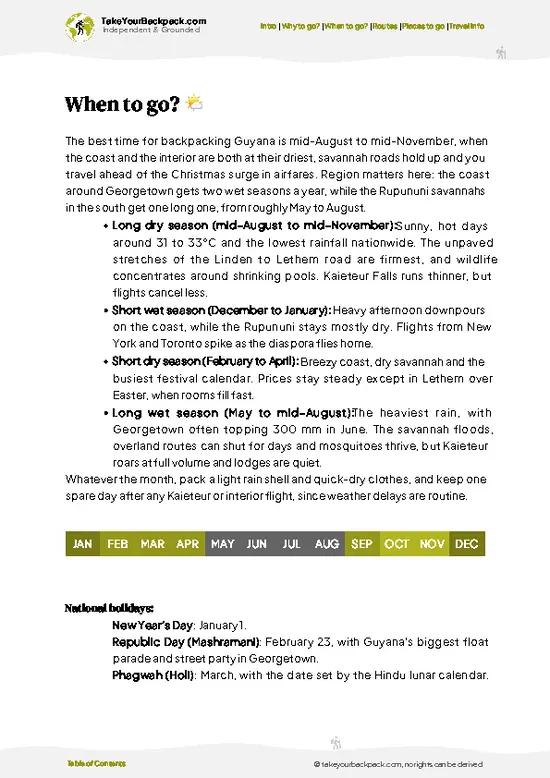
Best months: The best months are September to November and February to mid-April, when the two dry spells keep interior tracks firm and river crossings passable. Guyana sits just north of the equator, so temperatures barely move: expect 26 to 32°C on the coast and similar, steamier heat in the forest.

Wet and shoulder seasons: Two rainy seasons shape plans. The long one runs mid-April to mid-August, with Georgetown seeing roughly 2,000 to 2,500 mm of rain a year overall and the heaviest falls here. Roads in the interior turn to red slurry, some flights are delayed, and the air smells of wet earth and rotting leaves. The short wet spell, mid-November to January, is lighter and often broken by sunny mornings. The Rupununi savannah in the southwest is the exception: it is flooded and hard to … read more 👉
Best months: The best months are September to November and February to mid-April, when the two dry spells keep interior tracks firm and river crossings passable. Guyana sits just north of the equator, so temperatures barely move: expect 26 to 32°C on the coast and similar, steamier heat in the forest.

Wet and shoulder seasons: Two rainy seasons shape plans. The long one runs mid-April to mid-August, with Georgetown seeing roughly 2,000 to 2,500 mm of rain a year overall and the heaviest falls here. Roads in the interior turn to red slurry, some flights are delayed, and the air smells of wet earth and rotting leaves. The short wet spell, mid-November to January, is lighter and often broken by sunny mornings. The Rupununi savannah in the southwest is the exception: it is flooded and hard to cross from May to August but dry, dusty and golden from September to April.

Peaks and prices: Visitor numbers peak around Christmas and Easter, and Mashramani in February fills Georgetown hotels. Book lodges and flights early then. Outside those weeks, rates stay broadly flat, though wet-season deals on tours are common.

attraction hoppingHow to Combine attractions Into One Trip

How long to allow: A trip combining several attractions in Guyana needs 10 to 14 days, because getting between regions eats more time than seeing anything. Georgetown is the hub: nearly every flight, bus and tour starts there, and the Cheddi Jagan airport sits about 40 km from town (roughly an hour by taxi).

Grouping regions and direction: Three clusters work. The coast and Georgetown need 1 to 2 days. The Kaieteur and Potaro area is reached by a chartered plane from Georgetown in about 1 hour, with most visitors staying a day or two. The Rupununi savannah in the south is 1.5 to 2 hours by small plane to Lethem, or 12 to 20 hours overland on a jolting, dusty track. Allow 3 to 5 days there, since distances between ranches and villages are long. A sensible direction is Georgetown first, then … read more 👉
How long to allow: A trip combining several attractions in Guyana needs 10 to 14 days, because getting between regions eats more time than seeing anything. Georgetown is the hub: nearly every flight, bus and tour starts there, and the Cheddi Jagan airport sits about 40 km from town (roughly an hour by taxi).

Grouping regions and direction: Three clusters work. The coast and Georgetown need 1 to 2 days. The Kaieteur and Potaro area is reached by a chartered plane from Georgetown in about 1 hour, with most visitors staying a day or two. The Rupununi savannah in the south is 1.5 to 2 hours by small plane to Lethem, or 12 to 20 hours overland on a jolting, dusty track. Allow 3 to 5 days there, since distances between ranches and villages are long. A sensible direction is Georgetown first, then the Potaro, then the Rupununi, and a return flight to the capital.

Common planning errors: Travelers often squeeze tight connections into days with small-plane flights, which get delayed by rain or cloud. Leave a buffer day before an international flight. Others underestimate overland hours, with the Linden to Lethem route turning to sticky red mud in the wet season. Pick one or two interior regions rather than three. Book guides and lodges before you arrive, as walk-up options are scarce.

The ListThe Best attractions of Guyana

1 St. George’s Cathedral

Wooden spire, timber nave, stained glass, Sunday services

Walk the full perimeter of one of the tallest wooden buildings on earth, then step inside to see exposed beams shaped like a ship’s hull.

guyana-attraction-st-georges-cathedral
© Google |

2 Iwokrama Canopy Walkway

Suspension bridges, 30-meter platforms, dawn howlers, night walk

Cross four swaying bridges between giant trees, then listen for howler monkeys and toucans at first light before the day groups arrive.

3 Stabroek Market

Cast-iron clock tower, riveted shed, bush medicine, cook-up stalls

Wander under the iron roof past cassava, spices and fish, and eat cheaply from nearby stalls before watching the Demerara ferries load.

4 Guyana National Museum

Stuffed jaguars, arapaima display, sloth skeleton, 1951 museum halls

Study mounted jaguars, caimans and a giant arapaima in a mid-century gallery, a quick primer on the wildlife waiting in the interior.

guyana-attraction-guyana-national-museum
© Google |

5 Walter Roth Museum of Anthropology

Amerindian pottery, cassava presses, petroglyph images, timber house

Read slowly through clay vessels, woven baskets and cassava tools in a quiet wooden house that explains how interior communities live and work.

guyana-attraction-walter-roth-museum-of-anthropology
© Google |

6 Umana Yana

Nail-free thatch, Wai Wai builders, conical roof, Main Street

Look up at a cone of layered palm fronds lashed with vine and fiber, built by Wai Wai craftsmen for a 1972 diplomatic meeting.

guyana-attraction-umana-yana
© Google |

7 Karanambu Ranch

Giant otter families, Victoria lilies, spotlight boat, anteater tracking

Paddle quiet black-water creeks to watch otters hauling fish ashore, then search the savannah with guides for anteaters near termite mounds.

8 Promenade Gardens

Shaded benches, free entry, tropical trees, Georgetown pause

Sit under mature trees in the cooler hours and watch ordinary city life, then walk on to the cathedral, market and Umana Yana.

9 Dadanawa Ranch

Working vaqueros, giant anteaters, savannah horseback, night drives

Ride out with ranch hands across open grassland, watch anteaters forage in the cool hours, and end days on a hammock veranda under big skies.

10 Parliament Building, Guyana

Neoclassical facade, public gallery, Brickdam streets, Cuffy monument

Admire the pale symmetrical front in morning light, and step into the gallery if the National Assembly is sitting.

11 Guyana Zoo

Jaguar enclosure, harpy eagle, capybaras, shaded paths

Compare the size and color of jaguars, tapirs and macaws up close, useful practice before searching for them in the rainforest.

guyana-attraction-guyana-zoo
© Google |
Loading the map 🌍

Expert viewInsights from Locals and Experts

How many attractions to plan for: Three to five major attractions is the right number for a trip of two to three weeks. Guyana’s sights sit far apart, connected by rough laterite roads, river crossings and small aircraft, so each one eats a day or two of transit. Pack in more and you spend the trip in a minibus with red dust in your teeth, watching the forest blur past. Fewer, longer stays let you hear the howler monkeys start up before dawn and still be there when the light turns the river the color of tea.
Choosing between kinds of attractions: Rainforest lodges and wildlife reserves suit travelers who want animals and quiet. Expect humid air thick with insect noise, hammocks, and tannin-dark water. Waterfalls and interior treks suit the fit and the patient: trails turn to slick red mud in … read more 👉
How many attractions to plan for: Three to five major attractions is the right number for a trip of two to three weeks. Guyana’s sights sit far apart, connected by rough laterite roads, river crossings and small aircraft, so each one eats a day or two of transit. Pack in more and you spend the trip in a minibus with red dust in your teeth, watching the forest blur past. Fewer, longer stays let you hear the howler monkeys start up before dawn and still be there when the light turns the river the color of tea.
Choosing between kinds of attractions: Rainforest lodges and wildlife reserves suit travelers who want animals and quiet. Expect humid air thick with insect noise, hammocks, and tannin-dark water. Waterfalls and interior treks suit the fit and the patient: trails turn to slick red mud in the wet months, and the walk in is part of the point. Coastal Georgetown and the Dutch-colonial wooden architecture suit short stays and rainy days, with market stalls, roti shops and the smell of curry and frying dough. Cultural visits to Indigenous villages suit travelers who like slow mornings and conversation over cassava bread. Pick one main kind and add one contrasting stop.
What it costs: Budget US$50 to 90 a day on the coast, and US$100 to 200 a day inland, where almost everything is packaged. Local currency is the Guyanese dollar (GYD), but many tour operators quote in US dollars. Entry or community fees run roughly US$5 to 20 a visit. Licensed guides cost US$30 to 80 a day, and are often required. Minibus rides between towns cost US$5 to 20, while charter flights to the interior run US$150 to 400 return per person depending on distance, and fill quickly. Lodge nights with meals run US$70 to 250. Carry cash, since cards are patchy outside Georgetown and ATMs vanish inland.
Safety and cultural considerations: In Georgetown, take licensed taxis after dark rather than walking, and keep phones out of sight near markets and the seawall. Inland, the main hazards are heat, sudden downpours, river currents and biting insects. Bring a hat, rain shell, repellent and enough water for long hikes, and ask your guide before swimming. Malaria is present in parts of the interior and yellow fever vaccination is commonly requested at entry, so see a travel clinic well ahead. Indigenous villages have their own rules. Ask the village leader or your guide before photographing people, dress modestly, and buy crafts directly from makers. Guyana is a mix of Indo-Guyanese, Afro-Guyanese, Indigenous and other communities, and a friendly greeting and a little patience about schedules go a long way. Buses and boats leave when full, not on time. One practical note: in the wet season I would always book a flexible final night near Georgetown, because grounded flights are common and a spare day saves your onward ticket.

✈️ The backpacker research shortcutGuyana Travel Guide

An offline-friendly backpacking guide with optimized travel routes, ranked highlights, transport advice, and the best areas to stay.
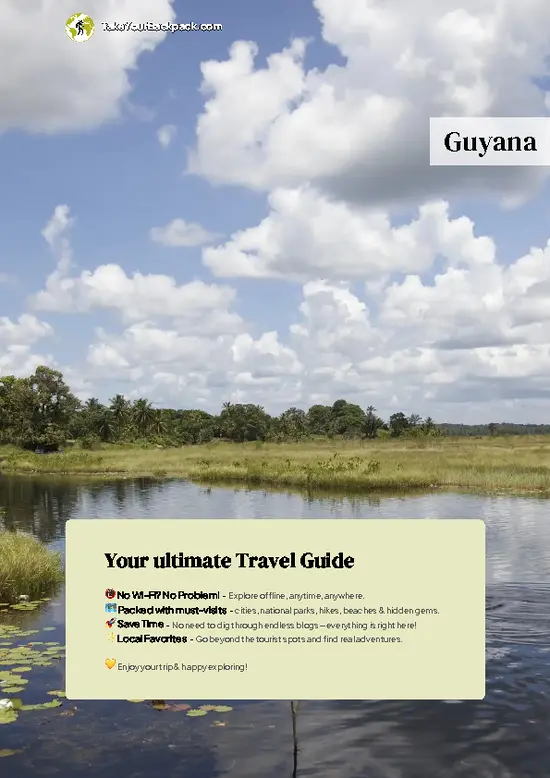
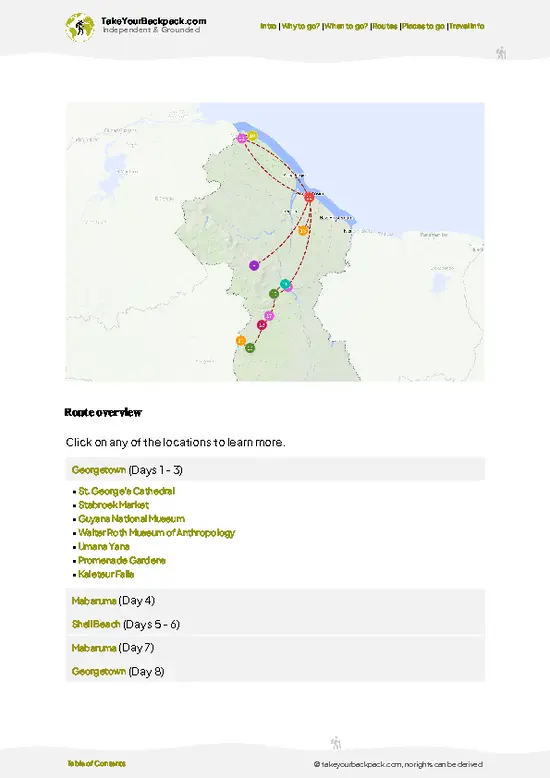
example page 0 from our offline Travel Guide for Guyana
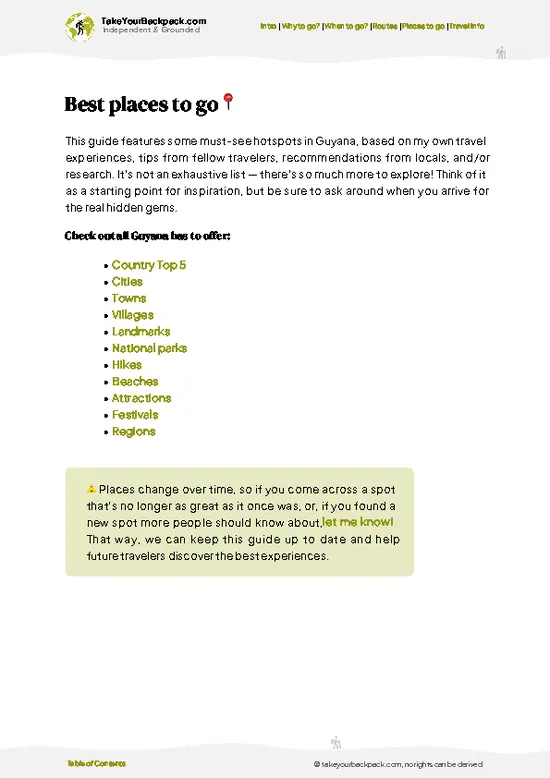
example page 1 from our offline Travel Guide for Guyana
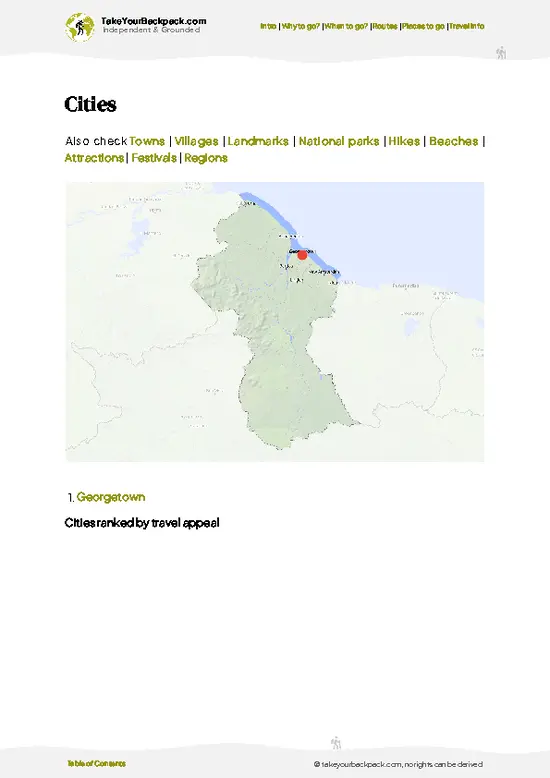
example page 2 from our offline Travel Guide for Guyana
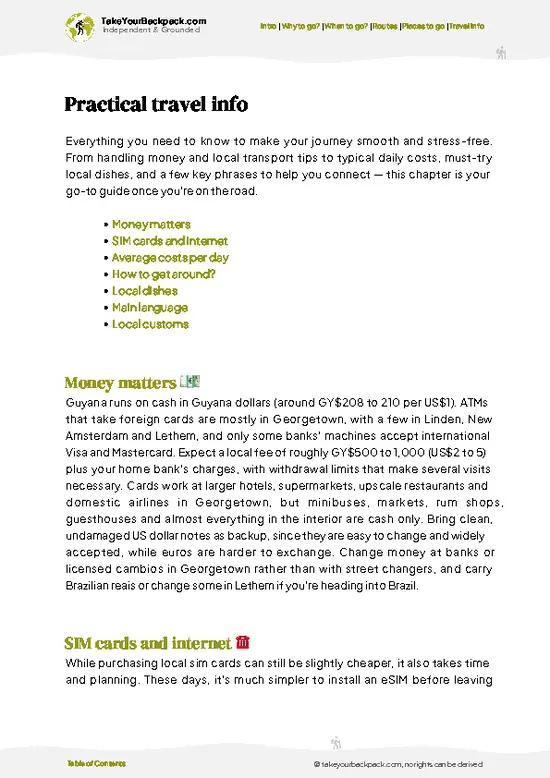
example page 3 from our offline Travel Guide for Guyana
example page 4 from our offline Travel Guide for Guyana
example page 5 from our offline Travel Guide for Guyana
example page 6 from our offline Travel Guide for Guyana
example page 7 from our offline Travel Guide for Guyana
The digital guide (161 pages) contains:
✅ 43 highlights, ranked by travel appeal
✅ Optimized 5, 10 & 15-day travel routes
✅ Cities, national parks, landmarks, beaches
✅ How to get around
✅ Offline-friendly for travel without Wi-Fi
👉 Click to see all 30+ guide features

📅 Plan smarter in minutes, not weeks
✅ Month by month travel advice
✅ Festivals & national holidays
✅ Budget expectations

🗺️ Go to the right places, skip the overrated ones
✅ Honest pros & cons of destinations
✅ Top hikes, parks & viewpoints
✅ Lesser-known places most travelers miss
✅ Clear “worth it vs skip it” guidance

🛏️ Travel smoothly without rookie mistakes
✅ Best areas to stay
✅ Transport systems explained simply
✅ Common scams & safety advice
✅ SIM cards, money & practical tips

🌍 Understand the country, not just visit it
✅ Culture & traditions
✅ Local customs
✅ Festivals worth planning around
✅ Traveler-friendly historical context
✅ Insights that make places more meaningful

📱 Built for real travel conditions
✅ Fully downloadable PDF
✅ Works completely offline
✅ Optimized for phone use
✅ Useful in remote areas & buses
✅ Everything in one place
Stop searching, start planning
Get instant access to your full guide. 30‑day money-back guarantee.
+ Add another guide for just

By proceeding you agree to our terms.
Sent to your inbox immediately after payment • 100% Secure Checkout
Best Backpacking Travel Advisor 2025 tourism awardBest Backpacking
Travel Advisor
2025
What others say about Take Your Backpack Guides:
⭐⭐⭐⭐⭐
Fantastic, amazing amount of information!
⭐⭐⭐⭐⭐
My goodness this is amazing, it's what I've been looking for hats off too you!
⭐⭐⭐⭐⭐
I think this is absolutely BRILLIANT
⭐⭐⭐⭐
Very complete and informative. It's still missing places, but I gotta to commend you
⭐⭐⭐⭐⭐
This is truly amazing, thank you, can't wait to explore it with my kids!
⭐⭐⭐⭐⭐
Awesome resource, thank you!
⭐⭐⭐⭐⭐
This is amazing! Can't wait to explore the ones I haven't seen
⭐⭐⭐⭐
I love this! Well done, great idea.
⭐⭐⭐⭐⭐
Thanks for taking the time to make this gem!
⭐⭐⭐⭐⭐
This might be the best website I've ever seen.
⭐⭐⭐⭐⭐
Congratulations, and thank you so much for your work; it's incredibly valuable.
⭐⭐⭐⭐
In all seriousness I think you did a great job pointing out the important spots
⭐⭐⭐⭐⭐
10/10 very good
⭐⭐⭐⭐⭐
As someone who's only just starting to visit regularly this is awesome, thank you.
⭐⭐⭐⭐
Thank you very much! I'm going to visit my dad, it's going to be very useful!
⭐⭐⭐⭐⭐
This is really cool! We'll be travelling for the first time and this definitely come in handy.
⭐⭐⭐⭐⭐
You are now our minister of culture, congratulations 👨‍💼
⭐⭐⭐⭐⭐
Just wanted to tell you that this is a pearl! Going to follow your recommendations.
⭐⭐⭐⭐⭐
This is so cool. I'll definitely be using the resource for my travels soon.
⭐⭐⭐⭐⭐
This is very impressive! Good work.
⭐⭐⭐⭐⭐
This is an amazing and informative site. Very well done!

🛏️ Where to stay?Accommodation Highlights

Guyana has only a handful of true backpacker hostels, so most budget travelers stay in simple guesthouses and small family-run hotels in Georgetown, where a private room usually costs US$25 to 50 a night. Kingston and the streets near the seawall put you closest to restaurants, bars and weekend nightlife, while leafy Queenstown is quieter and more residential but still walkable to the center. Bel Air and Lamaha Gardens feel safer and calmer after dark at the cost of a taxi ride everywhere, and the area around Stabroek is cheap and central but best avoided once the market closes.

If you enjoy meeting fellow travelers, consider choosing hostels with high ratings for atmosphere. On the other hand, … read more 👉
Guyana has only a handful of true backpacker hostels, so most budget travelers stay in simple guesthouses and small family-run hotels in Georgetown, where a private room usually costs US$25 to 50 a night. Kingston and the streets near the seawall put you closest to restaurants, bars and weekend nightlife, while leafy Queenstown is quieter and more residential but still walkable to the center. Bel Air and Lamaha Gardens feel safer and calmer after dark at the cost of a taxi ride everywhere, and the area around Stabroek is cheap and central but best avoided once the market closes.

If you enjoy meeting fellow travelers, consider choosing hostels with high ratings for atmosphere. On the other hand, if you prefer having your own space, a hotel might be a better option.

GuyanaSee More of Guyana

👋 Meet the founderWho’s Behind Take Your Backpack?

Johan, backpacker and founder of TakeYourBackpackHi, I’m Johan (Netherlands 🇳🇱), the creator of TakeYourBackpack. Over the past 3 decades, I’ve backpacked through 90+ countries across six continents, gaining extensive experience with independent travel, long-term trips, and overland routes.

This site is built on a combination of firsthand travel experience and carefully curated insights from other backpackers. Many guides are based on places I’ve personally visited, while others bring together tips, observations, and practical advice shared by trusted travelers I’ve met along the way.

The goal is to provide realistic, experience-driven guidance — not generic itineraries — so you can explore destinations with better context, clearer expectations, and more confidence.