


×

Guyana🇬🇾 | national parksKaieteur National ParkKaieteur Falls, sandstone plateau, endemic frogs | things to do and best time to go

Explore Iwokrama Forest ReserveExplore Kanuku Mountains

Backpacking in Kaieteur
🏆 Top picknational park ranked #1
By Johan Kruseman 🇳🇱 | Updated July 11, 2026

Most people only realize after they leave that Kaieteur is one of the few world-class waterfalls where you can still walk right up to the rim without railings, tour buses, or ticketed “viewing platforms” eating your time and money. It sits in central Guyana on the Potaro River, inside the Kaieteur National Park on the Guiana Shield plateau. For backpackers, it’s raw and simple: a short but sweaty jungle hike from the airstrip to several viewpoints, dense rainforest, good chances of seeing cock-of-the-rock birds and tiny golden frogs, and almost no crowds. The catch is access and cost: most visitors fly in on a pricey day trip, entrance fees are folded into tour prices, and independent overland approaches are slow and logistically heavy. Camping and budget beds near the falls are very limited and basic. Compared with Iwokrama or Shell Beach, Kaieteur is less about variety and more about one huge, isolated, high-impact sight.

Discover everything you want to know in the 📖 Guyana Travel Guide.


Get your Guyana guide
46 ranked highlights, routes & tips, works offline (205 pages)
Loading the map 🌍
CLICK TO FILTER
cities
towns
villages
landmarks
national parks
hikes
beaches
attractions
festivals
regions
SHOW COUNTRY’S BESTSHOW ALL

✨ Why go?
Ranked #1 national park in Guyana
Why Kaieteur should be on your travel list

Kaieteur National Park in Guyana is a backpacker’s dream for several reasons. First, independent exploration is highly encouraged here. The park’s layout allows you to wander at your own pace, soaking in the sights without the constraints of a guided tour. This freedom is a huge draw for those who prefer to chart their own course.

Budget-conscious travelers will appreciate the camping options and nearby hostels. You can pitch a tent under the stars or find a cozy spot in a hostel, keeping costs low while still enjoying the park’s natural beauty. This flexibility means you can allocate more of your budget to experiences that matter, like local food or unique activities.

The trail variety is another highlight. Whether you’re up for a challenging hike or a leisurely stroll, the park caters … read more 👉
Kaieteur National Park in Guyana is a backpacker’s dream for several reasons. First, independent exploration is highly encouraged here. The park’s layout allows you to wander at your own pace, soaking in the sights without the constraints of a guided tour. This freedom is a huge draw for those who prefer to chart their own course.

Budget-conscious travelers will appreciate the camping options and nearby hostels. You can pitch a tent under the stars or find a cozy spot in a hostel, keeping costs low while still enjoying the park’s natural beauty. This flexibility means you can allocate more of your budget to experiences that matter, like local food or unique activities.

The trail variety is another highlight. Whether you’re up for a challenging hike or a leisurely stroll, the park caters to all levels. This makes it ideal for both seasoned trekkers and those just starting out.

Lastly, while some may opt for tours, the park is very much suited for self-guided travelers. With clear signage and well-maintained paths, you can navigate confidently. Just remember to pack enough water and snacks to keep your energy up for those breathtaking views.
Want to include Kaieteur National Park in your Guyana route?
Create a personalized Guyana itinerary that includes Kaieteur National Park and the places that fit your trip — based on your travel style, budget, and available time. Get your route in seconds.

Generate my trip

💡 HighlightsEssential experiences to have while exploring Kaieteur

  • Kaieteur Falls — The showstopper: a single-drop waterfall of roughly 226 m (741 ft) with enormous volume, creating thunderous spray and a green, mist-shrouded amphitheater; it’s the park’s heartbeat and worth the trip alone.
  • Main Lookout / Edge Viewpoint — A short walk from the airstrip brings you to the dramatic rim where you can peer straight over the drop; the scale is hard to photograph but unforgettable in person, especially when the sun lights the mist.
  • Downstream & Below-Falls Views — Trails and guided routes give different perspectives of the falls’ base, plunge pool and gorge; the contrast between the flat plateau above and the cut-out canyon below is striking.
  • Kaieteur Plateau and Sandstone Cliffs — The plateau’s weathered sandstone shelves and cliff faces feel almost tepui-like,
read more 👉
  • Kaieteur Falls — The showstopper: a single-drop waterfall of roughly 226 m (741 ft) with enormous volume, creating thunderous spray and a green, mist-shrouded amphitheater; it’s the park’s heartbeat and worth the trip alone.
  • Main Lookout / Edge Viewpoint — A short walk from the airstrip brings you to the dramatic rim where you can peer straight over the drop; the scale is hard to photograph but unforgettable in person, especially when the sun lights the mist.
  • Downstream & Below-Falls Views — Trails and guided routes give different perspectives of the falls’ base, plunge pool and gorge; the contrast between the flat plateau above and the cut-out canyon below is striking.
  • Kaieteur Plateau and Sandstone Cliffs — The plateau’s weathered sandstone shelves and cliff faces feel almost tepui-like, with weird rock formations and sudden sheer drops that make for dramatic scenery and good photo angles.
  • Potaro River and Gorge — The river that feeds Kaieteur carves riffles, rapids and a narrow gorge downstream; it’s a great study in raw river power and the place where you’ll hear the falls’ roar echoing off the rock.
  • Birdlife and Wildlife Watching — Expect rich forest birds (think cock-of-the-rock displays, toucans, macaws and assorted canopy species) plus the usual tropical mammals and insects — bring binoculars and patience.
  • Unique Plants and Microhabitats — The plateau hosts giant bromeliads, orchids and other Guiana Shield specialists clinging to rock and ledge; small pools, wet mossy patches and spray zones create quirky niches full of life.
  • Short Hikes and Guided Jungle Walks — Most visits include easy, scenic walks from the airstrip plus options for longer guided treks into the surrounding rainforest; guides point out subtle things you’d miss on your own.
Spotted a mistake or missing something? Contact us.

🌤️ When to go?Choosing the right time of year


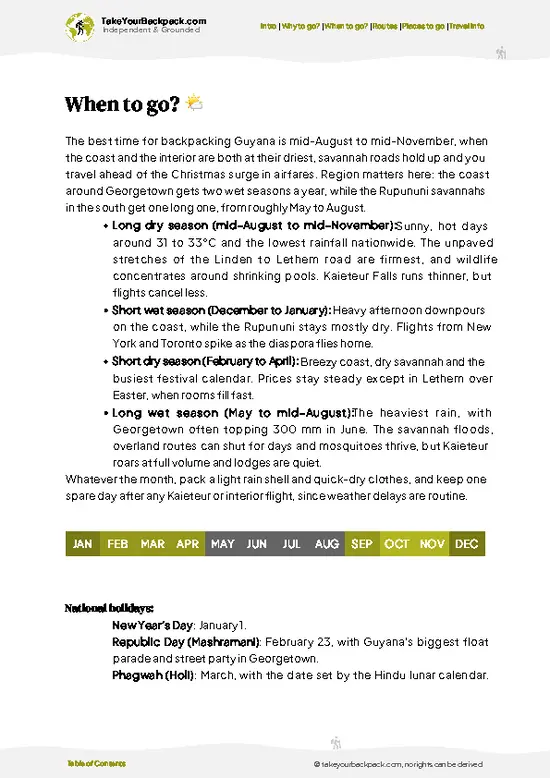
  • Weather: The dry season from August to November is your best bet. Rainfall drops significantly, making trails less slippery and river crossings safer. The wet season, especially May to July, brings heavy rains that can turn paths into mud traps and sometimes flood access points.

  • Temperature: Expect daytime highs around 28-32°C (82-90°F) and nights cooling to 20-22°C (68-72°F). The dry season tends to be slightly warmer and more comfortable for hiking, while the wet season feels more humid and oppressive.

  • Daylight Hours: Near the equator, daylight is steady year-round—roughly 11.5 to 12.5 hours daily. This consistency means you won’t lose daylight hours to plan your hikes, but early starts are still wise to avoid afternoon heat and rain.

  • Crowds: Kaieteur isn’t exactly a tourist hotspot,
read more 👉

  • Weather: The dry season from August to November is your best bet. Rainfall drops significantly, making trails less slippery and river crossings safer. The wet season, especially May to July, brings heavy rains that can turn paths into mud traps and sometimes flood access points.

  • Temperature: Expect daytime highs around 28-32°C (82-90°F) and nights cooling to 20-22°C (68-72°F). The dry season tends to be slightly warmer and more comfortable for hiking, while the wet season feels more humid and oppressive.

  • Daylight Hours: Near the equator, daylight is steady year-round—roughly 11.5 to 12.5 hours daily. This consistency means you won’t lose daylight hours to plan your hikes, but early starts are still wise to avoid afternoon heat and rain.

  • Crowds: Kaieteur isn’t exactly a tourist hotspot, but the dry season sees a modest uptick in visitors. If you want solitude, aim for shoulder months like late July or early December, when the weather is decent but fewer people show up.

  • Seasonal Activities: Wildlife spotting peaks during the dry season when animals gather near water sources. The wet season offers lush greenery but fewer visible animals, as many retreat or disperse.

  • Price Fluctuations: Tour operators and flights to Kaieteur Falls tend to hike prices during the dry season due to demand. Booking well in advance can save you a chunk, especially if you’re traveling solo or on a tight budget.


Pro-tip: Prioritize the dry season for reliable trails and wildlife viewing, but book early to lock in better rates and avoid last-minute stress.


source: climatestotravel.comJANJanuary: good for travelingFEBFebruary: good for travelingMARMarch: good for travelingAPRApril: good for travelingMAYMay: fair for travelingJUNJune: fair for travelingJULJuly: good for travelingAUGAugust: excellent for travelingSEPSeptember: excellent for travelingOCTOctober: excellent for travelingNOVNovember: excellent for travelingDECDecember: highly recommended for traveling
guyana-national-park-kaieteur-national-park
© Google | Jun Yokoyama

✈️ The backpacker research shortcutGuyana Travel Guide

An offline-friendly backpacking guide with optimized travel routes, ranked highlights, transport advice, and the best areas to stay.
example page 0 from our offline Travel Guide for Guyana
example page 1 from our offline Travel Guide for Guyana
example page 2 from our offline Travel Guide for Guyana
example page 3 from our offline Travel Guide for Guyana
example page 4 from our offline Travel Guide for Guyana
example page 5 from our offline Travel Guide for Guyana
example page 6 from our offline Travel Guide for Guyana
example page 7 from our offline Travel Guide for Guyana
The digital guide (205 pages) contains:
46 highlights, ranked by travel appeal
Optimized 5, 10 & 15-day travel routes
Cities, national parks, landmarks, beaches
How to get around
Offline-friendly for travel without Wi-Fi
👉 Click to see all 30+ guide features

📅 Plan smarter in minutes, not weeks
Month by month travel advice
Festivals & national holidays
Budget expectations

🗺️ Go to the right places, skip the overrated ones
Honest pros & cons of destinations
Top hikes, parks & viewpoints
Lesser-known places most travelers miss
Clear “worth it vs skip it” guidance

🛏️ Travel smoothly without rookie mistakes
Best areas to stay
Transport systems explained simply
Common scams & safety advice
SIM cards, money & practical tips

🌍 Understand the country, not just visit it
Culture & traditions
Local customs
Festivals worth planning around
Traveler-friendly historical context
Insights that make places more meaningful

📱 Built for real travel conditions
Fully downloadable PDF
Works completely offline
Optimized for phone use
Useful in remote areas & buses
Everything in one place
Save weeks of stressful planning
Get instant access to your full guide. 30‑day money-back guarantee.


By proceeding you agree to our terms.
Sent to your inbox immediately after payment • 100% Secure Checkout
Best Backpacking Travel Advisor 2025 tourism awardBest Backpacking
Travel Advisor
2025
What others say about Take Your Backpack Guides:
⭐⭐⭐⭐⭐
Fantastic, amazing amount of information!
⭐⭐⭐⭐⭐
My goodness this is amazing, it's what I've been looking for hats off too you!
⭐⭐⭐⭐⭐
I think this is absolutely BRILLIANT
⭐⭐⭐⭐
Very complete and informative. It's still missing places, but I gotta to commend you
⭐⭐⭐⭐⭐
This is truly amazing, thank you, can't wait to explore it with my kids!
⭐⭐⭐⭐⭐
Awesome resource, thank you!
⭐⭐⭐⭐⭐
This is amazing! Can't wait to explore the ones I haven't seen
⭐⭐⭐⭐
I love this! Well done, great idea.
⭐⭐⭐⭐⭐
Thanks for taking the time to make this gem!
⭐⭐⭐⭐⭐
This might be the best website I've ever seen.
⭐⭐⭐⭐⭐
Congratulations, and thank you so much for your work; it's incredibly valuable.
⭐⭐⭐⭐
In all seriousness I think you did a great job pointing out the important spots
⭐⭐⭐⭐⭐
10/10 very good
⭐⭐⭐⭐⭐
As someone who's only just starting to visit regularly this is awesome, thank you.
⭐⭐⭐⭐
Thank you very much! I'm going to visit my dad, it's going to be very useful!
⭐⭐⭐⭐⭐
This is really cool! We'll be travelling for the first time and this definitely come in handy.
⭐⭐⭐⭐⭐
You are now our minister of culture, congratulations 👨‍💼
⭐⭐⭐⭐⭐
Just wanted to tell you that this is a pearl! Going to follow your recommendations.
⭐⭐⭐⭐⭐
This is so cool. I'll definitely be using the resource for my travels soon.
⭐⭐⭐⭐⭐
This is very impressive! Good work.
⭐⭐⭐⭐⭐
This is an amazing and informative site. Very well done!

🛏️ Where to stay?Choosing the right base

Kaieteur National Park is a remote treasure in Guyana, and finding a place to stay can be a bit tricky. There are no accommodations directly inside the park. The closest option is the small town of Kaieteur, where you can find basic lodgings. These are often simple guesthouses or eco-lodges that cater to adventurous travelers. Expect limited amenities, but the proximity to the falls is a major perk.

For a more comfortable stay, consider Bartica, a larger town about 90 miles away. It offers a range of accommodations, from budget hostels to mid-range hotels. Bartica is a hub for river transport, … read more 👉
Kaieteur National Park is a remote treasure in Guyana, and finding a place to stay can be a bit tricky. There are no accommodations directly inside the park. The closest option is the small town of Kaieteur, where you can find basic lodgings. These are often simple guesthouses or eco-lodges that cater to adventurous travelers. Expect limited amenities, but the proximity to the falls is a major perk.

For a more comfortable stay, consider Bartica, a larger town about 90 miles away. It offers a range of accommodations, from budget hostels to mid-range hotels. Bartica is a hub for river transport, making it a good base for exploring the park. Just be prepared for a boat ride to reach the falls, which can take a few hours.

If you’re looking for a more urban experience, Georgetown is about 150 miles from the park. It has a wider selection of hotels and restaurants, but the travel time to Kaieteur will be longer.

Plan your logistics carefully. Transport options can be limited, and costs can add up quickly. Prioritize your energy and budget for the experiences that matter most—like standing in awe at the falls.

👛 Costs (as of 9 April 2026)Travel costs and budget guide for Kaieteur

Visiting Kaieteur National Park in Guyana is a unique experience, but it comes with specific costs that can catch you off guard if you’re not prepared.

First, the entry fee to the park is around $10 USD. This is a small price for the natural wonders you’ll encounter. However, the real expense comes from transportation. Most visitors opt for a flight from Georgetown, which can range from $150 to $250 USD round trip. Prices fluctuate based on demand and season, so booking in advance is wise.

If you’re considering a guided tour, expect to pay an additional $50 to $100 USD. This often includes a knowledgeable guide who can enhance your experience with insights about the flora and fauna.

Food options within the park are limited. Bring snacks or a packed lunch to avoid paying inflated prices … read more 👉
Visiting Kaieteur National Park in Guyana is a unique experience, but it comes with specific costs that can catch you off guard if you’re not prepared.

First, the entry fee to the park is around $10 USD. This is a small price for the natural wonders you’ll encounter. However, the real expense comes from transportation. Most visitors opt for a flight from Georgetown, which can range from $150 to $250 USD round trip. Prices fluctuate based on demand and season, so booking in advance is wise.

If you’re considering a guided tour, expect to pay an additional $50 to $100 USD. This often includes a knowledgeable guide who can enhance your experience with insights about the flora and fauna.

Food options within the park are limited. Bring snacks or a packed lunch to avoid paying inflated prices for basic meals. Water is essential, so ensure you have enough, as purchasing it on-site can be pricier than in town.

Lastly, factor in transportation to and from the airport in Georgetown. Taxis can cost around $30 USD each way.

In summary, budgeting around $300 to $400 USD for a day trip to Kaieteur National Park is a safe estimate. This covers entry, transportation, and a meal. Being aware of these costs will help you focus on the breathtaking views and the experience itself, rather than worrying about your wallet.


source: guyanatourism.com
⚠️ Prices can change and everyone travels differently, so take this as a rough guide. Hope it helps you plan your adventure!

🥾 TrailsPlan your hike in Kaieteur: routes, terrain, and sights

Kaieteur National Park is a hidden gem in Guyana, offering some jaw-dropping hiking opportunities amidst lush rainforest and stunning waterfalls. The terrain is a mix of well-trodden paths and rugged trails, so be prepared for a bit of adventure. Wildlife here is abundant; you might spot everything from colorful birds to elusive monkeys. The park’s centerpiece, the Kaieteur Falls, is a must-see—it’s one of the tallest waterfalls in the world and absolutely breathtaking.

There are a couple of designated trails worth exploring:
  • Trail Name: Kaieteur Falls Trail
    • Length: 2 miles
    • Estimated Duration: 1-2
read more 👉
Kaieteur National Park is a hidden gem in Guyana, offering some jaw-dropping hiking opportunities amidst lush rainforest and stunning waterfalls. The terrain is a mix of well-trodden paths and rugged trails, so be prepared for a bit of adventure. Wildlife here is abundant; you might spot everything from colorful birds to elusive monkeys. The park’s centerpiece, the Kaieteur Falls, is a must-see—it’s one of the tallest waterfalls in the world and absolutely breathtaking.

There are a couple of designated trails worth exploring:
  • Trail Name: Kaieteur Falls Trail
    • Length: 2 miles
    • Estimated Duration: 1-2 hours
    • Difficulty Level: Easy
    • Key Features: Stunning views of the falls, lookout points, diverse flora and fauna
    • Terrain: Mostly flat with some uneven sections
  • Trail Name: Rainforest Loop
    • Length: 3 miles
    • Estimated Duration: 2-3 hours
    • Difficulty Level: Moderate
    • Key Features: Dense rainforest, birdwatching opportunities, potential wildlife sightings
    • Terrain: Varied, with some steep inclines and muddy patches

Getting to the park isn’t too tricky. Most visitors take a flight from Georgetown to Kaieteur, which is a short but scenic ride. There are no public transport options directly into the park, so flights are the way to go. It’s not usually overcrowded, which is a plus if you’re looking for some peace in nature. As for an entrance fee, there’s typically a small charge, but it’s best to check ahead since fees can change. Just bring your sense of adventure and a good camera—you’ll want to capture those views!
⚠️ Hiking info can sometimes be outdated or inaccurate. Before you hit the trail, check the latest conditions with locals. If you do spot anything that's off, I'd love to hear from you, so I can update it for fellow travelers.

🛡️ SafetyScams, Hazards, and Annoyances

Kaieteur National Park offers a straightforward hiking experience, but a few practical considerations can enhance your adventure. The weather can shift quickly; expect sudden rain showers, especially in the wet season. Dress in layers and carry a waterproof jacket to stay comfortable.

The terrain is generally manageable, but some trails can be steep and slippery after rain. Good footwear is essential—opt for sturdy, well-gripped hiking boots. Navigation is usually clear, but keep an eye on trail markers to avoid wandering off course.

Wildlife encounters are part of the charm here. While spotting a jaguar or giant river otter is thrilling, maintain a respectful distance. Don’t feed animals; it disrupts their natural behavior.

Lastly, be mindful of your pace. The humid climate can be taxing, … read more 👉
Kaieteur National Park offers a straightforward hiking experience, but a few practical considerations can enhance your adventure. The weather can shift quickly; expect sudden rain showers, especially in the wet season. Dress in layers and carry a waterproof jacket to stay comfortable.

The terrain is generally manageable, but some trails can be steep and slippery after rain. Good footwear is essential—opt for sturdy, well-gripped hiking boots. Navigation is usually clear, but keep an eye on trail markers to avoid wandering off course.

Wildlife encounters are part of the charm here. While spotting a jaguar or giant river otter is thrilling, maintain a respectful distance. Don’t feed animals; it disrupts their natural behavior.

Lastly, be mindful of your pace. The humid climate can be taxing, so take breaks and hydrate regularly. With these tips, you’ll preserve your energy for the breathtaking views and moments that truly matter.

Other Guyanese national parks near Kaieteur

Explore more nearby:


💡 Not sure where to go next?
Create a personalized itinerary for Guyana including Kaieteur and the places that fit your trip.

Generate my itinerary

👉 Discover all national parks

Or checkout all Guyana has to offer (think cities, towns, villages, national parks, hikes, beaches, festivals)
Country photo of Guyana

We 💚 feedbackWhat to keep in mind

Kaieteur National Park is a raw slice of nature that feels untouched. The roar of the falls is a constant reminder of its power. Don’t be surprised if the trails get muddy; sturdy boots are a must. The best surprise? Spotting the golden frog, a rare treat that feels like a personal gift from the jungle. Keep your camera ready, but also your patience—sometimes, the best views come after a little hike. Embrace the wild, but respect its unpredictability.

✍️ Help improve this page!
The information on this page is based on in-depth research, insights shared by experienced travelers, and feedback from the local travel community in Guyana. While every effort is made to keep the information accurate and current, conditions can change — so if you spot anything incorrect or outdated, please get in touch.


🙋‍♂️ Give feedback

👋 Meet the founderWho’s Behind Take Your Backpack?

Johan, backpacker and founder of TakeYourBackpackHi, I’m Johan (Netherlands 🇳🇱), the creator of TakeYourBackpack. Over the past decade, I’ve backpacked through 80+ countries across six continents, gaining extensive experience with independent travel, long-term trips, and overland routes.

This site is built on a combination of firsthand travel experience and carefully curated insights from other backpackers. Many guides are based on places I’ve personally visited, while others bring together tips, observations, and practical advice shared by trusted travelers I’ve met along the way.

The goal is to provide realistic, experience-driven guidance — not generic itineraries — so you can explore destinations with better context, clearer expectations, and more confidence.

Get full Guyana guide •
Instant download • 46 highlights • Full Offline guide