×

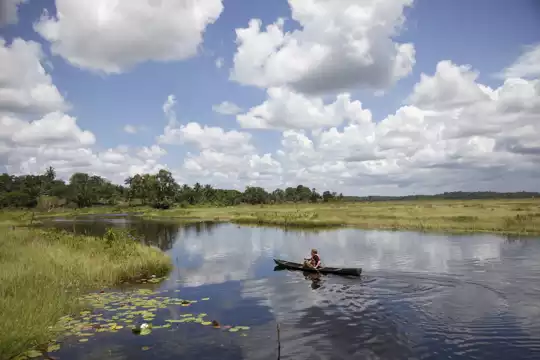
Guyana🇬🇾 | national parksKanashen Community Owned Conservation AreaWai Wai community, Essequibo headwaters, harpy eagles, giant otters | things to do and best time to go

Explore Kanuku MountainsExplore Cuyuni-Mazaruni Region

Backpacking in Kanashen Community Owned Conservation Area
👌 Worth visitingnational park ranked #4
By Johan Kruseman 🇳🇱 | Updated October 19, 2026

Kanashen is owned and run by the Wai Wai community of Masakenari, and you cannot simply walk in: visits are arranged through the community, which is why independent drop-ins rarely work. It sits in the far south of Guyana, in the Upper Essequibo region near the Brazilian border, over 600,000 hectares of rainforest. Getting there means a small charter flight and then river travel, so the smarter move is to book through a community-linked operator who handles permission, boatmen and food. Expect heat that sticks to your shirt, the roar of howler monkeys before dawn, wet leaf litter underfoot and river water the color of tea. Wildlife is the draw: giant river otters, harpy eagles, tapirs and jaguars live here, though sightings take patience. Comforts are thin and the logistics are costly. Anyone who loves deep jungle and Indigenous-led travel will thrive. People wanting set trails, quick access or hotel comforts will struggle.

Discover everything you want to know in the 📖 Guyana Travel Guide.


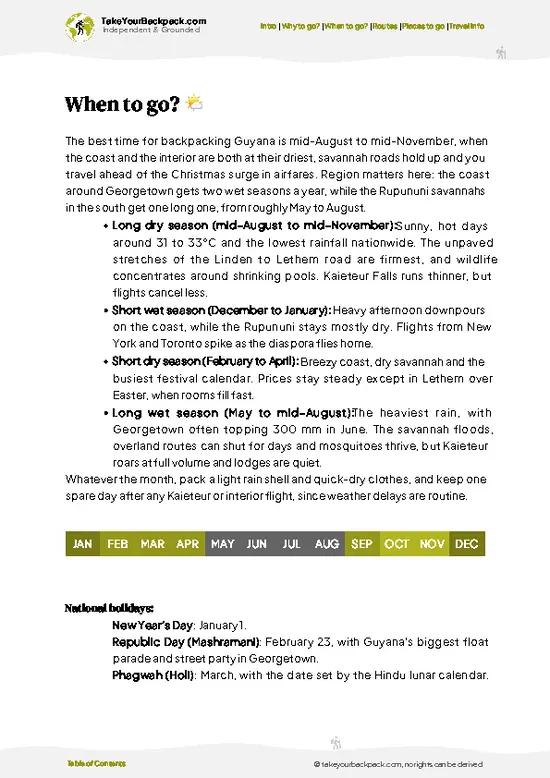
example page 0 from our offline Travel Guide for Guyana
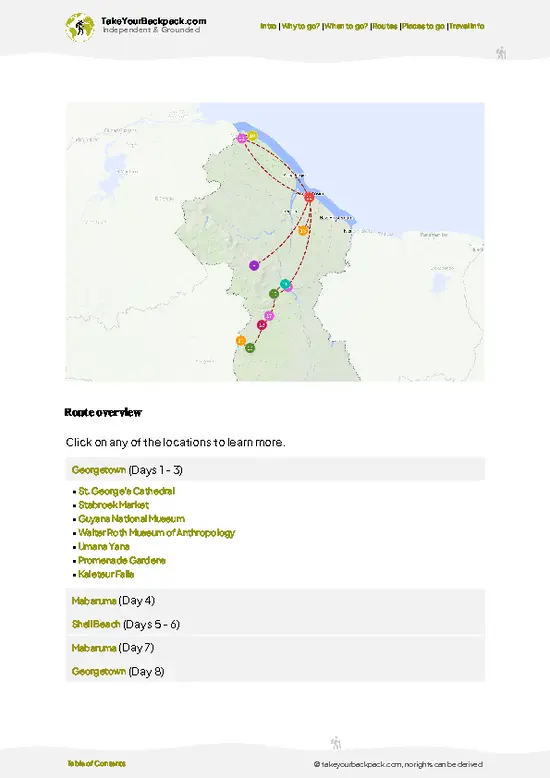
example page 1 from our offline Travel Guide for Guyana
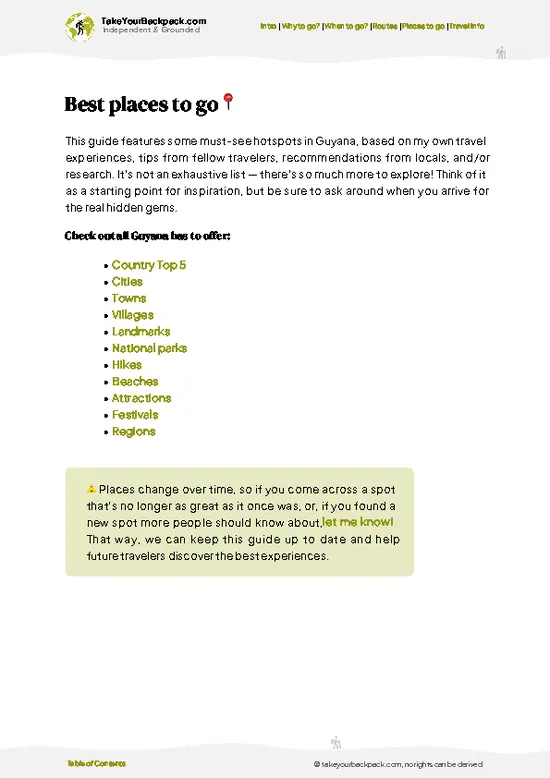
example page 2 from our offline Travel Guide for Guyana
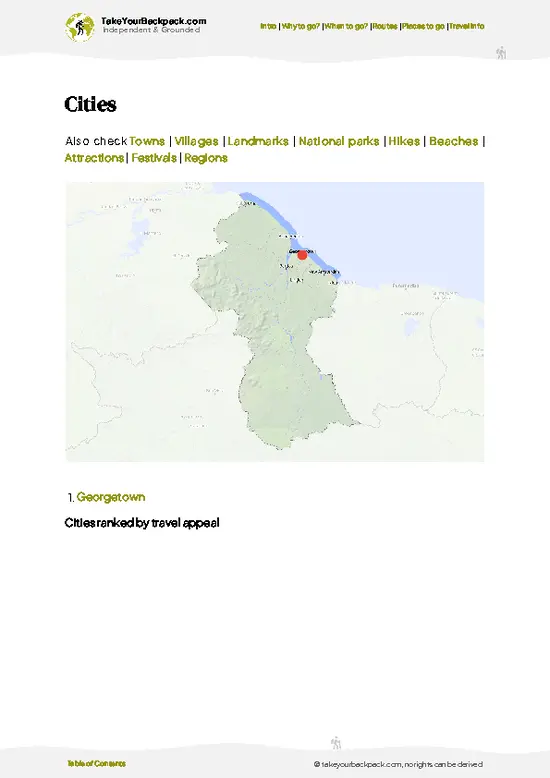
example page 3 from our offline Travel Guide for Guyana
example page 4 from our offline Travel Guide for Guyana
example page 5 from our offline Travel Guide for Guyana
example page 6 from our offline Travel Guide for Guyana
example page 7 from our offline Travel Guide for Guyana
Loading the map 🌍
CLICK TO FILTER
cities
towns
villages
landmarks
national parks
hikes
beaches
attractions
festivals
regions
SHOW COUNTRY’S BESTSHOW ALL

✨ Why go?
Ranked #4 national park in Guyana
The unique appeal for travelers

Kanashen Community Owned Conservation Area draws backpackers who want rainforest that has barely seen a tourist boot. The reason is ownership: the Wai Wai manage the land themselves, so guides are local hunters and fishers who read tracks, bird calls and river moods in a way no guidebook can. You are traveling with the people whose territory it is, and that changes every conversation around the fire.

Independent wandering is not the model here. Visits are guided and small, which suits travelers happy to hand over planning for something rare. You sleep in hammocks, wash in the river and eat cassava bread, fish and farine alongside your hosts. Birders come for harpy eagle and cock-of-the-rock chances, and paddlers come for slow stretches of the Essequibo River headwaters where otters surface … read more 👉
Kanashen Community Owned Conservation Area draws backpackers who want rainforest that has barely seen a tourist boot. The reason is ownership: the Wai Wai manage the land themselves, so guides are local hunters and fishers who read tracks, bird calls and river moods in a way no guidebook can. You are traveling with the people whose territory it is, and that changes every conversation around the fire.

Independent wandering is not the model here. Visits are guided and small, which suits travelers happy to hand over planning for something rare. You sleep in hammocks, wash in the river and eat cassava bread, fish and farine alongside your hosts. Birders come for harpy eagle and cock-of-the-rock chances, and paddlers come for slow stretches of the Essequibo River headwaters where otters surface beside the boat. If you want a place that feels like genuine expedition travel, this is among the few in the Guianas that still delivers it without crowds.

💡 HighlightsEssential experiences to have while exploring Kanashen Community Owned Conservation Area

  1. Wai Wai village of Masakenari: the community that owns the conservation area, with thatched homes, cassava processing and a chance to learn how the forest is managed.
  2. Essequibo River headwaters: dark, quiet water you travel by boat, with caiman eyes glinting at night and kingfishers working the banks.
  3. Giant river otters: family groups fish and squeal along calm stretches, and sightings are among the best in Guyana.
  4. Harpy eagle territory: one of the planet’s largest raptors nests in the canopy here, and local guides know where to look.
  5. Jaguar and tapir habitat: tracks on sandy banks are common, and the animals themselves appear rarely but memorably, often at dawn or after dark.
  6. Primary rainforest walks: buttress roots, strangler figs and a dim, humid understory, with guides naming plants for food,
… read more 👉
  1. Wai Wai village of Masakenari: the community that owns the conservation area, with thatched homes, cassava processing and a chance to learn how the forest is managed.
  2. Essequibo River headwaters: dark, quiet water you travel by boat, with caiman eyes glinting at night and kingfishers working the banks.
  3. Giant river otters: family groups fish and squeal along calm stretches, and sightings are among the best in Guyana.
  4. Harpy eagle territory: one of the planet’s largest raptors nests in the canopy here, and local guides know where to look.
  5. Jaguar and tapir habitat: tracks on sandy banks are common, and the animals themselves appear rarely but memorably, often at dawn or after dark.
  6. Primary rainforest walks: buttress roots, strangler figs and a dim, humid understory, with guides naming plants for food, medicine and building.
  7. Night boat spotting: headlamps pick out caiman, nightjars and sometimes capybara along the shoreline.
  8. Birdlife of the canopy: macaws, toucans, trogons and the shrieking calls of screaming piha ring through the trees.
Most visitors overlook the evening hours around the village, when Wai Wai elders share stories and cooking smoke drifts over the river.
Spotted a mistake or missing something? Contact us.
🌤️ When to go?Weather, crowds, and seasonal trade-offs

The main dry spell from late August to November is the easiest window for reaching Kanashen Community Owned Conservation Area, in the far south of Guyana near the Brazilian border.
  • Long Dry Season (Sept to Nov): Days run 30 to 34°C (86 to 93°F), nights 22 to 24°C (72 to 75°F). Rivers drop, so boat travel gets harder in places, but trails and camps stay firmer underfoot. Flights into the south are most reliable now.
  • Short Dry Season (Feb to March): Similar temperatures with lighter showers, and a good second option for birding and forest walks.
  • Main Wet Season (May to mid-August): Heavy daily downpours, high rivers and muddy trails. Mosquitoes and sandflies peak, and charter flights or river legs can be delayed. Expect 29 to 32°C (84 to 90°F) with humidity near saturation.
  • Crowds and Prices: Visitor
… read more 👉
The main dry spell from late August to November is the easiest window for reaching Kanashen Community Owned Conservation Area, in the far south of Guyana near the Brazilian border.
  • Long Dry Season (Sept to Nov): Days run 30 to 34°C (86 to 93°F), nights 22 to 24°C (72 to 75°F). Rivers drop, so boat travel gets harder in places, but trails and camps stay firmer underfoot. Flights into the south are most reliable now.
  • Short Dry Season (Feb to March): Similar temperatures with lighter showers, and a good second option for birding and forest walks.
  • Main Wet Season (May to mid-August): Heavy daily downpours, high rivers and muddy trails. Mosquitoes and sandflies peak, and charter flights or river legs can be delayed. Expect 29 to 32°C (84 to 90°F) with humidity near saturation.
  • Crowds and Prices: Visitor numbers stay tiny all year. Charter flights and guide fees cost about the same in every season, so rain, not price, drives timing.
Daylight stays close to 12 hours all year, so plan on dark by early evening. Book flights and community guides several weeks ahead.


source: climatestotravel.comJANJanuary: good for travelingFEBFebruary: good for travelingMARMarch: good for travelingAPRApril: good for travelingMAYMay: fair for travelingJUNJune: fair for travelingJULJuly: fair for travelingAUGAugust: highly recommended for travelingSEPSeptember: excellent for travelingOCTOctober: excellent for travelingNOVNovember: excellent for travelingDECDecember: good for traveling
guyana-national-park-kanashen-community-owned-conservation-area
© Google |

✈️ The backpacker research shortcutGuyana Travel Guide

An offline-friendly backpacking guide with optimized travel routes, ranked highlights, transport advice, and the best areas to stay.
example page 0 from our offline Travel Guide for Guyana
example page 1 from our offline Travel Guide for Guyana
example page 2 from our offline Travel Guide for Guyana
example page 3 from our offline Travel Guide for Guyana
example page 4 from our offline Travel Guide for Guyana
example page 5 from our offline Travel Guide for Guyana
example page 6 from our offline Travel Guide for Guyana
example page 7 from our offline Travel Guide for Guyana
The digital guide (161 pages) contains:
✅ 43 highlights, ranked by travel appeal
✅ Optimized 5, 10 & 15-day travel routes
✅ Cities, national parks, landmarks, beaches
✅ How to get around
✅ Offline-friendly for travel without Wi-Fi
👉 Click to see all 30+ guide features

📅 Plan smarter in minutes, not weeks
✅ Month by month travel advice
✅ Festivals & national holidays
✅ Budget expectations

🗺️ Go to the right places, skip the overrated ones
✅ Honest pros & cons of destinations
✅ Top hikes, parks & viewpoints
✅ Lesser-known places most travelers miss
✅ Clear “worth it vs skip it” guidance

🛏️ Travel smoothly without rookie mistakes
✅ Best areas to stay
✅ Transport systems explained simply
✅ Common scams & safety advice
✅ SIM cards, money & practical tips

🌍 Understand the country, not just visit it
✅ Culture & traditions
✅ Local customs
✅ Festivals worth planning around
✅ Traveler-friendly historical context
✅ Insights that make places more meaningful

📱 Built for real travel conditions
✅ Fully downloadable PDF
✅ Works completely offline
✅ Optimized for phone use
✅ Useful in remote areas & buses
✅ Everything in one place
Stop searching, start planning
Get instant access to your full guide. 30‑day money-back guarantee.
+ Add another guide for just

By proceeding you agree to our terms.
Sent to your inbox immediately after payment • 100% Secure Checkout
Best Backpacking Travel Advisor 2025 tourism awardBest Backpacking
Travel Advisor
2025
What others say about Take Your Backpack Guides:
⭐⭐⭐⭐⭐
Fantastic, amazing amount of information!
⭐⭐⭐⭐⭐
My goodness this is amazing, it's what I've been looking for hats off too you!
⭐⭐⭐⭐⭐
I think this is absolutely BRILLIANT
⭐⭐⭐⭐
Very complete and informative. It's still missing places, but I gotta to commend you
⭐⭐⭐⭐⭐
This is truly amazing, thank you, can't wait to explore it with my kids!
⭐⭐⭐⭐⭐
Awesome resource, thank you!
⭐⭐⭐⭐⭐
This is amazing! Can't wait to explore the ones I haven't seen
⭐⭐⭐⭐
I love this! Well done, great idea.
⭐⭐⭐⭐⭐
Thanks for taking the time to make this gem!
⭐⭐⭐⭐⭐
This might be the best website I've ever seen.
⭐⭐⭐⭐⭐
Congratulations, and thank you so much for your work; it's incredibly valuable.
⭐⭐⭐⭐
In all seriousness I think you did a great job pointing out the important spots
⭐⭐⭐⭐⭐
10/10 very good
⭐⭐⭐⭐⭐
As someone who's only just starting to visit regularly this is awesome, thank you.
⭐⭐⭐⭐
Thank you very much! I'm going to visit my dad, it's going to be very useful!
⭐⭐⭐⭐⭐
This is really cool! We'll be travelling for the first time and this definitely come in handy.
⭐⭐⭐⭐⭐
You are now our minister of culture, congratulations 👨‍💼
⭐⭐⭐⭐⭐
Just wanted to tell you that this is a pearl! Going to follow your recommendations.
⭐⭐⭐⭐⭐
This is so cool. I'll definitely be using the resource for my travels soon.
⭐⭐⭐⭐⭐
This is very impressive! Good work.
⭐⭐⭐⭐⭐
This is an amazing and informative site. Very well done!

🛏️ Where to stay?Best areas to stay in Guyana

Inside Kanashen, you stay in the Wai Wai community’s own simple lodging, and Georgetown is where you sort out everything beforehand.
The conservation area is owned and run by the Wai Wai people, and visitors are hosted at the village of Masakenari or at community-run camps and benabs (open thatched shelters) with hammock space. Expect basic conditions: hammocks with your own mosquito net, shared washing in the river, meals prepared by hosts. Costs run about US$30 to 60 per person per night including food, though arrangements vary by trip. Visits are organized in advance through the community and … read more 👉
Inside Kanashen, you stay in the Wai Wai community’s own simple lodging, and Georgetown is where you sort out everything beforehand.
The conservation area is owned and run by the Wai Wai people, and visitors are hosted at the village of Masakenari or at community-run camps and benabs (open thatched shelters) with hammock space. Expect basic conditions: hammocks with your own mosquito net, shared washing in the river, meals prepared by hosts. Costs run about US$30 to 60 per person per night including food, though arrangements vary by trip. Visits are organized in advance through the community and the Protected Areas Commission, and operators in Georgetown can bundle the logistics.
There are no hotels, hostels or towns near the area. The closest settlements are other Wai Wai and Amerindian villages in the deep south, and the nearest sizable communities are Lethem, in the Rupununi savannah, and Georgetown on the coast. Most travelers overnight in Georgetown before and after the trip, where guesthouses cost roughly US$30 to 80 a double. In Lethem, simple guesthouses run about US$25 to 60. Bring your own hammock, net, headlamp and a dry bag, and confirm bedding availability with your host.

👛 Costs (as of 19 October 2026)Money, prices, and spending tips

A realistic budget for Kanashen Community Owned Conservation Area is about US$160 to 235 per day, because everything is arranged through the community and access usually needs a charter flight or long river trip.
CategoryBudget RangeLocal Reality
Entrance and community feesUS$10 to 25Paid to the Wai Wai community, typically per person per day; confirm when booking.
Accommodation (high season)US$20 to 40Hammock space in a village or camp benab. Bring your own hammock and net.
MealsUS$10 to 20Cassava bread, fish, farine and rice cooked by hosts. Bring snacks from Georgetown.
Local guideUS$30 to 50Community guides lead forest walks and river trips; mandatory for most visits.
Transport (daily average)US$90 to 100Charter flights to the south cost several hundred dollars round trip and are shared among
… read more 👉
A realistic budget for Kanashen Community Owned Conservation Area is about US$160 to 235 per day, because everything is arranged through the community and access usually needs a charter flight or long river trip.
CategoryBudget RangeLocal Reality
Entrance and community feesUS$10 to 25Paid to the Wai Wai community, typically per person per day; confirm when booking.
Accommodation (high season)US$20 to 40Hammock space in a village or camp benab. Bring your own hammock and net.
MealsUS$10 to 20Cassava bread, fish, farine and rice cooked by hosts. Bring snacks from Georgetown.
Local guideUS$30 to 50Community guides lead forest walks and river trips; mandatory for most visits.
Transport (daily average)US$90 to 100Charter flights to the south cost several hundred dollars round trip and are shared among passengers; boat fuel adds to local trips.
Total Daily BudgetUS$160 to 235Per person, per day, in high season.
⚠️ Prices can change and everyone travels differently, so take this as a rough guide. Hope it helps you plan your adventure!

🥾 TrailsTrail guide for Kanashen Community Owned Conservation Area national park

Kanashen Community Owned Conservation Area has no marked, numbered trails, so the walking is guide-led and shaped by season, river level and what animals are doing.
  • Forest walks from camp: Short loops of one to three hours leave from the riverside camp, crossing flat to gently rolling ground with roots, mud and fallen logs. Easy to moderate, but humidity makes them tiring.
  • Full-day treks: Longer outings of five to eight hours follow hunting paths into primary forest, passing creeks, palm swamps and tapir wallows. Moderate difficulty, with wet crossings likely.
  • River and trail combinations: Boats
… read more 👉
Kanashen Community Owned Conservation Area has no marked, numbered trails, so the walking is guide-led and shaped by season, river level and what animals are doing.
  • Forest walks from camp: Short loops of one to three hours leave from the riverside camp, crossing flat to gently rolling ground with roots, mud and fallen logs. Easy to moderate, but humidity makes them tiring.
  • Full-day treks: Longer outings of five to eight hours follow hunting paths into primary forest, passing creeks, palm swamps and tapir wallows. Moderate difficulty, with wet crossings likely.
  • River and trail combinations: Boats carry you upstream, then you walk inland to search for monkeys, birds and otter holts. Good for those who prefer less hiking.
  • Night walks: Slow, quiet outings with headlamps to spot frogs, insects and sometimes larger mammals. Easy terrain but best with a guide.
Wildlife along these routes includes spider, howler and bearded saki monkeys, agoutis, peccaries, harpy eagles and sometimes jaguar. Bring quick-dry clothing, rubber boots or sturdy trail shoes, insect repellent and a dry bag for electronics.

Access is the hard part. There is no public transport to the area. Visitors normally fly by small plane from Georgetown to a nearby airstrip and continue by boat, all arranged through a tour operator working with the community. Entry is by permission only, and fees are usually folded into the package price rather than paid at a gate. Numbers are tiny, so you are unlikely to meet other groups, and the forest stays quiet apart from insects, birds and rain on the leaves.
⚠️ Hiking info can sometimes be outdated or inaccurate. Before you hit the trail, check the latest conditions with locals. If you do spot anything that's off, I'd love to hear from you, so I can update it for fellow travelers.

🛡️ SafetyTraveler Safety Guide

Kanashen is a remote rainforest area where the main risks are isolation, heat and wet ground, and all of them are manageable with a local guide.
There is no cell coverage and no quick road to a hospital, so carry a full first aid kit, personal medication, and a satellite messenger if you have one. Malaria occurs in southern Guyana, so talk to a travel clinic about prophylaxis and use repellent, long sleeves and a treated net. Yellow fever vaccination is advised.
Trails are muddy and root-tangled, and river travel in dugout or motorized canoes means rapids and fallen trees. Wear boots with grip, pack everything in dry bags and walk at a steady pace in the humidity. Jaguars, snakes and peccaries live here but rarely bother people. Stay with your guide, never step blindly over logs, and shake out … read more 👉
Kanashen is a remote rainforest area where the main risks are isolation, heat and wet ground, and all of them are manageable with a local guide.
There is no cell coverage and no quick road to a hospital, so carry a full first aid kit, personal medication, and a satellite messenger if you have one. Malaria occurs in southern Guyana, so talk to a travel clinic about prophylaxis and use repellent, long sleeves and a treated net. Yellow fever vaccination is advised.
Trails are muddy and root-tangled, and river travel in dugout or motorized canoes means rapids and fallen trees. Wear boots with grip, pack everything in dry bags and walk at a steady pace in the humidity. Jaguars, snakes and peccaries live here but rarely bother people. Stay with your guide, never step blindly over logs, and shake out footwear. Treat or filter all water, and respect community rules on photography and hunting areas.

FAQFrequently asked questions about Kanashen Community Owned Conservation Area

Plan on 5 to 7 days for Kanashen Community Owned Conservation Area, including travel. Getting there from Georgetown takes a charter flight and then river or trail travel, and you want at least 3 nights on site for forest walks, birding and river trips with Wai Wai guides.
Reaching Kanashen Community Owned Conservation Area without a car is the normal way, since no road goes there. Most visitors fly by charter from Georgetown to the Wai Wai area in the far south, or come overland from Lethem with a guide and boat. Once there, you move on foot and by canoe.
Yes, Kanashen Community Owned Conservation Area requires advance permission, since it is owned by the Wai Wai community. Expect community and guide fees of roughly US$10 to 25 per person per day, arranged through the community, the Protected Areas Commission or a Georgetown operator. Do not turn up unannounced, and book several weeks ahead.
⚠️ Things can change over time, so always validate details locally before you go.

Other Guyanese national parks near Kanashen Community Owned Conservation Area

Explore more nearby:

  • Kanuku Mountains—Twin ranges split by river, Makushi and Wapishana villages, guided savannah-to-forest walks, hammock camping| 204 km away
  • Iwokrama Forest Reserve—Canopy walkway, jaguar tracking, Essequibo night boats, Turtle Mountain| 332 km away
  • Kaieteur National Park—226-meter plunge, rim viewpoints, golden rocket frogs, charter flight access| 422 km away

💡 Not sure where to go next?
Create a personalized itinerary for Guyana including Kanashen Community Owned Conservation Area and the places that fit your trip.

Generate my itinerary

👉 Discover all national parks

Or checkout all Guyana has to offer (think cities, towns, villages, national parks, hikes, beaches, festivals)
Country photo of Guyana

We 💚 feedbackWhat to keep in mind

Kanashen Community Owned Conservation Area rewards those who linger at the village after the walks end. The cassava bread, the language, the way hunters read the river all say more about this forest than any sighting. I would pack a spare set of dry sleep clothes, and plan at least a week so the logistics do not swallow the experience.

✍️ Help improve this page!
The information on this page is based on in-depth research, insights shared by experienced travelers, and feedback from the local travel community in Guyana. While every effort is made to keep the information accurate and current, conditions can change — so if you spot anything incorrect or outdated, please get in touch.


🙋‍♂️ Give feedback

👋 Meet the founderWho’s Behind Take Your Backpack?

Johan, backpacker and founder of TakeYourBackpackHi, I’m Johan (Netherlands 🇳🇱), the creator of TakeYourBackpack. Over the past 3 decades, I’ve backpacked through 90+ countries across six continents, gaining extensive experience with independent travel, long-term trips, and overland routes.

This site is built on a combination of firsthand travel experience and carefully curated insights from other backpackers. Many guides are based on places I’ve personally visited, while others bring together tips, observations, and practical advice shared by trusted travelers I’ve met along the way.

The goal is to provide realistic, experience-driven guidance — not generic itineraries — so you can explore destinations with better context, clearer expectations, and more confidence.