×

Guyana🇬🇾 | villagesSuramaSurama Mountain, Burro Burro canoe, Makushi benabs, cassava demonstration | things to do and best time to go

Explore RockstoneExplore Mabaruma

Backpacking in Surama
🏆 Top pickvillage ranked #1
By Johan Kruseman 🇳🇱 | Updated October 19, 2026

The village has a single airstrip-sized grass field in the middle of it, and at dusk kids and dogs share it with a few grazing cows. Surama sits in the North Rupununi savannah in central Guyana, a Makushi community of roughly 250 to 300 people ringed by the Pakaraima foothills and the Iwokrama forest edge. Red dirt tracks link thatched benabs and small homes, and the air carries wood smoke, cattle and dry grass. Days are hot and open, so you walk early, when parrots cross the sky and the savannah is still cool. The upsides are birdwatching, forest trails and Makushi hosts who run everything. The downsides are distance, basic rooms, patchy electricity and few other travelers. Evenings are quiet: a shared meal, a lantern, early sleep. You meet others mainly at the lodge or on guided walks. The last thing you hear is frogs from the creek, loud as a generator.

Discover everything you want to know in the 📖 Guyana Travel Guide.


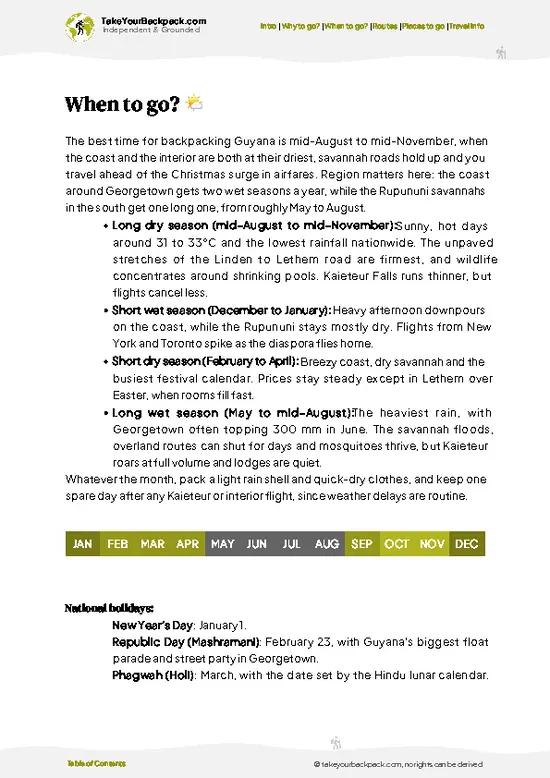
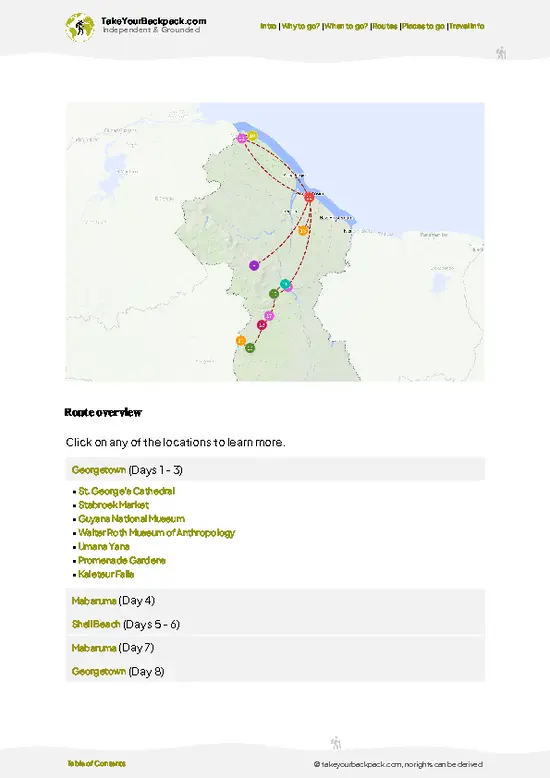
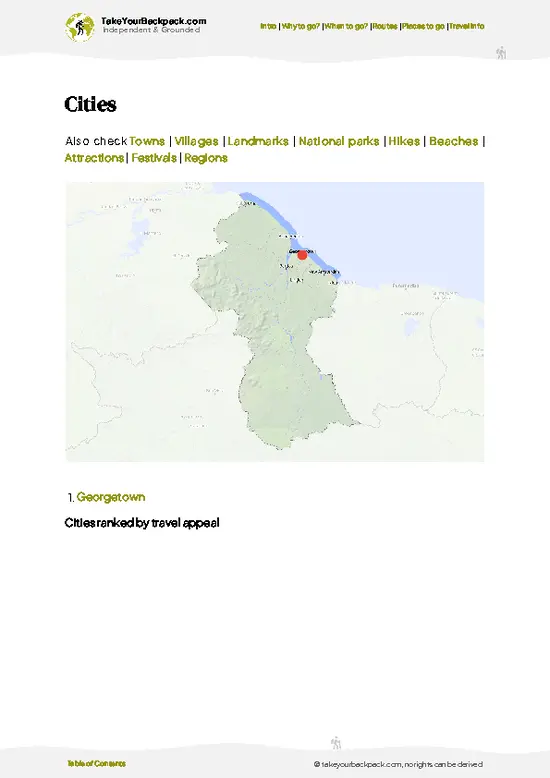
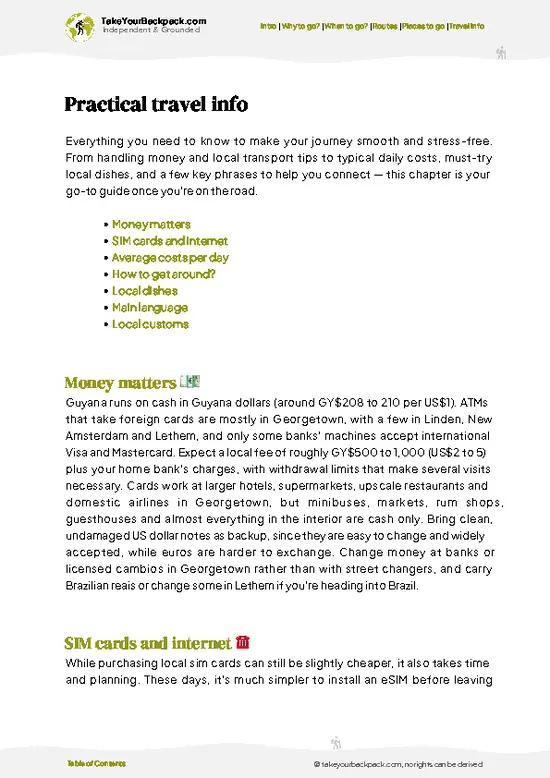
example page 0 from our offline Travel Guide for Guyana
example page 1 from our offline Travel Guide for Guyana
example page 2 from our offline Travel Guide for Guyana
example page 3 from our offline Travel Guide for Guyana
example page 4 from our offline Travel Guide for Guyana
example page 5 from our offline Travel Guide for Guyana
example page 6 from our offline Travel Guide for Guyana
example page 7 from our offline Travel Guide for Guyana
Loading the map 🌍
CLICK TO FILTER
cities
towns
villages
landmarks
national parks
hikes
beaches
attractions
festivals
regions
SHOW COUNTRY’S BESTSHOW ALL

✨ Why go?
Ranked #1 village in Guyana
Why Surama should be on your travel list

Surama is a community-run stop where the village itself is the experience, and that is what draws backpackers away from the coast and the Georgetown to Lethem road. You sleep in a simple village lodge or homestay, eat cassava bread and pepperpot cooked by your hosts, and walk with local guides who know the forest by sound. The big pull is Surama Mountain, a steep climb to a view over the savannah and the Burro Burro River, plus the chance of giant river otters and harpy eagle country nearby. Most people stay one or two nights, though birders and slow travelers happily stretch to three. It suits solo travelers who like quiet, couples, hikers and anyone curious about Makushi life. It is a poor fit if you want nightlife, fast wifi or spontaneous plans, since guides and meals are arranged through … read more 👉
Surama is a community-run stop where the village itself is the experience, and that is what draws backpackers away from the coast and the Georgetown to Lethem road. You sleep in a simple village lodge or homestay, eat cassava bread and pepperpot cooked by your hosts, and walk with local guides who know the forest by sound. The big pull is Surama Mountain, a steep climb to a view over the savannah and the Burro Burro River, plus the chance of giant river otters and harpy eagle country nearby. Most people stay one or two nights, though birders and slow travelers happily stretch to three. It suits solo travelers who like quiet, couples, hikers and anyone curious about Makushi life. It is a poor fit if you want nightlife, fast wifi or spontaneous plans, since guides and meals are arranged through the village tourism committee. As a pause on the long road south toward Lethem and the Rupununi, it gives you shade, birdsong and human company without any hard sell.

💡 HighlightsTop highlights of Surama

  1. Surama Mountain climb: The village’s best-known hike climbs through forest to a rocky viewpoint above the savannah, with the Burro Burro curling below and the Pakaraima range on the horizon. Go at dawn or late afternoon when it is cooler and birds are active. Guided walks usually cost US$15 to 30 per person and take 3 to 4 hours round trip. The steep sections get slick after rain, so wear shoes with grip.
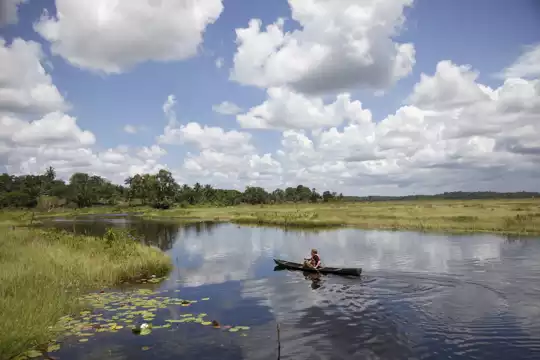
  2. Burro Burro River boat trip: Local guides take small groups by boat or canoe along the river edge of the village area, watching for herons, kingfishers, caiman and sometimes giant otters. Early morning is best for activity. Expect roughly US$30 to 60 per group depending on boat and length, and 2 to 4 hours on the water. The quiet is the point, so keep voices low.
  3. Makushi cultural walk and cassava
… read more 👉
  1. Surama Mountain climb: The village’s best-known hike climbs through forest to a rocky viewpoint above the savannah, with the Burro Burro curling below and the Pakaraima range on the horizon. Go at dawn or late afternoon when it is cooler and birds are active. Guided walks usually cost US$15 to 30 per person and take 3 to 4 hours round trip. The steep sections get slick after rain, so wear shoes with grip.
  2. Burro Burro River boat trip: Local guides take small groups by boat or canoe along the river edge of the village area, watching for herons, kingfishers, caiman and sometimes giant otters. Early morning is best for activity. Expect roughly US$30 to 60 per group depending on boat and length, and 2 to 4 hours on the water. The quiet is the point, so keep voices low.
  3. Makushi cultural walk and cassava demonstration: Villagers show how bitter cassava is grated, squeezed through a woven tube and baked into flat bread on a hot griddle, and explain farm plots, traditional crafts and community life. Mornings suit it best, when cooking is under way. Budget about US$10 to 25 per person for 1 to 2 hours, and bring small bills to buy handmade items directly from the makers.
Start with the Surama Mountain climb on your first morning, because the cool hours and clear views are gone by midday and the legs are fresher. For day trips, the Iwokrama Rainforest and its canopy walkway, the Annai area with Rock View, and the wider Burro Burro trails and savannah ranches around the North Rupununi can all be explored from here.
Spotted a mistake or missing something? Contact us.

Things to do near Surama

Ratings based on Tripadvisor reviews. When you book through this link, you support our work at no extra cost to you.

🌤️ When to go?Best time to visit Surama

  • Main dry season (September to December): Roads are firmest, trails are walkable and the Burro-Burro River drops, which makes birds and giant river otters easier to spot. Days run 31 to 35°C (88 to 95°F), nights 22 to 24°C (72 to 75°F), with about 12 hours of daylight. Lodge rates are at their highest.
  • Short dry spell (February to April): Skies are mostly clear and hot, up to 36°C (97°F). Easter brings rodeo crowds to the Rupununi, so vehicles and beds fill quickly.
  • Wet season (May to August): Heavy afternoon downpours turn the red laterite track from Annai to mud and sometimes block it for a day. Temperatures sit at 24 to 31°C (75 to 88°F). Surama is green and quiet, lodges cut rates, and boat trips reach further along the flooded creeks. Mosquitoes and sandflies are worst now.
Book your 4x4 … read more 👉
  • Main dry season (September to December): Roads are firmest, trails are walkable and the Burro-Burro River drops, which makes birds and giant river otters easier to spot. Days run 31 to 35°C (88 to 95°F), nights 22 to 24°C (72 to 75°F), with about 12 hours of daylight. Lodge rates are at their highest.
  • Short dry spell (February to April): Skies are mostly clear and hot, up to 36°C (97°F). Easter brings rodeo crowds to the Rupununi, so vehicles and beds fill quickly.
  • Wet season (May to August): Heavy afternoon downpours turn the red laterite track from Annai to mud and sometimes block it for a day. Temperatures sit at 24 to 31°C (75 to 88°F). Surama is green and quiet, lodges cut rates, and boat trips reach further along the flooded creeks. Mosquitoes and sandflies are worst now.
Book your 4x4 transfer at least two weeks ahead for December or Easter, and expect the best discounts in June.


source: climatestotravel.comJANJanuary: highly recommended for travelingFEBFebruary: excellent for travelingMARMarch: excellent for travelingAPRApril: excellent for travelingMAYMay: fair for travelingJUNJune: fair for travelingJULJuly: fair for travelingAUGAugust: fair for travelingSEPSeptember: highly recommended for travelingOCTOctober: highly recommended for travelingNOVNovember: fair for travelingDECDecember: highly recommended for traveling
when-to-go

✈️ The backpacker research shortcutGuyana Travel Guide

An offline-friendly backpacking guide with optimized travel routes, ranked highlights, transport advice, and the best areas to stay.
example page 0 from our offline Travel Guide for Guyana
example page 1 from our offline Travel Guide for Guyana
example page 2 from our offline Travel Guide for Guyana
example page 3 from our offline Travel Guide for Guyana
example page 4 from our offline Travel Guide for Guyana
example page 5 from our offline Travel Guide for Guyana
example page 6 from our offline Travel Guide for Guyana
example page 7 from our offline Travel Guide for Guyana
The digital guide (161 pages) contains:
✅ 43 highlights, ranked by travel appeal
✅ Optimized 5, 10 & 15-day travel routes
✅ Cities, national parks, landmarks, beaches
✅ How to get around
✅ Offline-friendly for travel without Wi-Fi
👉 Click to see all 30+ guide features

📅 Plan smarter in minutes, not weeks
✅ Month by month travel advice
✅ Festivals & national holidays
✅ Budget expectations

🗺️ Go to the right places, skip the overrated ones
✅ Honest pros & cons of destinations
✅ Top hikes, parks & viewpoints
✅ Lesser-known places most travelers miss
✅ Clear “worth it vs skip it” guidance

🛏️ Travel smoothly without rookie mistakes
✅ Best areas to stay
✅ Transport systems explained simply
✅ Common scams & safety advice
✅ SIM cards, money & practical tips

🌍 Understand the country, not just visit it
✅ Culture & traditions
✅ Local customs
✅ Festivals worth planning around
✅ Traveler-friendly historical context
✅ Insights that make places more meaningful

📱 Built for real travel conditions
✅ Fully downloadable PDF
✅ Works completely offline
✅ Optimized for phone use
✅ Useful in remote areas & buses
✅ Everything in one place
Stop searching, start planning
Get instant access to your full guide. 30‑day money-back guarantee.
+ Add another guide for just

By proceeding you agree to our terms.
Sent to your inbox immediately after payment • 100% Secure Checkout
Best Backpacking Travel Advisor 2025 tourism awardBest Backpacking
Travel Advisor
2025
What others say about Take Your Backpack Guides:
⭐⭐⭐⭐⭐
Fantastic, amazing amount of information!
⭐⭐⭐⭐⭐
My goodness this is amazing, it's what I've been looking for hats off too you!
⭐⭐⭐⭐⭐
I think this is absolutely BRILLIANT
⭐⭐⭐⭐
Very complete and informative. It's still missing places, but I gotta to commend you
⭐⭐⭐⭐⭐
This is truly amazing, thank you, can't wait to explore it with my kids!
⭐⭐⭐⭐⭐
Awesome resource, thank you!
⭐⭐⭐⭐⭐
This is amazing! Can't wait to explore the ones I haven't seen
⭐⭐⭐⭐
I love this! Well done, great idea.
⭐⭐⭐⭐⭐
Thanks for taking the time to make this gem!
⭐⭐⭐⭐⭐
This might be the best website I've ever seen.
⭐⭐⭐⭐⭐
Congratulations, and thank you so much for your work; it's incredibly valuable.
⭐⭐⭐⭐
In all seriousness I think you did a great job pointing out the important spots
⭐⭐⭐⭐⭐
10/10 very good
⭐⭐⭐⭐⭐
As someone who's only just starting to visit regularly this is awesome, thank you.
⭐⭐⭐⭐
Thank you very much! I'm going to visit my dad, it's going to be very useful!
⭐⭐⭐⭐⭐
This is really cool! We'll be travelling for the first time and this definitely come in handy.
⭐⭐⭐⭐⭐
You are now our minister of culture, congratulations 👨‍💼
⭐⭐⭐⭐⭐
Just wanted to tell you that this is a pearl! Going to follow your recommendations.
⭐⭐⭐⭐⭐
This is so cool. I'll definitely be using the resource for my travels soon.
⭐⭐⭐⭐⭐
This is very impressive! Good work.
⭐⭐⭐⭐⭐
This is an amazing and informative site. Very well done!

🛏️ Where to stay?Choosing the right base

Surama has no hostels, so your choices are the community-run Surama Eco-Lodge, village homestays and hammock space, all run by the Makushi community and booked through the village council or lodge.
The Surama Eco-Lodge is the main option. Rooms are in thatched-roof benabs with mosquito nets and shared or private bathrooms, and rates usually run US$60 to 100 per person with three meals. The staff, mostly villagers, guide the trails and canoe trips, so most guests arrange activities as part of the stay. It also has a few hammock spots, which are the cheapest way to sleep indoors here.
Homestays with … read more 👉
Surama has no hostels, so your choices are the community-run Surama Eco-Lodge, village homestays and hammock space, all run by the Makushi community and booked through the village council or lodge.
The Surama Eco-Lodge is the main option. Rooms are in thatched-roof benabs with mosquito nets and shared or private bathrooms, and rates usually run US$60 to 100 per person with three meals. The staff, mostly villagers, guide the trails and canoe trips, so most guests arrange activities as part of the stay. It also has a few hammock spots, which are the cheapest way to sleep indoors here.
Homestays with local families cost roughly US$25 to 45 per person including meals. You eat cassava bread, farine, pepperpot or fish with the family, sleep under a net in a simple room and pay for guiding separately. Quality varies by household, so ask the village office for a family that is used to hosting. Cash is needed because nowhere takes cards.
Hammock camping near the village benab costs about US$10 to 15 a night if you bring your own hammock and net. Electricity is limited and mobile signal is patchy, so charge devices before you arrive. Rock View Lodge in Annai, about an hour away, is a backup if Surama is full.

🚌 Day tripsBest day trips from Surama

Surama works well as a base because the main guided outings start in the village or within a couple of hours' drive, though there is no public transport, so anything farther needs a pre-booked 4x4 at roughly US$80 to 150 per vehicle.Surama Mountain Hike: Steep trails lead through forest to a rock summit with a view across the Burro-Burro valley and the canopy as far as the Pakaraima foothills. Allow 4 to 5 hours return, with a local guide at about US$20 to 35 per group. Go early, since midday heat under the forest is sapping, and the first-timer error is wearing sandals on the root-laced path.
Burro-Burro River Paddle: Guides take you by canoe or on foot along the river to look for giant river otters, black caiman, macaws and sometimes tapirs. Trips run 2 to 4 hours and cost around US$20 to … read more 👉
Surama works well as a base because the main guided outings start in the village or within a couple of hours' drive, though there is no public transport, so anything farther needs a pre-booked 4x4 at roughly US$80 to 150 per vehicle.Surama Mountain Hike: Steep trails lead through forest to a rock summit with a view across the Burro-Burro valley and the canopy as far as the Pakaraima foothills. Allow 4 to 5 hours return, with a local guide at about US$20 to 35 per group. Go early, since midday heat under the forest is sapping, and the first-timer error is wearing sandals on the root-laced path.
Burro-Burro River Paddle: Guides take you by canoe or on foot along the river to look for giant river otters, black caiman, macaws and sometimes tapirs. Trips run 2 to 4 hours and cost around US$20 to 40 per person, often cheaper if you are already staying in the village. Water is lowest from September to April, which makes animals easier to see. Many people go midday, but dawn and late afternoon are far better.
Iwokrama Canopy Walkway: Suspended bridges and platforms reach about 30 meters up in the Iwokrama Forest, where you can see toucans, parrots and monkeys at eye level. Allow roughly 1 hour of driving each way plus a half day on site. With transport, guide and entry, budget US$120 to 200 per person if you split the vehicle. Book through Iwokrama in advance, since staff must be there to take you up.
👉 Explore Iwokrama Canopy WalkwayYupukari and the Caiman House: This Makushi village on the Rupununi savanna runs a research center where locals catch and measure black caiman at night. It is about 2 hours by road from Surama, so most people go in the late afternoon and drive back after dark. Costs run US$100 to 170 per person including transport and the tour. Dry season visits are easiest, as the savanna track can flood in wet months.

FAQTraveler FAQ

Reaching Surama takes a drive of 10 to 12 hours from Georgetown along the Linden-Lethem road, then a roughly 1 hour turn-off track from the main road near Annai. Buses on the Georgetown to Lethem route cost around US$40 to 60 and can drop you at the junction, but you must arrange a pickup from the village or lodge in advance. A faster option is a flight from Georgetown to Annai (about 1 hour), followed by a transfer of about an hour.
Yes, Surama is one of the best places in Guyana to meet a Makushi community and see rainforest wildlife without a luxury budget. You can hike Surama Mountain in half a day, and Burro-Burro River trips offer a chance to see giant river otters, caiman and macaws. Plan 2 nights to fit in the walk, the river and a night outing, which cost roughly US$20 to 40 per activity.
Surama is hard to see in a single day trip from Georgetown, since the journey alone takes 10 to 12 hours each way. From Annai, Rock View Lodge or Iwokrama it works, with 1 to 2 hours of driving each way and enough time left for the mountain hike or a river paddle. Staying at least one night, from about US$25 for a homestay to US$60 to 100 at the Eco-Lodge, lets you do dawn and dusk wildlife outings.
⚠️ Things can change over time, so always validate details locally before you go.

Other Guyanese villages near Surama

Explore more nearby:

  • Bina Hill—Training institute, Makushi weaving, craft shop, dawn guides| 18 km away
  • Annai—Rock View Lodge, anteater savannah, Bina Hill visit, Rupununi road stop| 19 km away
  • Kurupukari—Pontoon ferry, Essequibo crossing, checkpoint stop, Iwokrama edge| 73 km away

💡 Not sure where to go next?
Create a personalized itinerary for Guyana including Surama and the places that fit your trip.

Generate my itinerary

👉 Discover all villages

Or checkout all Guyana has to offer (think cities, towns, villages, national parks, hikes, beaches, festivals)
Country photo of Guyana

We 💚 feedbackSumming up the experience

Surama is best for hikers, birders and slow travelers who like being guided by people who grew up on the land. If you want a party or reliable screens, skip it. I would bring a headlamp, insect repellent and small cash, and book your walks the day you arrive.

✍️ Help improve this page!
The information on this page is based on in-depth research, insights shared by experienced travelers, and feedback from the local travel community in Guyana. While every effort is made to keep the information accurate and current, conditions can change — so if you spot anything incorrect or outdated, please get in touch.


🙋‍♂️ Give feedback

👋 Meet the founderWho’s Behind Take Your Backpack?

Johan, backpacker and founder of TakeYourBackpackHi, I’m Johan (Netherlands 🇳🇱), the creator of TakeYourBackpack. Over the past 3 decades, I’ve backpacked through 90+ countries across six continents, gaining extensive experience with independent travel, long-term trips, and overland routes.

This site is built on a combination of firsthand travel experience and carefully curated insights from other backpackers. Many guides are based on places I’ve personally visited, while others bring together tips, observations, and practical advice shared by trusted travelers I’ve met along the way.

The goal is to provide realistic, experience-driven guidance — not generic itineraries — so you can explore destinations with better context, clearer expectations, and more confidence.