×

Guyana🇬🇾 | best villagesExplore the 9 Best villages in Guyana

Villages in Guyana are small, mostly Indigenous or Afro- and Indo-Guyanese communities strung along rivers, savannas and one long coastal road, and the differences between them are huge. In the Rupununi savanna, cattle ranch light turns the grass copper at dusk, and you sleep in thatched benabs with a hammock and the call of nightjars. Along the coast, villages are linked by minibuses, rum shops and roti stalls, and costs stay low. Interior rainforest communities mean boats, red dust and no signal. Independent travelers should expect basic lodging, few crowds and long, bumpy transfers.

By Johan Kruseman 🇳🇱 | Updated October 20, 2026
Explore the best landmarks in Guyana

Why go?What Makes Them Special

Guyana suits village travel because almost everything outside Georgetown is a village. Roughly 90 percent of the population lives on a narrow coastal strip, while the vast interior holds Indigenous communities (Makushi, Wapishana, Wai Wai, Patamona and others) who own titled land and often run their own tourism. There are no big resorts between them, so a visit usually means a community-run guesthouse, a meal cooked on a wood fire, and a guide from the village itself. That is rare in South America and it is the main draw.

The cost is infrastructure. Interior roads are laterite and sand, turning to slick red mud in heavy rain, and many places need a 4x4, a small plane or a boat. Electricity may be solar or a generator that stops at night. Heat is humid year-round, sandflies and mosquitoes … read more 👉
Guyana suits village travel because almost everything outside Georgetown is a village. Roughly 90 percent of the population lives on a narrow coastal strip, while the vast interior holds Indigenous communities (Makushi, Wapishana, Wai Wai, Patamona and others) who own titled land and often run their own tourism. There are no big resorts between them, so a visit usually means a community-run guesthouse, a meal cooked on a wood fire, and a guide from the village itself. That is rare in South America and it is the main draw.

The cost is infrastructure. Interior roads are laterite and sand, turning to slick red mud in heavy rain, and many places need a 4x4, a small plane or a boat. Electricity may be solar or a generator that stops at night. Heat is humid year-round, sandflies and mosquitoes are constant, and the soundtrack is howler monkeys, frogs and rain on zinc roofs.

Before choosing Guyana, know that most community stays need advance arrangement by phone or through a Georgetown operator, that cash in Guyanese dollars is essential away from the coast, and that visiting Indigenous land often requires permission from the village council. English is the national language, which makes conversation easy.
How the List Was Created
The list of best villages in Guyana is created based on authenticity, scenic beauty, community spirit, traditions, and overall character. If you feel a village is missing in this list, please let us know.

When to go?Optimal Periods for Travel

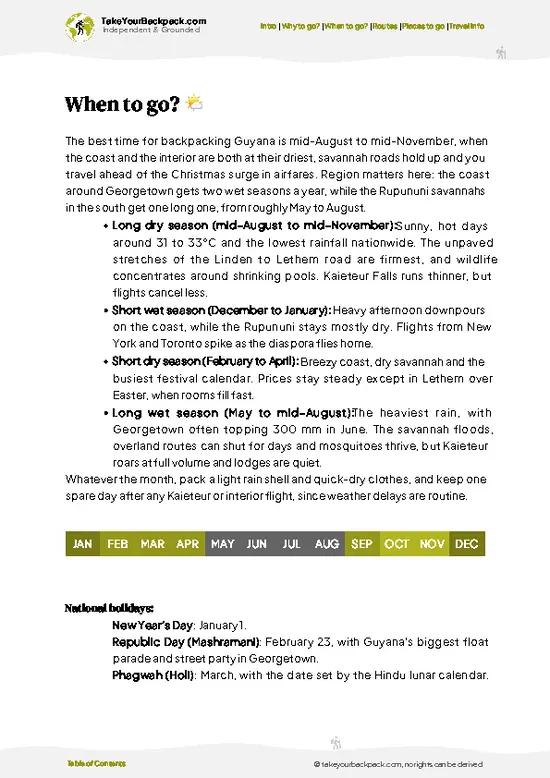
Best months for village visits: September to November is the best window for villages in Guyana, because the long dry season has dried the red laterite roads and the savannah trails, and the rivers still carry enough water for boats. February to April is the second, shorter dry spell and works almost as well.
Rain and road conditions: Guyana has two wet seasons, roughly May to mid-August and mid-November to January. Georgetown and the coast get 2,000 to 2,800 mm of rain a year, and in June the downpours arrive as warm, loud afternoon sheets that turn clay tracks into slick, orange paste. In the interior, the Rupununi savannah floods between May and August, and the Lethem to Georgetown road can stall trucks for a day or more. In the dry months the same savannah goes pale gold and dusty, with … read more 👉
Best months for village visits: September to November is the best window for villages in Guyana, because the long dry season has dried the red laterite roads and the savannah trails, and the rivers still carry enough water for boats. February to April is the second, shorter dry spell and works almost as well.
Rain and road conditions: Guyana has two wet seasons, roughly May to mid-August and mid-November to January. Georgetown and the coast get 2,000 to 2,800 mm of rain a year, and in June the downpours arrive as warm, loud afternoon sheets that turn clay tracks into slick, orange paste. In the interior, the Rupununi savannah floods between May and August, and the Lethem to Georgetown road can stall trucks for a day or more. In the dry months the same savannah goes pale gold and dusty, with cracked ground and a dry-grass smell by midday.
Temperatures and shoulder seasons: Expect 26 to 32°C on the coast year-round, with humidity around 80 percent and a sea breeze in the evening. The Rupununi runs hotter, often 33 to 36°C in September and October, with cool nights near 20°C. Rainforest villages in the Iwokrama and Essequibo areas stay damp and warm in every season. May and December make good shoulder months for lower prices and green, loud forest, but expect delays and mud.
Crowds and prices: Village stays stay quiet nearly all year. Demand peaks around Easter, Mashramani in February, and Christmas, when seats on domestic flights and minibuses fill and fares rise by 10 to 25 percent. Rupununi Rodeo around Easter fills Lethem-area lodging fast, so book ahead.

village hoppingHow to Combine villages Into One Trip

Trip length: A trip combining several villages in Guyana needs 10 to 14 days, because every transfer eats half a day or more. The country splits into three clusters: the coast around Georgetown, the Rupununi savanna reached via Lethem, and the rainforest rivers of the Essequibo, Mazaruni and Potaro areas.
Direction of travel: Start in Georgetown for permits, cash and bookings, then head to the interior while you are fresh. Flying to Lethem or Annai takes about 1.5 hours, while the overland route from Georgetown through Linden and Mabura Hill to Annai usually takes 10 to 14 hours in dry weather and far longer in rain. Moving south through the savanna and returning by air avoids backtracking on the worst road. Coastal stops fit before or after, by minibus or taxi from Stabroek Market.
Pacing and … read more 👉
Trip length: A trip combining several villages in Guyana needs 10 to 14 days, because every transfer eats half a day or more. The country splits into three clusters: the coast around Georgetown, the Rupununi savanna reached via Lethem, and the rainforest rivers of the Essequibo, Mazaruni and Potaro areas.
Direction of travel: Start in Georgetown for permits, cash and bookings, then head to the interior while you are fresh. Flying to Lethem or Annai takes about 1.5 hours, while the overland route from Georgetown through Linden and Mabura Hill to Annai usually takes 10 to 14 hours in dry weather and far longer in rain. Moving south through the savanna and returning by air avoids backtracking on the worst road. Coastal stops fit before or after, by minibus or taxi from Stabroek Market.
Pacing and mistakes: Allow 2 to 3 nights per interior stop, and one night for a coastal visit. Savanna villages are 1 to 4 hours apart by 4x4, and river communities may need a half-day boat.

Travelers often squeeze in too many stops, trust a bus timetable that does not exist, or ignore the rains. Instead, book transport days ahead, leave a buffer day before international flights, and keep the schedule loose enough to wait out a flooded track.

The ListThe Best villages of Guyana

1 Surama

Surama Mountain, Burro Burro canoe, Makushi benabs, cassava demonstration

Climb through forest to a rocky lookout, paddle the Burro Burro for caiman and otters, and watch Makushi hosts bake cassava bread.

2 Annai

Rock View Lodge, anteater savannah, Bina Hill visit, Rupununi road stop

Watch hummingbirds from a lodge veranda, ride horses across open grassland, and search for giant anteaters along quiet tracks at dawn.

3 Aishalton

Makatau petroglyphs, Wapishana lanes, savanna creeks, remote south Rupununi

Hike with a local guide up Makatau’s boulders to carved timehri, then cool off in the village creeks and watch cassava being processed.

guyana-city-aishalton
© Google |

4 Paramakatoi

Mountain ridge, misty valleys, Patamona lanes, waterfall paths

Look out over forested valleys from a cool ridge at dawn, follow guided footpaths to creeks and falls, and walk the village’s packed-earth lanes.

5 Kurupukari

Pontoon ferry, Essequibo crossing, checkpoint stop, Iwokrama edge

Cross the broad Essequibo on a slow steel pontoon, scan the bank for kingfishers, and join a guided walk into the forest at the reserve’s edge.

6 Rockstone

Essequibo crossing, Fish Festival, Gluck Island boats, Golden Beach

Catch a boat from the riverbank to Gluck Island and Golden Beach for swimming and birdwatching, or time a visit for the annual fish festival.

7 Mabaruma

Hill viewpoint, Region 1 town, produce market, Hosororo trails

Climb the hill above town for views over canopy, browse the market for cassava and citrus, and arrange forest walks toward Hosororo.

8 Port Kaituma

Jonestown site, Kaituma landing, frontier market, gold-country hub

Visit the forest-reclaimed Jonestown site with a local guide, watch boats and fuel drums arrive at the river landing, and browse the miners’ market.

9 Kamarang

Mazaruni landing, dirt airstrip, Akawaio hub, upriver gateway

Watch light planes land among gathered villagers, wander red dirt lanes, and swim in tea-colored shallows where boats load fuel for upriver.

Loading the map 🌍

Expert viewInsights from Locals and Experts

How many villages: Visit three to four villages on one trip, because each interior transfer costs half a day on rough track or river, and you only see a community properly by staying at least two nights. That gives you time for a morning walk with a village guide, a dinner of cassava bread and pepperpot, and an evening when the only light is stars and a kerosene lamp.
Choosing the kind: For wildlife and birding, prioritize savanna and forest-edge Indigenous communities, where guides track giant anteaters, caiman and macaws. For culture and food, add one Indigenous interior stay run by the community itself. If your budget is tight, or your time short, choose coastal villages, reachable by minibus, with sugar-estate history, Hindu temples, mosques and rum shops. Mixing one of each gives the clearest … read more 👉
How many villages: Visit three to four villages on one trip, because each interior transfer costs half a day on rough track or river, and you only see a community properly by staying at least two nights. That gives you time for a morning walk with a village guide, a dinner of cassava bread and pepperpot, and an evening when the only light is stars and a kerosene lamp.
Choosing the kind: For wildlife and birding, prioritize savanna and forest-edge Indigenous communities, where guides track giant anteaters, caiman and macaws. For culture and food, add one Indigenous interior stay run by the community itself. If your budget is tight, or your time short, choose coastal villages, reachable by minibus, with sugar-estate history, Hindu temples, mosques and rum shops. Mixing one of each gives the clearest picture of the country.
What it costs: Budget US$50 to 90 a day in the interior, since transport is the big expense, and US$25 to 40 on the coast. Community guesthouses typically charge about US$20 to 50 a night per person with meals extra or included at US$8 to 15. Village guides run about US$25 to 60 a day, and some communities add a visitor or camera fee of US$5 to 20. Shared 4x4 transfers cost roughly US$30 to 80 a seat, and small flights run US$150 to 250 each way. Carry Guyanese dollars in small notes, since cards and ATMs vanish outside towns.
Safety and etiquette: Villages are generally welcoming, but ask first. Many are on titled Indigenous land where the village council (the Toshao leads it) expects visitors to register, hire a local guide and follow its rules. Photograph people only with permission, dress modestly (long shorts, covered shoulders), and buy crafts directly from makers. Alcohol rules vary, so follow the host.

Health matters more than crime out here. Bring DEET repellent, a long-sleeved shirt for dusk, a water filter, and proof of yellow fever vaccination, which is required for entry in many cases. Malaria occurs in the interior, so discuss prophylaxis with a travel clinic. Medical help can be hours away, so pack a basic kit. On the coast, stay alert at night in Georgetown and use registered taxis after dark.

✈️ The backpacker research shortcutGuyana Travel Guide

An offline-friendly backpacking guide with optimized travel routes, ranked highlights, transport advice, and the best areas to stay.
example page 0 from our offline Travel Guide for Guyana
example page 1 from our offline Travel Guide for Guyana
example page 2 from our offline Travel Guide for Guyana
example page 3 from our offline Travel Guide for Guyana
example page 4 from our offline Travel Guide for Guyana
example page 5 from our offline Travel Guide for Guyana
example page 6 from our offline Travel Guide for Guyana
example page 7 from our offline Travel Guide for Guyana
The digital guide (161 pages) contains:
✅ 43 highlights, ranked by travel appeal
✅ Optimized 5, 10 & 15-day travel routes
✅ Cities, national parks, landmarks, beaches
✅ How to get around
✅ Offline-friendly for travel without Wi-Fi
👉 Click to see all 30+ guide features

📅 Plan smarter in minutes, not weeks
✅ Month by month travel advice
✅ Festivals & national holidays
✅ Budget expectations

🗺️ Go to the right places, skip the overrated ones
✅ Honest pros & cons of destinations
✅ Top hikes, parks & viewpoints
✅ Lesser-known places most travelers miss
✅ Clear “worth it vs skip it” guidance

🛏️ Travel smoothly without rookie mistakes
✅ Best areas to stay
✅ Transport systems explained simply
✅ Common scams & safety advice
✅ SIM cards, money & practical tips

🌍 Understand the country, not just visit it
✅ Culture & traditions
✅ Local customs
✅ Festivals worth planning around
✅ Traveler-friendly historical context
✅ Insights that make places more meaningful

📱 Built for real travel conditions
✅ Fully downloadable PDF
✅ Works completely offline
✅ Optimized for phone use
✅ Useful in remote areas & buses
✅ Everything in one place
Stop searching, start planning
Get instant access to your full guide. 30‑day money-back guarantee.
+ Add another guide for just

By proceeding you agree to our terms.
Sent to your inbox immediately after payment • 100% Secure Checkout
Best Backpacking Travel Advisor 2025 tourism awardBest Backpacking
Travel Advisor
2025
What others say about Take Your Backpack Guides:
⭐⭐⭐⭐⭐
Fantastic, amazing amount of information!
⭐⭐⭐⭐⭐
My goodness this is amazing, it's what I've been looking for hats off too you!
⭐⭐⭐⭐⭐
I think this is absolutely BRILLIANT
⭐⭐⭐⭐
Very complete and informative. It's still missing places, but I gotta to commend you
⭐⭐⭐⭐⭐
This is truly amazing, thank you, can't wait to explore it with my kids!
⭐⭐⭐⭐⭐
Awesome resource, thank you!
⭐⭐⭐⭐⭐
This is amazing! Can't wait to explore the ones I haven't seen
⭐⭐⭐⭐
I love this! Well done, great idea.
⭐⭐⭐⭐⭐
Thanks for taking the time to make this gem!
⭐⭐⭐⭐⭐
This might be the best website I've ever seen.
⭐⭐⭐⭐⭐
Congratulations, and thank you so much for your work; it's incredibly valuable.
⭐⭐⭐⭐
In all seriousness I think you did a great job pointing out the important spots
⭐⭐⭐⭐⭐
10/10 very good
⭐⭐⭐⭐⭐
As someone who's only just starting to visit regularly this is awesome, thank you.
⭐⭐⭐⭐
Thank you very much! I'm going to visit my dad, it's going to be very useful!
⭐⭐⭐⭐⭐
This is really cool! We'll be travelling for the first time and this definitely come in handy.
⭐⭐⭐⭐⭐
You are now our minister of culture, congratulations 👨‍💼
⭐⭐⭐⭐⭐
Just wanted to tell you that this is a pearl! Going to follow your recommendations.
⭐⭐⭐⭐⭐
This is so cool. I'll definitely be using the resource for my travels soon.
⭐⭐⭐⭐⭐
This is very impressive! Good work.
⭐⭐⭐⭐⭐
This is an amazing and informative site. Very well done!

🛏️ Where to stay?Top Areas to Stay

Guyana has only a handful of true backpacker hostels, so most budget travelers stay in simple guesthouses and small family-run hotels in Georgetown, where a private room usually costs US$25 to 50 a night. Kingston and the streets near the seawall put you closest to restaurants, bars and weekend nightlife, while leafy Queenstown is quieter and more residential but still walkable to the center. Bel Air and Lamaha Gardens feel safer and calmer after dark at the cost of a taxi ride everywhere, and the area around Stabroek is cheap and central but best avoided once the market closes.

If you enjoy meeting fellow travelers, consider choosing hostels with high ratings for atmosphere. On the other hand, … read more 👉
Guyana has only a handful of true backpacker hostels, so most budget travelers stay in simple guesthouses and small family-run hotels in Georgetown, where a private room usually costs US$25 to 50 a night. Kingston and the streets near the seawall put you closest to restaurants, bars and weekend nightlife, while leafy Queenstown is quieter and more residential but still walkable to the center. Bel Air and Lamaha Gardens feel safer and calmer after dark at the cost of a taxi ride everywhere, and the area around Stabroek is cheap and central but best avoided once the market closes.

If you enjoy meeting fellow travelers, consider choosing hostels with high ratings for atmosphere. On the other hand, if you prefer having your own space, a hotel might be a better option.

GuyanaDiscover the Country

👋 Meet the founderWho’s Behind Take Your Backpack?

Johan, backpacker and founder of TakeYourBackpackHi, I’m Johan (Netherlands 🇳🇱), the creator of TakeYourBackpack. Over the past 3 decades, I’ve backpacked through 90+ countries across six continents, gaining extensive experience with independent travel, long-term trips, and overland routes.

This site is built on a combination of firsthand travel experience and carefully curated insights from other backpackers. Many guides are based on places I’ve personally visited, while others bring together tips, observations, and practical advice shared by trusted travelers I’ve met along the way.

The goal is to provide realistic, experience-driven guidance — not generic itineraries — so you can explore destinations with better context, clearer expectations, and more confidence.