

×

Haiti🇭🇹 | attractionsNational Theatre of Haitimodern auditorium, performance venue, cultural programming, city landmark | things to do and best time to go

Explore Place d’Armes and Historic Quarter of Cap-HaïtienExplore Cormier Plage

Backpacking in National Theatre of Haiti
👀 For curious travelersattraction ranked #13
By Johan Kruseman 🇳🇱 | Updated September 4, 2026

A drumbeat ricochets off concrete walls, sweat beads on your brow, and the air is thick with incense and anticipation—then, a dancer’s bare feet slap the stage, and the crowd erupts, not with polite applause but with a full-throated, contagious roar. That’s the National Theatre of Haiti: raw, electric, and utterly unfiltered, right in the heart of Port-au-Prince, just north of the city center. Forget the Instagram fantasy of pristine colonial facades—this is Haiti’s cultural engine room, where art is survival and every performance feels like a minor miracle. Backpackers won’t find glossy tourist polish or air-conditioned comfort here; you’ll get peeling paint, unpredictable showtimes, and ticket prices that swing from pocket change to “wait, really?” depending on the event. But you’ll also get a front-row seat to Haiti’s creative pulse, a place where history and resistance are danced, drummed, and shouted into being. Compared to the beaches or Citadelle Laferrière, the theatre is less about postcard beauty and more about adrenaline, soul, and the kind of communal energy you’ll remember long after your tan fades.

Discover everything you want to know in the 📖 Haiti Travel Guide.
Safety warning

The current risk level for Haiti is high. Check the advice before going.


Get your Haiti guide
98 ranked highlights, routes & tips, works offline (361 pages)
Loading the map 🌍
CLICK TO FILTER
cities
towns
villages
landmarks
national parks
hikes
beaches
attractions
festivals
SHOW COUNTRY’S BESTSHOW ALL

✨ Why go?
Ranked #13 attraction in Haiti
What makes this attraction worth visiting

The National Theatre of Haiti isn’t your typical postcard stop. Sure, it’s not a polished, tourist-packed spectacle like the Eiffel Tower or Sydney Opera House. Expect crowds, yes—but not the kind that drown out the soul of the place. This theatre is a raw, pulsating heart of Haitian culture, where history and art collide in a way that’s impossible to fake. It’s iconic because it’s one of the few venues where you can witness Haiti’s complex story unfold live—through plays, music, and dance that carry the weight of centuries of struggle and resilience.

Backpackers who make the trek here aren’t just ticking a box; they’re diving into a cultural milestone that’s as much about the people as the performances. The effort to get inside—navigating local transport, language quirks, and sometimes unpredictable … read more 👉
The National Theatre of Haiti isn’t your typical postcard stop. Sure, it’s not a polished, tourist-packed spectacle like the Eiffel Tower or Sydney Opera House. Expect crowds, yes—but not the kind that drown out the soul of the place. This theatre is a raw, pulsating heart of Haitian culture, where history and art collide in a way that’s impossible to fake. It’s iconic because it’s one of the few venues where you can witness Haiti’s complex story unfold live—through plays, music, and dance that carry the weight of centuries of struggle and resilience.

Backpackers who make the trek here aren’t just ticking a box; they’re diving into a cultural milestone that’s as much about the people as the performances. The effort to get inside—navigating local transport, language quirks, and sometimes unpredictable schedules—pays off with an adrenaline rush that’s more than just entertainment. It’s a front-row seat to Haiti’s soul, raw and unfiltered. This isn’t a polished tourist trap; it’s a living, breathing testament to a nation’s spirit. For anyone serious about understanding Haiti beyond the headlines, the National Theatre is a non-negotiable stop on the route.
Want to include National Theatre of Haiti in your Haiti route?
Create a personalized Haiti itinerary that includes National Theatre of Haiti and the places that fit your trip — based on your travel style, budget, and available time. Get your route in seconds.

Generate my trip

💡 HighlightsWhat this place is best known for

1. Live Performances: Haitian Theater, Raw and Unfiltered
Forget velvet ropes and polite applause. The National Theatre of Haiti is where you get Haitian drama in its purest, most electric form. The actors don’t just perform—they channel the country’s history, humor, and heartbreak right into your lap. Expect Creole dialogue, political satire, and folklore that bites. The crowd is part of the show: people shout, laugh, and sometimes argue with the actors. If you want to see how a nation processes its struggles and joys, this is the front row seat. No Instagram filter can capture the energy when the house lights go down and the drums start.


2. Dance Shows: Vodou, Carnival, and the Pulse of Port-au-Prince
The dance troupes here don’t do polite pirouettes. They stomp, spin, and sweat through … read more 👉
1. Live Performances: Haitian Theater, Raw and Unfiltered
Forget velvet ropes and polite applause. The National Theatre of Haiti is where you get Haitian drama in its purest, most electric form. The actors don’t just perform—they channel the country’s history, humor, and heartbreak right into your lap. Expect Creole dialogue, political satire, and folklore that bites. The crowd is part of the show: people shout, laugh, and sometimes argue with the actors. If you want to see how a nation processes its struggles and joys, this is the front row seat. No Instagram filter can capture the energy when the house lights go down and the drums start.


2. Dance Shows: Vodou, Carnival, and the Pulse of Port-au-Prince
The dance troupes here don’t do polite pirouettes. They stomp, spin, and sweat through routines that pull from Vodou rituals, Carnival street parades, and the everyday grind of Haitian life. You’ll see bodies moving in ways that defy Western choreography—shoulders shaking, feet pounding, hips telling stories older than the city itself. The music is live, loud, and relentless. If you’re lucky enough to catch a major festival performance, you’ll leave with your heart thumping and your worldview rattled.


3. Music Concerts: Roots, Resistance, and the Real Sound of Haiti
This isn’t a touristy steel-drum sideshow. The National Theatre hosts concerts that showcase Haiti’s musical backbone—compas, rara, mizik rasin. The bands are local legends, and the sound system is built for volume, not subtlety. You’ll hear lyrics about revolution, love, and survival, often in Creole, sometimes in French, never in bland English. The crowd dances in the aisles. If you want to understand why music is Haiti’s lifeblood, this is where you plug in.


4. Street-Level Art Exhibits: Graffiti, Sculpture, and Political Fire
The lobby and public spaces double as a rotating gallery for Haiti’s visual artists. Don’t expect polite landscapes or safe abstracts. You’ll see graffiti murals, welded scrap-metal sculptures, and paintings that tackle poverty, protest, and pride head-on. The art is confrontational, sometimes chaotic, always alive. It’s not curated for foreign tastes—it’s made for Haitians, by Haitians, and it hits harder because of it.


5. Community Workshops: Where the Next Generation Gets Loud
The National Theatre isn’t just a stage—it’s a training ground. Local kids and young adults come here for acting, dance, and drumming workshops. Sometimes you can watch, sometimes you can join in. The energy is raw, the instruction is tough love, and the talent is real. If you want to see the future of Haitian culture being forged in real time, skip the gift shop and find a workshop in session. This is where the magic starts, long before the curtain rises.
Spotted a mistake or missing something? Contact us.

🌤️ When to go?When to go for the best experience


  • Weather: Haiti’s climate is tropical, so expect heat and humidity most of the year. The dry season from November to March offers more comfortable conditions, with less rain and a breeze that keeps things bearable. Avoid May to October if you hate sticky days and sudden downpours.

  • Temperature: Daytime highs hover around 28-32°C (82-90°F) during the dry months, cooling slightly at night. The wet season pushes temps up a notch, making it feel hotter and more oppressive.

  • Daylight Hours: Daylight is fairly consistent year-round, roughly 11 to 12 hours daily. This means you can plan your theatre visits without worrying about early sunsets cutting your experience short.

  • Crowds: The National Theatre isn’t a tourist magnet like the beaches, but local events and festivals can pack the house,
read more 👉

  • Weather: Haiti’s climate is tropical, so expect heat and humidity most of the year. The dry season from November to March offers more comfortable conditions, with less rain and a breeze that keeps things bearable. Avoid May to October if you hate sticky days and sudden downpours.

  • Temperature: Daytime highs hover around 28-32°C (82-90°F) during the dry months, cooling slightly at night. The wet season pushes temps up a notch, making it feel hotter and more oppressive.

  • Daylight Hours: Daylight is fairly consistent year-round, roughly 11 to 12 hours daily. This means you can plan your theatre visits without worrying about early sunsets cutting your experience short.

  • Crowds: The National Theatre isn’t a tourist magnet like the beaches, but local events and festivals can pack the house, especially during cultural celebrations in February and July. If you want space to breathe, avoid those peak event times.

  • Seasonal Activities: The theatre shines during Haiti’s Carnival season in February, with performances that pulse with raw energy and local flavor. If you want the full cultural immersion, this is your moment, but brace for crowds and higher prices.

  • Price Fluctuations: Ticket prices and accommodation nearby spike during Carnival and major festivals. Visiting in the shoulder months of April or November can save you cash and still deliver solid weather and fewer crowds.


Pro-tip: Aim for late November to early March to dodge the rain, dodge the crush, and catch the theatre when it’s alive but not overwhelmed.


source: climatestotravel.comJANJanuary: excellent for travelingFEBFebruary: highly recommended for travelingMARMarch: excellent for travelingAPRApril: highly recommended for travelingMAYMay: fair for travelingJUNJune: fair for travelingJULJuly: good for travelingAUGAugust: fair for travelingSEPSeptember: fair for travelingOCTOctober: fair for travelingNOVNovember: highly recommended for travelingDECDecember: excellent for traveling
when-to-go

✈️ The backpacker research shortcutHaiti Travel Guide

An offline-friendly backpacking guide with optimized travel routes, ranked highlights, transport advice, and the best areas to stay.
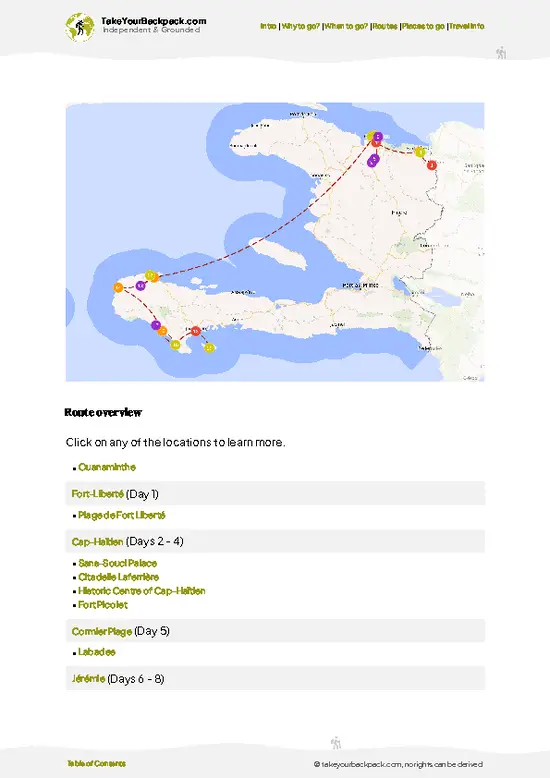
example page 0 from our offline Travel Guide for Haiti
example page 1 from our offline Travel Guide for Haiti
example page 2 from our offline Travel Guide for Haiti
example page 3 from our offline Travel Guide for Haiti
example page 4 from our offline Travel Guide for Haiti
example page 5 from our offline Travel Guide for Haiti
example page 6 from our offline Travel Guide for Haiti
example page 7 from our offline Travel Guide for Haiti
The digital guide (361 pages) contains:
98 highlights, ranked by travel appeal
Optimized 5, 10 & 15-day travel routes
Cities, national parks, landmarks, beaches
How to get around
Offline-friendly for travel without Wi-Fi
👉 Click to see all 30+ guide features

📅 Plan smarter in minutes, not weeks
Month by month travel advice
Festivals & national holidays
Budget expectations

🗺️ Go to the right places, skip the overrated ones
Honest pros & cons of destinations
Top hikes, parks & viewpoints
Lesser-known places most travelers miss
Clear “worth it vs skip it” guidance

🛏️ Travel smoothly without rookie mistakes
Best areas to stay
Transport systems explained simply
Common scams & safety advice
SIM cards, money & practical tips

🌍 Understand the country, not just visit it
Culture & traditions
52 Essential phrases & customs
Festivals worth planning around
Traveler-friendly historical context
Insights that make places more meaningful

📱 Built for real travel conditions
Fully downloadable PDF
Works completely offline
Optimized for phone use
Useful in remote areas & buses
Everything in one place
Save weeks of stressful planning
Get instant access to your full guide. 30‑day money-back guarantee.
+ Add another guide for just US$7.80

By proceeding you agree to our terms.
Sent to your inbox immediately after payment • 100% Secure Checkout
Best Backpacking Travel Advisor 2025 tourism awardBest Backpacking
Travel Advisor
2025
What others say about Take Your Backpack Guides:
⭐⭐⭐⭐⭐
Fantastic, amazing amount of information!
⭐⭐⭐⭐⭐
My goodness this is amazing, it's what I've been looking for hats off too you!
⭐⭐⭐⭐⭐
I think this is absolutely BRILLIANT
⭐⭐⭐⭐
Very complete and informative. It's still missing places, but I gotta to commend you
⭐⭐⭐⭐⭐
This is truly amazing, thank you, can't wait to explore it with my kids!
⭐⭐⭐⭐⭐
Awesome resource, thank you!
⭐⭐⭐⭐⭐
This is amazing! Can't wait to explore the ones I haven't seen
⭐⭐⭐⭐
I love this! Well done, great idea.
⭐⭐⭐⭐⭐
Thanks for taking the time to make this gem!
⭐⭐⭐⭐⭐
This might be the best website I've ever seen.
⭐⭐⭐⭐⭐
Congratulations, and thank you so much for your work; it's incredibly valuable.
⭐⭐⭐⭐
In all seriousness I think you did a great job pointing out the important spots
⭐⭐⭐⭐⭐
10/10 very good
⭐⭐⭐⭐⭐
As someone who's only just starting to visit regularly this is awesome, thank you.
⭐⭐⭐⭐
Thank you very much! I'm going to visit my dad, it's going to be very useful!
⭐⭐⭐⭐⭐
This is really cool! We'll be travelling for the first time and this definitely come in handy.
⭐⭐⭐⭐⭐
You are now our minister of culture, congratulations 👨‍💼
⭐⭐⭐⭐⭐
Just wanted to tell you that this is a pearl! Going to follow your recommendations.
⭐⭐⭐⭐⭐
This is so cool. I'll definitely be using the resource for my travels soon.
⭐⭐⭐⭐⭐
This is very impressive! Good work.
⭐⭐⭐⭐⭐
This is an amazing and informative site. Very well done!

🛏️ Where to stay?How to pick the right area

The National Theatre of Haiti sits smack in the middle of Port-au-Prince’s chaotic heart, and let’s be real: this isn’t a polished tourist zone. If you’re chasing the Instagram-perfect vibe, you’ll find crowds and noise, but not the sanitized charm of a postcard. The real magic here is gritty and raw, soaked in history and culture that’s impossible to fake.

For backpackers, the best places to stay are neighborhoods like Pétion-Ville and Delmas. Pétion-Ville is the safer, more upscale option, with a lively mix of cafes, bars, and art spaces where you can meet locals and fellow travelers without … read more 👉
The National Theatre of Haiti sits smack in the middle of Port-au-Prince’s chaotic heart, and let’s be real: this isn’t a polished tourist zone. If you’re chasing the Instagram-perfect vibe, you’ll find crowds and noise, but not the sanitized charm of a postcard. The real magic here is gritty and raw, soaked in history and culture that’s impossible to fake.

For backpackers, the best places to stay are neighborhoods like Pétion-Ville and Delmas. Pétion-Ville is the safer, more upscale option, with a lively mix of cafes, bars, and art spaces where you can meet locals and fellow travelers without feeling like you’re walking into a trap. It’s social, it’s buzzing, and it’s where you’ll catch the pulse of Haiti’s creative scene. Delmas, on the other hand, is more affordable and authentic, with a working-class vibe that’s less polished but more real. It’s where you get a sense of everyday Haitian life, and if you’re street-smart, it’s a great base to explore the city’s cultural landmarks, including the National Theatre.

Neither area is a luxury bubble, so expect power cuts, street noise, and the occasional hustle. But that’s part of the experience. Staying close to the theatre means you’re not just visiting a building—you’re stepping into the living, breathing story of Haiti’s resilience and artistry. That’s worth every bit of the discomfort.

👛 Costs (as of 4 September 2026)Travel costs and budget guide for National Theatre of Haiti

As of the most recent estimates, the National Theatre of Haiti does not have publicly available ticket prices. For the most accurate and up-to-date information, please visit the official website of the Ministry of Tourism and Creative Industries of Haiti.
⚠️ Prices can change and everyone travels differently, so take this as a rough guide. Hope it helps you plan your adventure!

FAQTraveler FAQ

30 to 45 minutes is sufficient to visit the National Theatre of Haiti, enough time to explore the architecture and any ongoing exhibitions or performances.
Yes, the National Theatre of Haiti is worth the entrance fee, which is typically around 200 Haitian gourdes. It offers a unique cultural experience showcasing Haitian performing arts and history.
To get to the National Theatre of Haiti, located in Port-au-Prince, take a local tap-tap or taxi from the city center. It is about 2 kilometers from the main market area, making it accessible by a short ride.
⚠️ Things can change over time, so always validate details locally before you go.

Other Haitian attractions near National Theatre of Haiti

Explore more nearby:


💡 Not sure where to go next?
Create a personalized itinerary for Haiti including National Theatre of Haiti and the places that fit your trip.

Generate my itinerary

👉 Discover all attractions

Or checkout all Haiti has to offer (think cities, towns, villages, national parks, hikes, beaches, festivals)
Country photo of Haiti

We 💚 feedbackKey takeaways before you go

The National Theatre of Haiti isn’t your polished, touristy stage—it’s raw, alive, and sometimes chaotic. Expect crowds that spill into the streets and a ticket line that tests your patience. But once inside, the energy is electric, like the heartbeat of a country refusing to be silenced. The real magic? The performances blend history, struggle, and hope in a way no glossy brochure can capture. If you want a show that’s more than entertainment—something that grabs your gut and won’t let go—this is it. Just don’t come expecting comfort; come ready to feel.

✍️ Help improve this page!
The information on this page is based on in-depth research, insights shared by experienced travelers, and feedback from the local travel community in Haiti. While every effort is made to keep the information accurate and current, conditions can change — so if you spot anything incorrect or outdated, please get in touch.


🙋‍♂️ Give feedback

👋 Meet the founderWho’s Behind Take Your Backpack?

Johan, backpacker and founder of TakeYourBackpackHi, I’m Johan (Netherlands 🇳🇱), the creator of TakeYourBackpack. Over the past decade, I’ve backpacked through 80+ countries across six continents, gaining extensive experience with independent travel, long-term trips, and overland routes.

This site is built on a combination of firsthand travel experience and carefully curated insights from other backpackers. Many guides are based on places I’ve personally visited, while others bring together tips, observations, and practical advice shared by trusted travelers I’ve met along the way.

The goal is to provide realistic, experience-driven guidance — not generic itineraries — so you can explore destinations with better context, clearer expectations, and more confidence.

Get full Haiti guide •
Instant download • 98 highlights • Full Offline guide