v2.webp)
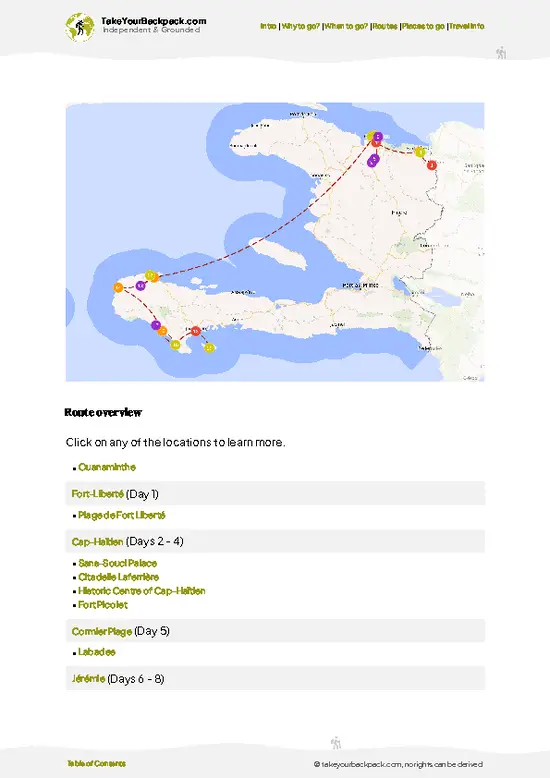
- Dajabón-Ouanaminthe Border Market (Binational Market): This is what Ouanaminthe is known for. Twice a week, on Monday and Friday, traders from both countries meet at the border bridge zone, and Haitian porters push loaded carts through the gate at a run. Go early, around 8 AM, before the heat peaks. Entry is free, though you need your passport and may pay a small crossing or guide fee of US$2 to 10. Allow 2 to 3 hours.
- Massacre River (Rivière Massacre) at the border bridge: The slow, shallow river forms the boundary with the Dominican Republic. Locals wash clothes and cross on foot on market days, and you can watch the whole scene from the Haitian bank. Mornings are cooler and busier. Free, and 30 to 45 minutes is plenty.
- Place d’Armes and the Cathédrale Sainte-Anne area: The central square
- Dajabón-Ouanaminthe Border Market (Binational Market): This is what Ouanaminthe is known for. Twice a week, on Monday and Friday, traders from both countries meet at the border bridge zone, and Haitian porters push loaded carts through the gate at a run. Go early, around 8 AM, before the heat peaks. Entry is free, though you need your passport and may pay a small crossing or guide fee of US$2 to 10. Allow 2 to 3 hours.
- Massacre River (Rivière Massacre) at the border bridge: The slow, shallow river forms the boundary with the Dominican Republic. Locals wash clothes and cross on foot on market days, and you can watch the whole scene from the Haitian bank. Mornings are cooler and busier. Free, and 30 to 45 minutes is plenty.
- Place d’Armes and the Cathédrale Sainte-Anne area: The central square and the church beside it are where the town’s daily life concentrates. Motorcycle taxis idle, vendors sell fruit and phone credit, and you can sit in the shade and take in how this frontier town works. Late afternoon is best, when it cools and people gather. Free, about 45 minutes.
- Grand Marché of Ouanaminthe: The main covered market sells secondhand clothes, rice, plantains, charcoal, and goods hauled across from the Dominican side. It is loud and crowded, so keep your phone in a front pocket and go before noon. Browsing is free, and a snack or drink costs US$1 to 3. Allow about 1 hour.
- Parc Industriel de Codevi: This large industrial park beside the border explains why the town has grown so fast, with garment factories employing thousands. Visiting inside generally needs prior permission, so most travelers simply see the zone and the worker traffic from the road at shift change. Free from outside, and 20 to 30 minutes is enough.
Spotted a mistake or missing something? Contact us.

 Best Backpacking
.jpg) Hi, I’m Johan (Netherlands 🇳🇱), the creator of TakeYourBackpack. Over the past 3 decades, I’ve backpacked through 90+ countries across six continents, gaining extensive experience with independent travel, long-term trips, and overland routes.
Hi, I’m Johan (Netherlands 🇳🇱), the creator of TakeYourBackpack. Over the past 3 decades, I’ve backpacked through 90+ countries across six continents, gaining extensive experience with independent travel, long-term trips, and overland routes.