×

Indonesia🇮🇩 | attractionsBorobudur Temple CompoundsStupa terraces, volcanic stone, sunrise entry, Java | things to do and best time to go

Explore TetebatuExplore Taman Mini Indonesia Indah

Backpacking in Borobudur Temple Compounds
By Johan Kruseman 🇳🇱 | Updated October 15, 2026

Forget the idea that you can stroll up at dawn and watch the sun rise from the top terrace. Climbing is now capped at roughly 1,200 visitors a day, you need a timed slot, and you wear special woven sandals. Borobudur sits in Magelang Regency, Central Java, about 40 km northwest of Yogyakarta. The monument is the world’s largest Buddhist temple, and it still floors you. Foreign tickets cost far more than local ones, and midday heat bakes the stone, so crowds and costs are real. But walk the galleries slowly and the 2,600-plus carved panels turn into a stone comic strip. I once pressed my palm against a warm andesite wall at 7 a.m., tracing a carved ship while mist peeled off the Menoreh hills. That moment beat anything in the ticket price. Compared with Bali’s temples, this is quieter, older and more solemn. Come early, bring water, and move.

Discover everything you want to know in the 📖 Indonesia Travel Guide.


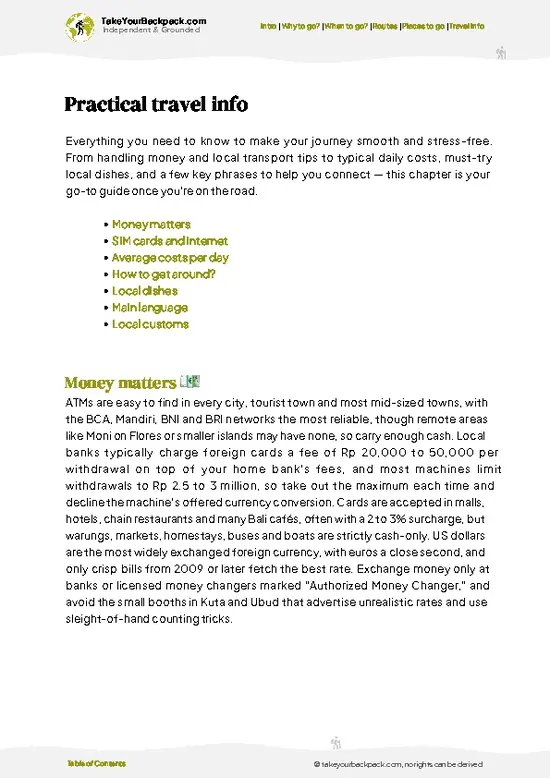
example page 0 from our offline Travel Guide for Indonesia
example page 1 from our offline Travel Guide for Indonesia
example page 2 from our offline Travel Guide for Indonesia
example page 3 from our offline Travel Guide for Indonesia
example page 4 from our offline Travel Guide for Indonesia
example page 5 from our offline Travel Guide for Indonesia
example page 6 from our offline Travel Guide for Indonesia
example page 7 from our offline Travel Guide for Indonesia
Loading the map 🌍
CLICK TO FILTER
cities
towns
villages
landmarks
national parks
hikes
beaches
attractions
festivals
regions
SHOW COUNTRY’S BESTSHOW ALL

✨ Why go?
Ranked #99 attraction in Indonesia
What makes it a must-see attraction

Backpackers make time for Borobudur because it is the anchor of any Java route. Few places in Southeast Asia match its scale: nine stacked platforms, 72 bell-shaped stupas and a central dome, built in the 8th and 9th centuries under the Sailendra dynasty. It is a Mahayana Buddhist monument designed as a walking path, so you climb through carved stories of daily life, karma and enlightenment before reaching open terraces with bare stupas and wide views. The UNESCO World Heritage listing (1991) is deserved. It is also easy to reach from Yogyakarta, so it fits a day trip or an overnight. The effort is modest: an early start and some stairs. Pair it with Mendut and Pawon temples on the same alignment, or with a sunrise at a nearby hill viewpoint. If you only see one ancient site in Indonesia, … read more 👉
Backpackers make time for Borobudur because it is the anchor of any Java route. Few places in Southeast Asia match its scale: nine stacked platforms, 72 bell-shaped stupas and a central dome, built in the 8th and 9th centuries under the Sailendra dynasty. It is a Mahayana Buddhist monument designed as a walking path, so you climb through carved stories of daily life, karma and enlightenment before reaching open terraces with bare stupas and wide views. The UNESCO World Heritage listing (1991) is deserved. It is also easy to reach from Yogyakarta, so it fits a day trip or an overnight. The effort is modest: an early start and some stairs. Pair it with Mendut and Pawon temples on the same alignment, or with a sunrise at a nearby hill viewpoint. If you only see one ancient site in Indonesia, this is the one that sets the standard, and it makes a strong contrast with the volcano hikes and beaches elsewhere on your route.

💡 HighlightsWhat this place is best known for

  1. The Relief Galleries: Around 2,670 carved panels wrap the lower levels, showing Buddhist teachings, royal life and village scenes. Walk them clockwise, as pilgrims do, and you read a story from base to summit.
  2. The Upper Circular Terraces: Three round platforms hold 72 perforated stupas, each hiding a seated Buddha. Peeking through the diamond holes is the monument’s most playful moment.
  3. The Central Stupa: The largest, topmost dome sits above the rest. The summit view across rice fields, palms and volcanoes is the payoff for the climb.
  4. Ship Relief Panel: One carving shows an outrigger ship, evidence of ancient maritime links across the Indian Ocean. It inspired the Samudraraksa replica voyage to Africa in 2003 to 2004.
  5. Buddha Statues: About 500 statues line the balustrades, each with a different
… read more 👉
  1. The Relief Galleries: Around 2,670 carved panels wrap the lower levels, showing Buddhist teachings, royal life and village scenes. Walk them clockwise, as pilgrims do, and you read a story from base to summit.
  2. The Upper Circular Terraces: Three round platforms hold 72 perforated stupas, each hiding a seated Buddha. Peeking through the diamond holes is the monument’s most playful moment.
  3. The Central Stupa: The largest, topmost dome sits above the rest. The summit view across rice fields, palms and volcanoes is the payoff for the climb.
  4. Ship Relief Panel: One carving shows an outrigger ship, evidence of ancient maritime links across the Indian Ocean. It inspired the Samudraraksa replica voyage to Africa in 2003 to 2004.
  5. Buddha Statues: About 500 statues line the balustrades, each with a different hand gesture (mudra) facing a cardinal direction. Many are headless, a sad result of looting, but the details still reward a close look.
  6. Mendut and Pawon Temples: These smaller temples line up with Borobudur and sit within a few kilometers. Mendut has a huge seated Buddha inside, and Pawon is a compact, finely carved shrine. A walk or bike ride links them through villages.
  7. Sunrise from Punthuk Setumbu: This nearby hill gives you a view of Borobudur emerging from morning mist, with volcanoes behind. It costs little and avoids ticket quotas.
I would pick the relief galleries first. They are what separates Borobudur from any other hilltop temple, and early in the day they are quiet enough to read properly.
Spotted a mistake or missing something? Contact us.

Things to do around Borobudur Temple Compounds

Ratings based on Tripadvisor reviews. When you book through this link, you support our work at no extra cost to you.

🌤️ When to go?Seasonal considerations and timing

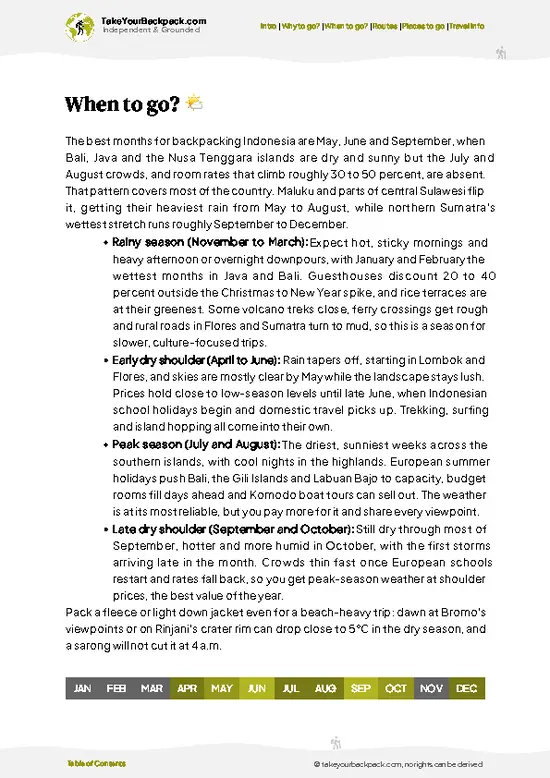
The best window is May to September, when the dry season gives clear skies and the least rain on the stone steps.
  • Dry Season (May to September): Days run 22 to 32°C (72 to 90°F), mornings are cool and clear, and sunrise around 5:30 a.m. gives soft light. Crowds and prices peak in June to August.
  • Wet Season (November to March): Expect 23 to 31°C (73 to 88°F), heavy afternoon downpours and slippery steps. Mist can hide views, but visitors thin out and accommodation is cheaper.
  • Shoulder Months (April and October): Weather is mixed, with fewer people and fair rates.
  • Vesak (May or June): Buddhist pilgrims and monks gather for ceremonies at Mendut, Pawon and Borobudur. It is atmospheric but busy, and rooms book out.
  • Indonesian Holidays: Lebaran and school breaks bring domestic crowds and higher prices.
… read more 👉
The best window is May to September, when the dry season gives clear skies and the least rain on the stone steps.
  • Dry Season (May to September): Days run 22 to 32°C (72 to 90°F), mornings are cool and clear, and sunrise around 5:30 a.m. gives soft light. Crowds and prices peak in June to August.
  • Wet Season (November to March): Expect 23 to 31°C (73 to 88°F), heavy afternoon downpours and slippery steps. Mist can hide views, but visitors thin out and accommodation is cheaper.
  • Shoulder Months (April and October): Weather is mixed, with fewer people and fair rates.
  • Vesak (May or June): Buddhist pilgrims and monks gather for ceremonies at Mendut, Pawon and Borobudur. It is atmospheric but busy, and rooms book out.
  • Indonesian Holidays: Lebaran and school breaks bring domestic crowds and higher prices.
Book the earliest climbing slot, since the stone gets hot by 10 a.m.


source: climatestotravel.comJANJanuary: fair for travelingFEBFebruary: fair for travelingMARMarch: fair for travelingAPRApril: fair for travelingMAYMay: highly recommended for travelingJUNJune: excellent for travelingJULJuly: highly recommended for travelingAUGAugust: highly recommended for travelingSEPSeptember: highly recommended for travelingOCTOctober: fair for travelingNOVNovember: fair for travelingDECDecember: fair for traveling
when-to-go

✈️ The backpacker research shortcutIndonesia Travel Guide

An offline-friendly backpacking guide with optimized travel routes, ranked highlights, transport advice, and the best areas to stay.
example page 0 from our offline Travel Guide for Indonesia
example page 1 from our offline Travel Guide for Indonesia
example page 2 from our offline Travel Guide for Indonesia
example page 3 from our offline Travel Guide for Indonesia
example page 4 from our offline Travel Guide for Indonesia
example page 5 from our offline Travel Guide for Indonesia
example page 6 from our offline Travel Guide for Indonesia
example page 7 from our offline Travel Guide for Indonesia
The digital guide (460 pages) contains:
✅ 153 highlights, ranked by travel appeal
✅ Optimized 14, 21 & 30-day travel routes
✅ Cities, national parks, landmarks, beaches
✅ How to get around
✅ Offline-friendly for travel without Wi-Fi
👉 Click to see all 30+ guide features

📅 Plan smarter in minutes, not weeks
✅ Month by month travel advice
✅ Festivals & national holidays
✅ Budget expectations

🗺️ Go to the right places, skip the overrated ones
✅ Honest pros & cons of destinations
✅ Top hikes, parks & viewpoints
✅ Lesser-known places most travelers miss
✅ Clear “worth it vs skip it” guidance

🛏️ Travel smoothly without rookie mistakes
✅ Best areas to stay
✅ Transport systems explained simply
✅ Common scams & safety advice
✅ SIM cards, money & practical tips

🌍 Understand the country, not just visit it
✅ Culture & traditions
✅ 52 Essential phrases & customs
✅ Festivals worth planning around
✅ Traveler-friendly historical context
✅ Insights that make places more meaningful

📱 Built for real travel conditions
✅ Fully downloadable PDF
✅ Works completely offline
✅ Optimized for phone use
✅ Useful in remote areas & buses
✅ Everything in one place
Stop searching, start planning
Get instant access to your full guide. 30‑day money-back guarantee.
+ Add another guide for just

By proceeding you agree to our terms.
Sent to your inbox immediately after payment • 100% Secure Checkout
Best Backpacking Travel Advisor 2025 tourism awardBest Backpacking
Travel Advisor
2025
What others say about Take Your Backpack Guides:
⭐⭐⭐⭐⭐
Fantastic, amazing amount of information!
⭐⭐⭐⭐⭐
My goodness this is amazing, it's what I've been looking for hats off too you!
⭐⭐⭐⭐⭐
I think this is absolutely BRILLIANT
⭐⭐⭐⭐
Very complete and informative. It's still missing places, but I gotta to commend you
⭐⭐⭐⭐⭐
This is truly amazing, thank you, can't wait to explore it with my kids!
⭐⭐⭐⭐⭐
Awesome resource, thank you!
⭐⭐⭐⭐⭐
This is amazing! Can't wait to explore the ones I haven't seen
⭐⭐⭐⭐
I love this! Well done, great idea.
⭐⭐⭐⭐⭐
Thanks for taking the time to make this gem!
⭐⭐⭐⭐⭐
This might be the best website I've ever seen.
⭐⭐⭐⭐⭐
Congratulations, and thank you so much for your work; it's incredibly valuable.
⭐⭐⭐⭐
In all seriousness I think you did a great job pointing out the important spots
⭐⭐⭐⭐⭐
10/10 very good
⭐⭐⭐⭐⭐
As someone who's only just starting to visit regularly this is awesome, thank you.
⭐⭐⭐⭐
Thank you very much! I'm going to visit my dad, it's going to be very useful!
⭐⭐⭐⭐⭐
This is really cool! We'll be travelling for the first time and this definitely come in handy.
⭐⭐⭐⭐⭐
You are now our minister of culture, congratulations 👨‍💼
⭐⭐⭐⭐⭐
Just wanted to tell you that this is a pearl! Going to follow your recommendations.
⭐⭐⭐⭐⭐
This is so cool. I'll definitely be using the resource for my travels soon.
⭐⭐⭐⭐⭐
This is very impressive! Good work.
⭐⭐⭐⭐⭐
This is an amazing and informative site. Very well done!

🛏️ Where to stay?Where staying makes the most sense

Yogyakarta is the best base for most backpackers, since Borobudur is about 40 km away and a 1 to 1.5 hour trip each way. The Prawirotaman area is the social hub, with relaxed streets, cafés, bars and many travelers swapping route tips. Sosrowijayan, near Malioboro and the train station, is the classic budget lane. It is cramped and noisy but cheap, with easy access to buses and tour desks. Both areas are safe at night and walkable, and both let you arrange early minivans or taxis to the temple.

If you want sunrise or an unhurried morning, stay in the villages around Borobudur itself, such as Borobudur … read more 👉
Yogyakarta is the best base for most backpackers, since Borobudur is about 40 km away and a 1 to 1.5 hour trip each way. The Prawirotaman area is the social hub, with relaxed streets, cafés, bars and many travelers swapping route tips. Sosrowijayan, near Malioboro and the train station, is the classic budget lane. It is cramped and noisy but cheap, with easy access to buses and tour desks. Both areas are safe at night and walkable, and both let you arrange early minivans or taxis to the temple.

If you want sunrise or an unhurried morning, stay in the villages around Borobudur itself, such as Borobudur village and Karanganyar. Here homestays and small guesthouses are quieter, family-run and cheap, and you can walk or ride a bike to Mendut, Pawon and Punthuk Setumbu before the day-trip crowds arrive. Evenings are very quiet, with few places to eat after dark, and the social scene is thin, so this suits couples and solo travelers who value calm over nightlife.

Magelang town is a middle option, with more food choices and local bus links, though fewer travelers. For most trips, two nights in Yogyakarta plus one night near the temple works well.

👛 Costs (as of 15 October 2026)How expensive it really is

A visit to Borobudur costs roughly USD 25 to 35 for the ticket and USD 35 to 70 per day all in, including transport from Yogyakarta, food and a sunrise viewpoint.
CategoryBudget RangeLocal Reality
Courtyard entry (foreigners)USD 25 to 30Lets you walk the grounds and see the monument from below. Prices are set in rupiah and change from time to time.
Climbing ticket (foreigners)USD 30 to 35Limited to about 1,200 climbers daily in timed slots. Book ahead online for busy dates.
Student discountUSD 15 to 20Valid student ID is usually required.
Upanat sandalsIncluded or about USD 1 to 3Mandatory woven sandals protect the stone steps.
Punthuk Setumbu sunriseUSD 2 to 4A hill viewpoint near the temple, paid at the gate.
Mendut and Pawon templesUSD 2 to 5 eachSmaller sites nearby, sometimes bundled in packages.
… read more 👉
A visit to Borobudur costs roughly USD 25 to 35 for the ticket and USD 35 to 70 per day all in, including transport from Yogyakarta, food and a sunrise viewpoint.
CategoryBudget RangeLocal Reality
Courtyard entry (foreigners)USD 25 to 30Lets you walk the grounds and see the monument from below. Prices are set in rupiah and change from time to time.
Climbing ticket (foreigners)USD 30 to 35Limited to about 1,200 climbers daily in timed slots. Book ahead online for busy dates.
Student discountUSD 15 to 20Valid student ID is usually required.
Upanat sandalsIncluded or about USD 1 to 3Mandatory woven sandals protect the stone steps.
Punthuk Setumbu sunriseUSD 2 to 4A hill viewpoint near the temple, paid at the gate.
Mendut and Pawon templesUSD 2 to 5 eachSmaller sites nearby, sometimes bundled in packages.
Transport from YogyakartaUSD 2 to 20Local buses from Jombor terminal cost little, while ride-hailing or a private car is USD 12 to 25 each way.
Food and drinkUSD 3 to 10Warungs near the gates are cheap, while on-site cafés cost more.
GuideUSD 10 to 25Official guides charge a set rate per group.
⚠️ Prices can change and everyone travels differently, so take this as a rough guide. Hope it helps you plan your adventure!

FAQFrequently asked questions about Borobudur Temple Compounds

Plan three to four hours at the main monument itself, or a full day if you add Mendut and Pawon temples and a sunrise at Punthuk Setumbu. The climb is limited to timed slots, so budget about an hour for the terraces and the same for the relief galleries. Day trips from Yogyakarta take 1 to 1.5 hours each way, so an overnight in a nearby village lets you enjoy it without rushing.
For most travelers the ticket, at roughly USD 25 to 35 for foreigners, is worth paying once, particularly the climbing ticket that gets you onto the upper terraces. You get around 2,600 carved panels, 72 stupas on the summit and a major UNESCO site that is the largest Buddhist temple in the world. Go at opening time to avoid heat and crowds, and skip it only if you are on a very tight budget, in which case viewing from Punthuk Setumbu costs around USD 2 to 4.
Most travelers start in Yogyakarta, about 40 km away, and the trip takes 1 to 1.5 hours. Local buses leave from Jombor terminal for roughly USD 1 to 2, while a ride-hailing car or private driver costs about USD 12 to 25 each way. Many hostels also sell minivan tours for sunrise or day trips. If you come from Semarang or Solo, go via Magelang, which takes about 2 hours from Semarang.
⚠️ Things can change over time, so always validate details locally before you go.

Other Indonesian attractions near Borobudur Temple Compounds

Explore more nearby:


💡 Not sure where to go next?
Create a personalized itinerary for Indonesia including Borobudur Temple Compounds and the places that fit your trip.

Generate my itinerary

👉 Discover all attractions

Or checkout all Indonesia has to offer (think cities, towns, villages, national parks, hikes, beaches, festivals)
Country photo of Indonesia

We 💚 feedbackSumming up the experience

Borobudur earns its fame because the carved galleries reward slow walking. Go at opening time, read a few panels clockwise, then climb to the quiet summit terraces while the air is still cool. The drawback is control: timed slots, ticket prices several times the local rate and midday tour groups can make the visit feel rushed. Book ahead, avoid weekends and school holidays, and the monument still earns its place on your route.

✈️ When did I visit Indonesia?
As part of my 1.5 year travel around the world trip, I visited Indonesia twice (and it was worth it): first in September 2015 and a bit later again in January and February 2016.

✍️ Help improve this page!
The information on this page is based on my own backpacking experience in Indonesia, supplemented with up-to-date research and feedback from other travelers. Travel details can change, so if you notice anything outdated or incomplete, feel free to let me know.


🙋‍♂️ Give feedback

👋 Meet the founderWho’s Behind Take Your Backpack?

Johan, backpacker and founder of TakeYourBackpackHi, I’m Johan (Netherlands 🇳🇱), the creator of TakeYourBackpack. Over the past 3 decades, I’ve backpacked through 90+ countries across six continents, gaining extensive experience with independent travel, long-term trips, and overland routes.

This site is built on a combination of firsthand travel experience and carefully curated insights from other backpackers. Many guides are based on places I’ve personally visited, while others bring together tips, observations, and practical advice shared by trusted travelers I’ve met along the way.

The goal is to provide realistic, experience-driven guidance — not generic itineraries — so you can explore destinations with better context, clearer expectations, and more confidence.