×

Kenya🇰🇪 | attractionsMaasai Marketopen-air stalls, beadwork, Maasai crafts | things to do and best time to go

Explore Railway MuseumExplore Fort Jesus Museum

Backpacking in Maasai Market
👍 Recommendedattraction ranked #9
By Johan Kruseman 🇳🇱 | Updated June 3, 2026

If you want the best deals at Maasai Market, show up late—most travelers rush in early, but the real bargains happen when sellers are packing up and eager to make a final sale. Maasai Market isn’t a single place; it’s a roving open-air bazaar that pops up in different spots across Nairobi, Kenya’s capital, each day of the week. Here’s the truth: the market is a sensory overload—color, noise, and a thousand hands waving beaded bracelets at you. It’s not the serene, sun-dappled Instagram fantasy. You’ll jostle with crowds, haggle hard, and yes, prices start high for tourists. But if you can handle the chaos, you’ll find more than souvenirs. The Maasai Market is a living showcase of Kenya’s artistry, hustle, and humor. It’s cheaper than most Nairobi attractions, wildly accessible by matatu or foot, and delivers a cultural punch you won’t get at a safari lodge. It’s not polished, but it’s real.

Discover everything you want to know in the 📖 Kenya Travel Guide.


Get your Kenya guide
114 ranked highlights, routes & tips, works offline (429 pages)
Loading the map 🌍
CLICK TO FILTER
cities
towns
landmarks
national parks
hikes
beaches
attractions
festivals
regions
SHOW COUNTRY’S BESTSHOW ALL

✨ Why go?
Ranked #9 attraction in Kenya
What sets this place apart

The Maasai Market in Kenya is not your typical tourist trap, but it’s also not some quiet cultural retreat. It’s loud, chaotic, and packed with people hustling for your attention. Yes, it’s crowded and bargaining can feel like a full-contact sport. But here’s the truth: this market is a raw, unfiltered slice of Kenyan life that no Instagram filter can capture. It’s where you get to see the authentic craftsmanship of Maasai beadwork, hand-carved wooden artifacts, and vibrant textiles that carry stories older than the country itself.

Backpackers make time for Maasai Market because it’s a cultural crossroads—a place where tradition meets the modern hustle. It’s not just about buying souvenirs; it’s about engaging with the people behind the art, hearing their stories, and understanding the historical read more 👉
The Maasai Market in Kenya is not your typical tourist trap, but it’s also not some quiet cultural retreat. It’s loud, chaotic, and packed with people hustling for your attention. Yes, it’s crowded and bargaining can feel like a full-contact sport. But here’s the truth: this market is a raw, unfiltered slice of Kenyan life that no Instagram filter can capture. It’s where you get to see the authentic craftsmanship of Maasai beadwork, hand-carved wooden artifacts, and vibrant textiles that carry stories older than the country itself.

Backpackers make time for Maasai Market because it’s a cultural crossroads—a place where tradition meets the modern hustle. It’s not just about buying souvenirs; it’s about engaging with the people behind the art, hearing their stories, and understanding the historical depth of Maasai culture in a way that museums can’t replicate. The adrenaline rush of navigating the stalls, haggling prices, and spotting genuine pieces amid the mass-produced stuff is part of the experience.

For anyone trekking through Kenya, Maasai Market is a major milestone—a checkpoint that connects you to the heart of the country’s heritage and the pulse of its present. It’s worth the effort because it delivers something no polished tourist spot can: real, unvarnished connection.
Want to include Maasai Market in your Kenya route?
Create a personalized Kenya itinerary that includes Maasai Market and the places that fit your trip — based on your travel style, budget, and available time. Get your route in seconds.

Generate my trip

💡 HighlightsTop highlights of Maasai Market

1. The Art of the Bargain
Forget the Instagram shots of smiling tourists clutching beaded necklaces. The real Maasai Market is a full-contact sport of negotiation. If you’re not haggling, you’re doing it wrong—and missing half the fun. Sellers expect you to counter their first price (which is always, always inflated for tourists). There’s theater in the back-and-forth: laughter, mock outrage, sly grins. It’s a social ritual, not a battle. You’ll walk away with a story, not just a souvenir. And yes, you’ll probably still pay more than a local, but that’s part of the unspoken contract.


2. Live Craftsmanship—Right in Front of You
This isn’t a sterile souvenir shop. Here, you’ll see Maasai women threading beads into intricate patterns, carvers shaping soapstone with battered knives, and tailors … read more 👉
1. The Art of the Bargain
Forget the Instagram shots of smiling tourists clutching beaded necklaces. The real Maasai Market is a full-contact sport of negotiation. If you’re not haggling, you’re doing it wrong—and missing half the fun. Sellers expect you to counter their first price (which is always, always inflated for tourists). There’s theater in the back-and-forth: laughter, mock outrage, sly grins. It’s a social ritual, not a battle. You’ll walk away with a story, not just a souvenir. And yes, you’ll probably still pay more than a local, but that’s part of the unspoken contract.


2. Live Craftsmanship—Right in Front of You
This isn’t a sterile souvenir shop. Here, you’ll see Maasai women threading beads into intricate patterns, carvers shaping soapstone with battered knives, and tailors hunched over battered sewing machines, stitching bold kanga fabrics into bags and shirts. The process is as much on display as the product. If you’re curious, ask questions. Most artisans are proud to explain their techniques—sometimes with a little pantomime, sometimes in perfect English. Watching a bracelet take shape in real time beats any factory-made trinket.


3. The Color Riot
The market is a sensory overload—no filter needed. Picture rows of Maasai shukas (those iconic red and blue blankets), stacks of beaded jewelry that catch the sun, and paintings so bright they almost hum. The colors aren’t just for show; they’re loaded with meaning, from clan identity to status. You’ll see patterns and palettes you won’t find in any Western mall. This is the place to buy something you’ll actually wear, not just stash in a drawer.


4. The Human Connection
You’ll get more than a transaction here. Many vendors are the makers themselves, and they’re not shy about sharing their stories—how they learned their craft, what the patterns mean, how business has changed. If you’re open to conversation, you’ll leave with a crash course in Maasai culture, Nairobi hustle, and the realities of modern Kenya. This is the antidote to the sanitized, scripted “cultural experiences” sold in hotels.


5. The Pop-Up Phenomenon
Maasai Market isn’t a fixed address. It rotates locations throughout Nairobi—one day in the city center, another in a mall parking lot, another in a leafy suburb. This keeps things fresh and unpredictable. The crowd shifts: some days it’s mostly locals, other days it’s a tourist parade. The vibe changes with the venue. If you’re in town for a few days, track down more than one location. Each has its own flavor, from the chaos of the CBD to the more relaxed weekend setups.


6. The Unexpected Finds
Sure, you’ll see the usual suspects—beaded jewelry, wooden animals, batik fabrics. But keep your eyes open for the oddball treasures: recycled-metal sculptures, vintage Kenyan vinyl, hand-painted sneakers, or even a Maasai warrior’s ceremonial club (yes, you can buy one, but good luck getting it through airport security). The best buys are the ones you didn’t know you wanted until you saw them.
Spotted a mistake or missing something? Contact us.

Things to do around Maasai Market

Ratings based on Tripadvisor reviews. When you book through this link, you support our work at no extra cost to you.

🌤️ When to go?Weather, crowds, and seasonal trade-offs


  • Topic: Weather and Temperature – The Maasai Market thrives in Nairobi’s mild climate. From June to September, expect cooler days around 15-20°C (59-68°F), perfect for wandering without sweating buckets. Avoid the heavy rains of March to May when downpours can turn the market into a muddy slog.

  • Topic: Daylight Hours – Kenya sits near the equator, so daylight is steady year-round, roughly 12 hours daily. Markets typically run from morning until late afternoon, so plan to arrive early to beat the heat and catch the freshest goods.

  • Topic: Crowds – The market buzzes most on weekends, especially Saturday and Sunday, when locals and tourists flood in. If you want elbow room and better bargaining power, hit it on a weekday, but expect fewer stalls and less variety.

  • Topic: Seasonal Activities
read more 👉

  • Topic: Weather and Temperature – The Maasai Market thrives in Nairobi’s mild climate. From June to September, expect cooler days around 15-20°C (59-68°F), perfect for wandering without sweating buckets. Avoid the heavy rains of March to May when downpours can turn the market into a muddy slog.

  • Topic: Daylight Hours – Kenya sits near the equator, so daylight is steady year-round, roughly 12 hours daily. Markets typically run from morning until late afternoon, so plan to arrive early to beat the heat and catch the freshest goods.

  • Topic: Crowds – The market buzzes most on weekends, especially Saturday and Sunday, when locals and tourists flood in. If you want elbow room and better bargaining power, hit it on a weekday, but expect fewer stalls and less variety.

  • Topic: Seasonal Activities – December to February brings festive energy with holiday shoppers and occasional cultural performances. This adds flavor but also spikes prices and crowds. For a more authentic vibe, lean towards the quieter shoulder months like October or November.

  • Topic: Price Fluctuations – Prices can swell during peak tourist seasons (July-August and December holidays). Vendors know tourists are willing to pay more, so haggling is a must. Off-peak months often yield better deals and a more relaxed shopping experience.


Pro-tip: Visit the Maasai Market early on a weekday in the dry season (June to September) to dodge crowds, avoid rain, and snag the best bargains without the tourist markup.


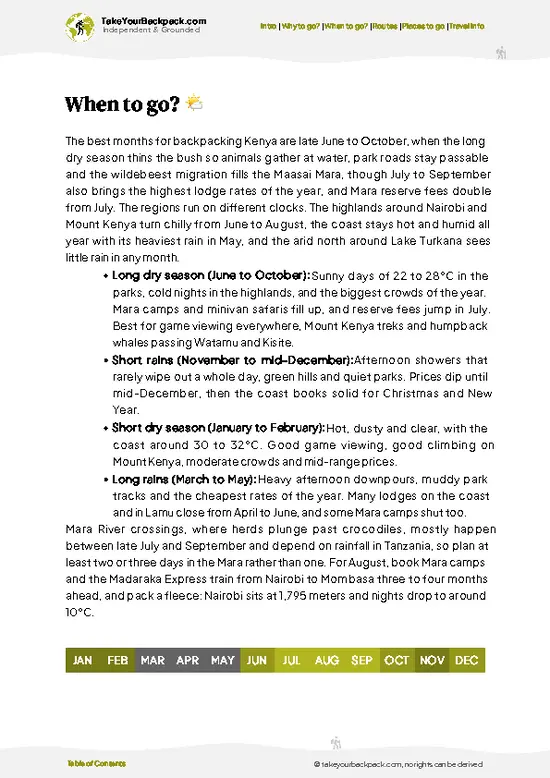
source: climatestotravel.comJANJanuary: good for travelingFEBFebruary: good for travelingMARMarch: below average for travelingAPRApril: below average for travelingMAYMay: below average for travelingJUNJune: excellent for travelingJULJuly: highly recommended for travelingAUGAugust: highly recommended for travelingSEPSeptember: excellent for travelingOCTOctober: highly recommended for travelingNOVNovember: highly recommended for travelingDECDecember: good for traveling
when-to-go

✈️ The backpacker research shortcutKenya Travel Guide

An offline-friendly backpacking guide with optimized travel routes, ranked highlights, transport advice, and the best areas to stay.
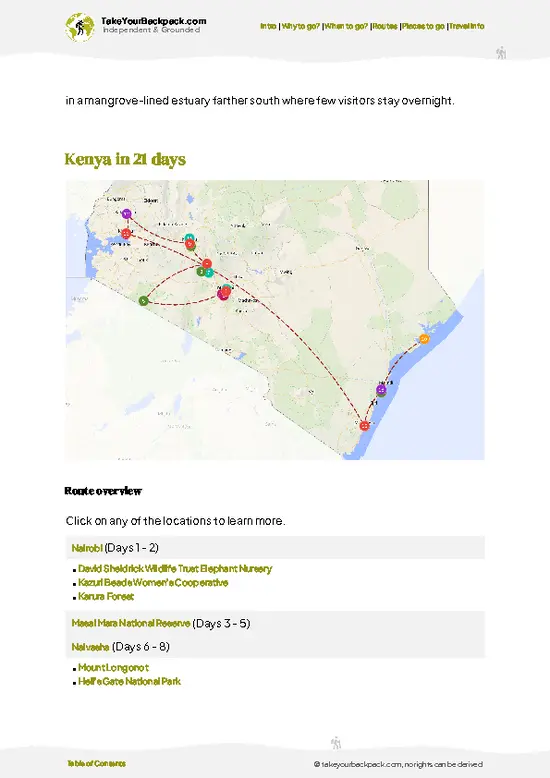
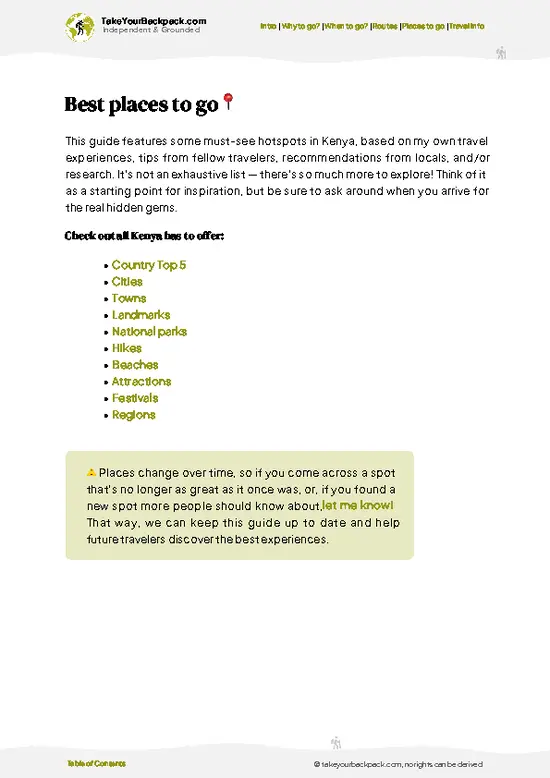
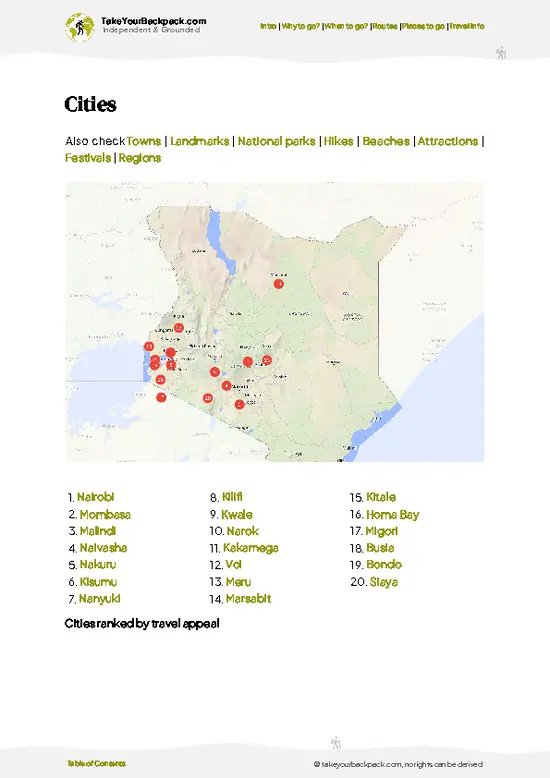
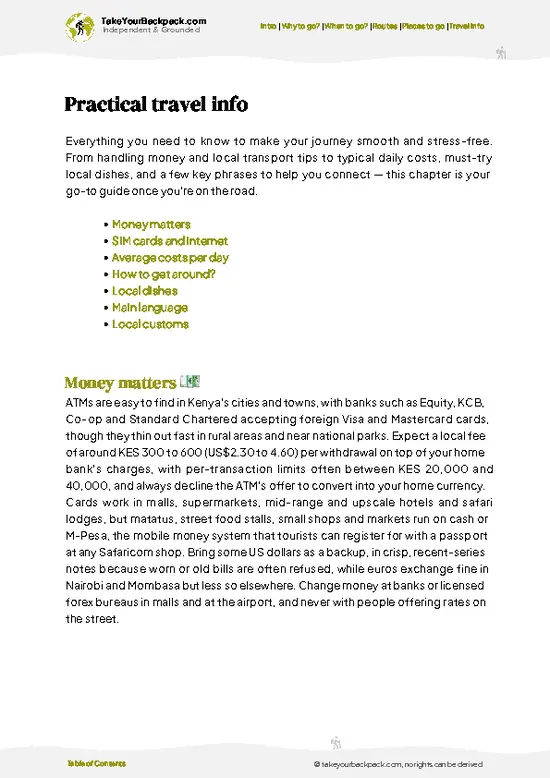
example page 0 from our offline Travel Guide for Kenya
example page 1 from our offline Travel Guide for Kenya
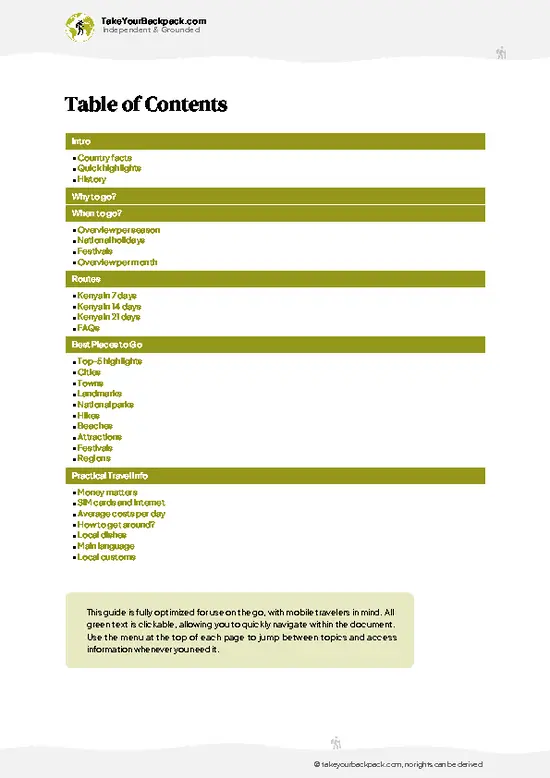
example page 2 from our offline Travel Guide for Kenya
example page 3 from our offline Travel Guide for Kenya
example page 4 from our offline Travel Guide for Kenya
example page 5 from our offline Travel Guide for Kenya
example page 6 from our offline Travel Guide for Kenya
example page 7 from our offline Travel Guide for Kenya
The digital guide (429 pages) contains:
114 highlights, ranked by travel appeal
Optimized 7, 14 & 21-day travel routes
Cities, national parks, landmarks, beaches
How to get around
Offline-friendly for travel without Wi-Fi
👉 Click to see all 30+ guide features

📅 Plan smarter in minutes, not weeks
Month by month travel advice
Festivals & national holidays
Budget expectations

🗺️ Go to the right places, skip the overrated ones
Honest pros & cons of destinations
Top hikes, parks & viewpoints
Lesser-known places most travelers miss
Clear “worth it vs skip it” guidance

🛏️ Travel smoothly without rookie mistakes
Best areas to stay
Transport systems explained simply
Common scams & safety advice
SIM cards, money & practical tips

🌍 Understand the country, not just visit it
Culture & traditions
52 Essential phrases & customs
Festivals worth planning around
Traveler-friendly historical context
Insights that make places more meaningful

📱 Built for real travel conditions
Fully downloadable PDF
Works completely offline
Optimized for phone use
Useful in remote areas & buses
Everything in one place
Save weeks of stressful planning
Get instant access to your full guide. 30‑day money-back guarantee.


By proceeding you agree to our terms.
Sent to your inbox immediately after payment • 100% Secure Checkout
Best Backpacking Travel Advisor 2025 tourism awardBest Backpacking
Travel Advisor
2025
What others say about Take Your Backpack Guides:
⭐⭐⭐⭐⭐
Fantastic, amazing amount of information!
⭐⭐⭐⭐⭐
My goodness this is amazing, it's what I've been looking for hats off too you!
⭐⭐⭐⭐⭐
I think this is absolutely BRILLIANT
⭐⭐⭐⭐
Very complete and informative. It's still missing places, but I gotta to commend you
⭐⭐⭐⭐⭐
This is truly amazing, thank you, can't wait to explore it with my kids!
⭐⭐⭐⭐⭐
Awesome resource, thank you!
⭐⭐⭐⭐⭐
This is amazing! Can't wait to explore the ones I haven't seen
⭐⭐⭐⭐
I love this! Well done, great idea.
⭐⭐⭐⭐⭐
Thanks for taking the time to make this gem!
⭐⭐⭐⭐⭐
This might be the best website I've ever seen.
⭐⭐⭐⭐⭐
Congratulations, and thank you so much for your work; it's incredibly valuable.
⭐⭐⭐⭐
In all seriousness I think you did a great job pointing out the important spots
⭐⭐⭐⭐⭐
10/10 very good
⭐⭐⭐⭐⭐
As someone who's only just starting to visit regularly this is awesome, thank you.
⭐⭐⭐⭐
Thank you very much! I'm going to visit my dad, it's going to be very useful!
⭐⭐⭐⭐⭐
This is really cool! We'll be travelling for the first time and this definitely come in handy.
⭐⭐⭐⭐⭐
You are now our minister of culture, congratulations 👨‍💼
⭐⭐⭐⭐⭐
Just wanted to tell you that this is a pearl! Going to follow your recommendations.
⭐⭐⭐⭐⭐
This is so cool. I'll definitely be using the resource for my travels soon.
⭐⭐⭐⭐⭐
This is very impressive! Good work.
⭐⭐⭐⭐⭐
This is an amazing and informative site. Very well done!

🛏️ Where to stay?Best areas and accommodation options

The Maasai Market in Nairobi is a magnet for backpackers chasing authentic Kenyan crafts, but let’s cut through the Instagram gloss: it’s crowded, chaotic, and can feel like a pressure cooker for anyone not ready for the hustle. The real magic isn’t just in the market stalls but in where you land after the crowds thin out.

If you want to be close enough to hit the market early and avoid the midday crush, look at staying in the Langata or Karen areas. These neighborhoods aren’t just about proximity; they offer a safer, more relaxed vibe compared to the city center’s frantic pace. Langata, in particular, … read more 👉
The Maasai Market in Nairobi is a magnet for backpackers chasing authentic Kenyan crafts, but let’s cut through the Instagram gloss: it’s crowded, chaotic, and can feel like a pressure cooker for anyone not ready for the hustle. The real magic isn’t just in the market stalls but in where you land after the crowds thin out.

If you want to be close enough to hit the market early and avoid the midday crush, look at staying in the Langata or Karen areas. These neighborhoods aren’t just about proximity; they offer a safer, more relaxed vibe compared to the city center’s frantic pace. Langata, in particular, is a favorite among solo travelers who want a social scene without the noise of downtown Nairobi. You’ll find guesthouses and budget lodges where backpackers swap stories over cheap chai, and the local vibe is genuine—not staged for tourists.

Karen is a bit more upscale but still has pockets where budget travelers can find affordable stays. It’s quieter, greener, and perfect if you want to decompress after the sensory overload of the market. Both areas have decent transport links, so you’re never stuck, but you’re also not in the thick of Nairobi’s notorious traffic jams.

Bottom line: skip the city center chaos. Stay where you can breathe, connect with fellow travelers, and recharge. That’s where the Maasai Market experience really starts to make sense.

👛 Costs (as of 6 October 2025)How expensive it really is

Entry to the Maasai Market is free; you only pay for the items you wish to purchase. The cost of goods varies widely, with items such as beadwork, clothing, and carvings typically ranging from €5 to €100, depending on the quality and intricacy.

source: maasaimara.ke
⚠️ Prices can change and everyone travels differently, so take this as a rough guide. Hope it helps you plan your adventure!

Other Kenyan attractions near Maasai Market

Explore more nearby:


💡 Not sure where to go next?
Create a personalized itinerary for Kenya including Maasai Market and the places that fit your trip.

Generate my itinerary

👉 Discover all attractions

Or checkout all Kenya has to offer (think cities, towns, villages, national parks, hikes, beaches, festivals)
Country photo of Kenya

We 💚 feedbackParting advice and final tips

Maasai Market is a whirlwind—crowded, noisy, and yes, a bit chaotic. It’s not the serene shopping spree Instagram makes it out to be. But here’s the kicker: beyond the hustle, you’ll find genuine craftsmanship that’s impossible to fake. The colors, the textures, the stories behind each bead and carving—they hit different when you’re face-to-face with the makers. Just keep your wits about you, haggle smart, and don’t expect a quiet stroll. This market’s magic is raw, real, and worth every sweaty, bustling minute.

✍️ Help improve this page!
The information on this page is based on in-depth research, insights shared by experienced travelers, and feedback from the local travel community in Kenya. While every effort is made to keep the information accurate and current, conditions can change — so if you spot anything incorrect or outdated, please get in touch.


🙋‍♂️ Give feedback

👋 Meet the founderWho’s Behind Take Your Backpack?

Johan, backpacker and founder of TakeYourBackpackHi, I’m Johan (Netherlands 🇳🇱), the creator of TakeYourBackpack. Over the past decade, I’ve backpacked through 80+ countries across six continents, gaining extensive experience with independent travel, long-term trips, and overland routes.

This site is built on a combination of firsthand travel experience and carefully curated insights from other backpackers. Many guides are based on places I’ve personally visited, while others bring together tips, observations, and practical advice shared by trusted travelers I’ve met along the way.

The goal is to provide realistic, experience-driven guidance — not generic itineraries — so you can explore destinations with better context, clearer expectations, and more confidence.

Get full Kenya guide •
Instant download • 114 highlights • Full Offline guide