×

Kiribati🇰🇮 | best villagesTop-Rated villages in Kiribati

Villages in Kiribati are clusters of thatched maneaba meeting houses, coral-rock paths and pandanus-shaded homes strung along narrow atoll strips, with the lagoon on one side and surf thundering on the other. Expect copra smoke, salt wind and roosters at dawn. South Tarawa is crowded and easy to reach. The outer islands are quiet and cheaper, but flights are few and independent travelers must plan around them.

By Johan Kruseman 🇳🇱 | Updated October 18, 2026
Explore the best landmarks in Kiribati

Why go?Why These village Stand Out

Kiribati’s villages exist because of atoll geography. Land is rarely more than a few hundred meters wide and a couple of meters above sea level, so settlements sit in a line along one road or sandy track, and everything revolves around the maneaba, where the community decides matters, hosts guests and settles disputes. Life follows reef, lagoon and coconut palm: fishing at low tide, toddy cutting at dawn, pandanus weaving in the shade.

Travelers should know that this is not a polished tourism landscape. Guesthouses are small, food is mostly fish, rice, breadfruit and coconut, and freshwater is limited. Power can be intermittent outside Tarawa. Rising seas and king tides are visible in eroded shorelines and seawalls. Visits work best when you arrive with respect, patience and flexible plans.
Why These Made the Cut
The list of best villages in Kiribati is created based on authenticity, scenic beauty, community spirit, traditions, and overall character. If you feel a village is missing in this list, please let us know.

When to go?Timing Your Visit for the Best Experience

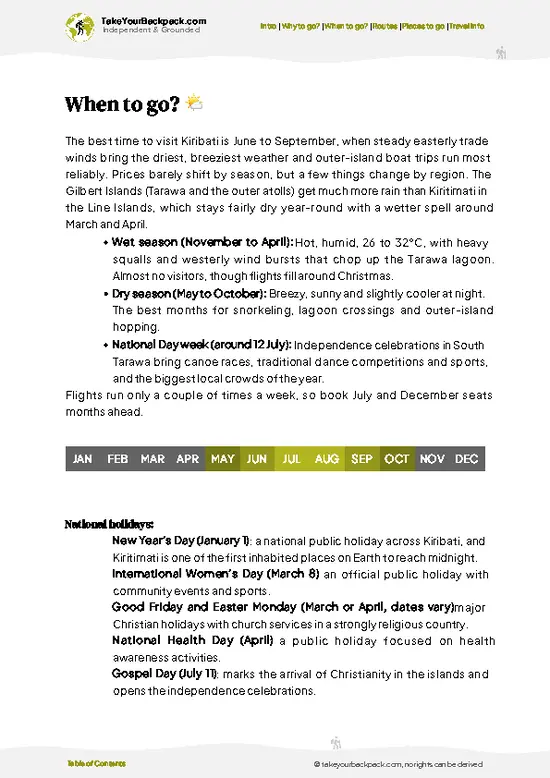
Best Months for Village Visits: The best months are May to October, when trade winds blow and rain is lighter, which makes boat trips and walking along the sun-baked coral roads far more comfortable. Daytime temperatures sit around 28 to 32°C all year, so heat never really lets up, but the breeze softens it.Wet Season and Shoulders: From roughly November to April, westerly squalls bring heavier showers, stickier air and rougher lagoon crossings. Rainfall is highest in the Gilberts group, while the drier southern atolls can run short of water in some years. April and November are workable shoulder months, with fewer travelers and flexible guesthouse rates. Kiribati has no real peak season, though Independence Day on July 12 fills Tarawa with dancing and sends accommodation prices upward. Inter-island … read more 👉
Best Months for Village Visits: The best months are May to October, when trade winds blow and rain is lighter, which makes boat trips and walking along the sun-baked coral roads far more comfortable. Daytime temperatures sit around 28 to 32°C all year, so heat never really lets up, but the breeze softens it.Wet Season and Shoulders: From roughly November to April, westerly squalls bring heavier showers, stickier air and rougher lagoon crossings. Rainfall is highest in the Gilberts group, while the drier southern atolls can run short of water in some years. April and November are workable shoulder months, with fewer travelers and flexible guesthouse rates. Kiribati has no real peak season, though Independence Day on July 12 fills Tarawa with dancing and sends accommodation prices upward. Inter-island flights and boats are scarce, so build in spare days.

village hoppingOptimizing Your Multi-Stop Itinerary

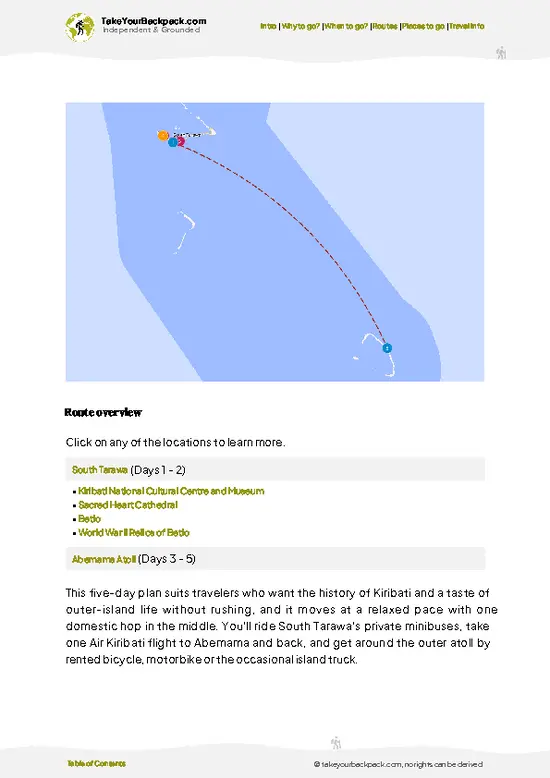
How Many Days to Allow: A trip linking several villages needs 7 to 14 days, because Tarawa is the only real transport hub and flights to the outer islands run only a few times a week, sometimes less. Start in South Tarawa, then fly outward to one or two atolls rather than many. Northern and southern Gilberts group less well together than they look on the map, since most flights return through Tarawa first.Pacing and Common Mistakes: Allow 2 to 4 nights per island. Flights usually take 45 minutes to 2 hours, while cargo boats can take a day or more, with no guaranteed departures. The classic mistake is booking tight connections to an international flight, which one cancellation can ruin. Another is trying to cover too many atolls. Instead, confirm flights locally, keep a spare buffer of 2 to 3 days, and pack extra cash, water and snacks.

The ListMust-Visit villages in Kiribati

1 Buariki

WWII battle sites, northern North Tarawa, lagoon fish weirs, host-family stays

Follow a host relative through coconut groves where the last Japanese troops were hunted in 1943, then end the day at the lagoon shore.

Loading the map 🌍

Expert viewInsights from Locals and Experts

How Many Villages to Visit: I advise two to four villages in total. Transport is thin, and the best moments come from staying long enough to share a meal, a coconut and an evening under the maneaba roof, not from ticking places off. One busy base plus one or two quiet atoll stays gives you contrast without wasting days waiting at a dusty airstrip.Which Kind Suits You: Comfort seekers and first-timers should favor South Tarawa, where shops, ATMs, restaurants and reliable power exist, though the roads are loud with minibuses and the shoreline is crowded. Adventurous travelers should choose outer-island villages, where the reward is silence broken by surf, frigatebirds and a night sky with almost no light pollution. Culture-minded visitors get the most from places with an active maneaba and a … read more 👉
How Many Villages to Visit: I advise two to four villages in total. Transport is thin, and the best moments come from staying long enough to share a meal, a coconut and an evening under the maneaba roof, not from ticking places off. One busy base plus one or two quiet atoll stays gives you contrast without wasting days waiting at a dusty airstrip.Which Kind Suits You: Comfort seekers and first-timers should favor South Tarawa, where shops, ATMs, restaurants and reliable power exist, though the roads are loud with minibuses and the shoreline is crowded. Adventurous travelers should choose outer-island villages, where the reward is silence broken by surf, frigatebirds and a night sky with almost no light pollution. Culture-minded visitors get the most from places with an active maneaba and a host family.What It Costs: Budget about US$60 to 120 a day on Tarawa, mostly for guesthouse rooms, which run roughly US$40 to 90 a night. Outer islands often cost US$35 to 70 a day with simple lodging and meals included, but domestic flights add around US$80 to 200 each way. Village visits seldom have a fixed entry fee. A small gift or contribution of about US$5 to 15 is appropriate, and local guides or boat hire run around US$20 to 50 a day. Bring Australian dollars, the currency used in Kiribati, in small notes.Safety and Etiquette: Crime is low, but ask permission before entering a maneaba, photographing people or swimming near a village. Dress modestly, with shoulders and knees covered, and avoid swimwear away from the beach. Alcohol is restricted in many communities. Sun, dehydration and reef cuts are the real hazards, so carry water, sun protection and reef shoes. Tap water is often unsafe to drink. Lagoon currents can be strong near channels. Following local advice earns you warmth, shared food and quiet laughter.

✈️ The backpacker research shortcutKiribati Travel Guide

An offline-friendly backpacking guide with optimized travel routes, ranked highlights, transport advice, and the best areas to stay.
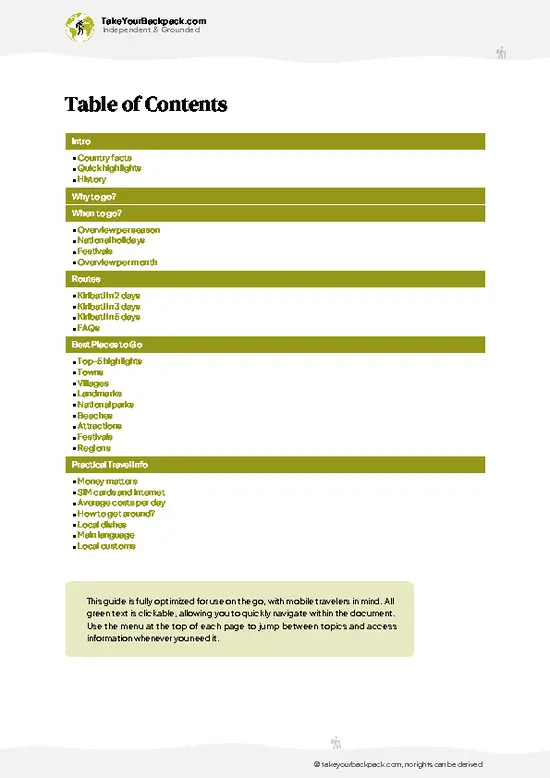
example page 0 from our offline Travel Guide for Kiribati
example page 1 from our offline Travel Guide for Kiribati
example page 2 from our offline Travel Guide for Kiribati
example page 3 from our offline Travel Guide for Kiribati
example page 4 from our offline Travel Guide for Kiribati
example page 5 from our offline Travel Guide for Kiribati
example page 6 from our offline Travel Guide for Kiribati
example page 7 from our offline Travel Guide for Kiribati
The digital guide (120 pages) contains:
✅ 25 highlights, ranked by travel appeal
✅ Optimized 2, 3 & 5-day travel routes
✅ Cities, national parks, landmarks, beaches
✅ How to get around
✅ Offline-friendly for travel without Wi-Fi
👉 Click to see all 30+ guide features

📅 Plan smarter in minutes, not weeks
✅ Month by month travel advice
✅ Festivals & national holidays
✅ Budget expectations

🗺️ Go to the right places, skip the overrated ones
✅ Honest pros & cons of destinations
✅ Top hikes, parks & viewpoints
✅ Lesser-known places most travelers miss
✅ Clear “worth it vs skip it” guidance

🛏️ Travel smoothly without rookie mistakes
✅ Best areas to stay
✅ Transport systems explained simply
✅ Common scams & safety advice
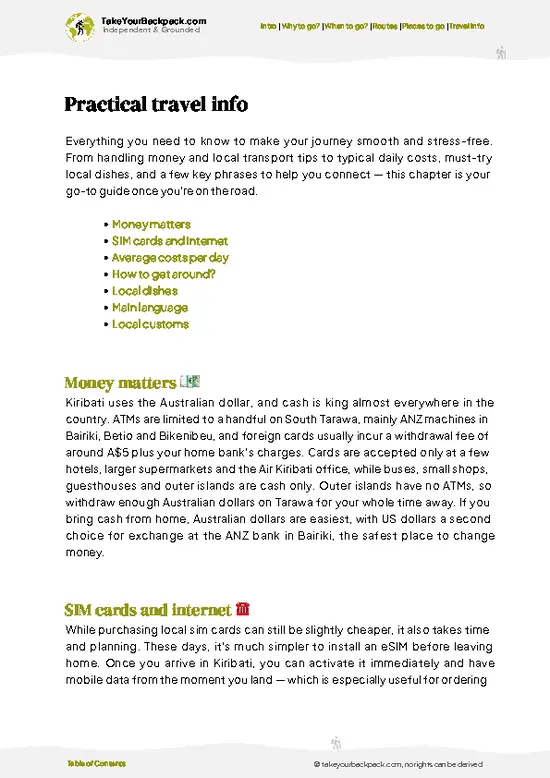
✅ SIM cards, money & practical tips

🌍 Understand the country, not just visit it
✅ Culture & traditions
✅ 52 Essential phrases & customs
✅ Festivals worth planning around
✅ Traveler-friendly historical context
✅ Insights that make places more meaningful

📱 Built for real travel conditions
✅ Fully downloadable PDF
✅ Works completely offline
✅ Optimized for phone use
✅ Useful in remote areas & buses
✅ Everything in one place
Stop searching, start planning
Get instant access to your full guide. 30‑day money-back guarantee.
+ Add another guide for just

By proceeding you agree to our terms.
Sent to your inbox immediately after payment • 100% Secure Checkout
Best Backpacking Travel Advisor 2025 tourism awardBest Backpacking
Travel Advisor
2025
What others say about Take Your Backpack Guides:
⭐⭐⭐⭐⭐
Fantastic, amazing amount of information!
⭐⭐⭐⭐⭐
My goodness this is amazing, it's what I've been looking for hats off too you!
⭐⭐⭐⭐⭐
I think this is absolutely BRILLIANT
⭐⭐⭐⭐
Very complete and informative. It's still missing places, but I gotta to commend you
⭐⭐⭐⭐⭐
This is truly amazing, thank you, can't wait to explore it with my kids!
⭐⭐⭐⭐⭐
Awesome resource, thank you!
⭐⭐⭐⭐⭐
This is amazing! Can't wait to explore the ones I haven't seen
⭐⭐⭐⭐
I love this! Well done, great idea.
⭐⭐⭐⭐⭐
Thanks for taking the time to make this gem!
⭐⭐⭐⭐⭐
This might be the best website I've ever seen.
⭐⭐⭐⭐⭐
Congratulations, and thank you so much for your work; it's incredibly valuable.
⭐⭐⭐⭐
In all seriousness I think you did a great job pointing out the important spots
⭐⭐⭐⭐⭐
10/10 very good
⭐⭐⭐⭐⭐
As someone who's only just starting to visit regularly this is awesome, thank you.
⭐⭐⭐⭐
Thank you very much! I'm going to visit my dad, it's going to be very useful!
⭐⭐⭐⭐⭐
This is really cool! We'll be travelling for the first time and this definitely come in handy.
⭐⭐⭐⭐⭐
You are now our minister of culture, congratulations 👨‍💼
⭐⭐⭐⭐⭐
Just wanted to tell you that this is a pearl! Going to follow your recommendations.
⭐⭐⭐⭐⭐
This is so cool. I'll definitely be using the resource for my travels soon.
⭐⭐⭐⭐⭐
This is very impressive! Good work.
⭐⭐⭐⭐⭐
This is an amazing and informative site. Very well done!

🛏️ Where to stay?Where to Stay in Kiribati

Kiribati has no backpacker hostels in the dorm-bed sense, so budget travel here means simple guesthouses, family-run lodges and motels, typically AU$80 to 150 (about US$55 to 100) a night for a private room with a fan or air-con. On South Tarawa, Bairiki and nearby Teaoraereke put you closest to government offices, banks and the causeway minibuses, while Betio sits beside the WWII battle sites but is crowded and noisier. Bikenibeu and Bonriki in the east are quieter, with lagoon views and easy airport access, at the cost of a 40-minute minibus ride to the main sights.

If you enjoy meeting fellow travelers, consider choosing hostels with high ratings for atmosphere. On the other hand, if you prefer … read more 👉
Kiribati has no backpacker hostels in the dorm-bed sense, so budget travel here means simple guesthouses, family-run lodges and motels, typically AU$80 to 150 (about US$55 to 100) a night for a private room with a fan or air-con. On South Tarawa, Bairiki and nearby Teaoraereke put you closest to government offices, banks and the causeway minibuses, while Betio sits beside the WWII battle sites but is crowded and noisier. Bikenibeu and Bonriki in the east are quieter, with lagoon views and easy airport access, at the cost of a 40-minute minibus ride to the main sights.

If you enjoy meeting fellow travelers, consider choosing hostels with high ratings for atmosphere. On the other hand, if you prefer having your own space, a hotel might be a better option.

KiribatiMore of Kiribati

👋 Meet the founderWho’s Behind Take Your Backpack?

Johan, backpacker and founder of TakeYourBackpackHi, I’m Johan (Netherlands 🇳🇱), the creator of TakeYourBackpack. Over the past 3 decades, I’ve backpacked through 90+ countries across six continents, gaining extensive experience with independent travel, long-term trips, and overland routes.

This site is built on a combination of firsthand travel experience and carefully curated insights from other backpackers. Many guides are based on places I’ve personally visited, while others bring together tips, observations, and practical advice shared by trusted travelers I’ve met along the way.

The goal is to provide realistic, experience-driven guidance — not generic itineraries — so you can explore destinations with better context, clearer expectations, and more confidence.