×

Kiribati🇰🇮 | best regionsTop-Rated 10 regions in Kiribati

Regions in Kiribati split into three very different worlds: South Tarawa, a crowded causeway strip of tin roofs and scooter horns; the quiet outer islands, where roosters and surf are the only alarm clocks; and the far-flung Line and Phoenix groups. Costs jump with every flight. Independent travelers should know that access, not distance, defines each choice, and that comfort drops as quiet rises.

By Johan Kruseman 🇳🇱 | Updated October 18, 2026
Explore the best towns in Kiribati

Why go?Why These region Stand Out

Kiribati is 33 low coral atolls scattered across roughly 3.5 million square kilometers of Pacific, straddling the equator and the International Date Line. That geography shapes everything. Land rarely rises more than 2 to 3 meters above a glittering lagoon, so the sea is always audible, and flights are the only practical link between island groups, run by Air Kiribati on thin, sometimes delayed schedules. Food is coconut, fish and breadfruit, and guesthouses are simple, often with bucket showers and brackish water. Visitors arrive in small numbers, so a stay means joining village life through the maneaba, the open-sided meeting house, where customs on dress and greetings matter. Know that sea-level rise is a daily concern for locals. Pack patience, cash in Australian dollars (the currency used) and flexible plans.
Evaluating the Top Choices
The list of best regions in Kiribati is created based on landscapes, local culture, attractions, vibes, and overall appeal. If you feel a region is missing in this list, please let us know.

When to go?Timing Your Visit for the Best Experience

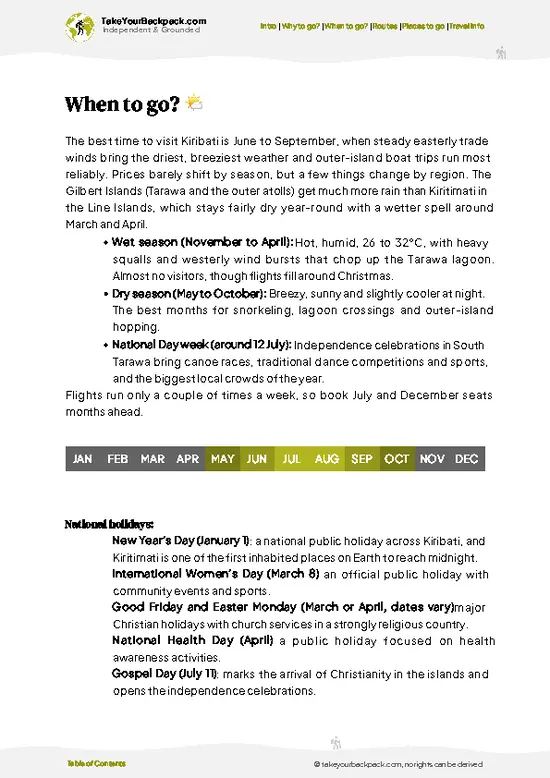
Best months: The best months are May to October, when the dry season brings trade winds, calmer afternoons and less humidity. Daytime temperatures sit near 28 to 32°C all year, so seasons are felt through rain and wind rather than heat. Wet season and shoulders: From November to April, heavy squalls drum on tin roofs and westerly storms can churn the lagoon and delay boats and flights. Rainfall is far lower in the northern Gilberts, where drought is a worry, than in the wetter Line Islands near the equator, which see frequent downpours. Kiritimati is driest around the middle of the year. Crowds stay thin year-round, though fishing and diving operators book up in the dry months. Prices change little by season, but domestic flights fill around school holidays and Christmas.

region hoppingOptimizing Your Multi-Stop Itinerary

Trip length: A trip combining several regions in Kiribati needs 10 to 14 days, mainly because flights run only a few times a week. Pair South Tarawa with one nearby outer island group, then add a distant group only if you have two weeks. Start at Bonriki airport, the hub for almost every domestic flight, and work outward, finishing back on Tarawa for your international departure. Pacing: Allow 3 to 5 days per stop. Hops within the Gilberts take 1 to 2 hours by air, while Tarawa to Kiritimati takes about 3.5 hours and typically runs weekly. The common mistake is squeezing in too many stops and missing a connection, then sitting on a sunbaked airstrip for days. Instead, leave a buffer day before each international flight and confirm every ticket in person at the Air Kiribati office.

The ListMust-Visit regions in Kiribati

1 Tamana Island

Flight-day airstrip, no lagoon, reef-edge loop, clan maneaba

Watch the whole island gather at the coral airstrip when a plane lands, then walk the coastal track past taro pits and breadfruit trees.

2 Kiritimati Island

Bonefish flats, salt ponds, Cook’s landing, ruined Paris

Hire a driver to reach bonefish flats, pink-tinged salt ponds and the roofless church at Paris across an enormous, wind-swept coral ring.

3 Tarawa Atoll

Betio bunkers, rusted guns, causeway road, maneaba halls, fish stalls

Trace the 1943 battle along Betio's shoreline of concrete fortifications and coastal guns, then cross the causeways to government islets, meeting houses and smoky fish stalls.

4 Kuria Island

Dry reef shelf, tide pools, village maneaba, Milky Way skies

Time your visit to the tide, exploring pools on the exposed shelf by day and watching a dark, star-packed sky after sunset.

5 Abaiang

Wade-in landings, lagoon sandbars, village homestays, Sunday hymns

Wade ashore at low tide, snorkel coral heads off shifting sandbars, and sit in a village maneaba where families host visitors and Sunday hymns fill the churches.

6 South Tarawa

Betio bunkers, Red Beach, minibus rides, Bikenibeu museum

Ride the crowded minibus along the single road to climb Japanese bunkers, scan Red Beach wreckage and browse the national museum in Bikenibeu.

7 Nonouti

Low-tide sandflats, toddy at dawn, quiet lagoon, no traffic

Slow down on a long coral ribbon where rays and wading birds cross the sandflats and men climb palms before sunrise for sap.

8 Onotoa

Long lagoon, sandbar wading, rim-walking between villages, toddy tappers

Wade across shifting sandbars at low tide, then walk or bike the islet rim to village maneabas where hosts welcome you in the afternoon shade.

9 North Tarawa

Low-tide Abatao crossing, Buariki relics, village guesthouses, reef gleaning

Cross the causeway to reach quiet villages, walk Buariki’s battle sites with a local and sail a lagoon canoe over shifting sandbars.

10 Arorae

Oceanfront coral sand, reef-edge surf, babai pits, toddy cutters

Walk a lagoonless coast where pale coral sand meets open swell, then follow villagers to reef flats and sunken taro pits inland.

kiribati-region-arorae
© Google | Verde Speranza

11 Tabiteuea South

Long southern atoll, single sandy road, clan-split villages, pandanus weaving

Follow one sandy road between lagoon and surf, join a host family for toddy cutting, and learn mat weaving from local women.

12 Abemama Atoll

Stevenson sites, Tem Binoka’s tomb, lagoon swims, causeway walks

Follow the lanes to King Tembinok’s tomb near Tabontebike, then drift in warm lagoon shallows or wade the sandbars at low tide.

13 Butaritari

Makin Raid markers, Japanese bunkers, taro pits, canoe crossings

Pedal the main island road past wartime bunkers and swamp gardens, then hire a boatman to cross the lagoon shallows to sandbars.

14 Marakei

Enclosed lagoon, fish weirs, coast-road cycling, homestays

Ride the coastal track between villages, then paddle the almost closed lagoon with your host to see stone fish traps at low water.

kiribati-region-marakei
© Google |

15 Makin

Makin maneaba, sailing canoes, lagoon snorkeling, pandanus weaving

Stay with a host family to watch outrigger canoes, learn mat weaving and snorkel clear lagoon coral patches at rising tide.

16 Beru Atoll

Single-road villages, babai pits, ocean reef walks, maneaba meals

Cycle the flat coastal road past taro pits and thatched halls, with calm lagoon on one side and crashing surf on the other.

Think you know Kiribati?

Prove you’re a true local — uncover 6 lesser-known regions in Kiribati that locals tend to keep to themselves.
Loading the map 🌍

Expert viewInsights from Locals and Experts

How many to visit: I advise two regions, three at most with two weeks. Flights are infrequent, a delay can eat a full day, and the best moments here come from slowing down on one island: warm lagoon water, a shared meal of grilled fish and coconut toddy, evening singing from the maneaba. Choosing your kind: Culture seekers should favor village-based outer islands, where you sleep in a family guesthouse and wake to cockerels and surf. Divers and fishers should prioritize the remote fishing atolls, where flats and reefs are almost empty. Anyone wanting hot showers and restaurants will get them only in South Tarawa, and even there they are basic. What it costs: Budget US$50 to 90 a day on outer islands, covering a guesthouse room at US$25 to 50, meals at US$10 to 25 and local transport. South … read more 👉
How many to visit: I advise two regions, three at most with two weeks. Flights are infrequent, a delay can eat a full day, and the best moments here come from slowing down on one island: warm lagoon water, a shared meal of grilled fish and coconut toddy, evening singing from the maneaba. Choosing your kind: Culture seekers should favor village-based outer islands, where you sleep in a family guesthouse and wake to cockerels and surf. Divers and fishers should prioritize the remote fishing atolls, where flats and reefs are almost empty. Anyone wanting hot showers and restaurants will get them only in South Tarawa, and even there they are basic. What it costs: Budget US$50 to 90 a day on outer islands, covering a guesthouse room at US$25 to 50, meals at US$10 to 25 and local transport. South Tarawa runs US$70 to 120. Domestic flights cost roughly US$100 to 250 one way, and Kiritimati flights more. Guides and boat charters often run US$30 to 80 a day, and fishing trips more. Cash is vital, as ATMs are scarce. Safety and customs: Violent crime is low, but sun and water are the real hazards: sunburn, dehydration and strong lagoon currents. Drink only boiled or bottled water. Dress modestly, with shoulders and knees covered in villages, and swim in shorts or a sarong. Ask before photographing people, remove shoes at a maneaba, and bring a small gift such as rice or sugar when staying with a family. Sunday is quiet and church-focused, so plan to rest, with the reward of hearing hymns drift across the water.

✈️ The backpacker research shortcutKiribati Travel Guide

What the free pages can't give you: ready-made routes, every place ranked, and it works offline. All in 1 guide.
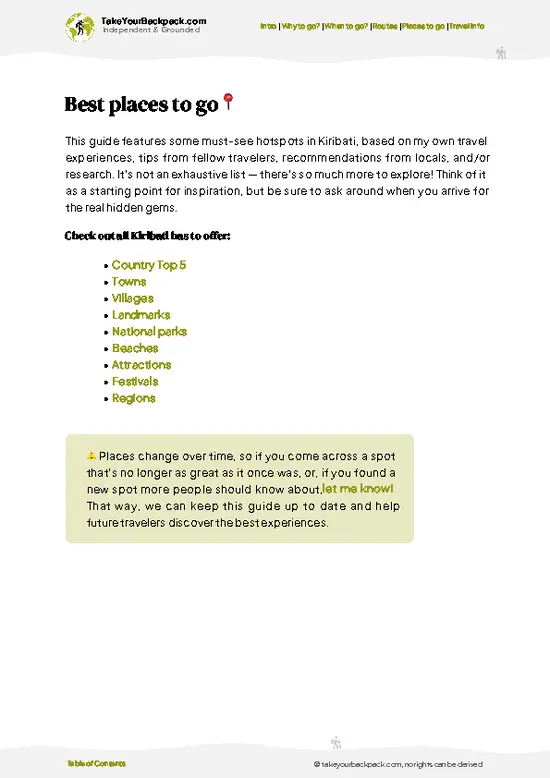
example page 0 from our offline Travel Guide for Kiribati
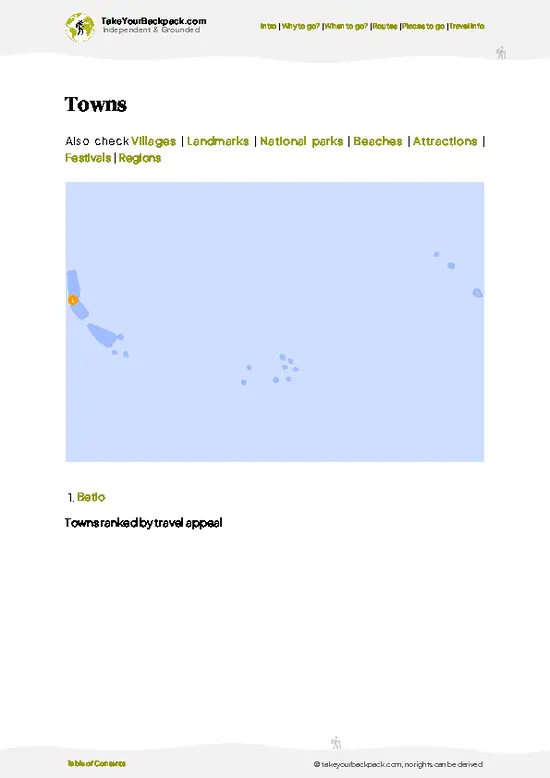
example page 1 from our offline Travel Guide for Kiribati
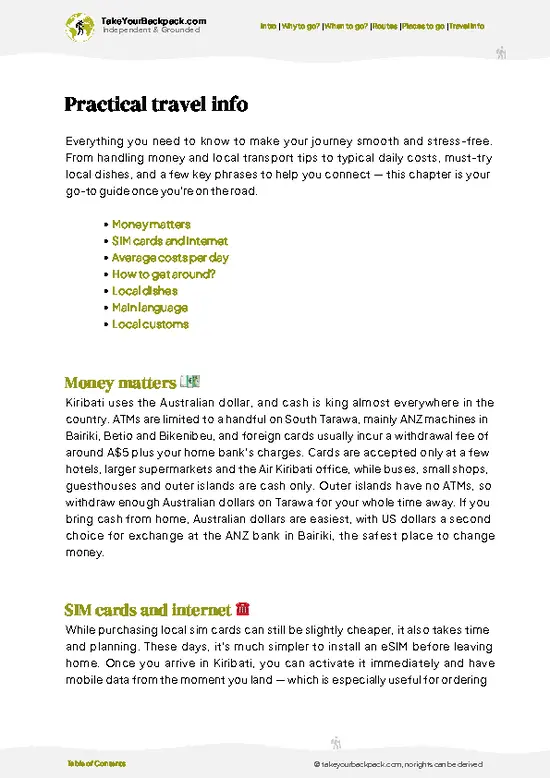
example page 2 from our offline Travel Guide for Kiribati
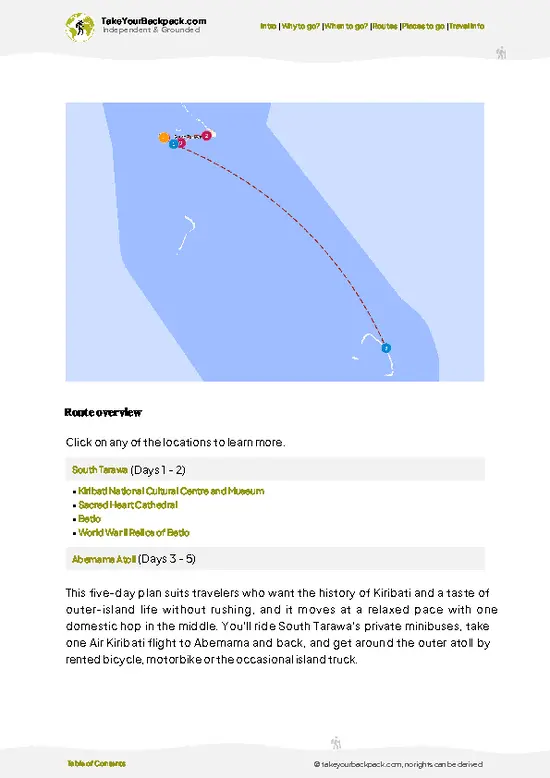
example page 3 from our offline Travel Guide for Kiribati
example page 4 from our offline Travel Guide for Kiribati
example page 5 from our offline Travel Guide for Kiribati
example page 6 from our offline Travel Guide for Kiribati
example page 7 from our offline Travel Guide for Kiribati
The digital guide (120 pages) contains:-page digital guide:
✅ Ready-made 2, 3 & 5-day routes
✅ All 25 places ranked, so you skip the overrated ones
✅ Works offline, all in 1 guide
✅ Cities, national parks, landmarks, beaches
✅ How to get around
👉 Click to see all 30+ guide features

📅 Plan smarter in minutes, not weeks
✅ Month by month travel advice
✅ Festivals & national holidays
✅ Budget expectations

🗺️ Go to the right places, skip the overrated ones
✅ Honest pros & cons of destinations
✅ Top hikes, parks & viewpoints
✅ Lesser-known places most travelers miss
✅ Clear “worth it vs skip it” guidance

🛏️ Travel smoothly without rookie mistakes
✅ Best areas to stay
✅ Transport systems explained simply
✅ Common scams & safety advice
✅ SIM cards, money & practical tips

🌍 Understand the country, not just visit it
✅ Culture & traditions
✅ 52 Essential phrases & customs
✅ Festivals worth planning around
✅ Traveler-friendly historical context
✅ Insights that make places more meaningful

📱 Built for real travel conditions
✅ Fully downloadable PDF
✅ Works completely offline
✅ Optimized for phone use
✅ Useful in remote areas & buses
✅ All in 1 guide
Stop searching, start planning
Get instant access to your full guide. 30‑day money-back guarantee.


By proceeding you agree to our terms.
Sent to your inbox immediately after payment • 100% Secure Checkout
Best Backpacking Travel Advisor 2025 tourism awardBest Backpacking
Travel Advisor
2025
What others say about Take Your Backpack Guides:
⭐⭐⭐⭐⭐
Fantastic, amazing amount of information!
⭐⭐⭐⭐⭐
My goodness this is amazing, it's what I've been looking for hats off too you!
⭐⭐⭐⭐⭐
I think this is absolutely BRILLIANT
⭐⭐⭐⭐
Very complete and informative. It's still missing places, but I gotta to commend you
⭐⭐⭐⭐⭐
This is truly amazing, thank you, can't wait to explore it with my kids!
⭐⭐⭐⭐⭐
Awesome resource, thank you!
⭐⭐⭐⭐⭐
This is amazing! Can't wait to explore the ones I haven't seen
⭐⭐⭐⭐
I love this! Well done, great idea.
⭐⭐⭐⭐⭐
Thanks for taking the time to make this gem!
⭐⭐⭐⭐⭐
This might be the best website I've ever seen.
⭐⭐⭐⭐⭐
Congratulations, and thank you so much for your work; it's incredibly valuable.
⭐⭐⭐⭐
In all seriousness I think you did a great job pointing out the important spots
⭐⭐⭐⭐⭐
10/10 very good
⭐⭐⭐⭐⭐
As someone who's only just starting to visit regularly this is awesome, thank you.
⭐⭐⭐⭐
Thank you very much! I'm going to visit my dad, it's going to be very useful!
⭐⭐⭐⭐⭐
This is really cool! We'll be travelling for the first time and this definitely come in handy.
⭐⭐⭐⭐⭐
You are now our minister of culture, congratulations 👨‍💼
⭐⭐⭐⭐⭐
Just wanted to tell you that this is a pearl! Going to follow your recommendations.
⭐⭐⭐⭐⭐
This is so cool. I'll definitely be using the resource for my travels soon.
⭐⭐⭐⭐⭐
This is very impressive! Good work.
⭐⭐⭐⭐⭐
This is an amazing and informative site. Very well done!

🛏️ Where to stay?Best Places to Stay in Kiribati

Kiribati has no backpacker hostels in the dorm-bed sense, so budget travel here means simple guesthouses, family-run lodges and motels, typically AU$80 to 150 (about US$55 to 100) a night for a private room with a fan or air-con. On South Tarawa, Bairiki and nearby Teaoraereke put you closest to government offices, banks and the causeway minibuses, while Betio sits beside the WWII battle sites but is crowded and noisier. Bikenibeu and Bonriki in the east are quieter, with lagoon views and easy airport access, at the cost of a 40-minute minibus ride to the main sights.

If you enjoy meeting fellow travelers, consider choosing hostels with high ratings for atmosphere. On the other hand, if you prefer … read more 👉
Kiribati has no backpacker hostels in the dorm-bed sense, so budget travel here means simple guesthouses, family-run lodges and motels, typically AU$80 to 150 (about US$55 to 100) a night for a private room with a fan or air-con. On South Tarawa, Bairiki and nearby Teaoraereke put you closest to government offices, banks and the causeway minibuses, while Betio sits beside the WWII battle sites but is crowded and noisier. Bikenibeu and Bonriki in the east are quieter, with lagoon views and easy airport access, at the cost of a 40-minute minibus ride to the main sights.

If you enjoy meeting fellow travelers, consider choosing hostels with high ratings for atmosphere. On the other hand, if you prefer having your own space, a hotel might be a better option.

KiribatiExplore Kiribati

👋 Meet the founderWho’s Behind Take Your Backpack?

Johan, backpacker and founder of TakeYourBackpackHi, I’m Johan (Netherlands 🇳🇱), the creator of TakeYourBackpack. Over the past 30 years, I’ve backpacked through 88 countries across six continents, gaining extensive experience with independent travel, long-term trips, and overland routes.

This site is built on a combination of firsthand travel experience and carefully curated insights from other backpackers. Many guides are based on places I’ve personally visited, while others bring together tips, observations, and practical advice shared by trusted travelers I’ve met along the way.

The goal is to provide realistic, experience-driven guidance — not generic itineraries — so you can explore destinations with better context, clearer expectations, and more confidence.