×

Kiribati🇰🇮 | regionsKuria IslandDry reef shelf, tide pools, village maneaba, Milky Way skies | things to do and best time to go

Explore AroraeExplore Abaiang

Backpacking in Kuria Island
🏆 Top pickregion ranked #2
By Johan Kruseman 🇳🇱 | Updated October 15, 2026

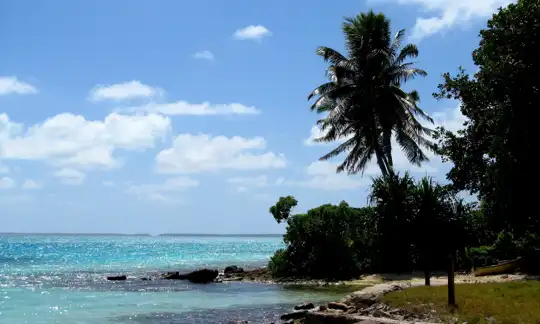
Kuria Island beach is not a lagoon beach, because the island is a nearly round coral platform with an ocean-facing shore, and the water you swim in comes straight off the Pacific over a reef flat. It sits in the Gilbert Islands of Kiribati, just north of the equator and a short hop from Abemama. Expect white coral sand, a hot light that bounces off every surface, the constant hiss of surf on the reef edge and the dry rattle of coconut fronds. Nobody rakes it or sells you a sunbed, and the crowds are a few kids and a dog. Swimming depends on tide, since low water leaves pools and rock. Surf and dive operators do not exist, though snorkeling the reef edge with local company can be superb. Food is simple: fish, rice, coconut and breadfruit, cooked by your hosts. Before going, arrange a homestay and your flight in advance, and carry cash and extra snacks.

Discover everything you want to know in the 📖 Kiribati Travel Guide.


example page 0 from our offline Travel Guide for Kiribati
example page 1 from our offline Travel Guide for Kiribati
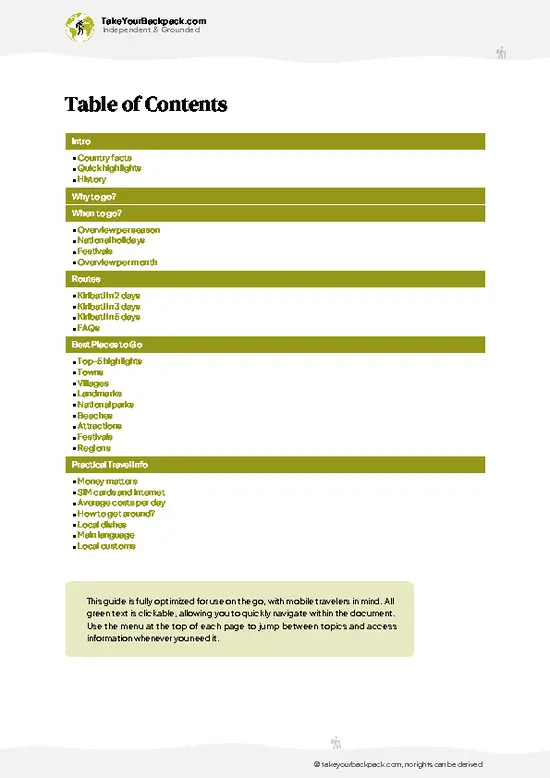
example page 2 from our offline Travel Guide for Kiribati
example page 3 from our offline Travel Guide for Kiribati
example page 4 from our offline Travel Guide for Kiribati
example page 5 from our offline Travel Guide for Kiribati
example page 6 from our offline Travel Guide for Kiribati
example page 7 from our offline Travel Guide for Kiribati
Loading the map 🌍
CLICK TO FILTER
towns
villages
landmarks
national parks
beaches
attractions
festivals
regions
SHOW COUNTRY’S BESTSHOW ALL

✨ Why go?
Ranked #2 region in Kiribati
Reasons people choose to visit here

Backpackers stop here because Kuria is one of the few places in the Gilberts where daily life is still the main event. With roughly a thousand residents on a single small island, you will be greeted at the village maneaba, the open-sided meeting house where visitors are expected to sit, listen and be fed. That social access is the real draw. A stay costs little and is built around a family, so you eat what they catch and trade stories in the shade.

The second reason is the water. Because the island is almost circular with a reef flat running along its shore, you get tidepools at low water and clear, deep blue swimming at high tide, with no resort or boat traffic anywhere in sight.

It also works as a pause on a slow route through the central Gilberts. Few travelers make it here, so a couple … read more 👉
Backpackers stop here because Kuria is one of the few places in the Gilberts where daily life is still the main event. With roughly a thousand residents on a single small island, you will be greeted at the village maneaba, the open-sided meeting house where visitors are expected to sit, listen and be fed. That social access is the real draw. A stay costs little and is built around a family, so you eat what they catch and trade stories in the shade.

The second reason is the water. Because the island is almost circular with a reef flat running along its shore, you get tidepools at low water and clear, deep blue swimming at high tide, with no resort or boat traffic anywhere in sight.

It also works as a pause on a slow route through the central Gilberts. Few travelers make it here, so a couple of days feels like a real break from Tarawa, and you leave rested, a little sunburned and with a better sense of how atoll life runs.

💡 HighlightsDon't-miss highlights and experiences

  1. Reef flat at low tide: The shore is best known for the broad coral shelf that dries out at low water. Walk slowly in sandals and you will find small fish trapped in pools, sea cucumbers, urchins and the odd octopus hole. Locals gather shellfish here, so ask before taking anything.
  2. Swimming and snorkeling at high tide: When the tide fills the shelf, the water turns warm and clear, ideal for floating and looking for reef fish near the drop-off. Stay close to shore and ask your host about currents, as there are no lifeguards.
  3. The village maneaba: This open-sided meeting house is the center of social life. Sit cross-legged, accept whatever is offered and expect questions about your country. Gatherings may include singing and dancing, and it is the most direct way to understand the island.
  4. Toddy cutting
… read more 👉
  1. Reef flat at low tide: The shore is best known for the broad coral shelf that dries out at low water. Walk slowly in sandals and you will find small fish trapped in pools, sea cucumbers, urchins and the odd octopus hole. Locals gather shellfish here, so ask before taking anything.
  2. Swimming and snorkeling at high tide: When the tide fills the shelf, the water turns warm and clear, ideal for floating and looking for reef fish near the drop-off. Stay close to shore and ask your host about currents, as there are no lifeguards.
  3. The village maneaba: This open-sided meeting house is the center of social life. Sit cross-legged, accept whatever is offered and expect questions about your country. Gatherings may include singing and dancing, and it is the most direct way to understand the island.
  4. Toddy cutting and fishing with locals: At dawn and dusk, men climb coconut palms to collect sap, the base of the island’s sweet drink and syrup. Small outrigger and reef fishing trips are also common. Offer to help carry or clean the catch, and you will be fed well.
  5. Sunrise and star-filled nights: With no street lighting to speak of, the sky is intensely dark. Dawn on the eastern shore comes with a fast change from gray to gold, and after sunset the Milky Way is bright enough to cast faint shadows on the sand.
Most visitors miss the pandanus handicrafts: women weave mats, baskets and fans on the veranda, and watching them work is a quiet highlight.
Spotted a mistake or missing something? Contact us.

⌛️ 5 daysWhat you can realistically do in a week

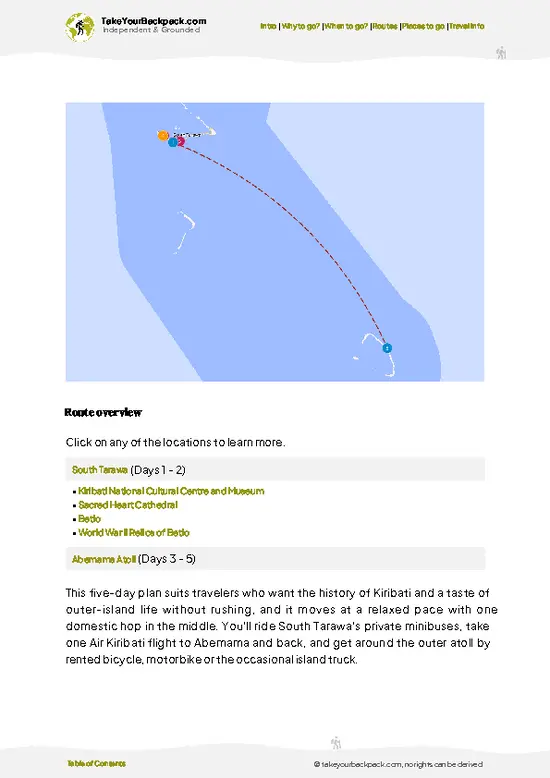
Day 1: Buariki: Start in Buariki on the first morning, because the flight from Tarawa is infrequent and puts you on the ground with no slack. Settle with your host, walk the road in the cooler hours and let the village see you before you start asking favors. Day 2 stays here: join the morning fishing and toddy routines, sit in the maneaba when invited, and learn which stretches of the ocean reef are safe to wade. Moving slowly is the only option, since the single road, bicycles and the odd pickup set the speed, and nothing runs on a timetable.Day 3: Oneeke: Shift to Oneeke on day 3, early, before the heat flattens everyone. It is the other reef island, quieter and more worked by hand, and the walk between the two lets you read the whole place at foot pace. Spend the day with families who gather … read more 👉
Day 1: Buariki: Start in Buariki on the first morning, because the flight from Tarawa is infrequent and puts you on the ground with no slack. Settle with your host, walk the road in the cooler hours and let the village see you before you start asking favors. Day 2 stays here: join the morning fishing and toddy routines, sit in the maneaba when invited, and learn which stretches of the ocean reef are safe to wade. Moving slowly is the only option, since the single road, bicycles and the odd pickup set the speed, and nothing runs on a timetable.Day 3: Oneeke: Shift to Oneeke on day 3, early, before the heat flattens everyone. It is the other reef island, quieter and more worked by hand, and the walk between the two lets you read the whole place at foot pace. Spend the day with families who gather pandanus and coconut, and eat what they offer. Day 4 is for the detour: follow the shore to the island’s far end, where the reef flat stretches wide and the Pacific breaks hard on the outer edge. It adds a lot and costs nothing in logistics, since you simply walk out from where you already sleep and walk back. Go with a local guide, because the reef edge and its surge demand respect, and leave early enough to be home before dark.Day 5: Departure: Keep the last day loose. Pack, thank your hosts properly and be ready well ahead of the plane, since schedules shift with weather and the airstrip crowd gathers early.
The day that justifies the whole trip is day 4. Standing on that open reef with the ocean on one side and the island’s thin green line on the other, with nobody else in sight, shows you Kuria Island at its most distinctive.

🌤️ When to go?When to go for the best experience

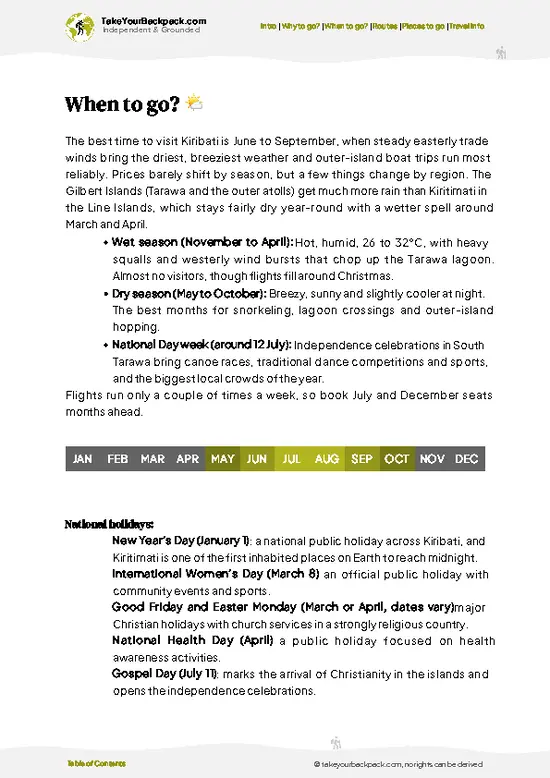
  • Dry season (roughly May to October): Trade winds keep daytime highs around 29 to 31°C (84 to 88°F) and the sea breeze takes the edge off. Rain is lighter and the sea is calmest, so this suits boat hops and long beach days.
  • Wet season (roughly November to April): Expect squalls, heavier downpours and higher humidity, with temperatures similar at 27 to 31°C (81 to 88°F). Showers usually pass within an hour, but cloud can linger for days and flights or boats may shift.
  • Daylight: Sitting almost on the equator, Kuria gets about 12 hours of light all year. Sunrise comes between about 6:05 and 6:40 am and sunset between about 6:15 and 6:45 pm.
  • Crowds and prices: Visitors are rare in every month, so the beach is empty whatever the date. Costs barely move with the season, though flights from Tarawa fill
… read more 👉
  • Dry season (roughly May to October): Trade winds keep daytime highs around 29 to 31°C (84 to 88°F) and the sea breeze takes the edge off. Rain is lighter and the sea is calmest, so this suits boat hops and long beach days.
  • Wet season (roughly November to April): Expect squalls, heavier downpours and higher humidity, with temperatures similar at 27 to 31°C (81 to 88°F). Showers usually pass within an hour, but cloud can linger for days and flights or boats may shift.
  • Daylight: Sitting almost on the equator, Kuria gets about 12 hours of light all year. Sunrise comes between about 6:05 and 6:40 am and sunset between about 6:15 and 6:45 pm.
  • Crowds and prices: Visitors are rare in every month, so the beach is empty whatever the date. Costs barely move with the season, though flights from Tarawa fill around Christmas and school holidays when families travel home.
Book your inter-island flight early, then pad your plans with a spare day in case a schedule slips.


source: climatestotravel.comJANJanuary: fair for travelingFEBFebruary: fair for travelingMARMarch: fair for travelingAPRApril: good for travelingMAYMay: excellent for travelingJUNJune: excellent for travelingJULJuly: excellent for travelingAUGAugust: excellent for travelingSEPSeptember: excellent for travelingOCTOctober: excellent for travelingNOVNovember: good for travelingDECDecember: fair for traveling
when-to-go

✈️ The backpacker research shortcutKiribati Travel Guide

An offline-friendly backpacking guide with optimized travel routes, ranked highlights, transport advice, and the best areas to stay.
example page 0 from our offline Travel Guide for Kiribati
example page 1 from our offline Travel Guide for Kiribati
example page 2 from our offline Travel Guide for Kiribati
example page 3 from our offline Travel Guide for Kiribati
example page 4 from our offline Travel Guide for Kiribati
example page 5 from our offline Travel Guide for Kiribati
example page 6 from our offline Travel Guide for Kiribati
example page 7 from our offline Travel Guide for Kiribati
The digital guide (120 pages) contains:
✅ 25 highlights, ranked by travel appeal
✅ Optimized 2, 3 & 5-day travel routes
✅ Cities, national parks, landmarks, beaches
✅ How to get around
✅ Offline-friendly for travel without Wi-Fi
👉 Click to see all 30+ guide features

📅 Plan smarter in minutes, not weeks
✅ Month by month travel advice
✅ Festivals & national holidays
✅ Budget expectations

🗺️ Go to the right places, skip the overrated ones
✅ Honest pros & cons of destinations
✅ Top hikes, parks & viewpoints
✅ Lesser-known places most travelers miss
✅ Clear “worth it vs skip it” guidance

🛏️ Travel smoothly without rookie mistakes
✅ Best areas to stay
✅ Transport systems explained simply
✅ Common scams & safety advice
✅ SIM cards, money & practical tips

🌍 Understand the country, not just visit it
✅ Culture & traditions
✅ 52 Essential phrases & customs
✅ Festivals worth planning around
✅ Traveler-friendly historical context
✅ Insights that make places more meaningful

📱 Built for real travel conditions
✅ Fully downloadable PDF
✅ Works completely offline
✅ Optimized for phone use
✅ Useful in remote areas & buses
✅ Everything in one place
Stop searching, start planning
Get instant access to your full guide. 30‑day money-back guarantee.
+ Add another guide for just

By proceeding you agree to our terms.
Sent to your inbox immediately after payment • 100% Secure Checkout
Best Backpacking Travel Advisor 2025 tourism awardBest Backpacking
Travel Advisor
2025
What others say about Take Your Backpack Guides:
⭐⭐⭐⭐⭐
Fantastic, amazing amount of information!
⭐⭐⭐⭐⭐
My goodness this is amazing, it's what I've been looking for hats off too you!
⭐⭐⭐⭐⭐
I think this is absolutely BRILLIANT
⭐⭐⭐⭐
Very complete and informative. It's still missing places, but I gotta to commend you
⭐⭐⭐⭐⭐
This is truly amazing, thank you, can't wait to explore it with my kids!
⭐⭐⭐⭐⭐
Awesome resource, thank you!
⭐⭐⭐⭐⭐
This is amazing! Can't wait to explore the ones I haven't seen
⭐⭐⭐⭐
I love this! Well done, great idea.
⭐⭐⭐⭐⭐
Thanks for taking the time to make this gem!
⭐⭐⭐⭐⭐
This might be the best website I've ever seen.
⭐⭐⭐⭐⭐
Congratulations, and thank you so much for your work; it's incredibly valuable.
⭐⭐⭐⭐
In all seriousness I think you did a great job pointing out the important spots
⭐⭐⭐⭐⭐
10/10 very good
⭐⭐⭐⭐⭐
As someone who's only just starting to visit regularly this is awesome, thank you.
⭐⭐⭐⭐
Thank you very much! I'm going to visit my dad, it's going to be very useful!
⭐⭐⭐⭐⭐
This is really cool! We'll be travelling for the first time and this definitely come in handy.
⭐⭐⭐⭐⭐
You are now our minister of culture, congratulations 👨‍💼
⭐⭐⭐⭐⭐
Just wanted to tell you that this is a pearl! Going to follow your recommendations.
⭐⭐⭐⭐⭐
This is so cool. I'll definitely be using the resource for my travels soon.
⭐⭐⭐⭐⭐
This is very impressive! Good work.
⭐⭐⭐⭐⭐
This is an amazing and informative site. Very well done!

🛏️ Where to stay?Where staying makes the most sense

Stay in the main villages on Buariki, Kuria’s main islet, because that is where the few places to sleep, the shops and the landing are. Kuria is a small, flat atoll-like island with roughly 1,000 residents, so there is no hostel scene or backpacker strip. Accommodation means a basic guesthouse room or a homestay with a local family, usually arranged through the island council, a contact in Tarawa or on arrival. Expect roughly A$30 to 60 (about US$20 to 40) per night including simple meals of fish, rice, breadfruit and coconut. Nights are quiet and the social side comes from the family you stay … read more 👉
Stay in the main villages on Buariki, Kuria’s main islet, because that is where the few places to sleep, the shops and the landing are. Kuria is a small, flat atoll-like island with roughly 1,000 residents, so there is no hostel scene or backpacker strip. Accommodation means a basic guesthouse room or a homestay with a local family, usually arranged through the island council, a contact in Tarawa or on arrival. Expect roughly A$30 to 60 (about US$20 to 40) per night including simple meals of fish, rice, breadfruit and coconut. Nights are quiet and the social side comes from the family you stay with, from evenings spent in the village maneaba (meeting house), and from joining fishing trips. Pick a spot within a short walk of the beach so you can swim at dawn or dusk when it is cool. Rooms are simple, often with a fan, bucket showers and limited power. Bring cash in Australian dollars, since Kiribati uses the Australian dollar and there are no ATMs. Bring snacks, water purification and a headlamp as well. Ask permission before camping or setting up anywhere, because land belongs to families.

🚌 Getting aroundMoving around without the hassle

Kuria Island is small enough that you can walk the length of a village in twenty minutes, with coral-gravel paths crunching underfoot and the smell of drying copra drifting from every yard. Walking stops making sense once you leave the village you sleep in. Kuria is two reef islands, Buariki and Oneeke, strung along one causeway-linked coast, and the full run between the far ends is long enough to wilt you by midday in the equatorial glare.

There is no tourist transport network here, and that is the point. Things move on local rhythm: a shared truck, a borrowed bike, a friend of your host with a motorbike. It works, but nothing runs to a timetable, so plan loosely.
  • Walking. Free, and the best way to meet people, since everyone greets you from the shade of their maneaba. Start before 8 am,
… read more 👉
Kuria Island is small enough that you can walk the length of a village in twenty minutes, with coral-gravel paths crunching underfoot and the smell of drying copra drifting from every yard. Walking stops making sense once you leave the village you sleep in. Kuria is two reef islands, Buariki and Oneeke, strung along one causeway-linked coast, and the full run between the far ends is long enough to wilt you by midday in the equatorial glare.

There is no tourist transport network here, and that is the point. Things move on local rhythm: a shared truck, a borrowed bike, a friend of your host with a motorbike. It works, but nothing runs to a timetable, so plan loosely.
  • Walking. Free, and the best way to meet people, since everyone greets you from the shade of their maneaba. Start before 8 am, when the sand is cool and the lagoon-less reef side smells of salt and drying seaweed, and stop by late morning.
  • Bicycle. Locals ride everywhere because the single road is flat and the sea breeze helps. Your host family can usually lend one, or you can pay roughly US$3 to 6 a day for a borrowed bike. Expect loose chains and squeaking pedals, so test the brakes first.
  • Motorbike or pickup rides. Few vehicles exist, and rides between villages are informal. A short hop costs about US$1 to 3, and a longer trip across the island may run US$5 to 10. Experienced travelers ask a day ahead, because the driver may also be fishing or tending a copra yard.
  • Inter-island flight or boat. Getting to Kuria from Tarawa is by a small Coconut Airlines plane (around 1 hour) or an irregular cargo ship (a day or more of diesel fumes and deck mats). Flights run only a few days a week and cost roughly US$100 to 150 each way, so fly if your schedule matters and take the boat only if you can absorb delays.

Book the return flight the moment you land, and confirm it again at the airline office in person. Seats are few, bookings are sometimes bumped for cargo or officials, and a roadside chat is the only reliable way to hear about a change.

🍲 FoodEating & Drinking in Kuria Island

Food on Kuria Island is built from the reef and the coconut tree. Fresh fish comes in daily, grilled over coconut husk until the skin blisters and smokes, or eaten raw in coconut cream with lime. Expect rice at nearly every meal, plus breadfruit and pandanus when in season, and the occasional sweet, chewy block of dried pandanus paste. Palu sami, a rich pudding of taro leaves and coconut cream, is worth asking for.

The main drink is toddy, the sap tapped from coconut flower stalks. Fresh in the morning it is sweet and faintly fizzy, and by evening it turns sour. Young drinking coconuts are handed over with a machete-opened top, cool and slightly salty.

There are no restaurants to speak of. You eat with your host family on mats in the shade, or buy tinned fish, ship biscuits and noodles from … read more 👉
Food on Kuria Island is built from the reef and the coconut tree. Fresh fish comes in daily, grilled over coconut husk until the skin blisters and smokes, or eaten raw in coconut cream with lime. Expect rice at nearly every meal, plus breadfruit and pandanus when in season, and the occasional sweet, chewy block of dried pandanus paste. Palu sami, a rich pudding of taro leaves and coconut cream, is worth asking for.

The main drink is toddy, the sap tapped from coconut flower stalks. Fresh in the morning it is sweet and faintly fizzy, and by evening it turns sour. Young drinking coconuts are handed over with a machete-opened top, cool and slightly salty.

There are no restaurants to speak of. You eat with your host family on mats in the shade, or buy tinned fish, ship biscuits and noodles from a tiny village shop. Bring snacks if you want variety.

Food is shared, and the guest is usually served first. Wait until the family invites you to start, take a little of everything, and do not refuse a gift of fish. Dress modestly at meals, and finish what you take, because waste is noticed on an island where everything arrives by sea.

🛡️ SafetyTraveler Safety Guide

Kuria’s beaches are generally calm and low-risk, and the biggest daily factor is the sun. Near the equator the UV is intense from about 10 am to 3 pm, so swim early or late, wear a rash guard and carry water. Kuria has no lagoon, and the reef edge can carry stronger surf and currents, particularly when swells run, so ask villagers where they swim and follow them. Tides change how much water covers the reef flat. At low tide the coral is sharp and cuts easily, so wear reef shoes and check the tide before walking out. Stonefish and sea urchins hide in shallows, which makes shuffling your feet sensible. Sharks exist in the open water, but locals fish and swim here routinely. Theft is rare, though cover your valuables and respect village norms by dressing modestly away from the beach. There are … read more 👉
Kuria’s beaches are generally calm and low-risk, and the biggest daily factor is the sun. Near the equator the UV is intense from about 10 am to 3 pm, so swim early or late, wear a rash guard and carry water. Kuria has no lagoon, and the reef edge can carry stronger surf and currents, particularly when swells run, so ask villagers where they swim and follow them. Tides change how much water covers the reef flat. At low tide the coral is sharp and cuts easily, so wear reef shoes and check the tide before walking out. Stonefish and sea urchins hide in shallows, which makes shuffling your feet sensible. Sharks exist in the open water, but locals fish and swim here routinely. Theft is rare, though cover your valuables and respect village norms by dressing modestly away from the beach. There are no lifeguards and no medical facilities beyond a small clinic, so keep a basic first aid kit.

FAQFrequently asked questions about Kuria Island

Fly from Tarawa (Bonriki airport) to Kuria with Air Kiribati, which runs limited flights on a few days a week and takes about 40 to 60 minutes. Fares are roughly A$100 to 200 one way, and schedules change often. Cargo boats also make the trip from Tarawa, but they take around a day or more and run irregularly. Confirm with Air Kiribati in Tarawa and arrange a village host before you go.
Swimming is good, especially over the reef flat at high tide when the water is deeper and clear. Snorkeling is rewarding over the reef edges, where you can see reef fish and corals, but wear reef shoes and go with a local guide because currents run on the ocean side. There is no surf scene or board rental, and the ocean side swell is not set up for visitors. Bring your own mask and snorkel, as nothing is available to rent.
Yes, the beach itself costs nothing, and there is no entry gate or ticket. Land is held by local families, so ask your host or village elder before settling in, and a small gift or contribution to your homestay is appreciated. Your main costs are getting there, roughly A$100 to 200 each way by air from Tarawa, and a bed and meals at about A$30 to 60 a night.
⚠️ Things can change over time, so always validate details locally before you go.

Other I-Kiribati regions near Kuria Island

Explore more nearby:

  • Abemama Atoll—Stevenson sites, Tem Binoka’s tomb, lagoon swims, causeway walks| 59 km away
  • South Tarawa—Betio bunkers, Red Beach, minibus rides, Bikenibeu museum| 131 km away
  • Tarawa Atoll—Betio bunkers, rusted guns, causeway road, maneaba halls, fish stalls| 144 km away

💡 Not sure where to go next?
Create a personalized itinerary for Kiribati including Kuria Island and the places that fit your trip.

Generate my itinerary

👉 Discover all regions

Or checkout all Kiribati has to offer (think cities, towns, villages, national parks, hikes, beaches, festivals)
Country photo of Kiribati

We 💚 feedbackKey takeaways before you go

Kuria pairs best with a few days on Abemama or Tarawa, so you can trade a little urban bustle for atoll quiet and see two very different sides of the Gilberts. I would go in with flexible dates, since flights and boats run on island time. Bring small gifts for your host family, a reusable water bottle and a good book for the long afternoons.

✍️ Help improve this page!
The information on this page is based on in-depth research, insights shared by experienced travelers, and feedback from the local travel community in Kiribati. While every effort is made to keep the information accurate and current, conditions can change — so if you spot anything incorrect or outdated, please get in touch.


🙋‍♂️ Give feedback

👋 Meet the founderWho’s Behind Take Your Backpack?

Johan, backpacker and founder of TakeYourBackpackHi, I’m Johan (Netherlands 🇳🇱), the creator of TakeYourBackpack. Over the past 3 decades, I’ve backpacked through 90+ countries across six continents, gaining extensive experience with independent travel, long-term trips, and overland routes.

This site is built on a combination of firsthand travel experience and carefully curated insights from other backpackers. Many guides are based on places I’ve personally visited, while others bring together tips, observations, and practical advice shared by trusted travelers I’ve met along the way.

The goal is to provide realistic, experience-driven guidance — not generic itineraries — so you can explore destinations with better context, clearer expectations, and more confidence.