
Betio War Relics
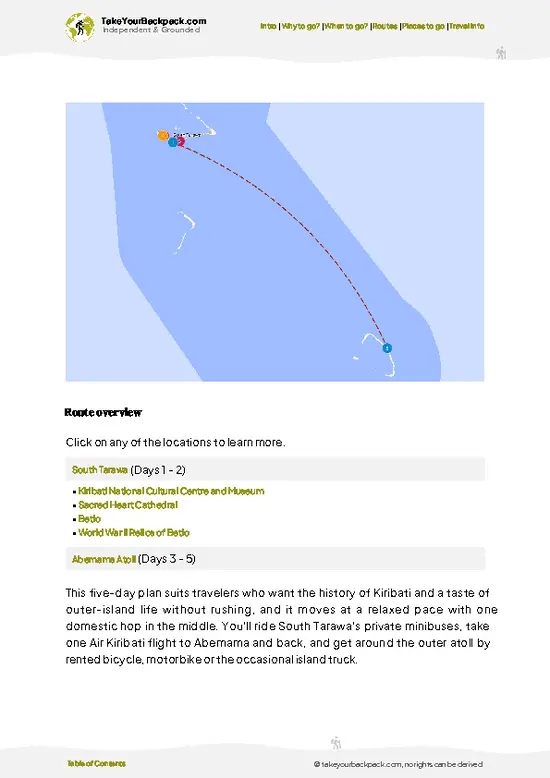
If you want to feel the pulse of history, Betio is where you stand on the very sand that changed the Pacific. The rusting tanks, bunkers, and gun emplacements aren’t museum pieces—they’re scattered across the island, half-swallowed by vines and tide. You’ll see bullet holes in concrete and the eerie outlines of foxholes. It’s raw, unfiltered World War II, and you can walk it at your own pace, no velvet ropes or curated plaques. Bring water, sun protection, and a sense of respect—this is still a graveyard for many.
Te Umanibong (Kiribati Cultural Museum)
This isn’t your average capital-city museum. Te Umanibong is small but dense with artifacts: shark-tooth weapons, woven armor, and the kind of local art that tells you what matters here. The staff are usually up for a chat, … read more 👉
If you want to feel the pulse of history, Betio is where you stand on the very sand that changed the Pacific. The rusting tanks, bunkers, and gun emplacements aren’t museum pieces—they’re scattered across the island, half-swallowed by vines and tide. You’ll see bullet holes in concrete and the eerie outlines of foxholes. It’s raw, unfiltered World War II, and you can walk it at your own pace, no velvet ropes or curated plaques. Bring water, sun protection, and a sense of respect—this is still a graveyard for many.
Te Umanibong (Kiribati Cultural Museum)
This isn’t your average capital-city museum. Te Umanibong is small but dense with artifacts: shark-tooth weapons, woven armor, and the kind of local art that tells you what matters here. The staff are usually up for a chat, … read more 👉
Betio War Relics
If you want to feel the pulse of history, Betio is where you stand on the very sand that changed the Pacific. The rusting tanks, bunkers, and gun emplacements aren’t museum pieces—they’re scattered across the island, half-swallowed by vines and tide. You’ll see bullet holes in concrete and the eerie outlines of foxholes. It’s raw, unfiltered World War II, and you can walk it at your own pace, no velvet ropes or curated plaques. Bring water, sun protection, and a sense of respect—this is still a graveyard for many.
Te Umanibong (Kiribati Cultural Museum)
This isn’t your average capital-city museum. Te Umanibong is small but dense with artifacts: shark-tooth weapons, woven armor, and the kind of local art that tells you what matters here. The staff are usually up for a chat, and if you time it right, you might catch a school group learning traditional dance. It’s the best crash course in Kiribati’s soul you’ll get without an invitation to someone’s home.
Ambo Island Causeway Walk
Here’s the move: go early, before the sun’s a hammer, and walk the causeway from Bairiki to Ambo. On one side, the lagoon glows turquoise; on the other, the Pacific flexes its muscle. Fishermen haul in their morning catch, kids race bikes, and you’ll get a front-row seat to daily life. It’s the closest thing to a local commute, and the views are pure South Tarawa.
Bonriki Mangrove Forest (Hidden Gem)
Most visitors skip right past Bonriki, but the mangrove forest is a living laboratory. Walk the raised boardwalks and watch for mudskippers, crabs, and the occasional heron. The air is thick and salty, and the roots twist like something out of a Miyazaki film. It’s a cool, shaded break from the heat and a reminder that Kiribati is fighting hard to keep its coastline alive.
Teaoraereke Catholic Cathedral
This isn’t just a church—it’s a community anchor. Step inside during a Sunday service and you’ll hear harmonies that could raise the roof. The stained glass is simple but heartfelt, and the open-air design lets in the sea breeze. Even if you’re not religious, the sense of togetherness is contagious.
Bairiki Market
Forget souvenirs—this is where you taste South Tarawa. Try coconut toddy, fresh breadfruit chips, or the day’s catch grilled right in front of you. The market is chaotic, loud, and full of character. If you want to practice your I-Kiribati greetings, this is the place.
Nanikai Seawall (Hidden Gem)
At high tide, the Nanikai seawall is where locals gather to cool off, gossip, and watch the sun drop into the lagoon. It’s not a beach, but it’s the social heart of the neighborhood. Bring a cold drink, dangle your feet, and you’ll be part of the scene in no time.
Betio Fish Market (Hidden Gem)
Arrive before 8 a.m. and you’ll see the real action—fishermen unloading tuna, reef fish, and the occasional oddity. The bargaining is fast and friendly, and if you’re lucky, someone will grill you a piece on the spot. It’s gritty, authentic, and a sensory overload.
Parliament House (Maneaba ni Maungatabu)
You can’t always go inside, but the building itself is worth a look. Modeled after a traditional maneaba (meeting house), it’s where national decisions happen. The grounds are open, and if you linger, you might catch a delegation or a school group. It’s a reminder that Kiribati’s democracy is homegrown, not imported.
Lagoon Swimming at Ambo
Skip the hotel pool. The Ambo lagoon is where locals swim, especially at high tide. The water is warm, the bottom is sandy, and you’ll often have it to yourself if you go midday. Just watch for currents and ask around for the safest spots—locals know best.
If you want to feel the pulse of history, Betio is where you stand on the very sand that changed the Pacific. The rusting tanks, bunkers, and gun emplacements aren’t museum pieces—they’re scattered across the island, half-swallowed by vines and tide. You’ll see bullet holes in concrete and the eerie outlines of foxholes. It’s raw, unfiltered World War II, and you can walk it at your own pace, no velvet ropes or curated plaques. Bring water, sun protection, and a sense of respect—this is still a graveyard for many.
Te Umanibong (Kiribati Cultural Museum)
This isn’t your average capital-city museum. Te Umanibong is small but dense with artifacts: shark-tooth weapons, woven armor, and the kind of local art that tells you what matters here. The staff are usually up for a chat, and if you time it right, you might catch a school group learning traditional dance. It’s the best crash course in Kiribati’s soul you’ll get without an invitation to someone’s home.
Ambo Island Causeway Walk
Here’s the move: go early, before the sun’s a hammer, and walk the causeway from Bairiki to Ambo. On one side, the lagoon glows turquoise; on the other, the Pacific flexes its muscle. Fishermen haul in their morning catch, kids race bikes, and you’ll get a front-row seat to daily life. It’s the closest thing to a local commute, and the views are pure South Tarawa.
Bonriki Mangrove Forest (Hidden Gem)
Most visitors skip right past Bonriki, but the mangrove forest is a living laboratory. Walk the raised boardwalks and watch for mudskippers, crabs, and the occasional heron. The air is thick and salty, and the roots twist like something out of a Miyazaki film. It’s a cool, shaded break from the heat and a reminder that Kiribati is fighting hard to keep its coastline alive.
Teaoraereke Catholic Cathedral
This isn’t just a church—it’s a community anchor. Step inside during a Sunday service and you’ll hear harmonies that could raise the roof. The stained glass is simple but heartfelt, and the open-air design lets in the sea breeze. Even if you’re not religious, the sense of togetherness is contagious.
Bairiki Market
Forget souvenirs—this is where you taste South Tarawa. Try coconut toddy, fresh breadfruit chips, or the day’s catch grilled right in front of you. The market is chaotic, loud, and full of character. If you want to practice your I-Kiribati greetings, this is the place.
Nanikai Seawall (Hidden Gem)
At high tide, the Nanikai seawall is where locals gather to cool off, gossip, and watch the sun drop into the lagoon. It’s not a beach, but it’s the social heart of the neighborhood. Bring a cold drink, dangle your feet, and you’ll be part of the scene in no time.
Betio Fish Market (Hidden Gem)
Arrive before 8 a.m. and you’ll see the real action—fishermen unloading tuna, reef fish, and the occasional oddity. The bargaining is fast and friendly, and if you’re lucky, someone will grill you a piece on the spot. It’s gritty, authentic, and a sensory overload.
Parliament House (Maneaba ni Maungatabu)
You can’t always go inside, but the building itself is worth a look. Modeled after a traditional maneaba (meeting house), it’s where national decisions happen. The grounds are open, and if you linger, you might catch a delegation or a school group. It’s a reminder that Kiribati’s democracy is homegrown, not imported.
Lagoon Swimming at Ambo
Skip the hotel pool. The Ambo lagoon is where locals swim, especially at high tide. The water is warm, the bottom is sandy, and you’ll often have it to yourself if you go midday. Just watch for currents and ask around for the safest spots—locals know best.
Spotted a mistake or missing something? Contact us.
v2.webp)

Best Backpacking
Hi, I’m Johan (Netherlands 🇳🇱), the creator of TakeYourBackpack. Over the past decade, I’ve backpacked through 80+ countries across six continents, gaining extensive experience with independent travel, long-term trips, and overland routes.