×

Liberia🇱🇷 | best landmarksBest landmarks in Liberia

Landmarks in Liberia are rarely ticketed monuments with turnstiles. They are colonial-era ruins, rainforest reserves, surf-battered coastlines and war-scarred buildings, reached by red laterite roads that turn to soup in the rain. Around Monrovia, sites sit minutes apart, with the smell of woodsmoke, diesel and fried plantain in the air and entry costing little or nothing. Upcountry, in Nimba, Lofa and the southeast, distances stretch, humidity thickens and a local guide becomes necessary. For backpackers and independent travelers, the coast is easy and cheap, while the interior costs more in time, grit and transport.

By Johan Kruseman 🇳🇱 | Updated October 18, 2026
Explore the best national parks in Liberia

Why go?Key Factors That Shape the Experience

Liberia’s landmarks are shaped by an unusual story: freed African Americans settled the coast in the 1800s, building Georgian-style houses and churches beside older Indigenous communities whose sacred groves, masks and forest societies still matter in daily life. That layering exists almost nowhere else in West Africa, and you read it in rusting zinc roofs, mossy stone walls and the sound of Liberian English mixing with Kpelle, Bassa and Kru.

The 14-year civil war (ending in 2003) left its mark too. Some buildings stand gutted, others were rebuilt without much signage, and museum-style interpretation is thin. Expect to learn from people, not plaques.

The tropical climate is hard on everything. Moisture eats concrete, forest swallows ruins, and roads wash out. Infrastructure is limited, so … read more 👉
Liberia’s landmarks are shaped by an unusual story: freed African Americans settled the coast in the 1800s, building Georgian-style houses and churches beside older Indigenous communities whose sacred groves, masks and forest societies still matter in daily life. That layering exists almost nowhere else in West Africa, and you read it in rusting zinc roofs, mossy stone walls and the sound of Liberian English mixing with Kpelle, Bassa and Kru.

The 14-year civil war (ending in 2003) left its mark too. Some buildings stand gutted, others were rebuilt without much signage, and museum-style interpretation is thin. Expect to learn from people, not plaques.

The tropical climate is hard on everything. Moisture eats concrete, forest swallows ruins, and roads wash out. Infrastructure is limited, so fuel, bridges and shared taxis dictate what you can reach. Tourism is young, which means few crowds, no fixed prices and a lot of improvised hospitality. Bring cash in small bills (Liberian dollars and US dollars are both used), patience for unmarked turnoffs, and the expectation that a landmark here is often a conversation with a caretaker rather than a polished visit.
Behind the Scenes of Selection
The list of best unique sites in Liberia is created based on history or culture, wow factor, atmosphere, quirks, and memorability. If you feel a unique site is missing in this list, please let us know.

When to go?Seasonal Guide to Visiting

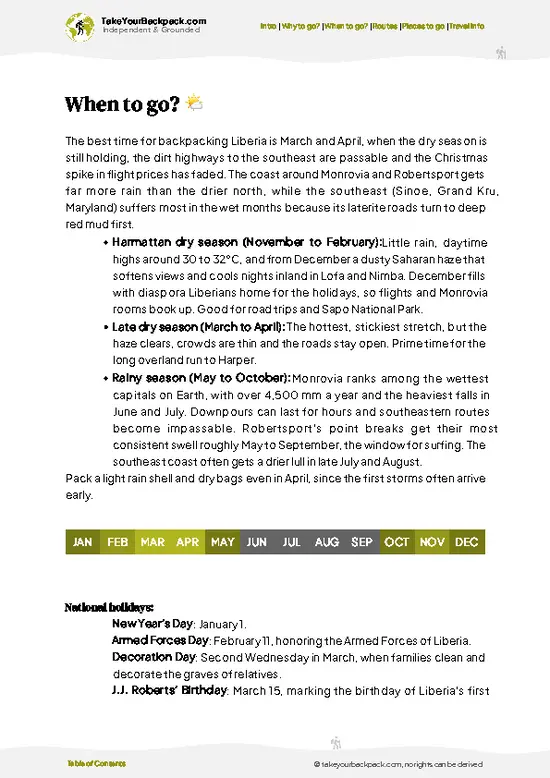
Best months: The best months for landmarks in Liberia are November to March, the dry season, when laterite roads are firm, skies turn hazy blue and harmattan dust softens the light at dawn. Daytime temperatures sit around 28 to 33°C, with humidity still sticky near the coast.

Shoulder and wet seasons: April and October are the shoulder months, with building heat and afternoon downpours. From May to September the rains arrive hard: Monrovia receives some of the highest rainfall of any capital in the world, often more than 4,000 mm a year, with June to August the heaviest. Rain hammers tin roofs, rivers turn brown and trails in Nimba, Lofa and the southeast become mud-slick or impassable, with bridges and tracks sometimes cut off for days. Coastal sites near Monrovia stay reachable, but expect … read more 👉
Best months: The best months for landmarks in Liberia are November to March, the dry season, when laterite roads are firm, skies turn hazy blue and harmattan dust softens the light at dawn. Daytime temperatures sit around 28 to 33°C, with humidity still sticky near the coast.

Shoulder and wet seasons: April and October are the shoulder months, with building heat and afternoon downpours. From May to September the rains arrive hard: Monrovia receives some of the highest rainfall of any capital in the world, often more than 4,000 mm a year, with June to August the heaviest. Rain hammers tin roofs, rivers turn brown and trails in Nimba, Lofa and the southeast become mud-slick or impassable, with bridges and tracks sometimes cut off for days. Coastal sites near Monrovia stay reachable, but expect wet shoes and canceled plans.

Crowds and prices: Crowds stay small year-round. Prices barely shift with season, though transport costs rise when roads worsen, as drivers charge more for rough routes. December can fill hotels with returning diaspora families, so book Monrovia rooms early then. Upcountry guides and drivers are easiest to arrange in the dry months, and the clearer air gives better views from high points.

unique site hoppingHow to Combine landmarks Into One Trip

Trip length: A trip combining several landmarks in Liberia needs 7 to 12 days, and the extra time is mostly road time.

Grouping and direction: Start in Monrovia, which has the airport, ATMs and the densest cluster of sites; allow 2 to 3 days there. Then choose one direction: northeast toward Nimba via Gbarnga (roughly 4 to 6 hours by road in the dry season), or southeast along the coast toward Buchanan and Greenville. Doing both in one short trip is a common mistake, because the two are separated by long, rough stretches and the loop back eats days. Gbarnga makes a useful hub for the interior, and Buchanan for the coast, each about 2 to 3 hours from Monrovia on paved or mostly paved road.

Pacing: Give each interior stop one full day including a guide, and coastal stops a half day. Shared … read more 👉
Trip length: A trip combining several landmarks in Liberia needs 7 to 12 days, and the extra time is mostly road time.

Grouping and direction: Start in Monrovia, which has the airport, ATMs and the densest cluster of sites; allow 2 to 3 days there. Then choose one direction: northeast toward Nimba via Gbarnga (roughly 4 to 6 hours by road in the dry season), or southeast along the coast toward Buchanan and Greenville. Doing both in one short trip is a common mistake, because the two are separated by long, rough stretches and the loop back eats days. Gbarnga makes a useful hub for the interior, and Buchanan for the coast, each about 2 to 3 hours from Monrovia on paved or mostly paved road.

Pacing: Give each interior stop one full day including a guide, and coastal stops a half day. Shared taxis and minibuses leave when full, so mornings are best, and fumes, loud radios and packed seats are part of the ride. Plan buffer days in the rainy season, since a single washed-out bridge can add six hours. Carry cash for fuel and fares, since cards rarely work outside Monrovia, and avoid driving after dark on unlit roads full of walkers and motorbikes.

The ListMust-Visit landmarks in Liberia

1 Kpatawee Waterfall

forest pools, cool cascades, rural Bong County, picnic spots

Follow forest trails to a series of cool, multi-level falls where locals gather, swim, and relax in the shade of dense trees.

Loading the map 🌍

Expert viewWhat You Should Know

How many to visit: I advise four to six landmarks on a first trip. Liberia’s roads are slow, and each stop beyond the capital costs most of a day in transit. Fewer stops mean you can sit with a caretaker, hear the stories and let the heat and forest sounds settle. Cramming in more means you spend your time in the back of a shared taxi.

Choosing by travel style: If you like history, prioritize the settler-era and war-memory sites near Monrovia, where you leave with context that makes the rest of the country make sense. If you want nature, put the forest and mountain reserves first, with their dripping canopy, hornbill calls and cool air at altitude. For beach and surf, stay on the coast, where salt wind, palm shade and grilled fish at sunset make easy afternoons. Most budget travelers do best … read more 👉
How many to visit: I advise four to six landmarks on a first trip. Liberia’s roads are slow, and each stop beyond the capital costs most of a day in transit. Fewer stops mean you can sit with a caretaker, hear the stories and let the heat and forest sounds settle. Cramming in more means you spend your time in the back of a shared taxi.

Choosing by travel style: If you like history, prioritize the settler-era and war-memory sites near Monrovia, where you leave with context that makes the rest of the country make sense. If you want nature, put the forest and mountain reserves first, with their dripping canopy, hornbill calls and cool air at altitude. For beach and surf, stay on the coast, where salt wind, palm shade and grilled fish at sunset make easy afternoons. Most budget travelers do best mixing two of the three kinds.

What it costs: Budget US$40 to 70 a day including a basic room (US$20 to 40), food from street stalls and local restaurants (US$5 to 12), and local transport. Liberia is not as cheap as much of West Africa. Coastal and city sites often cost nothing or a few dollars as a donation or caretaker tip. Reserves and guided hikes run roughly US$10 to 40 per visit for fees and guide, plus US$30 to 80 for a hired car or motorbike taxi on longer legs. Carry small US dollar bills and Liberian dollars, since change is scarce and ATMs unreliable beyond Monrovia. The payoff is a day where a guide cuts a path through ferns and names every bird.

Safety and etiquette: Always ask before photographing people, ceremonial objects and anything linked to wartime memory, and ask a local contact before entering a sacred forest or society ground, because some areas are closed to outsiders or to women or men. Dress modestly, greet everyone first and accept that conversation comes before business. Hire local guides for forest and remote sites, since trails are unmarked and mobile signal vanishes. Take malaria prophylaxis, since mosquitoes swarm after dusk, and carry water and rain gear. Petty theft happens in crowded Monrovia markets, so keep valuables out of sight. Avoid night travel, and expect police or checkpoint stops to be routine and polite when you stay calm and carry a passport copy.

✈️ The backpacker research shortcutLiberia Travel Guide

An offline-friendly backpacking guide with optimized travel routes, ranked highlights, transport advice, and the best areas to stay.
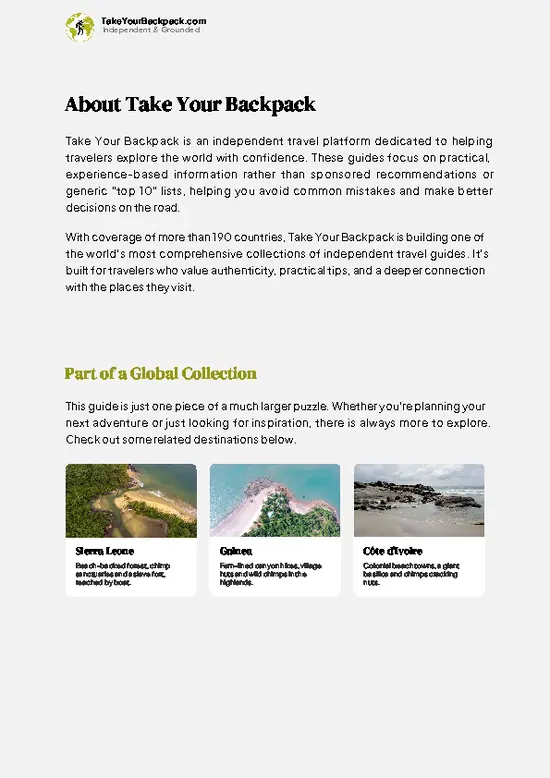
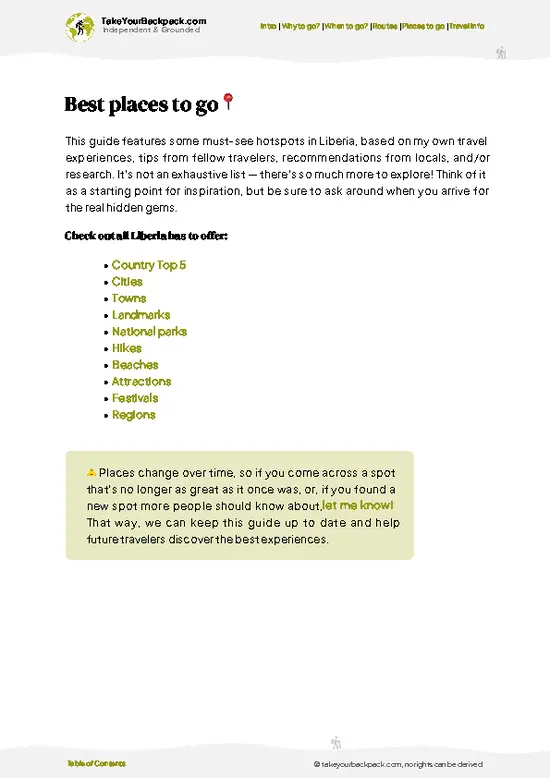
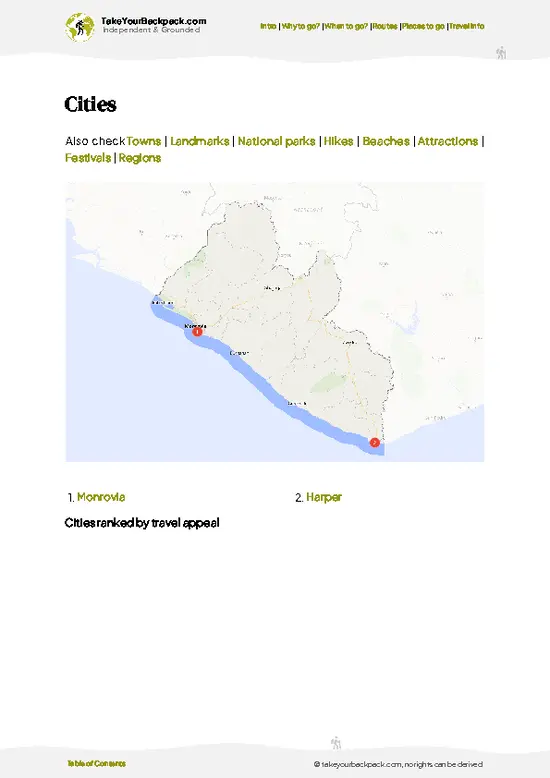
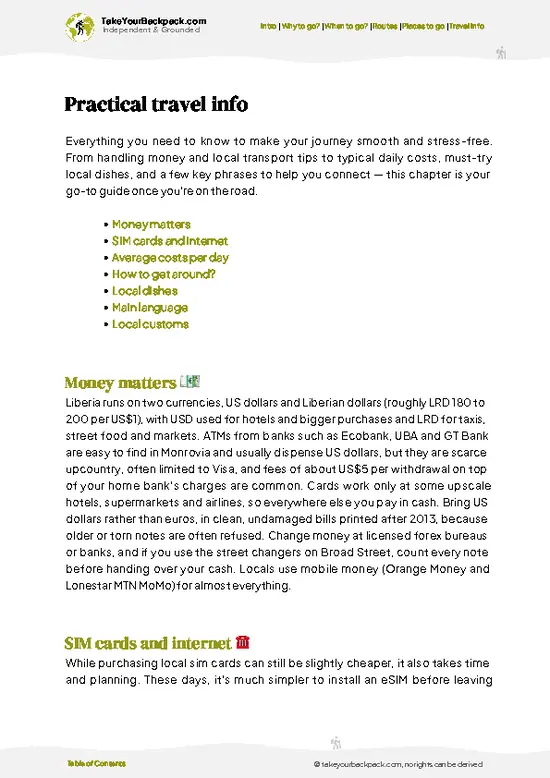
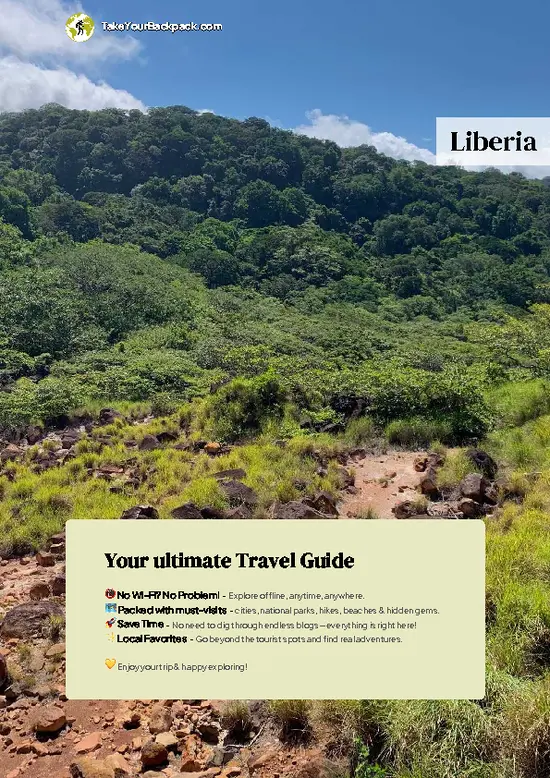
example page 0 from our offline Travel Guide for Liberia
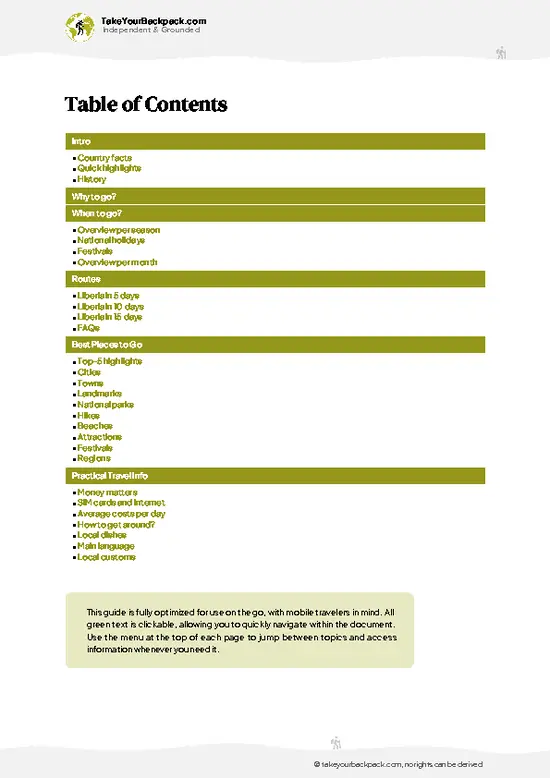
example page 1 from our offline Travel Guide for Liberia
example page 2 from our offline Travel Guide for Liberia
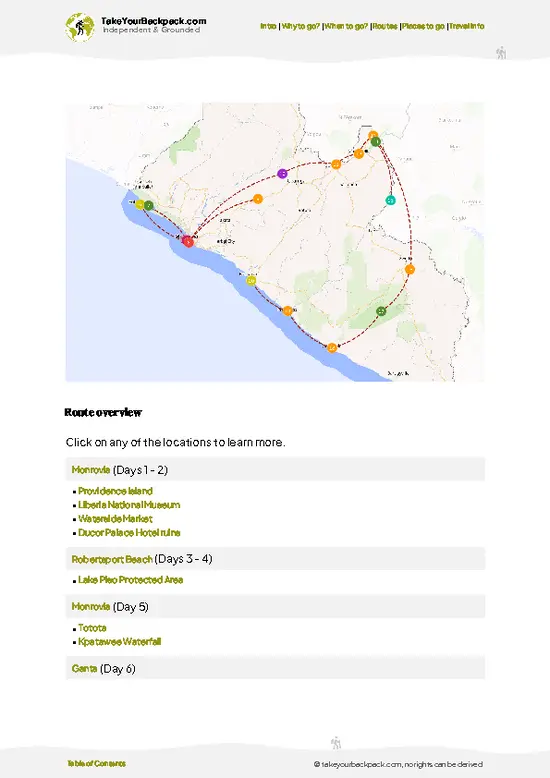
example page 3 from our offline Travel Guide for Liberia
example page 4 from our offline Travel Guide for Liberia
example page 5 from our offline Travel Guide for Liberia
example page 6 from our offline Travel Guide for Liberia
example page 7 from our offline Travel Guide for Liberia
The digital guide (211 pages) contains:
✅ 49 highlights, ranked by travel appeal
✅ Optimized 5, 10 & 15-day travel routes
✅ Cities, national parks, landmarks, beaches
✅ How to get around
✅ Offline-friendly for travel without Wi-Fi
👉 Click to see all 30+ guide features

📅 Plan smarter in minutes, not weeks
✅ Month by month travel advice
✅ Festivals & national holidays
✅ Budget expectations

🗺️ Go to the right places, skip the overrated ones
✅ Honest pros & cons of destinations
✅ Top hikes, parks & viewpoints
✅ Lesser-known places most travelers miss
✅ Clear “worth it vs skip it” guidance

🛏️ Travel smoothly without rookie mistakes
✅ Best areas to stay
✅ Transport systems explained simply
✅ Common scams & safety advice
✅ SIM cards, money & practical tips

🌍 Understand the country, not just visit it
✅ Culture & traditions
✅ Local customs
✅ Festivals worth planning around
✅ Traveler-friendly historical context
✅ Insights that make places more meaningful

📱 Built for real travel conditions
✅ Fully downloadable PDF
✅ Works completely offline
✅ Optimized for phone use
✅ Useful in remote areas & buses
✅ Everything in one place
Stop searching, start planning
Get instant access to your full guide. 30‑day money-back guarantee.
+ Add another guide for just

By proceeding you agree to our terms.
Sent to your inbox immediately after payment • 100% Secure Checkout
Best Backpacking Travel Advisor 2025 tourism awardBest Backpacking
Travel Advisor
2025
What others say about Take Your Backpack Guides:
⭐⭐⭐⭐⭐
Fantastic, amazing amount of information!
⭐⭐⭐⭐⭐
My goodness this is amazing, it's what I've been looking for hats off too you!
⭐⭐⭐⭐⭐
I think this is absolutely BRILLIANT
⭐⭐⭐⭐
Very complete and informative. It's still missing places, but I gotta to commend you
⭐⭐⭐⭐⭐
This is truly amazing, thank you, can't wait to explore it with my kids!
⭐⭐⭐⭐⭐
Awesome resource, thank you!
⭐⭐⭐⭐⭐
This is amazing! Can't wait to explore the ones I haven't seen
⭐⭐⭐⭐
I love this! Well done, great idea.
⭐⭐⭐⭐⭐
Thanks for taking the time to make this gem!
⭐⭐⭐⭐⭐
This might be the best website I've ever seen.
⭐⭐⭐⭐⭐
Congratulations, and thank you so much for your work; it's incredibly valuable.
⭐⭐⭐⭐
In all seriousness I think you did a great job pointing out the important spots
⭐⭐⭐⭐⭐
10/10 very good
⭐⭐⭐⭐⭐
As someone who's only just starting to visit regularly this is awesome, thank you.
⭐⭐⭐⭐
Thank you very much! I'm going to visit my dad, it's going to be very useful!
⭐⭐⭐⭐⭐
This is really cool! We'll be travelling for the first time and this definitely come in handy.
⭐⭐⭐⭐⭐
You are now our minister of culture, congratulations 👨‍💼
⭐⭐⭐⭐⭐
Just wanted to tell you that this is a pearl! Going to follow your recommendations.
⭐⭐⭐⭐⭐
This is so cool. I'll definitely be using the resource for my travels soon.
⭐⭐⭐⭐⭐
This is very impressive! Good work.
⭐⭐⭐⭐⭐
This is an amazing and informative site. Very well done!

🛏️ Where to stay?Accommodation Highlights

Liberia has almost no true backpacker hostels, so budget travel here means simple guesthouses and small hotels, usually around US$25 to 50 a night for a private room with a fan or air conditioning and a generator for power cuts. In Monrovia, Sinkor has the widest spread of mid-priced rooms close to beach bars and restaurants along Tubman Boulevard, while Mamba Point is the safest and best-connected area thanks to the embassies, but rooms there cost noticeably more. Downtown around Broad Street is cheaper and handy for markets and shared taxis but loud and sketchier after dark, and Paynesville is cheaper still but far from everything, while on the coast Robertsport has basic surf camps and beach … read more 👉
Liberia has almost no true backpacker hostels, so budget travel here means simple guesthouses and small hotels, usually around US$25 to 50 a night for a private room with a fan or air conditioning and a generator for power cuts. In Monrovia, Sinkor has the widest spread of mid-priced rooms close to beach bars and restaurants along Tubman Boulevard, while Mamba Point is the safest and best-connected area thanks to the embassies, but rooms there cost noticeably more. Downtown around Broad Street is cheaper and handy for markets and shared taxis but loud and sketchier after dark, and Paynesville is cheaper still but far from everything, while on the coast Robertsport has basic surf camps and beach huts that suit tighter budgets.

If you enjoy meeting fellow travelers, consider choosing hostels with high ratings for atmosphere. On the other hand, if you prefer having your own space, a hotel might be a better option.

LiberiaSee More of Liberia

👋 Meet the founderWho’s Behind Take Your Backpack?

Johan, backpacker and founder of TakeYourBackpackHi, I’m Johan (Netherlands 🇳🇱), the creator of TakeYourBackpack. Over the past 3 decades, I’ve backpacked through 90+ countries across six continents, gaining extensive experience with independent travel, long-term trips, and overland routes.

This site is built on a combination of firsthand travel experience and carefully curated insights from other backpackers. Many guides are based on places I’ve personally visited, while others bring together tips, observations, and practical advice shared by trusted travelers I’ve met along the way.

The goal is to provide realistic, experience-driven guidance — not generic itineraries — so you can explore destinations with better context, clearer expectations, and more confidence.