×

Liberia🇱🇷 | best attractionsBest 7 attractions in Liberia

Attractions in Liberia are raw, unpolished and mostly uncrowded. Forget ticket booths and tour buses. You get red laterite roads that stain everything the color of rust, surf pounding black rock, and rainforest thick with the whine of cicadas. Monrovia and the coast hold the history, markets and beaches, with easy taxi access and the odd generator-hum bar. The interior holds forest and wildlife, reached by long, bumpy rides and basic guesthouses. Costs stay modest in town and climb once you need a driver. For independent travel or backpacking, expect to improvise, and to be welcomed with curiosity.

By Johan Kruseman 🇳🇱 | Updated October 23, 2026
Explore the best festivals in Liberia

Why go?Key Factors That Shape the Experience

Liberia is one of the few West African countries where tourism infrastructure barely exists, and that shapes everything. Founded in 1822 by freed African Americans, it carries a unique settler and Indigenous history that shows in its architecture, its Americo-Liberian surnames, its use of US dollars alongside Liberian dollars and its Liberian English. Much of the country is still Upper Guinean rainforest, among the largest remaining blocks in West Africa, so wildlife and forest rank above monuments. The coastline is long, sandy and lined with palms, with surf breaks and fishing villages where smoke from drying fish hangs in the air.

Be clear about the limits before you choose it. Years of civil war ending in 2003 and the Ebola outbreak of 2014 to 2016 left roads, signage and visitor facilities … read more 👉
Liberia is one of the few West African countries where tourism infrastructure barely exists, and that shapes everything. Founded in 1822 by freed African Americans, it carries a unique settler and Indigenous history that shows in its architecture, its Americo-Liberian surnames, its use of US dollars alongside Liberian dollars and its Liberian English. Much of the country is still Upper Guinean rainforest, among the largest remaining blocks in West Africa, so wildlife and forest rank above monuments. The coastline is long, sandy and lined with palms, with surf breaks and fishing villages where smoke from drying fish hangs in the air.

Be clear about the limits before you choose it. Years of civil war ending in 2003 and the Ebola outbreak of 2014 to 2016 left roads, signage and visitor facilities thin. Outside Monrovia, many unpaved roads turn to red slurry in the rains and can swallow a vehicle. Electricity is patchy, cash is king, and ATMs are scarce away from the capital. Information is often passed by word of mouth, so plan to hire local guides and ask around. What you gain is almost no crowds, open conversations and the feeling of arriving somewhere before the rest of the world has.
How the List Was Created
The list of best attractions in Liberia is created based on cultural significance or entertainment value. If you feel a attraction is missing in this list, please let us know.

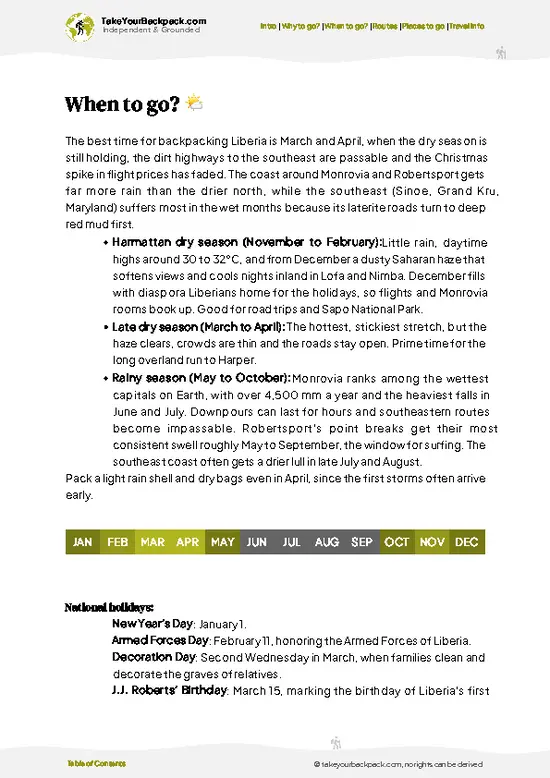
When to go?Seasonal Guide to Visiting

Best months and weather: The best months are December to March, when the dry season brings the lowest rainfall, firmer roads and clearer skies. Days run about 28 to 33°C with humid nights around 22 to 24°C. The Harmattan, a dry dust-laden wind from the Sahara, can haze the light from December to February, especially inland, and leaves lips cracked and a fine film on everything.
Rainy season: From May to October the rains hammer the coast, which is among the wettest on earth. Monrovia can see over 4,000 mm in a year, with June to August the heaviest, and downpours drum on tin roofs for hours. Interior tracks turn to sticky red mud, rivers swell and some forest routes become impassable. Rainforest smells of wet earth and rotting leaves, and leeches and mosquitoes multiply.
Shoulder months and … read more 👉
Best months and weather: The best months are December to March, when the dry season brings the lowest rainfall, firmer roads and clearer skies. Days run about 28 to 33°C with humid nights around 22 to 24°C. The Harmattan, a dry dust-laden wind from the Sahara, can haze the light from December to February, especially inland, and leaves lips cracked and a fine film on everything.
Rainy season: From May to October the rains hammer the coast, which is among the wettest on earth. Monrovia can see over 4,000 mm in a year, with June to August the heaviest, and downpours drum on tin roofs for hours. Interior tracks turn to sticky red mud, rivers swell and some forest routes become impassable. Rainforest smells of wet earth and rotting leaves, and leeches and mosquitoes multiply.
Shoulder months and prices: November and April are workable shoulders. Showers come in short, heavy bursts, roads are mostly passable and there are still few other visitors. Prices barely swing with the seasons because tourism is so small, though transport costs and driver rates rise when roads are bad. Book rooms ahead in January and February if you need a specific lodge, since good beds are limited.

attraction hoppingHow to Combine attractions Into One Trip

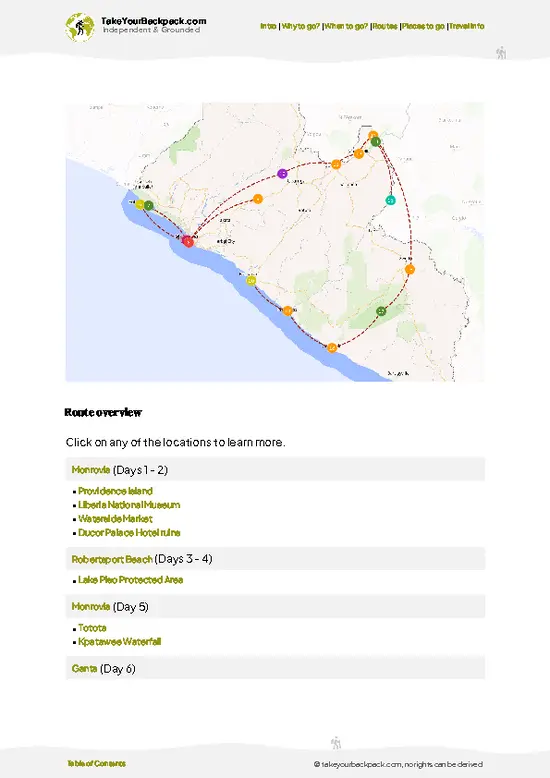
Trip length and direction: A trip combining several attractions in Liberia needs 10 to 14 days, because distances are modest on the map but slow on the ground. Start in Monrovia, the main hub for flights, money exchange, SIM cards and shared taxis, then work along the coast and finish by heading inland. Coastal stops cluster well along the road toward Robertsport to the northwest or toward Buchanan to the southeast. The interior forests sit further out, so go there as the last leg while you still have energy.
Time per stop and transport: Allow 2 to 3 days for Monrovia, 2 to 4 days per coastal stop and 3 to 5 days for forest areas, where guides, permits and early starts eat time. Monrovia to Buchanan takes about 3 to 4 hours, to Robertsport roughly 3 to 5 hours, and Monrovia to Gbarnga or Ganta … read more 👉
Trip length and direction: A trip combining several attractions in Liberia needs 10 to 14 days, because distances are modest on the map but slow on the ground. Start in Monrovia, the main hub for flights, money exchange, SIM cards and shared taxis, then work along the coast and finish by heading inland. Coastal stops cluster well along the road toward Robertsport to the northwest or toward Buchanan to the southeast. The interior forests sit further out, so go there as the last leg while you still have energy.
Time per stop and transport: Allow 2 to 3 days for Monrovia, 2 to 4 days per coastal stop and 3 to 5 days for forest areas, where guides, permits and early starts eat time. Monrovia to Buchanan takes about 3 to 4 hours, to Robertsport roughly 3 to 5 hours, and Monrovia to Gbarnga or Ganta 4 to 7 hours depending on road and rain. Transport means shared taxis, minibuses, motorbike taxis and hired 4x4s, and vehicles leave when full.
Common planning mistakes: Travelers often cram too much into a day, assuming a 150 km run takes two hours. Build in a buffer day for breakdowns and checkpoints. Another error is traveling inland in the wet months and getting stuck on flooded tracks, so keep the interior for the dry season. Finally, many arrive with too little cash, so draw dollars in Monrovia before heading out.

The ListMust-Visit attractions in Liberia

1 Providence Island

Landing markers, Providence Baptist Church, Stockton Creek, river canoes

Stand at the water’s edge where settlers landed in 1822, then look across the creek toward the downtown skyline.

2 Liberia National Museum

Sande masks, Poro regalia, settler portraits, 1847 documents

Study carved Dan and Gio faces, secret society regalia and settler-era furniture in one compact morning on Ashmun Street.

liberia-attraction-liberia-national-museum
© Google |

3 Waterside Market

Lappa cloth, dried fish rows, head porters, Mesurado riverside edge

Thread through lanes of wax-print fabric, smoked fish and palm oil sellers, then catch your breath where the stalls open onto the river.

liberia-attraction-waterside-market
© Google |

4 Ducor Palace Hotel ruins

Gutted ten-story tower, rooftop panorama, Crown Hill, empty pool terrace

Climb with a local guide through the burned-out shell to look over the port, the lagoon edges and the Atlantic surf line.

5 Liberian National Cultural Center

Kendeja dance arena, stilt walkers, carvers and weavers, replica huts

Watch drummers, masked dancers and stilt walkers perform, then talk with carvers and basket makers working at their stalls.

liberia-attraction-liberian-national-cultural-center
© Google |

6 Antoinette Tubman Stadium

Premier League matchdays, drum-driven terraces, Congo Town snack vendors

Catch a local club match from the shaded grandstand or the noisy terraces, then wander the street outside where fans argue over the result.

liberia-attraction-antoinette-tubman-stadium
© Google |

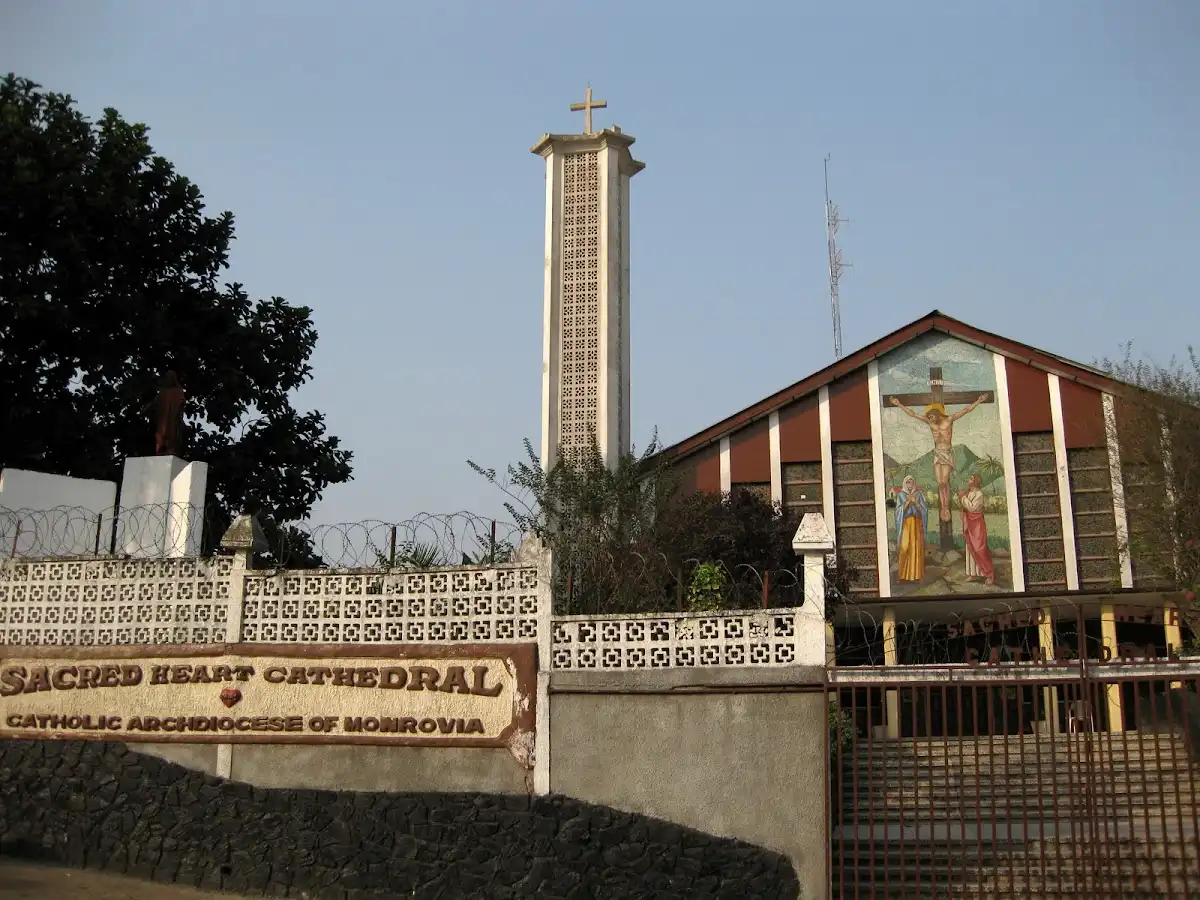
7 Sacred Heart Cathedral

Sunday Mass choir, Mamba Point, cathedral grounds, working parish

Sit at the back of a Sunday service filled with choir, drums and bright cloth, then step out into the shady grounds.

liberia-attraction-sacred-heart-cathedral
© Google |
Loading the map 🌍

Expert viewWhat You Should Know

Pick three to five, and stop there: Three to five attractions is the right number for a trip in Liberia, because the roads decide it. A 100-kilometer drive can eat four to six hours when red laterite turns to soup in the rains, and every stop needs a day of slack for a missed bush taxi or a bridge that is simply out. Pile on more and you spend the trip staring through a dusty windshield at palm oil stalls instead of standing at the place you came for. Three well-spent stops beat seven rushed ones, and the long afternoon on a beach or a porch with a cold Club beer is part of what you came for.Match the kind of attraction to how you travel: Beach and surf towns suit travelers who want easy days. You get salt air, woodsmoke from fish smokers, grilled barracuda on a plastic table and a shared … read more 👉
Pick three to five, and stop there: Three to five attractions is the right number for a trip in Liberia, because the roads decide it. A 100-kilometer drive can eat four to six hours when red laterite turns to soup in the rains, and every stop needs a day of slack for a missed bush taxi or a bridge that is simply out. Pile on more and you spend the trip staring through a dusty windshield at palm oil stalls instead of standing at the place you came for. Three well-spent stops beat seven rushed ones, and the long afternoon on a beach or a porch with a cold Club beer is part of what you came for.Match the kind of attraction to how you travel: Beach and surf towns suit travelers who want easy days. You get salt air, woodsmoke from fish smokers, grilled barracuda on a plastic table and a shared taxi back for pocket change. Rainforest and wildlife areas suit people who can handle sweat, leeches, mud to the shins and a guide who walks quietly ahead. You get the hush of the canopy, the sudden hoot of a hornbill and the sense that almost nobody else has been there. Historical and cultural sites in and around Monrovia suit anyone short on time or stamina, since they work in any weather and a car can reach them. You get the story of a country founded by freed Americans and the wars that followed, told by people who lived it. Choose one of each kind and the trip balances itself.What it costs: Plan on US$40 to 70 a day for a backpacker who is moving, and expect Liberia to cost more than neighbors like Sierra Leone or Guinea. Liberia runs on the Liberian dollar, but US dollars are used everywhere, so carry clean, undamaged small notes. Entry or community fees at protected areas typically run US$5 to 20 per person. Guides and trackers add US$10 to 30 a day. Local transport is the sneaky line: shared taxis and minibuses cost US$3 to 15 per leg, while a chartered car or motorbike taxi for a rough road can reach US$50 to 100 for the day. ATMs are scarce outside Monrovia, so withdraw before you leave the capital and bring more cash than seems sensible. You get a trip that never stalls over a missing coin.Safety and cultural manners: Daytime travel is the rule, because unlit roads, unmarked checkpoints and heavy rain after dark are a poor combination. In Monrovia, use registered taxis at night and keep phones out of sight in crowded markets like Waterside. On beaches, respect the currents, since rip tides are strong and lifeguards are rare. Ask before photographing people, ceremonies, or anything connected with the secret societies, whose sacred forests and masks are off limits to outsiders. Greet everyone first with a handshake, often finished with the Liberian finger snap, and the conversation that follows is usually the best part of the visit. Dress modestly in villages and on Sundays, when churches fill the air with singing. Pay guides and community committees directly and agree prices first, so the money reaches the village. Malaria is a daily reality, so take prophylaxis and cover up at dusk. What you get is a welcome that feels earned rather than staged.

✈️ The backpacker research shortcutLiberia Travel Guide

An offline-friendly backpacking guide with optimized travel routes, ranked highlights, transport advice, and the best areas to stay.
example page 0 from our offline Travel Guide for Liberia
example page 1 from our offline Travel Guide for Liberia
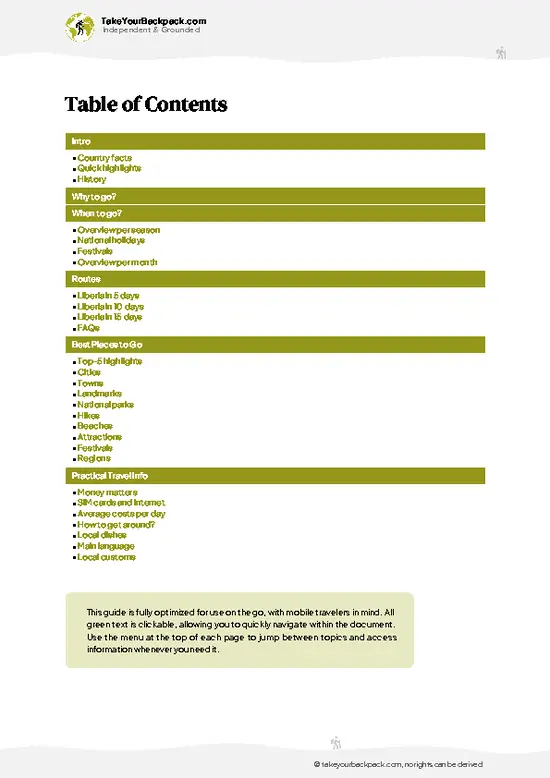
example page 2 from our offline Travel Guide for Liberia
example page 3 from our offline Travel Guide for Liberia
example page 4 from our offline Travel Guide for Liberia
example page 5 from our offline Travel Guide for Liberia
example page 6 from our offline Travel Guide for Liberia
example page 7 from our offline Travel Guide for Liberia
The digital guide (211 pages) contains:
✅ 49 highlights, ranked by travel appeal
✅ Optimized 5, 10 & 15-day travel routes
✅ Cities, national parks, landmarks, beaches
✅ How to get around
✅ Offline-friendly for travel without Wi-Fi
👉 Click to see all 30+ guide features

📅 Plan smarter in minutes, not weeks
✅ Month by month travel advice
✅ Festivals & national holidays
✅ Budget expectations

🗺️ Go to the right places, skip the overrated ones
✅ Honest pros & cons of destinations
✅ Top hikes, parks & viewpoints
✅ Lesser-known places most travelers miss
✅ Clear “worth it vs skip it” guidance

🛏️ Travel smoothly without rookie mistakes
✅ Best areas to stay
✅ Transport systems explained simply
✅ Common scams & safety advice
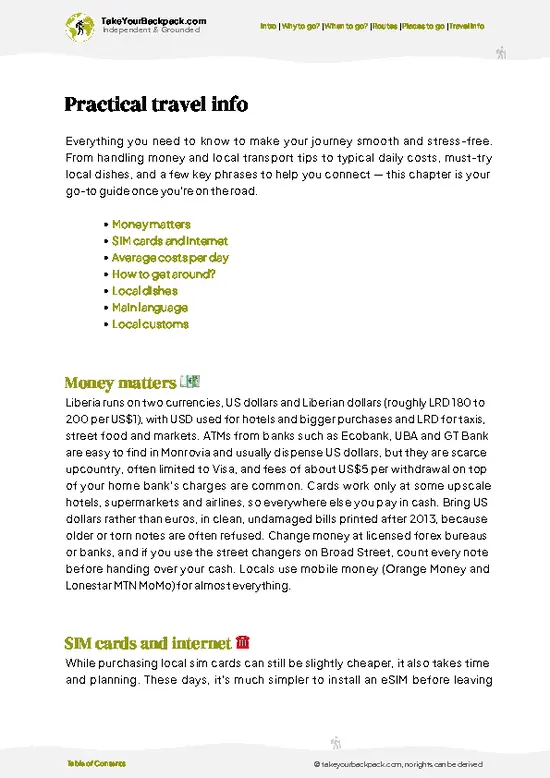
✅ SIM cards, money & practical tips

🌍 Understand the country, not just visit it
✅ Culture & traditions
✅ Local customs
✅ Festivals worth planning around
✅ Traveler-friendly historical context
✅ Insights that make places more meaningful

📱 Built for real travel conditions
✅ Fully downloadable PDF
✅ Works completely offline
✅ Optimized for phone use
✅ Useful in remote areas & buses
✅ Everything in one place
Stop searching, start planning
Get instant access to your full guide. 30‑day money-back guarantee.
+ Add another guide for just

By proceeding you agree to our terms.
Sent to your inbox immediately after payment • 100% Secure Checkout
Best Backpacking Travel Advisor 2025 tourism awardBest Backpacking
Travel Advisor
2025
What others say about Take Your Backpack Guides:
⭐⭐⭐⭐⭐
Fantastic, amazing amount of information!
⭐⭐⭐⭐⭐
My goodness this is amazing, it's what I've been looking for hats off too you!
⭐⭐⭐⭐⭐
I think this is absolutely BRILLIANT
⭐⭐⭐⭐
Very complete and informative. It's still missing places, but I gotta to commend you
⭐⭐⭐⭐⭐
This is truly amazing, thank you, can't wait to explore it with my kids!
⭐⭐⭐⭐⭐
Awesome resource, thank you!
⭐⭐⭐⭐⭐
This is amazing! Can't wait to explore the ones I haven't seen
⭐⭐⭐⭐
I love this! Well done, great idea.
⭐⭐⭐⭐⭐
Thanks for taking the time to make this gem!
⭐⭐⭐⭐⭐
This might be the best website I've ever seen.
⭐⭐⭐⭐⭐
Congratulations, and thank you so much for your work; it's incredibly valuable.
⭐⭐⭐⭐
In all seriousness I think you did a great job pointing out the important spots
⭐⭐⭐⭐⭐
10/10 very good
⭐⭐⭐⭐⭐
As someone who's only just starting to visit regularly this is awesome, thank you.
⭐⭐⭐⭐
Thank you very much! I'm going to visit my dad, it's going to be very useful!
⭐⭐⭐⭐⭐
This is really cool! We'll be travelling for the first time and this definitely come in handy.
⭐⭐⭐⭐⭐
You are now our minister of culture, congratulations 👨‍💼
⭐⭐⭐⭐⭐
Just wanted to tell you that this is a pearl! Going to follow your recommendations.
⭐⭐⭐⭐⭐
This is so cool. I'll definitely be using the resource for my travels soon.
⭐⭐⭐⭐⭐
This is very impressive! Good work.
⭐⭐⭐⭐⭐
This is an amazing and informative site. Very well done!

🛏️ Where to stay?Where to Stay: Liberia Edition

Liberia has almost no true backpacker hostels, so budget travel here means simple guesthouses and small hotels, usually around US$25 to 50 a night for a private room with a fan or air conditioning and a generator for power cuts. In Monrovia, Sinkor has the widest spread of mid-priced rooms close to beach bars and restaurants along Tubman Boulevard, while Mamba Point is the safest and best-connected area thanks to the embassies, but rooms there cost noticeably more. Downtown around Broad Street is cheaper and handy for markets and shared taxis but loud and sketchier after dark, and Paynesville is cheaper still but far from everything, while on the coast Robertsport has basic surf camps and beach … read more 👉
Liberia has almost no true backpacker hostels, so budget travel here means simple guesthouses and small hotels, usually around US$25 to 50 a night for a private room with a fan or air conditioning and a generator for power cuts. In Monrovia, Sinkor has the widest spread of mid-priced rooms close to beach bars and restaurants along Tubman Boulevard, while Mamba Point is the safest and best-connected area thanks to the embassies, but rooms there cost noticeably more. Downtown around Broad Street is cheaper and handy for markets and shared taxis but loud and sketchier after dark, and Paynesville is cheaper still but far from everything, while on the coast Robertsport has basic surf camps and beach huts that suit tighter budgets.

If you enjoy meeting fellow travelers, consider choosing hostels with high ratings for atmosphere. On the other hand, if you prefer having your own space, a hotel might be a better option.

LiberiaExplore Beyond This Category

👋 Meet the founderWho’s Behind Take Your Backpack?

Johan, backpacker and founder of TakeYourBackpackHi, I’m Johan (Netherlands 🇳🇱), the creator of TakeYourBackpack. Over the past 3 decades, I’ve backpacked through 90+ countries across six continents, gaining extensive experience with independent travel, long-term trips, and overland routes.

This site is built on a combination of firsthand travel experience and carefully curated insights from other backpackers. Many guides are based on places I’ve personally visited, while others bring together tips, observations, and practical advice shared by trusted travelers I’ve met along the way.

The goal is to provide realistic, experience-driven guidance — not generic itineraries — so you can explore destinations with better context, clearer expectations, and more confidence.