×

Liberia🇱🇷 | best regionsBest 5 regions in Liberia

Liberia’s regions split along a few hard lines: the Monrovia coast with its salt-air traffic and beach shacks, the southeastern coast of palm-fringed surf and mud roads, and the forested interior of red laterite tracks and hill towns. Cost and access shift with each. Monrovia has ATMs, taxis and guesthouses at US$30 to 80 a night. Past the paved roads, motorbike taxis, shared cars and rain-gouged tracks set the pace, and prices drop but transport gets slow. For independent travel, Liberia rewards patience: crowds are almost nonexistent, and a night under a tin roof in the rain is part of the deal.

By Johan Kruseman 🇳🇱 | Updated October 23, 2026
Explore the best cities in Liberia

Why go?Key Factors That Shape the Experience

Liberia is unusual because almost nothing here is packaged. Decades of civil war ended in 2003, and the road network, power grid and tourism services are still being rebuilt, so the country feels like the opposite of a polished circuit. That is its appeal and its challenge. Roads outside the capital region are often unpaved, and in the rains they turn to slick red mud that can stretch a 100-kilometer journey into a full day. Electricity is patchy, mobile data fades in the interior, and cards are rarely accepted beyond a few Monrovia hotels, so cash matters, in Liberian dollars for local costs and US dollars widely accepted in bigger transactions.

What you gain is raw geography: the country holds a large share of the remaining Upper Guinean rainforest in West Africa, along with long Atlantic … read more 👉
Liberia is unusual because almost nothing here is packaged. Decades of civil war ended in 2003, and the road network, power grid and tourism services are still being rebuilt, so the country feels like the opposite of a polished circuit. That is its appeal and its challenge. Roads outside the capital region are often unpaved, and in the rains they turn to slick red mud that can stretch a 100-kilometer journey into a full day. Electricity is patchy, mobile data fades in the interior, and cards are rarely accepted beyond a few Monrovia hotels, so cash matters, in Liberian dollars for local costs and US dollars widely accepted in bigger transactions.

What you gain is raw geography: the country holds a large share of the remaining Upper Guinean rainforest in West Africa, along with long Atlantic beaches where you can walk for an hour and meet only fishermen hauling nets. The climate is hot and humid year round, with the air thick with woodsmoke, palm oil and rain on hot tin. Liberia is also shaped by its settler history and sixteen-plus ethnic groups, giving towns different languages, food and customs. Travelers should know that infrastructure is thin, health preparation (yellow fever vaccination, malaria prophylaxis) is required, and flexibility is not optional.
Behind the Scenes of Selection
The list of best regions in Liberia is created based on landscapes, local culture, attractions, vibes, and overall appeal. If you feel a region is missing in this list, please let us know.

When to go?Seasonal Guide to Visiting

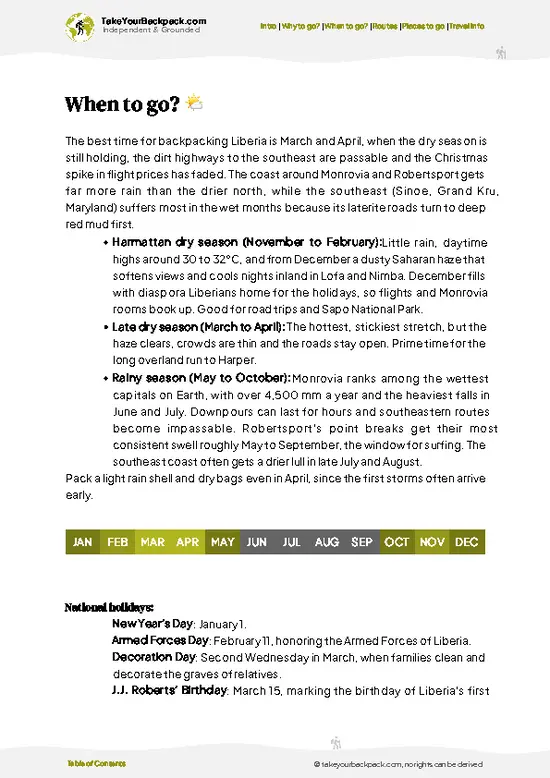
Best months and the dry season: The best months are December to March, when the dry season brings the least rain and the roads are at their firmest. Daytime temperatures sit around 28 to 33°C, with harmattan haze occasionally softening the light and dusting the air in the early part of the season. Unpaved routes into the interior and the southeast are passable by shared car and motorbike, and beaches are good for walking and swimming.

The wet season and shoulder months: Liberia is among the wettest countries in Africa. From May to October the coast can receive well over 4,000 millimeters of rain, with June to August the heaviest. Rain drums on rooftops for hours, rivers swell, and many interior tracks become impassable or very slow; ferries and bush taxis run unpredictably. Rivers and surf … read more 👉
Best months and the dry season: The best months are December to March, when the dry season brings the least rain and the roads are at their firmest. Daytime temperatures sit around 28 to 33°C, with harmattan haze occasionally softening the light and dusting the air in the early part of the season. Unpaved routes into the interior and the southeast are passable by shared car and motorbike, and beaches are good for walking and swimming.

The wet season and shoulder months: Liberia is among the wettest countries in Africa. From May to October the coast can receive well over 4,000 millimeters of rain, with June to August the heaviest. Rain drums on rooftops for hours, rivers swell, and many interior tracks become impassable or very slow; ferries and bush taxis run unpredictably. Rivers and surf are rough, so swimming can be dangerous. April and November are shoulder months: showers start or fade, the forest stays green, and travel is still manageable with extra time built in.

Prices and crowds: Crowds are never a concern in Liberia, and there is no formal high season. Prices shift slightly: Monrovia hotels and flights tend to cost a little more in the dry months and around Christmas, when returning diaspora fill rooms. Book ahead in December. Outside Monrovia, rates for rooms stay fairly steady year round, though transport costs climb in the rains when drivers charge extra for bad roads.

region hoppingHow to Combine regions Into One Trip

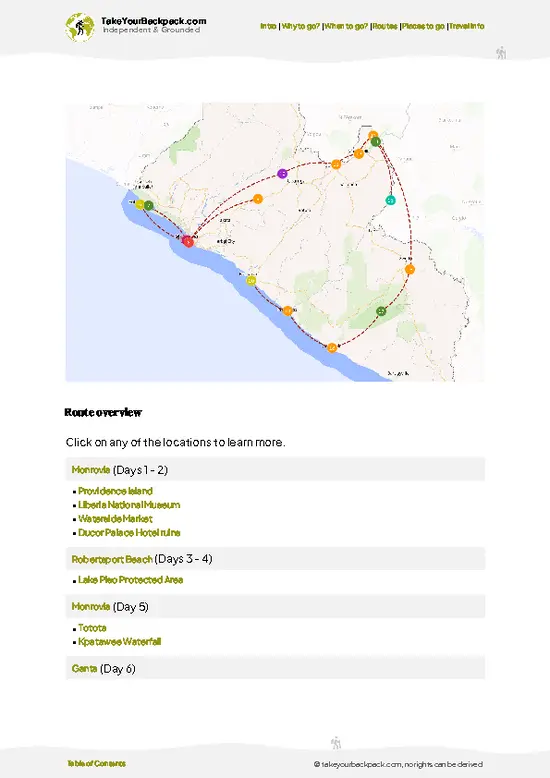
How many days to plan: A trip combining several regions in Liberia needs 10 to 14 days, because distances are modest on the map but slow on the ground. Monrovia is the natural hub, with the main international airport at Roberts International about 55 kilometers outside the city, and most routes begin and end there.

Direction and grouping: Group regions by road corridor rather than by distance. Coastal stops cluster along the paved or semi-paved route southeast from Monrovia, while interior stops hang off the northbound highway toward Gbarnga and beyond. Travel out along one corridor and return along another, or loop back through Monrovia to reset, restock cash and wash the red dust out of your clothes. Allow 2 to 4 days per stop, since the first day is often lost to arrival. Travel times … read more 👉
How many days to plan: A trip combining several regions in Liberia needs 10 to 14 days, because distances are modest on the map but slow on the ground. Monrovia is the natural hub, with the main international airport at Roberts International about 55 kilometers outside the city, and most routes begin and end there.

Direction and grouping: Group regions by road corridor rather than by distance. Coastal stops cluster along the paved or semi-paved route southeast from Monrovia, while interior stops hang off the northbound highway toward Gbarnga and beyond. Travel out along one corridor and return along another, or loop back through Monrovia to reset, restock cash and wash the red dust out of your clothes. Allow 2 to 4 days per stop, since the first day is often lost to arrival. Travel times add up: Monrovia to Gbarnga is roughly 4 to 5 hours by shared car in the dry season, while the southeastern coast can take 8 to 12 hours or more, longer in the rains.

Common planning mistakes: The biggest error is cramming too many stops in, assuming a 150-kilometer journey takes two hours. Plan one long transfer per day at most and leave buffer days. Another is relying on cards or ATMs outside Monrovia; carry enough cash, in small notes. Travelers also leave early departures too late. Shared cars fill and leave at dawn, so be at the motor park by 6 or 7 a.m.

The ListMust-Visit regions in Liberia

1 Mount Nimba

Guided Nimba ridges, Yekepa ore town, montane grassland, chimpanzee forest

Climb with a guide from Yekepa through damp forest into open grassland, with chimpanzee calls overhead and the Guinea ridgeline ahead.

2 Wologizi Mountain

Misted Wologizi crests, Loma villages, Zorzor guides, Lofa border markets

Hike farm and hunting tracks along forested ridges with a local guide, then trade stories in Zorzor, Voinjama and Foya markets below.

3 Bomi Hills

Rust-red ore pits, mine railway remnants, company bungalows, Tubmanburg market

Walk terraced pits, overgrown rail cuttings and mid-century staff housing, then finish with rice and soup in Tubmanburg while locals recall the mining years.

4 St. John River

Edina settlement, Buchanan surf, estuary canoes, smoked-fish landings

Cross the tea-colored river mouth by dugout to Edina, then follow Buchanan’s beach at dawn as fishermen launch and women smoke the catch.

5 Lofa River

Robertsport surf, canoe ferries, Lake Piso, Gola Forest

Cross rivers in pole boats, paddle mangroves behind Robertsport and ride a long left break before heading inland toward Gola’s rainforest trails.

Loading the map 🌍

Expert viewWhat You Should Know

How many regions to visit: I advise two or three regions on a single trip of two weeks. Roads are slow, shared cars leave only when full, and every transfer eats most of a day. Spreading across four or five leaves you with a blur of dust and bus seats. Two or three lets you sit on a veranda while the afternoon rain hisses down and the evening cooks smell of palm oil and charcoal.

Choosing the kind of region: Pick by travel style. If you want comfort and services, stay on the coast near Monrovia, with working ATMs, restaurants, and guesthouses with generators. If surf, empty beaches and fishing villages appeal, the southeast gives you salt wind and palm shade, at the price of long journeys. If you want forest and wildlife, the interior gives you hills, rivers, and canopy noise at dawn, but … read more 👉
How many regions to visit: I advise two or three regions on a single trip of two weeks. Roads are slow, shared cars leave only when full, and every transfer eats most of a day. Spreading across four or five leaves you with a blur of dust and bus seats. Two or three lets you sit on a veranda while the afternoon rain hisses down and the evening cooks smell of palm oil and charcoal.

Choosing the kind of region: Pick by travel style. If you want comfort and services, stay on the coast near Monrovia, with working ATMs, restaurants, and guesthouses with generators. If surf, empty beaches and fishing villages appeal, the southeast gives you salt wind and palm shade, at the price of long journeys. If you want forest and wildlife, the interior gives you hills, rivers, and canopy noise at dawn, but you need a guide and a tolerance for rough tracks. Most first-timers do best mixing one easy stop with one remote one.

What it costs: Budget US$40 to 70 a day traveling independently outside Monrovia: a basic guesthouse room runs US$15 to 35, a plate of rice with soup or cassava leaf US$2 to 5, and shared cars or motorbike taxis US$3 to 25 per leg depending on distance. In Monrovia, mid-range rooms run US$50 to 100 or more. Protected area fees and guides typically add US$10 to 40 per visit, and a private car with a driver for several days can run US$100 to 150 a day. Carry US dollars in clean, recent notes and Liberian dollars for small purchases. A trip of two weeks lands roughly between US$600 and 1,200 excluding flights.

Safety and cultural considerations: Malaria is a real risk year round, so carry prophylaxis, a net and repellent, and bring proof of yellow fever vaccination. Healthcare outside Monrovia is limited, so pack a good medical kit. Avoid driving at night, as roads are unlit and have potholes and unmarked checkpoints. Keep valuables out of sight in Monrovia, especially in crowded markets and after dark. Swimming is risky on much of the coast: strong rip currents are common, and you should ask local fishermen before entering the water.

Culturally, greet people before asking anything; a handshake with the distinctive finger snap is common and earns smiles. Dress modestly in villages, ask before photographing people, and expect to be introduced to a town chief or elder in smaller communities. Bring small gifts of kola nuts or a modest contribution when visiting a village. The warmth you get in return, a bowl of pepper soup shared on a porch, is often the best part of the trip.

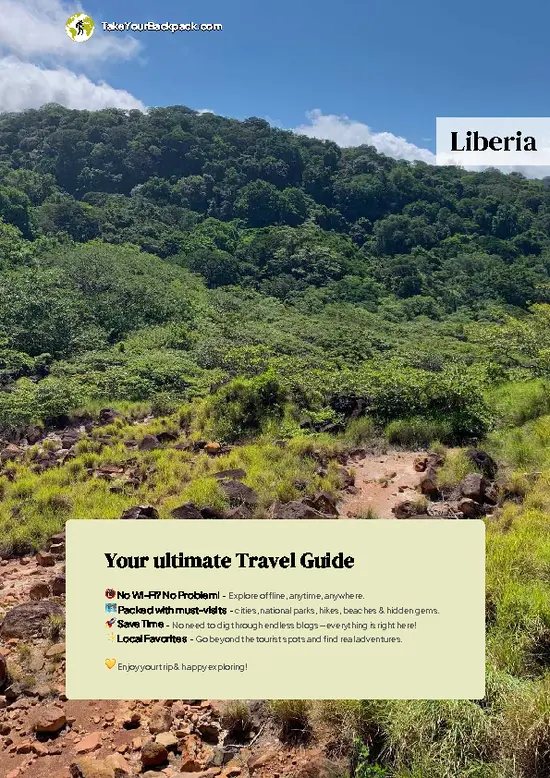
✈️ The backpacker research shortcutLiberia Travel Guide

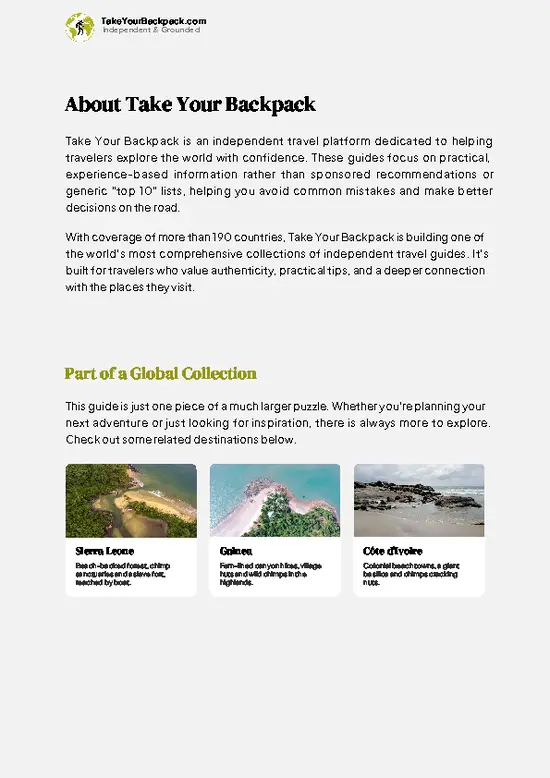
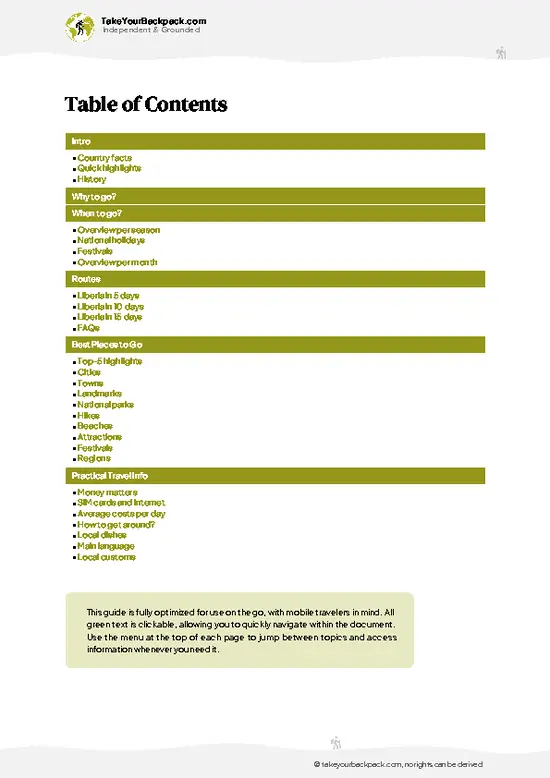
An offline-friendly backpacking guide with optimized travel routes, ranked highlights, transport advice, and the best areas to stay.
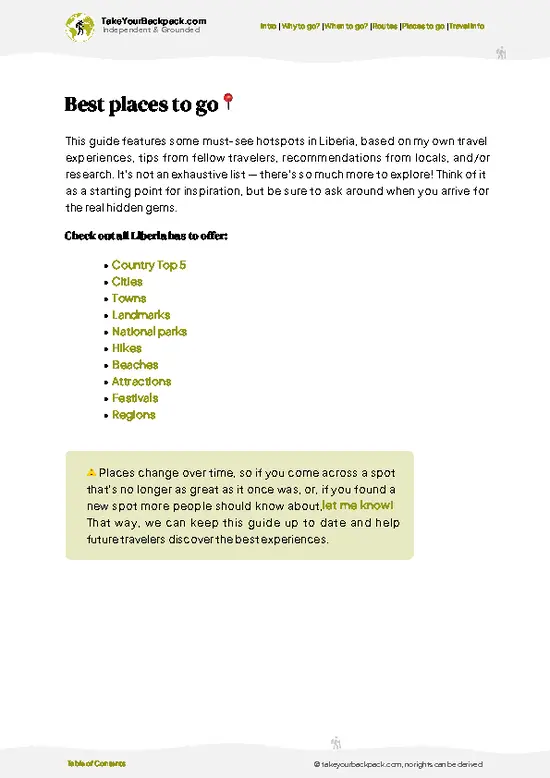
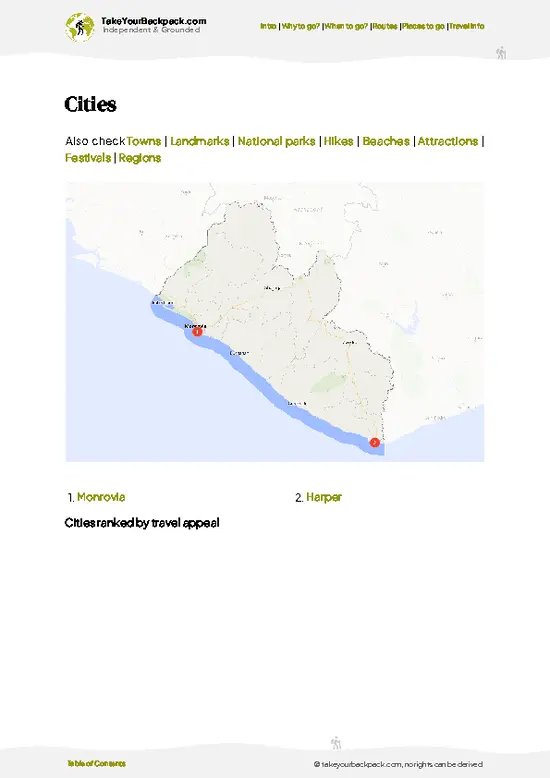
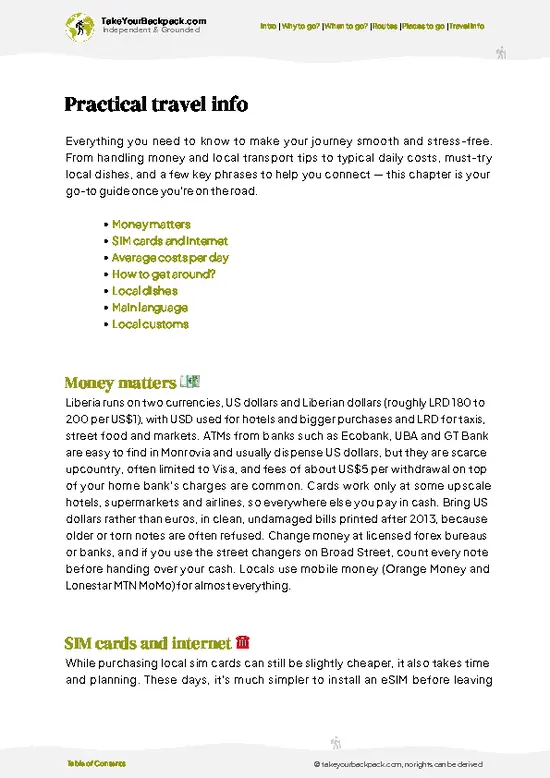
example page 0 from our offline Travel Guide for Liberia
example page 1 from our offline Travel Guide for Liberia
example page 2 from our offline Travel Guide for Liberia
example page 3 from our offline Travel Guide for Liberia
example page 4 from our offline Travel Guide for Liberia
example page 5 from our offline Travel Guide for Liberia
example page 6 from our offline Travel Guide for Liberia
example page 7 from our offline Travel Guide for Liberia
The digital guide (211 pages) contains:
✅ 49 highlights, ranked by travel appeal
✅ Optimized 5, 10 & 15-day travel routes
✅ Cities, national parks, landmarks, beaches
✅ How to get around
✅ Offline-friendly for travel without Wi-Fi
👉 Click to see all 30+ guide features

📅 Plan smarter in minutes, not weeks
✅ Month by month travel advice
✅ Festivals & national holidays
✅ Budget expectations

🗺️ Go to the right places, skip the overrated ones
✅ Honest pros & cons of destinations
✅ Top hikes, parks & viewpoints
✅ Lesser-known places most travelers miss
✅ Clear “worth it vs skip it” guidance

🛏️ Travel smoothly without rookie mistakes
✅ Best areas to stay
✅ Transport systems explained simply
✅ Common scams & safety advice
✅ SIM cards, money & practical tips

🌍 Understand the country, not just visit it
✅ Culture & traditions
✅ Local customs
✅ Festivals worth planning around
✅ Traveler-friendly historical context
✅ Insights that make places more meaningful

📱 Built for real travel conditions
✅ Fully downloadable PDF
✅ Works completely offline
✅ Optimized for phone use
✅ Useful in remote areas & buses
✅ Everything in one place
Stop searching, start planning
Get instant access to your full guide. 30‑day money-back guarantee.
+ Add another guide for just

By proceeding you agree to our terms.
Sent to your inbox immediately after payment • 100% Secure Checkout
Best Backpacking Travel Advisor 2025 tourism awardBest Backpacking
Travel Advisor
2025
What others say about Take Your Backpack Guides:
⭐⭐⭐⭐⭐
Fantastic, amazing amount of information!
⭐⭐⭐⭐⭐
My goodness this is amazing, it's what I've been looking for hats off too you!
⭐⭐⭐⭐⭐
I think this is absolutely BRILLIANT
⭐⭐⭐⭐
Very complete and informative. It's still missing places, but I gotta to commend you
⭐⭐⭐⭐⭐
This is truly amazing, thank you, can't wait to explore it with my kids!
⭐⭐⭐⭐⭐
Awesome resource, thank you!
⭐⭐⭐⭐⭐
This is amazing! Can't wait to explore the ones I haven't seen
⭐⭐⭐⭐
I love this! Well done, great idea.
⭐⭐⭐⭐⭐
Thanks for taking the time to make this gem!
⭐⭐⭐⭐⭐
This might be the best website I've ever seen.
⭐⭐⭐⭐⭐
Congratulations, and thank you so much for your work; it's incredibly valuable.
⭐⭐⭐⭐
In all seriousness I think you did a great job pointing out the important spots
⭐⭐⭐⭐⭐
10/10 very good
⭐⭐⭐⭐⭐
As someone who's only just starting to visit regularly this is awesome, thank you.
⭐⭐⭐⭐
Thank you very much! I'm going to visit my dad, it's going to be very useful!
⭐⭐⭐⭐⭐
This is really cool! We'll be travelling for the first time and this definitely come in handy.
⭐⭐⭐⭐⭐
You are now our minister of culture, congratulations 👨‍💼
⭐⭐⭐⭐⭐
Just wanted to tell you that this is a pearl! Going to follow your recommendations.
⭐⭐⭐⭐⭐
This is so cool. I'll definitely be using the resource for my travels soon.
⭐⭐⭐⭐⭐
This is very impressive! Good work.
⭐⭐⭐⭐⭐
This is an amazing and informative site. Very well done!

🛏️ Where to stay?Where to Stay in Liberia

Liberia has almost no true backpacker hostels, so budget travel here means simple guesthouses and small hotels, usually around US$25 to 50 a night for a private room with a fan or air conditioning and a generator for power cuts. In Monrovia, Sinkor has the widest spread of mid-priced rooms close to beach bars and restaurants along Tubman Boulevard, while Mamba Point is the safest and best-connected area thanks to the embassies, but rooms there cost noticeably more. Downtown around Broad Street is cheaper and handy for markets and shared taxis but loud and sketchier after dark, and Paynesville is cheaper still but far from everything, while on the coast Robertsport has basic surf camps and beach … read more 👉
Liberia has almost no true backpacker hostels, so budget travel here means simple guesthouses and small hotels, usually around US$25 to 50 a night for a private room with a fan or air conditioning and a generator for power cuts. In Monrovia, Sinkor has the widest spread of mid-priced rooms close to beach bars and restaurants along Tubman Boulevard, while Mamba Point is the safest and best-connected area thanks to the embassies, but rooms there cost noticeably more. Downtown around Broad Street is cheaper and handy for markets and shared taxis but loud and sketchier after dark, and Paynesville is cheaper still but far from everything, while on the coast Robertsport has basic surf camps and beach huts that suit tighter budgets.

If you enjoy meeting fellow travelers, consider choosing hostels with high ratings for atmosphere. On the other hand, if you prefer having your own space, a hotel might be a better option.

LiberiaMore of Liberia

👋 Meet the founderWho’s Behind Take Your Backpack?

Johan, backpacker and founder of TakeYourBackpackHi, I’m Johan (Netherlands 🇳🇱), the creator of TakeYourBackpack. Over the past 3 decades, I’ve backpacked through 90+ countries across six continents, gaining extensive experience with independent travel, long-term trips, and overland routes.

This site is built on a combination of firsthand travel experience and carefully curated insights from other backpackers. Many guides are based on places I’ve personally visited, while others bring together tips, observations, and practical advice shared by trusted travelers I’ve met along the way.

The goal is to provide realistic, experience-driven guidance — not generic itineraries — so you can explore destinations with better context, clearer expectations, and more confidence.