×

Libya🇱🇾 | best beachesThe Must-See 2 beaches in Libya

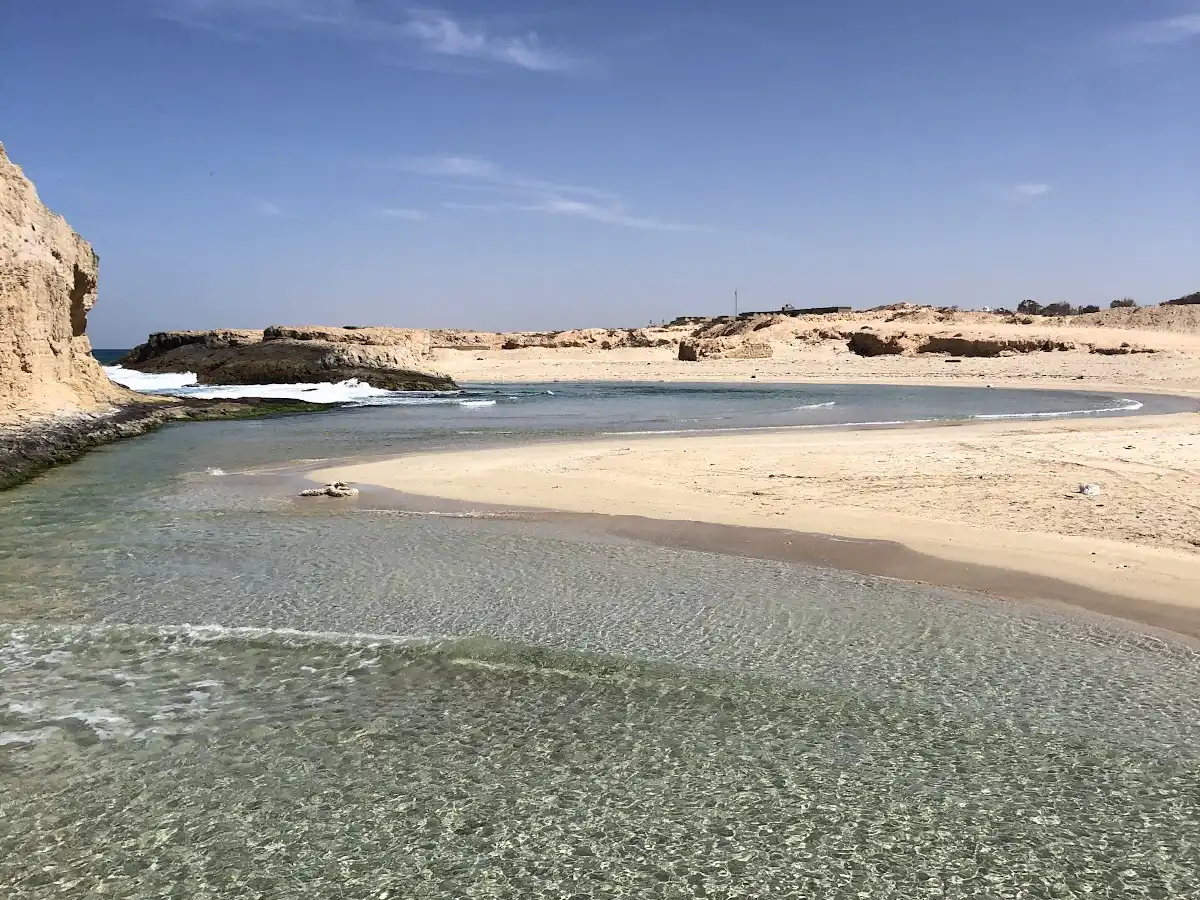
Beaches in Libya run along roughly 1,770 km of Mediterranean coast, and the experience changes sharply by region. The western coast around Tripoli, Sabratha and Zuwara has the most road access, sandy bays, simple cafés and busy family crowds on summer weekends. The eastern coast in Cyrenaica has rocky coves and clear water under limestone cliffs, with almost no facilities and almost no people. Skip any idea of resort lounging, because it does not exist here. Independent travel and backpacking depend on a visa sponsor and a local host arranged in advance, so plan the logistics first. Choose the west for ease, the east for empty water.

By Johan Kruseman 🇳🇱 | Updated October 19, 2026
Explore the best attractions in Libya

Why go?Understanding Their Importance

Libya has one of the longest coastlines on the Mediterranean, and almost everything behind it is Sahara. About 90 percent of the country is desert, so people, roads and towns hug the shore. That gives you long stretches of pale sand and clean, shallow water, often backed by Greek and Roman ruins that stand directly at the sea. Few countries pair beaches and archaeology this closely.

What Libya lacks is a beach industry. Decades of sanctions, then the conflict after 2011, left almost no resorts, no sunbed rental, no water sports and no organized tourism. Beaches here are for local families, picnics and fishing. Do not choose Libya for a party coast or for comfort. Choose it for space and for the rare chance to swim with nobody around.

Know the conditions before committing. Most governments advise … read more 👉
Libya has one of the longest coastlines on the Mediterranean, and almost everything behind it is Sahara. About 90 percent of the country is desert, so people, roads and towns hug the shore. That gives you long stretches of pale sand and clean, shallow water, often backed by Greek and Roman ruins that stand directly at the sea. Few countries pair beaches and archaeology this closely.

What Libya lacks is a beach industry. Decades of sanctions, then the conflict after 2011, left almost no resorts, no sunbed rental, no water sports and no organized tourism. Beaches here are for local families, picnics and fishing. Do not choose Libya for a party coast or for comfort. Choose it for space and for the rare chance to swim with nobody around.

Know the conditions before committing. Most governments advise against travel to much of the country, and a visa normally requires an invitation from a licensed local operator, so turning up and wandering is not realistic. Cards rarely work and cash is the norm. Local norms are conservative, and swimwear is modest. Sea water near the large cities can be polluted, and some eastern areas still hold unexploded ordnance from past fighting, so local guidance on where to walk and swim matters more here than anywhere else on the Mediterranean.
Our Approach to Ranking
The list of best beaches in Libya is created based on beauty, vibe, water quality, activities, and surrounding scenery. If you feel a beach is missing in this list, please let us know.

When to go?Best Time to Visit Libya for beaches

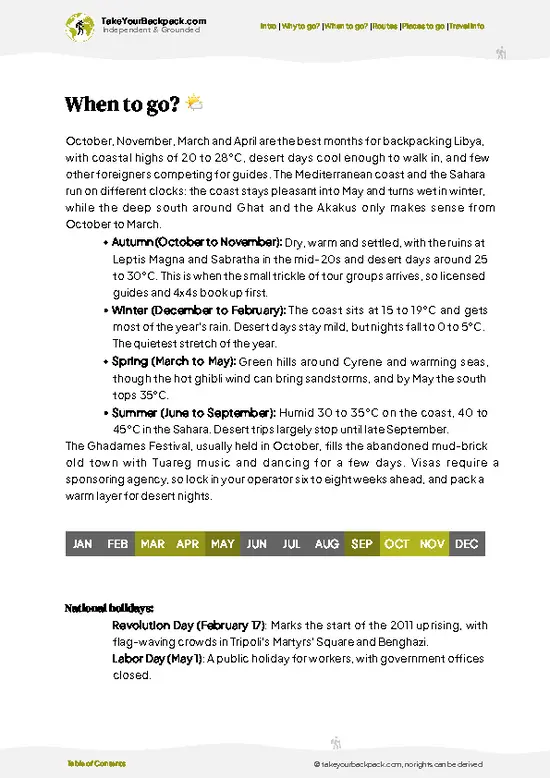
Best months: The best months for Libya’s beaches are June to September, when the Mediterranean reaches 24 to 27°C and coastal rain is close to zero. July and August are the hottest, with highs around 30 to 34°C on the coast and strong sun from mid-morning, so plan swimming for early morning and late afternoon.Shoulder seasons: May and October are the practical shoulder months. Air temperatures sit around 24 to 28°C, but the sea is cooler in May (about 18 to 20°C) and still warm in October (about 24 to 25°C). October is the better pick for swimming. Both months can bring the ghibli, a hot, dusty desert wind that pushes temperatures past 40°C for a day or two and turns the sky orange. Do not schedule a beach day on top of one.Winter and regional differences: November to March is not worth the … read more 👉
Best months: The best months for Libya’s beaches are June to September, when the Mediterranean reaches 24 to 27°C and coastal rain is close to zero. July and August are the hottest, with highs around 30 to 34°C on the coast and strong sun from mid-morning, so plan swimming for early morning and late afternoon.Shoulder seasons: May and October are the practical shoulder months. Air temperatures sit around 24 to 28°C, but the sea is cooler in May (about 18 to 20°C) and still warm in October (about 24 to 25°C). October is the better pick for swimming. Both months can bring the ghibli, a hot, dusty desert wind that pushes temperatures past 40°C for a day or two and turns the sky orange. Do not schedule a beach day on top of one.Winter and regional differences: November to March is not worth the trip for swimming. Coastal highs are 14 to 19°C, the sea drops to 15 to 17°C, and most rain falls from December to February. Tripoli and the west get roughly 250 to 350 mm a year, while the northeastern coast below the Green Mountain is noticeably wetter, with cold, windy, grey days in winter.Crowds and closures: Local crowds peak on summer Fridays and during Eid holidays. During Ramadan, daytime cafés and food stalls near the shore are mostly closed, and the dates move earlier each year.

beach hoppingSuggested Travel Strategies

How long to allow: A trip that combines several Libyan beaches needs 7 to 10 days, and anything shorter should stay in one region. The coast is long, roads are slow and checkpoint and permit delays are routine, so a tight schedule falls apart quickly.Which regions group well: The west clusters naturally: Tripoli as the arrival hub, Sabratha about 1 to 1.5 hours west by road, and Zuwara roughly 1.5 to 2 hours beyond Tripoli. Three to four days covers it without rushing. The east is a separate trip: Benghazi to the Cyrenaican coast takes about 2 to 3 hours, and Benghazi to Tobruk 5 to 6 hours. Tripoli to Benghazi is around 1,000 km, 11 to 13 hours by road, or a flight of about 1.5 hours when services are running.Direction and pacing: Start in the west, where entry and arrival are simplest, and … read more 👉
How long to allow: A trip that combines several Libyan beaches needs 7 to 10 days, and anything shorter should stay in one region. The coast is long, roads are slow and checkpoint and permit delays are routine, so a tight schedule falls apart quickly.Which regions group well: The west clusters naturally: Tripoli as the arrival hub, Sabratha about 1 to 1.5 hours west by road, and Zuwara roughly 1.5 to 2 hours beyond Tripoli. Three to four days covers it without rushing. The east is a separate trip: Benghazi to the Cyrenaican coast takes about 2 to 3 hours, and Benghazi to Tobruk 5 to 6 hours. Tripoli to Benghazi is around 1,000 km, 11 to 13 hours by road, or a flight of about 1.5 hours when services are running.Direction and pacing: Start in the west, where entry and arrival are simplest, and fly east only if you have at least 8 days. Give each beach stop one night and a half-day of swimming, with a full day only where the beach sits near ruins you want to see.Planning mistakes: The first is trying to drive the whole coast in one go. The distances eat days and add checkpoint stops, so pick a region or fly the long gap. The second is trusting a domestic flight time, because cancellations are common, so keep a spare day on either side. The third is booking separate guides in each region. Use one licensed operator with partners in both, so permits and convoy arrangements stay consistent.

The ListTop beaches of Libya

1 Janzour Beach

urban coastline, local families, shallow waters, city proximity

Swim alongside locals in calm, shallow surf, then watch daily life unfold on a beach that sits just outside Tripoli’s busy streets.

2 Zuwara Beach

wide bay, fishing boats, Berber community, sandy expanse

Experience a broad shoreline shaped by fishing traditions and Berber culture, with plenty of room to wander or watch boats return at dusk.

libya-beach-zuwara-beach
© Google |
Loading the map 🌍

Expert viewTips and Advice from Travelers

How many beaches to visit: Plan on two to four beach stops in total. Distances are large, access depends on permits and escorts, and the sea looks much the same from one cove to the next. Beyond four you spend the trip in a car. Two or three well-chosen swims each give you time to actually sit, snorkel and talk to locals.Which kind to prioritize: If ruins are why you are coming, choose the shorelines beside Greek and Roman sites and let the swim be the end of a day of walking. If you want company, local culture and cheap food, pick the western town beaches on a Friday, where families grill by the water. If you want space, the eastern coves are the best in the country, but you must bring your own water, food and shade. The closer a beach is to a big city, the less it is worth your time, since … read more 👉
How many beaches to visit: Plan on two to four beach stops in total. Distances are large, access depends on permits and escorts, and the sea looks much the same from one cove to the next. Beyond four you spend the trip in a car. Two or three well-chosen swims each give you time to actually sit, snorkel and talk to locals.Which kind to prioritize: If ruins are why you are coming, choose the shorelines beside Greek and Roman sites and let the swim be the end of a day of walking. If you want company, local culture and cheap food, pick the western town beaches on a Friday, where families grill by the water. If you want space, the eastern coves are the best in the country, but you must bring your own water, food and shade. The closer a beach is to a big city, the less it is worth your time, since sewage and litter are persistent problems.Budget: Expect US$100 to 180 a day. Most of that is the required guide and driver, usually US$50 to 100 a day, plus a guesthouse or hotel at US$30 to 80 and meals at US$8 to 15. Public beaches are free. Private beach clubs and some site-side beaches charge about US$3 to 10, and informal parking attendants may ask for a small tip. Cards rarely work, so bring crisp US dollars or euros and change them at the market rate, not the official bank rate, which can cost you a large share of the value.Delays and costs that catch people out: Visa approval via a sponsor can take several weeks, so book the operator before flights, and keep tickets flexible. Checkpoints add one to two hours on long drives, so never plan a sunset swim at the end of a long transfer. Leave an extra day on each side of any domestic flight. Carry your own water, because roadside beaches seldom sell it.Safety and culture: Check your government’s travel advice and follow the local operator’s guidance on which stretches are open. There are no lifeguards or flag systems, and currents can pull hard on open sand beaches, so swim close to shore and never alone. In the east, stay on tracks and established paths, as unexploded ordnance remains in some areas. Dress modestly: men swim in shorts and a T-shirt, and women usually in a long top and leggings. Some stretches are effectively segregated, and some are family-only. Ask before photographing anyone, and never photograph ports, military posts or checkpoints. Alcohol is banned, so leave it out of your packing. Drones are not welcome.

✈️ The backpacker research shortcutLibya Travel Guide

An offline-friendly backpacking guide with optimized travel routes, ranked highlights, transport advice, and the best areas to stay.
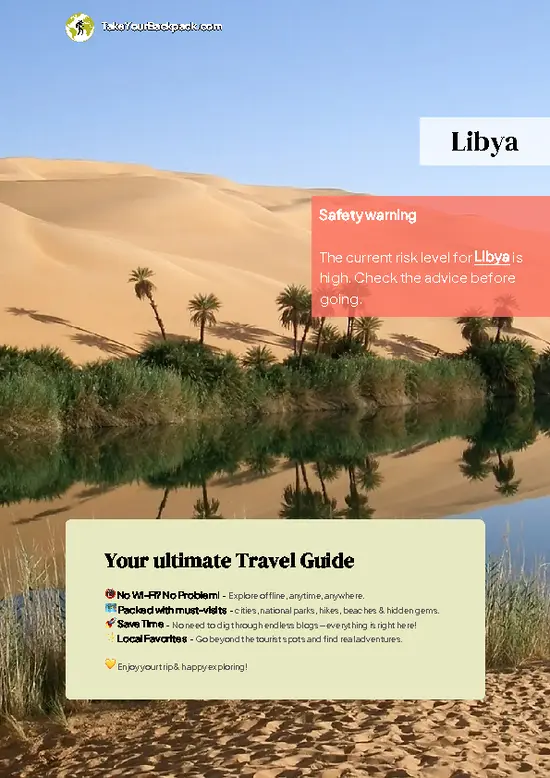
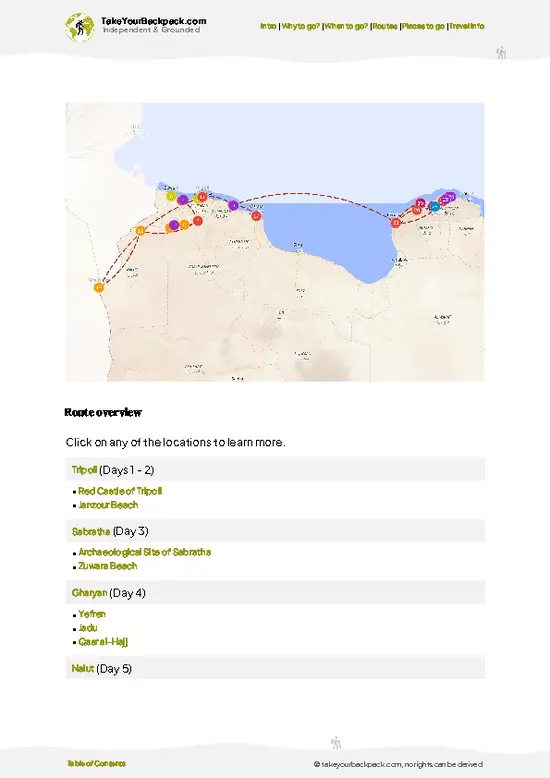
example page 0 from our offline Travel Guide for Libya
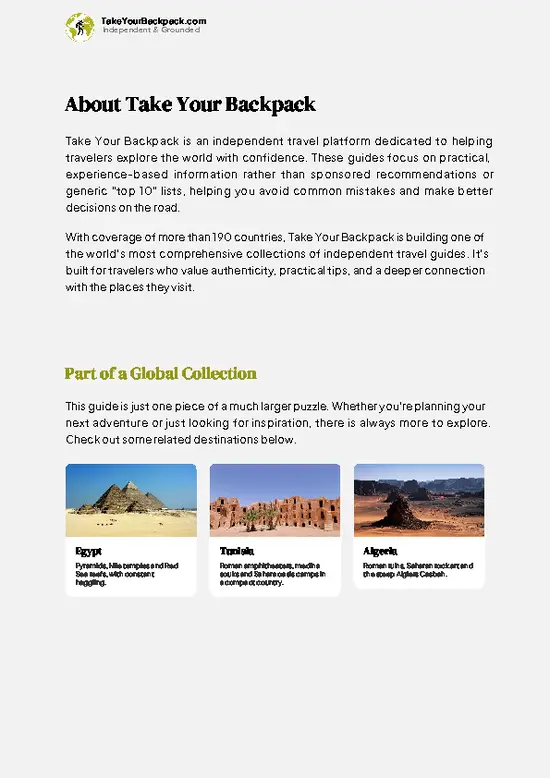
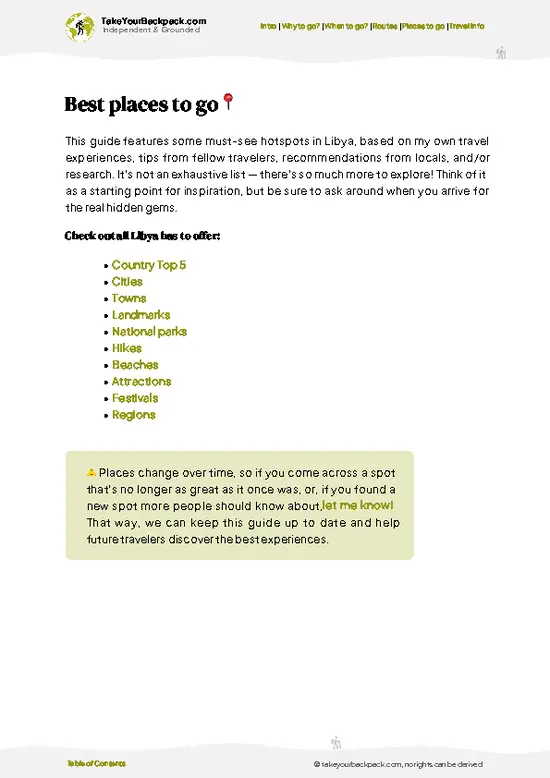
example page 1 from our offline Travel Guide for Libya
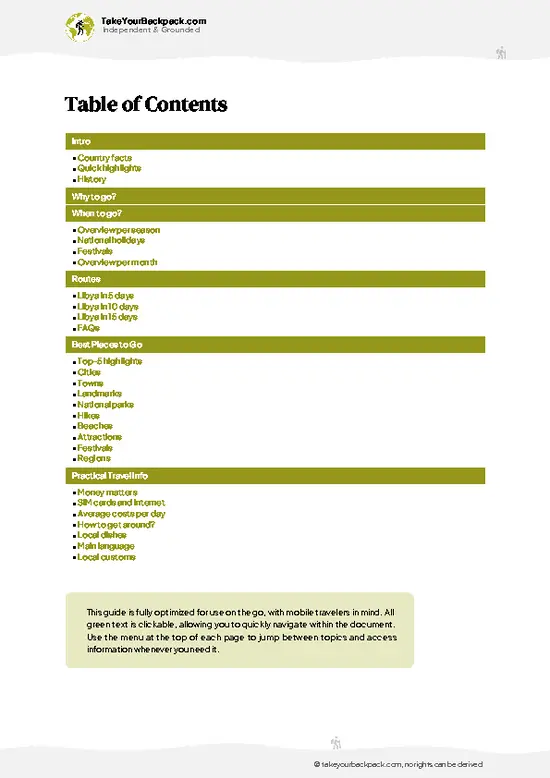
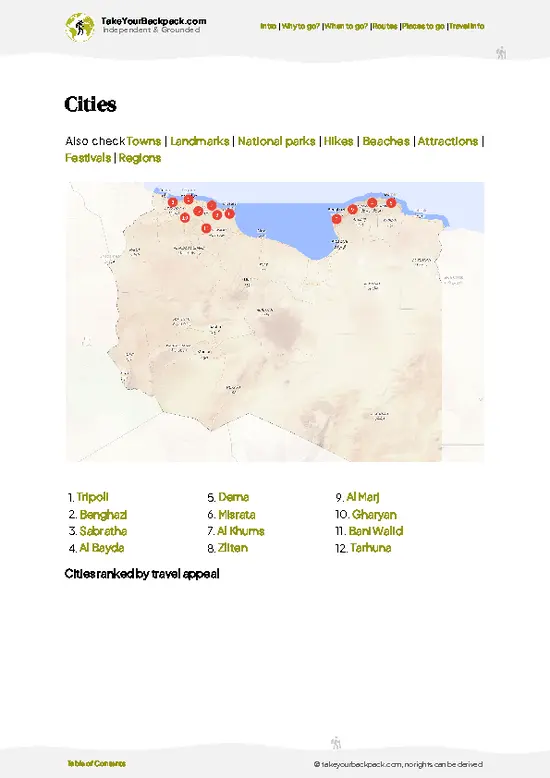
example page 2 from our offline Travel Guide for Libya
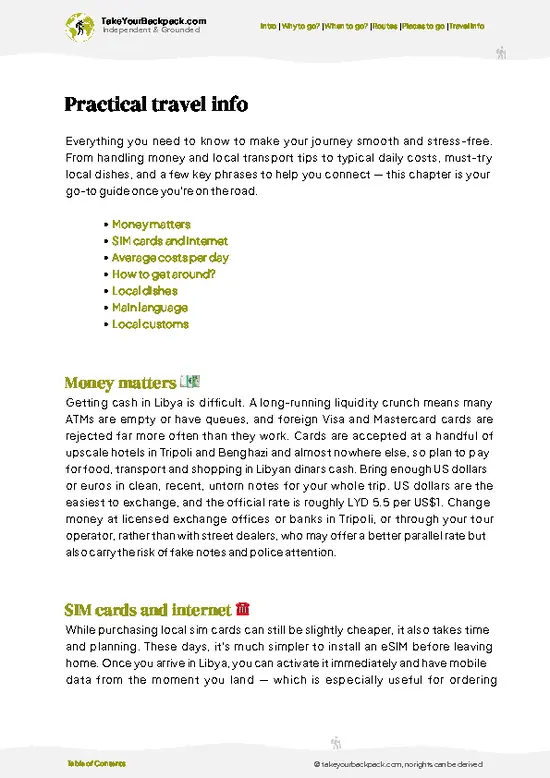
example page 3 from our offline Travel Guide for Libya
example page 4 from our offline Travel Guide for Libya
example page 5 from our offline Travel Guide for Libya
example page 6 from our offline Travel Guide for Libya
example page 7 from our offline Travel Guide for Libya
The digital guide (205 pages) contains:
✅ 45 highlights, ranked by travel appeal
✅ Optimized 5, 10 & 15-day travel routes
✅ Cities, national parks, landmarks, beaches
✅ How to get around
✅ Offline-friendly for travel without Wi-Fi
👉 Click to see all 30+ guide features

📅 Plan smarter in minutes, not weeks
✅ Month by month travel advice
✅ Festivals & national holidays
✅ Budget expectations

🗺️ Go to the right places, skip the overrated ones
✅ Honest pros & cons of destinations
✅ Top hikes, parks & viewpoints
✅ Lesser-known places most travelers miss
✅ Clear “worth it vs skip it” guidance

🛏️ Travel smoothly without rookie mistakes
✅ Best areas to stay
✅ Transport systems explained simply
✅ Common scams & safety advice
✅ SIM cards, money & practical tips

🌍 Understand the country, not just visit it
✅ Culture & traditions
✅ 52 Essential phrases & customs
✅ Festivals worth planning around
✅ Traveler-friendly historical context
✅ Insights that make places more meaningful

📱 Built for real travel conditions
✅ Fully downloadable PDF
✅ Works completely offline
✅ Optimized for phone use
✅ Useful in remote areas & buses
✅ Everything in one place
Stop searching, start planning
Get instant access to your full guide. 30‑day money-back guarantee.
+ Add another guide for just

By proceeding you agree to our terms.
Sent to your inbox immediately after payment • 100% Secure Checkout
Best Backpacking Travel Advisor 2025 tourism awardBest Backpacking
Travel Advisor
2025
What others say about Take Your Backpack Guides:
⭐⭐⭐⭐⭐
Fantastic, amazing amount of information!
⭐⭐⭐⭐⭐
My goodness this is amazing, it's what I've been looking for hats off too you!
⭐⭐⭐⭐⭐
I think this is absolutely BRILLIANT
⭐⭐⭐⭐
Very complete and informative. It's still missing places, but I gotta to commend you
⭐⭐⭐⭐⭐
This is truly amazing, thank you, can't wait to explore it with my kids!
⭐⭐⭐⭐⭐
Awesome resource, thank you!
⭐⭐⭐⭐⭐
This is amazing! Can't wait to explore the ones I haven't seen
⭐⭐⭐⭐
I love this! Well done, great idea.
⭐⭐⭐⭐⭐
Thanks for taking the time to make this gem!
⭐⭐⭐⭐⭐
This might be the best website I've ever seen.
⭐⭐⭐⭐⭐
Congratulations, and thank you so much for your work; it's incredibly valuable.
⭐⭐⭐⭐
In all seriousness I think you did a great job pointing out the important spots
⭐⭐⭐⭐⭐
10/10 very good
⭐⭐⭐⭐⭐
As someone who's only just starting to visit regularly this is awesome, thank you.
⭐⭐⭐⭐
Thank you very much! I'm going to visit my dad, it's going to be very useful!
⭐⭐⭐⭐⭐
This is really cool! We'll be travelling for the first time and this definitely come in handy.
⭐⭐⭐⭐⭐
You are now our minister of culture, congratulations 👨‍💼
⭐⭐⭐⭐⭐
Just wanted to tell you that this is a pearl! Going to follow your recommendations.
⭐⭐⭐⭐⭐
This is so cool. I'll definitely be using the resource for my travels soon.
⭐⭐⭐⭐⭐
This is very impressive! Good work.
⭐⭐⭐⭐⭐
This is an amazing and informative site. Very well done!

🛏️ Where to stay?Accommodation Highlights

Libya has no backpacker hostels, so budget accommodation means simple local hotels and a few guesthouses at roughly US$40 to 80 a night, usually booked through the licensed tour operator that sponsors your visa. In Tripoli, the streets around Martyrs’ Square and the Medina put you within walking distance of the old city and the Red Castle, but they get noisy with traffic and offer little after dark. Gargaresh, to the west, has the liveliest strip of cafés, shisha lounges and late-opening restaurants (Libya has no bars), while Ben Ashour and Dahra are calmer residential districts with mid-range hotels and a quieter feel, a short taxi ride from the center.

If you enjoy meeting fellow travelers, … read more 👉
Libya has no backpacker hostels, so budget accommodation means simple local hotels and a few guesthouses at roughly US$40 to 80 a night, usually booked through the licensed tour operator that sponsors your visa. In Tripoli, the streets around Martyrs’ Square and the Medina put you within walking distance of the old city and the Red Castle, but they get noisy with traffic and offer little after dark. Gargaresh, to the west, has the liveliest strip of cafés, shisha lounges and late-opening restaurants (Libya has no bars), while Ben Ashour and Dahra are calmer residential districts with mid-range hotels and a quieter feel, a short taxi ride from the center.

If you enjoy meeting fellow travelers, consider choosing hostels with high ratings for atmosphere. On the other hand, if you prefer having your own space, a hotel might be a better option.

LibyaSee More of Libya

👋 Meet the founderWho’s Behind Take Your Backpack?

Johan, backpacker and founder of TakeYourBackpackHi, I’m Johan (Netherlands 🇳🇱), the creator of TakeYourBackpack. Over the past 3 decades, I’ve backpacked through 90+ countries across six continents, gaining extensive experience with independent travel, long-term trips, and overland routes.

This site is built on a combination of firsthand travel experience and carefully curated insights from other backpackers. Many guides are based on places I’ve personally visited, while others bring together tips, observations, and practical advice shared by trusted travelers I’ve met along the way.

The goal is to provide realistic, experience-driven guidance — not generic itineraries — so you can explore destinations with better context, clearer expectations, and more confidence.