×

Libya🇱🇾 | best citiesThe Must-See 12 cities in Libya

Libya has three kinds of city, and the region decides the trip. The Tripolitanian coast in the west holds the biggest urban centers, with working hotels, airports and the most reliable logistics. Cyrenaica in the east has cooler, greener, quieter towns and the least foot traffic, but long distances between them. Fezzan in the southwest has Saharan oasis towns that are cheap to sleep in and hard to reach. Independent backpacking in the usual sense does not work here. Entry depends on sponsored visas and approved operators, so costs run far above regional norms. Pick the coast for ease, the east for space, and the desert only with a specialist.

By Johan Kruseman 🇳🇱 | Updated October 19, 2026
Explore the best towns in Libya

Why go?Understanding Their Importance

Libya’s cities exist because of one fact: almost all of the country is desert, so people settled on a thin Mediterranean strip or around Saharan oases. About 90 percent of the country is arid, and the population clusters on the coast. That gives Libya a clear urban split, with port cities that carry Phoenician, Greek, Roman, Ottoman and Italian layers, and desert towns built around water and caravan trade. Few countries stack that much ancient history so close to the sea, and almost none have so little tourist traffic.

But Libya is a poor choice for a casual city break. Since 2011 the country has been divided between rival administrations in the west and east, and armed groups control many neighborhoods and checkpoints. Most governments advise against all travel. Visas require a sponsor or … read more 👉
Libya’s cities exist because of one fact: almost all of the country is desert, so people settled on a thin Mediterranean strip or around Saharan oases. About 90 percent of the country is arid, and the population clusters on the coast. That gives Libya a clear urban split, with port cities that carry Phoenician, Greek, Roman, Ottoman and Italian layers, and desert towns built around water and caravan trade. Few countries stack that much ancient history so close to the sea, and almost none have so little tourist traffic.

But Libya is a poor choice for a casual city break. Since 2011 the country has been divided between rival administrations in the west and east, and armed groups control many neighborhoods and checkpoints. Most governments advise against all travel. Visas require a sponsor or licensed agency, so you cannot just turn up. Public transport between regions is minimal, cash is the main way to pay, and cards and foreign ATMs are unreliable. Nightlife, hostels and drop-in tourist infrastructure are close to nonexistent. Expect conservative norms, no alcohol and few places to eat after dark. Choose Libya for its cities only if you accept a supervised, pre-arranged, costly trip, and skip it if you want spontaneity.
How the List Was Created
The list of best cities in Libya is created based on culture, vibe, attractions, transport ease, and local charm. If you feel a city is missing in this list, please let us know.

When to go?Best Time to Visit Libya for cities

Best months: The best months for Libya’s cities are March to May and October to November, when coastal highs sit around 20 to 28°C and humidity is manageable. Winter brings rain to the coast and hills, mostly November to February, with Tripolitania and Cyrenaica seeing roughly 250 to 400 mm a year and highs of 14 to 18°C. It is mild but damp, and a wet day makes ruins and open-air sites miserable.
Seasons to avoid: Summer is a poor choice for cities. July and August on the coast reach 30 to 35°C with heavy humidity, and inland Fezzan regularly passes 40°C, sometimes 45°C. Spring also brings the ghibli, a hot dusty wind that can fill the air for a day or two and cut visibility, so do not schedule tight plans in April and May without slack.
Holidays and prices: There is no true peak season because … read more 👉
Best months: The best months for Libya’s cities are March to May and October to November, when coastal highs sit around 20 to 28°C and humidity is manageable. Winter brings rain to the coast and hills, mostly November to February, with Tripolitania and Cyrenaica seeing roughly 250 to 400 mm a year and highs of 14 to 18°C. It is mild but damp, and a wet day makes ruins and open-air sites miserable.
Seasons to avoid: Summer is a poor choice for cities. July and August on the coast reach 30 to 35°C with heavy humidity, and inland Fezzan regularly passes 40°C, sometimes 45°C. Spring also brings the ghibli, a hot dusty wind that can fill the air for a day or two and cut visibility, so do not schedule tight plans in April and May without slack.
Holidays and prices: There is no true peak season because so few visitors come. Tour prices are set by operators rather than seasons, so expect little discount in summer. Ramadan matters more than weather: restaurants close by day, opening hours shrink and the pace slows until the evening meal. The two Eid holidays shut offices and some transport for several days. Check the lunar calendar before booking, and avoid Ramadan if you want normal museum hours and daytime meals.

city hoppingSuggested Travel Strategies

How many days: A trip combining several Libyan cities needs 8 to 12 days, and more if it crosses between east and west. Distances are the problem. The coast road from the western regions to Cyrenaica runs roughly 1,000 km, about 10 to 14 hours by road with checkpoints, and the desert south of Tripolitania to Fezzan adds another 700 to 800 km.
Grouping regions: Keep to one region per trip. Tripolitania pairs well with nearby coastal sites, which are 1 to 3 hours apart. Cyrenaica works as its own loop based on Benghazi or Al Bayda. Fezzan belongs on a separate specialist trip. Move west to east only if flights are confirmed, because a domestic hop saves a full day on the road. Travel direction matters less than operator access, since permissions often dictate order.
Time per stop: Allow 1 to 2 … read more 👉
How many days: A trip combining several Libyan cities needs 8 to 12 days, and more if it crosses between east and west. Distances are the problem. The coast road from the western regions to Cyrenaica runs roughly 1,000 km, about 10 to 14 hours by road with checkpoints, and the desert south of Tripolitania to Fezzan adds another 700 to 800 km.
Grouping regions: Keep to one region per trip. Tripolitania pairs well with nearby coastal sites, which are 1 to 3 hours apart. Cyrenaica works as its own loop based on Benghazi or Al Bayda. Fezzan belongs on a separate specialist trip. Move west to east only if flights are confirmed, because a domestic hop saves a full day on the road. Travel direction matters less than operator access, since permissions often dictate order.
Time per stop: Allow 1 to 2 days for a major city and a half day for a smaller town. Three-hour drive days are realistic. Anything over six hours should be a travel day with no sightseeing.
Common mistakes: The usual error is cramming east and west into a short trip, then losing days to delays. Another is assuming departures run on time, when flight cancellations and fuel shortages happen. Add one buffer day per region, book transfers through your agency, and get permits confirmed before you commit to any sequence.

The ListTop cities of Libya

1 Tripoli

Medina alleys, Ottoman mosques, Italian boulevards, city port

Lose yourself in winding old city lanes, admire diverse architecture, and sense the capital’s layered past at every turn.

2 Benghazi

Seafront corniche, Italian-era architecture, bustling squares

Stroll along the harbor, admire colonial facades, and experience the city’s energy in its open-air gathering places.

3 Sabratha

Roman theater, coastal ruins, palm-dotted beaches

Stand among ancient columns, listen to waves near archaeological sites, and relax on quiet stretches of sand.

libya-city-sabratha
© Google |

4 Al Bayda

green hills, Greek ruins, cool climate

Walk among forested hills and explore archaeological sites, where a milder climate sets this town apart from Libya’s arid heartland.

5 Derna

Mediterranean cliffs, river gorge, Ottoman-era mosques

Follow the river through a dramatic gorge to the sea, where old mosques and coastal cliffs create a striking urban landscape.

6 Misrata

Commercial port, textile markets, modern cityscape

Navigate busy streets lined with shops, discover the city’s industrial pulse, and observe how commerce shapes daily routines.

7 Al Khums

Leptis Magna ruins, Mediterranean coastline, local souks

Wander among ancient Roman stonework, sample fresh seafood, and experience a city where archaeological sites meet daily Libyan life.

8 Zliten

Sufi shrines, olive groves, Friday market

Visit religious landmarks, taste local olives, and join crowds at the weekly market for a glimpse of regional traditions.

9 Al Marj

agricultural plains, earthquake history, colonial grid

Trace the town’s unique layout and learn how a devastating earthquake led to its modern reconstruction amid productive farmlands.

10 Gharyan

Troglodyte houses, pottery workshops, mountain plateau

Descend into cave dwellings, watch artisans at work, and feel the altitude’s cool air above the northern plains.

11 Bani Walid

Wadi valleys, tribal gathering sites, olive groves

Travel through fertile valleys and meet local communities whose traditions and olive cultivation shape the rhythm of daily life.

12 Tarhuna

Hilltop views, wheat fields, Berber heritage

Climb gentle slopes for panoramic vistas, pass through agricultural landscapes, and notice traces of indigenous culture in village life.

Loading the map 🌍

Expert viewTips and Advice from Travelers

How many cities: I advise two to four cities, all in one region. Libyan distances, permit checks and escorts eat the day, so a fifth stop usually means a day in a car and nothing else. Two cities in a region lets you see them properly, while four is the ceiling before checkpoints and paperwork take over. Skip any itinerary that promises east, west and south in under a week, because it is not worth the money.
Choosing the kind of city: For first-timers and anyone short on nerve, choose coastal western cities. They have the best flight links, hotels and operators. History-focused travelers should weigh the eastern coast, which has less infrastructure and more independence from crowds, though you will pay for longer transfers. Desert oasis towns suit experienced desert travelers who accept heat, … read more 👉
How many cities: I advise two to four cities, all in one region. Libyan distances, permit checks and escorts eat the day, so a fifth stop usually means a day in a car and nothing else. Two cities in a region lets you see them properly, while four is the ceiling before checkpoints and paperwork take over. Skip any itinerary that promises east, west and south in under a week, because it is not worth the money.
Choosing the kind of city: For first-timers and anyone short on nerve, choose coastal western cities. They have the best flight links, hotels and operators. History-focused travelers should weigh the eastern coast, which has less infrastructure and more independence from crowds, though you will pay for longer transfers. Desert oasis towns suit experienced desert travelers who accept heat, fuel logistics and basic rooms. Do not expect nightlife or café culture anywhere, and do not plan a trip around food.
What it costs: Libya has no budget backpacker circuit. Expect US$150 to 300 a day on an arranged trip with guide, driver and vehicle. Hotels run about US$40 to 120 a night in cities, and meals in local restaurants cost US$5 to 12. Visa sponsorship and agency fees add roughly US$100 to 300 per person. Museum and archaeological site entry is modest, often a few dinars. The Libyan dinar trades at a large gap between the official and parallel rates, so settle your operator’s price in a stable currency and carry clean, recent US dollar or euro notes for exchange. Bring enough cash for the whole trip, because cards and foreign ATMs are unreliable and withdrawals are limited. An agency that quotes far under this range is likely skipping security or permits.
Safety and conduct: Government advisories in most countries say do not travel, and travel insurance often excludes Libya, so confirm cover in writing before you pay. Insist on a licensed local operator, never travel overland without a guide, and do not go out alone at night. Fighting can flare with little warning, especially around Tripoli, so keep your plans flexible and register with your embassy. Checkpoints are routine: carry your passport and permits, stay polite and do not photograph military sites, airports or officials. The country is conservative and alcohol-free. Dress modestly, with covered shoulders and knees, and women should carry a headscarf. Ask before photographing people, and avoid public displays of affection and discussion of politics or militias.

✈️ The backpacker research shortcutLibya Travel Guide

An offline-friendly backpacking guide with optimized travel routes, ranked highlights, transport advice, and the best areas to stay.
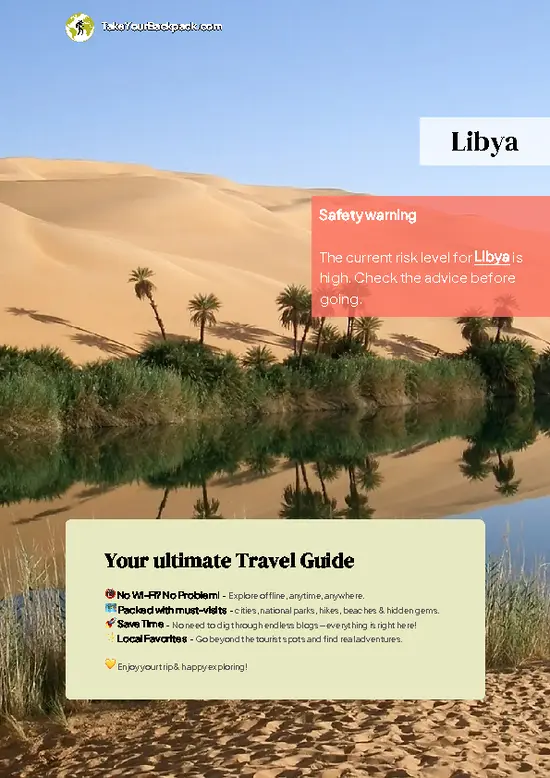
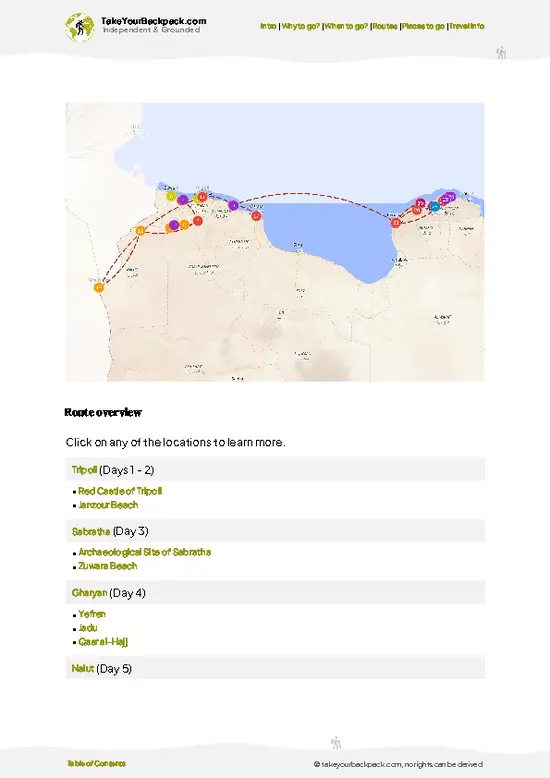
example page 0 from our offline Travel Guide for Libya
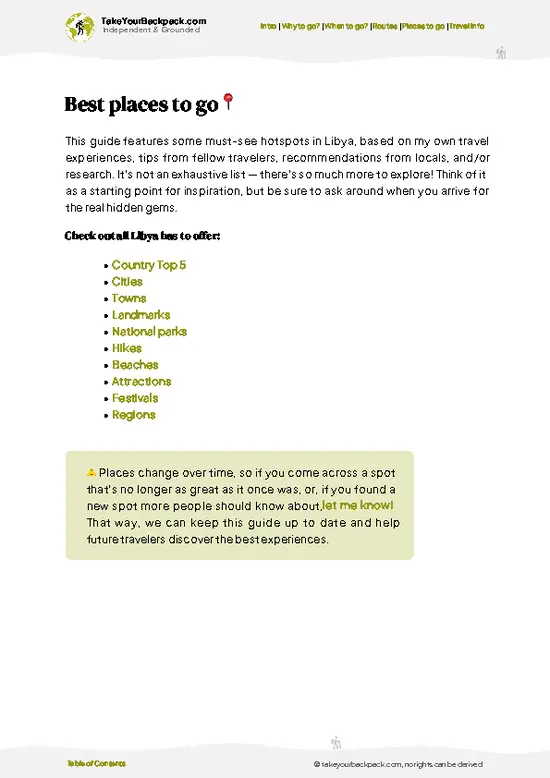
example page 1 from our offline Travel Guide for Libya
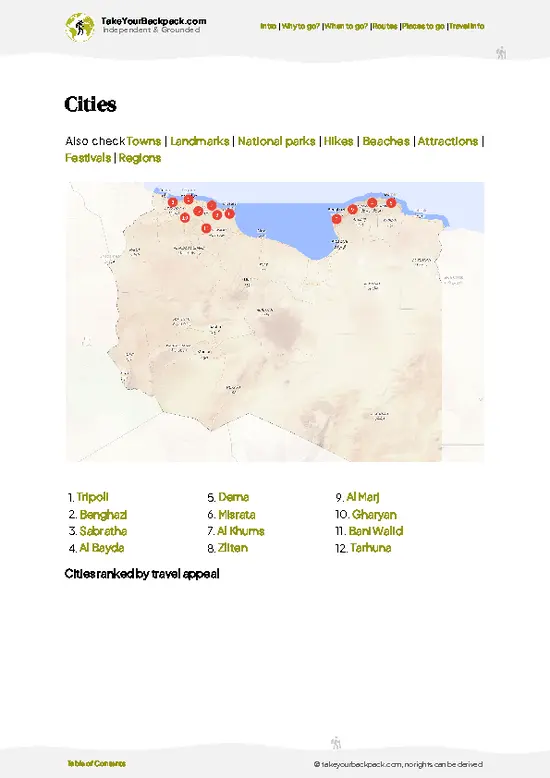
example page 2 from our offline Travel Guide for Libya
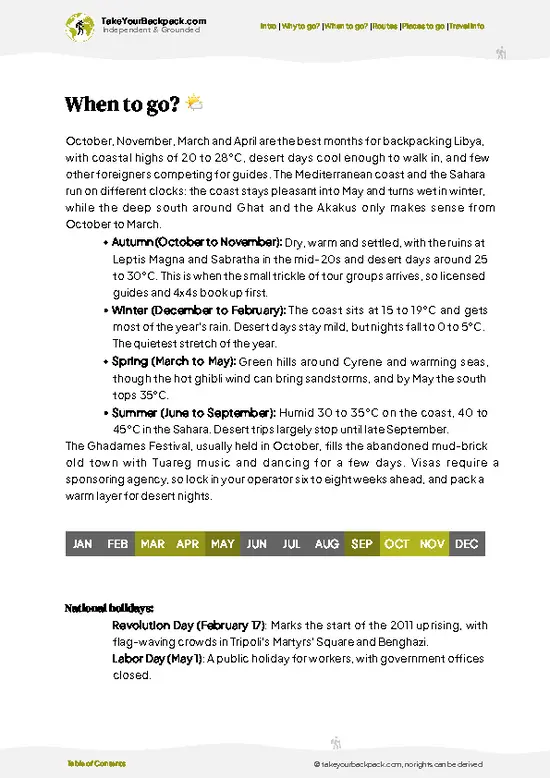
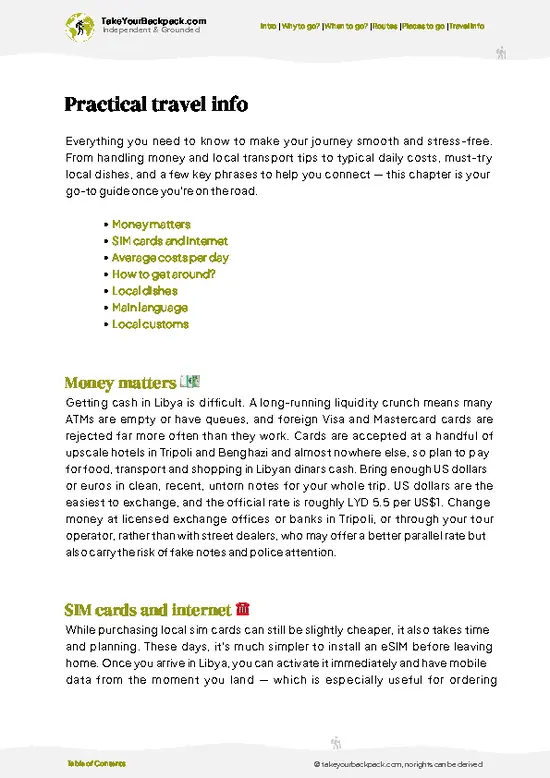
example page 3 from our offline Travel Guide for Libya
example page 4 from our offline Travel Guide for Libya
example page 5 from our offline Travel Guide for Libya
example page 6 from our offline Travel Guide for Libya
example page 7 from our offline Travel Guide for Libya
The digital guide (205 pages) contains:
✅ 45 highlights, ranked by travel appeal
✅ Optimized 5, 10 & 15-day travel routes
✅ Cities, national parks, landmarks, beaches
✅ How to get around
✅ Offline-friendly for travel without Wi-Fi
👉 Click to see all 30+ guide features

📅 Plan smarter in minutes, not weeks
✅ Month by month travel advice
✅ Festivals & national holidays
✅ Budget expectations

🗺️ Go to the right places, skip the overrated ones
✅ Honest pros & cons of destinations
✅ Top hikes, parks & viewpoints
✅ Lesser-known places most travelers miss
✅ Clear “worth it vs skip it” guidance

🛏️ Travel smoothly without rookie mistakes
✅ Best areas to stay
✅ Transport systems explained simply
✅ Common scams & safety advice
✅ SIM cards, money & practical tips

🌍 Understand the country, not just visit it
✅ Culture & traditions
✅ 52 Essential phrases & customs
✅ Festivals worth planning around
✅ Traveler-friendly historical context
✅ Insights that make places more meaningful

📱 Built for real travel conditions
✅ Fully downloadable PDF
✅ Works completely offline
✅ Optimized for phone use
✅ Useful in remote areas & buses
✅ Everything in one place
Stop searching, start planning
Get instant access to your full guide. 30‑day money-back guarantee.
+ Add another guide for just

By proceeding you agree to our terms.
Sent to your inbox immediately after payment • 100% Secure Checkout
Best Backpacking Travel Advisor 2025 tourism awardBest Backpacking
Travel Advisor
2025
What others say about Take Your Backpack Guides:
⭐⭐⭐⭐⭐
Fantastic, amazing amount of information!
⭐⭐⭐⭐⭐
My goodness this is amazing, it's what I've been looking for hats off too you!
⭐⭐⭐⭐⭐
I think this is absolutely BRILLIANT
⭐⭐⭐⭐
Very complete and informative. It's still missing places, but I gotta to commend you
⭐⭐⭐⭐⭐
This is truly amazing, thank you, can't wait to explore it with my kids!
⭐⭐⭐⭐⭐
Awesome resource, thank you!
⭐⭐⭐⭐⭐
This is amazing! Can't wait to explore the ones I haven't seen
⭐⭐⭐⭐
I love this! Well done, great idea.
⭐⭐⭐⭐⭐
Thanks for taking the time to make this gem!
⭐⭐⭐⭐⭐
This might be the best website I've ever seen.
⭐⭐⭐⭐⭐
Congratulations, and thank you so much for your work; it's incredibly valuable.
⭐⭐⭐⭐
In all seriousness I think you did a great job pointing out the important spots
⭐⭐⭐⭐⭐
10/10 very good
⭐⭐⭐⭐⭐
As someone who's only just starting to visit regularly this is awesome, thank you.
⭐⭐⭐⭐
Thank you very much! I'm going to visit my dad, it's going to be very useful!
⭐⭐⭐⭐⭐
This is really cool! We'll be travelling for the first time and this definitely come in handy.
⭐⭐⭐⭐⭐
You are now our minister of culture, congratulations 👨‍💼
⭐⭐⭐⭐⭐
Just wanted to tell you that this is a pearl! Going to follow your recommendations.
⭐⭐⭐⭐⭐
This is so cool. I'll definitely be using the resource for my travels soon.
⭐⭐⭐⭐⭐
This is very impressive! Good work.
⭐⭐⭐⭐⭐
This is an amazing and informative site. Very well done!

🛏️ Where to stay?Where to Base Yourself

Libya has no backpacker hostels, so budget accommodation means simple local hotels and a few guesthouses at roughly US$40 to 80 a night, usually booked through the licensed tour operator that sponsors your visa. In Tripoli, the streets around Martyrs’ Square and the Medina put you within walking distance of the old city and the Red Castle, but they get noisy with traffic and offer little after dark. Gargaresh, to the west, has the liveliest strip of cafés, shisha lounges and late-opening restaurants (Libya has no bars), while Ben Ashour and Dahra are calmer residential districts with mid-range hotels and a quieter feel, a short taxi ride from the center.

If you enjoy meeting fellow travelers, … read more 👉
Libya has no backpacker hostels, so budget accommodation means simple local hotels and a few guesthouses at roughly US$40 to 80 a night, usually booked through the licensed tour operator that sponsors your visa. In Tripoli, the streets around Martyrs’ Square and the Medina put you within walking distance of the old city and the Red Castle, but they get noisy with traffic and offer little after dark. Gargaresh, to the west, has the liveliest strip of cafés, shisha lounges and late-opening restaurants (Libya has no bars), while Ben Ashour and Dahra are calmer residential districts with mid-range hotels and a quieter feel, a short taxi ride from the center.

If you enjoy meeting fellow travelers, consider choosing hostels with high ratings for atmosphere. On the other hand, if you prefer having your own space, a hotel might be a better option.

LibyaExpand Your Journey

👋 Meet the founderWho’s Behind Take Your Backpack?

Johan, backpacker and founder of TakeYourBackpackHi, I’m Johan (Netherlands 🇳🇱), the creator of TakeYourBackpack. Over the past 3 decades, I’ve backpacked through 90+ countries across six continents, gaining extensive experience with independent travel, long-term trips, and overland routes.

This site is built on a combination of firsthand travel experience and carefully curated insights from other backpackers. Many guides are based on places I’ve personally visited, while others bring together tips, observations, and practical advice shared by trusted travelers I’ve met along the way.

The goal is to provide realistic, experience-driven guidance — not generic itineraries — so you can explore destinations with better context, clearer expectations, and more confidence.