×

Libya🇱🇾 | citiesTarhunaOlive presses, fig terraces, farm market, orchard hills | things to do and best time to go

Explore Bani WalidExplore Al Bayda

Backpacking in Tarhuna
👀 For curious travelerscity ranked #12
By Johan Kruseman 🇳🇱 | Updated October 22, 2026

Dust, diesel and the sweet bite of green olives hang over the roadside stalls as a shared taxi drops you at the edge of the town center. Tarhuna sits in the north of Libya, in rolling farm hills southeast of Tripoli. It suits experienced, self-reliant travelers who want to see ordinary Libyan life, not a checklist. It does not suit anyone after ruins, nightlife or hostels, because there are none worth planning around. Skip the town center sprawl and spend your time in the orchard country around it. Unlike Tripoli, it has no medina and no coast, just farmland and local hospitality.

Discover everything you want to know in the 📖 Libya Travel Guide.
Safety warning

The current risk level for Libya is high. Check the advice before going.


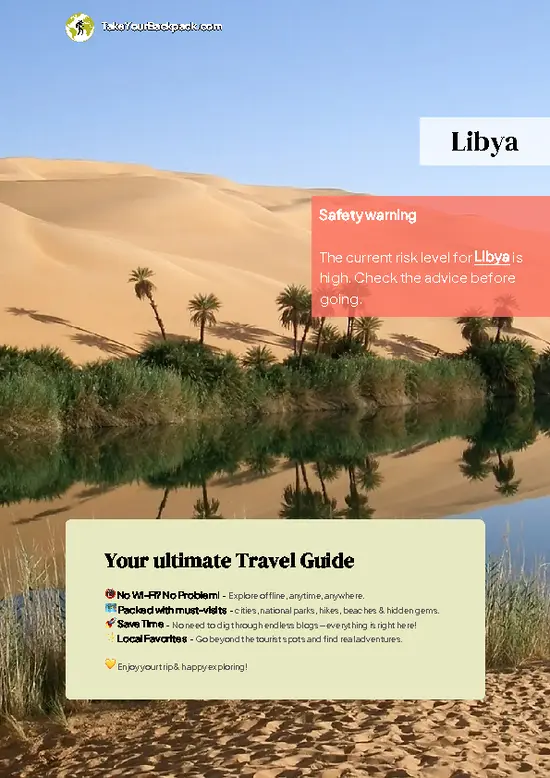
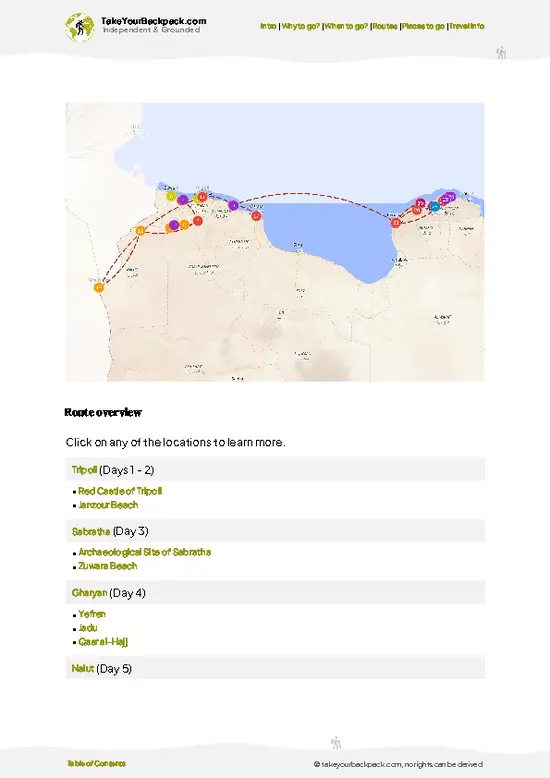
example page 0 from our offline Travel Guide for Libya
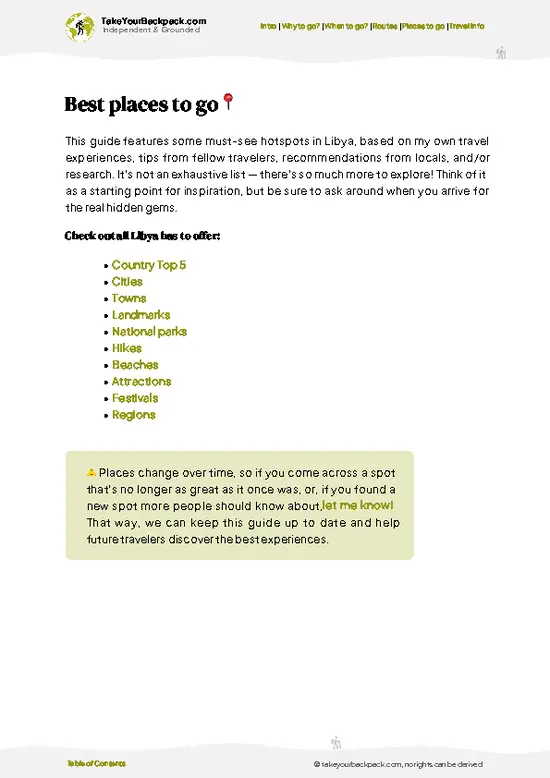
example page 1 from our offline Travel Guide for Libya
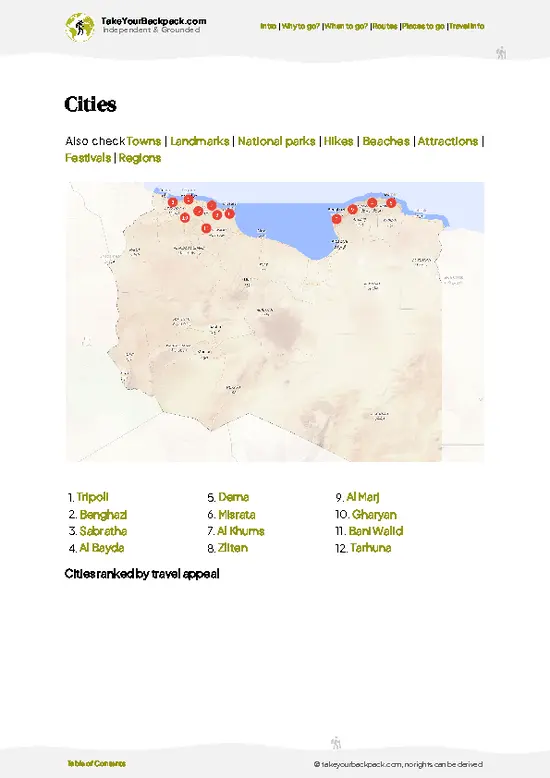
example page 2 from our offline Travel Guide for Libya
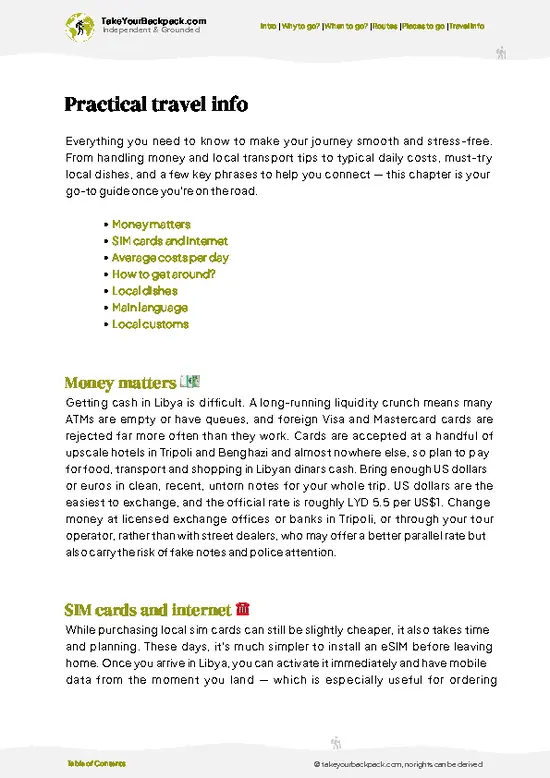
example page 3 from our offline Travel Guide for Libya
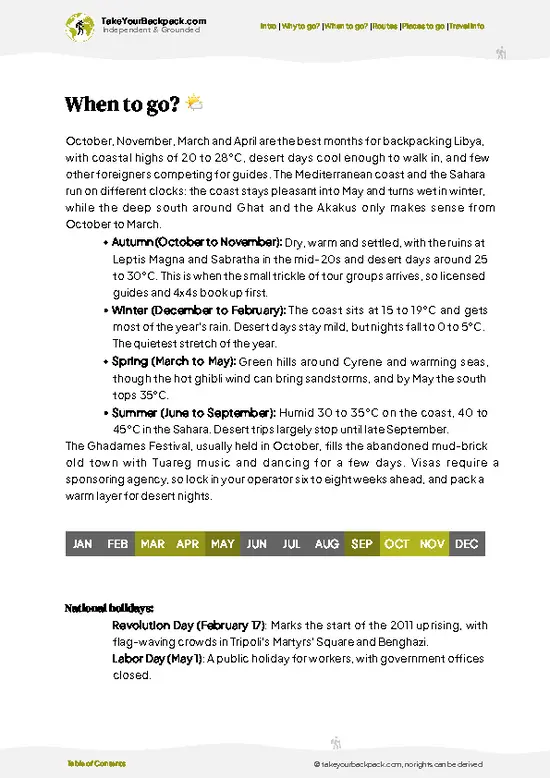
example page 4 from our offline Travel Guide for Libya
example page 5 from our offline Travel Guide for Libya
example page 6 from our offline Travel Guide for Libya
example page 7 from our offline Travel Guide for Libya
Loading the map 🌍
CLICK TO FILTER
cities
towns
landmarks
national parks
hikes
beaches
attractions
festivals
regions
SHOW COUNTRY’S BESTSHOW ALL

✨ Why go?
Ranked #12 city in Libya
The unique appeal for travelers

Tarhuna draws a very small number of backpackers, and they come for one thing: a look at inland farming Libya that the coastal itineraries skip. The hills around town are planted with olives, figs and almonds, and the harvest season shapes the whole rhythm of the market. It works only as a short detour from Tripoli, not as a base. Accommodation is minimal, so most people arrive with a local host or a firm plan for the evening. Eating is simple and local, built around grilled meat, bread and dates. If you want ruins, a medina or a hostel scene, head to the coast instead. If you like unscripted conversations with farmers and shopkeepers, Tarhuna rewards a few unhurried hours.

💡 HighlightsMust-see experiences and standout moments

  1. Central market area: The best place to watch Tarhuna work. Stalls sell local olives, olive oil, figs, dates and vegetables from the surrounding farms, and vendors will usually let you taste before you buy. Go in the morning when produce is freshest. Free to wander, with snacks costing US$1 to 3. Allow 1 to 2 hours.
  2. Olive and fig groves on the town’s edge: The hills around Tarhuna are the real landscape here, with terraced trees, dry stone boundaries and views over the farmland toward the coastal plain. Walk with a local contact who knows whose land you are crossing. Early morning or late afternoon is cooler and softer for photos. Free, 1 to 2 hours.
  3. Local olive press visit: During the autumn and early winter harvest, some family-run presses work through the season and the smell of fresh oil
… read more 👉
  1. Central market area: The best place to watch Tarhuna work. Stalls sell local olives, olive oil, figs, dates and vegetables from the surrounding farms, and vendors will usually let you taste before you buy. Go in the morning when produce is freshest. Free to wander, with snacks costing US$1 to 3. Allow 1 to 2 hours.
  2. Olive and fig groves on the town’s edge: The hills around Tarhuna are the real landscape here, with terraced trees, dry stone boundaries and views over the farmland toward the coastal plain. Walk with a local contact who knows whose land you are crossing. Early morning or late afternoon is cooler and softer for photos. Free, 1 to 2 hours.
  3. Local olive press visit: During the autumn and early winter harvest, some family-run presses work through the season and the smell of fresh oil carries down the street. Visits depend on an invitation from the owner. A small bottle of fresh oil costs about US$4 to 8. Allow around 1 hour.
Tarhuna rewards a visit to the surroundings of Leptis Magna’s Roman ruins, the old medina of Tripoli, the ancient theater of Sabratha and the beaches of Khoms, all of which work as day trips from Tripoli. For a first visit, the central market is the one to pick, because it gives you the town’s produce, people and pace in a single stop.
Spotted a mistake or missing something? Contact us.

🏘️ NeighborhoodsHow different areas shape the experience

Tarhuna is a hill town and farming district southeast of Tripoli, so its areas are few and easy to sort by usefulness.
  • Town center: The market streets and main road around the municipal buildings are where you eat, change money and find shared taxis. Spend an afternoon here, since everything is close enough to walk, but there is little formal sightseeing and no real nightlife.
  • Olive and fig groves: The farmland on the edges of town is the best reason to linger. Tarhuna is known for olives, figs and dates, and roads between the orchards make pleasant walks in cooler months. Go in the morning, and expect to need a ride to reach them.
  • Hilltops and Roman-era sites nearby: The ridges around Tarhuna have rocky viewpoints and scattered ancient remains, including the Roman mausoleum at Ghirza being a
… read more 👉
Tarhuna is a hill town and farming district southeast of Tripoli, so its areas are few and easy to sort by usefulness.
  • Town center: The market streets and main road around the municipal buildings are where you eat, change money and find shared taxis. Spend an afternoon here, since everything is close enough to walk, but there is little formal sightseeing and no real nightlife.
  • Olive and fig groves: The farmland on the edges of town is the best reason to linger. Tarhuna is known for olives, figs and dates, and roads between the orchards make pleasant walks in cooler months. Go in the morning, and expect to need a ride to reach them.
  • Hilltops and Roman-era sites nearby: The ridges around Tarhuna have rocky viewpoints and scattered ancient remains, including the Roman mausoleum at Ghirza being a far trip and not worth attempting. Local sites need a local guide, so skip them without one.
  • Outer suburbs: Residential sprawl with nothing to see. Skip it.

⌛️ 1 dayA smart one-day plan

8:00 AM, central market: Start here because the stalls are freshest and fullest early, and vendors have time to talk. Buy a handful of olives and fresh bread for breakfast, then walk the lanes around the market on foot.
10:00 AM, the edge-of-town groves: Head out with a local contact toward the olive and fig terraces. The hillside walking is gentle, and farmers working the trees are often happy to explain the season. Keep to paths you are shown.
12:30 PM, lunch with a family or at a simple grill: Order grilled lamb or chicken with bread and salad, and pay in local cash. This is the best moment to ask about the harvest and the area’s history.
3:00 PM, family-run olive press: Normally outside any tourist route, this is the stop that makes the day. If the press is working, you can watch the oil … read more 👉
8:00 AM, central market: Start here because the stalls are freshest and fullest early, and vendors have time to talk. Buy a handful of olives and fresh bread for breakfast, then walk the lanes around the market on foot.
10:00 AM, the edge-of-town groves: Head out with a local contact toward the olive and fig terraces. The hillside walking is gentle, and farmers working the trees are often happy to explain the season. Keep to paths you are shown.
12:30 PM, lunch with a family or at a simple grill: Order grilled lamb or chicken with bread and salad, and pay in local cash. This is the best moment to ask about the harvest and the area’s history.
3:00 PM, family-run olive press: Normally outside any tourist route, this is the stop that makes the day. If the press is working, you can watch the oil come off and taste it on bread. Without an open press, ask for a visit to a local orchard instead.
5:30 PM, tea on the main street: Finish with sweet tea and dates in a small café, then arrange your ride back well before dark.

🌤️ When to go?When to go for the best experience

Spring and autumn are the best seasons for Tarhuna, with mild days and none of the summer heat.
  • Spring (March to May): Highs of 18 to 27°C (64 to 81°F), green hillsides and blossom in the orchards. Occasional dusty ghibli winds can push temperatures up fast.
  • Summer (June to August): Highs of 30 to 38°C (86 to 100°F), with long daylight. Elevation keeps nights a little cooler than the coast, but midday is too hot for walking.
  • Autumn (September to November): Highs of 22 to 32°C (72 to 90°F) and olive and fig harvest activity. Prices stay steady.
  • Winter (December to February): Highs of 14 to 18°C (57 to 64°F), with cold nights and rain bursts, and shorter days.
Aim for late March or October, when roads are dry and the orchards are active.

source: climatestotravel.comJANJanuary: fair for travelingFEBFebruary: fair for travelingMARMarch: highly recommended for travelingAPRApril: excellent for travelingMAYMay: excellent for travelingJUNJune: good for travelingJULJuly: fair for travelingAUGAugust: fair for travelingSEPSeptember: good for travelingOCTOctober: good for travelingNOVNovember: good for travelingDECDecember: fair for traveling
when-to-go

✈️ The backpacker research shortcutLibya Travel Guide

An offline-friendly backpacking guide with optimized travel routes, ranked highlights, transport advice, and the best areas to stay.
example page 0 from our offline Travel Guide for Libya
example page 1 from our offline Travel Guide for Libya
example page 2 from our offline Travel Guide for Libya
example page 3 from our offline Travel Guide for Libya
example page 4 from our offline Travel Guide for Libya
example page 5 from our offline Travel Guide for Libya
example page 6 from our offline Travel Guide for Libya
example page 7 from our offline Travel Guide for Libya
The digital guide (205 pages) contains:
✅ 45 highlights, ranked by travel appeal
✅ Optimized 5, 10 & 15-day travel routes
✅ Cities, national parks, landmarks, beaches
✅ How to get around
✅ Offline-friendly for travel without Wi-Fi
👉 Click to see all 30+ guide features

📅 Plan smarter in minutes, not weeks
✅ Month by month travel advice
✅ Festivals & national holidays
✅ Budget expectations

🗺️ Go to the right places, skip the overrated ones
✅ Honest pros & cons of destinations
✅ Top hikes, parks & viewpoints
✅ Lesser-known places most travelers miss
✅ Clear “worth it vs skip it” guidance

🛏️ Travel smoothly without rookie mistakes
✅ Best areas to stay
✅ Transport systems explained simply
✅ Common scams & safety advice
✅ SIM cards, money & practical tips

🌍 Understand the country, not just visit it
✅ Culture & traditions
✅ 52 Essential phrases & customs
✅ Festivals worth planning around
✅ Traveler-friendly historical context
✅ Insights that make places more meaningful

📱 Built for real travel conditions
✅ Fully downloadable PDF
✅ Works completely offline
✅ Optimized for phone use
✅ Useful in remote areas & buses
✅ Everything in one place
Stop searching, start planning
Get instant access to your full guide. 30‑day money-back guarantee.
+ Add another guide for just

By proceeding you agree to our terms.
Sent to your inbox immediately after payment • 100% Secure Checkout
Best Backpacking Travel Advisor 2025 tourism awardBest Backpacking
Travel Advisor
2025
What others say about Take Your Backpack Guides:
⭐⭐⭐⭐⭐
Fantastic, amazing amount of information!
⭐⭐⭐⭐⭐
My goodness this is amazing, it's what I've been looking for hats off too you!
⭐⭐⭐⭐⭐
I think this is absolutely BRILLIANT
⭐⭐⭐⭐
Very complete and informative. It's still missing places, but I gotta to commend you
⭐⭐⭐⭐⭐
This is truly amazing, thank you, can't wait to explore it with my kids!
⭐⭐⭐⭐⭐
Awesome resource, thank you!
⭐⭐⭐⭐⭐
This is amazing! Can't wait to explore the ones I haven't seen
⭐⭐⭐⭐
I love this! Well done, great idea.
⭐⭐⭐⭐⭐
Thanks for taking the time to make this gem!
⭐⭐⭐⭐⭐
This might be the best website I've ever seen.
⭐⭐⭐⭐⭐
Congratulations, and thank you so much for your work; it's incredibly valuable.
⭐⭐⭐⭐
In all seriousness I think you did a great job pointing out the important spots
⭐⭐⭐⭐⭐
10/10 very good
⭐⭐⭐⭐⭐
As someone who's only just starting to visit regularly this is awesome, thank you.
⭐⭐⭐⭐
Thank you very much! I'm going to visit my dad, it's going to be very useful!
⭐⭐⭐⭐⭐
This is really cool! We'll be travelling for the first time and this definitely come in handy.
⭐⭐⭐⭐⭐
You are now our minister of culture, congratulations 👨‍💼
⭐⭐⭐⭐⭐
Just wanted to tell you that this is a pearl! Going to follow your recommendations.
⭐⭐⭐⭐⭐
This is so cool. I'll definitely be using the resource for my travels soon.
⭐⭐⭐⭐⭐
This is very impressive! Good work.
⭐⭐⭐⭐⭐
This is an amazing and informative site. Very well done!

🛏️ Where to stay?Best areas to stay in Libya

Tripoli is the practical place to sleep, because Tarhuna has very little budget accommodation and no real hostel scene. Staying in the Tripoli old city area or central districts gives you the widest range of cheap guesthouses and basic hotels, roughly US$15 to 35 a night for a simple room, plus shared taxis out to Tarhuna of 1 to 1.5 hours each way. Central Tripoli is busier and noisier, so choose a side street, and avoid walking alone late at night. If you stay in Tarhuna itself, arrange it through a local contact, since options are limited and informal. Arrive in daylight, and check bookings … read more 👉
Tripoli is the practical place to sleep, because Tarhuna has very little budget accommodation and no real hostel scene. Staying in the Tripoli old city area or central districts gives you the widest range of cheap guesthouses and basic hotels, roughly US$15 to 35 a night for a simple room, plus shared taxis out to Tarhuna of 1 to 1.5 hours each way. Central Tripoli is busier and noisier, so choose a side street, and avoid walking alone late at night. If you stay in Tarhuna itself, arrange it through a local contact, since options are limited and informal. Arrive in daylight, and check bookings ahead because walk-in availability is unpredictable.

🚌 Getting aroundHow to get around Tarhuna

Tarhuna’s center is compact enough to cover on foot in ten to twenty minutes, but the orchards, hilltops and outlying villages are too spread out to walk, so you will want a ride beyond the main market streets. Traffic is light compared with Tripoli, though roads can be rough and there is no reliable scheduled public transport. Most visitors arrive from Tripoli and lean on local drivers.
  • Walking: Free and the best way to see the market and main road. Skip walking along highways, which have fast traffic and little shade.
  • Shared taxis: The standard way between Tripoli and Tarhuna, usually about US$3 to 6 per seat for a ride of 1 to 1.5 hours. They leave when full, mainly in the morning and early afternoon, and are scarce after dark.
  • Private taxis: Around US$2 to 6 for short hops inside town. Agree
… read more 👉
Tarhuna’s center is compact enough to cover on foot in ten to twenty minutes, but the orchards, hilltops and outlying villages are too spread out to walk, so you will want a ride beyond the main market streets. Traffic is light compared with Tripoli, though roads can be rough and there is no reliable scheduled public transport. Most visitors arrive from Tripoli and lean on local drivers.
  • Walking: Free and the best way to see the market and main road. Skip walking along highways, which have fast traffic and little shade.
  • Shared taxis: The standard way between Tripoli and Tarhuna, usually about US$3 to 6 per seat for a ride of 1 to 1.5 hours. They leave when full, mainly in the morning and early afternoon, and are scarce after dark.
  • Private taxis: Around US$2 to 6 for short hops inside town. Agree the price before getting in, since there are no meters.
  • Hired car with driver: About US$40 to 80 for a day to reach farms, hills and nearby sites. This is worth it if you want more than the town center, and a local contact is the safest way to arrange it.

👛 Costs (as of 22 October 2026)Typical daily expenses

Tarhuna costs about US$48 to 60 a day for a backpacker who sleeps in Tripoli and day-trips, with pay in Libyan dinars.
CategoryBudget RangeLocal Reality
Dorm accommodation (high season)US$15 to 25Few dorms exist, so a basic single room is the norm
Dorm accommodation (off-season)US$12 to 20Slightly lower in winter
MealsUS$6 to 12Sandwiches, grills, bread and tea
Local transportUS$6 to 12Shared taxis and short private rides
City transport passNot availableNo pass exists, so pay per ride
Basic activities/entry feesUS$2 to 5Most sights are free, and sites charge small fees
MiscellaneousUS$3 to 6Water, SIM data and tips
Total Daily BudgetUS$48 to 60Higher with a hired driver
Carry small bills and share a hired car with other travelers to cut the cost of a day out.

source: numbeo.com
⚠️ Prices can change and everyone travels differently, so take this as a rough guide. Hope it helps you plan your adventure!

🚌 Day tripsWhere to go beyond the main area

Tarhuna works best as a day trip from Tripoli, and from it a few places are reachable in a day by road with a local driver.Leptis Magna: Libya’s best-known Roman city lies on the coast about 2 to 2.5 hours from Tarhuna. Expect to spend US$30 to 60 including transport and entry. Go in spring or autumn, and begin early because the site is large and shadeless.
👉 Explore Leptis MagnaKhoms: The coastal town of Khoms is about 1.5 hours away and gives you beaches, a fish market and access to Leptis Magna’s neighborhood. Budget US$15 to 30. First-timers often overlook the lack of public transport back, so arrange a return.
Gharyan: This hill town in the Nafusa Mountains sits roughly 2 hours from Tarhuna, known for cooler air, pottery and troglodyte houses. Budget US$20 to 40. Summer is the best season, … read more 👉
Tarhuna works best as a day trip from Tripoli, and from it a few places are reachable in a day by road with a local driver.Leptis Magna: Libya’s best-known Roman city lies on the coast about 2 to 2.5 hours from Tarhuna. Expect to spend US$30 to 60 including transport and entry. Go in spring or autumn, and begin early because the site is large and shadeless.
👉 Explore Leptis MagnaKhoms: The coastal town of Khoms is about 1.5 hours away and gives you beaches, a fish market and access to Leptis Magna’s neighborhood. Budget US$15 to 30. First-timers often overlook the lack of public transport back, so arrange a return.
Gharyan: This hill town in the Nafusa Mountains sits roughly 2 hours from Tarhuna, known for cooler air, pottery and troglodyte houses. Budget US$20 to 40. Summer is the best season, when the lowlands are hottest.
👉 Explore GharyanTripoli: Libya’s capital is 1 to 1.5 hours away, with the old medina, the Red Castle museum and markets. A day costs about US$15 to 30. Leave before dusk, as shared taxis thin out in the evening.
👉 Explore Tripoli

🍲 FoodLocal Flavors for Backpackers

Tarhuna’s figs, dates and olive oil are the local stars, as the district is a farming area. Look for fresh or dried figs in the markets in late summer, and for fresh oil poured over bread. Dates come with the heavy sweetness of asida or alongside strong tea. You will mostly eat at small cafés, bakeries and grill counters near the market, where a sandwich or a plate of grilled meat with bread runs about US$2 to 5. Fresh bread comes hot from the ovens in the morning. Drinking is tea and coffee, served small and sweet, and alcohol is not sold. Visitors are often invited to share food, so accept a first cup and say thanks.

🛡️ SafetyScams, Hazards, and Annoyances

Tarhuna is a conservative rural town, and the main issue is that Libya’s security situation can change quickly, so check current government advice before you go and arrange your visit through a trusted local contact. Armed groups operate in the region, and some roads have checkpoints, so carry your passport and be polite and patient at them. Avoid traveling after dark, and avoid drifting into unfamiliar outskirts. Solo women should dress modestly and will usually be better off with local company. Petty crime is not the main concern, but keep cash out of sight and ask before photographing people, buildings or checkpoints.

FAQFrequently asked questions about Tarhuna

One full day is enough for Tarhuna itself, and two if you add a nearby trip. You can walk the market in an hour or two, visit orchards by car, and reach Tripoli in 1 to 1.5 hours by shared taxi for about US$3 to 6.
Tarhuna is manageable for solo backpackers only with local contacts and up-to-date advice, because Libya’s security can shift quickly. Avoid traveling after dark, carry your passport for checkpoints, and dress modestly. Solo women will usually do best with local company, and a driver day costs about US$40 to 80.
Tarhuna is known for its figs, olives and dates, grown on hills southeast of Tripoli. It is a farming district with a market town at its center, and nearby ancient remains from the Roman period. Harvest time in late summer and autumn is when the produce is best.
⚠️ Things can change over time, so always validate details locally before you go.

Other Libyan cities near Tarhuna

Explore more nearby:

  • Al Khums—Leptis Magna ruins, Mediterranean coastline, local souks| 64 km away
  • Gharyan—Troglodyte houses, pottery workshops, mountain plateau| 65 km away
  • Tripoli—Medina alleys, Ottoman mosques, Italian boulevards, city port| 67 km away

💡 Not sure where to go next?
Create a personalized itinerary for Libya including Tarhuna and the places that fit your trip.

Generate my itinerary

👉 Discover all cities

Or checkout all Libya has to offer (think cities, towns, villages, national parks, hikes, beaches, festivals)
Country photo of Libya

We 💚 feedbackSumming up the experience

Tarhuna visitors often treat it as a sightseeing stop and leave disappointed. Treat it as a conversation instead. I would arrive with a local host, carry cash, buy olive oil straight from a farmer, and plan to leave well before dark.

✍️ Help improve this page!
The information on this page is based on in-depth research, insights shared by experienced travelers, and feedback from the local travel community in Libya. While every effort is made to keep the information accurate and current, conditions can change — so if you spot anything incorrect or outdated, please get in touch.


🙋‍♂️ Give feedback

👋 Meet the founderWho’s Behind Take Your Backpack?

Johan, backpacker and founder of TakeYourBackpackHi, I’m Johan (Netherlands 🇳🇱), the creator of TakeYourBackpack. Over the past 3 decades, I’ve backpacked through 90+ countries across six continents, gaining extensive experience with independent travel, long-term trips, and overland routes.

This site is built on a combination of firsthand travel experience and carefully curated insights from other backpackers. Many guides are based on places I’ve personally visited, while others bring together tips, observations, and practical advice shared by trusted travelers I’ve met along the way.

The goal is to provide realistic, experience-driven guidance — not generic itineraries — so you can explore destinations with better context, clearer expectations, and more confidence.