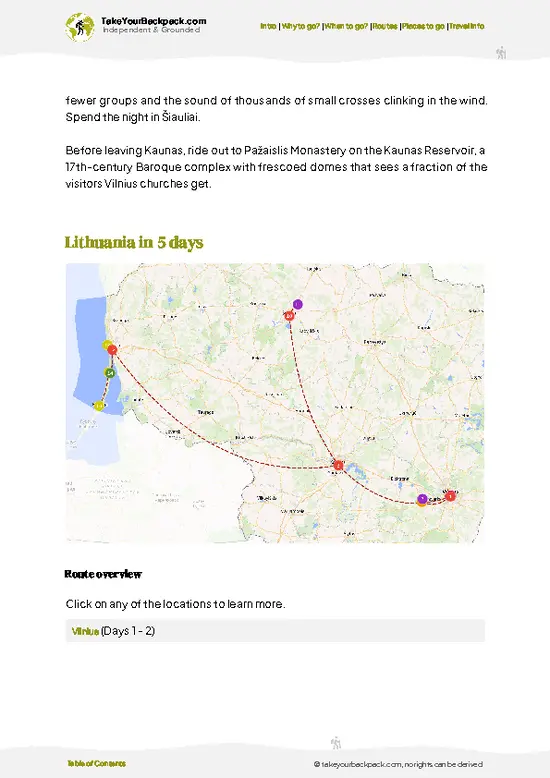
This five-day loop suits travelers who want Lithuania’s full sweep in under a week: the capital, the lake castle, the interwar second city, the cross-covered hill and the Baltic dunes. The pace is steady rather than rushed, with three bases and only one longer travel day. You’ll use regional trains, intercity buses, a local bus out to the Hill of Crosses, the Klaipėda passenger ferry and the Smiltynė to Nida bus along the spit.
Days 1-2: Vilnius and Trakai
Start in
Vilnius on foot. Climb the
Vilnius Cathedral Bell Tower first thing, when the light hits the Old Town’s red roofs and church domes, then wander east across the little Vilnia river into
Užupis. The self-declared “republic” posts its tongue-in-cheek constitution on Paupio street in dozens of languages, and the
Užupis Art Incubator and Gallery Spaces show what local artists are actually making right now, from prints to installations. Save late afternoon for the
MO Museum, a white Daniel Libeskind building whose collection of Lithuanian …
read more 👉This five-day loop suits travelers who want Lithuania’s full sweep in under a week: the capital, the lake castle, the interwar second city, the cross-covered hill and the Baltic dunes. The pace is steady rather than rushed, with three bases and only one longer travel day. You’ll use regional trains, intercity buses, a local bus out to the Hill of Crosses, the Klaipėda passenger ferry and the Smiltynė to Nida bus along the spit.
Days 1-2: Vilnius and Trakai
Start in Vilnius on foot. Climb the Vilnius Cathedral Bell Tower first thing, when the light hits the Old Town’s red roofs and church domes, then wander east across the little Vilnia river into Užupis. The self-declared “republic” posts its tongue-in-cheek constitution on Paupio street in dozens of languages, and the Užupis Art Incubator and Gallery Spaces show what local artists are actually making right now, from prints to installations. Save late afternoon for the MO Museum, a white Daniel Libeskind building whose collection of Lithuanian art from the 1960s onward explains more about the Soviet decades than many history displays.
Day two is a half-day hop to Trakai, 30 to 40 minutes by train or bus. Cross the wooden footbridges to the Trakai Island Castle Museum, a red-brick fortress sitting in Lake Galvė, then walk or rent a bike for the loop around the lake to Užutrakis Manor, the Tyszkiewicz family’s neoclassical estate with a formal park and a view straight back at the castle that the tour groups mostly miss. Eat kibinai, the meat-filled pastries of the Karaim community, before heading back to Vilnius for a second night.Day 3: Kaunas
The train to Kaunas takes about 1 hour 15 minutes, so you arrive with a full day ahead. Head for the Devil’s Museum, where painter Antanas Žmuidzinavičius’s collection has grown to over 3,000 devils carved, painted and sculpted from around the world; it’s funny, slightly unhinged and very Lithuanian. Then walk the length of Laisvės alėja, look up at the interwar modernist facades from the years Kaunas served as capital, and ride the old Aleksotas funicular for sunset over the river confluence.Day 4: Hill of Crosses to Klaipėda
This is the one long travel day, and it pays off. Take the morning train to Šiauliai (about 2 hours), then a local bus toward Joniškis to the Domantai stop, followed by a 2 km walk, or a taxi for roughly €10 to 15 each way. The Hill of Crosses Monument Complex holds well over 100,000 crosses, rosaries and carvings, rattling quietly in the wind; Soviet authorities bulldozed it several times and locals kept bringing crosses back. Allow 1 to 2 hours, then catch the train on to Klaipėda (about 2 hours). If you have energy left, a city bus gets you to Melnragė Beach in 15 to 20 minutes for a sunset walk along the north pier.Day 5: Curonian Spit
Spend the final day on the Curonian Spit National Park, a thin strip of pine forest and shifting sand between the Baltic and the Curonian Lagoon. The passenger ferry from Klaipėda’s Old Town crosses to Smiltynė in about 10 minutes, and buses run down the spit to Nida in about an hour. Hop off at Juodkrantė Beach for the Hill of Witches, a forest trail lined with wooden folk carvings of devils and spirits, plus a heron and cormorant colony that you hear before you see. Continue to Nida, climb the Parnidis Dune for views across sand toward the Russian border, and finish on the wide, pale sand of Nida Beach before the evening bus and ferry back to Klaipėda. Buses run roughly hourly in summer and much less often from October to April, so check the last departure.
With an extra day, head west of Šilutė to Ventė Cape, a lighthouse-tipped point on the lagoon where one of Europe’s oldest bird-ringing stations nets migrating birds every spring and autumn.
 Best Backpacking


