×

Madagascar🇲🇬 | citiesMahajangaBoulevard Marcony, sacred baobab, Tanambao shopfronts, Amborovy sand | things to do and best time to go

Explore FianarantsoaExplore Ambatondrazaka

Backpacking in Mahajanga
🌟 Highlightcity ranked #3
By Johan Kruseman 🇳🇱 | Updated October 16, 2026

Choosing between a bed in the old center and one along the Amborovy beach strip tips on how much you care about walking to dinner. The center costs you nothing in transit and puts you near the market and the seafront, while Amborovy buys quieter sand and costs time and moto-taxi rides every evening, so for a backpacker the center wins. Mahajanga sits on the northwest coast of Madagascar, where the Betsiboka river meets the Mozambique Channel. Evenings smell of charcoal and salt. I once ate a zebu skewer from a boulevard grill, still hot and smoky with a little chili paste, plus a fresh coconut hacked open in front of me, for about 3,000 Ariary (roughly US$0.65). Pousse-pousse bells clink behind you as you chew. The city is hot, a bit worn and slow, and the roads out are long. Beach-and-food travelers will love it most, while anyone wanting polished sights or fast transit won’t.

Discover everything you want to know in the 📖 Madagascar Travel Guide.


example page 0 from our offline Travel Guide for Madagascar
example page 1 from our offline Travel Guide for Madagascar
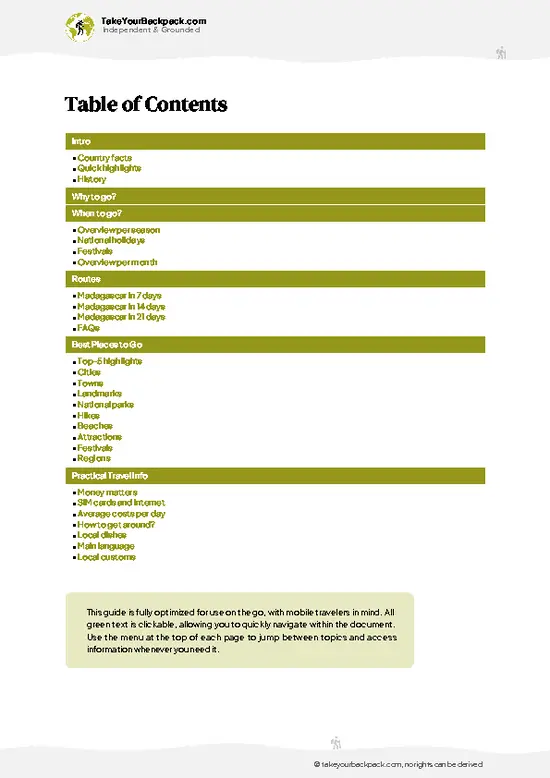
example page 2 from our offline Travel Guide for Madagascar
example page 3 from our offline Travel Guide for Madagascar
example page 4 from our offline Travel Guide for Madagascar
example page 5 from our offline Travel Guide for Madagascar
example page 6 from our offline Travel Guide for Madagascar
example page 7 from our offline Travel Guide for Madagascar
Loading the map 🌍
CLICK TO FILTER
cities
towns
landmarks
national parks
hikes
beaches
attractions
festivals
regions
SHOW COUNTRY’S BESTSHOW ALL

✨ Why go?
Ranked #3 city in Madagascar
What makes it a must-see city

Backpackers come to Mahajanga because it is the easy place to stop on the long haul between the highlands and the northwest, and the town has its own personality. The coast here carries a strong Swahili, Comorian and Indian flavor, so you eat differently than in the capital: grilled seafood, samosa-like street snacks and coconut ice cream, all within walking distance of the seafront. The old center is flat enough to cover on foot or by the city’s pedal-powered rickshaws, and hostels and small guesthouses are easy to find without booking weeks ahead. Mahajanga also works as a base for Ankarafantsika National Park and the Cirque Rouge formations, so you can spend a few nights here and fan out. Sunset along the Boulevard Marcony is the daily social event. It suits slow travelers who like salty … read more 👉
Backpackers come to Mahajanga because it is the easy place to stop on the long haul between the highlands and the northwest, and the town has its own personality. The coast here carries a strong Swahili, Comorian and Indian flavor, so you eat differently than in the capital: grilled seafood, samosa-like street snacks and coconut ice cream, all within walking distance of the seafront. The old center is flat enough to cover on foot or by the city’s pedal-powered rickshaws, and hostels and small guesthouses are easy to find without booking weeks ahead. Mahajanga also works as a base for Ankarafantsika National Park and the Cirque Rouge formations, so you can spend a few nights here and fan out. Sunset along the Boulevard Marcony is the daily social event. It suits slow travelers who like salty air and street food, and it works poorly as a rushed one-night stop because the trip in and out takes real time.

💡 HighlightsThe experiences that define the visit

  1. Boulevard Marcony: The seafront promenade is where the town gathers at dusk, with grilled skewers, coconut vendors and the Mozambique Channel turning orange. Come from about 5 PM, free, plan 1 to 2 hours.
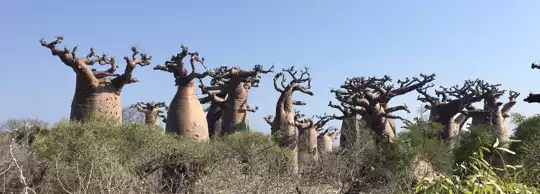
  2. Baobab Sacré (Grand Baobab): An enormous, centuries-old baobab in the Mahabibo area with a trunk wide enough that several people can’t circle it, still used for local offerings. Best in the morning or late afternoon light, small donation or fee of about 2,000 to 5,000 Ariary (US$0.50 to 1), 20 to 30 minutes.
  3. Marché Be: The main market runs on fish, spices, vanilla, cloth and piles of tropical fruit, and is the best place to see everyday coastal commerce. Go before 10 AM when it is freshest, free to wander, 1 hour.
  4. Akiba Museum: A small museum on the region’s history and Sakalava culture, helpful
… read more 👉
  1. Boulevard Marcony: The seafront promenade is where the town gathers at dusk, with grilled skewers, coconut vendors and the Mozambique Channel turning orange. Come from about 5 PM, free, plan 1 to 2 hours.
  2. Baobab Sacré (Grand Baobab): An enormous, centuries-old baobab in the Mahabibo area with a trunk wide enough that several people can’t circle it, still used for local offerings. Best in the morning or late afternoon light, small donation or fee of about 2,000 to 5,000 Ariary (US$0.50 to 1), 20 to 30 minutes.
  3. Marché Be: The main market runs on fish, spices, vanilla, cloth and piles of tropical fruit, and is the best place to see everyday coastal commerce. Go before 10 AM when it is freshest, free to wander, 1 hour.
  4. Akiba Museum: A small museum on the region’s history and Sakalava culture, helpful for context before you head inland. Open on weekdays and some weekend hours, entry roughly 5,000 to 10,000 Ariary (US$1 to 2), 45 minutes.
  5. Amborovy Beach: A wide sandy stretch just north of the center with shallow water and beach shacks serving fresh fish. Best on weekday mornings before the crowds, free to enter, 2 to 3 hours.
  6. Pousse-pousse ride through Tanambao: The old quarter has weathered Indian and Comorian shopfronts and carved doors, best seen at a rickshaw’s pace. Go in the morning, expect about 2,000 to 4,000 Ariary (US$0.45 to 0.90) per ride, 1 hour.
Day trips from the city include Ankarafantsika National Park for lemurs and dry forest, the red eroded amphitheater of Cirque Rouge, the Lovers’ Baobabs and the coastal village of Katsepy across the bay. For a first visit, the Boulevard Marcony at sunset is the one to prioritize.
Spotted a mistake or missing something? Contact us.

🏘️ NeighborhoodsUnderstanding the local layout

Mahajanga sprawls along a flat curve of the Betsiboka estuary mouth, and almost everything a backpacker wants sits within a few kilometers of the seafront. Here is how the areas compare.
  • Corniche and Boulevard Marcoany: The seafront promenade is where the town breathes after 5 pm, with grilled skewers smoking on the sand side, joggers, and sunsets that turn the bay copper. It is free, flat and walkable end to end, and it gives you the best atmosphere for the least effort.
  • Mahabibo and the center: Banyan-shaded streets, the old baobab (the huge Grand Baobab stands on the road to Amborovy), the main market, and shops selling spices and cheap fabric. Mornings are loud with taxi horns and vendors. Walk it early, before the heat flattens you.
  • Tsararano and Mahabibo's old quarter: Faded colonial and
… read more 👉
Mahajanga sprawls along a flat curve of the Betsiboka estuary mouth, and almost everything a backpacker wants sits within a few kilometers of the seafront. Here is how the areas compare.
  • Corniche and Boulevard Marcoany: The seafront promenade is where the town breathes after 5 pm, with grilled skewers smoking on the sand side, joggers, and sunsets that turn the bay copper. It is free, flat and walkable end to end, and it gives you the best atmosphere for the least effort.
  • Mahabibo and the center: Banyan-shaded streets, the old baobab (the huge Grand Baobab stands on the road to Amborovy), the main market, and shops selling spices and cheap fabric. Mornings are loud with taxi horns and vendors. Walk it early, before the heat flattens you.
  • Tsararano and Mahabibo's old quarter: Faded colonial and Indo-Arab facades, carved wooden doors, and mosques with calls to prayer that carry over tin roofs. Compact and good on foot, with quiet side lanes where the smell of frying mofo gasy hangs in the morning.
  • Amborovy: A beach strip about 8 to 10 km northeast, near the airport, with calmer sand and a handful of beachside bars. Reaching it takes a tuk-tuk or taxi-be, so go for an afternoon, not as a base for sightseeing.
  • Fiherenana and Antanimasaja: Residential, dusty and local, with cheap eateries and little tourist traffic. Interesting for a single wander, but not worth a long detour.

⌛️ 1 dayWhat you can realistically do in a day

7:30 AM: Baobab Sacré, Mahabibo Start early while the air is cool. The tree is huge and quiet this time of day, and local visitors still leave offerings. Take a pousse-pousse or short moto-taxi ride to the center afterward.

9:00 AM: Marché Be Walk the aisles for fish, vanilla, spices and fruit. Eat a fresh breakfast of samosas or fried dough from a stall and then continue on foot toward the old quarter, which is a few minutes away.

11:00 AM: Tanambao old quarter This quieter district, away from the standard tourist loop, has narrow lanes, old Indian and Comorian shopfronts and carved doors. Wander slowly, say hello to people sitting out front and stop for a cold drink in the shade.

1:00 PM: Lunch near the center Pick a simple restaurant for grilled fish or zebu with rice and coconut sauce. This … read more 👉
7:30 AM: Baobab Sacré, Mahabibo Start early while the air is cool. The tree is huge and quiet this time of day, and local visitors still leave offerings. Take a pousse-pousse or short moto-taxi ride to the center afterward.

9:00 AM: Marché Be Walk the aisles for fish, vanilla, spices and fruit. Eat a fresh breakfast of samosas or fried dough from a stall and then continue on foot toward the old quarter, which is a few minutes away.

11:00 AM: Tanambao old quarter This quieter district, away from the standard tourist loop, has narrow lanes, old Indian and Comorian shopfronts and carved doors. Wander slowly, say hello to people sitting out front and stop for a cold drink in the shade.

1:00 PM: Lunch near the center Pick a simple restaurant for grilled fish or zebu with rice and coconut sauce. This is the best time to rest indoors before the afternoon.

2:30 PM: Akiba Museum Spend an hour on the local history and Sakalava culture, which gives meaning to what you saw in the morning. Afterward, take a taxi or moto to the beach.

4:00 PM: Amborovy Beach Swim and walk in the shallow water, then buy a grilled snack from one of the beach shacks. Head back toward the center as the light softens.

5:45 PM: Boulevard Marcony End on the seafront promenade. Find a spot on the wall for sunset over the channel, then eat skewers and drink fresh coconut as the lights come on and the evening crowd arrives.

🌤️ When to go?Seasonal considerations and timing

The dry months of May to October suit Mahajanga best, with almost no rain and sunny days that rarely feel punishing.
  • Cool Dry Season (May to August): Days reach 29 to 31°C (84 to 88°F) and nights drop to about 18 to 20°C (64 to 68°F). Daylight runs roughly 11 to 12 hours. This is peak time for travelers, so rooms and flights fill and prices climb.
  • Hot Dry Season (September to November): Highs of 31 to 34°C (88 to 93°F), with sea breezes and fewer people. Good value, and the water is warm for swimming.
  • Rainy Season (December to March): Hot and sticky at 32 to 35°C (90 to 95°F) with heavy afternoon downpours, and cyclone risk from January to March. Roads to the interior can turn to mud, but rates drop sharply.
  • Shoulder Weeks (April): Rains fade and the town quiets down, a decent compromise.
Book … read more 👉
The dry months of May to October suit Mahajanga best, with almost no rain and sunny days that rarely feel punishing.
  • Cool Dry Season (May to August): Days reach 29 to 31°C (84 to 88°F) and nights drop to about 18 to 20°C (64 to 68°F). Daylight runs roughly 11 to 12 hours. This is peak time for travelers, so rooms and flights fill and prices climb.
  • Hot Dry Season (September to November): Highs of 31 to 34°C (88 to 93°F), with sea breezes and fewer people. Good value, and the water is warm for swimming.
  • Rainy Season (December to March): Hot and sticky at 32 to 35°C (90 to 95°F) with heavy afternoon downpours, and cyclone risk from January to March. Roads to the interior can turn to mud, but rates drop sharply.
  • Shoulder Weeks (April): Rains fade and the town quiets down, a decent compromise.
Book transport out of town a few days ahead during July and August, and again around school holidays.


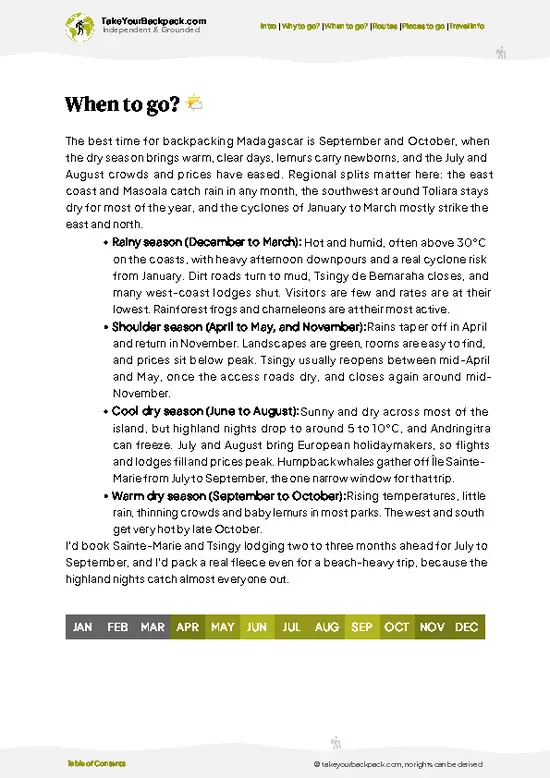
source: climatestotravel.comJANJanuary: fair for travelingFEBFebruary: fair for travelingMARMarch: fair for travelingAPRApril: highly recommended for travelingMAYMay: excellent for travelingJUNJune: excellent for travelingJULJuly: excellent for travelingAUGAugust: excellent for travelingSEPSeptember: excellent for travelingOCTOctober: highly recommended for travelingNOVNovember: fair for travelingDECDecember: fair for traveling
when-to-go

✈️ The backpacker research shortcutMadagascar Travel Guide

An offline-friendly backpacking guide with optimized travel routes, ranked highlights, transport advice, and the best areas to stay.
example page 0 from our offline Travel Guide for Madagascar
example page 1 from our offline Travel Guide for Madagascar
example page 2 from our offline Travel Guide for Madagascar
example page 3 from our offline Travel Guide for Madagascar
example page 4 from our offline Travel Guide for Madagascar
example page 5 from our offline Travel Guide for Madagascar
example page 6 from our offline Travel Guide for Madagascar
example page 7 from our offline Travel Guide for Madagascar
The digital guide (305 pages) contains:
✅ 96 highlights, ranked by travel appeal
✅ Optimized 7, 14 & 21-day travel routes
✅ Cities, national parks, landmarks, beaches
✅ How to get around
✅ Offline-friendly for travel without Wi-Fi
👉 Click to see all 30+ guide features

📅 Plan smarter in minutes, not weeks
✅ Month by month travel advice
✅ Festivals & national holidays
✅ Budget expectations

🗺️ Go to the right places, skip the overrated ones
✅ Honest pros & cons of destinations
✅ Top hikes, parks & viewpoints
✅ Lesser-known places most travelers miss
✅ Clear “worth it vs skip it” guidance

🛏️ Travel smoothly without rookie mistakes
✅ Best areas to stay
✅ Transport systems explained simply
✅ Common scams & safety advice
✅ SIM cards, money & practical tips

🌍 Understand the country, not just visit it
✅ Culture & traditions
✅ 52 Essential phrases & customs
✅ Festivals worth planning around
✅ Traveler-friendly historical context
✅ Insights that make places more meaningful

📱 Built for real travel conditions
✅ Fully downloadable PDF
✅ Works completely offline
✅ Optimized for phone use
✅ Useful in remote areas & buses
✅ Everything in one place
Stop searching, start planning
Get instant access to your full guide. 30‑day money-back guarantee.
+ Add another guide for just

By proceeding you agree to our terms.
Sent to your inbox immediately after payment • 100% Secure Checkout
Best Backpacking Travel Advisor 2025 tourism awardBest Backpacking
Travel Advisor
2025
What others say about Take Your Backpack Guides:
⭐⭐⭐⭐⭐
Fantastic, amazing amount of information!
⭐⭐⭐⭐⭐
My goodness this is amazing, it's what I've been looking for hats off too you!
⭐⭐⭐⭐⭐
I think this is absolutely BRILLIANT
⭐⭐⭐⭐
Very complete and informative. It's still missing places, but I gotta to commend you
⭐⭐⭐⭐⭐
This is truly amazing, thank you, can't wait to explore it with my kids!
⭐⭐⭐⭐⭐
Awesome resource, thank you!
⭐⭐⭐⭐⭐
This is amazing! Can't wait to explore the ones I haven't seen
⭐⭐⭐⭐
I love this! Well done, great idea.
⭐⭐⭐⭐⭐
Thanks for taking the time to make this gem!
⭐⭐⭐⭐⭐
This might be the best website I've ever seen.
⭐⭐⭐⭐⭐
Congratulations, and thank you so much for your work; it's incredibly valuable.
⭐⭐⭐⭐
In all seriousness I think you did a great job pointing out the important spots
⭐⭐⭐⭐⭐
10/10 very good
⭐⭐⭐⭐⭐
As someone who's only just starting to visit regularly this is awesome, thank you.
⭐⭐⭐⭐
Thank you very much! I'm going to visit my dad, it's going to be very useful!
⭐⭐⭐⭐⭐
This is really cool! We'll be travelling for the first time and this definitely come in handy.
⭐⭐⭐⭐⭐
You are now our minister of culture, congratulations 👨‍💼
⭐⭐⭐⭐⭐
Just wanted to tell you that this is a pearl! Going to follow your recommendations.
⭐⭐⭐⭐⭐
This is so cool. I'll definitely be using the resource for my travels soon.
⭐⭐⭐⭐⭐
This is very impressive! Good work.
⭐⭐⭐⭐⭐
This is an amazing and informative site. Very well done!

🛏️ Where to stay?Best areas to stay in Madagascar

The center near the Corniche and around Mahabibo is the best area for a budget bed, with the widest choice of guesthouses and a few dorm-style options at roughly US$8 to 15 a night.
It keeps you within a short walk of the market, the seafront eateries, and the taxi-be and tuk-tuk stands, so you rarely need a ride. The streets are lit and busy until about 9 or 10 pm, and walking back after dinner is comfortable, though a pousse-pousse is smarter after that. Noise is the main downside. Roosters, call to prayer, and bar music near the waterfront can start early and end late, so ask for a room away … read more 👉
The center near the Corniche and around Mahabibo is the best area for a budget bed, with the widest choice of guesthouses and a few dorm-style options at roughly US$8 to 15 a night.
It keeps you within a short walk of the market, the seafront eateries, and the taxi-be and tuk-tuk stands, so you rarely need a ride. The streets are lit and busy until about 9 or 10 pm, and walking back after dinner is comfortable, though a pousse-pousse is smarter after that. Noise is the main downside. Roosters, call to prayer, and bar music near the waterfront can start early and end late, so ask for a room away from the street and bring earplugs.
The second option is the Amborovy beach strip, 8 to 10 km out. It is calmer, with sea breezes at night and a few simple beach bungalows, but dorm beds are scarce and you depend on tuk-tuks for food and transport. It works if you want a couple of beach days. Book ahead from June to August, when budget rooms in the center fill up first.

🚌 Getting aroundMoving around without the hassle

A ride in a pousse-pousse (a bicycle or hand-pulled rickshaw cart) within the center costs roughly 2,000 to 4,000 Ariary (about US$0.50 to 1), paid in cash and agreed before you climb in. Bring small notes, since drivers rarely have change for 20,000.
Mahajanga is flat, hot and compact, and most visitors combine walking with short rides. Traffic is light compared with Antananarivo, though dust and motorbike fumes settle over the main avenues at midday.
  • Walking: Free, and the best choice along the seafront and through the old quarter. Start before 9 am or after 4 pm, as the midday sun hits hard and shade is patchy.
  • Pousse-pousse: Slow, open to the breeze, and good for short hops of one or two kilometers. Expect to pay 2,000 to 5,000 Ariary depending on distance and bargaining. It is the cheapest
… read more 👉
A ride in a pousse-pousse (a bicycle or hand-pulled rickshaw cart) within the center costs roughly 2,000 to 4,000 Ariary (about US$0.50 to 1), paid in cash and agreed before you climb in. Bring small notes, since drivers rarely have change for 20,000.
Mahajanga is flat, hot and compact, and most visitors combine walking with short rides. Traffic is light compared with Antananarivo, though dust and motorbike fumes settle over the main avenues at midday.
  • Walking: Free, and the best choice along the seafront and through the old quarter. Start before 9 am or after 4 pm, as the midday sun hits hard and shade is patchy.
  • Pousse-pousse: Slow, open to the breeze, and good for short hops of one or two kilometers. Expect to pay 2,000 to 5,000 Ariary depending on distance and bargaining. It is the cheapest comfortable way to cross town with a backpack.
  • Tuk-tuk (bajaj): Faster and louder than a pousse-pousse, about 3,000 to 8,000 Ariary for most trips, and about 10,000 to 15,000 Ariary to Amborovy. Hold on to your bag on potholed stretches. For distance, this gives you the best value for money.
  • Taxi-be (minibus): Crowded, hot, and cheap at roughly 500 to 1,000 Ariary a ride, with services running from about 6 am to early evening. Routes are shouted by the conductor rather than posted, so ask the driver where it goes. It suits you if you have time and patience.
  • Taxi: Metered rides are rare, so agree a price first. Expect 10,000 to 20,000 Ariary for a cross-town ride, and more at night. Worth it for the airport or when arriving after dark.

👛 Costs (as of 16 October 2026)Typical daily expenses

Backpacking in Mahajanga costs roughly US$24 to 53 a day, with dorm or basic room accommodation being the biggest expense.
CategoryBudget RangeLocal Reality
Dorm accommodation (high season)US$8 to 15Basic guesthouse beds or fan rooms from June to August
Dorm accommodation (off-season)US$6 to 12Easier to bargain, more availability
MealsUS$6 to 12Grill stalls and local eateries, with seafood at the pricier end
Local transportUS$2 to 5Pousse-pousse, tuk-tuks and taxi-be rides
City transport passNot availablePay per ride in cash
Basic activities/entry feesUS$5 to 15Cirque Rouge fee or the Katsepy boat, with Ankarafantsika costing more
MiscellaneousUS$3 to 6Water, snacks, SIM data
Total Daily BudgetUS$24 to 53Based on the high-season bed
Eat at the seafront grills and market stalls rather than tourist restaurants, … read more 👉
Backpacking in Mahajanga costs roughly US$24 to 53 a day, with dorm or basic room accommodation being the biggest expense.
CategoryBudget RangeLocal Reality
Dorm accommodation (high season)US$8 to 15Basic guesthouse beds or fan rooms from June to August
Dorm accommodation (off-season)US$6 to 12Easier to bargain, more availability
MealsUS$6 to 12Grill stalls and local eateries, with seafood at the pricier end
Local transportUS$2 to 5Pousse-pousse, tuk-tuks and taxi-be rides
City transport passNot availablePay per ride in cash
Basic activities/entry feesUS$5 to 15Cirque Rouge fee or the Katsepy boat, with Ankarafantsika costing more
MiscellaneousUS$3 to 6Water, snacks, SIM data
Total Daily BudgetUS$24 to 53Based on the high-season bed
Eat at the seafront grills and market stalls rather than tourist restaurants, and you will cut your food bill by about half.
⚠️ Prices can change and everyone travels differently, so take this as a rough guide. Hope it helps you plan your adventure!

🚌 Day tripsWhere to go beyond the main area

Mahajanga works well as a base for short outings by road or boat, though most worthwhile trips need an early start and cash in hand.Cirque Rouge: Red and white eroded sandstone formations with sharp ridges, reached by a 30 to 45 minute drive on a rough track northeast of town. A shared taxi or tuk-tuk round trip runs about 40,000 to 70,000 Ariary, plus an entrance fee of around 10,000 Ariary, and a local guide helps. Go in the late afternoon when the colors deepen, and avoid the rainy months when the track floods.
Ankarafantsika National Park: About 115 km southeast along RN4, roughly 2.5 to 3 hours by taxi-brousse at 15,000 to 25,000 Ariary each way. Park entry plus a guide for a short walk is about 65,000 to 100,000 Ariary. You can see Coquerel’s sifakas, and the lake at Ampijoroa is good … read more 👉
Mahajanga works well as a base for short outings by road or boat, though most worthwhile trips need an early start and cash in hand.Cirque Rouge: Red and white eroded sandstone formations with sharp ridges, reached by a 30 to 45 minute drive on a rough track northeast of town. A shared taxi or tuk-tuk round trip runs about 40,000 to 70,000 Ariary, plus an entrance fee of around 10,000 Ariary, and a local guide helps. Go in the late afternoon when the colors deepen, and avoid the rainy months when the track floods.
Ankarafantsika National Park: About 115 km southeast along RN4, roughly 2.5 to 3 hours by taxi-brousse at 15,000 to 25,000 Ariary each way. Park entry plus a guide for a short walk is about 65,000 to 100,000 Ariary. You can see Coquerel’s sifakas, and the lake at Ampijoroa is good for birds and crocodiles. Many first-timers arrive too late, so catch a 5 am departure, and note that returning the same day is tight. The dry season gives the best wildlife viewing.
👉 Explore Ankarafantsika National ParkKatsepy and the Lighthouse: A short boat ride across the estuary, 45 minutes to 1 hour, costs around 5,000 to 10,000 Ariary each way on a public boat. Katsepy has a small lighthouse, sandy beaches and a sleepy village feel. The common mistake is missing the last boat back, so confirm the final departure time. Best from May to October.
Grand Baobab and Amborovy Beach: A short ride out of town to a huge baobab near the road to the airport, ideal at sunset, then continue to Amborovy for a drink on the sand. Budget about 10,000 to 25,000 Ariary by tuk-tuk and little more for food.

🍲 FoodLocal Flavors for Backpackers

Mahajanga’s coastal position gives it a seafood-heavy table, with grilled fish, prawns and crab in coconut sauces that taste different from the highland rice-and-zebu plates. Look for zebu skewers and sambos as well, but the real specialty is the town’s Indian and Comorian influence, seen in samosas, mahamay-style spiced bites and sweet coconut sweets sold by street vendors.
The seafront at dusk is the social heart of eating. Grill stalls along the Corniche sell fish and skewers for about 5,000 to 15,000 Ariary, with a squeeze of lime and a smoky edge. The central market is the place for fresh mangoes, lychees (in season), cashews and spiced snacks, and mornings bring mofo gasy, rice-flour cakes cooked in iron pans.
For drinks, try fresh coconut water from a cart, THB beer in a beachfront bar, … read more 👉
Mahajanga’s coastal position gives it a seafood-heavy table, with grilled fish, prawns and crab in coconut sauces that taste different from the highland rice-and-zebu plates. Look for zebu skewers and sambos as well, but the real specialty is the town’s Indian and Comorian influence, seen in samosas, mahamay-style spiced bites and sweet coconut sweets sold by street vendors.
The seafront at dusk is the social heart of eating. Grill stalls along the Corniche sell fish and skewers for about 5,000 to 15,000 Ariary, with a squeeze of lime and a smoky edge. The central market is the place for fresh mangoes, lychees (in season), cashews and spiced snacks, and mornings bring mofo gasy, rice-flour cakes cooked in iron pans.
For drinks, try fresh coconut water from a cart, THB beer in a beachfront bar, and the local rhum arrangé, rum infused with fruit and spices. Evenings are slow and social, with plastic chairs pulled up to the sea breeze.

🛡️ SafetySafety Tips and Common Scams in Mahajanga

Mahajanga is generally relaxed, and most problems are petty theft and persistent touts rather than anything violent. Phones and cameras are the usual targets on the Corniche and around the market, so keep them in a front pocket or a zipped bag, and leave valuables at your guesthouse. After dark the seafront is lively until about 9 pm, but side streets and the beach are poorly lit, so take a tuk-tuk or pousse-pousse rather than walking home alone with a bag. Solo travelers, including women, usually get friendly attention, though persistent offers of guiding or souvenirs can wear thin. A calm no and a smile work. Agree prices before every ride to avoid inflated fares, and carry small notes. Swim only where locals do, since currents can pull near the river mouth, and avoid the estuary because … read more 👉
Mahajanga is generally relaxed, and most problems are petty theft and persistent touts rather than anything violent. Phones and cameras are the usual targets on the Corniche and around the market, so keep them in a front pocket or a zipped bag, and leave valuables at your guesthouse. After dark the seafront is lively until about 9 pm, but side streets and the beach are poorly lit, so take a tuk-tuk or pousse-pousse rather than walking home alone with a bag. Solo travelers, including women, usually get friendly attention, though persistent offers of guiding or souvenirs can wear thin. A calm no and a smile work. Agree prices before every ride to avoid inflated fares, and carry small notes. Swim only where locals do, since currents can pull near the river mouth, and avoid the estuary because of sharks and crocodiles upstream. Stick to bottled water.

FAQTraveler FAQ

Two to three days is enough for Mahajanga. That covers the Corniche, the market and the old quarter on day one, Cirque Rouge or the Katsepy boat on day two, and an optional third day for Ankarafantsika National Park, about 2.5 to 3 hours away by road.
Mahajanga is generally safe for solo backpackers, with petty theft the main concern. Keep phones out of sight on the Corniche, take a tuk-tuk (about 3,000 to 8,000 Ariary) after dark rather than walking side streets, and agree fares before riding.
Mahajanga is known for its sunset seafront, its giant baobab near Amborovy, and its Indo-Arab and Comorian influence in food and architecture. The town also serves as the gateway to the Cirque Rouge formations and Ankarafantsika National Park, home to Coquerel’s sifakas.
⚠️ Things can change over time, so always validate details locally before you go.

Other Malagasy cities near Mahajanga

Explore more nearby:

  • Ambatondrazaka—Lake Alaotra base, rice-grade market, paddy dikes, tilapia grills| 324 km away
  • Antananarivo—Analakely steps, Rova hilltop, Andravoahangy crafts, tin-roof views| 377 km away
  • Antsirabe—Colonial station, rickshaw loops, horn workshops, thermal spa| 468 km away

💡 Not sure where to go next?
Create a personalized itinerary for Madagascar including Mahajanga and the places that fit your trip.

Generate my itinerary

👉 Discover all cities

Or checkout all Madagascar has to offer (think cities, towns, villages, national parks, hikes, beaches, festivals)
Country photo of Madagascar

We 💚 feedbackSumming up the experience

Most first-timers rush to the beach and skip Tanambao, the old quarter with its Comorian and Indian-built shopfronts and carved doors. I’d spend a slow morning there before the heat builds, then take the pousse-pousse back. Mahajanga is not polished, but the layers show if you look.

✈️ When did I visit Madagascar?
Madagascar I went backpacking in October 2019. With a friend I rented a 4WD and drove around the southern part of Madagascar.

✍️ Help improve this page!
The information on this page is based on my own backpacking experience in Madagascar, supplemented with up-to-date research and feedback from other travelers. Travel details can change, so if you notice anything outdated or incomplete, feel free to let me know.


🙋‍♂️ Give feedback

👋 Meet the founderWho’s Behind Take Your Backpack?

Johan, backpacker and founder of TakeYourBackpackHi, I’m Johan (Netherlands 🇳🇱), the creator of TakeYourBackpack. Over the past 3 decades, I’ve backpacked through 90+ countries across six continents, gaining extensive experience with independent travel, long-term trips, and overland routes.

This site is built on a combination of firsthand travel experience and carefully curated insights from other backpackers. Many guides are based on places I’ve personally visited, while others bring together tips, observations, and practical advice shared by trusted travelers I’ve met along the way.

The goal is to provide realistic, experience-driven guidance — not generic itineraries — so you can explore destinations with better context, clearer expectations, and more confidence.