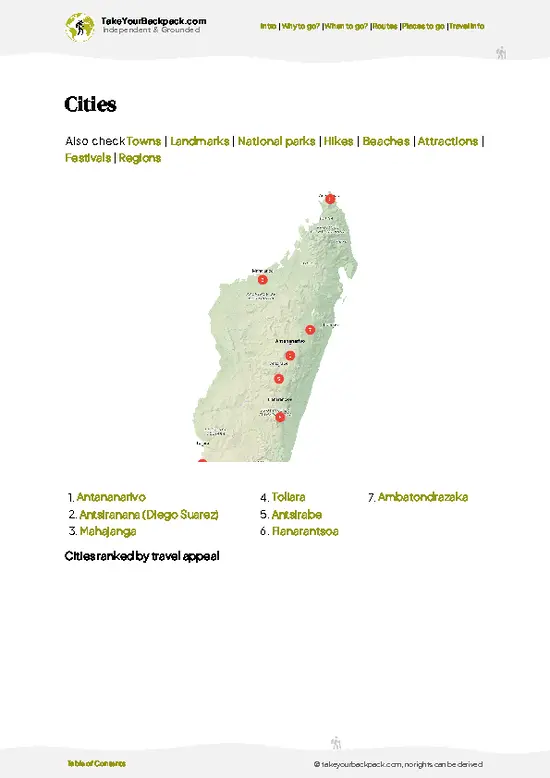
How many cities to visit: I advise
three to four cities on a first trip. Roads are slow, taxi-brousse seats are cramped, and every transfer eats most of a day, so more stops mean more time looking out of a window at red earth and rice paddies. Three or four lets you spend two or three nights in each, long enough to learn a market, find a favorite food stall and hear the evening sounds of a street settle.
Choosing the kind of city: Pick by travel style. If you like cooler air, steep alleys, brick houses and colonial and royal history, favor
highland towns, where mornings smell of woodsmoke and fresh bread. If you want sea air, beach evenings and seafood grilled on the street, favor
coastal towns, which are hotter, slower and easier to relax in. If wildlife and landscapes are your main goal, …
read more 👉 How many cities to visit: I advise
three to four cities on a first trip. Roads are slow, taxi-brousse seats are cramped, and every transfer eats most of a day, so more stops mean more time looking out of a window at red earth and rice paddies. Three or four lets you spend two or three nights in each, long enough to learn a market, find a favorite food stall and hear the evening sounds of a street settle.
Choosing the kind of city: Pick by travel style. If you like cooler air, steep alleys, brick houses and colonial and royal history, favor
highland towns, where mornings smell of woodsmoke and fresh bread. If you want sea air, beach evenings and seafood grilled on the street, favor
coastal towns, which are hotter, slower and easier to relax in. If wildlife and landscapes are your main goal, treat a city as a practical base: a place to arrange guides, buy supplies and rest before heading out. Culture-focused travelers will get the most from markets, craft quarters and local museums, which give a direct feel for daily life.
What it costs: Budget about
US$20 to 35 a day at backpacker level, which covers a simple room (roughly US$6 to 15), local meals at US$1.50 to 4, and short city rides. A mid-range day runs US$45 to 80. Museums and historic sites usually charge small fees, often US$1 to 5, and a local guide for a few hours costs around US$10 to 25. Short rides by taxi or pousse-pousse run about US$0.50 to 3. Long taxi-brousse legs cost roughly US$5 to 20, while private cars can reach US$60 to 120 a day with fuel and driver. Prices are quoted in ariary, so carry small notes, because change is scarce and ATMs in smaller towns are unreliable. Cash from larger-city machines is the safer plan.
Safety on the street: Petty theft is the main concern, especially in busy markets, bus stations and after dark. Keep phones and cameras out of sight, carry only the cash you need, and avoid walking alone on unlit streets at night. Taxis are the safer choice after sunset, and your guesthouse can call a trusted driver. In crowded spots, a zipped bag worn in front gives peace of mind while you browse stalls of spices, vanilla and woven baskets.
Local etiquette: Madagascar has strong
fady, local taboos that vary by region and community. These can cover certain foods, days, places or behaviors, and your guide or host can tell you what applies. Greet people with a hello before asking anything, dress modestly in towns, and ask before photographing people, since many refuse or expect a small thank-you. Pointing at sacred places or tombs with a finger is considered rude, so use an open hand. Bargaining is normal in markets, but keep it friendly and light.
Health and practical notes: Drink bottled or filtered water, and be careful with raw salads and ice outside well-run places. Street snacks such as hot, freshly fried samosas and mofo gasy are usually safe when cooked in front of you and served hot. Carry a headlamp, since power cuts are common, and keep earplugs handy for early-morning roosters, engines and radios. Mosquito protection matters year-round on the coasts.
v2.webp)


 Best Backpacking
.jpg) Hi, I’m Johan (Netherlands 🇳🇱), the creator of TakeYourBackpack. Over the past 3 decades, I’ve backpacked through 90+ countries across six continents, gaining extensive experience with independent travel, long-term trips, and overland routes.
Hi, I’m Johan (Netherlands 🇳🇱), the creator of TakeYourBackpack. Over the past 3 decades, I’ve backpacked through 90+ countries across six continents, gaining extensive experience with independent travel, long-term trips, and overland routes.