×

Mali🇲🇱 | citiesKitaRailway junction, music heritage, mango orchards | things to do and best time to go

Explore KoulikoroExplore Markala

Backpacking in Kita
👌 Worth visitingcity ranked #15
By Johan Kruseman 🇳🇱 | Updated June 15, 2026

If you crave nightlife, polished museums, or a city that hums with tourist infrastructure, Kita will frustrate you. But if you’re the kind of backpacker who finds value in slow mornings, red-dust sunsets, and the rhythm of a real Malian town, Kita rewards your patience. Sitting west of Bamako, on the main rail and road artery, Kita is more crossroads than destination—yet that’s its charm. The market is earthy and lively, the hills on the edge of town beg for a sunrise wander, and the pace is gentle. It’s not a social hotspot; you’ll meet more locals than travelers, and hostels are rare, but costs are low and the vibe is safe if you keep your wits. Compared to busier Kayes or Bamako, Kita feels like a breather—less scenic than Siby, but more authentic than a highway pit stop.

Discover everything you want to know in the 📖 Mali Travel Guide.
Safety warning

The current risk level for Mali is high. Check the advice before going.


Get your Mali guide
76 ranked highlights, routes & tips, works offline (321 pages)
Loading the map 🌍
CLICK TO FILTER
cities
towns
landmarks
national parks
hikes
attractions
festivals
regions
SHOW COUNTRY’S BESTSHOW ALL

✨ Why go?
Ranked #15 city in Mali
What makes this city worth visiting

Backpackers flock to Kita for its strategic location along the route to stunning hikes and cultural sites. The walkable streets invite exploration, while small-scale guesthouses offer a cozy, friendly vibe that feels like home. You’ll find local food stalls serving up hearty meals that fuel your adventures. Most travelers stay a few days, soaking in the laid-back atmosphere and connecting with fellow wanderers. It’s perfect for slow travelers and solo adventurers who appreciate a blend of community and tranquility. If you’re seeking a base to recharge before tackling the nearby landscapes, Kita is your spot.
Want to include Kita in your Mali route?
Create a personalized Mali itinerary that includes Kita and the places that fit your trip — based on your travel style, budget, and available time. Get your route in seconds.

Generate my trip

💡 HighlightsPlaces and moments you shouldn't skip

  • Marché Central (Central Market) — The heartbeat of Kita: rows of stalls selling fabrics, peanuts, spices and phone credit, with food vendors and a chaos that’s perfect for people-watching and picking up cheap, useful gear or local textiles.
  • Gare de Kita (Dakar-Niger Railway Station) — A small but atmospheric station on the old regional rail line; even if trains are infrequent, the platform, old signs and comings-and-goings give a real sense of the town’s place in Mali’s transport history.
  • Grande Mosquée (Main Mosque) — The town’s principal mosque and its surrounding square are central to daily life; visiting (respectfully) offers insight into local religious practice, architecture and neighborhood rhythms.
  • Quartier des Forgerons (Blacksmith Quarter) — Traditional metalworkers still hammer
read more 👉
  • Marché Central (Central Market) — The heartbeat of Kita: rows of stalls selling fabrics, peanuts, spices and phone credit, with food vendors and a chaos that’s perfect for people-watching and picking up cheap, useful gear or local textiles.
  • Gare de Kita (Dakar-Niger Railway Station) — A small but atmospheric station on the old regional rail line; even if trains are infrequent, the platform, old signs and comings-and-goings give a real sense of the town’s place in Mali’s transport history.
  • Grande Mosquée (Main Mosque) — The town’s principal mosque and its surrounding square are central to daily life; visiting (respectfully) offers insight into local religious practice, architecture and neighborhood rhythms.
  • Quartier des Forgerons (Blacksmith Quarter) — Traditional metalworkers still hammer out tools and farm implements here; watching a forge in action is vivid and tangible—plus it’s a great place to buy a useful handmade tool or hook up a local craft contact.
  • Ateliers d’artisans (Woodcarvers, Tailors & Instrument Makers) — Small workshops tucked down alleyways produce carved masks, drums, furniture and bespoke clothing; you can chat, watch the process and commission simple pieces at local prices.
  • Maison des Griots / Live Griot Performances — Kita is steeped in griot tradition: seek out family houses or small gatherings where storytellers and musicians perform—an authentic way to hear local history and music directly from the keepers of tradition.
  • Marché aux Bestiaux (Livestock Market) — A lively, periodic market where cattle, goats and sheep change hands; it’s noisy, smells like real life and gives a strong sense of rural trade that fuels the town economy.
  • Place du Commerce & Market Lanes — The narrow lanes and small squares around the commerce district are full of informal traders, food stalls and barber shops—great for wandering, practicing French or Bambara and finding inexpensive street food.
  • Stade Municipal (Town Stadium) — Local football matches draw loud, passionate crowds and are a perfect low-cost way to experience community spirit—ask around for match times and go early to soak in the atmosphere.
  • Préfecture / Administrative Quarter & Colonial-Era Streets — The administrative center and nearby streets show the town’s layout and older public buildings; strolling this area helps you understand Kita’s civic life and makes for straightforward orientation walks.
For easy day trips from Kita, look into Bafoulabé (the confluence of the Bafing and Bakoy rivers), nearby traditional Manding villages for deeper griot and craft visits, and the surrounding market towns and countryside where cotton and peanut farming shape daily life.
Spotted a mistake or missing something? Contact us.
🏘️ NeighborhoodsHow different areas shape the experience

Kita, Mali, offers a blend of vibrant culture and practical amenities for backpackers. Here’s how to navigate its neighborhoods:

Centre Ville: This is the heart of Kita. Expect a lively atmosphere with bustling markets and street vendors. It’s walkable, making it easy to explore local shops. Nightlife is low-key, perfect for unwinding after a day of adventures. Ideal for short stays, with budget-friendly guesthouses.

Quartier de la Gare: Close to the train station, this area is convenient for transport. The vibe is more residential, offering a glimpse into daily life. It’s quieter, making it suitable for longer stays. Prices are reasonable, and you’ll find local eateries serving authentic Malian dishes.

Quartier de l’Indépendance: A bit further out, this neighborhood feels more laid-back. … read more 👉
Kita, Mali, offers a blend of vibrant culture and practical amenities for backpackers. Here’s how to navigate its neighborhoods:

Centre Ville: This is the heart of Kita. Expect a lively atmosphere with bustling markets and street vendors. It’s walkable, making it easy to explore local shops. Nightlife is low-key, perfect for unwinding after a day of adventures. Ideal for short stays, with budget-friendly guesthouses.

Quartier de la Gare: Close to the train station, this area is convenient for transport. The vibe is more residential, offering a glimpse into daily life. It’s quieter, making it suitable for longer stays. Prices are reasonable, and you’ll find local eateries serving authentic Malian dishes.

Quartier de l’Indépendance: A bit further out, this neighborhood feels more laid-back. It’s great for those seeking a peaceful retreat. While nightlife is minimal, the local parks are perfect for relaxation. Walkability is decent, but a bike or taxi is recommended for longer distances.

⌛️ 1 day1-day itinerary for Kita

Kita, Mali, is a vibrant town where the pulse of daily life beats strong. The air is thick with the scent of spices and the sounds of laughter, making it a perfect spot for an immersive day.

Start your morning at the bustling market in the heart of town. The colors of fresh produce and handmade crafts are a feast for the eyes. Engage with local vendors; their stories add depth to your experience. Afterward, stroll through the nearby neighborhoods, where you’ll find traditional mud-brick homes and friendly faces.

In the afternoon, head to the ancient mosque, a striking example of local architecture. The intricate patterns on its walls tell tales of the past. For a unique twist, visit the nearby village of Tienfala, just a short drive away. The serene landscape and welcoming locals offer a … read more 👉
Kita, Mali, is a vibrant town where the pulse of daily life beats strong. The air is thick with the scent of spices and the sounds of laughter, making it a perfect spot for an immersive day.

Start your morning at the bustling market in the heart of town. The colors of fresh produce and handmade crafts are a feast for the eyes. Engage with local vendors; their stories add depth to your experience. Afterward, stroll through the nearby neighborhoods, where you’ll find traditional mud-brick homes and friendly faces.

In the afternoon, head to the ancient mosque, a striking example of local architecture. The intricate patterns on its walls tell tales of the past. For a unique twist, visit the nearby village of Tienfala, just a short drive away. The serene landscape and welcoming locals offer a glimpse into rural life, far from the usual tourist path.

As evening falls, return to Kita and savor a meal at a local eatery. The flavors of jollof rice and grilled fish will linger long after you leave, wrapping up your day with a taste of Mali’s rich culture.
Turn your Kita visit into an Mali adventure
Build a complete Mali route with Kita, hidden gems, must-see destinations, and realistic travel times included.

Generate my trip

🌤️ When to go?When to go for the best experience


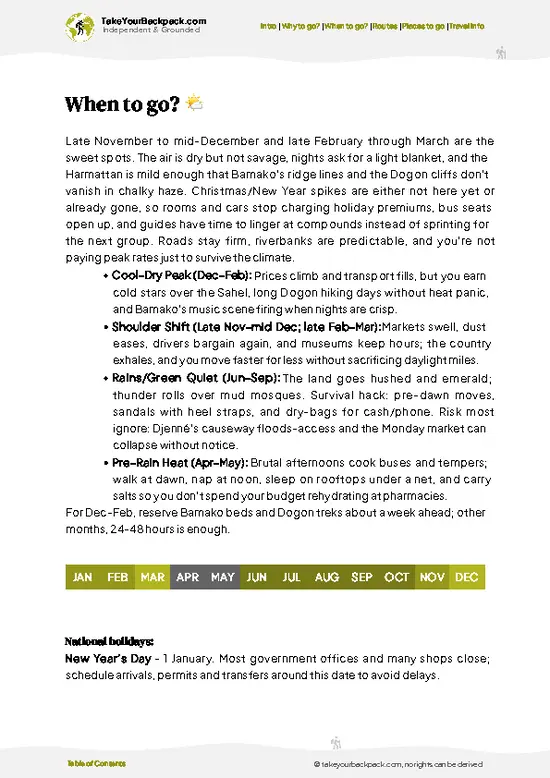
  • Weather: The dry season from November to February is your best bet—clear skies, almost no rain, and the air feels crisp rather than sticky. The rainy season (June to September) turns the red earth to mud, making travel tough and the town quieter.

  • Temperature: Daytime highs hover around 30-35°C (86-95°F) in the dry season, cooling off at night to a comfortable 15-20°C (59-68°F). The rainy season brings more humidity and unpredictable swings, which can sap your energy.

  • Daylight Hours: Daylight stays steady year-round, roughly 11 to 12 hours, but the dry season mornings bring a sharp, golden light that’s perfect for early hikes or photography.

  • Crowds: Tourist presence is minimal year-round, but the dry season sees a slight uptick as travelers chase the best conditions, so expect a livelier
read more 👉

  • Weather: The dry season from November to February is your best bet—clear skies, almost no rain, and the air feels crisp rather than sticky. The rainy season (June to September) turns the red earth to mud, making travel tough and the town quieter.

  • Temperature: Daytime highs hover around 30-35°C (86-95°F) in the dry season, cooling off at night to a comfortable 15-20°C (59-68°F). The rainy season brings more humidity and unpredictable swings, which can sap your energy.

  • Daylight Hours: Daylight stays steady year-round, roughly 11 to 12 hours, but the dry season mornings bring a sharp, golden light that’s perfect for early hikes or photography.

  • Crowds: Tourist presence is minimal year-round, but the dry season sees a slight uptick as travelers chase the best conditions, so expect a livelier atmosphere without feeling overwhelmed.

  • Seasonal Activities: The dry season opens up cultural festivals and markets, where you can catch traditional music and crafts at their peak. The rainy season limits outdoor options but offers lush, green landscapes if you’re up for the challenge.

  • Price Fluctuations: Accommodation and transport costs rise modestly during the dry season due to demand, but the difference is worth the smoother travel and richer experiences.


Pro-tip: Aim for late November or early December—when the air is fresh, the light is perfect, and the town hums quietly with local life before the main tourist flow arrives.


source: climatestotravel.comJANJanuary: excellent for travelingFEBFebruary: excellent for travelingMARMarch: highly recommended for travelingAPRApril: good for travelingMAYMay: fair for travelingJUNJune: below average for travelingJULJuly: below average for travelingAUGAugust: below average for travelingSEPSeptember: fair for travelingOCTOctober: good for travelingNOVNovember: excellent for travelingDECDecember: excellent for traveling
when-to-go

✈️ The backpacker research shortcutMali Travel Guide

An offline-friendly backpacking guide with optimized travel routes, ranked highlights, transport advice, and the best areas to stay.
example page 0 from our offline Travel Guide for Mali
example page 1 from our offline Travel Guide for Mali
example page 2 from our offline Travel Guide for Mali
example page 3 from our offline Travel Guide for Mali
example page 4 from our offline Travel Guide for Mali
example page 5 from our offline Travel Guide for Mali
example page 6 from our offline Travel Guide for Mali
example page 7 from our offline Travel Guide for Mali
The digital guide (321 pages) contains:
76 highlights, ranked by travel appeal
Optimized 5, 10 & 15-day travel routes
Cities, national parks, landmarks, beaches
How to get around
Offline-friendly for travel without Wi-Fi
👉 Click to see all 30+ guide features

📅 Plan smarter in minutes, not weeks
Month by month travel advice
Festivals & national holidays
Budget expectations

🗺️ Go to the right places, skip the overrated ones
Honest pros & cons of destinations
Top hikes, parks & viewpoints
Lesser-known places most travelers miss
Clear “worth it vs skip it” guidance

🛏️ Travel smoothly without rookie mistakes
Best areas to stay
Transport systems explained simply
Common scams & safety advice
SIM cards, money & practical tips

🌍 Understand the country, not just visit it
Culture & traditions
52 Essential phrases & customs
Festivals worth planning around
Traveler-friendly historical context
Insights that make places more meaningful

📱 Built for real travel conditions
Fully downloadable PDF
Works completely offline
Optimized for phone use
Useful in remote areas & buses
Everything in one place
Save weeks of stressful planning
Get instant access to your full guide. 30‑day money-back guarantee.


By proceeding you agree to our terms.
Sent to your inbox immediately after payment • 100% Secure Checkout
Best Backpacking Travel Advisor 2025 tourism awardBest Backpacking
Travel Advisor
2025
What others say about Take Your Backpack Guides:
⭐⭐⭐⭐⭐
Fantastic, amazing amount of information!
⭐⭐⭐⭐⭐
My goodness this is amazing, it's what I've been looking for hats off too you!
⭐⭐⭐⭐⭐
I think this is absolutely BRILLIANT
⭐⭐⭐⭐
Very complete and informative. It's still missing places, but I gotta to commend you
⭐⭐⭐⭐⭐
This is truly amazing, thank you, can't wait to explore it with my kids!
⭐⭐⭐⭐⭐
Awesome resource, thank you!
⭐⭐⭐⭐⭐
This is amazing! Can't wait to explore the ones I haven't seen
⭐⭐⭐⭐
I love this! Well done, great idea.
⭐⭐⭐⭐⭐
Thanks for taking the time to make this gem!
⭐⭐⭐⭐⭐
This might be the best website I've ever seen.
⭐⭐⭐⭐⭐
Congratulations, and thank you so much for your work; it's incredibly valuable.
⭐⭐⭐⭐
In all seriousness I think you did a great job pointing out the important spots
⭐⭐⭐⭐⭐
10/10 very good
⭐⭐⭐⭐⭐
As someone who's only just starting to visit regularly this is awesome, thank you.
⭐⭐⭐⭐
Thank you very much! I'm going to visit my dad, it's going to be very useful!
⭐⭐⭐⭐⭐
This is really cool! We'll be travelling for the first time and this definitely come in handy.
⭐⭐⭐⭐⭐
You are now our minister of culture, congratulations 👨‍💼
⭐⭐⭐⭐⭐
Just wanted to tell you that this is a pearl! Going to follow your recommendations.
⭐⭐⭐⭐⭐
This is so cool. I'll definitely be using the resource for my travels soon.
⭐⭐⭐⭐⭐
This is very impressive! Good work.
⭐⭐⭐⭐⭐
This is an amazing and informative site. Very well done!

🛏️ Where to stay?Choosing the right base

In Kita, Mali, the best spot for backpackers is the central neighborhood around the market area. This part of town pulses with life from dawn till dusk—vendors shouting, spices mingling in the air, and locals weaving through narrow streets. It’s where you’ll find the most budget-friendly guesthouses and a handful of hostels that cater to solo travelers. Staying here means you’re never far from the heart of the city’s rhythm, making it easy to strike up conversations and find fellow adventurers. Compared to the quieter, more residential outskirts, this area offers a safer, more social vibe with … read more 👉
In Kita, Mali, the best spot for backpackers is the central neighborhood around the market area. This part of town pulses with life from dawn till dusk—vendors shouting, spices mingling in the air, and locals weaving through narrow streets. It’s where you’ll find the most budget-friendly guesthouses and a handful of hostels that cater to solo travelers. Staying here means you’re never far from the heart of the city’s rhythm, making it easy to strike up conversations and find fellow adventurers. Compared to the quieter, more residential outskirts, this area offers a safer, more social vibe with plenty of street food stalls and communal spaces. It’s not polished, but that raw energy is exactly what makes the experience feel authentic and worth the occasional dust or noise.

🚌 Getting aroundMoving around without the hassle

Kita moves at its own rhythm—a blend of laid-back afternoons and bursts of local hustle. The sun filters through narrow streets, casting long shadows on weathered walls, while the scent of grilled street food mingles with the earthy aroma of nearby rice paddies. Time here isn’t dictated by clocks but by the ebb and flow of daily life. You’ll find that patience pays off, and a flexible attitude turns every transit moment into a chance to soak in the town’s character rather than just a means to an end.


  • Walking: The heart of Kita is best explored on foot. Streets are compact, and wandering lets you catch the subtle details—the cracked paint on a shopfront, the chatter of vendors setting up. It’s free, naturally, and perfect for spontaneous detours. Expect uneven sidewalks and occasional stray
read more 👉
Kita moves at its own rhythm—a blend of laid-back afternoons and bursts of local hustle. The sun filters through narrow streets, casting long shadows on weathered walls, while the scent of grilled street food mingles with the earthy aroma of nearby rice paddies. Time here isn’t dictated by clocks but by the ebb and flow of daily life. You’ll find that patience pays off, and a flexible attitude turns every transit moment into a chance to soak in the town’s character rather than just a means to an end.


  • Walking: The heart of Kita is best explored on foot. Streets are compact, and wandering lets you catch the subtle details—the cracked paint on a shopfront, the chatter of vendors setting up. It’s free, naturally, and perfect for spontaneous detours. Expect uneven sidewalks and occasional stray dogs, so sturdy shoes are a must.


  • Local Minibuses: These are the workhorses of Kita’s transit, running roughly from 6:00 AM to 8:00 PM. Fares hover around a dollar or less, making them a budget staple. They’re slow and often packed, but the windows slide open wide, letting in the warm breeze and street sounds. Don’t expect air conditioning—think of it as a moving open-air market.


  • Motorbike Taxis: When time is tight or you’re hauling gear, these zippy rides cut through traffic with ease. Prices vary but usually stay under $3 for short hops. Helmets are provided, but the ride can be bumpy—hold on tight and enjoy the rush of the town’s scents and sounds rushing past.


  • Bicycle Rentals: For a bit more freedom, renting a bike is a smart move. Rates start around $5 per day. The terrain is mostly flat, and cycling lets you cover more ground without losing the intimate feel of the streets. Early morning or late afternoon rides avoid the midday heat and reveal quieter corners of the town.

👛 Costs (as of 6 April 2026)Travel costs and budget guide for Kita

Backpacking in Kita, Mali, means embracing a raw, authentic West African town where your budget stretches but your senses stay sharp. Here’s what you’re looking at day-to-day.
  • Dorm Accommodation: Expect basic guesthouses or hostels with shared rooms, often simple but clean enough. Prices hover around €5 to €10 per night. Don’t expect luxury—think mosquito nets, a fan, and a hard mattress, but that’s part of the experience.
  • Meals: Street food and small local eateries dominate. A filling meal of rice, sauce, and grilled meat or fish will set you back about €1 to €3. Fresh fruit and snacks are cheap, but if you want something more Western or imported, prices jump sharply.
  • Local Transport: Transport is mostly by shared taxis or bush taxis. Short rides within town cost around €0.50 to €1. For
read more 👉
Backpacking in Kita, Mali, means embracing a raw, authentic West African town where your budget stretches but your senses stay sharp. Here’s what you’re looking at day-to-day.
  • Dorm Accommodation: Expect basic guesthouses or hostels with shared rooms, often simple but clean enough. Prices hover around €5 to €10 per night. Don’t expect luxury—think mosquito nets, a fan, and a hard mattress, but that’s part of the experience.
  • Meals: Street food and small local eateries dominate. A filling meal of rice, sauce, and grilled meat or fish will set you back about €1 to €3. Fresh fruit and snacks are cheap, but if you want something more Western or imported, prices jump sharply.
  • Local Transport: Transport is mostly by shared taxis or bush taxis. Short rides within town cost around €0.50 to €1. For longer trips or private hires, budget €3 to €5. Walking is often the best way to soak in the town’s atmosphere and save money.
  • Basic Activities/Entry Fees: Kita isn’t a tourist hotspot with formal entry fees. Visiting local markets, cultural spots, or nearby villages is usually free or involves a small tip or donation, around €0.50 to €2 if anything.
  • Miscellaneous Expenses: This covers bottled water (essential), phone credit, and occasional treats like a cold drink. Bottled water costs about €0.30, and a local SIM card with data might run €5 to €10 for a week’s worth. Budget a few euros for unexpected needs.

All told, you’re looking at roughly €10 to €20 per day to cover the essentials in Kita. It’s a lean budget, but it buys you a genuine slice of Malian life, where every euro stretches into a sensory patchwork of smells, sounds, and colors that no polished tourist trap can match.
⚠️ Prices can change and everyone travels differently, so take this as a rough guide. Hope it helps you plan your adventure!

🚌 Day tripsBest day trips from Kita

Kita, Mali, is a backpacker’s dream base for day trips, offering a blend of culture, nature, and adventure just a stone’s throw away.

Visit the Waterfalls of Djenne
A short ride from Kita, the Djenne waterfalls are a refreshing escape. The sound of cascading water fills the air, and the lush greenery surrounding the falls creates a serene atmosphere. It takes about an hour to get there, and you can expect to spend around $10 for transport and entry. The best time to visit is during the rainy season when the falls are at their most powerful. First-timers often underestimate the hike to the best viewing spots; wear sturdy shoes to navigate the rocky terrain.


Explore the Village of Koutiala
Koutiala is a vibrant market town, rich in local culture. The journey takes about 90 minutes, … read more 👉
Kita, Mali, is a backpacker’s dream base for day trips, offering a blend of culture, nature, and adventure just a stone’s throw away.

Visit the Waterfalls of Djenne
A short ride from Kita, the Djenne waterfalls are a refreshing escape. The sound of cascading water fills the air, and the lush greenery surrounding the falls creates a serene atmosphere. It takes about an hour to get there, and you can expect to spend around $10 for transport and entry. The best time to visit is during the rainy season when the falls are at their most powerful. First-timers often underestimate the hike to the best viewing spots; wear sturdy shoes to navigate the rocky terrain.


Explore the Village of Koutiala
Koutiala is a vibrant market town, rich in local culture. The journey takes about 90 minutes, costing around $15 for a shared taxi. You’ll find bustling markets filled with spices, textiles, and friendly locals eager to share stories. Aim for a Saturday visit to catch the lively market scene. A common mistake is arriving too late; the best action happens in the morning.
👉 Explore Koutiala

Hike the Falaise de Kita
For those craving adventure, the Falaise de Kita offers stunning views and a chance to connect with nature. The hike takes about two hours to reach the base, and you can hire a guide for around $20. The dry season is ideal, as the trails can get muddy otherwise. Many newcomers underestimate the difficulty of the ascent; pace yourself to enjoy the breathtaking vistas.
Want to know what more Mali offers?
The Mali Travel Guide describes 76 highlights, from cities to national parks, from beaches to hikes

Get the Travel Guide -

🍲 FoodEating & Drinking in Kita

In Kita, Mali, food is a lively negotiation between bold flavors and simple ingredients. You’ll want to dive into tigadèguèna, a peanut sauce stew that’s rich, nutty, and often served with rice or millet—comfort food with a local heartbeat. Street vendors offer fufu, a doughy staple that’s perfect for scooping up sauces, while grilled meats sizzle over open flames, filling the air with smoky promise.

Backpackers find their rhythm in bustling markets and casual roadside stalls where the pace slows just enough to savor each bite. Sharing a meal here is social currency; expect to eat with your hands and pass dishes around, a ritual that breaks down barriers faster than any phrasebook. When it comes to drinks, bissap (hibiscus tea) cools and refreshes, while locally brewed millet beer invites … read more 👉
In Kita, Mali, food is a lively negotiation between bold flavors and simple ingredients. You’ll want to dive into tigadèguèna, a peanut sauce stew that’s rich, nutty, and often served with rice or millet—comfort food with a local heartbeat. Street vendors offer fufu, a doughy staple that’s perfect for scooping up sauces, while grilled meats sizzle over open flames, filling the air with smoky promise.

Backpackers find their rhythm in bustling markets and casual roadside stalls where the pace slows just enough to savor each bite. Sharing a meal here is social currency; expect to eat with your hands and pass dishes around, a ritual that breaks down barriers faster than any phrasebook. When it comes to drinks, bissap (hibiscus tea) cools and refreshes, while locally brewed millet beer invites you to linger and connect. The vibe is unpretentious, the flavors honest—this is food that roots you in place.

🛡️ SafetyTraveler Safety Guide

Kita, Mali, is generally safe, but a few practical tips can enhance your experience. Stay aware in crowded markets; pickpockets can be sneaky. If you’re solo, avoid wandering too far after dark—stick to well-lit areas and move with purpose.

Common scams include overly friendly locals offering unsolicited help, often with a price tag attached. A polite but firm “no, thank you” usually suffices. Carry yourself confidently, and trust your instincts. The warmth of the community is genuine; just navigate it with a bit of savvy.

Other Malian cities near Kita

Explore more nearby:

  • Kati—Military base, commuter town, Bamako outskirts| 157 km away
  • Bamako—urban sprawl, music venues, street art, Niger River bridges| 167 km away
  • Koulikoro—river port, boatyards, cotton warehouses, riverside markets| 210 km away

💡 Not sure where to go next?
Create a personalized itinerary for Mali including Kita and the places that fit your trip.

Generate my itinerary

👉 Discover all cities

Or checkout all Mali has to offer (think cities, towns, villages, national parks, hikes, beaches, festivals)
Country photo of Mali

We 💚 feedbackParting advice and final tips

Kita pulses with a raw energy that’s hard to shake off. The scent of grilled fish wafts through the air, mingling with laughter from bustling markets. Just be ready for the heat—hydrate often. The warmth of the people makes every drop worth it.

✍️ Help improve this page!
The information on this page is based on in-depth research, insights shared by experienced travelers, and feedback from the local travel community in Mali. While every effort is made to keep the information accurate and current, conditions can change — so if you spot anything incorrect or outdated, please get in touch.


🙋‍♂️ Give feedback

👋 Meet the founderWho’s Behind Take Your Backpack?

Johan, backpacker and founder of TakeYourBackpackHi, I’m Johan (Netherlands 🇳🇱), the creator of TakeYourBackpack. Over the past decade, I’ve backpacked through 80+ countries across six continents, gaining extensive experience with independent travel, long-term trips, and overland routes.

This site is built on a combination of firsthand travel experience and carefully curated insights from other backpackers. Many guides are based on places I’ve personally visited, while others bring together tips, observations, and practical advice shared by trusted travelers I’ve met along the way.

The goal is to provide realistic, experience-driven guidance — not generic itineraries — so you can explore destinations with better context, clearer expectations, and more confidence.

Get full Mali guide •
Instant download • 76 highlights • Full Offline guide