×

Mali🇲🇱 | citiesBamakourban sprawl, music venues, street art, Niger River bridges | things to do and best time to go

Explore Sidi Yahia MosqueExplore Koutiala

Backpacking in Bamako
🏆 Top pickcity ranked #1
By Johan Kruseman 🇳🇱 | Updated June 14, 2026

A decade ago, Bamako was the kind of city where you could wander into a smoky bar, share tea with strangers, and feel the pulse of West Africa in every side street—chaotic, yes, but open and buzzing with possibility. Today, the city still hums, but the tempo has shifted. Security concerns have thinned the backpacker crowd and made some areas less accessible, but Bamako remains Mali’s beating heart, sprawled along the Niger River in the country’s southwest. For the adventurous, there’s still plenty to chew on: the National Museum’s artifacts are genuinely world-class, the Grand Marché is a sensory overload, and the riverside nightlife—if you know where to look—delivers live music that’s as raw as it gets. Costs are low, but comfort is basic; you’ll sweat, you’ll haggle, and you’ll probably get lost. Meeting fellow travelers is tougher than in places like Mopti or Ségou, but the city’s energy is infectious, unpredictable, and—if you’re game—rewarding.

Discover everything you want to know in the 📖 Mali Travel Guide.
Safety warning

The current risk level for Mali is high. Check the advice before going.


Get your Mali guide
76 ranked highlights, routes & tips, works offline (321 pages)
Loading the map 🌍
CLICK TO FILTER
cities
towns
landmarks
national parks
hikes
attractions
festivals
regions
SHOW COUNTRY’S BESTSHOW ALL

✨ Why go?
Ranked #1 city in Mali
Why Bamako should be on your travel list

Bamako is a strategic hub for backpackers navigating West Africa. It offers a unique blend of affordability and vibrancy that makes it a worthy stop. The hostels here are not just places to crash; they foster a sense of community, perfect for meeting fellow travelers and swapping stories. You’ll find delicious street food that won’t break the bank, allowing you to indulge without guilt.

The city is walkable, making it easy to explore local markets and cultural spots at your own pace. This is crucial for those who want to soak in the atmosphere without the hassle of transport. When night falls, Bamako transforms with a lively nightlife scene, where you can unwind after a day of exploration.

As a basecamp, it’s ideal for day trips to nearby attractions, giving you the flexibility to dive … read more 👉
Bamako is a strategic hub for backpackers navigating West Africa. It offers a unique blend of affordability and vibrancy that makes it a worthy stop. The hostels here are not just places to crash; they foster a sense of community, perfect for meeting fellow travelers and swapping stories. You’ll find delicious street food that won’t break the bank, allowing you to indulge without guilt.

The city is walkable, making it easy to explore local markets and cultural spots at your own pace. This is crucial for those who want to soak in the atmosphere without the hassle of transport. When night falls, Bamako transforms with a lively nightlife scene, where you can unwind after a day of exploration.

As a basecamp, it’s ideal for day trips to nearby attractions, giving you the flexibility to dive deeper into Mali’s rich culture without the need for constant packing and unpacking. If you’re looking for a place that balances comfort and value, Bamako is more than just a stopover; it’s a key piece in your West African adventure puzzle.
Want to include Bamako in your Mali route?
Create a personalized Mali itinerary that includes Bamako and the places that fit your trip — based on your travel style, budget, and available time. Get your route in seconds.

Generate my trip

💡 HighlightsKey sights and experiences for travelers

Musée National du Mali
If you want to understand Mali’s soul, start here. The National Museum is a masterclass in West African art, textiles, and archaeology. You’ll see Dogon masks, ancient terracotta, and rotating contemporary exhibits that make the country’s history feel alive, not dusty. The grounds are shady and calm—a rare oasis in Bamako’s kinetic sprawl. Go in the morning (8:30-12:30) to dodge school groups and the worst of the heat. Entry is about 2,500 CFA (roughly $4). Give yourself 1-2 hours if you’re curious, longer if you’re a culture sponge.

Grand Marché de Bamako
This is not a sanitized tourist market. It’s the city’s economic engine, a labyrinth of stalls selling everything from kora strings to knockoff sneakers. You’ll hear bargaining in Bambara, French, and a dozen other … read more 👉
Musée National du Mali
If you want to understand Mali’s soul, start here. The National Museum is a masterclass in West African art, textiles, and archaeology. You’ll see Dogon masks, ancient terracotta, and rotating contemporary exhibits that make the country’s history feel alive, not dusty. The grounds are shady and calm—a rare oasis in Bamako’s kinetic sprawl. Go in the morning (8:30-12:30) to dodge school groups and the worst of the heat. Entry is about 2,500 CFA (roughly $4). Give yourself 1-2 hours if you’re curious, longer if you’re a culture sponge.

Grand Marché de Bamako
This is not a sanitized tourist market. It’s the city’s economic engine, a labyrinth of stalls selling everything from kora strings to knockoff sneakers. You’ll hear bargaining in Bambara, French, and a dozen other languages. The sensory overload is the point: this is Bamako’s pulse. Go early (before 11am) to avoid the midday crush and keep your valuables close—petty theft is a reality. Free to enter, but you’ll want cash for snacks or souvenirs. Allow 1-2 hours, or more if you’re a people-watcher.

Point G Hill & Caves
For a literal change of perspective, hike up Point G. The climb is short but steep, and the reward is a panoramic view of Bamako’s sprawl, the Niger River, and the city’s red-dusted chaos. The caves themselves are ancient, with rock art that predates the city by centuries. Go at sunset for the best light and a breeze. No formal entry fee, but a local guide (expect to pay 2,000-5,000 CFA, about $3-$8) is worth it for context and safety. Set aside 2-3 hours, including the walk up.

Railway Station (Gare de Bamako)
The colonial-era train station is a relic from a different era, and while passenger trains are rare, the building’s faded grandeur and the bustle of vendors make it a living monument. The architecture is photogenic, and the area is a crossroads for travelers and hustlers alike. Visit in the late afternoon when the light is soft and the plaza is lively. Free to wander, but keep your wits about you. Thirty minutes to an hour is plenty unless you’re a train buff.

Le Blonba
Bamako’s creative scene is alive at Le Blonba, a theater and cultural space where you can catch live music, theater, or slam poetry. The programming is unpredictable but always high-energy and local. Check schedules ahead if you can, but even a spontaneous visit is rewarding. Shows usually start after 8pm. Tickets run 2,000-5,000 CFA ($3-$8). Plan for an evening—this is where Bamako’s night owls and artists converge.

For day trips just outside Bamako, consider the Siby cliffs, the sacred crocodile pools of Bazoulé, or the artisan village of Kalabancoro—each a different flavor of Malian adventure, all within easy striking distance.
Spotted a mistake or missing something? Contact us.

Things to do near Bamako

Ratings based on Tripadvisor reviews. When you book through this link, you support our work at no extra cost to you.

🏘️ NeighborhoodsKey areas and districts to know

Bamako, the vibrant capital of Mali, is a city where the pulse of West African culture beats strong. Each neighborhood offers a unique flavor, making it essential for backpackers to choose wisely.

Bamako Centre
This is the heart of the city. Bustling markets, street vendors, and a mix of locals and travelers create an energetic vibe. Costs are moderate, and you can easily walk to key attractions like the National Museum. Nightlife is lively, with bars and music venues nearby. Perfect for short stays, but longer visits might feel a bit chaotic.

Aci Mande
A quieter alternative, Aci Mande offers a more laid-back atmosphere. It’s slightly more upscale, with guesthouses and cafes that cater to a relaxed crowd. Walkability is decent, but you’ll need transport for major sights. Ideal for those … read more 👉
Bamako, the vibrant capital of Mali, is a city where the pulse of West African culture beats strong. Each neighborhood offers a unique flavor, making it essential for backpackers to choose wisely.

Bamako Centre
This is the heart of the city. Bustling markets, street vendors, and a mix of locals and travelers create an energetic vibe. Costs are moderate, and you can easily walk to key attractions like the National Museum. Nightlife is lively, with bars and music venues nearby. Perfect for short stays, but longer visits might feel a bit chaotic.

Aci Mande
A quieter alternative, Aci Mande offers a more laid-back atmosphere. It’s slightly more upscale, with guesthouses and cafes that cater to a relaxed crowd. Walkability is decent, but you’ll need transport for major sights. Ideal for those seeking comfort and a slower pace, making it suitable for longer stays.

Badalabougou
This neighborhood has a local feel, with fewer tourists. It’s affordable, with budget accommodations and local eateries. The vibe is friendly, and you can stroll through markets and parks. However, nightlife is limited, so it’s better for those who prefer quiet evenings. Great for longer stays if you want to immerse yourself in local life.

Kalaban Coura
Known for its artistic scene, Kalaban Coura is a hub for creatives. It’s a bit further from the city center, so transport is necessary. Costs are reasonable, and the area is walkable, with galleries and workshops to explore. Perfect for those looking to stay longer and engage with the local art community.

Hamdallaye
A more suburban feel, Hamdallaye is ideal for those seeking comfort and space. It’s quieter and offers larger accommodations. While it’s not as walkable, it’s well-connected by public transport. This area suits longer stays, especially for families or groups looking for a home base.

⌛️ 1 dayWhat you can realistically do in a day

Bamako, the vibrant capital of Mali, pulses with life and culture. It’s a city where the sounds of street vendors blend with the rhythm of traditional music, and the scent of grilled fish wafts through the air. This is a place where you can feel the heartbeat of West Africa, making it a perfect stop for those seeking authentic experiences.

Start your day in the bustling neighborhood of ACI 2000. Grab a breakfast of fresh baguettes and local coffee at a nearby café. The energy here is contagious, and you’ll find locals chatting animatedly, setting the tone for your adventure. After fueling up, head to the National Museum of Mali. It’s not just a collection of artifacts; it’s a deep dive into the country’s rich history and art. Spend a couple of hours wandering through the exhibits, absorbing … read more 👉
Bamako, the vibrant capital of Mali, pulses with life and culture. It’s a city where the sounds of street vendors blend with the rhythm of traditional music, and the scent of grilled fish wafts through the air. This is a place where you can feel the heartbeat of West Africa, making it a perfect stop for those seeking authentic experiences.

Start your day in the bustling neighborhood of ACI 2000. Grab a breakfast of fresh baguettes and local coffee at a nearby café. The energy here is contagious, and you’ll find locals chatting animatedly, setting the tone for your adventure. After fueling up, head to the National Museum of Mali. It’s not just a collection of artifacts; it’s a deep dive into the country’s rich history and art. Spend a couple of hours wandering through the exhibits, absorbing the stories of Mali’s past.

In the afternoon, make your way to the vibrant market at Grand Marché. This is where Bamako truly shines. The colors, sounds, and smells create a sensory overload. Browse through stalls filled with textiles, spices, and handmade crafts. Don’t rush; take your time to chat with vendors. You might even stumble upon a local artist showcasing their work, which is a refreshing break from the usual tourist spots.

As the sun begins to set, head to the banks of the Niger River in the neighborhood of Badalabougou. This area is often overlooked by tourists, but it offers a serene escape. Find a spot to relax and watch the sunset paint the sky in hues of orange and pink. Grab a bite at a nearby eatery serving traditional Malian dishes like jollof rice or fufu.

End your day with a visit to a local music venue. Bamako is known for its vibrant music scene, and catching a live performance will leave you buzzing with energy. You’ve navigated the trade-offs of time, money, and comfort, and in doing so, you’ve unlocked the essence of Bamako.
Turn your Bamako visit into an Mali adventure
Build a complete Mali route with Bamako, hidden gems, must-see destinations, and realistic travel times included.

Generate my trip

🌤️ When to go?Best time to visit Bamako


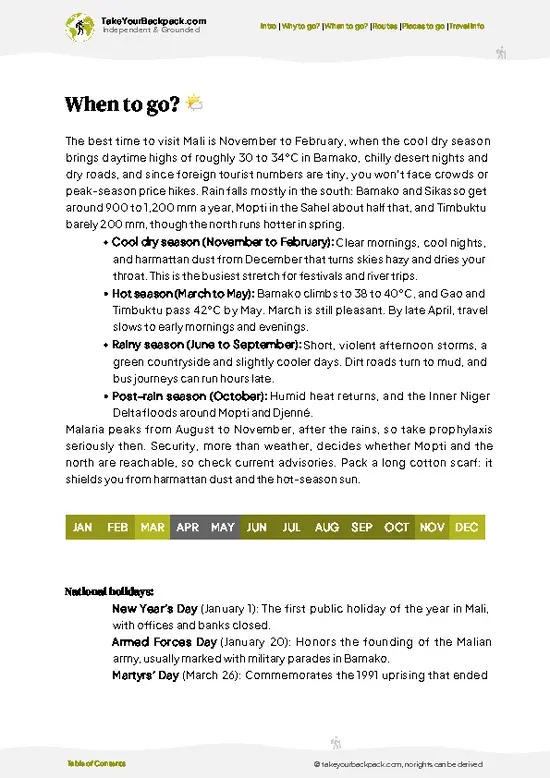
  • Topic: Weather and Temperature — Bamako’s climate swings between a hot, wet season and a scorching dry season. From June to October, expect daily highs around 30–35°C (86–95°F) with heavy rains that can turn dirt roads into mud traps. November to February offers dry, cooler days averaging 25–30°C (77–86°F), making trekking and city exploration far more comfortable.

  • Topic: Daylight Hours — Near the equator, Bamako enjoys fairly consistent daylight year-round, roughly 11.5 to 12.5 hours daily. This steadiness means you don’t have to juggle short days or long nights when planning your hikes or market visits.

  • Topic: Crowds — Tourist traffic peaks during the dry season, especially December and January, when the weather is most pleasant. If you want fewer people around, aim for the shoulder
read more 👉

  • Topic: Weather and Temperature — Bamako’s climate swings between a hot, wet season and a scorching dry season. From June to October, expect daily highs around 30–35°C (86–95°F) with heavy rains that can turn dirt roads into mud traps. November to February offers dry, cooler days averaging 25–30°C (77–86°F), making trekking and city exploration far more comfortable.

  • Topic: Daylight Hours — Near the equator, Bamako enjoys fairly consistent daylight year-round, roughly 11.5 to 12.5 hours daily. This steadiness means you don’t have to juggle short days or long nights when planning your hikes or market visits.

  • Topic: Crowds — Tourist traffic peaks during the dry season, especially December and January, when the weather is most pleasant. If you want fewer people around, aim for the shoulder months of November or February, balancing decent weather with less bustle.

  • Topic: Seasonal Activities — The dry season hosts cultural festivals and music events, which add rich layers to your experience. The rainy season, while less accessible, paints the landscape lush and green but limits outdoor activities.

  • Topic: Price Fluctuations — Accommodation and tours spike in the dry season due to demand. Booking in the shoulder months can save you money without sacrificing comfort, while the wet season offers the lowest prices but at the cost of convenience and accessibility.


Pro-tip: Target the dry shoulder months—November and February—for a smart balance of comfort, cost, and cultural immersion that feels like you’ve cracked Bamako’s timing code.


source: climatestotravel.comJANJanuary: excellent for travelingFEBFebruary: highly recommended for travelingMARMarch: fair for travelingAPRApril: fair for travelingMAYMay: fair for travelingJUNJune: fair for travelingJULJuly: below average for travelingAUGAugust: below average for travelingSEPSeptember: below average for travelingOCTOctober: fair for travelingNOVNovember: highly recommended for travelingDECDecember: excellent for traveling
when-to-go

✈️ The backpacker research shortcutMali Travel Guide

An offline-friendly backpacking guide with optimized travel routes, ranked highlights, transport advice, and the best areas to stay.
example page 0 from our offline Travel Guide for Mali
example page 1 from our offline Travel Guide for Mali
example page 2 from our offline Travel Guide for Mali
example page 3 from our offline Travel Guide for Mali
example page 4 from our offline Travel Guide for Mali
example page 5 from our offline Travel Guide for Mali
example page 6 from our offline Travel Guide for Mali
example page 7 from our offline Travel Guide for Mali
The digital guide (321 pages) contains:
76 highlights, ranked by travel appeal
Optimized 5, 10 & 15-day travel routes
Cities, national parks, landmarks, beaches
How to get around
Offline-friendly for travel without Wi-Fi
👉 Click to see all 30+ guide features

📅 Plan smarter in minutes, not weeks
Month by month travel advice
Festivals & national holidays
Budget expectations

🗺️ Go to the right places, skip the overrated ones
Honest pros & cons of destinations
Top hikes, parks & viewpoints
Lesser-known places most travelers miss
Clear “worth it vs skip it” guidance

🛏️ Travel smoothly without rookie mistakes
Best areas to stay
Transport systems explained simply
Common scams & safety advice
SIM cards, money & practical tips

🌍 Understand the country, not just visit it
Culture & traditions
52 Essential phrases & customs
Festivals worth planning around
Traveler-friendly historical context
Insights that make places more meaningful

📱 Built for real travel conditions
Fully downloadable PDF
Works completely offline
Optimized for phone use
Useful in remote areas & buses
Everything in one place
Save weeks of stressful planning
Get instant access to your full guide. 30‑day money-back guarantee.


By proceeding you agree to our terms.
Sent to your inbox immediately after payment • 100% Secure Checkout
Best Backpacking Travel Advisor 2025 tourism awardBest Backpacking
Travel Advisor
2025
What others say about Take Your Backpack Guides:
⭐⭐⭐⭐⭐
Fantastic, amazing amount of information!
⭐⭐⭐⭐⭐
My goodness this is amazing, it's what I've been looking for hats off too you!
⭐⭐⭐⭐⭐
I think this is absolutely BRILLIANT
⭐⭐⭐⭐
Very complete and informative. It's still missing places, but I gotta to commend you
⭐⭐⭐⭐⭐
This is truly amazing, thank you, can't wait to explore it with my kids!
⭐⭐⭐⭐⭐
Awesome resource, thank you!
⭐⭐⭐⭐⭐
This is amazing! Can't wait to explore the ones I haven't seen
⭐⭐⭐⭐
I love this! Well done, great idea.
⭐⭐⭐⭐⭐
Thanks for taking the time to make this gem!
⭐⭐⭐⭐⭐
This might be the best website I've ever seen.
⭐⭐⭐⭐⭐
Congratulations, and thank you so much for your work; it's incredibly valuable.
⭐⭐⭐⭐
In all seriousness I think you did a great job pointing out the important spots
⭐⭐⭐⭐⭐
10/10 very good
⭐⭐⭐⭐⭐
As someone who's only just starting to visit regularly this is awesome, thank you.
⭐⭐⭐⭐
Thank you very much! I'm going to visit my dad, it's going to be very useful!
⭐⭐⭐⭐⭐
This is really cool! We'll be travelling for the first time and this definitely come in handy.
⭐⭐⭐⭐⭐
You are now our minister of culture, congratulations 👨‍💼
⭐⭐⭐⭐⭐
Just wanted to tell you that this is a pearl! Going to follow your recommendations.
⭐⭐⭐⭐⭐
This is so cool. I'll definitely be using the resource for my travels soon.
⭐⭐⭐⭐⭐
This is very impressive! Good work.
⭐⭐⭐⭐⭐
This is an amazing and informative site. Very well done!

🛏️ Where to stay?Where staying makes the most sense

In Bamako, the real backpacker sweet spot lies in the neighborhoods of Hippodrome and Badalabougou. These areas strike a smart balance between safety, social buzz, and budget-friendly options, making them the natural hubs for solo travelers and those watching their wallets. Hippodrome is the city’s pulse for nightlife and casual meetups. It’s where you’ll find a cluster of guesthouses and hostels that cater to international backpackers, offering a chance to swap stories over a cold drink without breaking the bank. The vibe here is lively but manageable—enough energy to keep you engaged without … read more 👉
In Bamako, the real backpacker sweet spot lies in the neighborhoods of Hippodrome and Badalabougou. These areas strike a smart balance between safety, social buzz, and budget-friendly options, making them the natural hubs for solo travelers and those watching their wallets. Hippodrome is the city’s pulse for nightlife and casual meetups. It’s where you’ll find a cluster of guesthouses and hostels that cater to international backpackers, offering a chance to swap stories over a cold drink without breaking the bank. The vibe here is lively but manageable—enough energy to keep you engaged without the chaos of the city’s busiest districts.

Badalabougou, just a bit east, offers a quieter, more residential feel but still keeps you close to essential amenities and transport links. It’s a smart choice if you want to recharge after a day of exploring without sacrificing access to social spots. Both neighborhoods are safer than the sprawling, less predictable outskirts, where infrastructure and security can be hit or miss.

Compared to central Bamako or the markets near the Niger River, Hippodrome and Badalabougou give you a clearer, more reliable experience. You’re trading a bit of the city’s raw edge for comfort and connection—exactly the kind of trade-off that turns a trip from stressful to memorable.

🚌 Getting aroundTransportation options and practical tips

Bamako moves at its own rhythm—less a clockwork machine and more a pulse you feel in the streets. The city’s flow is a blend of improvisation and necessity, where schedules are suggestions and the real timetable is the ebb and surge of people, horns, and vendors. You’ll find that time here is elastic; what looks like chaos is actually a system of unspoken rules and quick decisions. Understanding this flow means you’re not just getting from A to B—you’re reading the city’s heartbeat, turning transit into a strategic game where every choice balances time, money, and comfort.


  • Walking: The most straightforward and cost-free way to navigate Bamako’s central neighborhoods. It’s slow but offers unmatched immersion—expect 10-20 minutes between major points downtown. Walking lets you dodge traffic
read more 👉
Bamako moves at its own rhythm—less a clockwork machine and more a pulse you feel in the streets. The city’s flow is a blend of improvisation and necessity, where schedules are suggestions and the real timetable is the ebb and surge of people, horns, and vendors. You’ll find that time here is elastic; what looks like chaos is actually a system of unspoken rules and quick decisions. Understanding this flow means you’re not just getting from A to B—you’re reading the city’s heartbeat, turning transit into a strategic game where every choice balances time, money, and comfort.


  • Walking: The most straightforward and cost-free way to navigate Bamako’s central neighborhoods. It’s slow but offers unmatched immersion—expect 10-20 minutes between major points downtown. Walking lets you dodge traffic snarls and soak in street life, but it’s not ideal for long distances or midday heat.


  • Taxi-brousse: These shared minibuses are the backbone of Bamako’s transit for budget travelers. They run from early morning (around 6 AM) until dusk (6-7 PM), costing roughly 200-500 CFA per trip depending on distance. They’re slow and often packed, but they cover longer distances efficiently if you’re willing to sacrifice personal space and a strict schedule.


  • Local Taxis: Metered taxis exist but are rare and usually pricier, starting around 1,000 CFA for short rides. They offer more comfort and speed than taxi-brousse but can be unpredictable in price and availability. Negotiation skills come in handy here, especially after dark.


  • Motorcycle Taxis (Jakarta): The fastest way through Bamako’s traffic maze, these cost about 300-700 CFA per ride. They’re perfect for short hops when time is tight, but safety and comfort are trade-offs—helmets are not always provided, and the ride can be bumpy.


  • Public Buses: Limited routes and irregular schedules make buses a less reliable option for visitors. They’re cheap (under 200 CFA) but slow and often overcrowded, best reserved for those with flexible time and a taste for local color over comfort.


Mastering Bamako’s transit means knowing when to walk, when to squeeze into a taxi-brousse, and when to gamble on a motorcycle taxi. Each mode is a calculated trade-off: save money but lose time, or pay a bit more for speed and ease. Your choice shapes not just your itinerary but your experience of the city’s pulse.

👛 Costs (as of 4 April 2026)Typical daily expenses

Backpacking in Bamako, Mali, involves a clear trade-off between cost and comfort, with prices reflecting the city’s developing infrastructure and local economy. Here’s a breakdown of what you can expect to spend daily.
  • Dorm Accommodation (High Season): Expect to pay around €8-€12 per night in basic hostels or guesthouses. These places are simple but clean, often with shared bathrooms and limited amenities.
  • Dorm Accommodation (Off-Season): Prices drop to about €5-€8 per night. Availability might be better, but some places may close or reduce services during quieter months.
  • Meals: Street food and local eateries offer filling meals for €1-€3 each. A daily food budget of €4-€7 covers three meals, focusing on staples like rice, millet, and grilled meats or fish.
  • Local Transport: Using shared
read more 👉
Backpacking in Bamako, Mali, involves a clear trade-off between cost and comfort, with prices reflecting the city’s developing infrastructure and local economy. Here’s a breakdown of what you can expect to spend daily.
  • Dorm Accommodation (High Season): Expect to pay around €8-€12 per night in basic hostels or guesthouses. These places are simple but clean, often with shared bathrooms and limited amenities.
  • Dorm Accommodation (Off-Season): Prices drop to about €5-€8 per night. Availability might be better, but some places may close or reduce services during quieter months.
  • Meals: Street food and local eateries offer filling meals for €1-€3 each. A daily food budget of €4-€7 covers three meals, focusing on staples like rice, millet, and grilled meats or fish.
  • Local Transport: Using shared taxis or minibuses (known locally as “gheughe”) costs roughly €0.30-€0.50 per ride. Budget around €1.50-€3 for multiple short trips across the city.
  • City Transport Pass: Bamako doesn’t have a formal city transport pass system. Regular fares apply, so plan for individual trip costs rather than a flat rate.
  • Basic Activities/Entry Fees: Museums and cultural sites charge between €1-€3. Markets and public spaces are free but expect to spend on souvenirs or snacks.
  • Miscellaneous Expenses: This includes bottled water, occasional internet cafes, or small tips, averaging €1-€2 daily.

Altogether, a realistic daily budget for backpacking in Bamako ranges from about €15 on a tight budget to €25 if you want a bit more comfort and flexibility. Knowing these trade-offs lets you decide where to save and where to invest in your experience.
⚠️ Prices can change and everyone travels differently, so take this as a rough guide. Hope it helps you plan your adventure!

🚌 Day tripsExploring the surroundings

Bamako, Mali, serves as a vibrant launchpad for day trips that blend culture, nature, and adventure. Here’s how to maximize your experience without breaking the bank.

Djenné
A UNESCO World Heritage site, Djenné is famous for its mud-brick architecture, particularly the Great Mosque, which is the largest of its kind in the world. The journey takes about 5 hours by bus, but the stunning views of the Niger River along the way make it worthwhile. Expect to spend around $10 on transport and a few bucks for lunch. The best time to visit is during the dry season, from November to February, when the weather is pleasant. A common mistake is underestimating the heat; bring plenty of water and a hat.


Ségou
Just a 3-hour ride from Bamako, Ségou offers a glimpse into traditional Malian life. Known … read more 👉
Bamako, Mali, serves as a vibrant launchpad for day trips that blend culture, nature, and adventure. Here’s how to maximize your experience without breaking the bank.

Djenné
A UNESCO World Heritage site, Djenné is famous for its mud-brick architecture, particularly the Great Mosque, which is the largest of its kind in the world. The journey takes about 5 hours by bus, but the stunning views of the Niger River along the way make it worthwhile. Expect to spend around $10 on transport and a few bucks for lunch. The best time to visit is during the dry season, from November to February, when the weather is pleasant. A common mistake is underestimating the heat; bring plenty of water and a hat.


Ségou
Just a 3-hour ride from Bamako, Ségou offers a glimpse into traditional Malian life. Known for its vibrant pottery and lively markets, it’s a great spot to interact with locals and sample authentic Malian cuisine. Budget around $8 for transport and $5 for a meal. The rainy season can dampen the experience, so aim for the dry months. Many first-timers miss the chance to explore the nearby banks of the Niger River, where you can relax and soak in the scenery.


Falaise de Bandiagara
This dramatic escarpment, about 6 hours from Bamako, is a UNESCO site that showcases the Dogon culture. The hike through the cliffs reveals ancient villages and breathtaking views. Expect to spend around $15 on transport and an additional $10 for a guide, which is highly recommended. The best time to go is during the cooler months, from November to March. A common pitfall is not allowing enough time for the hike; plan for a full day to truly appreciate the landscape.


Koutiala
Known as the ”Cotton Capital” of Mali, Koutiala is about 4 hours away and offers a unique look at the cotton production process. You can visit local farms and markets, immersing yourself in the agricultural side of Malian life. Budget around $10 for transport and $5 for food. The dry season is ideal for this trip. Many travelers overlook the local crafts; don’t miss the chance to pick up some handmade cotton products.
👉 Explore Koutiala

Mopti
A bustling port city, Mopti is roughly 8 hours from Bamako and is often called the ”Venice of Mali.” The vibrant markets and colorful boats on the Niger River create a lively atmosphere. Expect to spend about $15 on transport and $10 for a meal. The best time to visit is during the dry season. First-timers often rush through; take your time to explore the waterways and enjoy a boat ride.
👉 Explore Mopti
Want to know what more Mali offers?
The Mali Travel Guide describes 76 highlights, from cities to national parks, from beaches to hikes

Get the Travel Guide -

🍲 FoodLocal Flavors for Backpackers

In Bamako, the heart of Mali pulses through its food and drink. Dive into the local cuisine, and you’ll find jollof rice—a vibrant dish cooked with tomatoes, peppers, and spices that dances on your palate. Pair it with fufu, a starchy staple made from cassava or yam, and you’ve got a meal that’s both filling and flavorful.

Street food is where the magic happens. Vendors line the bustling markets, serving up grilled skewers of meat, often marinated in a blend of spices that will make your taste buds sing. Don’t miss out on bissap, a refreshing hibiscus drink that’s both tart and sweet, perfect for cooling off in the heat.

Eating in Bamako is a communal affair. You’ll often see locals sharing dishes, so don’t hesitate to join in. It’s customary to eat with your right hand, a gesture of respect. … read more 👉
In Bamako, the heart of Mali pulses through its food and drink. Dive into the local cuisine, and you’ll find jollof rice—a vibrant dish cooked with tomatoes, peppers, and spices that dances on your palate. Pair it with fufu, a starchy staple made from cassava or yam, and you’ve got a meal that’s both filling and flavorful.

Street food is where the magic happens. Vendors line the bustling markets, serving up grilled skewers of meat, often marinated in a blend of spices that will make your taste buds sing. Don’t miss out on bissap, a refreshing hibiscus drink that’s both tart and sweet, perfect for cooling off in the heat.

Eating in Bamako is a communal affair. You’ll often see locals sharing dishes, so don’t hesitate to join in. It’s customary to eat with your right hand, a gesture of respect. If you’re invited to someone’s home, bringing a small gift, like fruit or sweets, is a thoughtful touch.

As the sun sets, the city transforms. Casual bars and cafés buzz with laughter and conversation, where you can sip on maliba, a local beer, while soaking in the vibrant atmosphere. Embrace the flavors and the culture; it’s all part of the Bamako experience.

🛡️ SafetySafety Tips and Common Scams in Bamako

Bamako is generally safe for travelers, but like any bustling city, it has its quirks. Stay aware in crowded markets like Marché de Medina, where pickpockets might lurk. Keep your valuables close and avoid flashy displays of wealth.

If you’re solo, be cautious at night. Streets can be dimly lit, and while locals are friendly, it’s wise to stick to well-trafficked areas. Taxis are a reliable option, but always negotiate the fare beforehand to avoid misunderstandings.

Scams can pop up, particularly around tourist hotspots. Be wary of overly friendly strangers offering unsolicited help or guiding you to shops where they earn a commission. Politely decline and trust your instincts.

Everyday annoyances include aggressive street vendors and persistent touts. A firm but friendly “no, thank you” … read more 👉
Bamako is generally safe for travelers, but like any bustling city, it has its quirks. Stay aware in crowded markets like Marché de Medina, where pickpockets might lurk. Keep your valuables close and avoid flashy displays of wealth.

If you’re solo, be cautious at night. Streets can be dimly lit, and while locals are friendly, it’s wise to stick to well-trafficked areas. Taxis are a reliable option, but always negotiate the fare beforehand to avoid misunderstandings.

Scams can pop up, particularly around tourist hotspots. Be wary of overly friendly strangers offering unsolicited help or guiding you to shops where they earn a commission. Politely decline and trust your instincts.

Everyday annoyances include aggressive street vendors and persistent touts. A firm but friendly “no, thank you” usually does the trick. Embrace the chaos with a light heart, and you’ll find Bamako’s energy rewarding.

Other Malian cities near Bamako

Explore more nearby:

  • Kati—Military base, commuter town, Bamako outskirts| 14 km away
  • Koulikoro—river port, boatyards, cotton warehouses, riverside markets| 54 km away
  • Kita—Railway junction, music heritage, mango orchards| 167 km away

💡 Not sure where to go next?
Create a personalized itinerary for Mali including Bamako and the places that fit your trip.

Generate my itinerary

👉 Discover all cities

Or checkout all Mali has to offer (think cities, towns, villages, national parks, hikes, beaches, festivals)
Country photo of Mali

We 💚 feedbackWhat to keep in mind

Bamako pulses with life. The streets hum with music, and the markets overflow with colors and scents that pull you in. Don’t miss the National Museum; it’s a treasure trove of Mali’s rich history. The best surprise? The warmth of the locals—everyone’s ready to share a story or a meal. Just a heads-up: the traffic can be chaotic. Embrace the madness; it’s part of the charm. You’ll leave with a deeper appreciation for this vibrant city and its resilient spirit.

✍️ Help improve this page!
The information on this page is based on in-depth research, insights shared by experienced travelers, and feedback from the local travel community in Mali. While every effort is made to keep the information accurate and current, conditions can change — so if you spot anything incorrect or outdated, please get in touch.


🙋‍♂️ Give feedback

👋 Meet the founderWho’s Behind Take Your Backpack?

Johan, backpacker and founder of TakeYourBackpackHi, I’m Johan (Netherlands 🇳🇱), the creator of TakeYourBackpack. Over the past decade, I’ve backpacked through 80+ countries across six continents, gaining extensive experience with independent travel, long-term trips, and overland routes.

This site is built on a combination of firsthand travel experience and carefully curated insights from other backpackers. Many guides are based on places I’ve personally visited, while others bring together tips, observations, and practical advice shared by trusted travelers I’ve met along the way.

The goal is to provide realistic, experience-driven guidance — not generic itineraries — so you can explore destinations with better context, clearer expectations, and more confidence.

Get full Mali guide •
Instant download • 76 highlights • Full Offline guide