Yes, Mauritius is easy to travel independently: English is an official language, people switch between Kreol, French and English without blinking, and a cheap bus network reaches nearly every coastal village.
Dorm hostels are rare, so most backpackers use family guesthouses in
Flic en Flac,
Mahebourg or
Grand Baie at Rs 1,500 to 3,000 (US$33 to 65) for a double. Bus rides cost Rs 20 to 50 (under US$1.10), but rural routes wind down around 6:30 to 7 p.m., so plan days to finish early. A realistic daily budget runs €45 to 70 per person including food from roadside stalls, where dholl puri costs Rs 15 to 30.
Seven to ten days is the right amount of time for Mauritius, enough to see the southwest mountains, the central plateau, the southeast lagoon and Port Louis without rushing.
The island measures only about 65 by 45 kilometers, but buses are slow:
Port Louis to
Le Morne takes 2 to 2.5 hours by bus versus about 1.5 hours by car. With 2 days, stick to the southwest around
Tamarin and
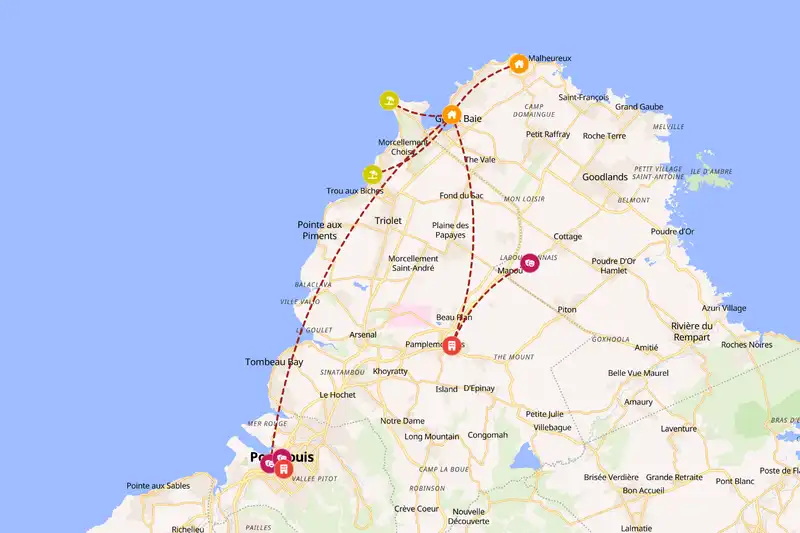
Chamarel. Three days suits Port Louis plus the north coast from
Grand Baie. Five days lets you loop from
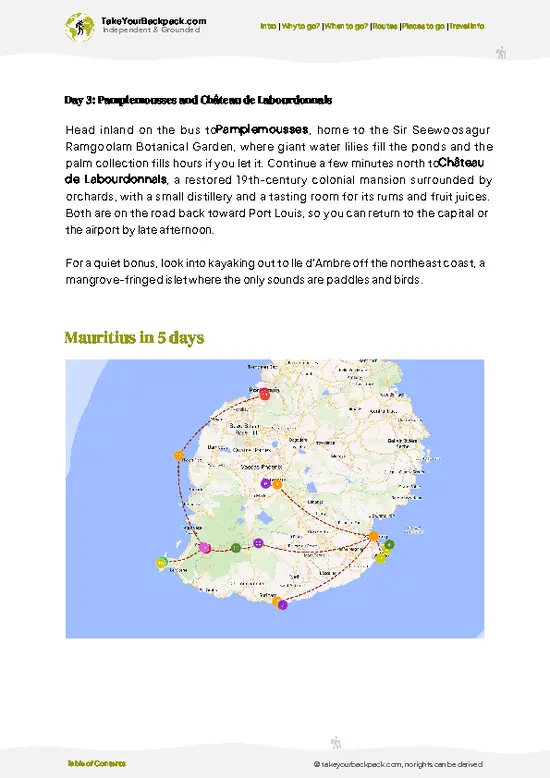
Mahebourg over the plateau to Le Morne and finish in the capital, with two or three bases.
You can get around Mauritius without a car, using public buses for the coast and towns and a hired taxi for the uplands.
Buses from
Port Louis leave Immigration Square for the north (Grand Baie in 45 minutes to 1 hour) and Victoria Square for the south and west. Fares run Rs 20 to 50 (under US$1.10). The Metro Express light rail links Port Louis with Rose Hill, Quatre Bornes and
Curepipe. The weak spot is the plateau:
Chamarel,
Grand Bassin and the
Black River Gorges viewpoint have little service, so hire a taxi for half a day at Rs 2,500 to 3,500 (US$55 to 75).
The must-visits in Mauritius are
Le Morne Brabant, the
Black River Gorges,
Chamarel,
Grand Bassin and
Aapravasi Ghat in Port Louis, plus at least one lagoon beach.
Climb Le Morne Brabant early; the hike takes 3 to 4 hours return and the 556 meter summit looks over the southwest lagoon. Pair the gorge viewpoint with Chamarel’s rum distillery in one taxi day.
Ile aux Aigrettes, a guided boat trip from near Mahebourg, is the place to see giant tortoises and pink pigeons. For swimming,
Trou aux Biches in the north has the calmest, clearest water year-round, while
Belle Mare in the east is best outside the windy June to August months.
If you are short on time in Mauritius, skip the Grand Baie shopping strip, the Odysseo Oceanarium and the smaller museums in Port Louis and Curepipe.
The oceanarium is pricey and you can see live reef fish for the cost of a snorkel at
Trou aux Biches or
Blue Bay. The Natural History Museum and Photography Museum suit a rainy afternoon, not a tight schedule.
Rochester Falls near Souillac is small and a detour without transport. If you already have a north coast base, the east coast can wait for a second trip; Grand Baie to Belle Mare takes 1.5 to 2 hours by bus with a change.
Yes, our itinerary-planner does exactly that. Set your trip length in days, give your interests and travel style, optionally give start- and end location and/or some mandatory stops you would like to include and the itinerary planner creates your personalized routes for Mauritius in seconds. Try it out!
Try the itinerary plannerv2.webp)
 Best Backpacking