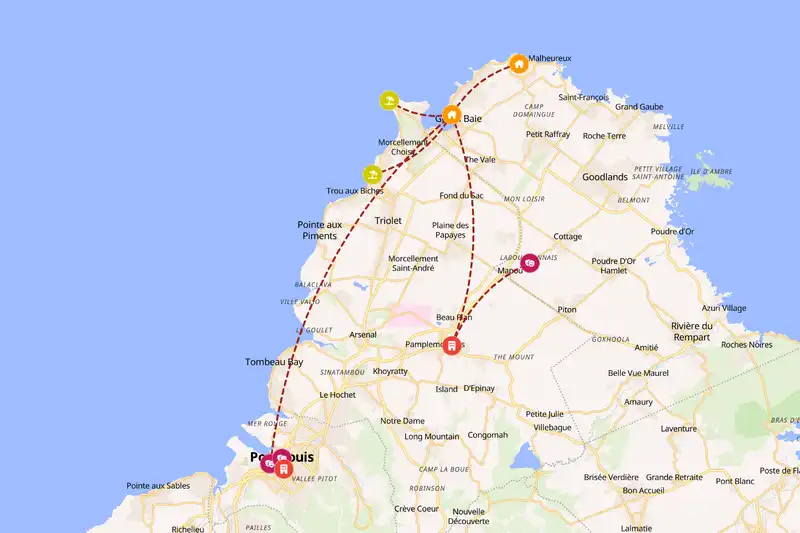
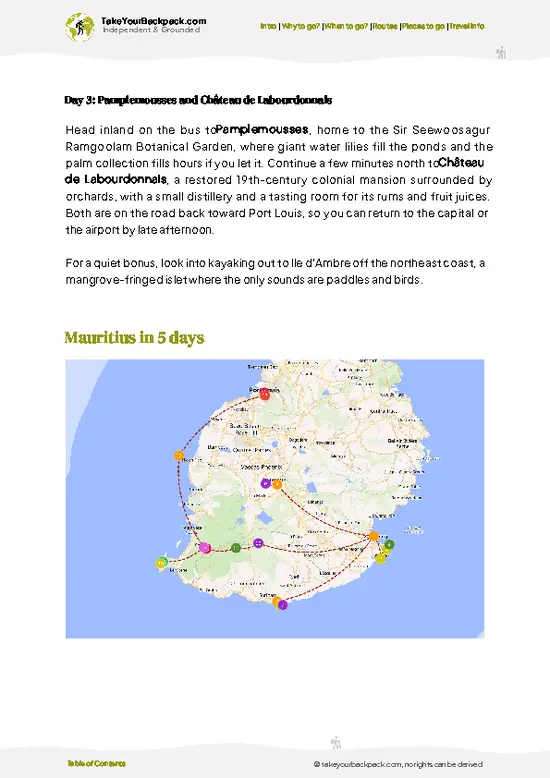
This five-day loop is for travelers who want the whole of Mauritius in one go: reef lagoon, crater lakes, rainforest gorges, the island’s most important mountain and its busy capital, without changing beds every night. The pace is relaxed, with one early start and one longer transfer day. Local buses carry you along most of the coast and between towns, a short boat ride takes you to Ile aux Aigrettes, and a hired taxi covers the central plateau, where bus service is thin.
Days 1-2: Mahebourg and the Southeast
The airport is a 15 to 20 minute taxi ride from
Mahebourg, so you start in an old fishing town instead of a resort strip. Drop your bag, then head five minutes down the road to
Blue Bay, where the marine park’s coral sits in water shallow enough to snorkel straight off the sand. Walk the shoreline back via
Pointe d’Esny, a calmer stretch of turquoise water lined with villas and kitesurfers, before dinner on Mahebourg’s waterfront.
Day two opens with
Ile aux Aigrettes Nature Reserve, …
read more 👉This five-day loop is for travelers who want the whole of Mauritius in one go: reef lagoon, crater lakes, rainforest gorges, the island’s most important mountain and its busy capital, without changing beds every night. The pace is relaxed, with one early start and one longer transfer day. Local buses carry you along most of the coast and between towns, a short boat ride takes you to Ile aux Aigrettes, and a hired taxi covers the central plateau, where bus service is thin.
Days 1-2: Mahebourg and the Southeast
The airport is a 15 to 20 minute taxi ride from Mahebourg, so you start in an old fishing town instead of a resort strip. Drop your bag, then head five minutes down the road to Blue Bay, where the marine park’s coral sits in water shallow enough to snorkel straight off the sand. Walk the shoreline back via Pointe d’Esny, a calmer stretch of turquoise water lined with villas and kitesurfers, before dinner on Mahebourg’s waterfront.
Day two opens with Ile aux Aigrettes Nature Reserve, reached by boat from Pointe Jérôme. The guided walk, run by the Mauritian Wildlife Foundation, passes Aldabra giant tortoises, pink pigeons and patches of the dry coastal forest that once covered this coast. Book ahead, since group sizes are capped. In the afternoon, take the coastal bus west (about an hour) to Souillac. Here the reef breaks off, and at Gris Gris the Indian Ocean hits black basalt cliffs with full force. Swimming is off the table, but the walk along the clifftop to La Roche qui Pleure, a rock that seems to weep as waves drain off it, makes this the wildest coastline of the trip.
Day 3: The Central Plateau to Chamarel
This is the transfer day, and it climbs. Catch a bus from Mahebourg to Curepipe (around an hour), the cool, damp town at the island’s center, and walk the 1 kilometer rim of Trou aux Cerfs, a dormant crater with views across to the west coast mountains on a clear morning. From Curepipe, a hired taxi (expect Rs 2,500 to 3,500, US$55 to 75) makes the rest of the day possible. First stop is Grand Bassin, the crater lake Hindus regard as sacred, guarded by a giant Shiva statue and lined with small temples where incense and offerings never seem to run out. Continue to the gorge viewpoint in Black River Gorges National Park, where the plateau drops away into forested valleys toward the sea. The road then winds down to Chamarel, a village of sugarcane fields and guesthouses where you spend the night. Arrive by mid-afternoon to tour the Rhumerie de Chamarel, which distills its rum straight from cane juice, and taste the agricole rums before they close.
Day 4: Le Morne to Flic en Flac
Set an alarm. A 20 to 25 minute taxi from Chamarel gets you to the trailhead of Le Morne Brabant by 7 a.m., ahead of the heat. The 556 meter mountain is a UNESCO site, remembered as a refuge for escaped slaves, and the climb takes 3 to 4 hours return, with a steep, hands-on final section where a local guide is a smart idea. Cool off afterward at Le Morne beach right below, where kitesurfers work the lagoon. In the late afternoon, ride the coast road north by bus or taxi to Flic en Flac, a long public beach with cheap snack stands and sunsets over the water.
Day 5: Port Louis
The bus from Flic en Flac reaches Port Louis in about an hour. Spend your last day at Aapravasi Ghat, the UNESCO-listed immigration depot where hundreds of thousands of indentured laborers, most from India, first set foot on the island from 1834 onward. It explains more about modern Mauritius than any beach can. Finish with lunch at the Central Market a few blocks away, then allow about an hour by taxi to the airport.
If you can squeeze in a spare morning near Port Louis, climb Le Pouce, the thumb-shaped peak behind the capital, for a view over the whole north of the island with almost nobody else on the trail.
 Best Backpacking