×

Mexico🇲🇽 | national parksCabo PulmoHard-coral reef, wade-in snorkeling, bull sharks, East Cape desert | things to do and best time to go

Explore Huatulco National ParkExplore Volcán Nevado de Colima

Backpacking in Cabo Pulmo
🏆 Top picknational park ranked #3
By Johan Kruseman 🇳🇱 | Updated October 20, 2026

Cabo Pulmo is not a resort strip with a snorkel tour bolted on; it is a tiny, mostly off-grid fishing community on the East Cape of Baja California Sur in Mexico, roughly two hours northeast of Cabo San Lucas. The national park protects the only hard-coral reef in the Gulf of California, and the draw is in the water: jacks, bull sharks, turtles, and schools so thick they blot out the light. On land you get desert scrub, dirt tracks, and a few hiking routes that are short and hot. Crowds stay thin because the road is rough and the town has no nightlife to speak of. I expected a reef you had to sail out to. Instead I waded in from the beach and had a school of jacks circling me within minutes, which felt suspiciously like cheating. The reef is close to shore because the park is small, so skip the pricey boat charters unless you want the farther dive sites. Bring cash and groceries, since the town has almost no shops and no ATM.

Discover everything you want to know in the 📖 Mexico Travel Guide.


example page 0 from our offline Travel Guide for Mexico
example page 1 from our offline Travel Guide for Mexico
example page 2 from our offline Travel Guide for Mexico
example page 3 from our offline Travel Guide for Mexico
example page 4 from our offline Travel Guide for Mexico
example page 5 from our offline Travel Guide for Mexico
example page 6 from our offline Travel Guide for Mexico
example page 7 from our offline Travel Guide for Mexico
Loading the map 🌍
CLICK TO FILTER
cities
towns
villages
landmarks
national parks
hikes
beaches
attractions
festivals
regions
SHOW COUNTRY’S BESTSHOW ALL

✨ Why go?
Ranked #3 national park in Mexico
Why visitors keep coming back

Cabo Pulmo works for backpackers because the best thing here needs no tour operator. You can snorkel straight off the beach at the Los Arbolitos end of the bay, using your own mask and fins, and meet turtles and parrotfish in shallow water. That makes it one of the few world-class marine sites where a self-guided traveler spends nothing extra to see the main show.

The second reason is the camping. Palm-shaded beach sites and basic spots along the sandy coast keep the stay simple and cheap, and the quiet after dark is the kind you notice. With no clubs and almost no light pollution, the night sky does the entertaining.

The park also holds a conservation story worth knowing. Local fishermen shut their own waters to fishing in the 1990s, and by the 2000s fish biomass had grown several times … read more 👉
Cabo Pulmo works for backpackers because the best thing here needs no tour operator. You can snorkel straight off the beach at the Los Arbolitos end of the bay, using your own mask and fins, and meet turtles and parrotfish in shallow water. That makes it one of the few world-class marine sites where a self-guided traveler spends nothing extra to see the main show.

The second reason is the camping. Palm-shaded beach sites and basic spots along the sandy coast keep the stay simple and cheap, and the quiet after dark is the kind you notice. With no clubs and almost no light pollution, the night sky does the entertaining.

The park also holds a conservation story worth knowing. Local fishermen shut their own waters to fishing in the 1990s, and by the 2000s fish biomass had grown several times over, which is why the reef sharks and giant schools of jacks turn up so reliably. You are swimming in proof that protection works. If you prefer guided hikes, packaged evenings, and restaurants on every corner, look elsewhere. If you like self-sufficiency, this is a natural fit.

💡 HighlightsDon't-miss highlights and experiences

  1. Cabo Pulmo Reef: The only major hard-coral reef in the Gulf of California, estimated at around 20,000 years old. Healthy coral heads, sea fans, and clouds of fish sit a short swim from shore.
  2. Los Arbolitos: A rocky point with coral and fish close to the beach. Good for first-time snorkelers because you can walk in and the water is often calm.
  3. El Cantil: A dive site where a wall drops off and big schools of jacks gather. Divers also see bull sharks here in certain seasons, usually in the cooler months.
  4. Los Frailes (Cabo Pulmo Bay side): A pair of rock formations near the bay with rich marine life, reached by boat. Sea lions often lounge nearby.
  5. Bull shark encounters: Dive operators run trips to see bull sharks from late fall into winter. The sharks are large but calm around trained guides.
  6. Whale
… read more 👉
  1. Cabo Pulmo Reef: The only major hard-coral reef in the Gulf of California, estimated at around 20,000 years old. Healthy coral heads, sea fans, and clouds of fish sit a short swim from shore.
  2. Los Arbolitos: A rocky point with coral and fish close to the beach. Good for first-time snorkelers because you can walk in and the water is often calm.
  3. El Cantil: A dive site where a wall drops off and big schools of jacks gather. Divers also see bull sharks here in certain seasons, usually in the cooler months.
  4. Los Frailes (Cabo Pulmo Bay side): A pair of rock formations near the bay with rich marine life, reached by boat. Sea lions often lounge nearby.
  5. Bull shark encounters: Dive operators run trips to see bull sharks from late fall into winter. The sharks are large but calm around trained guides.
  6. Whale watching offshore: Humpback whales pass through the Gulf in winter and early spring. Boat operators run seasonal trips from town.
  7. Beach at Cabo Pulmo town: A wide sweep of pale sand with waves you can watch from a hammock. Turtles surface close in on calm mornings.
  8. Desert hikes behind the beach: Short tracks into cardon cactus country offer wide views over the bay and hot, silent walks away from the water.
The beach at Cabo Pulmo is free to walk and swim, and snorkeling from shore costs only the national park fee, which is small.
Spotted a mistake or missing something? Contact us.

Things to do around Cabo Pulmo

Ratings based on Tripadvisor reviews. When you book through this link, you support our work at no extra cost to you.

🌤️ When to go?When to go for the best experience

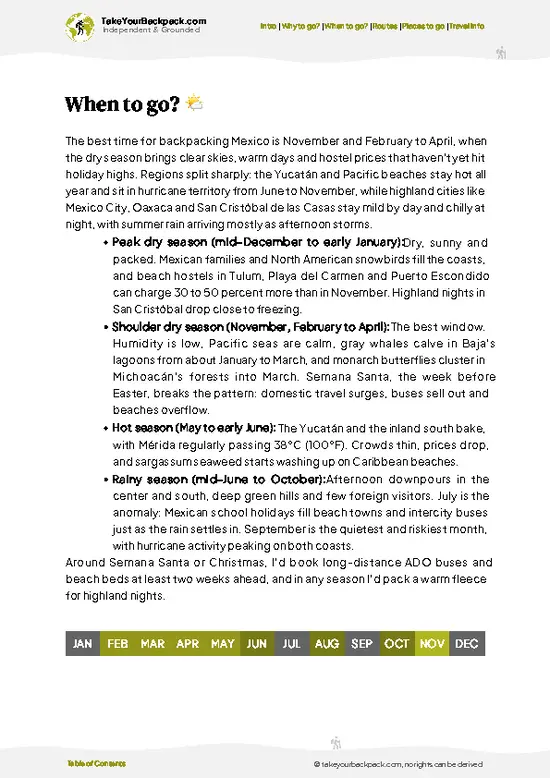
November through June is the window for Cabo Pulmo, with the clearest, calmest water for snorkeling usually from late spring into autumn, and the most comfortable air temperatures from November to April.
  • Winter (December to February): Days run 24 to 28°C (75 to 82°F), nights drop to 14 to 17°C (57 to 63°F). Water sits around 22 to 24°C (72 to 75°F), so bring a 3 mm wetsuit. Whale sharks and humpbacks are possible offshore, and winter northers can stir up the sea. Daylight is about 10.5 hours.
  • Spring (March to June): Highs of 28 to 34°C (82 to 93°F), dry, and calm seas with good visibility. Water warms from 23 to 27°C (73 to 81°F). Easter week fills the few rooms.
  • Summer (July to September): Hot at 33 to 38°C (91 to 100°F) with high humidity, water of 28 to 30°C (82 to 86°F), and the best bull
… read more 👉
November through June is the window for Cabo Pulmo, with the clearest, calmest water for snorkeling usually from late spring into autumn, and the most comfortable air temperatures from November to April.
  • Winter (December to February): Days run 24 to 28°C (75 to 82°F), nights drop to 14 to 17°C (57 to 63°F). Water sits around 22 to 24°C (72 to 75°F), so bring a 3 mm wetsuit. Whale sharks and humpbacks are possible offshore, and winter northers can stir up the sea. Daylight is about 10.5 hours.
  • Spring (March to June): Highs of 28 to 34°C (82 to 93°F), dry, and calm seas with good visibility. Water warms from 23 to 27°C (73 to 81°F). Easter week fills the few rooms.
  • Summer (July to September): Hot at 33 to 38°C (91 to 100°F) with high humidity, water of 28 to 30°C (82 to 86°F), and the best bull shark and reef action. Hurricane season peaks in September, and the dirt road can wash out. Rooms are cheapest.
  • Autumn (October to November): Storm risk fades by November and the crowds are still thin. Water is still warm.
Book winter weekends and Easter week weeks ahead, and check the hurricane forecast for any trip from August to October.


source: climatestotravel.comJANJanuary: excellent for travelingFEBFebruary: excellent for travelingMARMarch: excellent for travelingAPRApril: highly recommended for travelingMAYMay: highly recommended for travelingJUNJune: fair for travelingJULJuly: fair for travelingAUGAugust: fair for travelingSEPSeptember: fair for travelingOCTOctober: good for travelingNOVNovember: highly recommended for travelingDECDecember: highly recommended for traveling
mexico-national-park-cabo-pulmo v1
© Google |

✈️ The backpacker research shortcutMexico Travel Guide

An offline-friendly backpacking guide with optimized travel routes, ranked highlights, transport advice, and the best areas to stay.
example page 0 from our offline Travel Guide for Mexico
example page 1 from our offline Travel Guide for Mexico
example page 2 from our offline Travel Guide for Mexico
example page 3 from our offline Travel Guide for Mexico
example page 4 from our offline Travel Guide for Mexico
example page 5 from our offline Travel Guide for Mexico
example page 6 from our offline Travel Guide for Mexico
example page 7 from our offline Travel Guide for Mexico
The digital guide (402 pages) contains:
✅ 138 highlights, ranked by travel appeal
✅ Optimized 7, 14 & 21-day travel routes
✅ Cities, national parks, landmarks, beaches
✅ How to get around
✅ Offline-friendly for travel without Wi-Fi
👉 Click to see all 30+ guide features

📅 Plan smarter in minutes, not weeks
✅ Month by month travel advice
✅ Festivals & national holidays
✅ Budget expectations

🗺️ Go to the right places, skip the overrated ones
✅ Honest pros & cons of destinations
✅ Top hikes, parks & viewpoints
✅ Lesser-known places most travelers miss
✅ Clear “worth it vs skip it” guidance

🛏️ Travel smoothly without rookie mistakes
✅ Best areas to stay
✅ Transport systems explained simply
✅ Common scams & safety advice
✅ SIM cards, money & practical tips

🌍 Understand the country, not just visit it
✅ Culture & traditions
✅ 52 Essential phrases & customs
✅ Festivals worth planning around
✅ Traveler-friendly historical context
✅ Insights that make places more meaningful

📱 Built for real travel conditions
✅ Fully downloadable PDF
✅ Works completely offline
✅ Optimized for phone use
✅ Useful in remote areas & buses
✅ Everything in one place
Stop searching, start planning
Get instant access to your full guide. 30‑day money-back guarantee.
+ Add another guide for just

By proceeding you agree to our terms.
Sent to your inbox immediately after payment • 100% Secure Checkout
Best Backpacking Travel Advisor 2025 tourism awardBest Backpacking
Travel Advisor
2025
What others say about Take Your Backpack Guides:
⭐⭐⭐⭐⭐
Fantastic, amazing amount of information!
⭐⭐⭐⭐⭐
My goodness this is amazing, it's what I've been looking for hats off too you!
⭐⭐⭐⭐⭐
I think this is absolutely BRILLIANT
⭐⭐⭐⭐
Very complete and informative. It's still missing places, but I gotta to commend you
⭐⭐⭐⭐⭐
This is truly amazing, thank you, can't wait to explore it with my kids!
⭐⭐⭐⭐⭐
Awesome resource, thank you!
⭐⭐⭐⭐⭐
This is amazing! Can't wait to explore the ones I haven't seen
⭐⭐⭐⭐
I love this! Well done, great idea.
⭐⭐⭐⭐⭐
Thanks for taking the time to make this gem!
⭐⭐⭐⭐⭐
This might be the best website I've ever seen.
⭐⭐⭐⭐⭐
Congratulations, and thank you so much for your work; it's incredibly valuable.
⭐⭐⭐⭐
In all seriousness I think you did a great job pointing out the important spots
⭐⭐⭐⭐⭐
10/10 very good
⭐⭐⭐⭐⭐
As someone who's only just starting to visit regularly this is awesome, thank you.
⭐⭐⭐⭐
Thank you very much! I'm going to visit my dad, it's going to be very useful!
⭐⭐⭐⭐⭐
This is really cool! We'll be travelling for the first time and this definitely come in handy.
⭐⭐⭐⭐⭐
You are now our minister of culture, congratulations 👨‍💼
⭐⭐⭐⭐⭐
Just wanted to tell you that this is a pearl! Going to follow your recommendations.
⭐⭐⭐⭐⭐
This is so cool. I'll definitely be using the resource for my travels soon.
⭐⭐⭐⭐⭐
This is very impressive! Good work.
⭐⭐⭐⭐⭐
This is an amazing and informative site. Very well done!

🛏️ Where to stay?How to pick the right area

Cabo Pulmo village itself is the best base, with a handful of small eco-lodges, cabins and camping spots right by the reef, and no hotel chains. Rooms in the village are simple, often with fans or solar power, and book out in winter, so reserve ahead. Beds run roughly US$60 to 150 a night for a private room, while camping sites cost about US$10 to 25 per person at beachside spots in the village. Some places have basic shared kitchens, and a few have a small restaurant on site. Shops are minimal, so stock up before arriving.
Inside the marine park boundary, you can sleep only in the village area … read more 👉
Cabo Pulmo village itself is the best base, with a handful of small eco-lodges, cabins and camping spots right by the reef, and no hotel chains. Rooms in the village are simple, often with fans or solar power, and book out in winter, so reserve ahead. Beds run roughly US$60 to 150 a night for a private room, while camping sites cost about US$10 to 25 per person at beachside spots in the village. Some places have basic shared kitchens, and a few have a small restaurant on site. Shops are minimal, so stock up before arriving.
Inside the marine park boundary, you can sleep only in the village area or on its edges. Camping on the empty beaches north and south along the coast is common, but bring all your water and carry out your trash.
For more choice, stay in nearby towns. Los Barriles, about 45 minutes to an hour north by road, has hostels, budget hotels and wind-sport crowds, with rooms from about US$40 to 90. San José del Cabo is roughly 1.5 to 2 hours southwest and has the widest range, from hostel dorms around US$20 to 35 to midrange hotels. Staying outside means a rental car or a pre-arranged transfer, and you will want to be at the beach early for the calmest water.

👛 Costs (as of 20 October 2026)Typical daily expenses

A realistic budget for Cabo Pulmo is about US$110 a day if you camp or take a basic room, snorkel with a local operator and eat in the village.
CategoryBudget RangeLocal Reality
Park entryUS$3 to 6A small marine park fee is typically collected locally, and it is often paid in pesos.
Accommodation (high season)US$25 to 100Camping is about US$10 to 25 per person, while a simple cabin or room costs US$60 to 150 in winter.
Local transportUS$10 to 50A rental car from San José del Cabo costs about US$40 to 70 a day plus fuel. Shuttle transfers are pricier, and hitchhiking is unreliable.
Food and suppliesUS$20 to 40Fish tacos and village restaurant meals run US$8 to 18. Groceries are limited, so stock up beforehand.
Snorkel or dive tourUS$50 to 120A snorkel boat trip costs about US$50 to 80, and a two-tank
… read more 👉
A realistic budget for Cabo Pulmo is about US$110 a day if you camp or take a basic room, snorkel with a local operator and eat in the village.
CategoryBudget RangeLocal Reality
Park entryUS$3 to 6A small marine park fee is typically collected locally, and it is often paid in pesos.
Accommodation (high season)US$25 to 100Camping is about US$10 to 25 per person, while a simple cabin or room costs US$60 to 150 in winter.
Local transportUS$10 to 50A rental car from San José del Cabo costs about US$40 to 70 a day plus fuel. Shuttle transfers are pricier, and hitchhiking is unreliable.
Food and suppliesUS$20 to 40Fish tacos and village restaurant meals run US$8 to 18. Groceries are limited, so stock up beforehand.
Snorkel or dive tourUS$50 to 120A snorkel boat trip costs about US$50 to 80, and a two-tank dive about US$100 to 140. Gear rental is extra.
Total Daily BudgetUS$108 to 316Roughly US$110 for a tight budget with camping and one activity.
⚠️ Prices can change and everyone travels differently, so take this as a rough guide. Hope it helps you plan your adventure!

🥾 TrailsExploring Cabo Pulmo: trails, terrain, and views

Cabo Pulmo has no long, marked trail network, so the walking here is short and sandy, and the real exploring happens in the water.

  • Beach walk along the bay: A flat stroll of 2 to 4 kilometers on packed sand, taking an hour or two. You pass anchored fishing boats and tide pools, with snorkel stops along the way.
  • Los Arbolitos track: A short, easy path from town toward the rocky point, about 30 to 45 minutes each way over sand and loose stone. You get wide views of the reef edge.
  • Desert ridge scramble: An informal climb up dry hillsides behind the village, 1 to 2 hours round trip on rocky, thorny
… read more 👉
Cabo Pulmo has no long, marked trail network, so the walking here is short and sandy, and the real exploring happens in the water.

  • Beach walk along the bay: A flat stroll of 2 to 4 kilometers on packed sand, taking an hour or two. You pass anchored fishing boats and tide pools, with snorkel stops along the way.
  • Los Arbolitos track: A short, easy path from town toward the rocky point, about 30 to 45 minutes each way over sand and loose stone. You get wide views of the reef edge.
  • Desert ridge scramble: An informal climb up dry hillsides behind the village, 1 to 2 hours round trip on rocky, thorny ground. Cardon cactus, lizards, and quail show up, and the view over the bay is the main prize. Moderate effort in strong sun.
  • Dirt road walks: Sandy tracks run north and south along the coast. They are quiet and exposed, so choose early morning, and expect coyote tracks and hawks.
The terrain is hot and dusty, so wear closed shoes for the ridge and sandals for the sand. Wildlife is mostly marine: turtles, rays, sea lions, and schools of fish, plus whales in winter. On land you might spot roadrunners, ospreys, and rattlesnakes in warm months, so watch your step.

Getting there is the hard part. No regular public transport reaches the village, so most travelers rent a car or share a ride from the Los Cabos area. The last stretch is a rough dirt road that can wash out after storms. Once you arrive, everything is walkable. Crowds are light most of the year, with a bit more activity in winter and around holidays. There is a modest national park fee for snorkeling and diving, and you pay in pesos, so carry cash because card machines are rare.
⚠️ Hiking info can sometimes be outdated or inaccurate. Before you hit the trail, check the latest conditions with locals. If you do spot anything that's off, I'd love to hear from you, so I can update it for fellow travelers.

🛡️ SafetyStaying Safe: What Travelers Should Know

Cabo Pulmo is a calm, well-run marine park, and most problems come from sun, heat and the road in. Summer afternoons regularly pass 35°C (95°F), so snorkel in the morning, wear a rash guard, and use reef-safe sunscreen, which the park asks of every visitor. Shade is scarce along the beaches and trails.
The final stretch of road is partly washboard dirt, and it can be rough after summer storms and hurricanes, so drive slowly and carry a spare tire. Mobile coverage is patchy, so tell someone your plan.
Currents can pick up on the outer reef, particularly in winter when northers blow. Use a licensed local operator for boat dives and snorkel trips, stay with your group, and do not touch or stand on the coral. Bull sharks live here and are usually calm around divers who stay still and keep their … read more 👉
Cabo Pulmo is a calm, well-run marine park, and most problems come from sun, heat and the road in. Summer afternoons regularly pass 35°C (95°F), so snorkel in the morning, wear a rash guard, and use reef-safe sunscreen, which the park asks of every visitor. Shade is scarce along the beaches and trails.
The final stretch of road is partly washboard dirt, and it can be rough after summer storms and hurricanes, so drive slowly and carry a spare tire. Mobile coverage is patchy, so tell someone your plan.
Currents can pick up on the outer reef, particularly in winter when northers blow. Use a licensed local operator for boat dives and snorkel trips, stay with your group, and do not touch or stand on the coral. Bull sharks live here and are usually calm around divers who stay still and keep their distance. Scorpions and rattlesnakes are possible on land, so shake out shoes and watch your step at night. Keep cash and valuables locked, as petty theft from parked cars is possible.

FAQCommon questions from travelers

Two to three days suit Cabo Pulmo for most backpackers. That gives you at least two snorkel or dive outings on the reef, plus time for a beach walk and a quiet evening. Divers and those wanting to explore the nearby coast can stretch to four or five days.
Cabo Pulmo is hard without a car, though not impossible. The village sits about 1.5 to 2 hours by road from San José del Cabo, with the last stretch being dirt, and there is no regular public bus. You can book a private shuttle (roughly US$100 to 150 each way) or rent a car for about US$40 to 70 a day, and once in the village you can walk to the beach and dive shops.
Yes, Cabo Pulmo charges a small marine park fee, around US$3 to 6 a person, usually paid in pesos at the village. No advance permit is needed for snorkeling or swimming. Diving and boat trips require a licensed local operator, whose tour price typically includes the park fee.
⚠️ Things can change over time, so always validate details locally before you go.

Other Mexican national parks near Cabo Pulmo

Explore more nearby:

  • Isla Isabel—Blue-footed boobies, frigatebird colony, crater lakes, camping island| 405 km away
  • Copper Canyon—Chepe railway, Divisadero rim, Creel, Batopilas descent| 485 km away
  • Basaseachic Falls—246-meter drop, rim lookouts, plunge-pool descent, Candameña gorge| 541 km away

💡 Not sure where to go next?
Create a personalized itinerary for Mexico including Cabo Pulmo and the places that fit your trip.

Generate my itinerary

👉 Discover all national parks

Or checkout all Mexico has to offer (think cities, towns, villages, national parks, hikes, beaches, festivals)
Country photo of Mexico

We 💚 feedbackKey takeaways before you go

Cabo Pulmo is easy to treat as a one-day snorkel stop, and that is the mistake, because the quiet hours matter most. The water is calmest and clearest in the early morning, before the day boats arrive. I would stay at least two nights, pack your own food, and get in the water at first light.

✈️ When did I visit Mexico?
As part of my 1.5 year travel around the world trip, I visited Mexico in February and March 2016. Had to hurry a bit as I didn’t want to miss the free performance of the Rolling Stones in Cuba.

✍️ Help improve this page!
The information on this page is based on my own backpacking experience in Mexico, supplemented with up-to-date research and feedback from other travelers. Travel details can change, so if you notice anything outdated or incomplete, feel free to let me know.


🙋‍♂️ Give feedback

👋 Meet the founderWho’s Behind Take Your Backpack?

Johan, backpacker and founder of TakeYourBackpackHi, I’m Johan (Netherlands 🇳🇱), the creator of TakeYourBackpack. Over the past 3 decades, I’ve backpacked through 90+ countries across six continents, gaining extensive experience with independent travel, long-term trips, and overland routes.

This site is built on a combination of firsthand travel experience and carefully curated insights from other backpackers. Many guides are based on places I’ve personally visited, while others bring together tips, observations, and practical advice shared by trusted travelers I’ve met along the way.

The goal is to provide realistic, experience-driven guidance — not generic itineraries — so you can explore destinations with better context, clearer expectations, and more confidence.