×

Mozambique🇲🇿 | citiesNampulaInland crossroads, ethnology museum, colonial station, ebony carvings | things to do and best time to go

Explore MaputoExplore Pemba

Backpacking in Nampula
🌟 Highlightcity ranked #7
By Johan Kruseman 🇳🇱 | Updated October 22, 2026

Nampula is not on the coast, though plenty of travelers assume a Mozambican city this size must sit by the sea; it lies inland, in the north of Mozambique, a few hours from the beaches. Come anyway, because this is the region’s crossroads, loud with minibus horns, market stalls and Makua and Swahili-influenced coastal culture. The art museum and the old railway station reward a wander, while the downtown grid itself is mostly traffic and concrete, so don’t linger over it. It suits curious travelers who like markets and rough edges, and bores anyone who needs polish or nightlife. Carry cash in meticais from an ATM on arrival, since cards are accepted in few places.

Discover everything you want to know in the 📖 Mozambique Travel Guide.


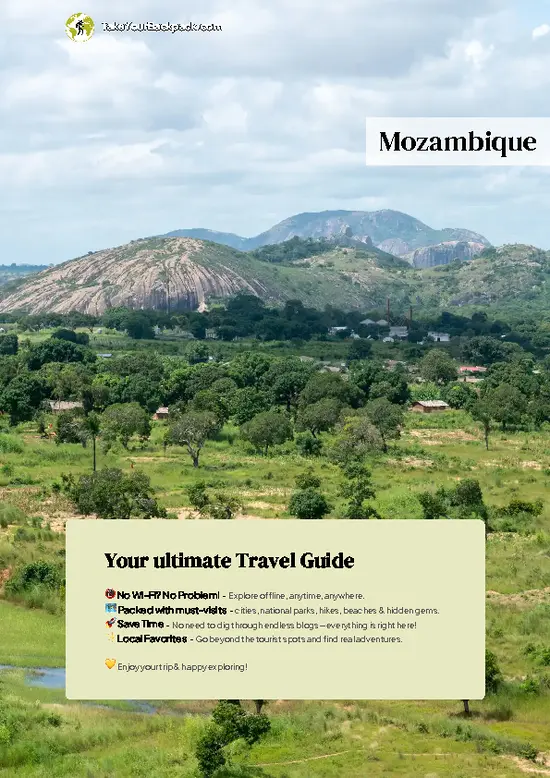
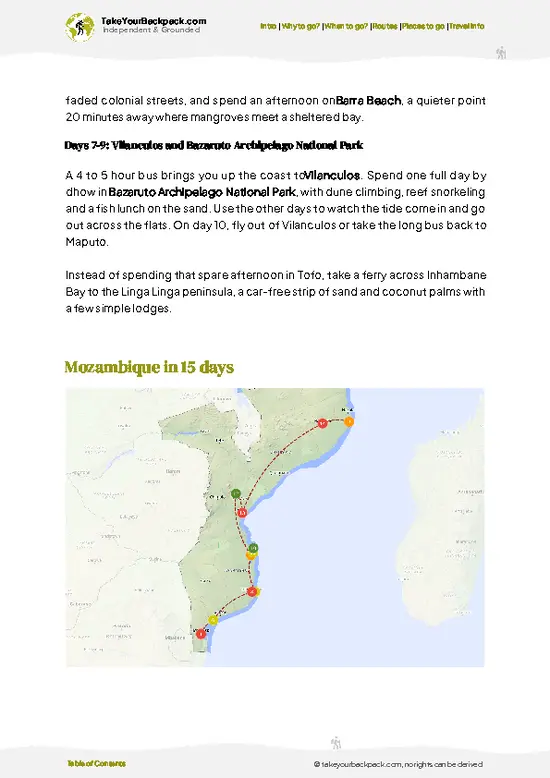
example page 0 from our offline Travel Guide for Mozambique
example page 1 from our offline Travel Guide for Mozambique
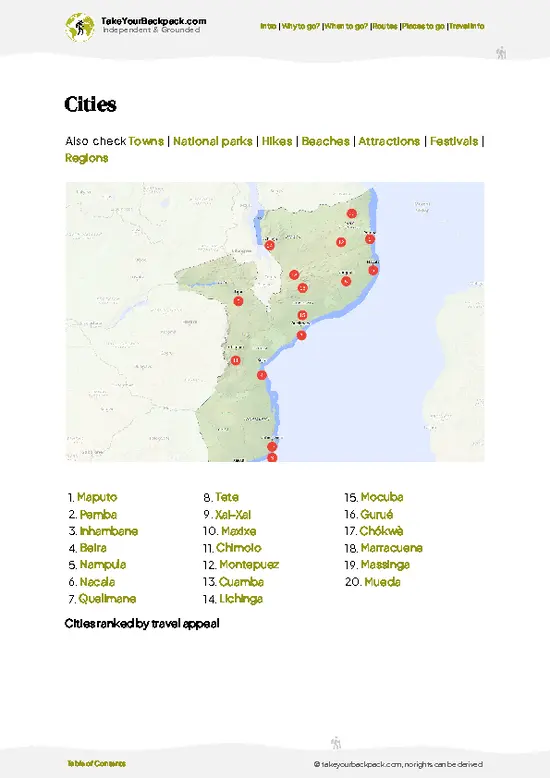
example page 2 from our offline Travel Guide for Mozambique
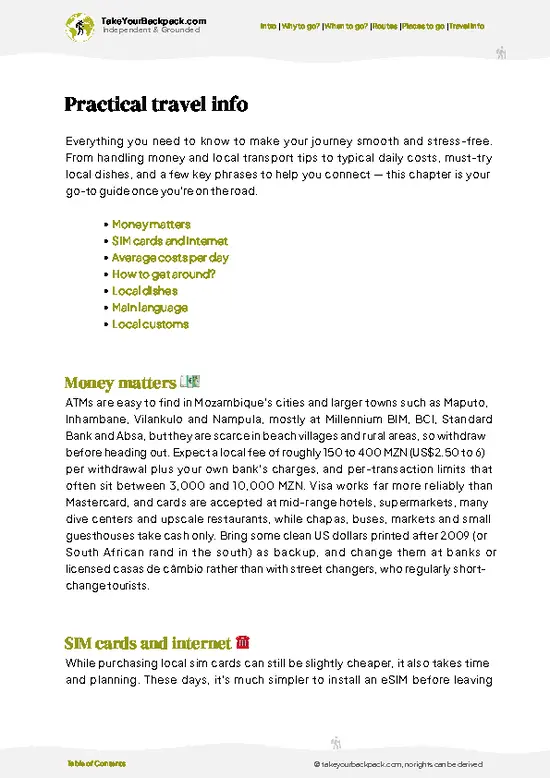
example page 3 from our offline Travel Guide for Mozambique
example page 4 from our offline Travel Guide for Mozambique
example page 5 from our offline Travel Guide for Mozambique
example page 6 from our offline Travel Guide for Mozambique
example page 7 from our offline Travel Guide for Mozambique
Loading the map 🌍
CLICK TO FILTER
cities
towns
national parks
hikes
beaches
attractions
festivals
regions
SHOW COUNTRY’S BESTSHOW ALL

✨ Why go?
Ranked #7 city in Mozambique
The unique appeal for travelers

Nampula is the northern hub that every route through this part of Mozambique eventually touches, and that alone justifies a night or two. From here you can branch toward the coast and island, toward Lake Niassa, or up to the Tanzanian border, so it works as a place to sort out buses, cash and supplies. A handful of solid guesthouses and hostel-style rooms make that easy. The city also has a real museum scene for its size, anchored by the Museu Nacional de Etnologia, and the markets are working markets rather than tourist stages. Food leans on grilled chicken, coconut-heavy sauces and fresh bread from street corners. Walking is fine in the center by day, but distances sprawl. Treat Nampula as a practical, interesting pause of one to two days, not a place to settle for a week. Anyone chasing Ilha de Moçambique will pass through anyway.

💡 HighlightsKey sights and experiences for travelers

  1. Museu Nacional de Etnologia: The country’s main ethnographic museum, with masks, Makonde carvings, musical instruments and displays on northern traditions. Go in the morning when it’s quiet. Entry is roughly US$1 to 3, and 1 to 1.5 hours is plenty.
  2. Nampula Railway Station: A fine colonial-era building on the line toward Malawi, with a worth-seeing platform scene when trains run. Early morning is liveliest. Free to look, 20 to 30 minutes.
  3. Cathedral of Our Lady of Fatima: A large modern-era cathedral with a striking bell tower and a calm interior, a good counterpoint to the street noise. Visit outside Sunday services. Free, 20 to 30 minutes.
  4. Mercado Central: Piles of capulana cloth, spices, dried fish, cashews and secondhand clothes. Go before 10 AM, keep valuables hidden, and allow 1 to 2 hours.
… read more 👉
  1. Museu Nacional de Etnologia: The country’s main ethnographic museum, with masks, Makonde carvings, musical instruments and displays on northern traditions. Go in the morning when it’s quiet. Entry is roughly US$1 to 3, and 1 to 1.5 hours is plenty.
  2. Nampula Railway Station: A fine colonial-era building on the line toward Malawi, with a worth-seeing platform scene when trains run. Early morning is liveliest. Free to look, 20 to 30 minutes.
  3. Cathedral of Our Lady of Fatima: A large modern-era cathedral with a striking bell tower and a calm interior, a good counterpoint to the street noise. Visit outside Sunday services. Free, 20 to 30 minutes.
  4. Mercado Central: Piles of capulana cloth, spices, dried fish, cashews and secondhand clothes. Go before 10 AM, keep valuables hidden, and allow 1 to 2 hours. Free to enter; cashews cost a few US dollars a bag.
  5. Makonde carving stalls: Craft sellers around the center offer ebony and blackwood carvings. Bargain hard and expect to pay about US$5 to 60 depending on size. Allow 45 minutes.
  6. Praça dos Heróis: A civic square where locals gather in the late afternoon, good for people-watching and a cold drink nearby. Free, 30 minutes.
Beyond the city, day trips can reach Monapo and its granite hills, and with an early start the Portuguese fort and old stone town of Ilha de Moçambique are reachable from Nampula, though an overnight there is better. Start with the Museu Nacional de Etnologia, since its context makes the markets and carvings that follow far easier to read.
Spotted a mistake or missing something? Contact us.

🏘️ NeighborhoodsUnderstanding the local layout

Nampula sprawls across a plateau, and the parts worth your time sit close together, so lace up and cover them in bursts.
  • Centro: Start here. Wide colonial avenues, the twin-towered cathedral, the old railway station and the Praça dos Trabalhadores square pack the best strolling into an hour or two. Cafés and grill spots stay open into the evening, and it’s the only area I’d walk after dark.
  • Mercado Central and Mercado Waresta zone: Dive in for stacked capulana cloth, dried fish, cassava flour and phone-repair stalls. Hold your bag in front and go before noon, when the heat and the crowds peak.
  • Museu Nacional de Etnologia area: Head east to this museum, which holds masks, Makonde carvings and Makua cultural displays. It’s small, quick and the best cultural stop in town, so don’t skip it.
  • Muhala
… read more 👉
Nampula sprawls across a plateau, and the parts worth your time sit close together, so lace up and cover them in bursts.
  • Centro: Start here. Wide colonial avenues, the twin-towered cathedral, the old railway station and the Praça dos Trabalhadores square pack the best strolling into an hour or two. Cafés and grill spots stay open into the evening, and it’s the only area I’d walk after dark.
  • Mercado Central and Mercado Waresta zone: Dive in for stacked capulana cloth, dried fish, cassava flour and phone-repair stalls. Hold your bag in front and go before noon, when the heat and the crowds peak.
  • Museu Nacional de Etnologia area: Head east to this museum, which holds masks, Makonde carvings and Makua cultural displays. It’s small, quick and the best cultural stop in town, so don’t skip it.
  • Muhala and Namicopo: These residential districts hold local life, with txopela tricycle taxis, roadside barbecues and neighborhood bars. Visit by day for the atmosphere, but there’s little to see and the streets are rough, so don’t make it a destination.
  • Napipine and the outskirts: Largely suburban sprawl, with a few lodges and bus yards. Pass through, but don’t linger.

⌛️ 1 dayA smart one-day plan

8:00 AM: Museu Nacional de Etnologia. Start here, before the heat and crowds, to get your bearings on Makua and Makonde culture. Take about 90 minutes, then walk or take a short taxi ride back toward the center.
10:00 AM: Mercado Central. Wander the cloth, spice and dried-fish stalls while trading is at its peak. Buy fruit or cashews for later, and keep your phone in a front pocket.
12:30 PM: Lunch near Praça dos Heróis. Order grilled chicken with rice or a coconut sauce at a local restaurant, then rest in the shade of the square.
2:30 PM: Cathedral of Our Lady of Fatima. A short walk or taxi ride away. The cool interior is a quiet break, and the tower makes a good photo.
4:00 PM: Makonde carving stalls. Spend time comparing pieces and bargaining. Ask the carvers about their styles; they usually … read more 👉
8:00 AM: Museu Nacional de Etnologia. Start here, before the heat and crowds, to get your bearings on Makua and Makonde culture. Take about 90 minutes, then walk or take a short taxi ride back toward the center.
10:00 AM: Mercado Central. Wander the cloth, spice and dried-fish stalls while trading is at its peak. Buy fruit or cashews for later, and keep your phone in a front pocket.
12:30 PM: Lunch near Praça dos Heróis. Order grilled chicken with rice or a coconut sauce at a local restaurant, then rest in the shade of the square.
2:30 PM: Cathedral of Our Lady of Fatima. A short walk or taxi ride away. The cool interior is a quiet break, and the tower makes a good photo.
4:00 PM: Makonde carving stalls. Spend time comparing pieces and bargaining. Ask the carvers about their styles; they usually enjoy explaining.
5:30 PM: Nampula Railway Station. Rarely on tourist lists, this is where locals load goods and wait for trains as the day cools. Watch the platform activity, then grab a taxi back to your guesthouse for dinner.

🌤️ When to go?Seasonal considerations and timing

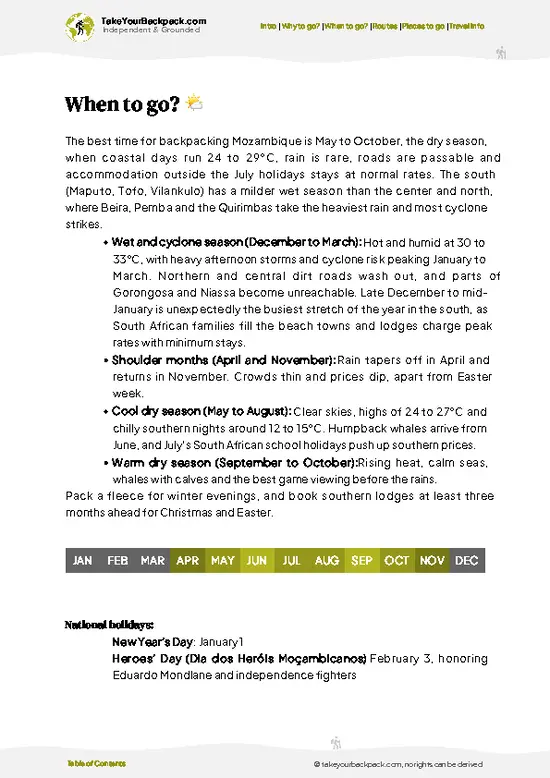
The cool dry months from May to September suit Nampula best for backpacking.
  • Cool Dry Season (May to August): Days reach 24 to 28°C (75 to 82°F) and nights dip to 14 to 17°C (57 to 63°F) at this 430-meter elevation. Roads are firm, days run about 11 hours and prices stay steady.
  • Hot Build-Up (September to November): Highs hit 31 to 35°C (88 to 95°F) with dusty air. Crowds are thin and rooms are easy to find.
  • Rainy Season (December to April): Expect 26 to 31°C (79 to 88°F), humid days, afternoon downpours and muddy side roads. Cyclone remnants sometimes arrive from January to March, and transport slows.
Aim for June or July if you plan to continue to the coast, because beach and island accommodation tightens then.

source: climatestotravel.comJANJanuary: fair for travelingFEBFebruary: fair for travelingMARMarch: fair for travelingAPRApril: fair for travelingMAYMay: highly recommended for travelingJUNJune: highly recommended for travelingJULJuly: excellent for travelingAUGAugust: excellent for travelingSEPSeptember: highly recommended for travelingOCTOctober: highly recommended for travelingNOVNovember: fair for travelingDECDecember: fair for traveling
when-to-go

✈️ The backpacker research shortcutMozambique Travel Guide

An offline-friendly backpacking guide with optimized travel routes, ranked highlights, transport advice, and the best areas to stay.
example page 0 from our offline Travel Guide for Mozambique
example page 1 from our offline Travel Guide for Mozambique
example page 2 from our offline Travel Guide for Mozambique
example page 3 from our offline Travel Guide for Mozambique
example page 4 from our offline Travel Guide for Mozambique
example page 5 from our offline Travel Guide for Mozambique
example page 6 from our offline Travel Guide for Mozambique
example page 7 from our offline Travel Guide for Mozambique
The digital guide (324 pages) contains:
✅ 78 highlights, ranked by travel appeal
✅ Optimized 5, 10 & 15-day travel routes
✅ Cities, national parks, landmarks, beaches
✅ How to get around
✅ Offline-friendly for travel without Wi-Fi
👉 Click to see all 30+ guide features

📅 Plan smarter in minutes, not weeks
✅ Month by month travel advice
✅ Festivals & national holidays
✅ Budget expectations

🗺️ Go to the right places, skip the overrated ones
✅ Honest pros & cons of destinations
✅ Top hikes, parks & viewpoints
✅ Lesser-known places most travelers miss
✅ Clear “worth it vs skip it” guidance

🛏️ Travel smoothly without rookie mistakes
✅ Best areas to stay
✅ Transport systems explained simply
✅ Common scams & safety advice
✅ SIM cards, money & practical tips

🌍 Understand the country, not just visit it
✅ Culture & traditions
✅ 52 Essential phrases & customs
✅ Festivals worth planning around
✅ Traveler-friendly historical context
✅ Insights that make places more meaningful

📱 Built for real travel conditions
✅ Fully downloadable PDF
✅ Works completely offline
✅ Optimized for phone use
✅ Useful in remote areas & buses
✅ Everything in one place
Stop searching, start planning
Get instant access to your full guide. 30‑day money-back guarantee.
+ Add another guide for just

By proceeding you agree to our terms.
Sent to your inbox immediately after payment • 100% Secure Checkout
Best Backpacking Travel Advisor 2025 tourism awardBest Backpacking
Travel Advisor
2025
What others say about Take Your Backpack Guides:
⭐⭐⭐⭐⭐
Fantastic, amazing amount of information!
⭐⭐⭐⭐⭐
My goodness this is amazing, it's what I've been looking for hats off too you!
⭐⭐⭐⭐⭐
I think this is absolutely BRILLIANT
⭐⭐⭐⭐
Very complete and informative. It's still missing places, but I gotta to commend you
⭐⭐⭐⭐⭐
This is truly amazing, thank you, can't wait to explore it with my kids!
⭐⭐⭐⭐⭐
Awesome resource, thank you!
⭐⭐⭐⭐⭐
This is amazing! Can't wait to explore the ones I haven't seen
⭐⭐⭐⭐
I love this! Well done, great idea.
⭐⭐⭐⭐⭐
Thanks for taking the time to make this gem!
⭐⭐⭐⭐⭐
This might be the best website I've ever seen.
⭐⭐⭐⭐⭐
Congratulations, and thank you so much for your work; it's incredibly valuable.
⭐⭐⭐⭐
In all seriousness I think you did a great job pointing out the important spots
⭐⭐⭐⭐⭐
10/10 very good
⭐⭐⭐⭐⭐
As someone who's only just starting to visit regularly this is awesome, thank you.
⭐⭐⭐⭐
Thank you very much! I'm going to visit my dad, it's going to be very useful!
⭐⭐⭐⭐⭐
This is really cool! We'll be travelling for the first time and this definitely come in handy.
⭐⭐⭐⭐⭐
You are now our minister of culture, congratulations 👨‍💼
⭐⭐⭐⭐⭐
Just wanted to tell you that this is a pearl! Going to follow your recommendations.
⭐⭐⭐⭐⭐
This is so cool. I'll definitely be using the resource for my travels soon.
⭐⭐⭐⭐⭐
This is very impressive! Good work.
⭐⭐⭐⭐⭐
This is an amazing and informative site. Very well done!

🛏️ Where to stay?Best areas to stay in Mozambique

Centro is the best base for budget travelers in Nampula, with the most hostels, guesthouses and cheap rooms within walking distance of restaurants and the main bus routes. A dorm or basic room here costs US$10 to 25, and you can walk to dinner and back without needing a taxi. Nights are quiet compared with other African cities, though generator noise and early chapa horns can wake light sleepers.
The neighborhoods near the main roads leading out toward the Ilha de Moçambique and Nacala bus yards are the second option. They suit travelers with early departures, since you can catch a minibus within … read more 👉
Centro is the best base for budget travelers in Nampula, with the most hostels, guesthouses and cheap rooms within walking distance of restaurants and the main bus routes. A dorm or basic room here costs US$10 to 25, and you can walk to dinner and back without needing a taxi. Nights are quiet compared with other African cities, though generator noise and early chapa horns can wake light sleepers.
The neighborhoods near the main roads leading out toward the Ilha de Moçambique and Nacala bus yards are the second option. They suit travelers with early departures, since you can catch a minibus within minutes, and rooms are a little cheaper. The trade-off is that services thin out after dark, so you’ll want a txopela to get home. Book ahead from June to August, when overlanders and volunteers fill the limited dorm beds. Check that your lodging has water storage and a generator or backup power, since outages happen.

🚌 Getting aroundHow to get from A to B

A ride in a chapa minibus around Nampula costs about US$0.20 to 0.40, paid in cash meticais to the conductor once you’re aboard. The center is compact enough to walk, but the museum, markets and outer districts spread out, and the heat saps you by midday. Traffic is thick near the markets, and most backpackers mix walking with cheap shared rides.
  • Walking: Free and best for Centro, where the cathedral, station and main square sit within a few blocks. Go early or late, since pavements disappear on the outskirts.
  • Chapas: Battered minibuses run fixed routes from early morning to roughly 6 or 7 pm. They’re the cheapest way to reach districts like Muhala, but they fill to bursting, so keep valuables close and ask the conductor for your stop.
  • Txopelas: These three-wheeled tricycle taxis cost about US$0.
… read more 👉
A ride in a chapa minibus around Nampula costs about US$0.20 to 0.40, paid in cash meticais to the conductor once you’re aboard. The center is compact enough to walk, but the museum, markets and outer districts spread out, and the heat saps you by midday. Traffic is thick near the markets, and most backpackers mix walking with cheap shared rides.
  • Walking: Free and best for Centro, where the cathedral, station and main square sit within a few blocks. Go early or late, since pavements disappear on the outskirts.
  • Chapas: Battered minibuses run fixed routes from early morning to roughly 6 or 7 pm. They’re the cheapest way to reach districts like Muhala, but they fill to bursting, so keep valuables close and ask the conductor for your stop.
  • Txopelas: These three-wheeled tricycle taxis cost about US$0.50 to 1.50 per short trip. Agree the price first. They’re perfect for the museum or a late dinner, and more fun than a car.
  • Taxis: Metered cabs are rare, so negotiate. Short hops run US$2 to 5, and I’d use them at night or with luggage.
  • Long-distance chapas and trains: Terminals on the city edge send minibuses to Ilha de Moçambique (US$4 to 6, about 3 hours) and Nacala (US$4 to 7, about 3 to 4 hours). Leave before 9 am for the best choice of seats. The railway line to Cuamba and Lichinga is slow but cheap, with the Nampula to Cuamba run often taking about 10 to 12 hours and costing under US$10.

👛 Costs (as of 22 October 2026)How expensive it really is

Nampula costs roughly US$21 to 37 a day for a backpacker, and the biggest swing is where you sleep. The table below shows realistic prices for independent travelers, paid mostly in cash meticais.
CategoryBudget RangeLocal Reality
Dorm accommodation (high season)US$10 to 15Beds are limited, and basic private rooms run US$15 to 25 in June to August.
Dorm accommodation (off-season)US$8 to 12Rainy months bring discounts and easy availability.
MealsUS$5 to 9Market plates and grilled chicken keep this low.
Local transportUS$1 to 3Chapas at US$0.20 to 0.40 and txopelas at US$0.50 to 1.50.
City transport passUS$0No pass exists, so you pay per ride.
Basic activities and entry feesUS$2 to 5The ethnology museum and cathedral area cost little, and day trips add more.
MiscellaneousUS$3 to 5Water, SIM data, snacks
… read more 👉
Nampula costs roughly US$21 to 37 a day for a backpacker, and the biggest swing is where you sleep. The table below shows realistic prices for independent travelers, paid mostly in cash meticais.
CategoryBudget RangeLocal Reality
Dorm accommodation (high season)US$10 to 15Beds are limited, and basic private rooms run US$15 to 25 in June to August.
Dorm accommodation (off-season)US$8 to 12Rainy months bring discounts and easy availability.
MealsUS$5 to 9Market plates and grilled chicken keep this low.
Local transportUS$1 to 3Chapas at US$0.20 to 0.40 and txopelas at US$0.50 to 1.50.
City transport passUS$0No pass exists, so you pay per ride.
Basic activities and entry feesUS$2 to 5The ethnology museum and cathedral area cost little, and day trips add more.
MiscellaneousUS$3 to 5Water, SIM data, snacks and the occasional beer.
Total Daily BudgetUS$21 to 37Based on a high-season dorm bed.
Eat your main meal at market stalls at lunchtime, when plates are cheapest and freshest, and save restaurant dinners for special nights.
⚠️ Prices can change and everyone travels differently, so take this as a rough guide. Hope it helps you plan your adventure!

🚌 Day tripsExploring the surroundings

Nampula works well as a base for day trips, with early chapas reaching the coast and the nearby inselbergs in a few hours.Ilha de Moçambique: This UNESCO-listed island fort town has Portuguese stonework, narrow lanes, mosques and cheap seafood grills. It’s about 180 kilometers away, a 3 to 3.5 hour chapa ride for US$4 to 6 each way, so leave by 7 am to get a few hours there. Expect US$20 to 30 in total with lunch and entry fees. The dry season from May to October is the most comfortable, and many first-timers underestimate how long it takes to return, since the last minibuses fill by mid-afternoon.
👉 Explore Ilha de MoçambiqueRibáuè: This rural district west of Nampula is known for granite inselbergs rising abruptly from farmland. It’s roughly 1.5 hours away, and chapas cost about US$2 to 3. … read more 👉
Nampula works well as a base for day trips, with early chapas reaching the coast and the nearby inselbergs in a few hours.Ilha de Moçambique: This UNESCO-listed island fort town has Portuguese stonework, narrow lanes, mosques and cheap seafood grills. It’s about 180 kilometers away, a 3 to 3.5 hour chapa ride for US$4 to 6 each way, so leave by 7 am to get a few hours there. Expect US$20 to 30 in total with lunch and entry fees. The dry season from May to October is the most comfortable, and many first-timers underestimate how long it takes to return, since the last minibuses fill by mid-afternoon.
👉 Explore Ilha de MoçambiqueRibáuè: This rural district west of Nampula is known for granite inselbergs rising abruptly from farmland. It’s roughly 1.5 hours away, and chapas cost about US$2 to 3. Hikes near the rock domes are best before 10 am, and costs stay under US$12 with a guide and snacks. Go from May to September, because the rains make paths slick.
Nacala: Mozambique’s deepwater port city sits roughly 3 to 4 hours away by minibus for US$4 to 7. It works as a long day trip for beach time and fresh fish, with a total spend around US$18 to 28. The mistake is arriving after noon, which leaves too little daylight to enjoy the coast and still get back safely.
👉 Explore Nacala

🍲 FoodLocal Flavors for Backpackers

Nampula sits in Makua country, so the cooking leans on coconut, cassava and peanuts more than in the south. Look for matapa served with coconut-heavy sauces, fresh cashew nuts from the region’s groves and chicken grilled over charcoal with piri-piri. Try caril de amendoim, a peanut curry, and sweet makoko or fried dough snacks from morning street vendors. Seafood arrives from the coast, so prawns and grilled fish appear on menus at lower prices than in the south.
Eat at the central market stalls for plates of rice, beans and stew for US$1.50 to 3, and at simple churrasqueiras in Centro for roast chicken with chips at US$4 to 7. Cafés near the old station sell strong coffee and pastries, and evenings bring cold 2M or Laurentina beer at open-air bars for about US$1 to 1.50. Street vendors sell … read more 👉
Nampula sits in Makua country, so the cooking leans on coconut, cassava and peanuts more than in the south. Look for matapa served with coconut-heavy sauces, fresh cashew nuts from the region’s groves and chicken grilled over charcoal with piri-piri. Try caril de amendoim, a peanut curry, and sweet makoko or fried dough snacks from morning street vendors. Seafood arrives from the coast, so prawns and grilled fish appear on menus at lower prices than in the south.
Eat at the central market stalls for plates of rice, beans and stew for US$1.50 to 3, and at simple churrasqueiras in Centro for roast chicken with chips at US$4 to 7. Cafés near the old station sell strong coffee and pastries, and evenings bring cold 2M or Laurentina beer at open-air bars for about US$1 to 1.50. Street vendors sell fried cassava and peanuts at nearly every corner.

🛡️ SafetyScams, Hazards, and Annoyances

Nampula feels calm by northern Mozambique standards, and most problems are petty. Pickpocketing and bag snatching happen around Mercado Central and crowded chapa stops, so carry only what you need, keep your phone out of sight and wear your daypack in front. After dark, take a txopela or taxi rather than walking outside Centro, since streets are poorly lit. Solo travelers, including women, generally manage fine with normal caution, but dress modestly and avoid empty roads at night. Police checkpoints on roads into the city sometimes ask for small payments, so keep a photocopy of your passport and visa, stay polite and ask for an official receipt. Agree prices before any ride, and watch your change at markets, where tourist prices can be inflated. Mosquitoes are a daily annoyance, and malaria precautions are worth taking.

FAQFrequently asked questions about Nampula

Two days are enough for Nampula itself, with a third if you want the Ribáuè inselbergs nearby. Spend one day on Centro, the cathedral, the market and the Museu Nacional de Etnologia, then use the second for a long day trip to Ilha de Moçambique, about 3 hours away by chapa for US$4 to 6 each way.
Nampula is reasonably safe for solo backpackers who take ordinary precautions. Petty theft near Mercado Central and chapa stops is the main issue, so carry little and wear your daypack in front. Use a txopela (about US$0.50 to 1.50) or taxi after dark, and carry a passport photocopy for police checkpoints.
Nampula is known as northern Mozambique’s largest city and its main transport hub, with rail and road links to Nacala, Ilha de Moçambique and Cuamba. It’s also famous for Makua and Makonde culture, shown in the Museu Nacional de Etnologia, and for its cashew nuts and busy central market. Most travelers stay one or two nights, with rooms from about US$10.
⚠️ Things can change over time, so always validate details locally before you go.

Other Mozambican cities near Nampula

Explore more nearby:

  • Nacala—Deepwater port, Nacala-a-Velha, bay beaches, cargo and dhows| 165 km away
  • Montepuez—Ruby-trade junction, cashew snacks, cathedral hymns, Cabo Delgado crossroads| 223 km away
  • Gurué—Tea slopes, Namuli massif, old factory, misty mornings| 249 km away

💡 Not sure where to go next?
Create a personalized itinerary for Mozambique including Nampula and the places that fit your trip.

Generate my itinerary

👉 Discover all cities

Or checkout all Mozambique has to offer (think cities, towns, villages, national parks, hikes, beaches, festivals)
Country photo of Mozambique

We 💚 feedbackParting advice and final tips

Nampula suits travelers who enjoy working-city energy, markets and a bit of improvisation, and it rewards anyone heading on to Ilha de Moçambique or Lake Niassa. I would arrive in the morning, sort cash and onward transport the same day, and keep the afternoon free for the museum.

✍️ Help improve this page!
The information on this page is based on in-depth research, insights shared by experienced travelers, and feedback from the local travel community in Mozambique. While every effort is made to keep the information accurate and current, conditions can change — so if you spot anything incorrect or outdated, please get in touch.


🙋‍♂️ Give feedback

👋 Meet the founderWho’s Behind Take Your Backpack?

Johan, backpacker and founder of TakeYourBackpackHi, I’m Johan (Netherlands 🇳🇱), the creator of TakeYourBackpack. Over the past 3 decades, I’ve backpacked through 90+ countries across six continents, gaining extensive experience with independent travel, long-term trips, and overland routes.

This site is built on a combination of firsthand travel experience and carefully curated insights from other backpackers. Many guides are based on places I’ve personally visited, while others bring together tips, observations, and practical advice shared by trusted travelers I’ve met along the way.

The goal is to provide realistic, experience-driven guidance — not generic itineraries — so you can explore destinations with better context, clearer expectations, and more confidence.