×

Namibia🇳🇦 | regionsNamib DesertSossusvlei dunes, Deadvlei clay pan, Sesriem Canyon, Sandwich Harbour | things to do and best time to go

Explore Kalahari DesertExplore Namib Sand Sea

Backpacking in Namib Desert
🏆 Top pickregion ranked #1
By Johan Kruseman 🇳🇱 | Updated October 22, 2026

Sleeping inside the park at Sesriem puts you at the dune gate before the tour convoys, and in the Namib Desert that head start matters, because the sand turns too hot for bare feet by mid-morning. The Namib Desert runs along Namibia’s Atlantic coast, and its best-known stretch lies south-west of Windhoek, where the red dunes of Sossusvlei rise from a dry riverbed. Expect cold dawns that smell of dust and cool stone, then a hard white glare by noon. Fuel and food are scarce, so fill the tank at every chance and carry groceries from town; distances between services are long and gravel roads shake loose anything poorly packed. Dune climbing is slow because every step slides back, so go up the ridgeline where the sand is firmer. The Namib is old, empty and quiet, though the main sights are busy at peak hours. Unlike the Kalahari, whose dunes are low and held in place by grass and thorn, these dunes are bare, towering and constantly shaped by wind.

Discover everything you want to know in the 📖 Namibia Travel Guide.


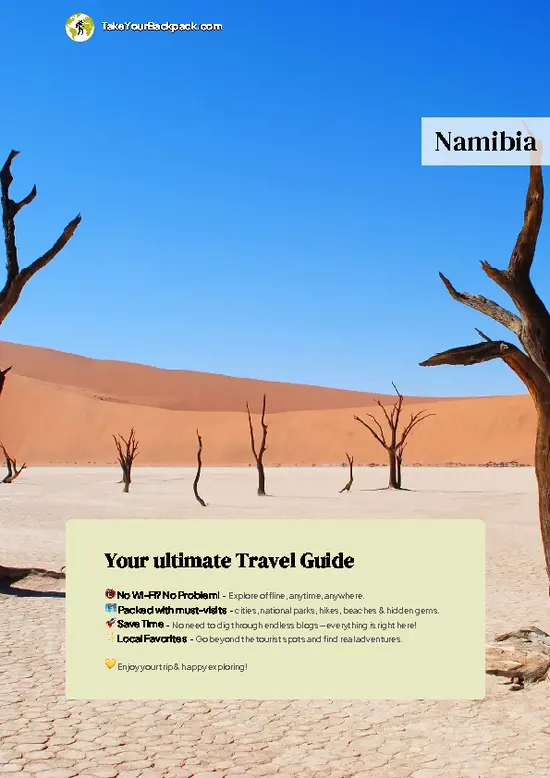
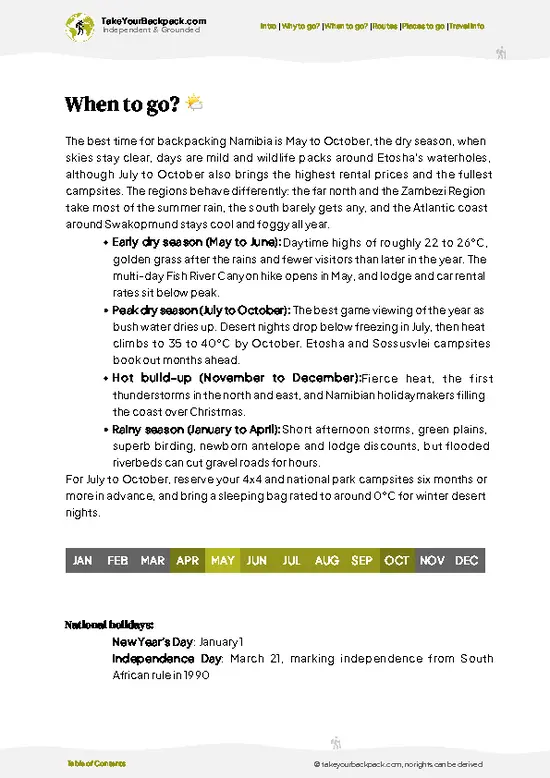
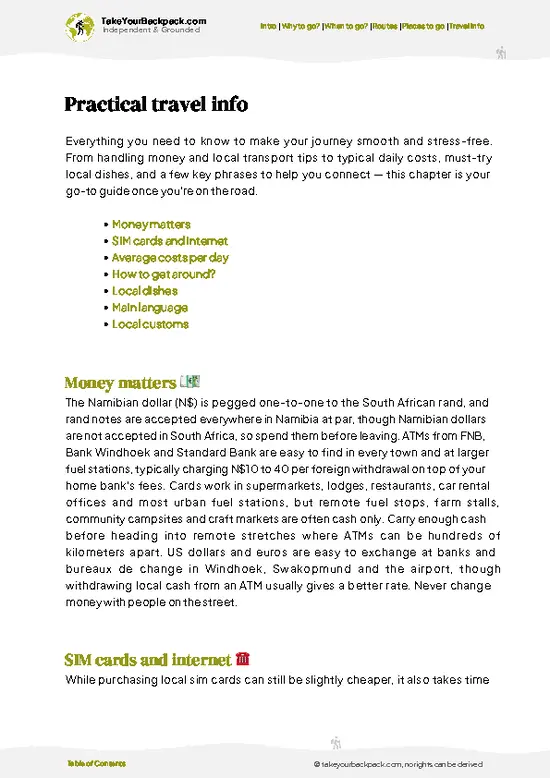
example page 0 from our offline Travel Guide for Namibia
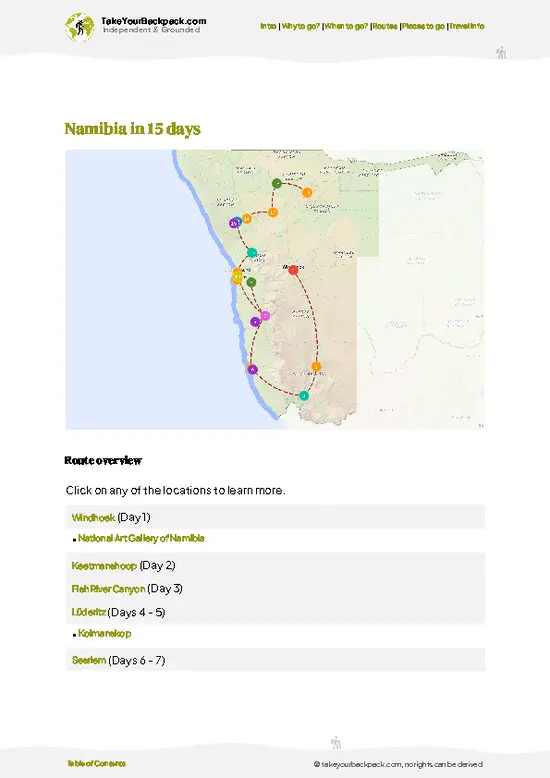
example page 1 from our offline Travel Guide for Namibia
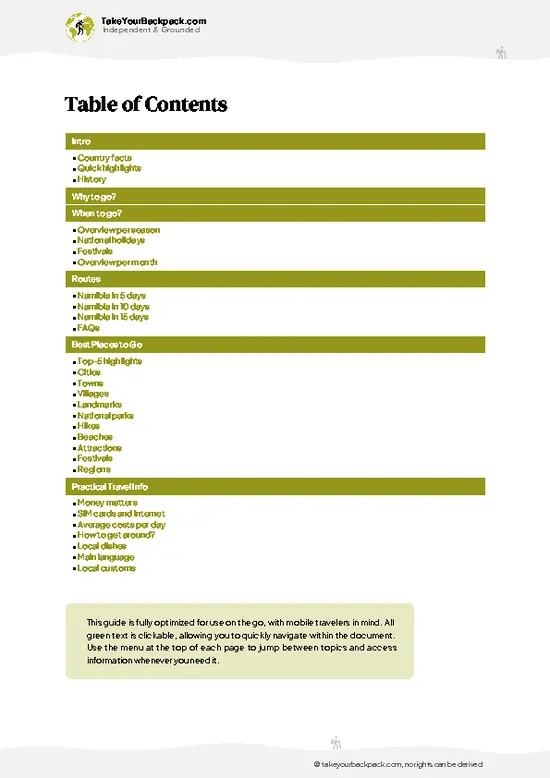
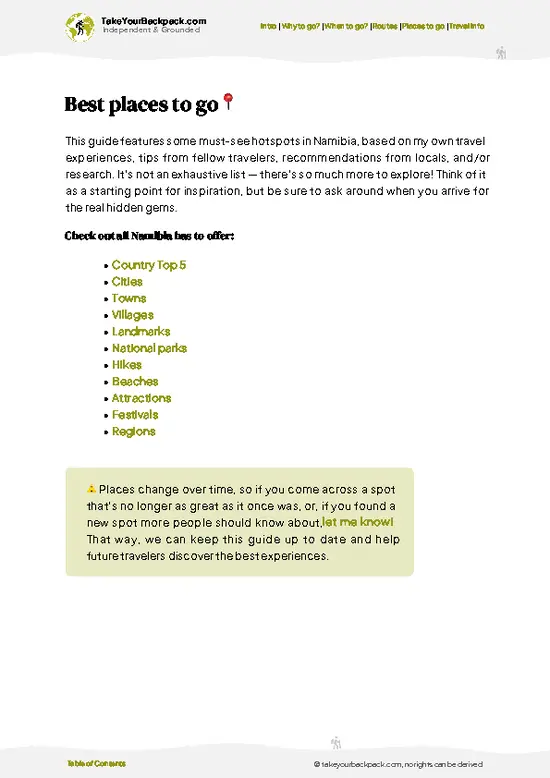
example page 2 from our offline Travel Guide for Namibia
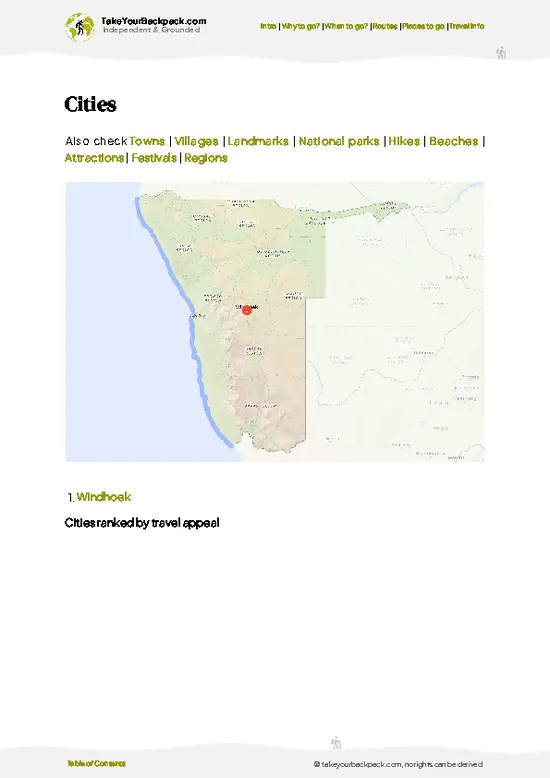
example page 3 from our offline Travel Guide for Namibia
example page 4 from our offline Travel Guide for Namibia
example page 5 from our offline Travel Guide for Namibia
example page 6 from our offline Travel Guide for Namibia
example page 7 from our offline Travel Guide for Namibia
Loading the map 🌍
CLICK TO FILTER
cities
towns
villages
landmarks
national parks
hikes
beaches
attractions
festivals
regions
SHOW COUNTRY’S BESTSHOW ALL

✨ Why go?
Ranked #1 region in Namibia
Why Namib Desert should be on your travel list

Namib Desert gives backpackers one of the few places on earth where a single base covers dune climbing, canyon walking and star-filled nights without any constant relocation. The Sesriem gate is the key to the pace here: camp or stay inside and you reach Sossusvlei while the light is still low and the sand holds a cool crunch underfoot. From that one corner you can scramble up Dune 45, cross a white clay pan to the skeletal camel thorn trees of Deadvlei, and still have an afternoon free for a short canyon walk.

Transport is flexible if you are willing to be self-sufficient. A rental car gives you full control over timing, while shuttles and guided day tours from the lodges cover those without wheels. Hitching is slow, so plan ahead. Once you head north, the landscape changes to gravel plains, … read more 👉
Namib Desert gives backpackers one of the few places on earth where a single base covers dune climbing, canyon walking and star-filled nights without any constant relocation. The Sesriem gate is the key to the pace here: camp or stay inside and you reach Sossusvlei while the light is still low and the sand holds a cool crunch underfoot. From that one corner you can scramble up Dune 45, cross a white clay pan to the skeletal camel thorn trees of Deadvlei, and still have an afternoon free for a short canyon walk.

Transport is flexible if you are willing to be self-sufficient. A rental car gives you full control over timing, while shuttles and guided day tours from the lodges cover those without wheels. Hitching is slow, so plan ahead. Once you head north, the landscape changes to gravel plains, canyon passes and a cold coast with lagoons and seals. That shift happens in the same desert, so the trip feels like a slow crossing between very different worlds rather than a repeated look at the same dunes.

💡 HighlightsPlaces and moments you shouldn't skip

  1. Dune 45: The dune everyone photographs, a sharp-crested ridge of red sand rising roughly 170 meters beside the road into Sossusvlei. The climb along the spine takes about an hour, your feet sink with every step, and the sand is cool and silky before the sun gets high. Entry is covered by the Namib-Naukluft Park permit.
  2. Sossusvlei: A white clay pan ringed by towering apricot dunes, usually bone dry. After rare heavy rain it fills and mirrors the slopes. The last stretch needs a 4x4 or the shuttle from the parking area.
  3. Deadvlei: A baked clay pan with blackened camel thorn skeletons, many several centuries old, standing against orange dunes. The contrast is startling, and the walk in from the 4x4 parking takes about 15 minutes over loose sand.
  4. Big Daddy Dune: The highest dune in the Sossusvlei
… read more 👉
  1. Dune 45: The dune everyone photographs, a sharp-crested ridge of red sand rising roughly 170 meters beside the road into Sossusvlei. The climb along the spine takes about an hour, your feet sink with every step, and the sand is cool and silky before the sun gets high. Entry is covered by the Namib-Naukluft Park permit.
  2. Sossusvlei: A white clay pan ringed by towering apricot dunes, usually bone dry. After rare heavy rain it fills and mirrors the slopes. The last stretch needs a 4x4 or the shuttle from the parking area.
  3. Deadvlei: A baked clay pan with blackened camel thorn skeletons, many several centuries old, standing against orange dunes. The contrast is startling, and the walk in from the 4x4 parking takes about 15 minutes over loose sand.
  4. Big Daddy Dune: The highest dune in the Sossusvlei area, climbed in about 1.5 hours. Run down the steep face toward Deadvlei, and expect sand in your shoes for days.
  5. Sesriem Canyon: A narrow gorge about 30 meters deep, cut by the Tsauchab River. You scramble between smooth, layered conglomerate walls, with pools that hold water after rain. It takes 30 to 45 minutes and is a cool break from the dunes.
  6. Elim Dune: A quieter dune near Sesriem, good for sunset. Few people come, so you get red sand and long shadows largely to yourself.
  7. Sandwich Harbour: Where the Namib dunes plunge straight into the Atlantic south of Walvis Bay. Flamingos and pelicans feed in the lagoon, while 4x4 guides drive the sand along the surf line. Go with a licensed operator, as the tides and soft sand are dangerous.
  8. Kuiseb Canyon: A rugged gorge where the river separates the gravel plains from the dune sea. It is a lesser-known detour with sweeping views and almost no traffic, and German geologists once sheltered here during the Second World War.
  9. Solitaire: A tiny roadside outpost with a few rusting car wrecks, a petrol pump and a bakery famous for apple pie. The cinnamon smell carries across the dusty yard, and it is a welcome break on the long gravel roads.
  10. Moon Landscape lookout: A viewpoint over eroded valleys of the Swakop River near Swakopmund, where ancient rock has been carved into a barren, lunar maze. Locals come at dusk for the changing colors and the silence.
Namib Desert is best started at Dune 45, because the cool air and soft light make the climb comfortable and the crowds thin out before the heat arrives.
Spotted a mistake or missing something? Contact us.

Things to do around Namib Desert

Ratings based on Tripadvisor reviews. When you book through this link, you support our work at no extra cost to you.

⌛️ 5 daysA smart one-week plan

A pre-dawn start sets the pace here, because the park gate and the sun both dictate when you move. Everything beyond the dunes is long gravel or tar between places with little else, so each day covers one anchor and a transfer.

Day 1: Sesriem: Arrive early, stock up on food and fuel, and camp or sleep inside the gate. That is the whole logic of the first night: you are first in line the next morning. Spend the late afternoon walking Sesriem Canyon, then drive to Elim Dune for the evening light. On Day 2 head out at the first light to Dune 45, Big Daddy and Deadvlei, and rest through the hot midday hours. This second day is the one that justifies the whole trip, because the shadowed ridges, white clay and silence will recalibrate your sense of scale.

Day 3: Solitaire: Drive north through … read more 👉
A pre-dawn start sets the pace here, because the park gate and the sun both dictate when you move. Everything beyond the dunes is long gravel or tar between places with little else, so each day covers one anchor and a transfer.

Day 1: Sesriem: Arrive early, stock up on food and fuel, and camp or sleep inside the gate. That is the whole logic of the first night: you are first in line the next morning. Spend the late afternoon walking Sesriem Canyon, then drive to Elim Dune for the evening light. On Day 2 head out at the first light to Dune 45, Big Daddy and Deadvlei, and rest through the hot midday hours. This second day is the one that justifies the whole trip, because the shadowed ridges, white clay and silence will recalibrate your sense of scale.

Day 3: Solitaire: Drive north through gravel plains and stop at the crossroads for pie and fuel. The road climbs through passes and canyons, so keep your pace relaxed. A side trip over Spreetshoogte Pass is the detour that adds the most: the descent is steep and photogenic, and it only takes a bit of extra time if you start early. Continue toward the coast by afternoon.

Day 4: Walvis Bay: The air turns cool and salty as fog rolls in. Book a morning guided 4x4 to Sandwich Harbour, where dunes meet the sea, and watch the flamingos at the lagoon in the afternoon.

Day 5: Swakopmund: Finish with Welwitschia Drive, giving you a look at the desert’s slowest-living residents before you connect onward by bus or car.

🌤️ When to go?Weather, crowds, and seasonal trade-offs

  • Winter (May to August): Days run 20 to 26°C (68 to 79°F) and nights on the dunes drop to 0 to 5°C (32 to 41°F). The air is dry and crisp, the light is low and sharp, and daylight lasts about 11 hours. This is peak season, so lodges and campsites near Sesriem book out and prices rise 20 to 40 percent.
  • Summer (November to March): Inland temperatures reach 35 to 42°C (95 to 108°F) by midafternoon, and the dunes are too hot to climb after mid-morning. Daylight stretches to about 13.5 hours. Rare thunderstorms can turn gravel roads to slick mud and flood dry riverbeds. Rates drop, though the December school holidays are busy.
  • Coast (year-round): Cold Atlantic fog keeps Swakopmund and Walvis Bay at 12 to 22°C (54 to 72°F), even when the interior bakes.
  • Shoulder (April, September, October): Warm days
… read more 👉
  • Winter (May to August): Days run 20 to 26°C (68 to 79°F) and nights on the dunes drop to 0 to 5°C (32 to 41°F). The air is dry and crisp, the light is low and sharp, and daylight lasts about 11 hours. This is peak season, so lodges and campsites near Sesriem book out and prices rise 20 to 40 percent.
  • Summer (November to March): Inland temperatures reach 35 to 42°C (95 to 108°F) by midafternoon, and the dunes are too hot to climb after mid-morning. Daylight stretches to about 13.5 hours. Rare thunderstorms can turn gravel roads to slick mud and flood dry riverbeds. Rates drop, though the December school holidays are busy.
  • Coast (year-round): Cold Atlantic fog keeps Swakopmund and Walvis Bay at 12 to 22°C (54 to 72°F), even when the interior bakes.
  • Shoulder (April, September, October): Warm days around 28 to 33°C (82 to 91°F), thin crowds and moderate prices.
Book Sesriem campsites months ahead for winter, since they hold the only sites inside the park gate.


source: climatestotravel.comJANJanuary: fair for travelingFEBFebruary: fair for travelingMARMarch: good for travelingAPRApril: highly recommended for travelingMAYMay: highly recommended for travelingJUNJune: excellent for travelingJULJuly: excellent for travelingAUGAugust: excellent for travelingSEPSeptember: highly recommended for travelingOCTOctober: highly recommended for travelingNOVNovember: fair for travelingDECDecember: fair for traveling
namibia-region-namib-desert
© Google |

✈️ The backpacker research shortcutNamibia Travel Guide

An offline-friendly backpacking guide with optimized travel routes, ranked highlights, transport advice, and the best areas to stay.
example page 0 from our offline Travel Guide for Namibia
example page 1 from our offline Travel Guide for Namibia
example page 2 from our offline Travel Guide for Namibia
example page 3 from our offline Travel Guide for Namibia
example page 4 from our offline Travel Guide for Namibia
example page 5 from our offline Travel Guide for Namibia
example page 6 from our offline Travel Guide for Namibia
example page 7 from our offline Travel Guide for Namibia
The digital guide (294 pages) contains:
✅ 71 highlights, ranked by travel appeal
✅ Optimized 5, 10 & 15-day travel routes
✅ Cities, national parks, landmarks, beaches
✅ How to get around
✅ Offline-friendly for travel without Wi-Fi
👉 Click to see all 30+ guide features

📅 Plan smarter in minutes, not weeks
✅ Month by month travel advice
✅ Festivals & national holidays
✅ Budget expectations

🗺️ Go to the right places, skip the overrated ones
✅ Honest pros & cons of destinations
✅ Top hikes, parks & viewpoints
✅ Lesser-known places most travelers miss
✅ Clear “worth it vs skip it” guidance

🛏️ Travel smoothly without rookie mistakes
✅ Best areas to stay
✅ Transport systems explained simply
✅ Common scams & safety advice
✅ SIM cards, money & practical tips

🌍 Understand the country, not just visit it
✅ Culture & traditions
✅ 52 Essential phrases & customs
✅ Festivals worth planning around
✅ Traveler-friendly historical context
✅ Insights that make places more meaningful

📱 Built for real travel conditions
✅ Fully downloadable PDF
✅ Works completely offline
✅ Optimized for phone use
✅ Useful in remote areas & buses
✅ Everything in one place
Stop searching, start planning
Get instant access to your full guide. 30‑day money-back guarantee.
+ Add another guide for just

By proceeding you agree to our terms.
Sent to your inbox immediately after payment • 100% Secure Checkout
Best Backpacking Travel Advisor 2025 tourism awardBest Backpacking
Travel Advisor
2025
What others say about Take Your Backpack Guides:
⭐⭐⭐⭐⭐
Fantastic, amazing amount of information!
⭐⭐⭐⭐⭐
My goodness this is amazing, it's what I've been looking for hats off too you!
⭐⭐⭐⭐⭐
I think this is absolutely BRILLIANT
⭐⭐⭐⭐
Very complete and informative. It's still missing places, but I gotta to commend you
⭐⭐⭐⭐⭐
This is truly amazing, thank you, can't wait to explore it with my kids!
⭐⭐⭐⭐⭐
Awesome resource, thank you!
⭐⭐⭐⭐⭐
This is amazing! Can't wait to explore the ones I haven't seen
⭐⭐⭐⭐
I love this! Well done, great idea.
⭐⭐⭐⭐⭐
Thanks for taking the time to make this gem!
⭐⭐⭐⭐⭐
This might be the best website I've ever seen.
⭐⭐⭐⭐⭐
Congratulations, and thank you so much for your work; it's incredibly valuable.
⭐⭐⭐⭐
In all seriousness I think you did a great job pointing out the important spots
⭐⭐⭐⭐⭐
10/10 very good
⭐⭐⭐⭐⭐
As someone who's only just starting to visit regularly this is awesome, thank you.
⭐⭐⭐⭐
Thank you very much! I'm going to visit my dad, it's going to be very useful!
⭐⭐⭐⭐⭐
This is really cool! We'll be travelling for the first time and this definitely come in handy.
⭐⭐⭐⭐⭐
You are now our minister of culture, congratulations 👨‍💼
⭐⭐⭐⭐⭐
Just wanted to tell you that this is a pearl! Going to follow your recommendations.
⭐⭐⭐⭐⭐
This is so cool. I'll definitely be using the resource for my travels soon.
⭐⭐⭐⭐⭐
This is very impressive! Good work.
⭐⭐⭐⭐⭐
This is an amazing and informative site. Very well done!

🛏️ Where to stay?How to pick the right area

Swakopmund is the easiest base for backpackers in the Namib Desert, with dorms from US$15 to 30, a walkable center, cafés, and a crowd of overlanders trading route tips. It also has the widest choice of activities, from sandboarding on the dunes to quad biking and kayaking trips to seal colonies. The cool, foggy mornings feel like a different country from the inland heat.
Walvis Bay, 30 km south, is quieter and cheaper, with lagoon flamingos, dolphin cruises and Sandwich Harbour tours. It suits you if you want a calmer base and fewer tourist shops. Evenings are low-key, so you will want to cook … read more 👉
Swakopmund is the easiest base for backpackers in the Namib Desert, with dorms from US$15 to 30, a walkable center, cafés, and a crowd of overlanders trading route tips. It also has the widest choice of activities, from sandboarding on the dunes to quad biking and kayaking trips to seal colonies. The cool, foggy mornings feel like a different country from the inland heat.
Walvis Bay, 30 km south, is quieter and cheaper, with lagoon flamingos, dolphin cruises and Sandwich Harbour tours. It suits you if you want a calmer base and fewer tourist shops. Evenings are low-key, so you will want to cook or head to Swakopmund for nightlife.
For the dunes themselves, Sesriem is the practical stop. Campsites inside the park gate cost roughly US$15 to 30 per person, and staying here lets you reach the dunes before the crowds. Sites are shaded by camelthorn trees and cluster around a shared fire pit, which makes it easy to meet other travelers and arrange car shares. Book early in winter.
Solitaire, on the road in from Windhoek, has basic camping and works as an overnight if you start late. Windhoek is the arrival point, with more hostels and a larger social scene for gathering a group before you head out to the desert.

🚌 Getting aroundHow to get from A to B

Namib Desert has no central bus or train station: the Intercape coach from Windhoek (about 4 hours, US$25 to 40) stops in Swakopmund, a 5 to 10 minute walk from the center, and Walvis Bay is the other coastal base. Beyond those two towns, public transport stops. Distances are huge, roads are gravel, and the sand does not care about timetables, so most backpackers rent a car or join a small-group tour.
  • Rental car: A 2WD sedan or small SUV costs about US$40 to 80 a day and handles the main gravel roads to Sesriem. Gravel shifts under your tires like loose marbles, so keep to 80 km/h, carry two spares and fill up at every fuel stop. Splitting costs among four people makes this the cheapest option.
  • Shuttle at Sossusvlei: The tar road ends at the Sossusvlei parking area, 65 km from Sesriem. The last
… read more 👉
Namib Desert has no central bus or train station: the Intercape coach from Windhoek (about 4 hours, US$25 to 40) stops in Swakopmund, a 5 to 10 minute walk from the center, and Walvis Bay is the other coastal base. Beyond those two towns, public transport stops. Distances are huge, roads are gravel, and the sand does not care about timetables, so most backpackers rent a car or join a small-group tour.
  • Rental car: A 2WD sedan or small SUV costs about US$40 to 80 a day and handles the main gravel roads to Sesriem. Gravel shifts under your tires like loose marbles, so keep to 80 km/h, carry two spares and fill up at every fuel stop. Splitting costs among four people makes this the cheapest option.
  • Shuttle at Sossusvlei: The tar road ends at the Sossusvlei parking area, 65 km from Sesriem. The last 5 km is soft sand that bogs down ordinary cars, so a shared 4x4 shuttle (about US$20 to 25 each way) carries you through, with the engine whining and sand hissing against the doors. Park entry is roughly US$15 to 20 per person.
  • Multi-day tours: Overland trips from Windhoek or Swakopmund run US$250 to 600 for two to three days, with the driver handling gravel, permits and camp setup. Dune sunrises come with a guide who knows which ridge catches the first orange light.
  • Shared taxis and short transfers: Between Swakopmund and Walvis Bay (about 30 km) taxis cost US$10 to 20 and run all day. Hitchhiking farther inland is possible, but traffic is sparse, and shade is scarce while you wait.
  • Scenic flights: Small planes from Swakopmund over the dune sea and the Skeleton Coast cost about US$250 to 400. The patterned ridges and shipwreck-dotted shoreline are worth the splurge if you have no car.
Fuel up and buy water in Solitaire or Swakopmund before heading into the interior, since services are rare and prices climb at remote stations.

🍲 FoodLocal Cuisine & Drinks

Desert menus lean on game meat: oryx steak and kudu come off the grill smoky and lean, and biltong is sold in strips by the bag at every gas station. A solid steak with sides runs US$10 to 18. On the coast, oysters from the Walvis Bay lagoon arrive cold and briny, about US$1 to 2 each, and the German bakeries in Swakopmund are good for dense rye, pretzels and Black Forest cake with strong filter coffee. In Solitaire, the famous apple crumble is warm and cinnamon-heavy, a good reward after hours of dust.
Backpackers eat at supermarkets and self-cater, grill meat at braai pits in campsites, or take simple café meals around US$6 to 12. Restaurant options are limited inland, so buy supplies before leaving town.
To drink, order a Windhoek Lager or Tafel, brewed under German purity rules. Rooibos … read more 👉
Desert menus lean on game meat: oryx steak and kudu come off the grill smoky and lean, and biltong is sold in strips by the bag at every gas station. A solid steak with sides runs US$10 to 18. On the coast, oysters from the Walvis Bay lagoon arrive cold and briny, about US$1 to 2 each, and the German bakeries in Swakopmund are good for dense rye, pretzels and Black Forest cake with strong filter coffee. In Solitaire, the famous apple crumble is warm and cinnamon-heavy, a good reward after hours of dust.
Backpackers eat at supermarkets and self-cater, grill meat at braai pits in campsites, or take simple café meals around US$6 to 12. Restaurant options are limited inland, so buy supplies before leaving town.
To drink, order a Windhoek Lager or Tafel, brewed under German purity rules. Rooibos tea is the usual caffeine-free choice, and Amarula cream liqueur is a standard nightcap.
Etiquette is easy. Sharing a braai invites conversation, and a 10 percent tip is normal in restaurants. Cash is useful at small stops, and menus can run out of items in remote lodges, so ask what is available.

FAQFrequently asked questions about Namib Desert

Three to four days is enough to cover the main sights of the Namib Desert, with a base in Sesriem for Sossusvlei and Deadvlei and one or two nights in Swakopmund. A longer trip of five to seven days lets you add Sandwich Harbour, the Naukluft hiking area and the long gravel drives from Windhoek, about 5 to 6 hours to Sesriem.
Getting around the Namib Desert without a car is possible but limited. Intercape coaches link Windhoek to Swakopmund in about 4 hours for US$25 to 40, and small-group tours from Swakopmund or Windhoek (US$250 to 600 for two to three days) cover Sesriem, Sossusvlei and Sandwich Harbour. Inside the park, a shared 4x4 shuttle covers the final 5 km of sand for about US$20 to 25.
The Namib Desert is known for the towering red dunes at Sossusvlei, some over 300 meters high, and for Deadvlei, a white clay pan dotted with skeletal camelthorn trees. It is also known for Sandwich Harbour, where dunes drop into the Atlantic, and the Skeleton Coast fog that supports unusual wildlife such as desert-adapted oryx and beetles. Many travelers also come for sandboarding and quad biking at Swakopmund, and for some of the clearest night skies in Africa.
⚠️ Things can change over time, so always validate details locally before you go.

Other Namibian regions near Namib Desert

Explore more nearby:

  • Namib Sand Sea—Towering dunes, shifting sands, Sossusvlei pans, fossilized trees| 88 km away
  • Kalahari Desert—Red dunes, camelthorn farmland, meerkats, Fish River viewpoints| 286 km away
  • Damaraland—Rock engravings, desert elephants, Brandberg massif, community campsites| 489 km away

💡 Not sure where to go next?
Create a personalized itinerary for Namibia including Namib Desert and the places that fit your trip.

Generate my itinerary

👉 Discover all regions

Or checkout all Namibia has to offer (think cities, towns, villages, national parks, hikes, beaches, festivals)
Country photo of Namibia

We 💚 feedbackParting advice and final tips

Namib Desert rewards three nights if you want dunes at both ends of the day, and five if you want the coast and the passes too. I would skip any trip shorter than two nights, because the drive eats a full day. Bring a sleeping bag warm enough for freezing dawns and a scarf for wind-blown sand. Stay one extra night at Sesriem; the second sunrise is always better than the first.

✍️ Help improve this page!
The information on this page is based on in-depth research, insights shared by experienced travelers, and feedback from the local travel community in Namibia. While every effort is made to keep the information accurate and current, conditions can change — so if you spot anything incorrect or outdated, please get in touch.


🙋‍♂️ Give feedback

👋 Meet the founderWho’s Behind Take Your Backpack?

Johan, backpacker and founder of TakeYourBackpackHi, I’m Johan (Netherlands 🇳🇱), the creator of TakeYourBackpack. Over the past 3 decades, I’ve backpacked through 90+ countries across six continents, gaining extensive experience with independent travel, long-term trips, and overland routes.

This site is built on a combination of firsthand travel experience and carefully curated insights from other backpackers. Many guides are based on places I’ve personally visited, while others bring together tips, observations, and practical advice shared by trusted travelers I’ve met along the way.

The goal is to provide realistic, experience-driven guidance — not generic itineraries — so you can explore destinations with better context, clearer expectations, and more confidence.