×

Namibia🇳🇦 | regionsDamaralandRock engravings, desert elephants, Brandberg massif, community campsites | things to do and best time to go

Explore Caprivi StripExplore Kalahari Desert

Backpacking in Damaraland
👍 Recommendedregion ranked #3
By Johan Kruseman 🇳🇱 | Updated October 22, 2026

Damaraland has no entry gates and almost no crowds, so you can camp beside a dry riverbed with desert-adapted elephants for a fraction of what Etosha or the Skeleton Coast cost. It sits in the northwest of Namibia, inland from the coast and roughly west of Khorixas. Expect orange basalt hills, ocher gravel plains, and the smell of dust and wild sage after a rare shower. Rock engravings at Twyfelfontein, the petrified forest and the Brandberg massif give the region more depth than its emptiness suggests. Lodges are pricey, community campsites are cheap but basic, and a rental car costs real money. For a backpacker, renting a 2WD with a shared group and camping gives the best value, since you trade a little comfort for freedom and a lot of savings. Nights are cold, and the heat at midday cracks your lips. Distances are huge and fuel stops are scarce, so fill your tank whenever you pass a pump.

Discover everything you want to know in the 📖 Namibia Travel Guide.


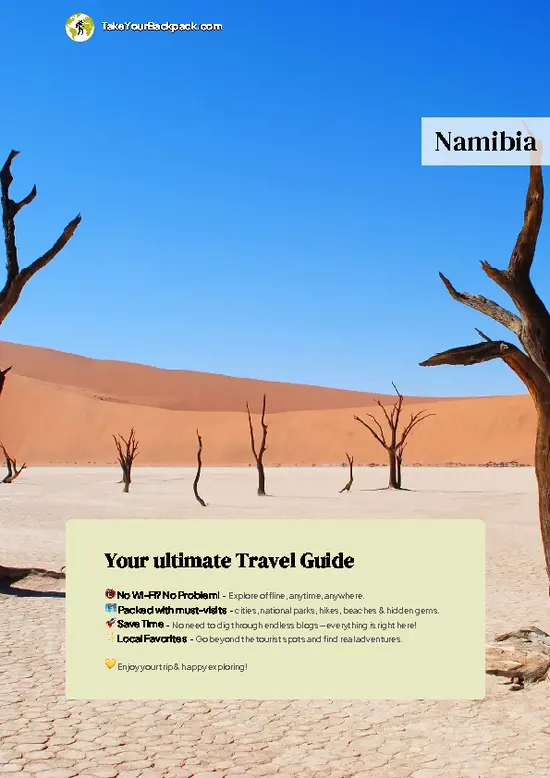
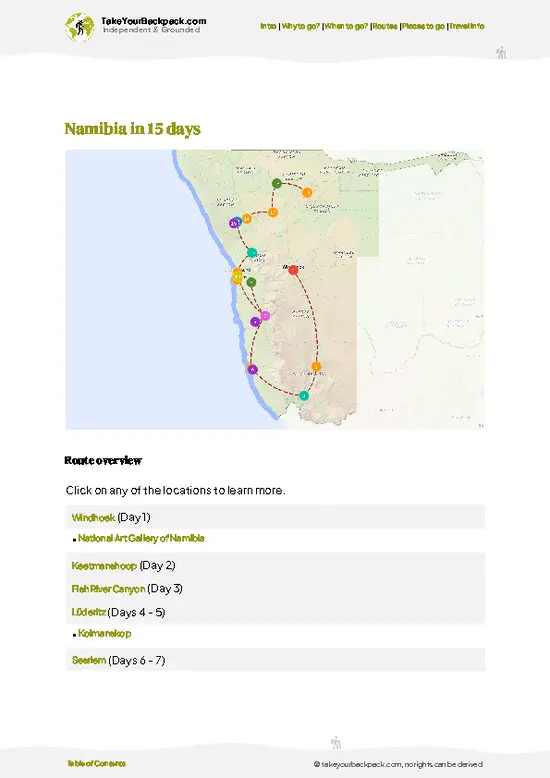
example page 0 from our offline Travel Guide for Namibia
example page 1 from our offline Travel Guide for Namibia
example page 2 from our offline Travel Guide for Namibia
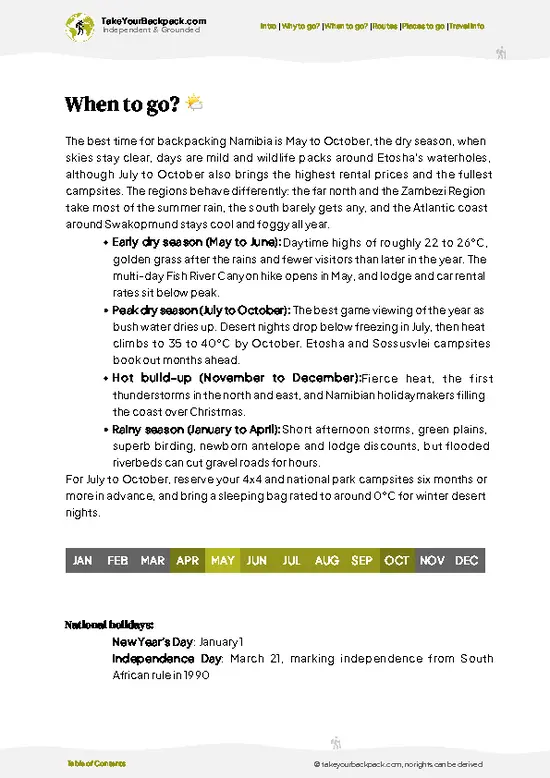
example page 3 from our offline Travel Guide for Namibia
example page 4 from our offline Travel Guide for Namibia
example page 5 from our offline Travel Guide for Namibia
example page 6 from our offline Travel Guide for Namibia
example page 7 from our offline Travel Guide for Namibia
Loading the map 🌍
CLICK TO FILTER
cities
towns
villages
landmarks
national parks
hikes
beaches
attractions
festivals
regions
SHOW COUNTRY’S BESTSHOW ALL

✨ Why go?
Ranked #3 region in Namibia
Why visitors keep coming back

Damaraland lets you stack several very different experiences along one gravel loop without changing bases often. In one day you can touch Twyfelfontein’s 2,000-plus rock engravings, walk through fallen tree trunks millions of years old, and scan a dry riverbed for tracks. Few places in Africa let you do that on foot and without a guide fee queue. Community-run campsites such as Aba-Huab and Palmwag area sites keep money in local hands, so your budget does visible good.

The second reason is wildlife you can pursue without an expensive safari. Desert-adapted elephants roam the Huab and Hoanib valleys, and with a local tracker you can follow them on foot or by vehicle. Black rhino tracking near Palmwag is a splurge, but it is the best-run rhino encounter in the country.

Finally, the roads make … read more 👉
Damaraland lets you stack several very different experiences along one gravel loop without changing bases often. In one day you can touch Twyfelfontein’s 2,000-plus rock engravings, walk through fallen tree trunks millions of years old, and scan a dry riverbed for tracks. Few places in Africa let you do that on foot and without a guide fee queue. Community-run campsites such as Aba-Huab and Palmwag area sites keep money in local hands, so your budget does visible good.

The second reason is wildlife you can pursue without an expensive safari. Desert-adapted elephants roam the Huab and Hoanib valleys, and with a local tracker you can follow them on foot or by vehicle. Black rhino tracking near Palmwag is a splurge, but it is the best-run rhino encounter in the country.

Finally, the roads make slow travel natural. Gravel stretches force a pace of 50 to 70 kilometers an hour, so each day holds one or two stops, long lunches in the shade and a campfire evening under a very dark sky.

💡 HighlightsEssential experiences to have while visiting Damaraland

  1. Twyfelfontein (Ui-//aes): Namibia’s first UNESCO World Heritage site, with thousands of San engravings of giraffe, lion and rhino on red sandstone slabs. Guided walks are compulsory, and an entry fee applies.
  2. Burnt Mountain: A ridge of volcanic rock that glows rust and violet in low light. It is a quick roadside stop beside the engravings.
  3. Organ Pipes: Vertical dolerite columns in a shallow gorge, easy to reach with a short walk down.
  4. Petrified Forest: Fossilized conifer trunks, some 30 meters long, lie in the open. A local guide explains how floods carried them here.
  5. Brandberg and the White Lady shelter: Namibia’s highest mountain, with a famed painted rock shelter reached on a roughly 40-minute walk along a river course.
  6. Palmwag Concession: A vast wildlife area known for black rhino, desert elephants
… read more 👉
  1. Twyfelfontein (Ui-//aes): Namibia’s first UNESCO World Heritage site, with thousands of San engravings of giraffe, lion and rhino on red sandstone slabs. Guided walks are compulsory, and an entry fee applies.
  2. Burnt Mountain: A ridge of volcanic rock that glows rust and violet in low light. It is a quick roadside stop beside the engravings.
  3. Organ Pipes: Vertical dolerite columns in a shallow gorge, easy to reach with a short walk down.
  4. Petrified Forest: Fossilized conifer trunks, some 30 meters long, lie in the open. A local guide explains how floods carried them here.
  5. Brandberg and the White Lady shelter: Namibia’s highest mountain, with a famed painted rock shelter reached on a roughly 40-minute walk along a river course.
  6. Palmwag Concession: A vast wildlife area known for black rhino, desert elephants and mountain zebra, best seen on a guided drive.
  7. Huab River elephant tracking: A lesser-known pursuit, following dry riverbed tracks with local trackers near community camps.
  8. Vingerklip: A 35-meter limestone pillar standing alone above the Ugab Valley, with a restaurant terrace for views at dusk.
  9. Mowe Bay-bound Ugab Rhino Trail: A multi-day guided hike along the dry Ugab riverbed, which few tourists attempt.
  10. Living Museum of the Damara: A community-run open-air village where Damara guides demonstrate fire-making, tools and songs.
In Damaraland, start with Twyfelfontein early, since the engravings are easiest to read when the light is low and the slabs are cool.
Spotted a mistake or missing something? Contact us.

⌛️ 5 daysHow to make the most of Damaraland

Day 1: Twyfelfontein: Start here, because the engravings frame everything else you will see, and the Living Museum of the Damara nearby gives local context. Arrive early, walk the loop, then drive the short hop to Burnt Mountain and the Organ Pipes for the afternoon light. Roads here are gravel, so days are short and you cannot rush them.

Day 2: Petrified Forest: Move north on the C39, where the fossil trunks lie beside the road. Fuel is scarce, so top up in Khorixas on the way, and camp at a community site where the night sky is very dark.

Day 3 and 4: Palmwag: Gravel stretches dictate a slow drive to Palmwag. Spend one day on a guided rhino drive and another following elephant tracks on foot. Detour: take the track toward Brandberg and the White Lady shelter, which adds a major painted … read more 👉
Day 1: Twyfelfontein: Start here, because the engravings frame everything else you will see, and the Living Museum of the Damara nearby gives local context. Arrive early, walk the loop, then drive the short hop to Burnt Mountain and the Organ Pipes for the afternoon light. Roads here are gravel, so days are short and you cannot rush them.

Day 2: Petrified Forest: Move north on the C39, where the fossil trunks lie beside the road. Fuel is scarce, so top up in Khorixas on the way, and camp at a community site where the night sky is very dark.

Day 3 and 4: Palmwag: Gravel stretches dictate a slow drive to Palmwag. Spend one day on a guided rhino drive and another following elephant tracks on foot. Detour: take the track toward Brandberg and the White Lady shelter, which adds a major painted site without leaving the loop.

Day 5: Vingerklip: Loop back south via the Ugab Valley and finish with sundowners below the stone finger. The pace stays easy because the road between stops is predictable.

If you only have one day to justify the trip, make it Day 3 at Palmwag. Watching a black rhino step out of the scrub is the moment the whole drive pays off.

🌤️ When to go?When to go for the best experience

  • Cool Dry Season (May to August): Days reach 24 to 28°C (75 to 82°F) and nights in the open can drop to 5 to 8°C (41 to 46°F), sometimes lower. Skies stay clear, daylight runs roughly 11 hours, and desert-adapted elephants follow the dry riverbeds. Lodges and campsites fill, so rates are highest.
  • Hot Dry Season (September to November): Afternoons climb to 33 to 40°C (91 to 104°F). Waterholes draw wildlife, and crowds thin as the heat builds. Daylight stretches to around 13 hours.
  • Rainy Season (December to April): Short, heavy storms arrive, mostly January to March, with highs of 30 to 36°C (86 to 97°F). The hills turn green, and the rivers can flood and cut gravel tracks for a day or two. Prices drop and you often have Twyfelfontein to yourself.
Book campsites early for June to August, and carry … read more 👉
  • Cool Dry Season (May to August): Days reach 24 to 28°C (75 to 82°F) and nights in the open can drop to 5 to 8°C (41 to 46°F), sometimes lower. Skies stay clear, daylight runs roughly 11 hours, and desert-adapted elephants follow the dry riverbeds. Lodges and campsites fill, so rates are highest.
  • Hot Dry Season (September to November): Afternoons climb to 33 to 40°C (91 to 104°F). Waterholes draw wildlife, and crowds thin as the heat builds. Daylight stretches to around 13 hours.
  • Rainy Season (December to April): Short, heavy storms arrive, mostly January to March, with highs of 30 to 36°C (86 to 97°F). The hills turn green, and the rivers can flood and cut gravel tracks for a day or two. Prices drop and you often have Twyfelfontein to yourself.
Book campsites early for June to August, and carry a warm layer for dawn game drives even in the heat.


source: climatestotravel.comJANJanuary: fair for travelingFEBFebruary: fair for travelingMARMarch: fair for travelingAPRApril: good for travelingMAYMay: highly recommended for travelingJUNJune: excellent for travelingJULJuly: excellent for travelingAUGAugust: excellent for travelingSEPSeptember: excellent for travelingOCTOctober: excellent for travelingNOVNovember: fair for travelingDECDecember: fair for traveling
namibia-region-damaraland
© Google |

✈️ The backpacker research shortcutNamibia Travel Guide

An offline-friendly backpacking guide with optimized travel routes, ranked highlights, transport advice, and the best areas to stay.
example page 0 from our offline Travel Guide for Namibia
example page 1 from our offline Travel Guide for Namibia
example page 2 from our offline Travel Guide for Namibia
example page 3 from our offline Travel Guide for Namibia
example page 4 from our offline Travel Guide for Namibia
example page 5 from our offline Travel Guide for Namibia
example page 6 from our offline Travel Guide for Namibia
example page 7 from our offline Travel Guide for Namibia
The digital guide (294 pages) contains:
✅ 71 highlights, ranked by travel appeal
✅ Optimized 5, 10 & 15-day travel routes
✅ Cities, national parks, landmarks, beaches
✅ How to get around
✅ Offline-friendly for travel without Wi-Fi
👉 Click to see all 30+ guide features

📅 Plan smarter in minutes, not weeks
✅ Month by month travel advice
✅ Festivals & national holidays
✅ Budget expectations

🗺️ Go to the right places, skip the overrated ones
✅ Honest pros & cons of destinations
✅ Top hikes, parks & viewpoints
✅ Lesser-known places most travelers miss
✅ Clear “worth it vs skip it” guidance

🛏️ Travel smoothly without rookie mistakes
✅ Best areas to stay
✅ Transport systems explained simply
✅ Common scams & safety advice
✅ SIM cards, money & practical tips

🌍 Understand the country, not just visit it
✅ Culture & traditions
✅ 52 Essential phrases & customs
✅ Festivals worth planning around
✅ Traveler-friendly historical context
✅ Insights that make places more meaningful

📱 Built for real travel conditions
✅ Fully downloadable PDF
✅ Works completely offline
✅ Optimized for phone use
✅ Useful in remote areas & buses
✅ Everything in one place
Stop searching, start planning
Get instant access to your full guide. 30‑day money-back guarantee.
+ Add another guide for just

By proceeding you agree to our terms.
Sent to your inbox immediately after payment • 100% Secure Checkout
Best Backpacking Travel Advisor 2025 tourism awardBest Backpacking
Travel Advisor
2025
What others say about Take Your Backpack Guides:
⭐⭐⭐⭐⭐
Fantastic, amazing amount of information!
⭐⭐⭐⭐⭐
My goodness this is amazing, it's what I've been looking for hats off too you!
⭐⭐⭐⭐⭐
I think this is absolutely BRILLIANT
⭐⭐⭐⭐
Very complete and informative. It's still missing places, but I gotta to commend you
⭐⭐⭐⭐⭐
This is truly amazing, thank you, can't wait to explore it with my kids!
⭐⭐⭐⭐⭐
Awesome resource, thank you!
⭐⭐⭐⭐⭐
This is amazing! Can't wait to explore the ones I haven't seen
⭐⭐⭐⭐
I love this! Well done, great idea.
⭐⭐⭐⭐⭐
Thanks for taking the time to make this gem!
⭐⭐⭐⭐⭐
This might be the best website I've ever seen.
⭐⭐⭐⭐⭐
Congratulations, and thank you so much for your work; it's incredibly valuable.
⭐⭐⭐⭐
In all seriousness I think you did a great job pointing out the important spots
⭐⭐⭐⭐⭐
10/10 very good
⭐⭐⭐⭐⭐
As someone who's only just starting to visit regularly this is awesome, thank you.
⭐⭐⭐⭐
Thank you very much! I'm going to visit my dad, it's going to be very useful!
⭐⭐⭐⭐⭐
This is really cool! We'll be travelling for the first time and this definitely come in handy.
⭐⭐⭐⭐⭐
You are now our minister of culture, congratulations 👨‍💼
⭐⭐⭐⭐⭐
Just wanted to tell you that this is a pearl! Going to follow your recommendations.
⭐⭐⭐⭐⭐
This is so cool. I'll definitely be using the resource for my travels soon.
⭐⭐⭐⭐⭐
This is very impressive! Good work.
⭐⭐⭐⭐⭐
This is an amazing and informative site. Very well done!

🛏️ Where to stay?Best areas to stay in Namibia

The best bases for backpackers in Damaraland are Khorixas, Twyfelfontein and Uis, with Outjo and Swakopmund as useful bookends. Khorixas is the region’s main town. It has fuel, a supermarket, banks and a market, and its basic guesthouses and campsites at US$10 to 20 per person make it a practical, safe stop for restocking. It is not a social scene, but it is where travelers meet to swap road conditions.
Twyfelfontein area has the most atmosphere. Campsites among the red sandstone boulders cost roughly US$12 to 25 per person, and you can walk to the rock engravings in the morning before tour groups … read more 👉
The best bases for backpackers in Damaraland are Khorixas, Twyfelfontein and Uis, with Outjo and Swakopmund as useful bookends. Khorixas is the region’s main town. It has fuel, a supermarket, banks and a market, and its basic guesthouses and campsites at US$10 to 20 per person make it a practical, safe stop for restocking. It is not a social scene, but it is where travelers meet to swap road conditions.
Twyfelfontein area has the most atmosphere. Campsites among the red sandstone boulders cost roughly US$12 to 25 per person, and you can walk to the rock engravings in the morning before tour groups arrive. Evenings are quiet, with fires, stars and a cold desert night, and you will mostly meet other self-drivers and overlanders.
Uis, on the southern edge near the Brandberg, is a former tin-mining town with simple guesthouses and campsites at about US$10 to 20 per person. It is a sensible base for the White Lady paintings and the hike toward Brandberg’s granite slopes, and it is compact enough to feel safe after dark.
Outjo, on the way in from the east, has several campsites and a bakery street where overlanders gather. Swakopmund, a few hours south, is where you find hostels with real social energy, and many people book their Damaraland trips from there.

🚌 Getting aroundGetting around like a local

Trying to cover Damaraland on public transport alone is what burns the most time and money, because the sights sit on gravel side roads far from any bus route. Most backpackers reach it from Windhoek or Swakopmund and then cover the region by rental car or an organized overland trip. Tarmac gets you to Khorixas and Outjo, and after that the road turns to corrugated gravel that hums through your seat, kicks up pale dust and smells of hot rock.
  • Rental 4x4 (shared): About US$80 to 130 a day for a vehicle, split between three or four people, which brings it to roughly US$20 to 40 each plus fuel. It costs the most in cash but gives you the best return on time, since you can reach Twyfelfontein, the Brandberg and the Ugab riverbed at dawn when the light is soft. Gravel driving is tiring and tires
… read more 👉
Trying to cover Damaraland on public transport alone is what burns the most time and money, because the sights sit on gravel side roads far from any bus route. Most backpackers reach it from Windhoek or Swakopmund and then cover the region by rental car or an organized overland trip. Tarmac gets you to Khorixas and Outjo, and after that the road turns to corrugated gravel that hums through your seat, kicks up pale dust and smells of hot rock.
  • Rental 4x4 (shared): About US$80 to 130 a day for a vehicle, split between three or four people, which brings it to roughly US$20 to 40 each plus fuel. It costs the most in cash but gives you the best return on time, since you can reach Twyfelfontein, the Brandberg and the Ugab riverbed at dawn when the light is soft. Gravel driving is tiring and tires fail often, so carry two spares.
  • Minibus taxi and bus to Khorixas: From Windhoek or Swakopmund, a seat costs about US$10 to 25 over 4 to 6 hours. It is cheap and crowded, with bags on laps and a radio playing the whole way, but it only drops you in town, so you still need a lift to the sights.
  • Small-group overland tour: Three to five day trips from Windhoek or Swakopmund run about US$350 to 700 including camping. You pay more per day than driving yourself, but nobody has to drive, and a guide can find desert elephants and explain the rock engravings.
  • Hitching: Traffic on the gravel roads is thin, so a wait of two to four hours in dry heat is normal. It costs nothing and suits only those with spare days and plenty of water.
For the most value, join a shared car with other travelers from a Swakopmund or Windhoek hostel noticeboard, and fill the tank in Khorixas or Outjo since fuel stops in between are rare.

🍲 FoodEating & Drinking in Damaraland

Food in Damaraland is simple and built around the fire. The main local dish is braai, meat grilled over camelthorn or mopane coals. Kudu, oryx and beef sausage (boerewors) arrive with a smoky, peppery crust, usually beside pap, a stiff maize porridge that you roll into a ball and use to scoop up gravy. Look for biltong, air-dried and spiced game strips, sold at roadside stalls and in Outjo and Khorixas shops for a few dollars a bag.
Backpackers mostly eat in three ways. Cook at your campsite, which usually has a braai pit, and buy meat, vegetables and bread in Khorixas or Outjo before heading into the desert, since supplies near the sights are thin. Small town cafés serve schnitzel and strong filter coffee with German-style cakes, a legacy of the colonial era. Himba and Damara craft stalls … read more 👉
Food in Damaraland is simple and built around the fire. The main local dish is braai, meat grilled over camelthorn or mopane coals. Kudu, oryx and beef sausage (boerewors) arrive with a smoky, peppery crust, usually beside pap, a stiff maize porridge that you roll into a ball and use to scoop up gravy. Look for biltong, air-dried and spiced game strips, sold at roadside stalls and in Outjo and Khorixas shops for a few dollars a bag.
Backpackers mostly eat in three ways. Cook at your campsite, which usually has a braai pit, and buy meat, vegetables and bread in Khorixas or Outjo before heading into the desert, since supplies near the sights are thin. Small town cafés serve schnitzel and strong filter coffee with German-style cakes, a legacy of the colonial era. Himba and Damara craft stalls sometimes sell snacks and cold drinks, and lodges welcome campers for an evening meal at around US$12 to 25.
Local drinks include Windhoek Lager and Tafel, served very cold, and rooibos tea by the pot. Eat after dark with your group around the fire, and share food when offered. Always bring more drinking water than you expect, since taps in the desert can be salty or absent.

FAQTraveler FAQ

Plan 3 to 4 days in Damaraland if you have your own vehicle. That is enough for the Twyfelfontein rock engravings, the Organ Pipes and Burnt Mountain, the White Lady paintings near Uis, and a drive along a riverbed to look for desert elephants. Add a day if you want to hike in the Brandberg or drive the long gravel roads at a relaxed pace.
Without a car, take a bus or minibus taxi to Khorixas from Windhoek or Swakopmund, which costs about US$10 to 25 and takes 4 to 6 hours. From there the sights are far apart on gravel roads, so most travelers join a small-group overland tour of 3 to 5 days for roughly US$350 to 700, or split a rental 4x4 with others at about US$20 to 40 each per day. Hitching is possible but slow, with waits of two to four hours.
Damaraland is known for the Twyfelfontein rock engravings, a UNESCO World Heritage Site with thousands of carvings that are thousands of years old. It also has desert-adapted elephants that roam dry riverbeds, the Organ Pipes basalt columns, the Petrified Forest, and the Brandberg massif, Namibia’s highest peak at 2,573 meters. Entry fees at the main sites are modest, usually US$5 to 12 per person plus a guide.
⚠️ Things can change over time, so always validate details locally before you go.

Other Namibian regions near Damaraland

Explore more nearby:

  • Kunene Region—Epupa cascades, Himba settlements, Opuwo, Marienfluss track| 283 km away
  • Skeleton Coast—Shipwrecks, Cape Cross seals, fog, Hoarusib canyon| 285 km away
  • Namib Sand Sea—Towering dunes, shifting sands, Sossusvlei pans, fossilized trees| 404 km away

💡 Not sure where to go next?
Create a personalized itinerary for Namibia including Damaraland and the places that fit your trip.

Generate my itinerary

👉 Discover all regions

Or checkout all Namibia has to offer (think cities, towns, villages, national parks, hikes, beaches, festivals)
Country photo of Namibia

We 💚 feedbackFinal thoughts on visiting Damaraland

Damaraland’s dry riverbeds are its real highways. Most first-timers stare at the rocks and miss the fresh dung, tracks and green ribbons of trees that show where elephants walked at dawn. I would hire a local community tracker for a morning, carry a warm jacket for the cold start, and keep a full spare fuel can.

✍️ Help improve this page!
The information on this page is based on in-depth research, insights shared by experienced travelers, and feedback from the local travel community in Namibia. While every effort is made to keep the information accurate and current, conditions can change — so if you spot anything incorrect or outdated, please get in touch.


🙋‍♂️ Give feedback

👋 Meet the founderWho’s Behind Take Your Backpack?

Johan, backpacker and founder of TakeYourBackpackHi, I’m Johan (Netherlands 🇳🇱), the creator of TakeYourBackpack. Over the past 3 decades, I’ve backpacked through 90+ countries across six continents, gaining extensive experience with independent travel, long-term trips, and overland routes.

This site is built on a combination of firsthand travel experience and carefully curated insights from other backpackers. Many guides are based on places I’ve personally visited, while others bring together tips, observations, and practical advice shared by trusted travelers I’ve met along the way.

The goal is to provide realistic, experience-driven guidance — not generic itineraries — so you can explore destinations with better context, clearer expectations, and more confidence.