×
Nauru🇳🇷 | 3 days itinerary

Backpacking Nauru: A 3-Day Guide

By Johan Kruseman 🇳🇱 | Updated May 7, 2026
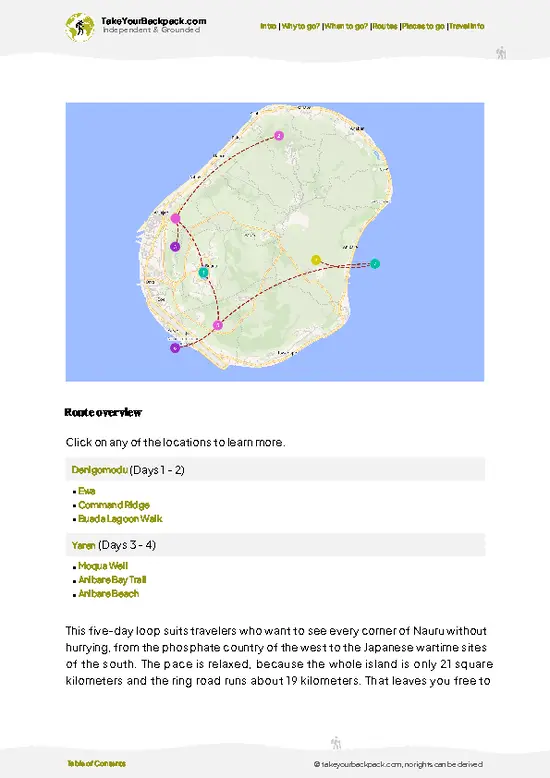
This 3-day itinerary is for travelers who want a fuller sense of Nauru’s story—war relics, lagoon life, and coastal villages—while still keeping things low-stress and mostly on foot with short taxi rides along the ring road. The pace is easy but exploratory, giving you time to linger at viewpoints, chat with locals, and swim every day rather than sprinting around the island.

Day 1: Civic heart, museum context, and Yaren coastline

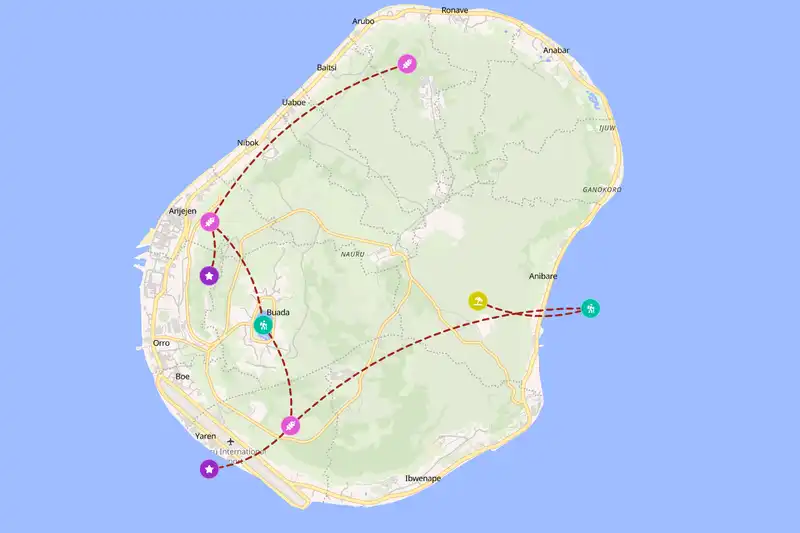
Begin in Yaren, where you can walk between the Nauru Civic Center and Parliament House and the Nauru Museum to get a compact primer on the island’s phosphate boom, independence story, and political life. This cluster lets you understand the island’s modern identity before you even leave the district, and you can break it up with coffee or a simple lunch nearby. In the late afternoon, unwind at Yaren Beach, swimming or just watching the reef break while planes occasionally come and go overhead, then spend the night in Yaren so you’re well-placed for the next day’s … read more 👉
This 3-day itinerary is for travelers who want a fuller sense of Nauru’s story—war relics, lagoon life, and coastal villages—while still keeping things low-stress and mostly on foot with short taxi rides along the ring road. The pace is easy but exploratory, giving you time to linger at viewpoints, chat with locals, and swim every day rather than sprinting around the island.

Day 1: Civic heart, museum context, and Yaren coastline

Begin in Yaren, where you can walk between the Nauru Civic Center and Parliament House and the Nauru Museum to get a compact primer on the island’s phosphate boom, independence story, and political life. This cluster lets you understand the island’s modern identity before you even leave the district, and you can break it up with coffee or a simple lunch nearby. In the late afternoon, unwind at Yaren Beach, swimming or just watching the reef break while planes occasionally come and go overhead, then spend the night in Yaren so you’re well-placed for the next day’s inland push.

Day 2: Buada’s inland calm and Moqua’s underground surprise

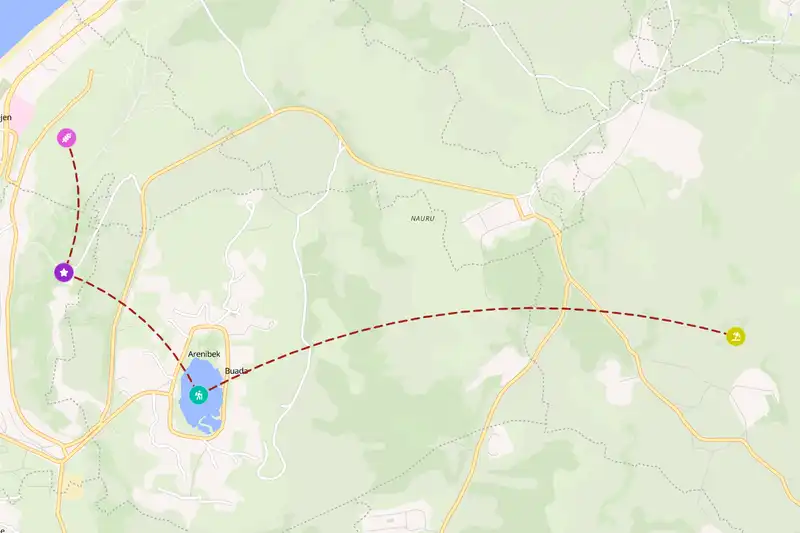
On day two, head inland to the crater world of Buada, circling the water on the Buada Lagoon Walk and pausing at Buada Lagoon Beach to feel how different this shaded, humid pocket is from the coast. After a slow loop and a simple meal, continue back toward the south to explore Moqua Well, a unique underground freshwater pool that shows off Nauru’s limestone underbelly and offers a cool, echoing contrast to the bright lagoon you just left. Return to the coast for a relaxed evening, either back in Yaren or nearby, keeping the day’s travel distances short and manageable.

Day 3: Command Ridge panoramas and Anibare’s east-coast arc

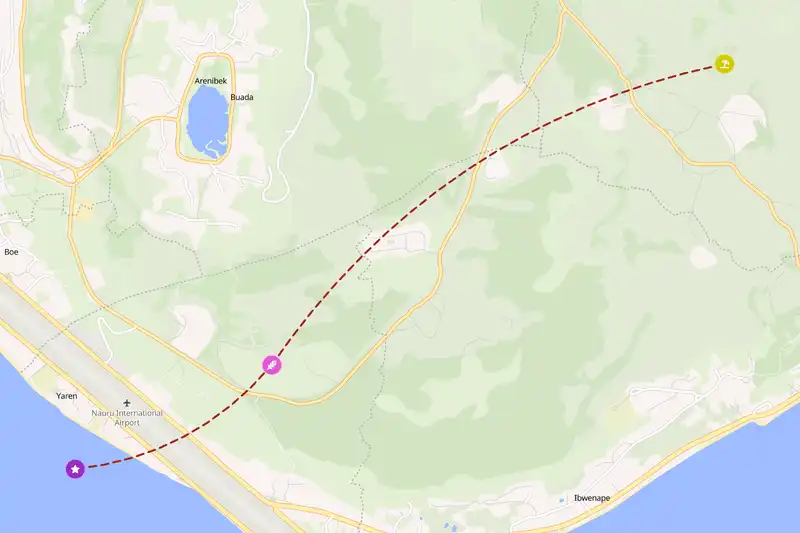
On your final day, climb Command Ridge to pair the Command Ridge WWII Relics with sweeping views that tie together everywhere you’ve been so far, from the inland crater to the coastal villages. After exploring the relics and taking your time on the ridge paths, follow the ring road around to Anibare for a long afternoon at Anibare Beach, where the broad arc of sand and strong Pacific swell give you a classic Nauruan beach finale before you circle back to your base in the evening.

For an extra off-the-map moment, ask around for a short walk out to a little-used coastal phosphate loading ruin where waves slam into old concrete pylons and you can feel Nauru’s industrial past dissolving back into the sea.
Loading the map 🌍
film
0
0
0a
Nauru Civic Center and Parliament House
film
1
1
1a
Buada Lagoon Walk
Jonas Oeschger
film
2
2
2a
Buada Lagoon Beach
Jonas Oeschger
film
3
3
3a
Moqua Well
film
4
4
4a
Command Ridge WWII Relics
film
5
5
5a
Anibare Beach
Fature 10k

🛏️ Where to stay?Itinerary Summary

✈️ The backpacker research shortcutNauru Travel Guide

An offline-friendly backpacking guide with optimized travel routes, ranked highlights, transport advice, and the best areas to stay.
example page 0 from our offline Travel Guide for Nauruexample page 1 from our offline Travel Guide for Nauruexample page 2 from our offline Travel Guide for Nauruexample page 3 from our offline Travel Guide for Nauruexample page 4 from our offline Travel Guide for Nauruexample page 5 from our offline Travel Guide for Nauru
The digital guide (97 pages) contains:
24 highlights, ranked by travel appeal
Optimized 2, 3 & 5-day travel routes
Best neighborhoods to stay
How to get around
Offline-friendly for travel without Wi-Fi
👉 See all 30+ guide features

📅 Plan smarter in minutes, not weeks
Month by month travel advice
Festivals & national holidays
Budget expectations

🗺️ Go to the right places, skip the overrated ones
Honest pros & cons of destinations
Top hikes, parks & viewpoints
Lesser-known places most travelers miss
Clear “worth it vs skip it” guidance

🛏️ Travel smoothly without rookie mistakes
Best areas to stay
Transport systems explained simply
Common scams & safety advice
SIM cards, money & practical tips

🌍 Understand the country, not just visit it
Culture & traditions
52 Essential phrases & customs
Festivals worth planning around
Traveler-friendly historical context
Insights that make places more meaningful

📱 Built for real travel conditions
Fully downloadable PDF
Works completely offline
Optimized for phone use
Useful in remote areas & buses
Everything in one place
Save weeks of stressful planning
Get instant access to the full guide directly. 30-day money-back guarantee.


Sent to your inbox immediately after payment • 100% Secure Checkout
Best Backpacking Travel Advisor 2025 tourism awardBest Backpacking
Travel Advisor
2025
What others say about Take Your Backpack Guides:
⭐⭐⭐⭐⭐
Fantastic, amazing amount of information!
⭐⭐⭐⭐⭐
My goodness this is amazing, it's what I've been looking for hats off too you!
⭐⭐⭐⭐⭐
I think this is absolutely BRILLIANT
⭐⭐⭐⭐
Very complete and informative. It's still missing places, but I gotta to commend you
⭐⭐⭐⭐⭐
This is truly amazing, thank you, can't wait to explore it with my kids!
⭐⭐⭐⭐⭐
Awesome resource, thank you!
⭐⭐⭐⭐⭐
This is amazing! Can't wait to explore the ones I haven't seen
⭐⭐⭐⭐
I love this! Well done, great idea.
⭐⭐⭐⭐⭐
Thanks for taking the time to make this gem!
⭐⭐⭐⭐⭐
This might be the best website I've ever seen.
⭐⭐⭐⭐⭐
Congratulations, and thank you so much for your work; it's incredibly valuable.
⭐⭐⭐⭐
In all seriousness I think you did a great job pointing out the important spots
⭐⭐⭐⭐⭐
10/10 very good
⭐⭐⭐⭐⭐
As someone who's only just starting to visit regularly this is awesome, thank you.
⭐⭐⭐⭐
Thank you very much! I'm going to visit my dad, it's going to be very useful!
⭐⭐⭐⭐⭐
This is really cool! We'll be travelling for the first time and this definitely come in handy.
⭐⭐⭐⭐⭐
You are now our minister of culture, congratulations 👨‍💼
⭐⭐⭐⭐⭐
Just wanted to tell you that this is a pearl! Going to follow your recommendations.
⭐⭐⭐⭐⭐
This is so cool. I'll definitely be using the resource for my travels soon.
⭐⭐⭐⭐⭐
This is very impressive! Good work.
⭐⭐⭐⭐⭐
This is an amazing and informative site. Very well done!

🧭 RouteChoose Your Itinerary

Travel Nauru your way — from a quick highlights trip to a slow-paced adventure.

🙋 FAQFrequently Asked Questions

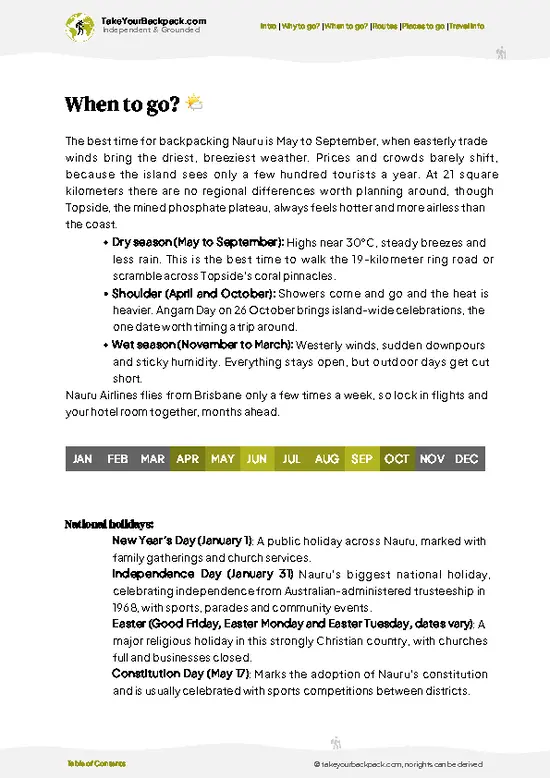
Short version: yes, but it’s not “Southeast Asia easy.” Nauru is tiny, safe, and friendly, but it’s also one of the least tourist-oriented countries on earth, so you need to be self-sufficient and flexible. There’s no hostel scene, no backpacker bars, and very little public info online, so you can’t just wing it the way you might in Thailand or Mexico. You’ll want to lock in accommodation before you arrive, because options are limited and walk‑in bargains basically don’t exist. Once you’re on the island, though, it’s simple: one main ring road, a handful of guesthouses/hotels, a few shops and Chinese restaurants, and the ocean in every direction. English is widely understood, locals are used to foreign workers and a trickle of visitors, and crime against travelers is rare, so solo backpackers generally feel relaxed walking or cycling around. The main “difficulty” is cost and logistics, not safety. Flights are infrequent and expensive, food and rooms are pricier than you’d expect for such a small place, and there’s no real way to cut costs with camping or couchsurfing. If you’re comfortable in places with minimal infrastructure, can handle a bit of boredom, and don’t need nightlife or constant stimulation, Nauru is very doable independently. If you need lots of options, social hostels, and easy onward transport, it will feel remote and awkward.
For most backpackers, 2–3 full days on the island is the sweet spot. The entire country is only about 21 square kilometers, and the ring road is roughly 19 km, so you can literally walk or cycle around the whole place in a day if you push it. One full day lets you circle the island, stop at beaches, poke around the phosphate ruins, and get a feel for daily life. A second day gives you time to explore the interior plateau, climb up to Command Ridge, check out the old mining infrastructure more slowly, and swim or snorkel without rushing. A third day is nice if you like slow travel, want to photograph sunrise and sunset from different sides of the island, or just enjoy the odd feeling of being in a country with almost no tourism. More than 3–4 days only makes sense if you’re deliberately collecting long stays in microstates, working remotely, or you really enjoy quiet, repetitive routines. Because flights are limited, your actual stay might be dictated by the schedule rather than your ideal plan, so it’s smart to build in one buffer day in case of delays and to avoid stressing about your exit flight.
You can get around Nauru without a car, but you need to be realistic about heat, sun, and your own patience. The ring road is flat and easy to follow, so walking sections of it is straightforward, and many backpackers do at least one long walk or full circuit on foot. However, the tropical sun is brutal in the middle of the day, shade is patchy, and there’s not a café every kilometer where you can duck in and cool off, so carry water, a hat, and sunscreen like it’s your job. Bicycles are the sweet spot if you can arrange one through your accommodation or a local contact; they’re fast enough to make a full loop fun, but slow enough that you can stop at beaches, bunkers, and viewpoints whenever something catches your eye. There’s no proper public bus system for tourists, and hitchhiking is possible but not something to rely on as your main transport plan; traffic is light, and people may be going only short distances. Taxis or informal rides can sometimes be arranged through your guesthouse, but they’re not metered city cabs waiting on every corner. If you’re on a tight budget and don’t want to rent a car, plan to walk early and late in the day, use a bike if you can get one, and treat any rides you’re offered as a bonus, not a guarantee.
Think of Nauru as one big loop with a few key stops rather than a long list of separate attractions. For a backpacker, these are the hits that actually feel worth the effort and money of getting there:

1) The Coastal Ring Road: Doing a full circuit, by bike or on foot in sections, is the core experience. You get constant ocean views, small villages, the airstrip, and a sense of how compact the country really is. Stop at random sea walls, small beaches, and local stores; the charm is in the everyday scenes.

2) Anibare Bay: This is the most photogenic stretch of coastline, with palm trees, sand, and good spots to swim when conditions are calm. It’s where you actually feel like you’re in a Pacific island postcard instead of an industrial site.

3) Command Ridge: The highest point on the island, with World War II relics and views over the interior and coast. It’s not a huge hike, but it gives you perspective on how the phosphate mining carved up the center of the island.

4) The Phosphate Interior (Topside): Walking or driving through the mined-out interior is eerie and oddly compelling. Jagged limestone pinnacles, abandoned equipment, and a landscape that looks more like a movie set than a tropical island. It’s one of the few places in the Pacific where you can see this scale of environmental transformation up close.

5) Japanese WWII Relics and Bunkers: Scattered around the island, especially inland and on small hills. They’re not curated or heavily signed, which actually makes them feel more raw and real. Combine them with your Command Ridge visit or ring-road loop.

6) Simple Local Hangouts: The small harbor area, local stores, and Chinese eateries where foreign workers and locals eat. Not glamorous, but this is where you feel the social heartbeat of the island and realize how different Nauru is from resort-style Pacific destinations.

If you hit those, you’ve basically experienced the core of Nauru’s character: remote, altered by mining, ringed by sea, and quietly going about its business without much tourism.
If you’re short on time or cash, you can safely skip anything that tries to turn Nauru into a generic beach resort in your head. You don’t need to chase every tiny beach or viewpoint; the ring-road loop and Anibare Bay already give you the best of the coast. You can also skip obsessing over finding “the best” snorkeling or diving; access is limited, currents can be strong, and the island isn’t set up as a major marine tourism hub, so you’re better off enjoying casual swims where locals go rather than paying a lot for underwhelming underwater time. Unless you have a specific interest, you can skip deep dives into government or administrative buildings; they’re functional, not sights. You also don’t need to spend hours trying to track down every single WWII relic or bunker; see a few around Command Ridge and along your loop, then move on. Finally, if your schedule is tight, don’t burn a whole day waiting for some perfect golden-hour photo or a highly specific viewpoint; the island is small enough that you’ll naturally see repeating versions of the same scenes. Focus on one good coastal session, one interior/Command Ridge session, and some time just walking or cycling through everyday life, and you won’t feel like you missed anything crucial.

🇳🇷 NauruExplore Nauru

Ready to build a truly unique trip? Predefined routes are perfect for first-time visitors, but there is so much more to discover. Whether you are chasing a city trip, pristine national parks, local food scenes, or quiet beaches, pick a category to design your own path.