×

Nigeria🇳🇬 | citiesBenin Citybronze casting, royal palace, moats and earthworks | things to do and best time to go

Explore KadunaExplore Ilorin

Backpacking in Benin City
🌟 Highlightcity ranked #7
By Johan Kruseman 🇳🇱 | Updated June 3, 2026

Everyone’s heard of Benin City for its bronzes—the famous plaques and sculptures that once dazzled European collectors. But if you’re backpacking, the real trade-off isn’t about seeing a museum piece; it’s about how much time and grit you’re willing to invest for a taste of living history. Benin City sits in southern Nigeria, a day’s bus ride from Lagos or Abuja, and it’s a place where the past and present jostle for space. The National Museum and the crumbling earthworks of the old city walls are the main draws, but the city’s energy—chaotic, proud, and a bit rough around the edges—matters more than any artifact. Costs are low, but so is the backpacker infrastructure; you’ll work for your discoveries and likely stand out. Safety is manageable with street smarts, but it’s not as easygoing as Calabar or as cosmopolitan as Lagos. Meeting fellow travelers is rare, but locals are curious and direct. Benin City rewards patience and curiosity, not comfort.

Discover everything you want to know in the 📖 Nigeria Travel Guide.
Safety warning

The current risk level for Nigeria is high. Check the advice before going.


Get your Nigeria guide
89 ranked highlights, routes & tips, works offline (332 pages)
Loading the map 🌍
CLICK TO FILTER
cities
towns
landmarks
national parks
hikes
beaches
attractions
festivals
regions
SHOW COUNTRY’S BESTSHOW ALL

✨ Why go?
Ranked #7 city in Nigeria
What sets this place apart

Benin City is a strategic stop for backpackers weaving through Nigeria. It offers a basecamp value that’s hard to beat, with affordable hostels that cater to budget travelers. The city’s walkability makes it easy to explore local markets and street food stalls, where you can savor authentic Nigerian dishes without breaking the bank. While the nightlife may not rival Lagos, it has its own charm, with local bars that buzz with energy. Plus, it’s a convenient launchpad for day trips to nearby attractions, making it a practical choice for those looking to maximize their time. If you’re after a blend of cultural immersion and affordability, Benin City fits the bill, but it’s best as a short stop rather than a long stay.
Want to include Benin City in your Nigeria route?
Create a personalized Nigeria itinerary that includes Benin City and the places that fit your trip — based on your travel style, budget, and available time. Get your route in seconds.

Generate my trip

💡 HighlightsDon't-miss highlights and experiences

Oba’s Palace (Royal Palace of the Oba of Benin)
This is the living, beating heart of Benin’s ancient monarchy—a place where centuries of ritual and power still shape daily life. The palace itself is a working seat of authority, not a museum, so you’re stepping into a space where tradition is alive and guarded. Guided tours are required and strictly timed, usually lasting about 45 minutes. Expect to pay a moderate entry fee (locals pay less; foreigners pay more, but it’s still reasonable). The best time to visit is mid-morning, when the palace is open to visitors but not yet crowded. You’ll sacrifice some comfort—no photos, strict rules, and the heat can be real—but you gain a front-row seat to living history.


Benin National Museum
If you want to understand Benin’s soul, start here. The museum’s … read more 👉
Oba’s Palace (Royal Palace of the Oba of Benin)
This is the living, beating heart of Benin’s ancient monarchy—a place where centuries of ritual and power still shape daily life. The palace itself is a working seat of authority, not a museum, so you’re stepping into a space where tradition is alive and guarded. Guided tours are required and strictly timed, usually lasting about 45 minutes. Expect to pay a moderate entry fee (locals pay less; foreigners pay more, but it’s still reasonable). The best time to visit is mid-morning, when the palace is open to visitors but not yet crowded. You’ll sacrifice some comfort—no photos, strict rules, and the heat can be real—but you gain a front-row seat to living history.


Benin National Museum
If you want to understand Benin’s soul, start here. The museum’s collection of bronzes, ivory, and royal regalia is compact but dense with meaning. You’ll see artifacts that once adorned the palace, and you’ll get context for the city’s role in West African history. Entry is affordable, and you can see the highlights in about 60-90 minutes. The museum is air-conditioned—a rare comfort in Benin City—so it’s a smart midday stop when the sun is at its fiercest. The trade-off: exhibits are sometimes poorly labeled, so you’ll need to bring your own curiosity and patience.


Igun Street (Bronze Casters’ Guild)
This isn’t a tourist show—it’s a working street where the descendants of Benin’s ancient bronze casters still create art using the lost-wax method. Walk the length of Igun Street and you’ll see workshops, forges, and artists at work. You can buy pieces directly from the makers, but even if you’re not shopping, the process is mesmerizing. Free to wander, but if you want a guided explanation, expect to tip. Early morning or late afternoon is best for seeing artists in action and avoiding the midday heat. You’ll trade some time and sweat for a genuine, hands-on encounter with Benin’s creative legacy.


Holy Aruosa Cathedral
Founded in the 16th century, this is not your average church. It’s a unique blend of Christian and traditional Edo beliefs, and services here are a living fusion of ritual, music, and symbolism. Visitors are welcome outside of service times, but if you want the full experience, attend a Sunday service—just be respectful and dress modestly. There’s no entry fee, but donations are appreciated. Expect to spend about an hour. The trade-off: you’ll need to plan around service times, and you may feel a bit like an outsider, but the cultural insight is worth it.


Ogba Zoo and Nature Park
A green escape on the city’s edge, Ogba Zoo offers a mix of wildlife (think monkeys, crocodiles, and birds) and a relaxed picnic atmosphere. It’s not a world-class zoo, but it’s a favorite for locals and a good way to see how Benin City unwinds. Entry is inexpensive, and you can spend 1-2 hours here. Go early to avoid crowds and heat. The comfort is basic—think dusty paths and simple facilities—but you’ll trade that for a slice of everyday Benin life.


If you’re itching to stretch your legs beyond the city, Ososo Hills, Okomu National Park, and the ancient town of Ughoton are all within day-trip range, each offering a different flavor of Edo State’s landscape and history.
Spotted a mistake or missing something? Contact us.

🏘️ NeighborhoodsNeighborhood guide to Benin City

Benin City offers a rich tapestry of culture and history, making it a compelling stop for backpackers. Here’s how the neighborhoods stack up:

Ring Road: This bustling hub is the heart of the city. It’s lively, with street vendors and local eateries. Affordable accommodations abound, and you can easily walk to shops and attractions. Nightlife is vibrant, but it quiets down by midnight. Perfect for short stays where you want to soak in the local vibe.

Uselu: A bit more laid-back, Uselu is known for its residential feel. It’s cheaper than Ring Road and offers a glimpse into daily life. Walkability is decent, but you might need a taxi for longer distances. Ideal for longer stays if you prefer a quieter atmosphere with local charm.

Ikpoba Hill: This area is more suburban and offers a mix of … read more 👉
Benin City offers a rich tapestry of culture and history, making it a compelling stop for backpackers. Here’s how the neighborhoods stack up:

Ring Road: This bustling hub is the heart of the city. It’s lively, with street vendors and local eateries. Affordable accommodations abound, and you can easily walk to shops and attractions. Nightlife is vibrant, but it quiets down by midnight. Perfect for short stays where you want to soak in the local vibe.

Uselu: A bit more laid-back, Uselu is known for its residential feel. It’s cheaper than Ring Road and offers a glimpse into daily life. Walkability is decent, but you might need a taxi for longer distances. Ideal for longer stays if you prefer a quieter atmosphere with local charm.

Ikpoba Hill: This area is more suburban and offers a mix of nature and community. It’s less touristy, which means lower prices and a chance to connect with locals. Transport options are available, but you’ll need to plan for longer travel times. Best for those looking to escape the hustle and stay a while.

⌛️ 1 dayA smart one-day plan

Benin City, Nigeria, is a vibrant tapestry of history and culture, where the echoes of the ancient Benin Kingdom still resonate. This city is a treasure trove of art, tradition, and local life, making it a fascinating stop for any traveler.

Start your morning at the **Benin City National Museum**. Here, you’ll dive into the rich history of the Edo people, with artifacts that tell stories of a powerful kingdom. Spend an hour or so exploring the exhibits, then stroll through the nearby **Ring Road** area, where local vendors sell everything from colorful fabrics to handmade crafts. Grab a quick breakfast at a local spot—try some **akara** (bean cakes) and **pap** (fermented corn pudding) for an authentic taste.

In the afternoon, head to **Igun Street**, known for its bronze casters. Watch … read more 👉
Benin City, Nigeria, is a vibrant tapestry of history and culture, where the echoes of the ancient Benin Kingdom still resonate. This city is a treasure trove of art, tradition, and local life, making it a fascinating stop for any traveler.

Start your morning at the **Benin City National Museum**. Here, you’ll dive into the rich history of the Edo people, with artifacts that tell stories of a powerful kingdom. Spend an hour or so exploring the exhibits, then stroll through the nearby **Ring Road** area, where local vendors sell everything from colorful fabrics to handmade crafts. Grab a quick breakfast at a local spot—try some **akara** (bean cakes) and **pap** (fermented corn pudding) for an authentic taste.

In the afternoon, head to **Igun Street**, known for its bronze casters. Watch artisans at work, creating intricate pieces that reflect centuries of craftsmanship. This isn’t just a tourist stop; it’s a glimpse into the heart of Benin’s artistic legacy. Afterward, take a leisurely walk to the **Oba’s Palace**, where you can admire the architecture and soak in the local atmosphere.

As evening approaches, make your way to **Uselu Market**. While it’s bustling and chaotic, it’s a fantastic place to experience daily life. Grab dinner at a nearby eatery—sample some **jollof rice** or **pepper soup**. End your day with a visit to a local bar for live music, where you can unwind and reflect on a day well spent in this captivating city.
Turn your Benin City visit into an Nigeria adventure
Build a complete Nigeria route with Benin City, hidden gems, must-see destinations, and realistic travel times included.

Generate my trip

🌤️ When to go?When to go for the best experience


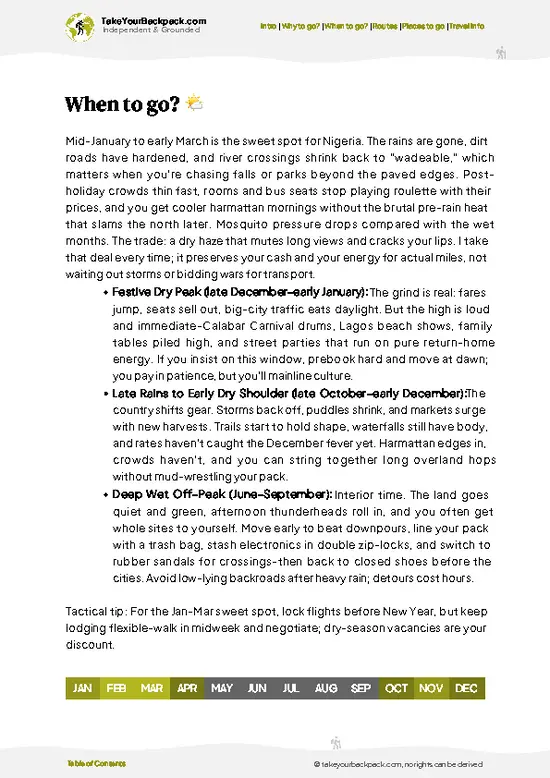
  • Topic: Weather – Benin City experiences a tropical climate with a pronounced rainy season from April to October. Expect heavy downpours and humidity, which can slow your pace and soak your gear. The dry season, November to March, offers clearer skies and less mud, making trekking and city exploration smoother.

  • Topic: Temperature – Temperatures hover between 24°C (75°F) and 31°C (88°F) year-round. The dry season tends to be slightly cooler and less oppressive, while the rainy months bring a sticky heat that can drain your energy faster.

  • Topic: Daylight Hours – Daylight remains fairly consistent, around 12 hours daily, with sunrise near 6:30 AM and sunset around 6:30 PM. This steady rhythm means you can plan your days reliably without worrying about early nightfall.

  • Topic: Crowds
read more 👉

  • Topic: Weather – Benin City experiences a tropical climate with a pronounced rainy season from April to October. Expect heavy downpours and humidity, which can slow your pace and soak your gear. The dry season, November to March, offers clearer skies and less mud, making trekking and city exploration smoother.

  • Topic: Temperature – Temperatures hover between 24°C (75°F) and 31°C (88°F) year-round. The dry season tends to be slightly cooler and less oppressive, while the rainy months bring a sticky heat that can drain your energy faster.

  • Topic: Daylight Hours – Daylight remains fairly consistent, around 12 hours daily, with sunrise near 6:30 AM and sunset around 6:30 PM. This steady rhythm means you can plan your days reliably without worrying about early nightfall.

  • Topic: Crowds – Tourist traffic is minimal year-round, but local festivals during the dry season can swell crowds, especially around December. This is a chance to witness vibrant culture but expect busier accommodations and transport.

  • Topic: Seasonal Activities – The dry season hosts key cultural events like the Igue Festival, a deep dive into Benin’s heritage. The rainy season limits outdoor activities but offers lush landscapes and fewer visitors.

  • Topic: Price Fluctuations – Accommodation and transport costs peak during the dry season and festival times due to demand. The rainy season sees lower prices but comes with trade-offs in comfort and accessibility.


Pro-tip: Aim for late dry season (February to March) to balance pleasant weather, cultural immersion, and better prices—your sweet spot for smart backpacking in Benin City.


source: climatestotravel.comJANJanuary: highly recommended for travelingFEBFebruary: excellent for travelingMARMarch: excellent for travelingAPRApril: fair for travelingMAYMay: fair for travelingJUNJune: fair for travelingJULJuly: fair for travelingAUGAugust: fair for travelingSEPSeptember: fair for travelingOCTOctober: fair for travelingNOVNovember: highly recommended for travelingDECDecember: good for traveling
when-to-go

✈️ The backpacker research shortcutNigeria Travel Guide

An offline-friendly backpacking guide with optimized travel routes, ranked highlights, transport advice, and the best areas to stay.
example page 0 from our offline Travel Guide for Nigeria
example page 1 from our offline Travel Guide for Nigeria
example page 2 from our offline Travel Guide for Nigeria
example page 3 from our offline Travel Guide for Nigeria
example page 4 from our offline Travel Guide for Nigeria
example page 5 from our offline Travel Guide for Nigeria
example page 6 from our offline Travel Guide for Nigeria
example page 7 from our offline Travel Guide for Nigeria
The digital guide (332 pages) contains:
89 highlights, ranked by travel appeal
Optimized 7, 14 & 21-day travel routes
Cities, national parks, landmarks, beaches
How to get around
Offline-friendly for travel without Wi-Fi
👉 Click to see all 30+ guide features

📅 Plan smarter in minutes, not weeks
Month by month travel advice
Festivals & national holidays
Budget expectations

🗺️ Go to the right places, skip the overrated ones
Honest pros & cons of destinations
Top hikes, parks & viewpoints
Lesser-known places most travelers miss
Clear “worth it vs skip it” guidance

🛏️ Travel smoothly without rookie mistakes
Best areas to stay
Transport systems explained simply
Common scams & safety advice
SIM cards, money & practical tips

🌍 Understand the country, not just visit it
Culture & traditions
52 Essential phrases & customs
Festivals worth planning around
Traveler-friendly historical context
Insights that make places more meaningful

📱 Built for real travel conditions
Fully downloadable PDF
Works completely offline
Optimized for phone use
Useful in remote areas & buses
Everything in one place
Save weeks of stressful planning
Get instant access to your full guide. 30‑day money-back guarantee.


By proceeding you agree to our terms.
Sent to your inbox immediately after payment • 100% Secure Checkout
Best Backpacking Travel Advisor 2025 tourism awardBest Backpacking
Travel Advisor
2025
What others say about Take Your Backpack Guides:
⭐⭐⭐⭐⭐
Fantastic, amazing amount of information!
⭐⭐⭐⭐⭐
My goodness this is amazing, it's what I've been looking for hats off too you!
⭐⭐⭐⭐⭐
I think this is absolutely BRILLIANT
⭐⭐⭐⭐
Very complete and informative. It's still missing places, but I gotta to commend you
⭐⭐⭐⭐⭐
This is truly amazing, thank you, can't wait to explore it with my kids!
⭐⭐⭐⭐⭐
Awesome resource, thank you!
⭐⭐⭐⭐⭐
This is amazing! Can't wait to explore the ones I haven't seen
⭐⭐⭐⭐
I love this! Well done, great idea.
⭐⭐⭐⭐⭐
Thanks for taking the time to make this gem!
⭐⭐⭐⭐⭐
This might be the best website I've ever seen.
⭐⭐⭐⭐⭐
Congratulations, and thank you so much for your work; it's incredibly valuable.
⭐⭐⭐⭐
In all seriousness I think you did a great job pointing out the important spots
⭐⭐⭐⭐⭐
10/10 very good
⭐⭐⭐⭐⭐
As someone who's only just starting to visit regularly this is awesome, thank you.
⭐⭐⭐⭐
Thank you very much! I'm going to visit my dad, it's going to be very useful!
⭐⭐⭐⭐⭐
This is really cool! We'll be travelling for the first time and this definitely come in handy.
⭐⭐⭐⭐⭐
You are now our minister of culture, congratulations 👨‍💼
⭐⭐⭐⭐⭐
Just wanted to tell you that this is a pearl! Going to follow your recommendations.
⭐⭐⭐⭐⭐
This is so cool. I'll definitely be using the resource for my travels soon.
⭐⭐⭐⭐⭐
This is very impressive! Good work.
⭐⭐⭐⭐⭐
This is an amazing and informative site. Very well done!

🛏️ Where to stay?Where staying makes the most sense

Benin City’s backpacker sweet spot lies primarily around the New Benin and Uselu neighborhoods. These areas strike a solid balance between safety, social buzz, and budget-friendly options. New Benin, with its mix of local markets and eateries, offers a lively atmosphere where you can easily meet fellow travelers and locals without feeling overwhelmed. It’s not touristy, which means you get an authentic slice of city life, plus a handful of hostels and guesthouses that cater to shoestring budgets.

Uselu, slightly more residential but still buzzing with street life, is another smart choice. It’s … read more 👉
Benin City’s backpacker sweet spot lies primarily around the New Benin and Uselu neighborhoods. These areas strike a solid balance between safety, social buzz, and budget-friendly options. New Benin, with its mix of local markets and eateries, offers a lively atmosphere where you can easily meet fellow travelers and locals without feeling overwhelmed. It’s not touristy, which means you get an authentic slice of city life, plus a handful of hostels and guesthouses that cater to shoestring budgets.

Uselu, slightly more residential but still buzzing with street life, is another smart choice. It’s quieter than New Benin but still has enough social spots—cafes, small bars, and local hangouts—to keep you connected. Hostels here tend to be smaller and more intimate, perfect if you want a low-key vibe with a chance to swap stories with other solo travelers.

Avoid the city center and more industrial zones if you value comfort and safety; they’re busier, less predictable, and lack the social infrastructure backpackers thrive on. Choosing New Benin or Uselu means you’re investing in a neighborhood where your time, money, and comfort align—no nasty surprises, just the right mix of energy and ease.

🚌 Getting aroundHow to get from A to B

Benin City moves at a rhythm that’s part improvisation, part old-school routine. It’s not a place where you can expect a Swiss watch’s precision, but neither is it a free-for-all chaos. Instead, the city’s pulse is set by a blend of informal networks and a few hard schedules, especially when it comes to getting around. You’ll find that understanding this flow—when to wait, when to jump in, and when to plan ahead—is your secret weapon. Mastering Benin City’s transit game means balancing time, money, and comfort like a pro, knowing exactly what you’re trading off with each choice.


  • Walking: The most straightforward and cost-free option. Benin City’s core is compact enough to explore on foot, especially around the historic center. Walking gives you full control over your time and lets you
read more 👉
Benin City moves at a rhythm that’s part improvisation, part old-school routine. It’s not a place where you can expect a Swiss watch’s precision, but neither is it a free-for-all chaos. Instead, the city’s pulse is set by a blend of informal networks and a few hard schedules, especially when it comes to getting around. You’ll find that understanding this flow—when to wait, when to jump in, and when to plan ahead—is your secret weapon. Mastering Benin City’s transit game means balancing time, money, and comfort like a pro, knowing exactly what you’re trading off with each choice.


  • Walking: The most straightforward and cost-free option. Benin City’s core is compact enough to explore on foot, especially around the historic center. Walking gives you full control over your time and lets you soak in the city’s textures, but it’s slower and can be taxing in the midday heat.


  • Okada (Motorcycle Taxi): Fast and flexible, okadas zip through traffic jams with ease. They run from early morning until late night, usually costing between 200 to 500 NGN depending on distance. The trade-off? Comfort and safety take a hit, but you save serious time and get a local’s perspective on the city’s pulse.


  • Danfo (Minibus): The budget traveler’s staple. Danfos operate roughly from 6 AM to 10 PM, with fares around 100 to 200 NGN. They’re slow and often packed, but they cover most routes and offer a genuine slice of daily life. Expect unpredictable schedules and a noisy, crowded ride.


  • Taxi (Shared or Private): More comfortable and private than danfos, taxis cost more—typically 1,000 NGN or higher for longer distances. They’re less common for short hops but perfect if you want to save time without the chaos of okadas. Availability varies, so booking ahead can be a smart move.


  • BRT (Bus Rapid Transit): Limited in Benin City compared to Lagos, but emerging. If you find one, it’s a middle ground—faster than danfos, cheaper than taxis, and more comfortable than okadas. Runs on a fixed schedule, usually from 7 AM to 7 PM, with fares around 150 NGN.


Understanding these options means you’re not just getting from A to B—you’re playing the city’s transit system like a chessboard. Each move costs you time, money, or comfort, but with the right strategy, you turn those trade-offs into wins that make your trip not just efficient, but genuinely memorable.

👛 Costs (as of 24 February 2026)How expensive it really is

Backpacking in Benin City, Nigeria, offers a clear-cut trade-off between cost and comfort, with prices that reflect the city’s developing infrastructure and local economy. Here’s how your daily budget breaks down:
  • Dorm Accommodation (High Season): Expect to pay around $10 to $15 per night. High season sees a slight bump due to demand, but options remain basic—think simple rooms with shared facilities.
  • Dorm Accommodation (Off-Season): Prices drop to about $7 to $10. Fewer travelers mean better bargaining power, but don’t expect luxury; it’s all about functional and safe lodging.
  • Meals: Street food and local eateries dominate the scene. Budget $3 to $6 for three meals a day if you stick to local dishes like amala or pounded yam with soup. Western-style meals or dining in tourist spots can
read more 👉
Backpacking in Benin City, Nigeria, offers a clear-cut trade-off between cost and comfort, with prices that reflect the city’s developing infrastructure and local economy. Here’s how your daily budget breaks down:
  • Dorm Accommodation (High Season): Expect to pay around $10 to $15 per night. High season sees a slight bump due to demand, but options remain basic—think simple rooms with shared facilities.
  • Dorm Accommodation (Off-Season): Prices drop to about $7 to $10. Fewer travelers mean better bargaining power, but don’t expect luxury; it’s all about functional and safe lodging.
  • Meals: Street food and local eateries dominate the scene. Budget $3 to $6 for three meals a day if you stick to local dishes like amala or pounded yam with soup. Western-style meals or dining in tourist spots can push this higher.
  • Local Transport: Mini-buses and shared taxis are the norm. A typical ride costs between $0.30 and $0.70. Budget around $1.50 to $3 daily if you’re hopping around the city frequently.
  • City Transport Pass: Not widely available or necessary. Most travelers rely on pay-per-ride options, which keeps your transport spending flexible but requires a bit more planning.
  • Basic Activities/Entry Fees: Museums and cultural sites charge modest fees, usually between $1 and $3. Expect to spend around $2 to $5 daily if you’re visiting a couple of spots.
  • Miscellaneous Expenses: This covers bottled water, occasional snacks, phone credit, and small tips. Set aside $2 to $4 to stay comfortable and connected.

In total, a realistic daily budget for backpacking in Benin City ranges from about $15 on a tight budget during the off-season to $30 if you lean towards more convenience and frequent outings. This balance lets you decide if you want to stretch your dollars or invest in a bit more ease without breaking the bank.
⚠️ Prices can change and everyone travels differently, so take this as a rough guide. Hope it helps you plan your adventure!

🚌 Day tripsBest day trips from Benin City

Benin City is a fantastic launchpad for day trips that offer a taste of Nigeria’s rich culture and history. Here are some worthwhile excursions that will make your trip memorable.

Awhum Waterfall
Just a couple of hours from Benin City, Awhum Waterfall is a breathtaking sight. The cascading water tumbles down rocky cliffs, surrounded by lush greenery. It’s a perfect spot for a picnic or a refreshing dip. The journey is about 90 minutes by bus, costing around 1,500 NGN. Aim for the dry season, between November and March, to avoid muddy trails. A common mistake is underestimating the hike; wear sturdy shoes and bring water.
👉 Explore Awhum Waterfall

Olokun Shrine
Dive into the spiritual heart of the Yoruba culture with a visit to the Olokun Shrine. Located about an hour away, this site … read more 👉
Benin City is a fantastic launchpad for day trips that offer a taste of Nigeria’s rich culture and history. Here are some worthwhile excursions that will make your trip memorable.

Awhum Waterfall
Just a couple of hours from Benin City, Awhum Waterfall is a breathtaking sight. The cascading water tumbles down rocky cliffs, surrounded by lush greenery. It’s a perfect spot for a picnic or a refreshing dip. The journey is about 90 minutes by bus, costing around 1,500 NGN. Aim for the dry season, between November and March, to avoid muddy trails. A common mistake is underestimating the hike; wear sturdy shoes and bring water.
👉 Explore Awhum Waterfall

Olokun Shrine
Dive into the spiritual heart of the Yoruba culture with a visit to the Olokun Shrine. Located about an hour away, this site is steeped in history and local lore. The shrine is dedicated to the goddess of the sea and is a hub for traditional rituals. Expect to spend around 1,000 NGN on transport and entrance fees. The best time to visit is during festivals, when the atmosphere is electric. First-timers often overlook the local guides who can enrich your experience with stories and insights.


Benin National Museum
Stay local and explore the Benin National Museum, just a short ride away. This museum showcases the rich history of the Benin Kingdom, featuring artifacts, bronze sculptures, and cultural exhibits. Entry is about 500 NGN, and you can easily spend a few hours here. The museum is best visited in the morning to avoid crowds. Many backpackers miss the guided tours, which provide context that makes the artifacts come alive.


Igun Street
For a taste of local craftsmanship, head to Igun Street, the traditional bronze-casting district. It’s a quick trip from the city center, and you can wander through workshops where artisans create stunning pieces. You’ll find unique souvenirs, with prices varying widely. The best time to visit is during the day when artisans are actively working. A common pitfall is rushing through; take your time to chat with the craftsmen and learn about their art.
Want to know what more Nigeria offers?
The Nigeria Travel Guide describes 89 highlights, from cities to national parks, from beaches to hikes

Get the Travel Guide -

🍲 FoodLocal Flavors for Backpackers

In Benin City, the food scene is a vibrant tapestry of flavors and aromas that beckon you to dive in. Start with pounded yam and egusi soup—a hearty dish made from ground melon seeds, rich in flavor and texture. The bitter leaf soup is another local favorite, offering a unique taste that’s both earthy and refreshing.

Street food is where the magic happens. Vendors line the bustling markets, serving up suya, spicy skewers of grilled meat that pack a punch. Pair it with a cold zobo, a hibiscus drink that’s both tart and sweet, perfect for cooling off in the heat.

Dining here is communal. Expect to share meals and stories, as locals often gather around tables, creating a warm, inviting atmosphere. Embrace the etiquette of eating with your hands—it’s not just accepted; it’s celebrated. This … read more 👉
In Benin City, the food scene is a vibrant tapestry of flavors and aromas that beckon you to dive in. Start with pounded yam and egusi soup—a hearty dish made from ground melon seeds, rich in flavor and texture. The bitter leaf soup is another local favorite, offering a unique taste that’s both earthy and refreshing.

Street food is where the magic happens. Vendors line the bustling markets, serving up suya, spicy skewers of grilled meat that pack a punch. Pair it with a cold zobo, a hibiscus drink that’s both tart and sweet, perfect for cooling off in the heat.

Dining here is communal. Expect to share meals and stories, as locals often gather around tables, creating a warm, inviting atmosphere. Embrace the etiquette of eating with your hands—it’s not just accepted; it’s celebrated. This is more than just food; it’s a cultural experience that connects you to the heart of Benin City.

🛡️ SafetyTraveler Safety Guide

Benin City is generally safe, but like any urban area, it has its quirks. Stay alert in crowded markets like Oba Market, where pickpockets might lurk. If you’re solo, avoid wandering too far after dark; stick to well-lit areas and main roads.

Common scams include overly friendly locals who may offer unsolicited help, only to expect a tip. Politely decline and keep moving. Everyday annoyances can include aggressive taxi drivers; agree on fares before getting in. Carry yourself confidently and engage with locals respectfully. This approach not only enhances your experience but also minimizes potential hassles.

Other Nigerian cities near Benin City

Explore more nearby:

  • Sapele—timber industry, riverine setting, colonial-era quarters| 52 km away
  • Warri—oil industry, river ports, Itsekiri culture| 89 km away
  • Akure—forest reserves, cocoa farms, palace grounds| 112 km away

💡 Not sure where to go next?
Create a personalized itinerary for Nigeria including Benin City and the places that fit your trip.

Generate my itinerary

👉 Discover all cities

Or checkout all Nigeria has to offer (think cities, towns, villages, national parks, hikes, beaches, festivals)
Country photo of Nigeria

We 💚 feedbackWhat to keep in mind

Benin City pulses with a raw, vibrant energy that’s hard to shake off. The best surprise? The local markets—bustling, colorful, and full of life. Just a heads-up: the heat can be relentless, so stay hydrated and pace yourself. Embrace the chaos; it’s part of the charm. You’ll leave with stories that linger long after you’ve gone.

✍️ Help improve this page!
The information on this page is based on in-depth research, insights shared by experienced travelers, and feedback from the local travel community in Nigeria. While every effort is made to keep the information accurate and current, conditions can change — so if you spot anything incorrect or outdated, please get in touch.


🙋‍♂️ Give feedback

👋 Meet the founderWho’s Behind Take Your Backpack?

Johan, backpacker and founder of TakeYourBackpackHi, I’m Johan (Netherlands 🇳🇱), the creator of TakeYourBackpack. Over the past decade, I’ve backpacked through 80+ countries across six continents, gaining extensive experience with independent travel, long-term trips, and overland routes.

This site is built on a combination of firsthand travel experience and carefully curated insights from other backpackers. Many guides are based on places I’ve personally visited, while others bring together tips, observations, and practical advice shared by trusted travelers I’ve met along the way.

The goal is to provide realistic, experience-driven guidance — not generic itineraries — so you can explore destinations with better context, clearer expectations, and more confidence.

Get full Nigeria guide •
Instant download • 89 highlights • Full Offline guide