×

North Korea🇰🇵 | citiesNampoWest Sea Barrage, shipping docks, salt flats | things to do and best time to go

Explore KumyaExplore Pyongsong

Backpacking in Nampo
🌟 Highlightcity ranked #4
By Johan Kruseman 🇳🇱 | Updated June 15, 2026

Everyone talks about Nampo for the West Sea Barrage, but the dam is just the postcard. What actually matters to you as a traveler is that Nampo is where North Korea briefly loosens its collar: a port city on the west coast, southwest of Pyongyang, with beaches, hot springs, and a slightly more relaxed, workaday feel. For backpackers, “independent” doesn’t exist here; you’re on a guided, pre-approved leash, but Nampo is often the cheapest way to add a second city beyond Pyongyang without blowing the budget. You trade freedom and spontaneity for safety, fixed costs, and a weirdly calm vibe—quiet streets, amusement parks that may or may not be running, workers’ resorts that feel like time capsules. It’s easier to move around than most provincial cities because tours know the route, but harder to meet other travelers than in Pyongyang, where everyone eventually crosses paths.

Discover everything you want to know in the 📖 North Korea Travel Guide.
Safety warning

The current risk level for North Korea is high. Check the advice before going.


Get your North Korea guide
74 ranked highlights, routes & tips, works offline (296 pages)
Loading the map 🌍
CLICK TO FILTER
cities
towns
landmarks
national parks
hikes
beaches
attractions
festivals
regions
SHOW COUNTRY’S BESTSHOW ALL

✨ Why go?
Ranked #4 city in North Korea
Why visitors keep coming back

Nampo is a unique stop for backpackers navigating North Korea. It offers a solid basecamp for day trips, allowing you to explore the surrounding countryside without the hassle of constant travel. The highlights here are varied, but what really makes Nampo shine is its walkability. You can easily stroll through the city, soaking in the local atmosphere, which is a refreshing change from the more regimented experiences elsewhere in the country.

Accommodations are straightforward, with several hostels that cater to budget travelers, providing a chance to meet fellow adventurers. When it comes to food, local eateries serve up hearty meals that won’t break the bank. The nightlife is low-key but interesting, offering a glimpse into daily life. Plus, Nampo’s easy onward travel options make it a … read more 👉
Nampo is a unique stop for backpackers navigating North Korea. It offers a solid basecamp for day trips, allowing you to explore the surrounding countryside without the hassle of constant travel. The highlights here are varied, but what really makes Nampo shine is its walkability. You can easily stroll through the city, soaking in the local atmosphere, which is a refreshing change from the more regimented experiences elsewhere in the country.

Accommodations are straightforward, with several hostels that cater to budget travelers, providing a chance to meet fellow adventurers. When it comes to food, local eateries serve up hearty meals that won’t break the bank. The nightlife is low-key but interesting, offering a glimpse into daily life. Plus, Nampo’s easy onward travel options make it a convenient stop on your route. If you’re looking for a blend of culture and practicality, Nampo is worth considering, but it’s best suited for a short stay rather than a long detour.
Want to include Nampo in your North Korea route?
Create a personalized North Korea itinerary that includes Nampo and the places that fit your trip — based on your travel style, budget, and available time. Get your route in seconds.

Generate my trip

💡 HighlightsMust-see experiences and standout moments

  1. West Sea Barrage (Namp’o Dam) — The single most famous thing in Nampo: a massive concrete sea gate and causeway that tames the Taedong estuary. Walk the top, watch ships slip through the locks, and see the scale of engineering the DPRK likes to show off — dramatic at low light and great for photos.
  2. Namp’o Port and Harborfront — Active, gritty, and very maritime: piers, container cranes, fishing boats and the bustle of a working North Korean seaport. Good for people-watching, industrial photography, and getting a sense of the city’s relationship with the sea.
  3. Chollima Steel Complex (visitor area) — One of the industrial showcases you’ll be steered to on an organized visit. You won’t be doing hands-on work, but the model rooms, plaques, and guided walkthroughs tell you a lot about how heavy
read more 👉
  1. West Sea Barrage (Namp’o Dam) — The single most famous thing in Nampo: a massive concrete sea gate and causeway that tames the Taedong estuary. Walk the top, watch ships slip through the locks, and see the scale of engineering the DPRK likes to show off — dramatic at low light and great for photos.
  2. Namp’o Port and Harborfront — Active, gritty, and very maritime: piers, container cranes, fishing boats and the bustle of a working North Korean seaport. Good for people-watching, industrial photography, and getting a sense of the city’s relationship with the sea.
  3. Chollima Steel Complex (visitor area) — One of the industrial showcases you’ll be steered to on an organized visit. You won’t be doing hands-on work, but the model rooms, plaques, and guided walkthroughs tell you a lot about how heavy industry is presented in DPRK narrative and local pride.
  4. Namp’o Fish/Seafood Market — A local market near the waterfront where fresh catches are displayed and local sellers do their thing. Markets are one of the few spots that feel genuinely local and unscripted — noisy, smelly, and worth seeing for the atmosphere and food stalls.
  5. Namp’o City Museum / Local History Exhibits — Municipal museums in DPRK towns often pack regional archaeology, maritime history, and revolutionary displays into compact, well-curated rooms. A short stop here fills in local context that the big national museums skip.
  6. Harbor Ferry Terminal & Island Vistas — The ferry area gives a pleasant seaside vibe and, if ferries are running, short rides out to nearby islands or coastal viewpoints. Even just standing on the quay at sunset is worthwhile.
  7. Central Square / Riverside Park — Like most North Korean cities, Namp’o has a tidy central square and green riverfront strips where locals stroll, exercise, and convene. It’s useful for observing daily life and the city’s public-space choreography.
  8. Local Revolutionary Memorials and Monuments — Scattered around the city are modest memorials and plaques commemorating wartime and revolutionary events. They’re small, ubiquitous, and surprisingly informative about what local history the state highlights.
  9. Namp’o Shipyard (outside viewing) — You’ll usually view this from a distance, but seeing the shipbuilding and repair yards gives real insight into the city’s industrial base and maritime economy — raw, loud, and oddly photogenic.
  10. Cultural House / Performance Venues (scheduled events) — Catching a local performance — music, dance, or a state-organized show — is one of the more rewarding experiences if your schedule lines up. Even short programs reveal a lot about local arts, costume, and community participation.
A few real, visitable highlights just outside Namp’o that make easy day trips are the Onch’ŏn (Onchon) Hot Springs, the nearby industrial city of Songrim with its steel works, and of course short trips into Pyongyang; my personal favorite for a relaxed day trip is the Onch’ŏn Hot Springs.
Spotted a mistake or missing something? Contact us.

🏘️ NeighborhoodsHow different areas shape the experience

Nampo, North Korea, offers a unique blend of experiences for the adventurous backpacker. Here’s how to navigate its neighborhoods, balancing time, money, and comfort.

Chongjin Street: This bustling area is the heart of Nampo. It’s vibrant, with local markets and street vendors. Expect a lively atmosphere, especially in the evenings. Walkability is excellent, making it easy to explore on foot. Costs are moderate, with budget-friendly eateries. Perfect for short stays where you want to soak in the local culture quickly.

Taedong Riverfront: A quieter stretch, ideal for those seeking a more relaxed vibe. The river views are stunning, and it’s a great spot for leisurely strolls. While nightlife is limited, the tranquility makes it suitable for longer stays. Transport access is decent, but you … read more 👉
Nampo, North Korea, offers a unique blend of experiences for the adventurous backpacker. Here’s how to navigate its neighborhoods, balancing time, money, and comfort.

Chongjin Street: This bustling area is the heart of Nampo. It’s vibrant, with local markets and street vendors. Expect a lively atmosphere, especially in the evenings. Walkability is excellent, making it easy to explore on foot. Costs are moderate, with budget-friendly eateries. Perfect for short stays where you want to soak in the local culture quickly.

Taedong Riverfront: A quieter stretch, ideal for those seeking a more relaxed vibe. The river views are stunning, and it’s a great spot for leisurely strolls. While nightlife is limited, the tranquility makes it suitable for longer stays. Transport access is decent, but you might need to plan ahead for excursions.

Haeju District: This area is less touristy, offering a glimpse into daily life. It’s a bit more challenging to navigate, but the authenticity is rewarding. Costs are lower here, making it a budget-friendly option. Suitable for longer stays if you’re keen on immersing yourself in local customs.

Each area presents a unique trade-off, allowing you to choose based on your travel priorities.

⌛️ 1 dayHow to make the most of one day

Nampo, North Korea, is a city that pulses with a unique blend of history and industry, offering a rare glimpse into the country’s daily life. While most travelers flock to Pyongyang, Nampo provides a more intimate experience, showcasing local culture and the rhythm of everyday activities.

Start your day at the Nampo West Sea Barrage. This impressive structure not only serves a practical purpose but also offers stunning views of the sea and surrounding landscapes. Stroll along the promenade, where you can watch fishermen casting their nets and families enjoying the fresh morning air. It’s a peaceful way to soak in the local vibe.

Afterward, head to the nearby Chollima Statue, a symbol of North Korean resilience and ambition. The statue is surrounded by lush gardens, perfect for a leisurely … read more 👉
Nampo, North Korea, is a city that pulses with a unique blend of history and industry, offering a rare glimpse into the country’s daily life. While most travelers flock to Pyongyang, Nampo provides a more intimate experience, showcasing local culture and the rhythm of everyday activities.

Start your day at the Nampo West Sea Barrage. This impressive structure not only serves a practical purpose but also offers stunning views of the sea and surrounding landscapes. Stroll along the promenade, where you can watch fishermen casting their nets and families enjoying the fresh morning air. It’s a peaceful way to soak in the local vibe.

Afterward, head to the nearby Chollima Statue, a symbol of North Korean resilience and ambition. The statue is surrounded by lush gardens, perfect for a leisurely walk. Here, you can chat with locals who often gather to relax and enjoy the scenery.

For lunch, venture into the bustling streets of the city center. Try a local eatery serving Naengmyeon, a cold noodle dish that’s refreshing and filling. It’s a favorite among residents, and you’ll feel like you’re part of the community.

In the afternoon, make your way to the Nampo Fish Market. This isn’t on the typical tourist trail, but it’s a vibrant spot where you can see the day’s catch and interact with local vendors. The energy here is contagious, and you might even snag a taste of freshly prepared seafood.

As evening falls, visit the Nampo Grand Theatre for a performance. The shows often feature traditional music and dance, providing a captivating insight into North Korean culture.

By the end of the day, you’ll have woven through the fabric of Nampo, experiencing its charm and character in a way that few get to see.
Turn your Nampo visit into an North Korea adventure
Build a complete North Korea route with Nampo, hidden gems, must-see destinations, and realistic travel times included.

Generate my trip

🌤️ When to go?Weather, crowds, and seasonal trade-offs


  • Weather: Spring (April to June) and autumn (September to October) offer the most stable weather. Expect mild conditions with low humidity, avoiding the harsh cold of winter and the stifling heat of summer.

  • Temperature: In spring and autumn, daytime highs hover around 15-22°C (59-72°F), perfect for walking without overheating or freezing. Winters can dip below -10°C (14°F), while summers often climb above 28°C (82°F), which can sap your energy fast.

  • Daylight Hours: Spring and autumn provide balanced daylight, roughly 12-14 hours, enough time to explore without rushing but not so long that you burn out.

  • Crowds: Tourist numbers peak during national holidays and summer months. Visiting in shoulder seasons means fewer groups, giving you more space to absorb the city’s unique atmosphere.
read more 👉

  • Weather: Spring (April to June) and autumn (September to October) offer the most stable weather. Expect mild conditions with low humidity, avoiding the harsh cold of winter and the stifling heat of summer.

  • Temperature: In spring and autumn, daytime highs hover around 15-22°C (59-72°F), perfect for walking without overheating or freezing. Winters can dip below -10°C (14°F), while summers often climb above 28°C (82°F), which can sap your energy fast.

  • Daylight Hours: Spring and autumn provide balanced daylight, roughly 12-14 hours, enough time to explore without rushing but not so long that you burn out.

  • Crowds: Tourist numbers peak during national holidays and summer months. Visiting in shoulder seasons means fewer groups, giving you more space to absorb the city’s unique atmosphere.

  • Seasonal Activities: Spring brings blooming flowers and outdoor festivals, while autumn showcases colorful foliage and harvest celebrations. Winter’s stark landscape offers a different, quieter vibe but limits outdoor options.

  • Price Fluctuations: Prices for accommodation and tours tend to rise during peak summer and major holidays. Shoulder seasons often yield better deals without sacrificing experience quality.


Pro-tip: Aim for late April or early October to hit the sweet spot of weather, daylight, and crowd size—maximizing comfort and value while keeping your energy high for discovery.


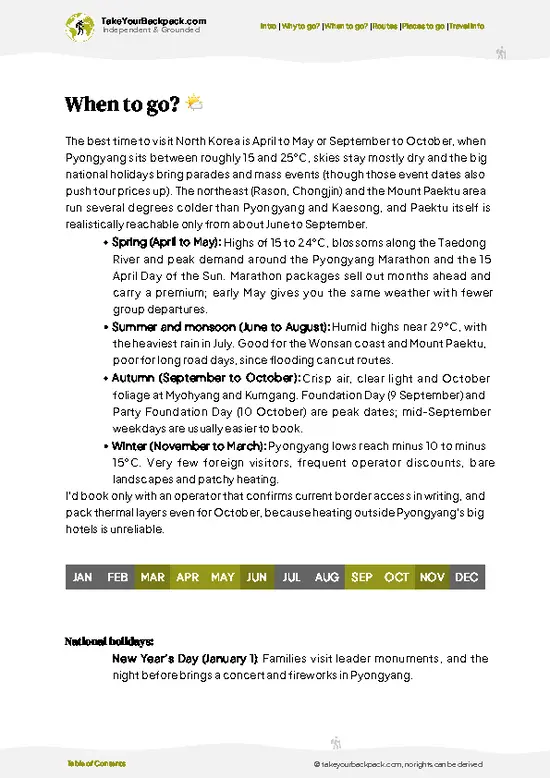
source: climatestotravel.comJANJanuary: below average for travelingFEBFebruary: below average for travelingMARMarch: good for travelingAPRApril: excellent for travelingMAYMay: excellent for travelingJUNJune: highly recommended for travelingJULJuly: fair for travelingAUGAugust: fair for travelingSEPSeptember: excellent for travelingOCTOctober: excellent for travelingNOVNovember: good for travelingDECDecember: below average for traveling
when-to-go

✈️ The backpacker research shortcutNorth Korea Travel Guide

An offline-friendly backpacking guide with optimized travel routes, ranked highlights, transport advice, and the best areas to stay.
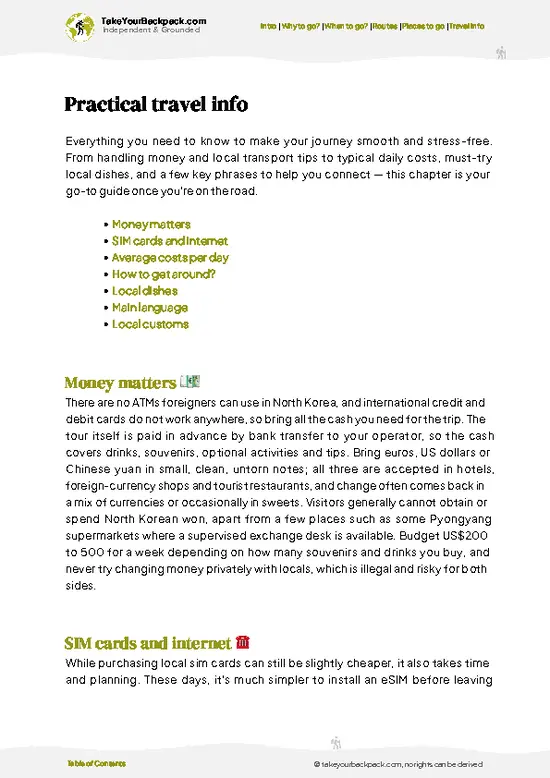
example page 0 from our offline Travel Guide for North Korea
example page 1 from our offline Travel Guide for North Korea
example page 2 from our offline Travel Guide for North Korea
example page 3 from our offline Travel Guide for North Korea
example page 4 from our offline Travel Guide for North Korea
example page 5 from our offline Travel Guide for North Korea
example page 6 from our offline Travel Guide for North Korea
example page 7 from our offline Travel Guide for North Korea
The digital guide (296 pages) contains:
74 highlights, ranked by travel appeal
Optimized 5, 10 & 15-day travel routes
Cities, national parks, landmarks, beaches
How to get around
Offline-friendly for travel without Wi-Fi
👉 Click to see all 30+ guide features

📅 Plan smarter in minutes, not weeks
Month by month travel advice
Festivals & national holidays
Budget expectations

🗺️ Go to the right places, skip the overrated ones
Honest pros & cons of destinations
Top hikes, parks & viewpoints
Lesser-known places most travelers miss
Clear “worth it vs skip it” guidance

🛏️ Travel smoothly without rookie mistakes
Best areas to stay
Transport systems explained simply
Common scams & safety advice
SIM cards, money & practical tips

🌍 Understand the country, not just visit it
Culture & traditions
52 Essential phrases & customs
Festivals worth planning around
Traveler-friendly historical context
Insights that make places more meaningful

📱 Built for real travel conditions
Fully downloadable PDF
Works completely offline
Optimized for phone use
Useful in remote areas & buses
Everything in one place
Save weeks of stressful planning
Get instant access to your full guide. 30‑day money-back guarantee.


By proceeding you agree to our terms.
Sent to your inbox immediately after payment • 100% Secure Checkout
Best Backpacking Travel Advisor 2025 tourism awardBest Backpacking
Travel Advisor
2025
What others say about Take Your Backpack Guides:
⭐⭐⭐⭐⭐
Fantastic, amazing amount of information!
⭐⭐⭐⭐⭐
My goodness this is amazing, it's what I've been looking for hats off too you!
⭐⭐⭐⭐⭐
I think this is absolutely BRILLIANT
⭐⭐⭐⭐
Very complete and informative. It's still missing places, but I gotta to commend you
⭐⭐⭐⭐⭐
This is truly amazing, thank you, can't wait to explore it with my kids!
⭐⭐⭐⭐⭐
Awesome resource, thank you!
⭐⭐⭐⭐⭐
This is amazing! Can't wait to explore the ones I haven't seen
⭐⭐⭐⭐
I love this! Well done, great idea.
⭐⭐⭐⭐⭐
Thanks for taking the time to make this gem!
⭐⭐⭐⭐⭐
This might be the best website I've ever seen.
⭐⭐⭐⭐⭐
Congratulations, and thank you so much for your work; it's incredibly valuable.
⭐⭐⭐⭐
In all seriousness I think you did a great job pointing out the important spots
⭐⭐⭐⭐⭐
10/10 very good
⭐⭐⭐⭐⭐
As someone who's only just starting to visit regularly this is awesome, thank you.
⭐⭐⭐⭐
Thank you very much! I'm going to visit my dad, it's going to be very useful!
⭐⭐⭐⭐⭐
This is really cool! We'll be travelling for the first time and this definitely come in handy.
⭐⭐⭐⭐⭐
You are now our minister of culture, congratulations 👨‍💼
⭐⭐⭐⭐⭐
Just wanted to tell you that this is a pearl! Going to follow your recommendations.
⭐⭐⭐⭐⭐
This is so cool. I'll definitely be using the resource for my travels soon.
⭐⭐⭐⭐⭐
This is very impressive! Good work.
⭐⭐⭐⭐⭐
This is an amazing and informative site. Very well done!

🛏️ Where to stay?Choosing the right base

Nampo’s city center is the clear choice for backpackers who want to maximize safety, social opportunities, and budget options. This area clusters around the West Sea Barrage and the bustling central square, where you’ll find the highest concentration of guesthouses and hostels catering to foreign visitors. Staying here means you’re never far from the main transport hubs, local markets, and eateries that offer authentic North Korean flavors without the tourist markup. The vibe is straightforward—functional, with a steady flow of other travelers, which makes it easier to strike up conversations … read more 👉
Nampo’s city center is the clear choice for backpackers who want to maximize safety, social opportunities, and budget options. This area clusters around the West Sea Barrage and the bustling central square, where you’ll find the highest concentration of guesthouses and hostels catering to foreign visitors. Staying here means you’re never far from the main transport hubs, local markets, and eateries that offer authentic North Korean flavors without the tourist markup. The vibe is straightforward—functional, with a steady flow of other travelers, which makes it easier to strike up conversations or find group tours.

Compared to the quieter, more residential districts on the city’s outskirts, the center feels alive without being overwhelming. It’s where you’ll get a genuine sense of daily life, balanced with the infrastructure that supports international visitors. The trade-off here is comfort versus immersion: you won’t find luxury, but you’ll gain access to a social atmosphere and practical amenities that make solo travel manageable and even enjoyable.

Avoid areas too far from the core; they tend to be less secure for foreigners and lack the communal spaces that make backpacking rewarding. In Nampo, proximity equals peace of mind and connection—two essentials when navigating a city with tight controls and limited traveler infrastructure.

🚌 Getting aroundTransportation options and practical tips

Nampo moves at a pace that’s neither frantic nor sluggish—it’s a city where the rhythm is set by a blend of old-school routines and bursts of spontaneous energy. You’ll find that schedules exist, but they’re more like guidelines than ironclad rules. The streets pulse with a mix of determined locals and curious travelers, all weaving through a network of transport options that reward those who understand the trade-offs between time, money, and comfort. Mastering Nampo’s flow means knowing when to save your energy and when to spend a little extra for convenience. It’s a game of balance, and every choice you make shapes the story of your trip.


  • Walking: The most straightforward and free way to explore Nampo’s compact downtown. Walking lets you soak in the city’s textures and surprises at your
read more 👉
Nampo moves at a pace that’s neither frantic nor sluggish—it’s a city where the rhythm is set by a blend of old-school routines and bursts of spontaneous energy. You’ll find that schedules exist, but they’re more like guidelines than ironclad rules. The streets pulse with a mix of determined locals and curious travelers, all weaving through a network of transport options that reward those who understand the trade-offs between time, money, and comfort. Mastering Nampo’s flow means knowing when to save your energy and when to spend a little extra for convenience. It’s a game of balance, and every choice you make shapes the story of your trip.


  • Walking: The most straightforward and free way to explore Nampo’s compact downtown. Walking lets you soak in the city’s textures and surprises at your own pace, but it’s time-intensive—expect to spend hours if you want to cover major sights. Comfort depends on weather and your stamina, but the payoff is total freedom and zero cost.


  • City Bus: Runs roughly from 6:00 AM to 10:00 PM, with fares around 500-700 KRW (less than a dollar). Buses are slow compared to taxis but reliable and cheap, perfect for budget travelers who don’t mind a bit of waiting and standing room. Comfort is basic—crowded during rush hours, but you get a real feel for local life.


  • Subway Line 1: Operating from about 5:30 AM to midnight, the subway is the fastest way to cover longer distances within Nampo and connect to surrounding areas. Tickets cost around 1,350 KRW. It’s clean, air-conditioned, and punctual, offering a solid middle ground between speed and cost. The trade-off is less street-level interaction and a fixed route.


  • Taxi: Starting fare is about 3,800 KRW, with additional charges per kilometer. Taxis offer door-to-door convenience and save time, especially if you’re carrying gear or traveling in a group. Comfort is high, but costs can add up quickly, especially during traffic jams or late-night rides. Ideal for when time is tight or you want to avoid the hassle of transfers.


  • Bicycle Rentals: Available in select areas, rental prices hover around 3,000-5,000 KRW per hour. Biking strikes a balance between walking and public transit—faster than foot, cheaper than taxis, and flexible enough to explore neighborhoods off the beaten path. Comfort depends on your fitness and the city’s bike infrastructure, which is decent but not extensive.

👛 Costs (as of 12 April 2026)Money, prices, and spending tips

Backpacking in Nampo, North Korea, is a unique challenge where costs are tightly controlled and options limited, but understanding the trade-offs between time, money, and comfort can help you navigate the experience with clarity.
  • Dorm Accommodation (High Season): Expect to pay around €30-€40 per night. High season here means limited availability, so prices spike due to demand and the scarcity of foreign-friendly lodging.
  • Dorm Accommodation (Off-Season): Prices drop to about €20-€25 per night. Off-season offers a bit more breathing room and slightly better bargaining power, but the quality and availability remain consistent.
  • Meals: Budget €5-€10 per day. Meals are basic, often set menus in state-run restaurants or guesthouse cafeterias. You won’t find street food stalls or diverse options,
read more 👉
Backpacking in Nampo, North Korea, is a unique challenge where costs are tightly controlled and options limited, but understanding the trade-offs between time, money, and comfort can help you navigate the experience with clarity.
  • Dorm Accommodation (High Season): Expect to pay around €30-€40 per night. High season here means limited availability, so prices spike due to demand and the scarcity of foreign-friendly lodging.
  • Dorm Accommodation (Off-Season): Prices drop to about €20-€25 per night. Off-season offers a bit more breathing room and slightly better bargaining power, but the quality and availability remain consistent.
  • Meals: Budget €5-€10 per day. Meals are basic, often set menus in state-run restaurants or guesthouse cafeterias. You won’t find street food stalls or diverse options, so expect simplicity and repetition.
  • Local Transport: Around €1-€2 per trip. Local buses and shared taxis are the main options. They’re slow and infrequent, so time is the real cost here, not just money.
  • City Transport Pass: Not commonly available for tourists. Most travelers pay per ride, so factor in multiple small fares if you plan to move around a lot.
  • Basic Activities/Entry Fees: Around €5-€10 per site. Most attractions are state-run museums, monuments, or parks with fixed entry fees. Guided tours often include these fees, so independent visits are rare and sometimes restricted.
  • Miscellaneous Expenses: Budget €3-€5 for essentials like bottled water, snacks, or small souvenirs. Options are limited, so prices can be inflated compared to what you might expect elsewhere.

Total daily costs for backpacking in Nampo typically range from €65 to €85, depending on season and how much you move around. The real trade-off here is between comfort and time: cheaper transport means slower travel, and limited accommodation options mean you’re paying a premium for the rare chance to stay in a foreigner-friendly spot. Knowing this upfront lets you plan smarter, balancing your budget against the unique constraints of this tightly controlled city.


source: korea-dpr.com
⚠️ Prices can change and everyone travels differently, so take this as a rough guide. Hope it helps you plan your adventure!

🚌 Day tripsShort trips worth adding

Nampo, North Korea, is a strategic launchpad for day trips that blend culture, history, and the unique quirks of this enigmatic country. Let’s dive into some worthwhile excursions that will enrich your experience.

**DPRK Maritime Museum**
Just a short bus ride from Nampo, the DPRK Maritime Museum offers a fascinating glimpse into North Korea’s naval history. You’ll find everything from vintage ships to intriguing exhibits on maritime strategy. The museum is often overlooked, but it’s a treasure trove of stories that reveal the country’s relationship with the sea. Expect to spend about two hours here, and budget around $5 for entry and transport. Spring and early autumn are ideal for pleasant weather. A common mistake is underestimating the time needed to explore; don’t rush through!

read more 👉
Nampo, North Korea, is a strategic launchpad for day trips that blend culture, history, and the unique quirks of this enigmatic country. Let’s dive into some worthwhile excursions that will enrich your experience.

**DPRK Maritime Museum**
Just a short bus ride from Nampo, the DPRK Maritime Museum offers a fascinating glimpse into North Korea’s naval history. You’ll find everything from vintage ships to intriguing exhibits on maritime strategy. The museum is often overlooked, but it’s a treasure trove of stories that reveal the country’s relationship with the sea. Expect to spend about two hours here, and budget around $5 for entry and transport. Spring and early autumn are ideal for pleasant weather. A common mistake is underestimating the time needed to explore; don’t rush through!


**Chongsanri Cooperative Farm**
A trip to Chongsanri Cooperative Farm immerses you in the daily life of North Korean farmers. It’s about an hour from Nampo, and you’ll witness traditional farming techniques and perhaps even join in some activities. The experience is authentic and offers a rare look at rural life. Plan for a total cost of around $10, including transport and a small fee for a guided tour. Late spring is particularly vibrant, with crops in full bloom. First-timers often miss the chance to engage with locals; don’t hesitate to ask questions!


**Kumya Beach**
Kumya Beach is a hidden spot for those seeking a bit of relaxation. It’s roughly 30 minutes from Nampo, making it an easy escape. The beach is clean and less crowded, perfect for a picnic or a swim. Bring your own snacks, as options are limited. Expect to spend around $5 for transport. Summer is the prime season, but be cautious of the sun—bring sunscreen! Many overlook the beach’s potential for a chill day; it’s a refreshing break from the usual itinerary.


**Nampo’s Mangyongdae Schoolchildren’s Palace**
This cultural center is about 20 minutes away and showcases the talents of North Korean youth through performances and art exhibitions. It’s a unique experience that highlights the country’s emphasis on education and culture. Admission is typically free, but you might want to budget for souvenirs. Visit in the afternoon for the best shows. A common oversight is not checking performance schedules in advance; plan ahead to catch a show!
Want to know what more North Korea offers?
The North Korea Travel Guide describes 74 highlights, from cities to national parks, from beaches to hikes

Get the Travel Guide -

🍲 FoodEating & Drinking in Nampo

In **Nampo**, the culinary scene is a vibrant tapestry of local flavors that beckons adventurous eaters. Start with **naengmyeon**, cold buckwheat noodles served with a tangy broth—perfect for the warm days. Pair it with **kimchi**, a staple that’s not just a side dish but a cultural experience, fermented to perfection with a spicy kick.

Street food is where the magic happens. Vendors line the bustling markets, offering **hotteok**, sweet pancakes filled with brown sugar and nuts, sizzling on griddles. The aroma wafts through the air, drawing you in. Grab a few and enjoy them while mingling with locals, who often share a smile and a nod.

When it comes to drinks, don’t miss **soju**—a clear, potent spirit that’s a social lubricant in North Korea. It’s common to see groups toasting with small … read more 👉
In **Nampo**, the culinary scene is a vibrant tapestry of local flavors that beckons adventurous eaters. Start with **naengmyeon**, cold buckwheat noodles served with a tangy broth—perfect for the warm days. Pair it with **kimchi**, a staple that’s not just a side dish but a cultural experience, fermented to perfection with a spicy kick.

Street food is where the magic happens. Vendors line the bustling markets, offering **hotteok**, sweet pancakes filled with brown sugar and nuts, sizzling on griddles. The aroma wafts through the air, drawing you in. Grab a few and enjoy them while mingling with locals, who often share a smile and a nod.

When it comes to drinks, don’t miss **soju**—a clear, potent spirit that’s a social lubricant in North Korea. It’s common to see groups toasting with small glasses, a ritual that emphasizes camaraderie. Remember, it’s polite to pour for others, not yourself, so embrace the communal spirit.

Eating in Nampo isn’t just about the food; it’s a chance to connect with the culture. Enjoy the experience, and let the flavors tell their story.

🛡️ SafetyTraveler Safety Guide

Nampo is generally safe for travelers, but staying aware is key. Stick to well-trodden paths, especially near the waterfront and markets. These areas can get busy, so keep your belongings close.

Solo travel is manageable, but avoid wandering alone after dark. The streets can feel deserted, and it’s best to have a local guide or travel in a group.

Scams are rare, but be cautious of overly friendly locals who might want to show you around for a fee. Politely decline if it feels off. Everyday annoyances include occasional language barriers; a translation app can be a lifesaver.

Overall, carry yourself with confidence, respect local customs, and you’ll navigate Nampo smoothly. Enjoy the experience without letting minor hiccups steal your joy.

Other North Korean cities near Nampo

Explore more nearby:

  • Sariwon—folk customs street, grape farms, provincial capital| 46 km away
  • Pyongyang—monumental architecture, central squares, state museums| 56 km away
  • Pyongsong—industrial zones, academic institutes, transport hub| 73 km away

💡 Not sure where to go next?
Create a personalized itinerary for North Korea including Nampo and the places that fit your trip.

Generate my itinerary

👉 Discover all cities

Or checkout all North Korea has to offer (think cities, towns, villages, national parks, hikes, beaches, festivals)
Country photo of North Korea

We 💚 feedbackIs it worth it?

Nampo offers a rare glimpse into North Korean life, where the blend of coastal charm and local culture creates a unique experience. You’ll see the country’s heart in its people and their daily routines. But be prepared: the restrictions can feel stifling. Freedom to explore is limited, and spontaneity is a luxury. Weigh that against the chance to witness a world few ever see. It’s a trade-off worth considering.

✈️ When did I visit North Korea?
As part of my 1.5 year travel around the world trip, I visited North Korea in August 2015. I had never expected I was able to get in.

✍️ Help improve this page!
The information on this page is based on my own backpacking experience in North Korea, supplemented with up-to-date research and feedback from other travelers. Travel details can change, so if you notice anything outdated or incomplete, feel free to let me know.


🙋‍♂️ Give feedback

👋 Meet the founderWho’s Behind Take Your Backpack?

Johan, backpacker and founder of TakeYourBackpackHi, I’m Johan (Netherlands 🇳🇱), the creator of TakeYourBackpack. Over the past decade, I’ve backpacked through 80+ countries across six continents, gaining extensive experience with independent travel, long-term trips, and overland routes.

This site is built on a combination of firsthand travel experience and carefully curated insights from other backpackers. Many guides are based on places I’ve personally visited, while others bring together tips, observations, and practical advice shared by trusted travelers I’ve met along the way.

The goal is to provide realistic, experience-driven guidance — not generic itineraries — so you can explore destinations with better context, clearer expectations, and more confidence.

Get full country guide •
Instant download • 74 highlights • Full Offline guide