×

Palestine🇵🇸 | attractionsTell es-Sultanprehistoric mound, ancient fortifications, archaeological trenches | things to do and best time to go

Explore Qasr HishamExplore Burqin Church

Backpacking in Tell es-Sultan
👍 Recommendedattraction ranked #7
By Johan Kruseman 🇳🇱 | Updated September 4, 2026

Forget the Instagram myth: Tell es-Sultan is not some untouched, Indiana Jones fantasy where you’ll wander alone among ancient ruins at sunrise. It’s a dusty, sun-baked mound just outside Jericho, in the West Bank, and yes, you’ll probably share it with a busload or two of day-trippers. But here’s the real magic: you’re standing on the bones of the world’s oldest city, with layers of human history under your boots—Neolithic walls, Bronze Age towers, the kind of archaeological depth that makes most “ancient” sites look like toddlers. It’s not cheap for what you get visually (think: a lot of dirt and some exposed walls), and the signage is patchy, but if you crave raw, unvarnished history over postcard perfection, Tell es-Sultan delivers. The vibe is low-key, a little scrappy, and absolutely real—no filter required.

Discover everything you want to know in the 📖 Palestine Travel Guide.
Safety warning

The current risk level for Palestine is high. Check the advice before going.


Get your Palestine guide
69 ranked highlights, routes & tips, works offline (273 pages)
Loading the map 🌍
CLICK TO FILTER
cities
towns
villages
landmarks
national parks
hikes
attractions
festivals
regions
SHOW COUNTRY’S BESTSHOW ALL

✨ Why go?
Ranked #7 attraction in Palestine
What makes this attraction worth visiting

Tell es-Sultan isn’t some polished postcard spot where you snap a quick selfie and move on. It’s a gritty, sprawling archaeological site that demands your attention—and your patience. Yes, the crowds can be a grind, especially during peak season, and the entry fee might sting a bit more than other regional sites. But here’s the kicker: this place is the heartbeat of ancient Jericho, one of the oldest continuously inhabited cities on Earth. Walking through Tell es-Sultan is like peeling back layers of human history, from Neolithic settlements to biblical tales that shaped entire civilizations. The sheer scale of the ruins, combined with the raw desert backdrop, gives you a visceral sense of time stretching back thousands of years. For backpackers threading through Palestine, it’s a milestone—proof … read more 👉
Tell es-Sultan isn’t some polished postcard spot where you snap a quick selfie and move on. It’s a gritty, sprawling archaeological site that demands your attention—and your patience. Yes, the crowds can be a grind, especially during peak season, and the entry fee might sting a bit more than other regional sites. But here’s the kicker: this place is the heartbeat of ancient Jericho, one of the oldest continuously inhabited cities on Earth. Walking through Tell es-Sultan is like peeling back layers of human history, from Neolithic settlements to biblical tales that shaped entire civilizations. The sheer scale of the ruins, combined with the raw desert backdrop, gives you a visceral sense of time stretching back thousands of years. For backpackers threading through Palestine, it’s a milestone—proof that you’re not just passing through but connecting with a story that predates modern borders. The effort to get here pays off in a way no glossy travel brochure can capture.
Want to include Tell es-Sultan in your Palestine route?
Create a personalized Palestine itinerary that includes Tell es-Sultan and the places that fit your trip — based on your travel style, budget, and available time. Get your route in seconds.

Generate my trip

💡 HighlightsKey sights and experiences for travelers

The Ancient City Mound
Forget the Instagram filters—Tell es-Sultan is not a photogenic stone archway or a perfectly preserved ruin. It’s a raw, sun-baked mound that looks, at first glance, like a pile of dirt with a few scattered stones. But this is the oldest continuously inhabited city on earth. You’re standing on 10,000 years of human hustle, layer upon layer of mudbrick homes, temples, and defensive walls. The real thrill isn’t in the visuals; it’s in the mental time travel. Every step is a leap across millennia.


The Neolithic Tower
This isn’t some crumbling column—this is a 28-foot stone tower built around 8000 BCE. It’s older than Stonehenge, older than the Pyramids, and it’s still standing. The base is open, so you can peer inside and imagine the labor it took to haul those stones … read more 👉
The Ancient City Mound
Forget the Instagram filters—Tell es-Sultan is not a photogenic stone archway or a perfectly preserved ruin. It’s a raw, sun-baked mound that looks, at first glance, like a pile of dirt with a few scattered stones. But this is the oldest continuously inhabited city on earth. You’re standing on 10,000 years of human hustle, layer upon layer of mudbrick homes, temples, and defensive walls. The real thrill isn’t in the visuals; it’s in the mental time travel. Every step is a leap across millennia.


The Neolithic Tower
This isn’t some crumbling column—this is a 28-foot stone tower built around 8000 BCE. It’s older than Stonehenge, older than the Pyramids, and it’s still standing. The base is open, so you can peer inside and imagine the labor it took to haul those stones before the wheel was even a thing. It’s not flashy, but it’s humbling. This is the kind of artifact that makes you question everything you thought you knew about “ancient.”


The Prehistoric Walls
You’ll see the remains of the world’s earliest city walls. These aren’t just rocks—they’re the blueprint for every walled city that came after. The walls are thick, squat, and utilitarian, built for survival, not for show. If you want to feel the pulse of early urban anxiety—this is it. The sense of vulnerability and ingenuity is almost physical.


The Spring of Elisha
A few steps from the mound, the spring that made Jericho possible still bubbles up, as it has for thousands of years. It’s not a dramatic waterfall, but it’s the reason anyone could live here at all. The water is cool, clear, and—if you’re lucky—shared with a local family filling jugs. This is the real oasis, not the postcard version.


The Archaeological Dig in Action
If you time it right, you might catch archaeologists at work. There’s no velvet rope here—sometimes you can watch as they brush away the dust of centuries, revealing new secrets in real time. It’s messy, slow, and absolutely riveting. This is my personal favorite. There’s nothing like seeing history rewritten by a trowel and a toothbrush, right in front of your eyes.
Spotted a mistake or missing something? Contact us.

🌤️ When to go?Best time to visit Tell es-Sultan


  • Weather: The best weather hits between March and May or September to November. Spring and fall bring mild temperatures and less dust, unlike the scorching summer months where highs can soar above 35°C (95°F), making hiking uncomfortable.

  • Temperature: Expect daytime temps around 20-25°C (68-77°F) in spring and fall, perfect for exploring without overheating. Winters (December to February) can dip to 5°C (41°F) at night, so pack layers if you go then.

  • Daylight Hours: From March to September, you get longer days—up to 12-14 hours of light—giving you more time to wander the ruins and soak in the landscape without rushing.

  • Crowds: Peak tourist season aligns with spring and fall, but Tell es-Sultan rarely feels overwhelmed. Still, visiting early morning or late afternoon helps dodge the
read more 👉

  • Weather: The best weather hits between March and May or September to November. Spring and fall bring mild temperatures and less dust, unlike the scorching summer months where highs can soar above 35°C (95°F), making hiking uncomfortable.

  • Temperature: Expect daytime temps around 20-25°C (68-77°F) in spring and fall, perfect for exploring without overheating. Winters (December to February) can dip to 5°C (41°F) at night, so pack layers if you go then.

  • Daylight Hours: From March to September, you get longer days—up to 12-14 hours of light—giving you more time to wander the ruins and soak in the landscape without rushing.

  • Crowds: Peak tourist season aligns with spring and fall, but Tell es-Sultan rarely feels overwhelmed. Still, visiting early morning or late afternoon helps dodge the small groups that do show up.

  • Seasonal Activities: Spring brings wildflowers and greener surroundings, adding unexpected color to the ancient stones. Autumn offers a quieter vibe with harvest season nearby, giving a glimpse into local life beyond the ruins.

  • Price Fluctuations: Entry fees and local guides’ prices stay steady year-round, but accommodation in nearby Jericho can spike during major holidays like Ramadan or Easter, so plan accordingly.


Pro-tip: Aim for late April or early October—cool temps, fewer crowds, and the landscape shows off its raw, unfiltered beauty without the tourist gloss.


source: climatestotravel.comJANJanuary: good for travelingFEBFebruary: good for travelingMARMarch: excellent for travelingAPRApril: excellent for travelingMAYMay: highly recommended for travelingJUNJune: fair for travelingJULJuly: below average for travelingAUGAugust: below average for travelingSEPSeptember: highly recommended for travelingOCTOctober: excellent for travelingNOVNovember: highly recommended for travelingDECDecember: good for traveling
when-to-go

✈️ The backpacker research shortcutPalestine Travel Guide

An offline-friendly backpacking guide with optimized travel routes, ranked highlights, transport advice, and the best areas to stay.
example page 0 from our offline Travel Guide for Palestine
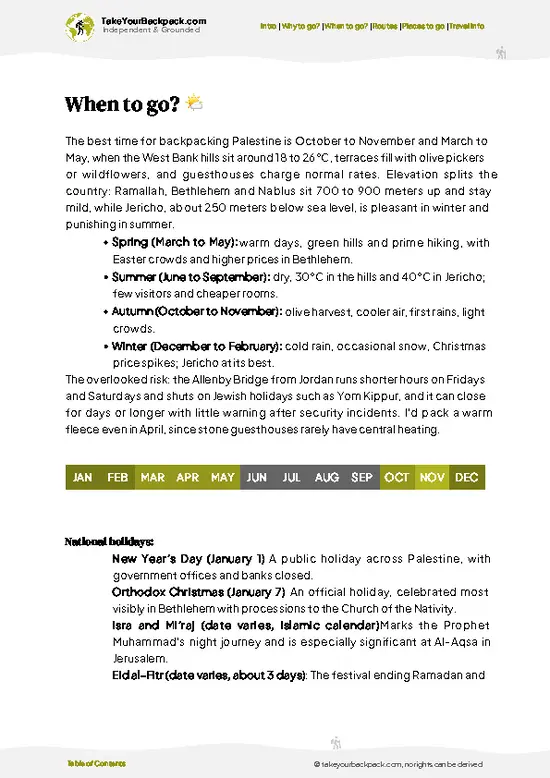
example page 1 from our offline Travel Guide for Palestine
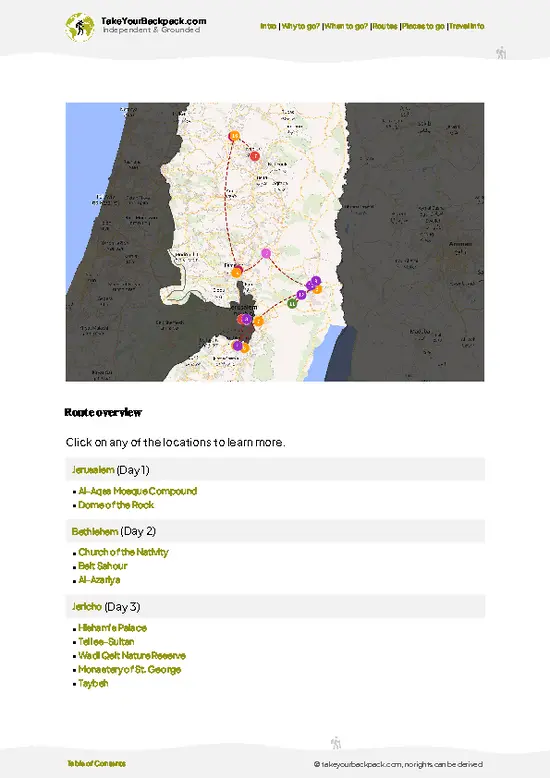
example page 2 from our offline Travel Guide for Palestine
example page 3 from our offline Travel Guide for Palestine
example page 4 from our offline Travel Guide for Palestine
example page 5 from our offline Travel Guide for Palestine
example page 6 from our offline Travel Guide for Palestine
example page 7 from our offline Travel Guide for Palestine
The digital guide (273 pages) contains:
69 highlights, ranked by travel appeal
Optimized 2, 3 & 5-day travel routes
Cities, national parks, landmarks, beaches
How to get around
Offline-friendly for travel without Wi-Fi
👉 Click to see all 30+ guide features

📅 Plan smarter in minutes, not weeks
Month by month travel advice
Festivals & national holidays
Budget expectations

🗺️ Go to the right places, skip the overrated ones
Honest pros & cons of destinations
Top hikes, parks & viewpoints
Lesser-known places most travelers miss
Clear “worth it vs skip it” guidance

🛏️ Travel smoothly without rookie mistakes
Best areas to stay
Transport systems explained simply
Common scams & safety advice
SIM cards, money & practical tips

🌍 Understand the country, not just visit it
Culture & traditions
52 Essential phrases & customs
Festivals worth planning around
Traveler-friendly historical context
Insights that make places more meaningful

📱 Built for real travel conditions
Fully downloadable PDF
Works completely offline
Optimized for phone use
Useful in remote areas & buses
Everything in one place
Save weeks of stressful planning
Get instant access to your full guide. 30‑day money-back guarantee.
+ Add another guide for just US$7.80

By proceeding you agree to our terms.
Sent to your inbox immediately after payment • 100% Secure Checkout
Best Backpacking Travel Advisor 2025 tourism awardBest Backpacking
Travel Advisor
2025
What others say about Take Your Backpack Guides:
⭐⭐⭐⭐⭐
Fantastic, amazing amount of information!
⭐⭐⭐⭐⭐
My goodness this is amazing, it's what I've been looking for hats off too you!
⭐⭐⭐⭐⭐
I think this is absolutely BRILLIANT
⭐⭐⭐⭐
Very complete and informative. It's still missing places, but I gotta to commend you
⭐⭐⭐⭐⭐
This is truly amazing, thank you, can't wait to explore it with my kids!
⭐⭐⭐⭐⭐
Awesome resource, thank you!
⭐⭐⭐⭐⭐
This is amazing! Can't wait to explore the ones I haven't seen
⭐⭐⭐⭐
I love this! Well done, great idea.
⭐⭐⭐⭐⭐
Thanks for taking the time to make this gem!
⭐⭐⭐⭐⭐
This might be the best website I've ever seen.
⭐⭐⭐⭐⭐
Congratulations, and thank you so much for your work; it's incredibly valuable.
⭐⭐⭐⭐
In all seriousness I think you did a great job pointing out the important spots
⭐⭐⭐⭐⭐
10/10 very good
⭐⭐⭐⭐⭐
As someone who's only just starting to visit regularly this is awesome, thank you.
⭐⭐⭐⭐
Thank you very much! I'm going to visit my dad, it's going to be very useful!
⭐⭐⭐⭐⭐
This is really cool! We'll be travelling for the first time and this definitely come in handy.
⭐⭐⭐⭐⭐
You are now our minister of culture, congratulations 👨‍💼
⭐⭐⭐⭐⭐
Just wanted to tell you that this is a pearl! Going to follow your recommendations.
⭐⭐⭐⭐⭐
This is so cool. I'll definitely be using the resource for my travels soon.
⭐⭐⭐⭐⭐
This is very impressive! Good work.
⭐⭐⭐⭐⭐
This is an amazing and informative site. Very well done!

🛏️ Where to stay?Best areas to stay in Palestine

If you’re heading to Tell es-Sultan, the ancient mound near Jericho, brace yourself: this isn’t a polished tourist hotspot with endless amenities. The crowds are modest, mostly local families and a handful of history buffs, so don’t expect a buzzing backpacker scene right at the site. That’s where staying in Jericho proper comes in. It’s the practical choice—safe, accessible, and where you’ll find the social pulse for budget travelers.

Jericho’s city center offers a gritty but genuine vibe. It’s where you’ll meet other solo travelers and locals over cheap falafel or mint tea. The streets are … read more 👉
If you’re heading to Tell es-Sultan, the ancient mound near Jericho, brace yourself: this isn’t a polished tourist hotspot with endless amenities. The crowds are modest, mostly local families and a handful of history buffs, so don’t expect a buzzing backpacker scene right at the site. That’s where staying in Jericho proper comes in. It’s the practical choice—safe, accessible, and where you’ll find the social pulse for budget travelers.

Jericho’s city center offers a gritty but genuine vibe. It’s where you’ll meet other solo travelers and locals over cheap falafel or mint tea. The streets are walkable, and you can easily catch a shared taxi or local bus to Tell es-Sultan without hassle. This area isn’t about luxury or polished hostels; it’s about raw, real Palestine. You get to soak in the everyday life, which is the real treasure here.

Avoid the temptation to camp or stay isolated near the ruins. Jericho’s city center keeps you grounded, connected, and safe—exactly what you want when you’re backpacking solo in a place that’s more about history and humanity than Instagram filters.

👛 Costs (as of 4 September 2026)Travel costs and budget guide for Tell es-Sultan

As of 2025, the entrance fee to Tell es-Sultan, also known as Ancient Jericho, is approximately €2 to €3. This fee grants access to the archaeological site, which includes ancient walls, buildings, and cisterns. Additional costs may include transportation to Jericho and meals, which are generally affordable.

source: oasis-jericho.ps
⚠️ Prices can change and everyone travels differently, so take this as a rough guide. Hope it helps you plan your adventure!

FAQFrequently asked questions about Tell es-Sultan

2 to 3 hours are sufficient to visit Tell es-Sultan, allowing time to explore the archaeological site and its key features. Guided tours may take longer, around 3 to 4 hours, for a more detailed understanding.
Yes, Tell es-Sultan is worth the entrance fee, which is typically around 10 to 15 ILS (Israeli Shekels). The site offers significant historical value as one of the oldest known cities, with well-preserved ruins and informative displays.
To get to Tell es-Sultan, travel to Jericho in the West Bank, then take a local taxi or walk from the city center; the site is about 2 kilometers from central Jericho. Public transportation options are limited, so arranging a taxi or private transport is recommended.
⚠️ Things can change over time, so always validate details locally before you go.

Other Palestinian attractions near Tell es-Sultan

Explore more nearby:

  • Qasr Hisham—desert palace, Umayyad mosaics, ruined bathhouse| 2 km away
  • Dome of the Rock—octagonal shrine, golden dome, religious relic| 22 km away
  • Al-Aqsa Mosque Compound—sacred precinct, layered architecture, religious significance, panoramic courtyards| 22 km away

💡 Not sure where to go next?
Create a personalized itinerary for Palestine including Tell es-Sultan and the places that fit your trip.

Generate my itinerary

👉 Discover all attractions

Or checkout all Palestine has to offer (think cities, towns, villages, national parks, hikes, beaches, festivals)
Country photo of Palestine

We 💚 feedbackFinal thoughts on visiting Tell es-Sultan

Tell es-Sultan isn’t a polished tourist magnet—it’s dusty, sprawling, and often quiet, which means you won’t find crowds or glossy facilities. But if you’re after a raw connection to the dawn of urban life, this is where history hits you in the gut. The real magic is standing where civilization first took root, feeling the weight of millennia beneath your boots. Just don’t expect comfort or Instagram-ready scenes.

✈️ When did I visit Palestine?
I visited Palestine (Westbank) in October 2013 in the same trip as I backpacked through Israel.

✍️ Help improve this page!
The information on this page is based on my own backpacking experience in Palestine, supplemented with up-to-date research and feedback from other travelers. Travel details can change, so if you notice anything outdated or incomplete, feel free to let me know.


🙋‍♂️ Give feedback

👋 Meet the founderWho’s Behind Take Your Backpack?

Johan, backpacker and founder of TakeYourBackpackHi, I’m Johan (Netherlands 🇳🇱), the creator of TakeYourBackpack. Over the past decade, I’ve backpacked through 80+ countries across six continents, gaining extensive experience with independent travel, long-term trips, and overland routes.

This site is built on a combination of firsthand travel experience and carefully curated insights from other backpackers. Many guides are based on places I’ve personally visited, while others bring together tips, observations, and practical advice shared by trusted travelers I’ve met along the way.

The goal is to provide realistic, experience-driven guidance — not generic itineraries — so you can explore destinations with better context, clearer expectations, and more confidence.

Get full Palestine guide •
Instant download • 69 highlights • Full Offline guide