×

Palestine🇵🇸 | best landmarksEssential 8 landmarks to Explore in Palestine

Landmarks in Palestine are mostly living places: old city quarters, churches, mosques and hilltop ruins people still use daily. The West Bank holds nearly everything, and it is compact, cheap and easy to reach by shared van. Jerusalem’s core draws the crowds and the queues. Skip the souvenir-heavy tour-bus stops. For independent travel, Hebron, Nablus and Jericho give more texture per shekel.

By Johan Kruseman 🇳🇱 | Updated October 18, 2026
Explore the best national parks in Palestine

Why go?Understanding Their Importance

Palestine packs an unusual density of sacred and layered history into a small area, with Canaanite, Roman, Byzantine, Crusader and Ottoman remains often within a short drive of each other. That is the real draw. Most sites are small, local and still in use, so expect worship, markets and neighbors rather than ticketed attractions with polished signage.

Be clear on the limits. Checkpoints and permits shape movement, opening hours shift without notice, and interpretation is thin at many sites, so a local guide adds more than any placard. Do not expect tidy infrastructure or big heritage budgets. Do expect low prices, direct hospitality and very few tourists outside Bethlehem and Jerusalem’s edge. Check the current security situation before booking, because it changes what is realistically open to visit.
Evaluating the Top Choices
The list of best unique sites in Palestine is created based on history or culture, wow factor, atmosphere, quirks, and memorability. If you feel a unique site is missing in this list, please let us know.

When to go?When to Plan Your Trip

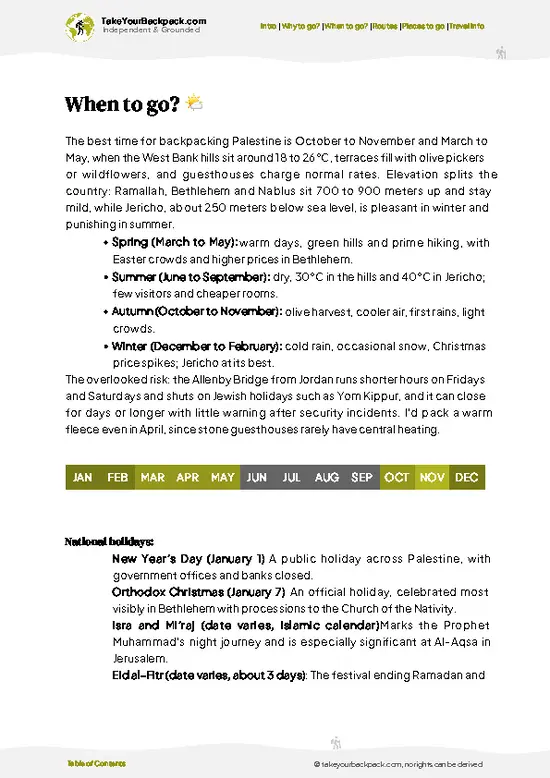
Best months and shoulder seasons: April, May, October and November are best for landmarks in Palestine because daytime highs sit around 22 to 30°C and the open-air sites are comfortable to walk. Winter, December to February, is cool and wet in the hills, with 8 to 15°C and most of the roughly 500 to 700 mm of annual rain in the highlands. Bring a waterproof, since stone paths turn slick.

Summer heat and peak periods: June to September is hot, around 30 to 35°C in the hills. Jericho and the Jordan Valley regularly pass 38°C, so go there at dawn or save it for winter, when it is pleasantly warm. Christmas and Easter push Bethlehem prices up and fill rooms, so book ahead or avoid them. Ramadan shortens opening hours and slows mornings.

unique site hoppingPlanning Your Route Efficiently

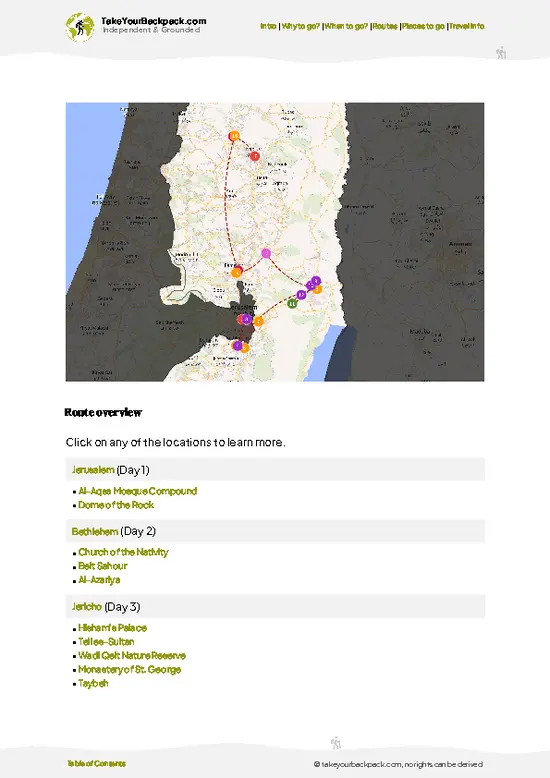
How many days to allow: A trip linking several landmarks in Palestine needs 5 to 8 days. Start in Jerusalem or Ramallah as your hub, since they have the most frequent transport, then fan out. Bethlehem and Hebron sit south, Nablus and Sebastia north, and Jericho east, so group them by direction rather than zigzagging.

Allow 2 to 4 hours per stop and a half day for the bigger old-city quarters. Typical drives run 30 to 90 minutes between regions by shared service taxi or bus, and checkpoint waits can add 20 to 60 minutes, sometimes more.

Planning mistakes: The common error is stacking three towns in one day. Cap it at two. Another is traveling after mid-afternoon, when shared vans thin out and stop running. Leave early, and keep the return leg flexible.

The ListThe Best landmarks of Palestine

1 Church of the Nativity

mosaic floors, pilgrimage site, grotto

Step into a centuries-old basilica where subdued light, incense, and ancient stonework frame the spot long revered as the birthplace of Jesus.

palestine-unique-site-church-of-the-nativity
© Google |

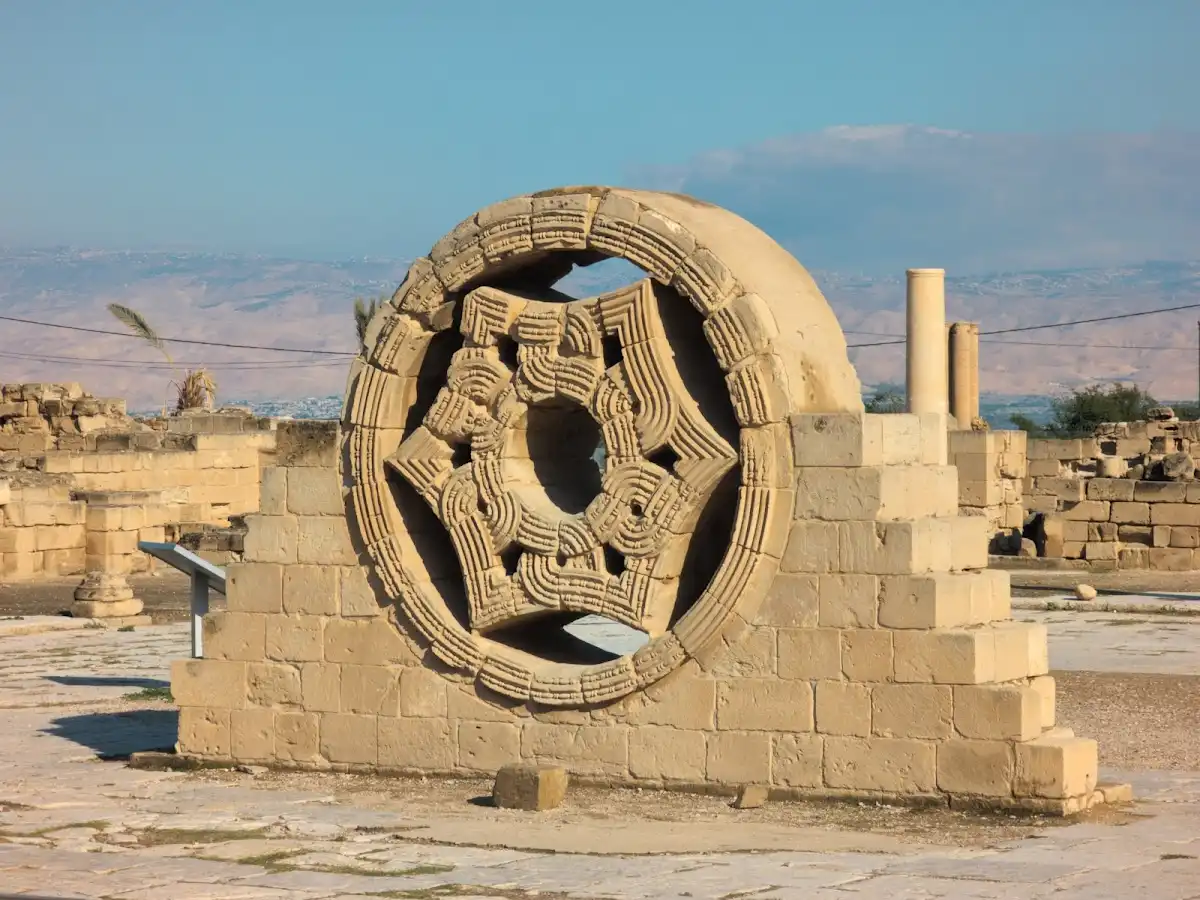
2 Hisham’s Palace

desert ruins, Umayyad mosaics, bathhouse

Wander through the remains of a winter retreat, where faded frescoes and elaborate floors evoke the luxury of early Islamic architecture.

palestine-unique-site-hishams-palace
© Google |

3 Dome of the Rock

octagonal shrine, golden dome, religious relic

Admire intricate tilework and geometric design while standing at a site revered for its spiritual and architectural resonance.

4 Tell es-Sultan

tell mound, Neolithic walls, archaeological layers

Survey excavation pits and exposed strata that reveal millennia of habitation in one of the world’s oldest continuously inhabited settlements.

5 Monastery of St. George

cliffside hermitage, desert gorge, monastic cells

Trace a winding path into Wadi Qelt to find a remote monastery clinging to rock, where silence and solitude define the landscape.

palestine-unique-site-monastery-of-st-george
© Google |

6 Mount Gerizim

Samaritan community, panoramic ridge, ritual site

Ascend a mountain long held sacred, observing seasonal pilgrimages and daily life among one of the world’s smallest religious groups.

7 Roman Theatre in Sebastia

stone tiers, hillside amphitheater, ancient city

Sit among weathered seats carved into the slope, imagining performances that once animated the heart of a Roman provincial capital.

palestine-unique-site-roman-theatre-in-sebastia
© Google |

8 Khan al-Lubban

caravanserai, stone courtyard, rural hills

Pause at a centuries-old roadside inn, surrounded by olive groves and echoing with the footsteps of traders who crossed the central highlands.

Loading the map 🌍

Expert viewPro Tips for Exploring the Best

How many to visit: Aim for 6 to 8 landmarks over a week. That gives each site 2 to 4 hours of real attention, plus time for tea with whoever offers it, and avoids the fatigue of stone streets, checkpoints and heat. More than two in a day turns into a blur of doorways.

Choosing by travel style: History fans should lean toward archaeological sites and old city quarters with a local guide. Pilgrims will want the major churches and mosques, but should expect queues at peak holidays. Travelers on a tight budget get the best value from walking old cities and markets, which cost nothing. Skip anything where the main product is a souvenir stop with a commission attached.

What it costs: Budget US$30 to 50 a day, including dorm or guesthouse beds, falafel meals and shared vans. Entry fees run around … read more 👉
How many to visit: Aim for 6 to 8 landmarks over a week. That gives each site 2 to 4 hours of real attention, plus time for tea with whoever offers it, and avoids the fatigue of stone streets, checkpoints and heat. More than two in a day turns into a blur of doorways.

Choosing by travel style: History fans should lean toward archaeological sites and old city quarters with a local guide. Pilgrims will want the major churches and mosques, but should expect queues at peak holidays. Travelers on a tight budget get the best value from walking old cities and markets, which cost nothing. Skip anything where the main product is a souvenir stop with a commission attached.

What it costs: Budget US$30 to 50 a day, including dorm or guesthouse beds, falafel meals and shared vans. Entry fees run around NIS 10 to 50 (US$3 to 14), and some religious sites are free. Local guides charge about NIS 150 to 400 (US$40 to 110) for a half day, which is worth paying at Hebron and at sites with little signage. Shared taxis cost NIS 5 to 25 (US$1.50 to 7) per ride. The payoff is context you cannot get from a plaque.

Safety and etiquette: Check current conditions daily, since closures and checkpoint rules change fast. Carry your passport at all times and keep to main roads. Dress modestly, with covered shoulders and knees, and bring a scarf for mosques and churches. Ask before photographing people, and never photograph soldiers or checkpoints. In Hebron, follow a local guide’s lead in areas under military control. Prayer times and Fridays close some sites to visitors, so plan around them and you will get calmer, friendlier visits.

✈️ The backpacker research shortcutPalestine Travel Guide

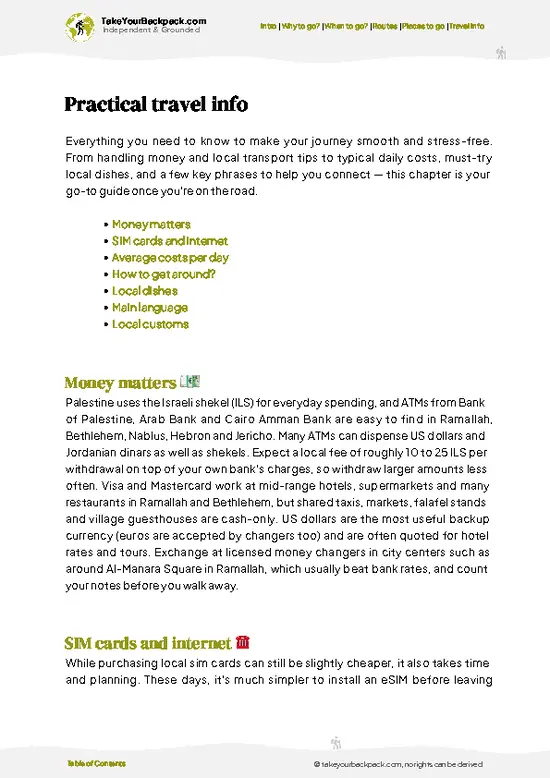
An offline-friendly backpacking guide with optimized travel routes, ranked highlights, transport advice, and the best areas to stay.
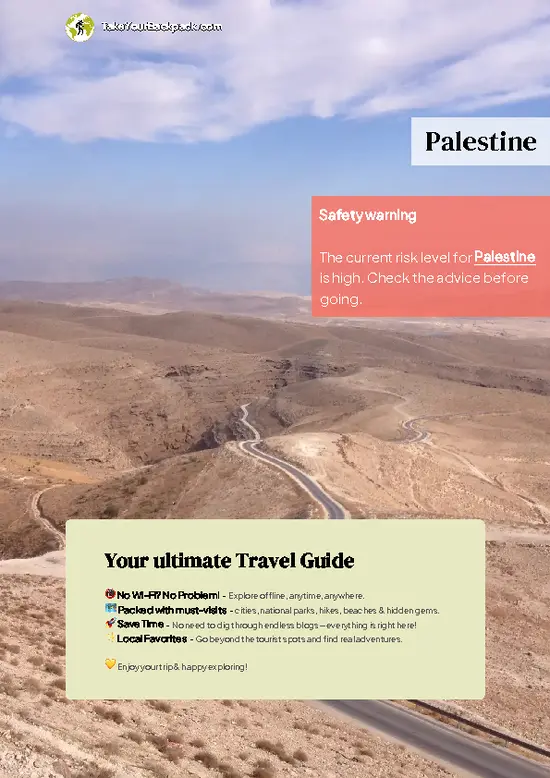
example page 0 from our offline Travel Guide for Palestine
example page 1 from our offline Travel Guide for Palestine
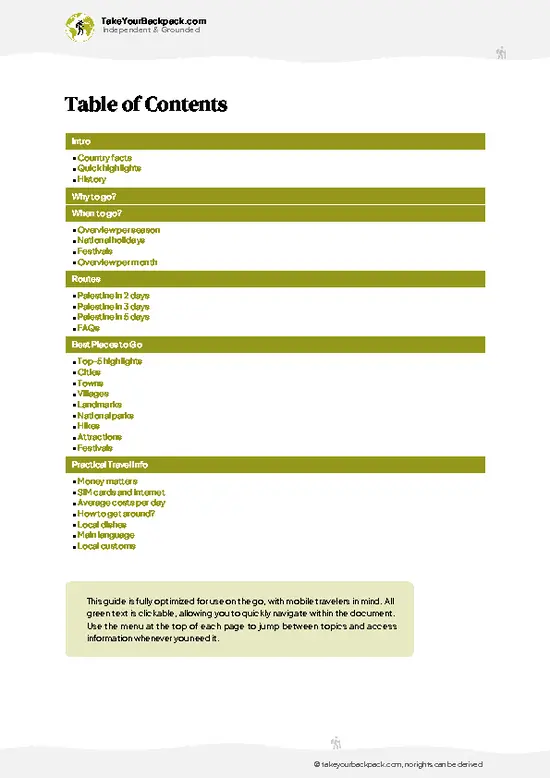
example page 2 from our offline Travel Guide for Palestine
example page 3 from our offline Travel Guide for Palestine
example page 4 from our offline Travel Guide for Palestine
example page 5 from our offline Travel Guide for Palestine
example page 6 from our offline Travel Guide for Palestine
example page 7 from our offline Travel Guide for Palestine
The digital guide (246 pages) contains:
✅ 61 highlights, ranked by travel appeal
✅ Optimized 2, 3 & 5-day travel routes
✅ Cities, national parks, landmarks, beaches
✅ How to get around
✅ Offline-friendly for travel without Wi-Fi
👉 Click to see all 30+ guide features

📅 Plan smarter in minutes, not weeks
✅ Month by month travel advice
✅ Festivals & national holidays
✅ Budget expectations

🗺️ Go to the right places, skip the overrated ones
✅ Honest pros & cons of destinations
✅ Top hikes, parks & viewpoints
✅ Lesser-known places most travelers miss
✅ Clear “worth it vs skip it” guidance

🛏️ Travel smoothly without rookie mistakes
✅ Best areas to stay
✅ Transport systems explained simply
✅ Common scams & safety advice
✅ SIM cards, money & practical tips

🌍 Understand the country, not just visit it
✅ Culture & traditions
✅ 52 Essential phrases & customs
✅ Festivals worth planning around
✅ Traveler-friendly historical context
✅ Insights that make places more meaningful

📱 Built for real travel conditions
✅ Fully downloadable PDF
✅ Works completely offline
✅ Optimized for phone use
✅ Useful in remote areas & buses
✅ Everything in one place
Stop searching, start planning
Get instant access to your full guide. 30‑day money-back guarantee.
+ Add another guide for just

By proceeding you agree to our terms.
Sent to your inbox immediately after payment • 100% Secure Checkout
Best Backpacking Travel Advisor 2025 tourism awardBest Backpacking
Travel Advisor
2025
What others say about Take Your Backpack Guides:
⭐⭐⭐⭐⭐
Fantastic, amazing amount of information!
⭐⭐⭐⭐⭐
My goodness this is amazing, it's what I've been looking for hats off too you!
⭐⭐⭐⭐⭐
I think this is absolutely BRILLIANT
⭐⭐⭐⭐
Very complete and informative. It's still missing places, but I gotta to commend you
⭐⭐⭐⭐⭐
This is truly amazing, thank you, can't wait to explore it with my kids!
⭐⭐⭐⭐⭐
Awesome resource, thank you!
⭐⭐⭐⭐⭐
This is amazing! Can't wait to explore the ones I haven't seen
⭐⭐⭐⭐
I love this! Well done, great idea.
⭐⭐⭐⭐⭐
Thanks for taking the time to make this gem!
⭐⭐⭐⭐⭐
This might be the best website I've ever seen.
⭐⭐⭐⭐⭐
Congratulations, and thank you so much for your work; it's incredibly valuable.
⭐⭐⭐⭐
In all seriousness I think you did a great job pointing out the important spots
⭐⭐⭐⭐⭐
10/10 very good
⭐⭐⭐⭐⭐
As someone who's only just starting to visit regularly this is awesome, thank you.
⭐⭐⭐⭐
Thank you very much! I'm going to visit my dad, it's going to be very useful!
⭐⭐⭐⭐⭐
This is really cool! We'll be travelling for the first time and this definitely come in handy.
⭐⭐⭐⭐⭐
You are now our minister of culture, congratulations 👨‍💼
⭐⭐⭐⭐⭐
Just wanted to tell you that this is a pearl! Going to follow your recommendations.
⭐⭐⭐⭐⭐
This is so cool. I'll definitely be using the resource for my travels soon.
⭐⭐⭐⭐⭐
This is very impressive! Good work.
⭐⭐⭐⭐⭐
This is an amazing and informative site. Very well done!

🛏️ Where to stay?Accommodation Highlights

Palestine has a small but growing network of hostels and family-run guesthouses, with dorm beds usually running ₪50 to 90 (about US$16 to 29) a night. Bethlehem has the most choice, mainly in and around the Old City near Star Street and Manger Square, which puts you within walking distance of the Church of the Nativity but gets quiet after dark. Ramallah suits you if you want cafés and bars, with beds clustered around Al-Manara downtown (central, noisy) and leafier Al-Masyoun (calmer, a short taxi ride from the action). Nablus offers atmospheric stays inside the Old City souq, ideal for food and history but with almost no nightlife and a conservative feel.

If you enjoy meeting fellow travelers, … read more 👉
Palestine has a small but growing network of hostels and family-run guesthouses, with dorm beds usually running ₪50 to 90 (about US$16 to 29) a night. Bethlehem has the most choice, mainly in and around the Old City near Star Street and Manger Square, which puts you within walking distance of the Church of the Nativity but gets quiet after dark. Ramallah suits you if you want cafés and bars, with beds clustered around Al-Manara downtown (central, noisy) and leafier Al-Masyoun (calmer, a short taxi ride from the action). Nablus offers atmospheric stays inside the Old City souq, ideal for food and history but with almost no nightlife and a conservative feel.

If you enjoy meeting fellow travelers, consider choosing hostels with high ratings for atmosphere. On the other hand, if you prefer having your own space, a hotel might be a better option.

PalestineSee More of Palestine

👋 Meet the founderWho’s Behind Take Your Backpack?

Johan, backpacker and founder of TakeYourBackpackHi, I’m Johan (Netherlands 🇳🇱), the creator of TakeYourBackpack. Over the past 3 decades, I’ve backpacked through 90+ countries across six continents, gaining extensive experience with independent travel, long-term trips, and overland routes.

This site is built on a combination of firsthand travel experience and carefully curated insights from other backpackers. Many guides are based on places I’ve personally visited, while others bring together tips, observations, and practical advice shared by trusted travelers I’ve met along the way.

The goal is to provide realistic, experience-driven guidance — not generic itineraries — so you can explore destinations with better context, clearer expectations, and more confidence.