
×

Papua New Guinea🇵🇬 | regionsDuke of York IslandsChannel canoe hops, house reefs, tabu shell money, copper sunsets | things to do and best time to go

Explore Misima IslandExplore Finschhafen

Backpacking in Duke of York Islands
👍 Recommendedregion ranked #8
By Johan Kruseman 🇳🇱 | Updated October 15, 2026

Your dugout canoe scrapes onto warm gray-white sand, a pig trots off under the coconut palms, and the water behind you runs clear enough to count the coral heads from the bow. That’s arrival on the Duke of York Islands, a small group in St George’s Channel between New Britain and New Ireland, in the east of Papua New Guinea. Beaches here are quiet and clean, and the snorkeling over reef walls is excellent. Swimming is easy in sheltered coves, though there’s no surf worth chasing. Getting here takes effort by boat, and guesthouses and trade-store food stay basic. You’ll pay for that with simplicity and gain solitude. Compared with the busier, resort-leaning shores around Kokopo, these beaches have village life at their edges and almost no other visitors.

Discover everything you want to know in the 📖 Papua New Guinea Travel Guide.


example page 0 from our offline Travel Guide for Papua New Guinea
example page 1 from our offline Travel Guide for Papua New Guinea
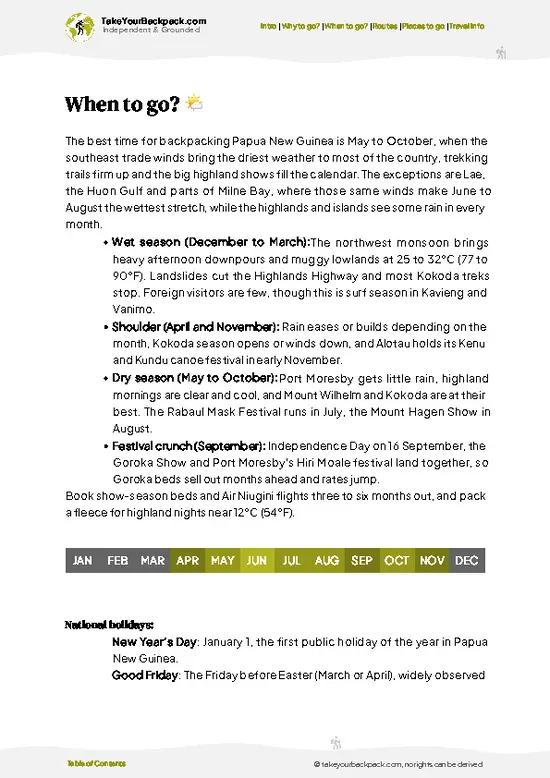
example page 2 from our offline Travel Guide for Papua New Guinea
example page 3 from our offline Travel Guide for Papua New Guinea
example page 4 from our offline Travel Guide for Papua New Guinea
example page 5 from our offline Travel Guide for Papua New Guinea
example page 6 from our offline Travel Guide for Papua New Guinea
example page 7 from our offline Travel Guide for Papua New Guinea
Loading the map 🌍
CLICK TO FILTER
cities
towns
national parks
hikes
beaches
attractions
festivals
regions
SHOW COUNTRY’S BESTSHOW ALL

✨ Why go?
Ranked #8 region in Papua New Guinea
What makes it a must-see region

Backpackers come for the water and the people. The reefs around Makada and Kerawara sit a short boat hop apart, so you can snorkel over walls of hard coral one morning and walk a village beach the next, often with nobody else in sight. Visitors stay in village guesthouses or with host families, so evenings mean sharing food, learning a few Tok Pisin phrases and watching kids launch canoes. The islands are also the home of the Tolai-related shell money tradition, tabu, and locals still talk about it with pride. Mainly, though, the islands work as a slow pause from the mainland route. You trade vehicles and traffic for paddles, outboards and tide tables, and the days settle into swimming, walking and talking. Nothing is polished here, which is the appeal.

💡 HighlightsWhat this place is best known for

  1. Snorkeling the house reefs: Shallow coral gardens drop to small walls just offshore, with reef fish, clams and the occasional turtle. Visibility is often superb on calm mornings.
  2. Canoe hopping between islands: Local boatmen ferry you across the channel between the islands, and the ride itself gives you dolphin chances and views toward the Gazelle Peninsula’s volcanoes.
  3. Village beach walks: Stroll the sandy edges past thatched houses, smoking fires and fishing nets. Greeting people is expected, and you’ll often be invited to sit and talk.
  4. Shell money culture: Ask your host about tabu, the strings of tiny shells used in ceremonies and exchange. Seeing how it is made and valued explains a lot about local life.
  5. Sunset on the western shores: The light turns the channel copper, fishing canoes slip out,
… read more 👉
  1. Snorkeling the house reefs: Shallow coral gardens drop to small walls just offshore, with reef fish, clams and the occasional turtle. Visibility is often superb on calm mornings.
  2. Canoe hopping between islands: Local boatmen ferry you across the channel between the islands, and the ride itself gives you dolphin chances and views toward the Gazelle Peninsula’s volcanoes.
  3. Village beach walks: Stroll the sandy edges past thatched houses, smoking fires and fishing nets. Greeting people is expected, and you’ll often be invited to sit and talk.
  4. Shell money culture: Ask your host about tabu, the strings of tiny shells used in ceremonies and exchange. Seeing how it is made and valued explains a lot about local life.
  5. Sunset on the western shores: The light turns the channel copper, fishing canoes slip out, and the night sky is dense with stars since there are almost no lights.
Snorkel the reefs in the morning and save the village walk for late afternoon, when the heat eases and people are out and about.
Spotted a mistake or missing something? Contact us.

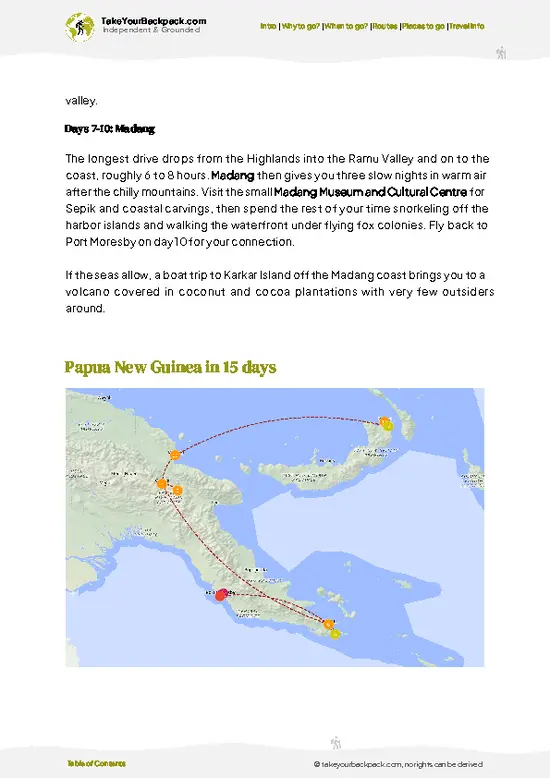
⌛️ 5 daysHow to make the most of Duke of York Islands

Day 1: Kokopo: Start on the mainland side, at the Kokopo waterfront, because the islands run on boat schedules and boats leave from the Kokopo coast when they fill, not when a timetable says. Buy fuel money, water and snacks in town, then get to the landing early so you are not stuck waiting for a full boat in the heat. The crossing across St. George’s Channel is short, and you land on Duke Island, the larger of the two main islands.Day 2: Duke Island: Spend the whole day on foot here. Coastal paths link villages, and the reef off the beaches is shallow enough for snorkeling right from shore. Because transport between islands depends on someone with a dinghy, ask your host to line up the next day’s ride tonight.Day 3: Ulu Island: Hire a boat to cross to Ulu, the smaller neighbor. Walk its … read more 👉
Day 1: Kokopo: Start on the mainland side, at the Kokopo waterfront, because the islands run on boat schedules and boats leave from the Kokopo coast when they fill, not when a timetable says. Buy fuel money, water and snacks in town, then get to the landing early so you are not stuck waiting for a full boat in the heat. The crossing across St. George’s Channel is short, and you land on Duke Island, the larger of the two main islands.Day 2: Duke Island: Spend the whole day on foot here. Coastal paths link villages, and the reef off the beaches is shallow enough for snorkeling right from shore. Because transport between islands depends on someone with a dinghy, ask your host to line up the next day’s ride tonight.Day 3: Ulu Island: Hire a boat to cross to Ulu, the smaller neighbor. Walk its villages, watch the tubu (shell money) tradition that the Tolai people still use at ceremonies, and snorkel over coral that sees almost no visitors. Plan to be back on Duke by the afternoon, since seas can pick up later in the day.Day 4: Detour to Kabakada: Back on the mainland, a short drive from Kokopo takes you to the Tolai villages around Rabaul’s harbor, where you can see volcanic ground and old war relics. This adds depth without adding another boat leg.Day 5: Kokopo: Use the final day for the market and a slow lunch, with buffer time before any onward flight.
If you can keep only one day, make it Day 3 on Ulu. The shell money culture and empty reef are the reason to come at all.

🌤️ When to go?When to go for the best experience

  • Southeast Trade Season (May to October): Drier and breezier, with calmer mornings and clearer water for snorkeling. Days sit around 28 to 31°C (82 to 88°F), nights 23 to 25°C (73 to 77°F). Sunrise and sunset stay close to 6:00 and 18:00 all year. Rough afternoon chop can slow boat crossings.
  • Northwest Monsoon (November to April): Hotter and more humid, 29 to 32°C (84 to 90°F), with heavy downpours and some days of cancelled small-boat runs. Seas are often glassy on dry mornings, though visibility drops after rain.
  • Crowds and Prices: Visitors are few in every month. Guesthouse rates barely shift, with a small bump around Christmas and when Rabaul events draw domestic travelers.
  • Local Events: The Mask Festival in Rabaul (usually July) draws visitors across the strait.
Book the boat out early in … read more 👉
  • Southeast Trade Season (May to October): Drier and breezier, with calmer mornings and clearer water for snorkeling. Days sit around 28 to 31°C (82 to 88°F), nights 23 to 25°C (73 to 77°F). Sunrise and sunset stay close to 6:00 and 18:00 all year. Rough afternoon chop can slow boat crossings.
  • Northwest Monsoon (November to April): Hotter and more humid, 29 to 32°C (84 to 90°F), with heavy downpours and some days of cancelled small-boat runs. Seas are often glassy on dry mornings, though visibility drops after rain.
  • Crowds and Prices: Visitors are few in every month. Guesthouse rates barely shift, with a small bump around Christmas and when Rabaul events draw domestic travelers.
  • Local Events: The Mask Festival in Rabaul (usually July) draws visitors across the strait.
Book the boat out early in the day, since afternoon wind and swell build in any season.


source: climatestotravel.comJANJanuary: fair for travelingFEBFebruary: fair for travelingMARMarch: fair for travelingAPRApril: fair for travelingMAYMay: highly recommended for travelingJUNJune: excellent for travelingJULJuly: excellent for travelingAUGAugust: excellent for travelingSEPSeptember: excellent for travelingOCTOctober: highly recommended for travelingNOVNovember: fair for travelingDECDecember: fair for traveling
papua-new-guinea-region-duke-of-york-islands
© Google |

✈️ The backpacker research shortcutPapua New Guinea Travel Guide

An offline-friendly backpacking guide with optimized travel routes, ranked highlights, transport advice, and the best areas to stay.
example page 0 from our offline Travel Guide for Papua New Guinea
example page 1 from our offline Travel Guide for Papua New Guinea
example page 2 from our offline Travel Guide for Papua New Guinea
example page 3 from our offline Travel Guide for Papua New Guinea
example page 4 from our offline Travel Guide for Papua New Guinea
example page 5 from our offline Travel Guide for Papua New Guinea
example page 6 from our offline Travel Guide for Papua New Guinea
example page 7 from our offline Travel Guide for Papua New Guinea
The digital guide (251 pages) contains:
✅ 81 highlights, ranked by travel appeal
✅ Optimized 5, 10 & 15-day travel routes
✅ Cities, national parks, landmarks, beaches
✅ How to get around
✅ Offline-friendly for travel without Wi-Fi
👉 Click to see all 30+ guide features

📅 Plan smarter in minutes, not weeks
✅ Month by month travel advice
✅ Festivals & national holidays
✅ Budget expectations

🗺️ Go to the right places, skip the overrated ones
✅ Honest pros & cons of destinations
✅ Top hikes, parks & viewpoints
✅ Lesser-known places most travelers miss
✅ Clear “worth it vs skip it” guidance

🛏️ Travel smoothly without rookie mistakes
✅ Best areas to stay
✅ Transport systems explained simply
✅ Common scams & safety advice
✅ SIM cards, money & practical tips

🌍 Understand the country, not just visit it
✅ Culture & traditions
✅ 52 Essential phrases & customs
✅ Festivals worth planning around
✅ Traveler-friendly historical context
✅ Insights that make places more meaningful

📱 Built for real travel conditions
✅ Fully downloadable PDF
✅ Works completely offline
✅ Optimized for phone use
✅ Useful in remote areas & buses
✅ Everything in one place
Stop searching, start planning
Get instant access to your full guide. 30‑day money-back guarantee.
+ Add another guide for just

By proceeding you agree to our terms.
Sent to your inbox immediately after payment • 100% Secure Checkout
Best Backpacking Travel Advisor 2025 tourism awardBest Backpacking
Travel Advisor
2025
What others say about Take Your Backpack Guides:
⭐⭐⭐⭐⭐
Fantastic, amazing amount of information!
⭐⭐⭐⭐⭐
My goodness this is amazing, it's what I've been looking for hats off too you!
⭐⭐⭐⭐⭐
I think this is absolutely BRILLIANT
⭐⭐⭐⭐
Very complete and informative. It's still missing places, but I gotta to commend you
⭐⭐⭐⭐⭐
This is truly amazing, thank you, can't wait to explore it with my kids!
⭐⭐⭐⭐⭐
Awesome resource, thank you!
⭐⭐⭐⭐⭐
This is amazing! Can't wait to explore the ones I haven't seen
⭐⭐⭐⭐
I love this! Well done, great idea.
⭐⭐⭐⭐⭐
Thanks for taking the time to make this gem!
⭐⭐⭐⭐⭐
This might be the best website I've ever seen.
⭐⭐⭐⭐⭐
Congratulations, and thank you so much for your work; it's incredibly valuable.
⭐⭐⭐⭐
In all seriousness I think you did a great job pointing out the important spots
⭐⭐⭐⭐⭐
10/10 very good
⭐⭐⭐⭐⭐
As someone who's only just starting to visit regularly this is awesome, thank you.
⭐⭐⭐⭐
Thank you very much! I'm going to visit my dad, it's going to be very useful!
⭐⭐⭐⭐⭐
This is really cool! We'll be travelling for the first time and this definitely come in handy.
⭐⭐⭐⭐⭐
You are now our minister of culture, congratulations 👨‍💼
⭐⭐⭐⭐⭐
Just wanted to tell you that this is a pearl! Going to follow your recommendations.
⭐⭐⭐⭐⭐
This is so cool. I'll definitely be using the resource for my travels soon.
⭐⭐⭐⭐⭐
This is very impressive! Good work.
⭐⭐⭐⭐⭐
This is an amazing and informative site. Very well done!

🛏️ Where to stay?Best areas and accommodation options

Most backpackers sleep in Kokopo or Rabaul on the mainland and cross to the islands, because the Duke of York group has only a handful of simple stays. Kokopo is the practical choice: a flat, walkable town with a market, banks, supermarkets and PMV buses, plus several budget guesthouses with shared kitchens or cheap meals, usually US$25 to 60 (K90 to 220) a night. It is also where you find boat operators, and other travelers who can split the charter. Rabaul suits volcano and WWII history fans, with fewer rooms but more atmosphere under Tavurvur. On the islands themselves, the best option is a … read more 👉
Most backpackers sleep in Kokopo or Rabaul on the mainland and cross to the islands, because the Duke of York group has only a handful of simple stays. Kokopo is the practical choice: a flat, walkable town with a market, banks, supermarkets and PMV buses, plus several budget guesthouses with shared kitchens or cheap meals, usually US$25 to 60 (K90 to 220) a night. It is also where you find boat operators, and other travelers who can split the charter. Rabaul suits volcano and WWII history fans, with fewer rooms but more atmosphere under Tavurvur. On the islands themselves, the best option is a village homestay or a small guesthouse near the landing on Makada or Duke of York Island proper. Expect a mat or basic bed, rainwater, and shared meals of fish, taro and coconut, often around K50 to 100 (US$12 to 25) per person. Arrange it through a contact beforehand, and bring cash in small notes, as there are no ATMs.

🚌 Getting aroundTransportation options and practical tips

The easiest way to cover the Duke of York Islands is to hop on a PMV (public motor vehicle, usually an open-back truck or minibus) and ride the sealed and gravel road that loops the main island, Makada, since a day’s fare is only pocket change. Boats do the rest. Reliability is loose: vehicles run when they fill and fuel is available, so expect to wait and expect conversation while you do.

  • PMV trucks and minibuses: Fares on the islands run about US$0.50 to 2 per hop, and vehicles leave when full, mostly in the morning. You squeeze onto a bench with villagers, produce sacks and the odd chicken, then bounce past coconut groves and village churches with the sea flashing between the trees.
  • Banana boats (outboard dinghies): These open fiberglass boats connect Kokopo and Rabaul area ports with the
… read more 👉
The easiest way to cover the Duke of York Islands is to hop on a PMV (public motor vehicle, usually an open-back truck or minibus) and ride the sealed and gravel road that loops the main island, Makada, since a day’s fare is only pocket change. Boats do the rest. Reliability is loose: vehicles run when they fill and fuel is available, so expect to wait and expect conversation while you do.

  • PMV trucks and minibuses: Fares on the islands run about US$0.50 to 2 per hop, and vehicles leave when full, mostly in the morning. You squeeze onto a bench with villagers, produce sacks and the odd chicken, then bounce past coconut groves and village churches with the sea flashing between the trees.
  • Banana boats (outboard dinghies): These open fiberglass boats connect Kokopo and Rabaul area ports with the islands, and cross between islands, for roughly US$5 to 15 per person depending on distance. Spray hits your face, the water runs a deep clear blue, and you land on a beach instead of a jetty.
  • Chartered boat: Splitting a whole boat with two or three others costs about US$40 to 100 for a day, depending on fuel and distance. You choose the stops, so you can drop onto a reef for snorkeling or detour to a quiet village shore.
  • Walking: Many villages sit within an hour or two of each other along the coast tracks. Shade, shell beaches and shouted greetings come with every kilometer, and you set the pace.

Boat departures follow tides, weather and fuel rather than a timetable, so ask villagers the evening before when the next boat leaves and be at the shore early with your bag wrapped in a dry sack.

🍲 FoodLocal Flavors for Backpackers

Eat what the sea and the garden give you. Fresh reef fish comes grilled over coals or boiled in coconut cream with greens, sweet and smoky at once. Mumu, food steamed in an earth oven with hot stones, brings out the best of taro, sweet potato, banana and pork, and the smell of smoke and leaves wafts across a village when the pit is opened. Fruit is everywhere: papaya, pineapple, mango in season and green drinking coconuts hacked open for a few cents.

There are few restaurants. You eat from village stalls, roadside sellers with roasted fish or cooked bananas, and the big markets in Kokopo on the mainland, where you can stock up on buai (betel nut), bread and tinned fish. Pack snacks, and arrange meals in advance when staying in a village guesthouse.

Share what you have and accept food offered … read more 👉
Eat what the sea and the garden give you. Fresh reef fish comes grilled over coals or boiled in coconut cream with greens, sweet and smoky at once. Mumu, food steamed in an earth oven with hot stones, brings out the best of taro, sweet potato, banana and pork, and the smell of smoke and leaves wafts across a village when the pit is opened. Fruit is everywhere: papaya, pineapple, mango in season and green drinking coconuts hacked open for a few cents.

There are few restaurants. You eat from village stalls, roadside sellers with roasted fish or cooked bananas, and the big markets in Kokopo on the mainland, where you can stock up on buai (betel nut), bread and tinned fish. Pack snacks, and arrange meals in advance when staying in a village guesthouse.

Share what you have and accept food offered with your right hand and a smile. Pay in small notes, and ask before you pick fruit from trees, since each one has an owner.

🛡️ SafetyTraveler Safety Guide

The beaches here are quiet, village-managed and generally safe, with the main risks coming from boat crossings and the sun. St George’s Channel can turn choppy by afternoon, so go early, wear a life jacket and keep electronics in a dry bag. Inside the bays, water is usually calm with little surf, though channel currents can run strongly off the points, so swim where villagers do. Reefs sit close to shore in places, with sea urchins and sharp coral, so reef shoes help. Saltwater crocodiles occur in Papua New Guinea, so ask locals about any beach before swimming, especially near river mouths or at dusk. Equatorial sun burns fast, so cover up between 10:00 and 15:00. Theft is uncommon on village beaches, but ask permission before using or photographing land, since beaches are customary property. A small fee to the landowner is normal.

FAQCommon questions from travelers

Take a PMV or taxi to Kokopo, then a boat to the islands. Small banana boats and dinghies cross St George’s Channel from Kokopo area landings, with times depending on sea and engine, and a charter often costs K400 to 1,000 (US$100 to 250). Fuel is the main expense, so share with other travelers. Kokopo is about 30 minutes by road from Rabaul and its airport at Tokua, with flights from Port Moresby taking about 1.5 hours.
Snorkeling is the standout, with shallow fringing reefs, clear water and few other people, while swimming is pleasant in sheltered bays. There is no real surf scene. Bring your own mask and fins since rental is rare, and aim for mornings when the channel is calm. Expect around 27 to 30°C (81 to 86°F) water, and ask villagers where the reef is safest.
Beaches are not ticketed, but most are customary land, so expect to pay a small landowner or village fee, commonly K10 to 50 (US$3 to 12). Ask permission on arrival and carry small notes. Boat transport and any homestay cost extra, with homestays around K50 to 100 (US$12 to 25) per person, meals included.
⚠️ Things can change over time, so always validate details locally before you go.

Other Papua New Guinean regions near Duke of York Islands

Explore more nearby:

  • Kimbe Bay—Coral walls, seamounts, jetty snorkeling, Willaumez hot springs| 242 km away
  • Kiriwina Island—Trobriand cricket, calm lagoons, canoe carvers, string band evenings| 527 km away
  • Manus Island—Empty Admiralty sand, Lorengau harbor, outrigger trips, Allied base relics| 659 km away

💡 Not sure where to go next?
Create a personalized itinerary for Papua New Guinea including Duke of York Islands and the places that fit your trip.

Generate my itinerary

👉 Discover all regions

Or checkout all Papua New Guinea has to offer (think cities, towns, villages, national parks, hikes, beaches, festivals)
Country photo of Papua New Guinea

We 💚 feedbackKey takeaways before you go

Pair the islands with a few days around Kokopo and the Rabaul volcanoes, then loop back toward the mainland. Go for a couple of nights, not one, because boat timing eats a day. Bring your own mask and cash in small bills, and skip fancy plans.

✍️ Help improve this page!
The information on this page is based on in-depth research, insights shared by experienced travelers, and feedback from the local travel community in Papua New Guinea. While every effort is made to keep the information accurate and current, conditions can change — so if you spot anything incorrect or outdated, please get in touch.


🙋‍♂️ Give feedback

👋 Meet the founderWho’s Behind Take Your Backpack?

Johan, backpacker and founder of TakeYourBackpackHi, I’m Johan (Netherlands 🇳🇱), the creator of TakeYourBackpack. Over the past 3 decades, I’ve backpacked through 90+ countries across six continents, gaining extensive experience with independent travel, long-term trips, and overland routes.

This site is built on a combination of firsthand travel experience and carefully curated insights from other backpackers. Many guides are based on places I’ve personally visited, while others bring together tips, observations, and practical advice shared by trusted travelers I’ve met along the way.

The goal is to provide realistic, experience-driven guidance — not generic itineraries — so you can explore destinations with better context, clearer expectations, and more confidence.