×

Papua New Guinea🇵🇬 | regionsKimbe BayCoral walls, seamounts, jetty snorkeling, Willaumez hot springs | things to do and best time to go

Explore Sepik RiverExplore Manus Island

Backpacking in Kimbe Bay
🏆 Top pickregion ranked #1
By Johan Kruseman 🇳🇱 | Updated October 15, 2026

Kimbe Bay holds more coral species than the entire Caribbean, which is why dive boats outnumber beach loungers here. The bay sits on the north coast of West New Britain in Papua New Guinea, curving around the oil palm town of Kimbe, and the shoreline itself is not the draw. Swim off the town foreshore and you get warm water, black volcanic sand in places, and the occasional bit of drifting debris, so skip it as a lazy beach day. Put your time into the water instead. Reefs, walls and seamounts start close to shore, snorkeling off nearby resort jetties is excellent, and the volcanic backdrop (Mount Bamus and the Willaumez Peninsula's cones) gives every sunset real drama. Crowds are nonexistent, the vibe is quiet and local, and budget food means market stalls and small bakeries rather than beach shacks. Kimbe has an airport and a working harbor, so reaching it is easy by PNG standards. Before you go, arrange your boat or dive operator in advance, because nothing here runs on a walk-up basis.

Discover everything you want to know in the 📖 Papua New Guinea Travel Guide.


example page 0 from our offline Travel Guide for Papua New Guinea
example page 1 from our offline Travel Guide for Papua New Guinea
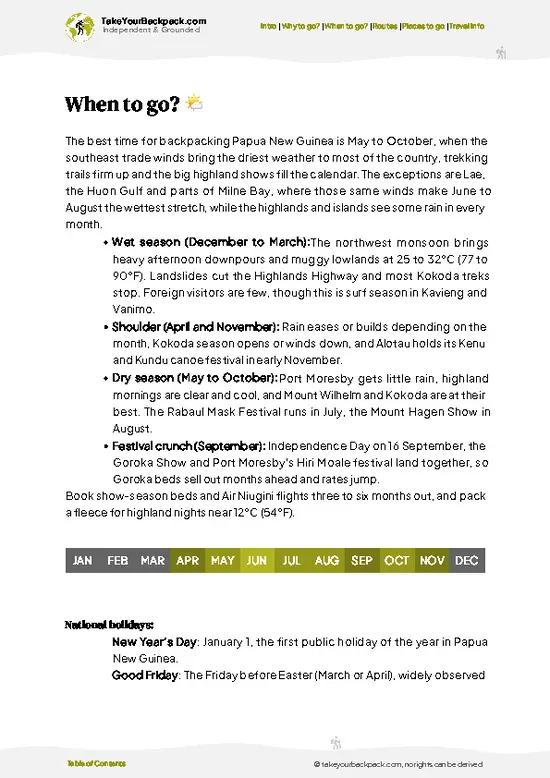
example page 2 from our offline Travel Guide for Papua New Guinea
example page 3 from our offline Travel Guide for Papua New Guinea
example page 4 from our offline Travel Guide for Papua New Guinea
example page 5 from our offline Travel Guide for Papua New Guinea
example page 6 from our offline Travel Guide for Papua New Guinea
example page 7 from our offline Travel Guide for Papua New Guinea
Loading the map 🌍
CLICK TO FILTER
cities
towns
national parks
hikes
beaches
attractions
festivals
regions
SHOW COUNTRY’S BESTSHOW ALL

✨ Why go?
Ranked #1 region in Papua New Guinea
What makes it a must-see region

Backpackers come to Kimbe Bay for the coral diversity that dive magazines rave about, and they can reach it without a liveaboard budget. Fringing reefs, sheer walls and offshore seamounts sit within a short boat run of town, so a single day can mean a drop-off dive in the morning and a shallow reef snorkel after lunch. Underwater life is thick: schooling barracuda, turtles, pygmy seahorses, and big pelagic fish near the seamounts. Dry land adds its own pull. The Willaumez Peninsula across the water has hot springs, steaming vents and volcanic hikes, so you can swap fins for boots without leaving the region. Town gives you a practical base, with a produce market, supermarkets, banks and places to stock up that are rare along this coast. That makes Kimbe a useful reset between rougher stretches … read more 👉
Backpackers come to Kimbe Bay for the coral diversity that dive magazines rave about, and they can reach it without a liveaboard budget. Fringing reefs, sheer walls and offshore seamounts sit within a short boat run of town, so a single day can mean a drop-off dive in the morning and a shallow reef snorkel after lunch. Underwater life is thick: schooling barracuda, turtles, pygmy seahorses, and big pelagic fish near the seamounts. Dry land adds its own pull. The Willaumez Peninsula across the water has hot springs, steaming vents and volcanic hikes, so you can swap fins for boots without leaving the region. Town gives you a practical base, with a produce market, supermarkets, banks and places to stock up that are rare along this coast. That makes Kimbe a useful reset between rougher stretches of travel in West New Britain. Come for water access and sociable dive-shop evenings with expats, researchers and fellow travelers, not for a sunbathing scene. If you want a place that rewards effort and curiosity, this one does.

💡 HighlightsDon't-miss highlights and experiences

  1. Kimbe Bay reefs and walls: The headline act. Drop-offs just off the coast are layered with soft corals, gorgonian fans and clouds of anthias, and the diversity of hard coral is among the highest recorded anywhere. Dive operators run daily boat trips.
  2. Seamount dives: Underwater peaks rising from deep water attract barracuda, tuna, sharks and rays. Currents can be strong, so these suit certified divers with some experience.
  3. Snorkeling at the resort jetties and fringing reefs: You do not need a tank. Shallow reef flats near the bay's resorts hold turtles, clownfish and brilliant coral gardens, and a mask plus a boat ride gets you there.
  4. Willaumez Peninsula hot springs and volcano views: Across the bay, geothermal activity gives you steaming vents and hot streams. Hire a local guide and boat, and
… read more 👉
  1. Kimbe Bay reefs and walls: The headline act. Drop-offs just off the coast are layered with soft corals, gorgonian fans and clouds of anthias, and the diversity of hard coral is among the highest recorded anywhere. Dive operators run daily boat trips.
  2. Seamount dives: Underwater peaks rising from deep water attract barracuda, tuna, sharks and rays. Currents can be strong, so these suit certified divers with some experience.
  3. Snorkeling at the resort jetties and fringing reefs: You do not need a tank. Shallow reef flats near the bay's resorts hold turtles, clownfish and brilliant coral gardens, and a mask plus a boat ride gets you there.
  4. Willaumez Peninsula hot springs and volcano views: Across the bay, geothermal activity gives you steaming vents and hot streams. Hire a local guide and boat, and bring sturdy shoes for the volcanic ground.
  5. Sunset on the Kimbe foreshore: Late light turns the water copper and outlines the volcanic cones across the bay. Locals gather along the shore, and it costs nothing.
Most visitors overlook the town produce market, where you can buy fresh tropical fruit, greens and cooked snacks and chat with growers who travel in from surrounding villages.
Spotted a mistake or missing something? Contact us.

⌛️ 5 daysA smart one-week plan

Kimbe Bay runs on dive-boat schedules and the one coastal road, so mornings belong to the water and afternoons to rest while the heat peaks and the PMV minibuses thin out. Plan around that rhythm and the five days fall into two phases.
Day 1: Kimbe Town: Arrive, settle in and spend the afternoon on foot around the Kimbe market and the harbor front, where fishing boats unload and you can sort out cash and supplies. Kimbe is the only place on the bay with proper shops and a bank, so do the errands now, before the boats take over your schedule. Book your dives or snorkel trips today.
Day 2: Kimbe Bay Reefs: Spend the next two days on the water. The bay has dramatic seamounts rising from deep water, and operators run from Kimbe or from the lodges along the coast. Dive trips leave early, so you are … read more 👉
Kimbe Bay runs on dive-boat schedules and the one coastal road, so mornings belong to the water and afternoons to rest while the heat peaks and the PMV minibuses thin out. Plan around that rhythm and the five days fall into two phases.
Day 1: Kimbe Town: Arrive, settle in and spend the afternoon on foot around the Kimbe market and the harbor front, where fishing boats unload and you can sort out cash and supplies. Kimbe is the only place on the bay with proper shops and a bank, so do the errands now, before the boats take over your schedule. Book your dives or snorkel trips today.
Day 2: Kimbe Bay Reefs: Spend the next two days on the water. The bay has dramatic seamounts rising from deep water, and operators run from Kimbe or from the lodges along the coast. Dive trips leave early, so you are back by early afternoon, which suits the sticky heat. Two days on the reef let you try both a seamount and a sheltered coral wall without rushing, and the second morning is easier once you know the boat routine.
Day 4: Hoskins and Garu: Now go east by road toward the Hoskins area, where the volcanic landscape of Mount Pago and Garbuna shows up as steaming vents and black sand beaches. Hire a driver for the day, since schedules for minibuses are loose and a car lets you stop at roadside villages and oil palm country. Hot springs near the shore are a good way to finish. This is also the detour that adds a lot without breaking the logistics, because you return to Kimbe the same evening.
Day 5: Walindi Coast: Finish with a slow morning on the coast west of town, where the lodges sit beside the reef and house reefs are a few steps from shore. Snorkel the shallows, watch the hornbills in the trees and let the last day stay unscheduled. Then head back to town for your onward flight or boat.

If you only get one day, make it the second one. A full morning over the seamounts, with schooling fish and clear water, is the reason to come to Kimbe Bay at all.

🌤️ When to go?Weather, crowds, and seasonal trade-offs

The drier months from May to October are the most comfortable window for Kimbe Bay, with calmer seas and better dive visibility.
  • Drier Season (May to October): Showers are shorter and the southeast trades keep afternoons breezy. Days run 25 to 31°C (77 to 88°F), nights 22 to 24°C (72 to 75°F). Snorkeling and diving conditions are at their steadiest.
  • Wet Season (November to April): Heavy downpours come in the afternoon and sometimes last for days. Temperatures stay about the same, but humidity is thick and roads to coastal villages turn to mud. Seas can be choppier on the north coast, though many dive days still run.
  • Daylight: Sunrise is around 6:00 and sunset around 18:00 all year, so plan boat trips and walks to finish before dark.
  • Crowds and Prices: Kimbe never gets crowded. Dive operators
… read more 👉
The drier months from May to October are the most comfortable window for Kimbe Bay, with calmer seas and better dive visibility.
  • Drier Season (May to October): Showers are shorter and the southeast trades keep afternoons breezy. Days run 25 to 31°C (77 to 88°F), nights 22 to 24°C (72 to 75°F). Snorkeling and diving conditions are at their steadiest.
  • Wet Season (November to April): Heavy downpours come in the afternoon and sometimes last for days. Temperatures stay about the same, but humidity is thick and roads to coastal villages turn to mud. Seas can be choppier on the north coast, though many dive days still run.
  • Daylight: Sunrise is around 6:00 and sunset around 18:00 all year, so plan boat trips and walks to finish before dark.
  • Crowds and Prices: Kimbe never gets crowded. Dive operators and lodges keep the same rates year-round, with only a small rise around school holidays and in the busiest diving months.
Book flights in from Port Moresby early for June to September, since seats on the Hoskins route fill up.


source: climatestotravel.comJANJanuary: fair for travelingFEBFebruary: fair for travelingMARMarch: fair for travelingAPRApril: fair for travelingMAYMay: highly recommended for travelingJUNJune: excellent for travelingJULJuly: excellent for travelingAUGAugust: excellent for travelingSEPSeptember: excellent for travelingOCTOctober: highly recommended for travelingNOVNovember: fair for travelingDECDecember: fair for traveling
when-to-go

✈️ The backpacker research shortcutPapua New Guinea Travel Guide

An offline-friendly backpacking guide with optimized travel routes, ranked highlights, transport advice, and the best areas to stay.
example page 0 from our offline Travel Guide for Papua New Guinea
example page 1 from our offline Travel Guide for Papua New Guinea
example page 2 from our offline Travel Guide for Papua New Guinea
example page 3 from our offline Travel Guide for Papua New Guinea
example page 4 from our offline Travel Guide for Papua New Guinea
example page 5 from our offline Travel Guide for Papua New Guinea
example page 6 from our offline Travel Guide for Papua New Guinea
example page 7 from our offline Travel Guide for Papua New Guinea
The digital guide (251 pages) contains:
✅ 81 highlights, ranked by travel appeal
✅ Optimized 5, 10 & 15-day travel routes
✅ Cities, national parks, landmarks, beaches
✅ How to get around
✅ Offline-friendly for travel without Wi-Fi
👉 Click to see all 30+ guide features

📅 Plan smarter in minutes, not weeks
✅ Month by month travel advice
✅ Festivals & national holidays
✅ Budget expectations

🗺️ Go to the right places, skip the overrated ones
✅ Honest pros & cons of destinations
✅ Top hikes, parks & viewpoints
✅ Lesser-known places most travelers miss
✅ Clear “worth it vs skip it” guidance

🛏️ Travel smoothly without rookie mistakes
✅ Best areas to stay
✅ Transport systems explained simply
✅ Common scams & safety advice
✅ SIM cards, money & practical tips

🌍 Understand the country, not just visit it
✅ Culture & traditions
✅ 52 Essential phrases & customs
✅ Festivals worth planning around
✅ Traveler-friendly historical context
✅ Insights that make places more meaningful

📱 Built for real travel conditions
✅ Fully downloadable PDF
✅ Works completely offline
✅ Optimized for phone use
✅ Useful in remote areas & buses
✅ Everything in one place
Stop searching, start planning
Get instant access to your full guide. 30‑day money-back guarantee.
+ Add another guide for just

By proceeding you agree to our terms.
Sent to your inbox immediately after payment • 100% Secure Checkout
Best Backpacking Travel Advisor 2025 tourism awardBest Backpacking
Travel Advisor
2025
What others say about Take Your Backpack Guides:
⭐⭐⭐⭐⭐
Fantastic, amazing amount of information!
⭐⭐⭐⭐⭐
My goodness this is amazing, it's what I've been looking for hats off too you!
⭐⭐⭐⭐⭐
I think this is absolutely BRILLIANT
⭐⭐⭐⭐
Very complete and informative. It's still missing places, but I gotta to commend you
⭐⭐⭐⭐⭐
This is truly amazing, thank you, can't wait to explore it with my kids!
⭐⭐⭐⭐⭐
Awesome resource, thank you!
⭐⭐⭐⭐⭐
This is amazing! Can't wait to explore the ones I haven't seen
⭐⭐⭐⭐
I love this! Well done, great idea.
⭐⭐⭐⭐⭐
Thanks for taking the time to make this gem!
⭐⭐⭐⭐⭐
This might be the best website I've ever seen.
⭐⭐⭐⭐⭐
Congratulations, and thank you so much for your work; it's incredibly valuable.
⭐⭐⭐⭐
In all seriousness I think you did a great job pointing out the important spots
⭐⭐⭐⭐⭐
10/10 very good
⭐⭐⭐⭐⭐
As someone who's only just starting to visit regularly this is awesome, thank you.
⭐⭐⭐⭐
Thank you very much! I'm going to visit my dad, it's going to be very useful!
⭐⭐⭐⭐⭐
This is really cool! We'll be travelling for the first time and this definitely come in handy.
⭐⭐⭐⭐⭐
You are now our minister of culture, congratulations 👨‍💼
⭐⭐⭐⭐⭐
Just wanted to tell you that this is a pearl! Going to follow your recommendations.
⭐⭐⭐⭐⭐
This is so cool. I'll definitely be using the resource for my travels soon.
⭐⭐⭐⭐⭐
This is very impressive! Good work.
⭐⭐⭐⭐⭐
This is an amazing and informative site. Very well done!

🛏️ Where to stay?How to pick the right area

Kimbe town is the practical base for backpackers, with Walindi and the Hoskins coast as the alternative for divers. Kimbe is the only place with a market, banks, supermarkets and PMV minibuses, so you can sort out cash and supplies without a long trip. Guesthouses and small lodges here suit budget travelers best. They are often a short walk or a PMV ride from the waterfront. Staying in town also puts you close to the fishing boats and to the people who can introduce you to local boat operators.

For reef access, the stretch of coast west of Kimbe toward Walindi suits snorkelers and divers. Accommodation … read more 👉
Kimbe town is the practical base for backpackers, with Walindi and the Hoskins coast as the alternative for divers. Kimbe is the only place with a market, banks, supermarkets and PMV minibuses, so you can sort out cash and supplies without a long trip. Guesthouses and small lodges here suit budget travelers best. They are often a short walk or a PMV ride from the waterfront. Staying in town also puts you close to the fishing boats and to the people who can introduce you to local boat operators.

For reef access, the stretch of coast west of Kimbe toward Walindi suits snorkelers and divers. Accommodation here is mostly resort-style and costs more, but the house reef is right off the beach. Dive-oriented places also bring together the few other travelers in the region, which makes them the most social option in the area. Dorm-style beds are rare in this part of Papua New Guinea, so expect private rooms, usually around K150 to 400 (US$40 to 105) a night in town and noticeably more at the dive resorts.

Hoskins, near the airport, works only for an early flight. Village stays near Talasea are possible by arranging with the community in advance, and they are the cheapest and most authentic choice. Stick to areas with a fenced compound or a recommended host, and arrive before dark.

🚌 Getting aroundTransportation options and practical tips

Kimbe town’s center is small enough to cross on foot in 15 to 20 minutes, so you stroll between the market, the waterfront and the shops without a second thought. Walking stops making sense the moment you head for the airport, the oil palm roads or the dive resorts strung along the coast, where distances stretch and the equatorial sun hits hard. Beyond town you ride, and you plan around daylight.

  • PMV minibuses. These are the backbone of local movement, with fares around US$0.50 to 2 for hops around town and the nearby plantation roads. They are cramped and loud, and they leave when full, but you get unbeatable local color for pocket change. For a backpacker chasing value, this is the winner for anything on the main sealed road.
  • Hired taxis and private drivers. A short town ride costs about
… read more 👉
Kimbe town’s center is small enough to cross on foot in 15 to 20 minutes, so you stroll between the market, the waterfront and the shops without a second thought. Walking stops making sense the moment you head for the airport, the oil palm roads or the dive resorts strung along the coast, where distances stretch and the equatorial sun hits hard. Beyond town you ride, and you plan around daylight.

  • PMV minibuses. These are the backbone of local movement, with fares around US$0.50 to 2 for hops around town and the nearby plantation roads. They are cramped and loud, and they leave when full, but you get unbeatable local color for pocket change. For a backpacker chasing value, this is the winner for anything on the main sealed road.
  • Hired taxis and private drivers. A short town ride costs about US$3 to 6, and a day hire to waterfalls, hot springs or villages runs roughly US$60 to 120 with fuel. You pay more, yet you gain speed, air-conditioning in some cars and a driver who knows which road washed out. Split it with two or three travelers and it becomes the smartest way to reach places the PMVs skip.
  • Dive operator and resort boats. Reefs, islands and black-sand beaches sit offshore, and boat transfers or day trips run about US$40 to 150 depending on the trip. They cost the most, but they are the only real way onto the water, and a good dive or snorkel outing here is worth the splurge. Book with a licensed operator rather than hunting for a random dinghy.
  • Domestic flights from Hoskins Airport. Air Niugini and PNG Air link Hoskins, about 30 to 40 minutes from Kimbe by road, with Port Moresby in roughly 1.5 hours of flying. Fares often land between US$150 and 300 one way, which hurts, but the overland alternative to the capital is not realistic. Fly, and fly early in the day because delays pile up later.
  • Coastal ferries and cargo boats. Some sea links serve New Britain and nearby islands, with fares from about US$20 to 60. They are slow, schedules shift, and comfort is basic, so they suit travelers with flexible days and a sense of adventure.

Carry small bills for every ride, confirm the fare before you climb in, and aim to be back in town well before dusk, when roads empty and options vanish.

🍲 FoodWhat to Eat & Drink

Eat where the locals eat and you taste fresh fish first. Reef fish and tuna arrive grilled over coals or steamed in coconut milk, often with taro, sweet potato or banana on the side. Look for mumu, food slow-cooked in an earth oven under hot stones, smoky and soft, usually served at celebrations or by resorts. Greens such as aibika are cooked down into rich, earthy bowls, and chili and ginger add sharp heat.

For a backpacker, the Kimbe market is the best first stop. Piles of pineapples, papaya, bananas, watermelon and betel nut crowd the tables, and a fruit snack costs under US$1. Roadside stalls and small takeaway counters sell fried fish, chicken and rice for about US$2 to 5, while casual restaurants and resort dining rooms charge roughly US$8 to 20 for a plate with a view.

Drink fresh … read more 👉
Eat where the locals eat and you taste fresh fish first. Reef fish and tuna arrive grilled over coals or steamed in coconut milk, often with taro, sweet potato or banana on the side. Look for mumu, food slow-cooked in an earth oven under hot stones, smoky and soft, usually served at celebrations or by resorts. Greens such as aibika are cooked down into rich, earthy bowls, and chili and ginger add sharp heat.

For a backpacker, the Kimbe market is the best first stop. Piles of pineapples, papaya, bananas, watermelon and betel nut crowd the tables, and a fruit snack costs under US$1. Roadside stalls and small takeaway counters sell fried fish, chicken and rice for about US$2 to 5, while casual restaurants and resort dining rooms charge roughly US$8 to 20 for a plate with a view.

Drink fresh coconut straight from the husk, which is sweet, cool and nearly free. Local SP lager is the beer of choice in the evening.

Customs matter. Eating is relaxed and often with the hands, and sharing is normal. Betel nut is chewed widely, and red spit stains pavements, so step carefully. Accept food politely when it’s offered in a village, and carry cash in small notes.

🛡️ SafetyStaying Safe: What Travelers Should Know

Kimbe Bay is mostly calm and sheltered, with little surf and weak currents along most beaches. Sand is dark volcanic in many places and gets very hot at midday, so wear sandals. Tides are small, but river mouths after heavy rain bring murky water and debris, so wait a day before swimming near them. Saltwater crocodiles live in the region, so ask locals before swimming near mangroves or estuaries and avoid swimming at dusk. Where villagers swim and wash is usually a good sign.

The reefs are healthy and rich in life. Wear reef shoes to avoid urchins and sharp coral, and do not stand on the reef. Stonefish and cone shells occur, so shuffle your feet in shallow water and never pick up shells. Jellyfish are uncommon but possible in the wet season.

The equatorial sun burns quickly, so use reef-safe … read more 👉
Kimbe Bay is mostly calm and sheltered, with little surf and weak currents along most beaches. Sand is dark volcanic in many places and gets very hot at midday, so wear sandals. Tides are small, but river mouths after heavy rain bring murky water and debris, so wait a day before swimming near them. Saltwater crocodiles live in the region, so ask locals before swimming near mangroves or estuaries and avoid swimming at dusk. Where villagers swim and wash is usually a good sign.

The reefs are healthy and rich in life. Wear reef shoes to avoid urchins and sharp coral, and do not stand on the reef. Stonefish and cone shells occur, so shuffle your feet in shallow water and never pick up shells. Jellyfish are uncommon but possible in the wet season.

The equatorial sun burns quickly, so use reef-safe sunscreen and a rash guard. Rain squalls come in fast, usually in the afternoon. Keep valuables out of sight, do not leave bags on an empty beach, and travel after dark only by arranged transport.

FAQFrequently asked questions about Kimbe Bay

Fly from Port Moresby to Hoskins Airport near Kimbe, a flight of about 1 hour 15 minutes to 1 hour 30 minutes with Air Niugini or PNG Air. From Hoskins, Kimbe town is roughly 30 to 45 minutes by road, and a taxi or lodge pickup costs about K50 to 150 (US$13 to 40), while a PMV minibus is cheaper. Most beaches and the Walindi dive area are another 20 to 40 minutes along the coast road, so arrange a lodge transfer in advance.
Snorkeling and diving are the main draws, and Kimbe Bay is known for walls, seamounts, and more than 400 coral species. Many reefs start a short boat ride from the shore, and some resorts have house reefs you can reach straight from the beach, with water around 28 to 30°C (82 to 86°F). Swimming is easy on sheltered stretches, but there is no real surf for surfers. Dive trips usually cost about US$100 to 150 for a two-tank day.
Most beaches have no ticket booth, but the land and reef belong to local communities and landowners, so ask before you use a village beach. Some villages ask for a small fee, typically K5 to 20 (US$1 to 5), and resort beaches may be restricted to guests. Boat trips, snorkeling guides, and dive operators all charge separately.
⚠️ Things can change over time, so always validate details locally before you go.

Other Papua New Guinean regions near Kimbe Bay

Explore more nearby:

  • Duke of York Islands—Channel canoe hops, house reefs, tabu shell money, copper sunsets| 242 km away
  • Kiriwina Island—Trobriand cricket, calm lagoons, canoe carvers, string band evenings| 392 km away
  • Rai Coast—Maclay Coast, Saidor wartime relics, black-sand bays, village homestays, Finisterre foothills| 516 km away

💡 Not sure where to go next?
Create a personalized itinerary for Papua New Guinea including Kimbe Bay and the places that fit your trip.

Generate my itinerary

👉 Discover all regions

Or checkout all Papua New Guinea has to offer (think cities, towns, villages, national parks, hikes, beaches, festivals)
Country photo of Papua New Guinea

We 💚 feedbackKey takeaways before you go

Kimbe Bay suits divers, snorkelers and curious travelers who like quiet shores and a bit of logistics. If you want a lounge-chair beach, pass. I would book dive or boat time a few days ahead, bring your own mask and reef-safe sunscreen, and keep an afternoon free for the volcanic coast across the water.

✍️ Help improve this page!
The information on this page is based on in-depth research, insights shared by experienced travelers, and feedback from the local travel community in Papua New Guinea. While every effort is made to keep the information accurate and current, conditions can change — so if you spot anything incorrect or outdated, please get in touch.


🙋‍♂️ Give feedback

👋 Meet the founderWho’s Behind Take Your Backpack?

Johan, backpacker and founder of TakeYourBackpackHi, I’m Johan (Netherlands 🇳🇱), the creator of TakeYourBackpack. Over the past 3 decades, I’ve backpacked through 90+ countries across six continents, gaining extensive experience with independent travel, long-term trips, and overland routes.

This site is built on a combination of firsthand travel experience and carefully curated insights from other backpackers. Many guides are based on places I’ve personally visited, while others bring together tips, observations, and practical advice shared by trusted travelers I’ve met along the way.

The goal is to provide realistic, experience-driven guidance — not generic itineraries — so you can explore destinations with better context, clearer expectations, and more confidence.