×

Papua New Guinea🇵🇬 | best regionsExplore the 9 Best regions in Papua New Guinea

Papua New Guinea does not hand you a neat tourist circuit, and that is the draw. Regions here split by geography and access more than by distance: the Highlands sit on a road network of rough but busy highways, the coast and islands run on flights and boats, and the river lowlands answer to dugout canoes and weather. Costs climb fast where planes replace buses. Crowds barely exist outside a few festival weekends, so you set the pace. Independent travel works best when you match a region to your appetite for adventure, culture or sea time, then plan around logistics, not mileage.

By Johan Kruseman 🇳🇱 | Updated October 18, 2026
Explore the best cities in Papua New Guinea

Why go?What Makes Them Special

Papua New Guinea packs over 800 languages into a country with mountains above 4,000 meters, swamp-fringed river systems and reef-ringed islands. That terrain explains everything about how regions feel. Communities stayed separate for thousands of years, so traditions, dress, ceremony and food shift sharply from one area to the next, and the rugged interior still has limited roads. Travel is shaped by air links, not highways, which means distances on a map tell you little about real journey times.

That makes the country thrilling and demanding in equal measure. Tourism infrastructure is thin, so you will often rely on guesthouses, church-run lodges, village stays and local guides rather than hostels and tour desks. Prices run higher than in much of Asia, mostly because of transport and limited … read more 👉
Papua New Guinea packs over 800 languages into a country with mountains above 4,000 meters, swamp-fringed river systems and reef-ringed islands. That terrain explains everything about how regions feel. Communities stayed separate for thousands of years, so traditions, dress, ceremony and food shift sharply from one area to the next, and the rugged interior still has limited roads. Travel is shaped by air links, not highways, which means distances on a map tell you little about real journey times.

That makes the country thrilling and demanding in equal measure. Tourism infrastructure is thin, so you will often rely on guesthouses, church-run lodges, village stays and local guides rather than hostels and tour desks. Prices run higher than in much of Asia, mostly because of transport and limited supply. Flights get delayed or rescheduled, and plans need slack built in.

Before committing, know that most visits need advance arrangements: a guide, a booked bed, a confirmed flight seat. Customary land ownership means access to many sites depends on local permission and fees. Spontaneity still pays off, but it works best on top of a solid skeleton. Come ready to explore at the pace the country sets, and you will see things few travelers ever witness.
Why These Made the Cut
The list of best regions in Papua New Guinea is created based on landscapes, local culture, attractions, vibes, and overall appeal. If you feel a region is missing in this list, please let us know.

When to go?Timing Your Visit for the Best Experience

Best Months and Dry Season: The best months for regions in Papua New Guinea are May to October, when the dry season brings lower rainfall, firmer tracks, clearer skies and more reliable flights. Most of the country sees heavy rain from roughly December to March, with the north-west monsoon turning trails to mud and grounding small aircraft more often.

Temperatures and Rainfall: Lowland and coastal areas stay hot year-round, typically 28 to 32°C by day with high humidity. The Highlands, at 1,500 to 2,500 meters, run mild by day at about 20 to 26°C and cold at night, sometimes dropping to 5 to 10°C. Rainfall is heavy almost everywhere; many lowland areas receive 2,500 to 4,000 mm a year, and Port Moresby is the notable dry exception with far less.

Shoulder Seasons and Peaks: April and November … read more 👉
Best Months and Dry Season: The best months for regions in Papua New Guinea are May to October, when the dry season brings lower rainfall, firmer tracks, clearer skies and more reliable flights. Most of the country sees heavy rain from roughly December to March, with the north-west monsoon turning trails to mud and grounding small aircraft more often.

Temperatures and Rainfall: Lowland and coastal areas stay hot year-round, typically 28 to 32°C by day with high humidity. The Highlands, at 1,500 to 2,500 meters, run mild by day at about 20 to 26°C and cold at night, sometimes dropping to 5 to 10°C. Rainfall is heavy almost everywhere; many lowland areas receive 2,500 to 4,000 mm a year, and Port Moresby is the notable dry exception with far less.

Shoulder Seasons and Peaks: April and November act as shoulder months, with patchy showers but usually workable conditions. The south coast around Port Moresby is drier and can suit travel earlier or later than the wetter north. Parts of the southern lowlands get their heaviest rain in the middle of the year, so check before locking dates.

Peak pressure comes around cultural festivals, especially in August and September, when beds and seats on flights fill quickly and prices rise. Book these months several weeks ahead. Dry-season diving visibility is also excellent, so book dive trips early.

region hoppingSuggested Travel Strategies

How Many Days You Need: A trip combining several regions in Papua New Guinea needs 14 to 21 days, because internal flights, weather delays and slow overland stretches eat time fast. Fewer than ten days works only if you stick to one or two areas.

Grouping and Direction: Port Moresby is the main gateway hub, with Lae, Mount Hagen, Madang and Alotau/Kokopo acting as secondary connection points. Regions that share an airline corridor group best: Highlands with the north coast, or the islands with the southeast. Flying between Mount Hagen and Madang takes about 45 minutes, while roads between them take most of a day. Starting in the drier, easier south and working toward more remote areas lets you build confidence, and keeps the hardest transfers away from your departure date.

Time Per Stop … read more 👉
How Many Days You Need: A trip combining several regions in Papua New Guinea needs 14 to 21 days, because internal flights, weather delays and slow overland stretches eat time fast. Fewer than ten days works only if you stick to one or two areas.

Grouping and Direction: Port Moresby is the main gateway hub, with Lae, Mount Hagen, Madang and Alotau/Kokopo acting as secondary connection points. Regions that share an airline corridor group best: Highlands with the north coast, or the islands with the southeast. Flying between Mount Hagen and Madang takes about 45 minutes, while roads between them take most of a day. Starting in the drier, easier south and working toward more remote areas lets you build confidence, and keeps the hardest transfers away from your departure date.

Time Per Stop and Transfers: Plan 3 to 5 nights per stop, with a minimum of two so one weather delay does not wreck everything. Domestic flights run roughly 45 minutes to 2 hours, and boat or road transfers can add 2 to 8 hours. Often you must route back through Port Moresby, so allow a day each time.

Common Planning Mistakes: The biggest error is packing too many regions into too few days. Cut one stop instead. Tight flight connections are another trap; leave a buffer day before international departures. Travelers also assume road links exist when they do not, so confirm every leg with a local operator, and reconfirm flights a day ahead.

The ListMust-Visit regions in Papua New Guinea

1 Milne Bay

Carved canoe prows, Trobriand yam houses, Solomon Sea islands, volcanic hot springs

Island-hop from Alotau to village reefs, steaming vents on Fergusson and Dobu, and Trobriand cricket, timing the trip for November’s canoe races.

2 Kimbe Bay

Coral walls, seamounts, jetty snorkeling, Willaumez hot springs

Book a dive boat to drop-offs and seamounts near shore, or snorkel resort jetties and visit steaming vents across the bay.

3 Rai Coast

Maclay Coast, Saidor wartime relics, black-sand bays, village homestays, Finisterre foothills

Ride a PMV truck along Astrolabe Bay, stay with village hosts, trace Maclay’s landing point and Saidor’s old airstrip, then climb into the foothills.

4 Sepik River

Dugout canoes, spirit houses, Chambri Lake, Angoram departure

Paddle and motor the Middle Sepik from Angoram, stopping at carved haus tambaran, carvers’ villages and a dawn crossing of Chambri Lake.

5 Duke of York Islands

Channel canoe hops, house reefs, tabu shell money, copper sunsets

Cross St George’s Channel by dugout to sheltered coves, float over reef walls, and learn how tabu shell strings are made and valued.

papua-new-guinea-region-duke-of-york-islands
© Google |

6 Kiriwina Island

Trobriand cricket, calm lagoons, canoe carvers, string band evenings

Time a visit for a cricket match played in feathers and grass skirts, then wade warm lagoon shallows and watch hulls take shape.

7 Manus Island

Empty Admiralty sand, Lorengau harbor, outrigger trips, Allied base relics

Walk tide-exposed flats beside fishing boats, snorkel village reefs, and ask hosts about outrigger paddles to nearby islets.

8 Misima Island

Louisiade coast tracks, drop-off reefs, dawn fishing, old gold mine

Follow footpaths between villages, snorkel coral beside the beach, and see the pits and rusting machinery of a former gold mine.

9 Sinasina

Simbu sing-sings, coffee terraces, ridge paths, kaukau markets

Walk coffee gardens and ridge paths between hamlets, and ask locally about sing-sing gatherings with feathers, drums and body paint.

Loading the map 🌍

Expert viewTips and Advice from Travelers

How many regions to pick: Choose two or three regions for a trip of three to four weeks, and resist the urge to add a fourth. Papua New Guinea has almost no road network linking its major areas, so most moves happen on domestic flights that get canceled, delayed or rebooked without much warning. Each extra region adds a flight, a buffer day and another round of local arrangements. Two or three regions leave room for the unplanned, which is where the best days here tend to happen: a village invitation, a canoe ride you did not book, a feast you were not expecting.
Which kind of region suits you: Divers and snorkelers should prioritize coastal and island regions, where you step off a dugout canoe straight onto reef walls and wartime wrecks. Trekkers and hardcore adventurers belong in the highlands … read more 👉
How many regions to pick: Choose two or three regions for a trip of three to four weeks, and resist the urge to add a fourth. Papua New Guinea has almost no road network linking its major areas, so most moves happen on domestic flights that get canceled, delayed or rebooked without much warning. Each extra region adds a flight, a buffer day and another round of local arrangements. Two or three regions leave room for the unplanned, which is where the best days here tend to happen: a village invitation, a canoe ride you did not book, a feast you were not expecting.
Which kind of region suits you: Divers and snorkelers should prioritize coastal and island regions, where you step off a dugout canoe straight onto reef walls and wartime wrecks. Trekkers and hardcore adventurers belong in the highlands and the rugged interior, where trails climb through cloud forest, cross swinging bridges and drop into valleys with no road in sight. Culture seekers should aim for the river and festival regions, where carved longhouses, sing-sing dances and face paint are living practice, not stage shows. Birdwatchers can chase birds of paradise in lowland and mid-mountain forest at dawn. Pick the type that matches your main reason for coming, then add a second type for contrast.
What it costs: Budget US$100 to 180 a day for a self-organized trip, and expect that to be at the lean end. Papua New Guinea is not a cheap country. Guesthouses and village homestays run roughly US$25 to 80 a night, simple meals US$5 to 15, and basic dive-resort or lodge packages push well above that. Domestic flights usually cost US$100 to 300 per leg. Local guides cost US$30 to 60 a day, and trekking or cultural visits often add community fees of US$10 to 50 a person. Festival entry or village visit fees are commonly paid in cash to the community, so carry small kina notes, because ATMs vanish outside the towns. Per region, plan on roughly US$600 to 1,200 for a week including flights, lodging, guide and fees. Spend on a good local guide first. That one decision turns a confusing trail into a day of stories, bush food and the right introductions.
Safety and cultural know-how: Safety here is about preparation. Crime is a real concern in Port Moresby, Lae and some highland towns, so arrange airport pickups in advance, avoid walking after dark and skip flashing phones or cameras in town centers. Travel with a local host or guide, ideally one arranged through a lodge or the community itself. Tribal disputes can flare quickly and close roads, so check conditions locally before any overland move. Land is owned by clans, and nearly every beach, reef, trail and waterfall belongs to someone. Ask permission and agree on a fee before you enter, hike or dive. Dress modestly, cover shoulders and knees, and ask before photographing people. A hand shake and a few words of Tok Pisin, like “halo” and “tenkyu tru”, open doors fast. Carry malaria prophylaxis, a good first aid kit and evacuation insurance, since medical care outside the main towns is thin. Do that, and you get a reward few places offer: welcomes that feel unrehearsed, with kids running alongside your canoe and elders pulling you into the circle.

✈️ The backpacker research shortcutPapua New Guinea Travel Guide

An offline-friendly backpacking guide with optimized travel routes, ranked highlights, transport advice, and the best areas to stay.
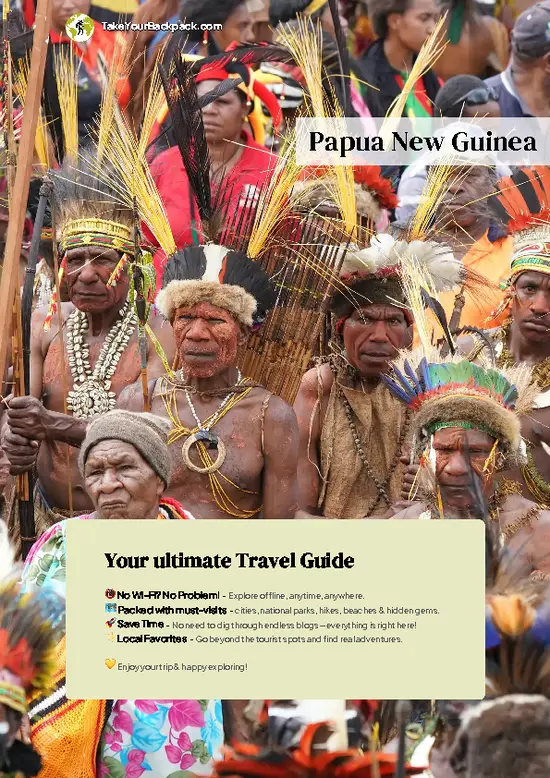
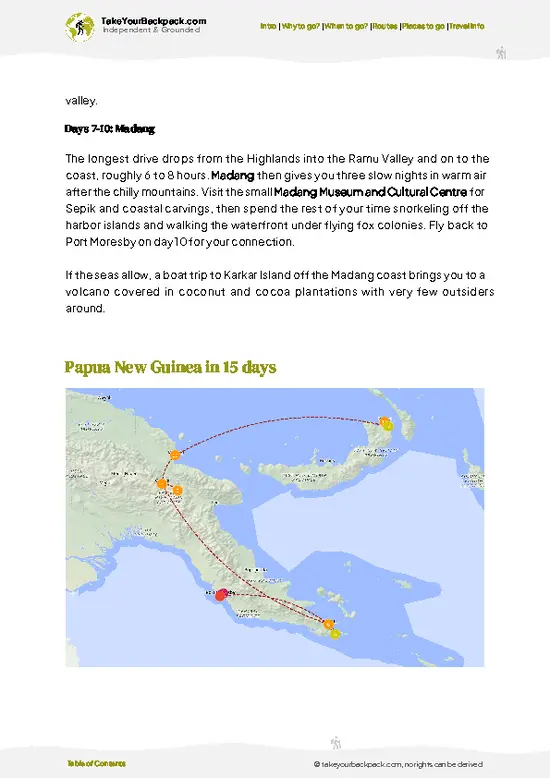
example page 0 from our offline Travel Guide for Papua New Guinea
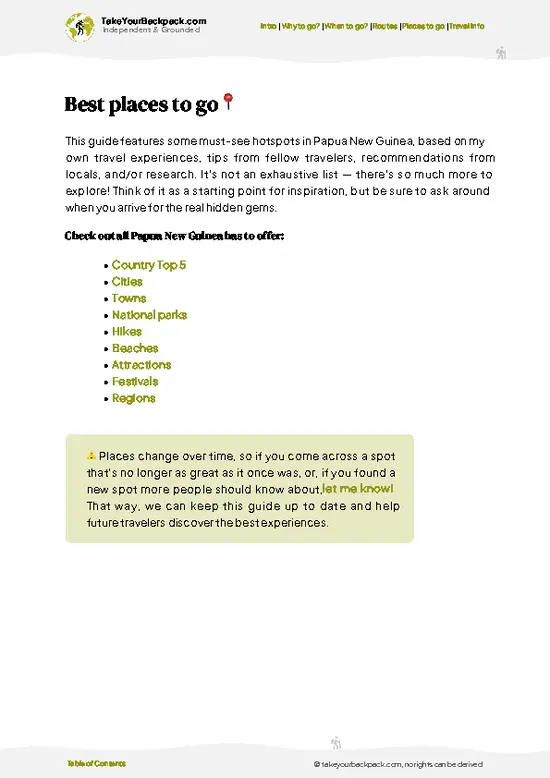
example page 1 from our offline Travel Guide for Papua New Guinea
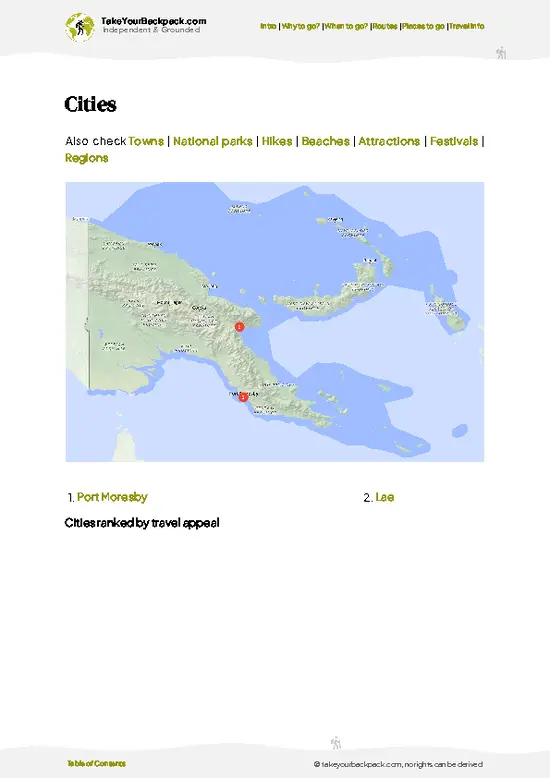
example page 2 from our offline Travel Guide for Papua New Guinea
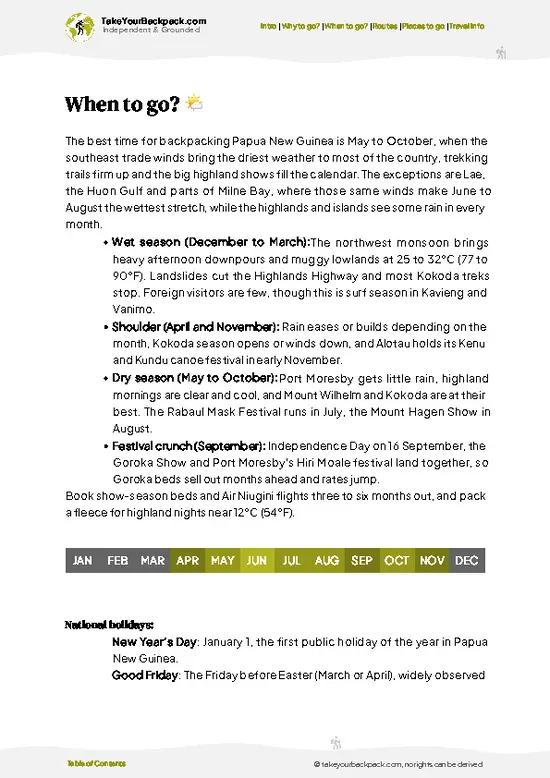
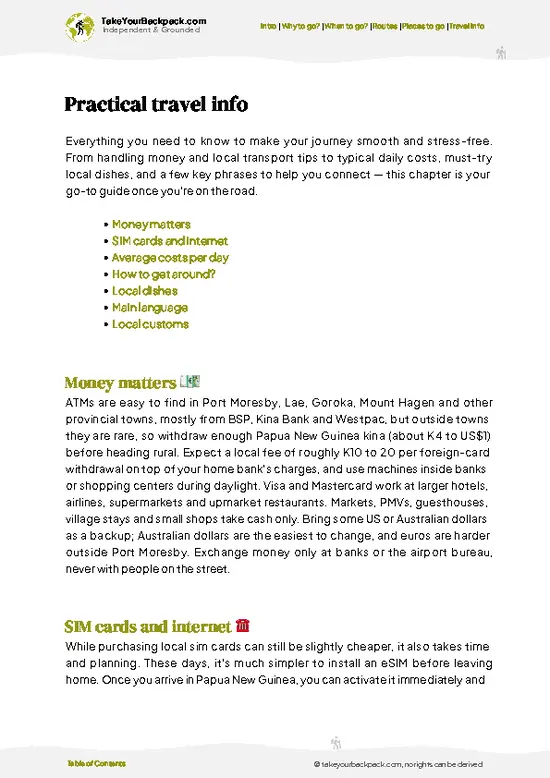
example page 3 from our offline Travel Guide for Papua New Guinea
example page 4 from our offline Travel Guide for Papua New Guinea
example page 5 from our offline Travel Guide for Papua New Guinea
example page 6 from our offline Travel Guide for Papua New Guinea
example page 7 from our offline Travel Guide for Papua New Guinea
The digital guide (251 pages) contains:
✅ 81 highlights, ranked by travel appeal
✅ Optimized 5, 10 & 15-day travel routes
✅ Cities, national parks, landmarks, beaches
✅ How to get around
✅ Offline-friendly for travel without Wi-Fi
👉 Click to see all 30+ guide features

📅 Plan smarter in minutes, not weeks
✅ Month by month travel advice
✅ Festivals & national holidays
✅ Budget expectations

🗺️ Go to the right places, skip the overrated ones
✅ Honest pros & cons of destinations
✅ Top hikes, parks & viewpoints
✅ Lesser-known places most travelers miss
✅ Clear “worth it vs skip it” guidance

🛏️ Travel smoothly without rookie mistakes
✅ Best areas to stay
✅ Transport systems explained simply
✅ Common scams & safety advice
✅ SIM cards, money & practical tips

🌍 Understand the country, not just visit it
✅ Culture & traditions
✅ 52 Essential phrases & customs
✅ Festivals worth planning around
✅ Traveler-friendly historical context
✅ Insights that make places more meaningful

📱 Built for real travel conditions
✅ Fully downloadable PDF
✅ Works completely offline
✅ Optimized for phone use
✅ Useful in remote areas & buses
✅ Everything in one place
Stop searching, start planning
Get instant access to your full guide. 30‑day money-back guarantee.
+ Add another guide for just

By proceeding you agree to our terms.
Sent to your inbox immediately after payment • 100% Secure Checkout
Best Backpacking Travel Advisor 2025 tourism awardBest Backpacking
Travel Advisor
2025
What others say about Take Your Backpack Guides:
⭐⭐⭐⭐⭐
Fantastic, amazing amount of information!
⭐⭐⭐⭐⭐
My goodness this is amazing, it's what I've been looking for hats off too you!
⭐⭐⭐⭐⭐
I think this is absolutely BRILLIANT
⭐⭐⭐⭐
Very complete and informative. It's still missing places, but I gotta to commend you
⭐⭐⭐⭐⭐
This is truly amazing, thank you, can't wait to explore it with my kids!
⭐⭐⭐⭐⭐
Awesome resource, thank you!
⭐⭐⭐⭐⭐
This is amazing! Can't wait to explore the ones I haven't seen
⭐⭐⭐⭐
I love this! Well done, great idea.
⭐⭐⭐⭐⭐
Thanks for taking the time to make this gem!
⭐⭐⭐⭐⭐
This might be the best website I've ever seen.
⭐⭐⭐⭐⭐
Congratulations, and thank you so much for your work; it's incredibly valuable.
⭐⭐⭐⭐
In all seriousness I think you did a great job pointing out the important spots
⭐⭐⭐⭐⭐
10/10 very good
⭐⭐⭐⭐⭐
As someone who's only just starting to visit regularly this is awesome, thank you.
⭐⭐⭐⭐
Thank you very much! I'm going to visit my dad, it's going to be very useful!
⭐⭐⭐⭐⭐
This is really cool! We'll be travelling for the first time and this definitely come in handy.
⭐⭐⭐⭐⭐
You are now our minister of culture, congratulations 👨‍💼
⭐⭐⭐⭐⭐
Just wanted to tell you that this is a pearl! Going to follow your recommendations.
⭐⭐⭐⭐⭐
This is so cool. I'll definitely be using the resource for my travels soon.
⭐⭐⭐⭐⭐
This is very impressive! Good work.
⭐⭐⭐⭐⭐
This is an amazing and informative site. Very well done!

🛏️ Where to stay?Top Places to Consider Staying

Papua New Guinea has almost no true backpacker hostels, so budget travelers mostly stay in church-run guesthouses, mission lodges and simple family guesthouses, typically K150 to 350 (about US$40 to 90) a night for a private room. In Port Moresby, Boroko has the most cheap guesthouses and is close to shops and PMV routes but feels hectic and unsafe on foot after dark, while Waigani is quieter and near the National Museum and Parliament House. Town and Ela Beach put you on the waterfront with the best restaurants, at noticeably higher prices. Elsewhere, Goroka and Madang have the best spread of affordable lodges, with calmer streets than the capital.

If you enjoy meeting fellow travelers, consider … read more 👉
Papua New Guinea has almost no true backpacker hostels, so budget travelers mostly stay in church-run guesthouses, mission lodges and simple family guesthouses, typically K150 to 350 (about US$40 to 90) a night for a private room. In Port Moresby, Boroko has the most cheap guesthouses and is close to shops and PMV routes but feels hectic and unsafe on foot after dark, while Waigani is quieter and near the National Museum and Parliament House. Town and Ela Beach put you on the waterfront with the best restaurants, at noticeably higher prices. Elsewhere, Goroka and Madang have the best spread of affordable lodges, with calmer streets than the capital.

If you enjoy meeting fellow travelers, consider choosing hostels with high ratings for atmosphere. On the other hand, if you prefer having your own space, a hotel might be a better option.

Papua New GuineaMore Places Across Papua New Guinea

👋 Meet the founderWho’s Behind Take Your Backpack?

Johan, backpacker and founder of TakeYourBackpackHi, I’m Johan (Netherlands 🇳🇱), the creator of TakeYourBackpack. Over the past 3 decades, I’ve backpacked through 90+ countries across six continents, gaining extensive experience with independent travel, long-term trips, and overland routes.

This site is built on a combination of firsthand travel experience and carefully curated insights from other backpackers. Many guides are based on places I’ve personally visited, while others bring together tips, observations, and practical advice shared by trusted travelers I’ve met along the way.

The goal is to provide realistic, experience-driven guidance — not generic itineraries — so you can explore destinations with better context, clearer expectations, and more confidence.