
×

Papua New Guinea🇵🇬 | townsKaviengNew Ireland tip, Albatross Passage, Japanese bunkers, Nusa snorkeling | things to do and best time to go

Explore GorokaExplore Kikori

Backpacking in Kavieng
🌟 Highlighttown ranked #7
By Johan Kruseman 🇳🇱 | Updated October 16, 2026

The outboard coughs, the bow slaps through a chop, and a dugout shoots past with a grinning kid holding a fishing line. That is a normal Kavieng morning. The town sits at the northwestern tip of New Ireland, in the north of Papua New Guinea, and it is small, sleepy and a little frayed. Its real value is the water: wrecks, reefs and surf breaks sit minutes away. Flights from Port Moresby make arrival simple, but ground transport is thin, so smart travelers book boat transfers and guesthouse pickups ahead instead of hoping a PMV turns up. Evenings are quiet, with a few guesthouse bars and not many other backpackers, so you will meet divers and surfers mostly at your lodge. Divers, surfers and slow travelers will love it. Anyone chasing nightlife or polished sights will not.

Discover everything you want to know in the 📖 Papua New Guinea Travel Guide.


example page 0 from our offline Travel Guide for Papua New Guinea
example page 1 from our offline Travel Guide for Papua New Guinea
example page 2 from our offline Travel Guide for Papua New Guinea
example page 3 from our offline Travel Guide for Papua New Guinea
example page 4 from our offline Travel Guide for Papua New Guinea
example page 5 from our offline Travel Guide for Papua New Guinea
example page 6 from our offline Travel Guide for Papua New Guinea
example page 7 from our offline Travel Guide for Papua New Guinea
Loading the map 🌍
CLICK TO FILTER
cities
towns
national parks
hikes
beaches
attractions
festivals
regions
SHOW COUNTRY’S BESTSHOW ALL

✨ Why go?
Ranked #7 town in Papua New Guinea
Why visitors keep coming back

Kavieng earns its place as a launch pad for the sea. Dive operators run trips to Albatross Passage, where currents bring in grey reef sharks, barracuda and big schools of fish, and to wartime wrecks such as the Japanese Pete floatplanes in the harbor. Surfers come for the reef breaks around the Tigak and Tsoi islands, reached by boat. Most travelers stay three to five days, long enough to dive, paddle out to an island and still have a lazy afternoon in town. The center is flat and easy to walk, with a market where you can eat fresh fruit and grilled fish. It is not a party stop. It suits solo divers, surfers, couples and anyone happy with quiet evenings and self-made plans. If you only want a quick city stop, skip it. If you like being on the water most of the day, give it time.

💡 HighlightsTop highlights of Kavieng

  1. Kavieng Harbour and Waterfront: The working heart of town, where boats load, kids jump off the jetties and the late-afternoon light turns the water gold. Come at sunset. Free, and an hour is plenty.
  2. Kavieng Market: Pyramids of bananas, betel nut, coconuts, taro and fresh reef fish laid out on tables. Go in the morning when stock is best. Buying snacks costs a few kina. Allow one hour.
  3. Albatross Passage Dive: The area’s signature dive, with strong currents and plenty of sharks and pelagic fish. Suited to experienced divers. Mornings are best. Expect roughly US$100 to 150 per two-tank day. Half a day.
  4. Japanese Wartime Relics: Kavieng was a major Japanese base, and rusting guns, bunkers and wrecks remain in and around town and under the water. Walk or ride between sites in daylight. Mostly free,
… read more 👉
  1. Kavieng Harbour and Waterfront: The working heart of town, where boats load, kids jump off the jetties and the late-afternoon light turns the water gold. Come at sunset. Free, and an hour is plenty.
  2. Kavieng Market: Pyramids of bananas, betel nut, coconuts, taro and fresh reef fish laid out on tables. Go in the morning when stock is best. Buying snacks costs a few kina. Allow one hour.
  3. Albatross Passage Dive: The area’s signature dive, with strong currents and plenty of sharks and pelagic fish. Suited to experienced divers. Mornings are best. Expect roughly US$100 to 150 per two-tank day. Half a day.
  4. Japanese Wartime Relics: Kavieng was a major Japanese base, and rusting guns, bunkers and wrecks remain in and around town and under the water. Walk or ride between sites in daylight. Mostly free, one to two hours on land.
  5. Nusa Island Snorkel Trip: A short boat ride from town gets you to clear water and reefs. Go on a calm morning. Boat hire through your lodge usually runs about K150 to 400 (US$40 to 100) per group. Half a day.
All five fit comfortably into three days, with the dive and boat trip taking the longest. For day trips, boat out to the Tigak Islands and Nusa, or drive south along the New Ireland highway toward the villages and beaches of the east coast.
Spotted a mistake or missing something? Contact us.

🏘️ NeighborhoodsUnderstanding the local layout

Kavieng sits on the northern tip of New Ireland, and the whole town fits on a few easy walking streets, so you can cover it in an afternoon and spend the rest of your time on the water.
  • Town Center and Harbor: This is where the market, trade stores, banks and the wharf cluster, because the harbor is the town’s lifeline. Go early, before the midday heat, when fresh fish, betel nut and sweet potato stalls are at their busiest. Eat cheap at the market and the small takeaway counters instead of hotel restaurants. Fully walkable.
  • Nusa and the Waterfront: The shore road runs past the old Japanese WWII guns and wrecks that lie just offshore, so this is where the history is. Walk it at dawn or late afternoon, since shade is scarce. Wander slowly, then ask locals about wreck access instead of trusting
… read more 👉
Kavieng sits on the northern tip of New Ireland, and the whole town fits on a few easy walking streets, so you can cover it in an afternoon and spend the rest of your time on the water.
  • Town Center and Harbor: This is where the market, trade stores, banks and the wharf cluster, because the harbor is the town’s lifeline. Go early, before the midday heat, when fresh fish, betel nut and sweet potato stalls are at their busiest. Eat cheap at the market and the small takeaway counters instead of hotel restaurants. Fully walkable.
  • Nusa and the Waterfront: The shore road runs past the old Japanese WWII guns and wrecks that lie just offshore, so this is where the history is. Walk it at dawn or late afternoon, since shade is scarce. Wander slowly, then ask locals about wreck access instead of trusting a stranger on the road.
  • Airport Side: A short walk or ride out, mostly practical. Come here for flights and a few shops, not for sightseeing. Quiet at night.
  • Offshore Islands (Nusa Lik, Nusa Lava): Sand, reef and village life across the water. Arrange boats through your guesthouse, because fuel is expensive and independent hires fill up fast. Nightlife is basically a few beers at a guesthouse bar, and everything closes early.

⌛️ 1 dayHow to make the most of one day

7:30 AM, Kavieng Market: Start here because the best fish and fruit are gone by mid-morning, and breakfast is cheap and local. Buy bananas and a bun, then watch boats unload as you wander.
9:00 AM, Harbour Waterfront: Walk along the shore past jetties and fishing canoes. It is flat, shaded in patches and easy to cover in under an hour.
10:30 AM, Wartime Relics: Follow the shoreline road to rusting guns and bunkers left from the Japanese occupation. Go in daylight and ask locals before stepping onto private land.
12:30 PM, Lunch: Pick a simple guesthouse or café for grilled fish and rice, then rest through the hottest hours.
2:30 PM, Local Village Edge (off the usual route): Walk or ride to a coastal settlement beyond the main town center. Greet people first, ask permission before photographing, … read more 👉
7:30 AM, Kavieng Market: Start here because the best fish and fruit are gone by mid-morning, and breakfast is cheap and local. Buy bananas and a bun, then watch boats unload as you wander.
9:00 AM, Harbour Waterfront: Walk along the shore past jetties and fishing canoes. It is flat, shaded in patches and easy to cover in under an hour.
10:30 AM, Wartime Relics: Follow the shoreline road to rusting guns and bunkers left from the Japanese occupation. Go in daylight and ask locals before stepping onto private land.
12:30 PM, Lunch: Pick a simple guesthouse or café for grilled fish and rice, then rest through the hottest hours.
2:30 PM, Local Village Edge (off the usual route): Walk or ride to a coastal settlement beyond the main town center. Greet people first, ask permission before photographing, and you may be offered coconut or shown carving work. It shows everyday life few visitors see.
5:00 PM, Sunset Jetty: Return to the water’s edge as boats come in and the sky turns orange. Finish with a cold drink at your lodge.

🌤️ When to go?Best time to visit Kavieng

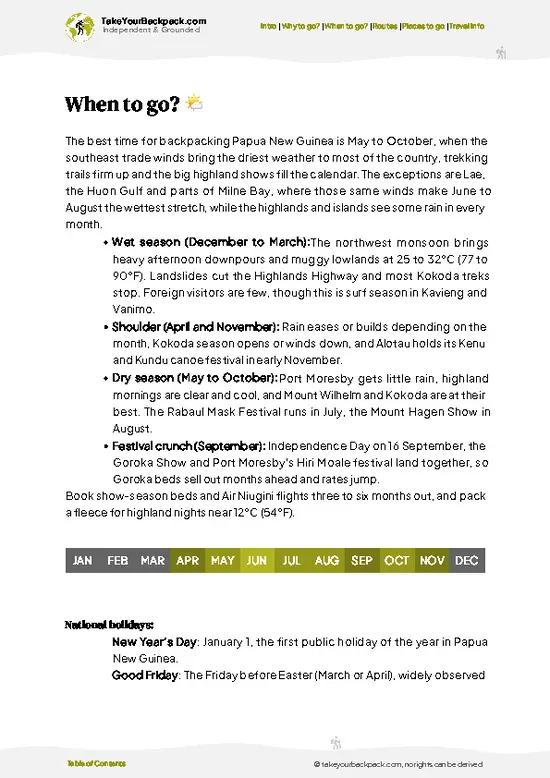
  • Dry Season (May to October): Southeast trade winds bring calmer, brighter days of about 29 to 31°C (84 to 88°F) with lower humidity. Seas around the islands can be choppy at times, but diving and surfing both run well. Daylight stays around 12 hours all year.
  • Wet Season (November to April): Northwest monsoon brings heavy showers, humidity and highs near 30 to 32°C (86 to 90°F), with nights around 23°C (73°F). Roads can turn muddy and boats get delayed, though prices for rooms stay fairly flat.
  • Surf Season (roughly November to April): Swells arrive and surf visitors fill the few resorts, so book ahead.
  • Crowds: Kavieng is never packed. Flight seats to Port Moresby and Rabaul region fill around holidays, especially December.
Book flights early for December and January, and pick May or June for the best balance of sun and calm.

source: climatestotravel.comJANJanuary: fair for travelingFEBFebruary: fair for travelingMARMarch: fair for travelingAPRApril: good for travelingMAYMay: highly recommended for travelingJUNJune: highly recommended for travelingJULJuly: excellent for travelingAUGAugust: excellent for travelingSEPSeptember: highly recommended for travelingOCTOctober: highly recommended for travelingNOVNovember: good for travelingDECDecember: fair for traveling
when-to-go

✈️ The backpacker research shortcutPapua New Guinea Travel Guide

An offline-friendly backpacking guide with optimized travel routes, ranked highlights, transport advice, and the best areas to stay.
example page 0 from our offline Travel Guide for Papua New Guinea
example page 1 from our offline Travel Guide for Papua New Guinea
example page 2 from our offline Travel Guide for Papua New Guinea
example page 3 from our offline Travel Guide for Papua New Guinea
example page 4 from our offline Travel Guide for Papua New Guinea
example page 5 from our offline Travel Guide for Papua New Guinea
example page 6 from our offline Travel Guide for Papua New Guinea
example page 7 from our offline Travel Guide for Papua New Guinea
The digital guide (251 pages) contains:
✅ 81 highlights, ranked by travel appeal
✅ Optimized 5, 10 & 15-day travel routes
✅ Cities, national parks, landmarks, beaches
✅ How to get around
✅ Offline-friendly for travel without Wi-Fi
👉 Click to see all 30+ guide features

📅 Plan smarter in minutes, not weeks
✅ Month by month travel advice
✅ Festivals & national holidays
✅ Budget expectations

🗺️ Go to the right places, skip the overrated ones
✅ Honest pros & cons of destinations
✅ Top hikes, parks & viewpoints
✅ Lesser-known places most travelers miss
✅ Clear “worth it vs skip it” guidance

🛏️ Travel smoothly without rookie mistakes
✅ Best areas to stay
✅ Transport systems explained simply
✅ Common scams & safety advice
✅ SIM cards, money & practical tips

🌍 Understand the country, not just visit it
✅ Culture & traditions
✅ 52 Essential phrases & customs
✅ Festivals worth planning around
✅ Traveler-friendly historical context
✅ Insights that make places more meaningful

📱 Built for real travel conditions
✅ Fully downloadable PDF
✅ Works completely offline
✅ Optimized for phone use
✅ Useful in remote areas & buses
✅ Everything in one place
Stop searching, start planning
Get instant access to your full guide. 30‑day money-back guarantee.
+ Add another guide for just

By proceeding you agree to our terms.
Sent to your inbox immediately after payment • 100% Secure Checkout
Best Backpacking Travel Advisor 2025 tourism awardBest Backpacking
Travel Advisor
2025
What others say about Take Your Backpack Guides:
⭐⭐⭐⭐⭐
Fantastic, amazing amount of information!
⭐⭐⭐⭐⭐
My goodness this is amazing, it's what I've been looking for hats off too you!
⭐⭐⭐⭐⭐
I think this is absolutely BRILLIANT
⭐⭐⭐⭐
Very complete and informative. It's still missing places, but I gotta to commend you
⭐⭐⭐⭐⭐
This is truly amazing, thank you, can't wait to explore it with my kids!
⭐⭐⭐⭐⭐
Awesome resource, thank you!
⭐⭐⭐⭐⭐
This is amazing! Can't wait to explore the ones I haven't seen
⭐⭐⭐⭐
I love this! Well done, great idea.
⭐⭐⭐⭐⭐
Thanks for taking the time to make this gem!
⭐⭐⭐⭐⭐
This might be the best website I've ever seen.
⭐⭐⭐⭐⭐
Congratulations, and thank you so much for your work; it's incredibly valuable.
⭐⭐⭐⭐
In all seriousness I think you did a great job pointing out the important spots
⭐⭐⭐⭐⭐
10/10 very good
⭐⭐⭐⭐⭐
As someone who's only just starting to visit regularly this is awesome, thank you.
⭐⭐⭐⭐
Thank you very much! I'm going to visit my dad, it's going to be very useful!
⭐⭐⭐⭐⭐
This is really cool! We'll be travelling for the first time and this definitely come in handy.
⭐⭐⭐⭐⭐
You are now our minister of culture, congratulations 👨‍💼
⭐⭐⭐⭐⭐
Just wanted to tell you that this is a pearl! Going to follow your recommendations.
⭐⭐⭐⭐⭐
This is so cool. I'll definitely be using the resource for my travels soon.
⭐⭐⭐⭐⭐
This is very impressive! Good work.
⭐⭐⭐⭐⭐
This is an amazing and informative site. Very well done!

🛏️ Where to stay?Choosing the right base

Stay within walking distance of the town center and harbor, since that is where the few budget rooms, the market and the PMV stops are.
Kavieng has no true hostel scene. Budget travelers use guesthouses and simple lodges, with private rooms usually between K120 and 300 (US$30 to 80) and rare shared options. Beds are limited, so book ahead by phone or message, particularly midweek when government and mining workers fill rooms. Hot water and reliable air conditioning are not guaranteed at the cheapest places, so check before paying.
The center is the safer choice at night because streets are lit in … read more 👉
Stay within walking distance of the town center and harbor, since that is where the few budget rooms, the market and the PMV stops are.
Kavieng has no true hostel scene. Budget travelers use guesthouses and simple lodges, with private rooms usually between K120 and 300 (US$30 to 80) and rare shared options. Beds are limited, so book ahead by phone or message, particularly midweek when government and mining workers fill rooms. Hot water and reliable air conditioning are not guaranteed at the cheapest places, so check before paying.
The center is the safer choice at night because streets are lit in spots and others are around, and you can walk to food and boats. Noise is mostly dogs, generators and the occasional late-night gathering.
The waterfront stretch toward Nusa suits those who want a breeze and sea views. Rooms here can cost a bit more, and the walk back after dark is less comfortable, so take a ride after sunset.
For a beach stay, island guesthouses offer simple bungalows and meals, usually with boat transfers arranged in advance.

🚌 Getting aroundMoving around without the hassle

Hiring a private boat or car for every outing drains a budget fast, when shared PMV minibuses and fuel-splitting with other travelers do the job for a fraction of the cost. Kavieng is small, flat and easy to cross on foot, but beyond the center the roads are patchy and public transport is informal and irregular.
  • Walking: The center and waterfront take 10 to 20 minutes end to end. Go early or late, because midday sun is brutal and covered walkways barely exist.
  • PMV minibuses: The backbone of local travel, costing roughly K2 to 5 (about US$0.50 to 1.50) around town and along the Boluminski Highway. They run from early morning until late afternoon and leave when full, so ask drivers about the last return before you go.
  • Taxis and hired cars: Informal taxis cost about K10 to 30 (US$3 to 8) for short
… read more 👉
Hiring a private boat or car for every outing drains a budget fast, when shared PMV minibuses and fuel-splitting with other travelers do the job for a fraction of the cost. Kavieng is small, flat and easy to cross on foot, but beyond the center the roads are patchy and public transport is informal and irregular.
  • Walking: The center and waterfront take 10 to 20 minutes end to end. Go early or late, because midday sun is brutal and covered walkways barely exist.
  • PMV minibuses: The backbone of local travel, costing roughly K2 to 5 (about US$0.50 to 1.50) around town and along the Boluminski Highway. They run from early morning until late afternoon and leave when full, so ask drivers about the last return before you go.
  • Taxis and hired cars: Informal taxis cost about K10 to 30 (US$3 to 8) for short trips. Agree the price first, because there are no meters. Full day hires with driver run K300 to 600 (US$80 to 160), worth splitting among four.
  • Boats: Small dinghies and banana boats reach nearby islands for K50 to 150 (US$13 to 40) per person, depending on distance and fuel costs. Ask your guesthouse to arrange them, check weather and wear a life jacket where offered.
  • Flights: Air Niugini and PNG Air link Kavieng with Port Moresby, typically US$150 to 300 one way. Book early, since seats are limited and cancellations happen. Cargo ships also arrive, though schedules are unreliable.

👛 Costs (as of 16 October 2026)What things cost and how to budget

Budget travelers should plan on about US$75 to 130 a day in Kavieng, because food, rooms and boat fuel are priced above the PNG norm.
CategoryBudget RangeLocal Reality
Dorm accommodationUS$30 to 60Few true dorms exist, so expect a basic private guesthouse room.
MealsUS$15 to 30Market produce and takeaway counters cost a fraction of lodge restaurant dinners.
Local transportUS$5 to 15PMVs are cheap; taxis and hired cars add up quickly.
Basic activities/entry feesUS$10 to 15Village visits, reef access and cultural fees are small but common.
Miscellaneous expensesUS$10 to 15Phone credit, water, toiletries and tips.
Total Daily BudgetUS$75 to 130Boat trips and dives push costs higher.
Buy fruit and vegetables at the market and share boat hires with other travelers to cut costs sharply.
⚠️ Prices can change and everyone travels differently, so take this as a rough guide. Hope it helps you plan your adventure!

🚌 Day tripsWhere to go beyond the main area

Kavieng works well as a base for day trips, because the best outings are short boat hops or a drive along the one main road up New Ireland's northwest tip, and you sleep in the same bed every night.
Nusa Island and Nusa Lik:
These two small islands sit just off the Kavieng waterfront, a 10 to 20 minute hop by small banana boat. Expect white sand, clear shallows and reef you can snorkel straight from the beach. Locals run the boats, and a return trip typically costs K50 to 150 (about US$13 to 40) depending on how many people share. Agree the pickup time before you land, because boats do not roam looking for you. Go between April and November, when the sea is calmer.
👉 Explore Nusa Island
Lissenung Island Day Visit:
Lissenung is a reef-ringed island about 30 to 40 minutes by boat from town, known … read more 👉
Kavieng works well as a base for day trips, because the best outings are short boat hops or a drive along the one main road up New Ireland's northwest tip, and you sleep in the same bed every night.
Nusa Island and Nusa Lik:
These two small islands sit just off the Kavieng waterfront, a 10 to 20 minute hop by small banana boat. Expect white sand, clear shallows and reef you can snorkel straight from the beach. Locals run the boats, and a return trip typically costs K50 to 150 (about US$13 to 40) depending on how many people share. Agree the pickup time before you land, because boats do not roam looking for you. Go between April and November, when the sea is calmer.
👉 Explore Nusa Island
Lissenung Island Day Visit:
Lissenung is a reef-ringed island about 30 to 40 minutes by boat from town, known for diving and snorkeling on walls and WWII wrecks. A day visit with snorkeling usually runs K150 to 300 (US$40 to 80) including transport, and diving costs more. First-timers often arrive without booking and find no boat available, so arrange it through a dive operator the day before. Calm, clear water makes May to October the best window.

Tabar-side WWII Relics Drive:
Hire a vehicle with a local driver for a half day along the Boluminski Highway, the sealed stretch running south-east from Kavieng. Rusting Japanese guns, bunkers and wartime airstrip remains lie close to town, and villages along the road sell fruit and betel nut. Budget K200 to 400 (US$50 to 105) for a shared vehicle and driver, or less if you hop on PMV trucks, which cost K5 to 20 per hop. Start early, since heavy afternoon rain turns side tracks to mud, and set the return time with your driver.

Albert Pass Beaches and Villages:
A 45 to 90 minute drive south along the highway brings you to quiet coastal villages with long stretches of empty beach and some snorkeling off the shore. This works as a full day with a hired car or PMV. Costs run K100 to 300 (US$25 to 80) all in. Bring cash and food, as shops thin out quickly beyond the first villages. Dry months from May to October are the most comfortable for this.

🛡️ SafetyStaying Safe: What Travelers Should Know

Kavieng is calmer than PNG’s big cities, but common sense still matters, especially after dark. Petty theft and opportunistic snatching happen, so keep phones, cameras and cash out of sight and carry only what you need. Avoid walking alone at night, particularly along dark waterfront stretches and the outskirts. Take a ride instead, even for short distances, and agree the fare first. Solo travelers, especially women, should dress modestly and stay in guesthouses with secure compounds. Crowds at the market are friendly, but watch your bag. Alcohol-fueled arguments can flare at night near bars, so leave if the mood turns. Ask locals about land and reef ownership before swimming, camping or taking photographs near villages, since permission and small fees are normal. Ask your guesthouse for current … read more 👉
Kavieng is calmer than PNG’s big cities, but common sense still matters, especially after dark. Petty theft and opportunistic snatching happen, so keep phones, cameras and cash out of sight and carry only what you need. Avoid walking alone at night, particularly along dark waterfront stretches and the outskirts. Take a ride instead, even for short distances, and agree the fare first. Solo travelers, especially women, should dress modestly and stay in guesthouses with secure compounds. Crowds at the market are friendly, but watch your bag. Alcohol-fueled arguments can flare at night near bars, so leave if the mood turns. Ask locals about land and reef ownership before swimming, camping or taking photographs near villages, since permission and small fees are normal. Ask your guesthouse for current local advice, which changes faster than any guide.

FAQCommon questions from travelers

Kavieng is worth visiting if you want WWII wrecks, quiet islands and surf, not city sights. Most travelers spend three to five days, enough for the Boluminski Highway, a night or two on an island such as Nusa Lik, and a dive or two. It is more than a stopover thanks to the sea, but only if you accept slow logistics and higher prices.
Plan on three to five days in Kavieng. One day covers the town, market and waterfront, one to two days suit the Boluminski Highway and village stops, and another one to two days fit island trips or diving at roughly US$100 to 180 per dive day. Add a buffer day because flights and boats are weather dependent.
Kavieng is not practical as a day trip from another city, because it sits at the northern tip of New Ireland and is reached mainly by flight from Port Moresby, typically 1.5 to 2 hours. Flights cost around US$150 to 300 one way and seats are limited. Staying at least two or three nights makes the journey worthwhile.
⚠️ Things can change over time, so always validate details locally before you go.

Other Papua New Guinean towns near Kavieng

Explore more nearby:

  • Rabaul—Tavurvur crater, Yamamoto bunker, barge tunnels, ash-buried streets| 236 km away
  • Kokopo—Blanche Bay, Tolai shell money, war museum tunnels, Vunapope| 256 km away
  • Namatanai—East New Ireland, Boluminski Highway, colonial station, village beaches| 303 km away

💡 Not sure where to go next?
Create a personalized itinerary for Papua New Guinea including Kavieng and the places that fit your trip.

Generate my itinerary

👉 Discover all towns

Or checkout all Papua New Guinea has to offer (think cities, towns, villages, national parks, hikes, beaches, festivals)
Country photo of Papua New Guinea

We 💚 feedbackFinal thoughts on visiting Kavieng

The classic mistake is arriving with no boat plan, then watching the sea all week from the shore. Message your lodge or a dive operator before landing, and book at least one day on the water. Bring cash in kina, since ATMs are unreliable, and pack reef-safe sunscreen.

✍️ Help improve this page!
The information on this page is based on in-depth research, insights shared by experienced travelers, and feedback from the local travel community in Papua New Guinea. While every effort is made to keep the information accurate and current, conditions can change — so if you spot anything incorrect or outdated, please get in touch.


🙋‍♂️ Give feedback

👋 Meet the founderWho’s Behind Take Your Backpack?

Johan, backpacker and founder of TakeYourBackpackHi, I’m Johan (Netherlands 🇳🇱), the creator of TakeYourBackpack. Over the past 3 decades, I’ve backpacked through 90+ countries across six continents, gaining extensive experience with independent travel, long-term trips, and overland routes.

This site is built on a combination of firsthand travel experience and carefully curated insights from other backpackers. Many guides are based on places I’ve personally visited, while others bring together tips, observations, and practical advice shared by trusted travelers I’ve met along the way.

The goal is to provide realistic, experience-driven guidance — not generic itineraries — so you can explore destinations with better context, clearer expectations, and more confidence.