



×

Papua New Guinea🇵🇬 | regionsRai CoastMaclay Coast, Saidor wartime relics, black-sand bays, village homestays, Finisterre foothills | things to do and best time to go

Explore Milne BayExplore Sepik River

Backpacking in Rai Coast
🌟 Highlightregion ranked #2
By Johan Kruseman 🇳🇱 | Updated October 15, 2026

Rai Coast is a rural stretch of Madang Province’s coastline southeast of Madang town, with no resort strip and no town center of its own. It lies in the north of Papua New Guinea, where the Finisterre Range drops steeply to Astrolabe Bay and the Vitiaz Strait. Bumping along in a PMV truck, you pass sago groves, coconut villages and black-sand beaches, then arrive somewhere you can swim off the shore with kids paddling canoes beside you. The payoff is real: no tour buses, village hosts, wartime relics at Saidor, and a coast tied to the Russian scientist Miklouho-Maclay. The downsides are rough roads, patchy phone signal, few formal guesthouses and plenty of improvising. Walk the beaches, ask for the story behind every carved house post, and eat what the family eats. Before you go, carry plenty of small kina notes and arrange your village host in advance.

Discover everything you want to know in the 📖 Papua New Guinea Travel Guide.


example page 0 from our offline Travel Guide for Papua New Guinea
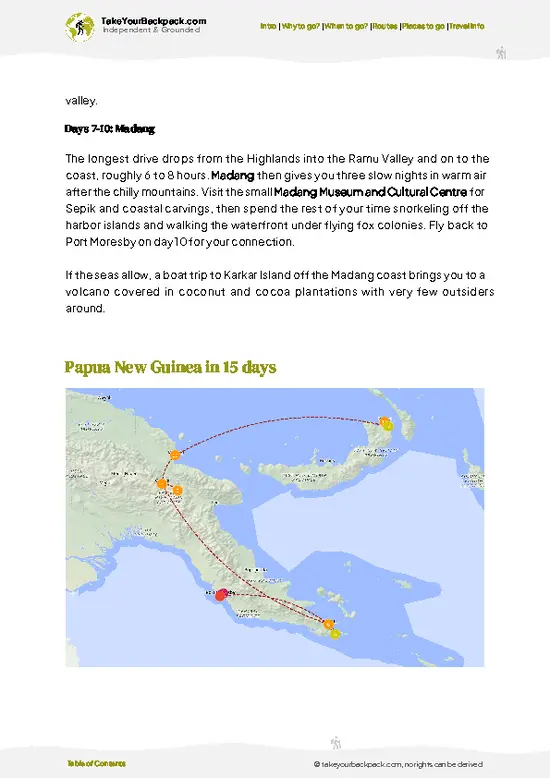
example page 1 from our offline Travel Guide for Papua New Guinea
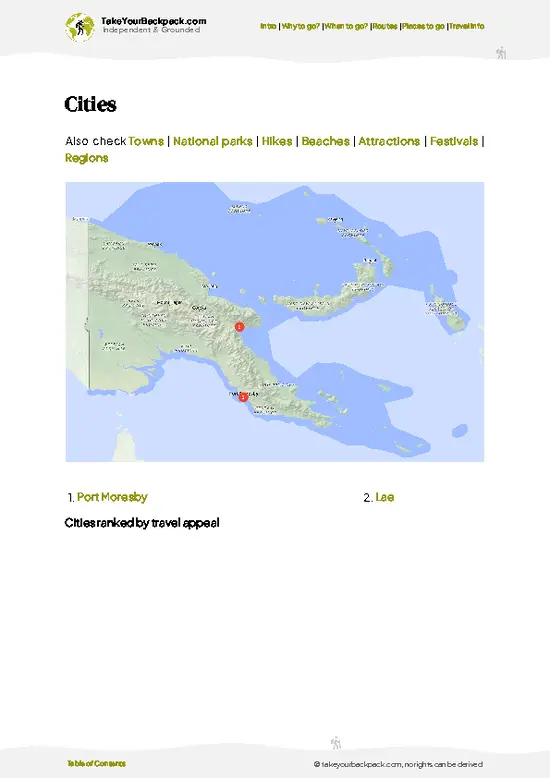
example page 2 from our offline Travel Guide for Papua New Guinea
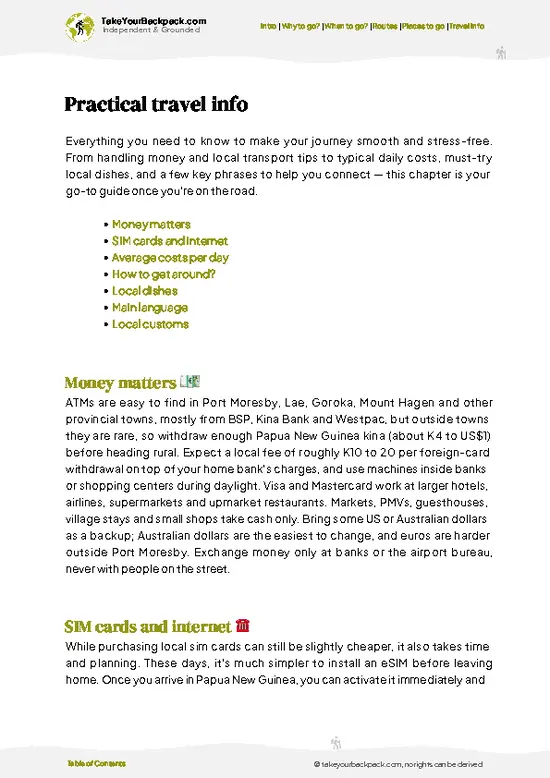
example page 3 from our offline Travel Guide for Papua New Guinea
example page 4 from our offline Travel Guide for Papua New Guinea
example page 5 from our offline Travel Guide for Papua New Guinea
example page 6 from our offline Travel Guide for Papua New Guinea
example page 7 from our offline Travel Guide for Papua New Guinea
Loading the map 🌍
CLICK TO FILTER
cities
towns
national parks
hikes
beaches
attractions
festivals
regions
SHOW COUNTRY’S BESTSHOW ALL

✨ Why go?
Ranked #2 region in Papua New Guinea
What makes this region worth visiting

Backpackers come to Rai Coast for access to everyday coastal life that few visitors ever see. The first reason is the Finisterre Range meeting Astrolabe Bay. You can swim in the morning, climb into forested foothills villages by afternoon, and sleep within earshot of the surf without repacking for a new region. The second is history you can touch. Saidor’s wartime airstrip still sits where Allied forces landed in 1944, and the Maclay Coast villages around Bongu keep the memory of the ethnographer who lived among them in the 1870s. Elders tell these stories themselves, which beats any plaque. The third is the pace. Public trucks and boats run when they fill, so you move slowly, stay in one village long enough to be fed, and learn the local bilum weaving, canoe building and garden routines. … read more 👉
Backpackers come to Rai Coast for access to everyday coastal life that few visitors ever see. The first reason is the Finisterre Range meeting Astrolabe Bay. You can swim in the morning, climb into forested foothills villages by afternoon, and sleep within earshot of the surf without repacking for a new region. The second is history you can touch. Saidor’s wartime airstrip still sits where Allied forces landed in 1944, and the Maclay Coast villages around Bongu keep the memory of the ethnographer who lived among them in the 1870s. Elders tell these stories themselves, which beats any plaque. The third is the pace. Public trucks and boats run when they fill, so you move slowly, stay in one village long enough to be fed, and learn the local bilum weaving, canoe building and garden routines. It suits travelers who like unscripted days and are happy to let a host steer the schedule.

💡 HighlightsEssential experiences to have while visiting Rai Coast

  1. Saidor Airstrip and Landing Beach: the wartime strip captured by Allied forces in January 1944 is still in use, with rusted relics tucked in the bush beside it and a quiet bay below.
  2. Garagassi and the Maclay Landing Point: where Nikolai Miklouho-Maclay settled in 1871, with local guides who retell the first-contact story in their own words.
  3. Bongu Village: a Maclay Coast village of stilted houses and canoe landings, good for a homestay and an evening watching fishermen come in.
  4. Bogadjim: an old German-era station village at the gateway to the coast, with shaded paths, a lively roadside scene and easy introductions to local hosts.
  5. Astrolabe Bay Beaches: dark volcanic sand, warm water and reef patches close to shore, with almost no one else around.
  6. Finisterre Foothill Villages: lesser-known walks
… read more 👉
  1. Saidor Airstrip and Landing Beach: the wartime strip captured by Allied forces in January 1944 is still in use, with rusted relics tucked in the bush beside it and a quiet bay below.
  2. Garagassi and the Maclay Landing Point: where Nikolai Miklouho-Maclay settled in 1871, with local guides who retell the first-contact story in their own words.
  3. Bongu Village: a Maclay Coast village of stilted houses and canoe landings, good for a homestay and an evening watching fishermen come in.
  4. Bogadjim: an old German-era station village at the gateway to the coast, with shaded paths, a lively roadside scene and easy introductions to local hosts.
  5. Astrolabe Bay Beaches: dark volcanic sand, warm water and reef patches close to shore, with almost no one else around.
  6. Finisterre Foothill Villages: lesser-known walks up into the ranges, through gardens and kunai grass to hamlets that see few visitors, with cooler air and big views of the coast.
  7. Yali Cargo Cult Country: the coast around Bogadjim shaped the Yali movement of the 1940s, and older residents can explain how it spread along the shore.
  8. Saidor Bay Canoe Landings: a lesser-known evening ritual of dugouts coming in with fish, where you can buy a fresh catch directly and watch the village gather.
  9. Village Bilum Workshops: local women make string bags from hand-rolled fiber and will show you the technique, with the finished piece yours to carry.
  10. Coastal Sago Groves: walks through working sago stands, where families process the starch by hand and cook sago pancakes on the spot.
Together, all of this fits into about five days at a relaxed pace.
Spotted a mistake or missing something? Contact us.

⌛️ 5 daysA smart one-week plan

Days here follow the rhythm of the coast: early walks on foot while it is cool, a long pause under a house roof when the heat peaks, then trucks and boats after the midday rest. Transport leaves when full, so nothing runs to a clock.
Day 1: Bogadjim: Arrive by PMV truck early, since vehicles thin out by afternoon. Bogadjim is the easiest place to find a host, swap contact numbers and learn which boats are heading further down the coast. Walk the village paths in the late afternoon, when everyone is out.
Day 2: Bongu: Move down the Maclay Coast and spend the day around Bongu and Garagassi. Local guides walk you to the landing point, and the beach is calm enough for a swim after the heat. Staying overnight means breakfast and evening stories are included.
Day 3: Finisterre Foothills: This is … read more 👉
Days here follow the rhythm of the coast: early walks on foot while it is cool, a long pause under a house roof when the heat peaks, then trucks and boats after the midday rest. Transport leaves when full, so nothing runs to a clock.
Day 1: Bogadjim: Arrive by PMV truck early, since vehicles thin out by afternoon. Bogadjim is the easiest place to find a host, swap contact numbers and learn which boats are heading further down the coast. Walk the village paths in the late afternoon, when everyone is out.
Day 2: Bongu: Move down the Maclay Coast and spend the day around Bongu and Garagassi. Local guides walk you to the landing point, and the beach is calm enough for a swim after the heat. Staying overnight means breakfast and evening stories are included.
Day 3: Finisterre Foothills: This is the detour. Leave your main bag with your host and take a guided walk up a ridge path to an upland hamlet. It adds cooler air, wide coastal views and garden life without changing your route, because you come back down the same day.
Day 4: Saidor: Catch a truck or boat southeast to Saidor. Spend the afternoon at the old airstrip and landing beach, where the history is easiest to picture, then watch the canoes come in at dusk.
Day 5: Saidor to Onward: Use the morning for a bilum workshop or a sago walk, then wait for the first transport out.

If you only have one day, make it Day 3. The climb into the foothills shows you the Rai Coast’s full shape, with sea, forest and ridge in one frame.

🌤️ When to go?Choosing the right time of year

The driest, calmest window on the Rai Coast runs from roughly June to October, when seas flatten and coastal tracks firm up.
  • Dry Season (June to October): Days reach 29 to 31°C (84 to 88°F), nights drop to 22 to 24°C (72 to 75°F), and rain comes in short bursts. Boat hops along the shore are most dependable now. Daylight holds near 12 hours, with sunset around 6 pm.
  • Wet Season (December to April): Northwest squalls dump heavy rain, rivers swell, and dirt roads turn to clay. Highs sit at 30 to 32°C (86 to 90°F) with thick humidity. Flights and boats get canceled, but the forest is loud and green.
  • Shoulder Months (May and November): Showers are patchy and the sea is often workable. Villages are quiet, and you get the most room to negotiate boat hire.
  • Festivals and Prices: Village events cluster
… read more 👉
The driest, calmest window on the Rai Coast runs from roughly June to October, when seas flatten and coastal tracks firm up.
  • Dry Season (June to October): Days reach 29 to 31°C (84 to 88°F), nights drop to 22 to 24°C (72 to 75°F), and rain comes in short bursts. Boat hops along the shore are most dependable now. Daylight holds near 12 hours, with sunset around 6 pm.
  • Wet Season (December to April): Northwest squalls dump heavy rain, rivers swell, and dirt roads turn to clay. Highs sit at 30 to 32°C (86 to 90°F) with thick humidity. Flights and boats get canceled, but the forest is loud and green.
  • Shoulder Months (May and November): Showers are patchy and the sea is often workable. Villages are quiet, and you get the most room to negotiate boat hire.
  • Festivals and Prices: Village events cluster around the dry months, and prices barely move because there is no mass tourism. Transport costs rise when fuel is scarce, whatever the month.
Book boats and flights with a spare day or two on either end, since weather decides departures.


source: climatestotravel.comJANJanuary: below average for travelingFEBFebruary: below average for travelingMARMarch: below average for travelingAPRApril: fair for travelingMAYMay: excellent for travelingJUNJune: excellent for travelingJULJuly: excellent for travelingAUGAugust: excellent for travelingSEPSeptember: excellent for travelingOCTOctober: excellent for travelingNOVNovember: fair for travelingDECDecember: below average for traveling
when-to-go

✈️ The backpacker research shortcutPapua New Guinea Travel Guide

An offline-friendly backpacking guide with optimized travel routes, ranked highlights, transport advice, and the best areas to stay.
example page 0 from our offline Travel Guide for Papua New Guinea
example page 1 from our offline Travel Guide for Papua New Guinea
example page 2 from our offline Travel Guide for Papua New Guinea
example page 3 from our offline Travel Guide for Papua New Guinea
example page 4 from our offline Travel Guide for Papua New Guinea
example page 5 from our offline Travel Guide for Papua New Guinea
example page 6 from our offline Travel Guide for Papua New Guinea
example page 7 from our offline Travel Guide for Papua New Guinea
The digital guide (251 pages) contains:
✅ 81 highlights, ranked by travel appeal
✅ Optimized 5, 10 & 15-day travel routes
✅ Cities, national parks, landmarks, beaches
✅ How to get around
✅ Offline-friendly for travel without Wi-Fi
👉 Click to see all 30+ guide features

📅 Plan smarter in minutes, not weeks
✅ Month by month travel advice
✅ Festivals & national holidays
✅ Budget expectations

🗺️ Go to the right places, skip the overrated ones
✅ Honest pros & cons of destinations
✅ Top hikes, parks & viewpoints
✅ Lesser-known places most travelers miss
✅ Clear “worth it vs skip it” guidance

🛏️ Travel smoothly without rookie mistakes
✅ Best areas to stay
✅ Transport systems explained simply
✅ Common scams & safety advice
✅ SIM cards, money & practical tips

🌍 Understand the country, not just visit it
✅ Culture & traditions
✅ 52 Essential phrases & customs
✅ Festivals worth planning around
✅ Traveler-friendly historical context
✅ Insights that make places more meaningful

📱 Built for real travel conditions
✅ Fully downloadable PDF
✅ Works completely offline
✅ Optimized for phone use
✅ Useful in remote areas & buses
✅ Everything in one place
Stop searching, start planning
Get instant access to your full guide. 30‑day money-back guarantee.
+ Add another guide for just

By proceeding you agree to our terms.
Sent to your inbox immediately after payment • 100% Secure Checkout
Best Backpacking Travel Advisor 2025 tourism awardBest Backpacking
Travel Advisor
2025
What others say about Take Your Backpack Guides:
⭐⭐⭐⭐⭐
Fantastic, amazing amount of information!
⭐⭐⭐⭐⭐
My goodness this is amazing, it's what I've been looking for hats off too you!
⭐⭐⭐⭐⭐
I think this is absolutely BRILLIANT
⭐⭐⭐⭐
Very complete and informative. It's still missing places, but I gotta to commend you
⭐⭐⭐⭐⭐
This is truly amazing, thank you, can't wait to explore it with my kids!
⭐⭐⭐⭐⭐
Awesome resource, thank you!
⭐⭐⭐⭐⭐
This is amazing! Can't wait to explore the ones I haven't seen
⭐⭐⭐⭐
I love this! Well done, great idea.
⭐⭐⭐⭐⭐
Thanks for taking the time to make this gem!
⭐⭐⭐⭐⭐
This might be the best website I've ever seen.
⭐⭐⭐⭐⭐
Congratulations, and thank you so much for your work; it's incredibly valuable.
⭐⭐⭐⭐
In all seriousness I think you did a great job pointing out the important spots
⭐⭐⭐⭐⭐
10/10 very good
⭐⭐⭐⭐⭐
As someone who's only just starting to visit regularly this is awesome, thank you.
⭐⭐⭐⭐
Thank you very much! I'm going to visit my dad, it's going to be very useful!
⭐⭐⭐⭐⭐
This is really cool! We'll be travelling for the first time and this definitely come in handy.
⭐⭐⭐⭐⭐
You are now our minister of culture, congratulations 👨‍💼
⭐⭐⭐⭐⭐
Just wanted to tell you that this is a pearl! Going to follow your recommendations.
⭐⭐⭐⭐⭐
This is so cool. I'll definitely be using the resource for my travels soon.
⭐⭐⭐⭐⭐
This is very impressive! Good work.
⭐⭐⭐⭐⭐
This is an amazing and informative site. Very well done!

🛏️ Where to stay?Choosing the right base

Madang town is the best base for reaching the Rai Coast, with the widest choice of cheap rooms, the safest and most social atmosphere, and the transport connections you need. Travelers meet over breakfast, trade boat contacts and arrange village visits from here. The waterfront is pleasant for early walks, and the town market is the place to stock up before heading out. Stay a night or two to sort cash, supplies and onward plans.

From there, Bogadjim is the easiest first stop on the coast itself. It sits on a road, so you can arrive by PMV and settle into a village guesthouse or family home, … read more 👉
Madang town is the best base for reaching the Rai Coast, with the widest choice of cheap rooms, the safest and most social atmosphere, and the transport connections you need. Travelers meet over breakfast, trade boat contacts and arrange village visits from here. The waterfront is pleasant for early walks, and the town market is the place to stock up before heading out. Stay a night or two to sort cash, supplies and onward plans.

From there, Bogadjim is the easiest first stop on the coast itself. It sits on a road, so you can arrive by PMV and settle into a village guesthouse or family home, where you share meals and learn about local life. Evenings are quiet, with the sea slapping the shore and lamps glowing in thatched houses.

Further along, Saidor is the district hub with an airstrip, a small market and a handful of basic lodging options, making it the practical anchor for exploring remote stretches. Solo travelers are generally welcomed warmly, but arriving with a local contact or introduction from Madang makes everything smoother. Village stays throughout the coast are simple: a mattress, a mosquito net and shared washing facilities. Bring cash in small notes, since cards and ATMs do not exist outside Madang, and agree the nightly rate in advance.

🚌 Getting aroundHow to get around Rai Coast

Each Rai Coast village can be crossed on foot in under an hour, with a coconut grove, a church and a beach all within a short stroll, but walking stops making sense the moment you want to reach the next settlement along the shore. Between them you rely on rough roads, dinghies and the odd light aircraft. Schedules are loose, fuel is expensive, and reliability depends on weather and mechanics, so build slack into everything.
  • PMV (public motor vehicle): Open-backed trucks and minibuses leave Madang for roadside settlements such as Bogadjim, usually when full. Expect roughly K10 to 30 (US$3 to 8) for a ride of one to three hours, depending on road condition. You stand or squat among bilums and bunches of bananas, and the chatter alone is worth the bruises.
  • Dinghy and banana boat: Fiberglass boats
… read more 👉
Each Rai Coast village can be crossed on foot in under an hour, with a coconut grove, a church and a beach all within a short stroll, but walking stops making sense the moment you want to reach the next settlement along the shore. Between them you rely on rough roads, dinghies and the odd light aircraft. Schedules are loose, fuel is expensive, and reliability depends on weather and mechanics, so build slack into everything.
  • PMV (public motor vehicle): Open-backed trucks and minibuses leave Madang for roadside settlements such as Bogadjim, usually when full. Expect roughly K10 to 30 (US$3 to 8) for a ride of one to three hours, depending on road condition. You stand or squat among bilums and bunches of bananas, and the chatter alone is worth the bruises.
  • Dinghy and banana boat: Fiberglass boats with outboards link coastal villages and skip the muddy roads entirely. Shared seats cost about K20 to 80 (US$5 to 20) for short hops, while a private charter can run K300 to 800 (US$75 to 200) per day depending on fuel. You skim past reef edges and mangroves with the wind in your face, then land on a beach where children sprint down to meet you.
  • Light aircraft: Small planes serve the Saidor airstrip and other gravel strips from Madang, and fares typically run K300 to 600 (US$75 to 150) one way. Flights are short, about 30 to 45 minutes, and you look straight down on jungle ridges that would take days to walk.
  • Walking tracks: Foot trails climb from the coast into the Finisterre foothills and link inland villages, with day treks of three to six hours. Hire a local guide for K50 to 100 (US$12 to 25) per day, and you earn a view of the entire shoreline plus a bowl of boiled taro at the top.
Carry small kina notes for every ride, pack waterproof bags for boat legs, and confirm departures with the village contact the evening before, because the vehicle that leaves first is the one with fuel.

🍲 FoodEating & Drinking in Rai Coast

The Rai Coast eats from the garden and the sea. The staple is taro and kaukau (sweet potato), boiled or roasted until the skin blackens and the inside turns sweet and dense. Sago arrives as a pale, rubbery pancake, usually served with a smoky fish stew. Fresh reef fish hits the coals wrapped in banana leaf, and coconut milk thickens everything it touches.

On feast days, villagers cook a mumu, an earth oven where pork, greens and root vegetables steam under hot stones for hours. The smell of woodsmoke and banana leaf drifts through the whole settlement. Look for aibika greens and roasted galip nuts, which taste like a creamy cross between almond and pine nut.

For drinks, a green coconut cut open with a bush knife is the best thirst quencher at any hour. Tea and sweet black coffee appear at … read more 👉
The Rai Coast eats from the garden and the sea. The staple is taro and kaukau (sweet potato), boiled or roasted until the skin blackens and the inside turns sweet and dense. Sago arrives as a pale, rubbery pancake, usually served with a smoky fish stew. Fresh reef fish hits the coals wrapped in banana leaf, and coconut milk thickens everything it touches.

On feast days, villagers cook a mumu, an earth oven where pork, greens and root vegetables steam under hot stones for hours. The smell of woodsmoke and banana leaf drifts through the whole settlement. Look for aibika greens and roasted galip nuts, which taste like a creamy cross between almond and pine nut.

For drinks, a green coconut cut open with a bush knife is the best thirst quencher at any hour. Tea and sweet black coffee appear at every guesthouse, and SP Lager is sold in Madang but rarely along the coast.

You eat at village guesthouses, roadside stalls and the Madang market, where women sell cooked bananas, fried dough and smoked fish. Eating usually happens with your hands, and it is polite to accept what a host offers. Chewing buai (betel nut) is everywhere, but you are not expected to join in. Pack snacks for longer trips, since supplies thin out fast beyond the road.

FAQCommon questions from travelers

Plan on four to seven days, with one or two in Madang to arrange transport and supplies. A trip to Bogadjim can be done in a day or two, while reaching Saidor and trekking inland needs at least five days to allow for delayed boats or flights. Add a buffer day in the wet season, from December to April.
PMV trucks run from Madang to roadside settlements such as Bogadjim for roughly K10 to 30 (US$3 to 8). Beyond the road, shared dinghies cost about K20 to 80 (US$5 to 20) per short hop, and light aircraft serve Saidor for around K300 to 600 (US$75 to 150) one way. For inland villages, walk with a local guide at about K50 to 100 (US$12 to 25) per day.
The Rai Coast is known for its remote coastal villages, traditional village life and rugged forest rising into the Finisterre foothills. Reef fishing, earth-oven feasts and carved and woven crafts are part of daily life here, and the area sees few visitors. Expect simple village stays, reef edges and mangroves, and walking tracks of three to six hours that link coast and highlands.
⚠️ Things can change over time, so always validate details locally before you go.

Other Papua New Guinean regions near Rai Coast

Explore more nearby:

  • Sinasina—Simbu sing-sings, coffee terraces, ridge paths, kaukau markets| 112 km away
  • Sepik River—Dugout canoes, spirit houses, Chambri Lake, Angoram departure| 376 km away
  • Manus Island—Empty Admiralty sand, Lorengau harbor, outrigger trips, Allied base relics| 396 km away

💡 Not sure where to go next?
Create a personalized itinerary for Papua New Guinea including Rai Coast and the places that fit your trip.

Generate my itinerary

👉 Discover all regions

Or checkout all Papua New Guinea has to offer (think cities, towns, villages, national parks, hikes, beaches, festivals)
Country photo of Papua New Guinea

We 💚 feedbackWhat to keep in mind

Rai Coast suits patient travelers who like staying put, trading stories and eating whatever comes out of the garden. It will frustrate anyone who needs a fixed schedule. I would bring a small gift for your host family, like rice or tea, and pack a headlamp. The best surprise is how quickly a stranger’s house starts to feel like yours.

✍️ Help improve this page!
The information on this page is based on in-depth research, insights shared by experienced travelers, and feedback from the local travel community in Papua New Guinea. While every effort is made to keep the information accurate and current, conditions can change — so if you spot anything incorrect or outdated, please get in touch.


🙋‍♂️ Give feedback

👋 Meet the founderWho’s Behind Take Your Backpack?

Johan, backpacker and founder of TakeYourBackpackHi, I’m Johan (Netherlands 🇳🇱), the creator of TakeYourBackpack. Over the past 3 decades, I’ve backpacked through 90+ countries across six continents, gaining extensive experience with independent travel, long-term trips, and overland routes.

This site is built on a combination of firsthand travel experience and carefully curated insights from other backpackers. Many guides are based on places I’ve personally visited, while others bring together tips, observations, and practical advice shared by trusted travelers I’ve met along the way.

The goal is to provide realistic, experience-driven guidance — not generic itineraries — so you can explore destinations with better context, clearer expectations, and more confidence.